*Corresponding author. Tel.: +61 3 9919 8097. 1
2 3 4 5 6 7 8 9 10 11 12 13 14 15 16 17 18 19 20 21 22 23 24
The effect of NOM characteristics and membrane type on
microfiltration performance
S. R. Gray1*, C. B. Ritchie2, T. Tran3 and B. A. Bolto3
1 Institute of Sustainability and Innovation, Victoria University, PO Box 14428, Melbourne, Vic 8001,
Australia.
2 P3M, Moore Rd, Nar Nar Goon North, Victoria, 3812, Australia
3 CSIRO Manufacturing & Materials Technology, Private Bag 33, Clayton South, Vic 3169, Australia.
Abstract
Efforts to understand and predict the role of different organic fractions in the fouling of low-pressure membranes are presented. Preliminary experiments with an experimental apparatus that
25 26 27
29 30 31 32 33 34 35 36 37 38 39 40 41 42 43 44 45 46 47 48 49 50
Keywords: Microfiltration; Membranes; Natural organic matter; Fouling
1. Introduction
28
Many factors affect membrane fouling by natural organic matter (NOM), including the nature of the NOM (size, hydrophobicity, charge), the membrane (hydrophobicity, charge, surface roughness), the solution (pH, ionic strength, hardness ion concentration) and the hydrodynamics of the
membrane system (solution flux, surface shear) (Taniguchi et al. 2003). In a study of hollow fibre
microfiltration (MF) membranes treating two surface water sources (Gray et al. 2007), we have
explored varying solution conditions such as NOM concentration, the ionic strength and the pH level, as well as the improvement gained by prior alum treatment, a topic that has been reviewed recently (Farahbakhsh et al.. 2004). The current paper is devoted to the influence of various NOM
fractions on membrane performance, so that a better understanding of the mechanism of NOM fouling might be obtained.
The use of NOM fractions from Moorabool River, near Anakie in south eastern Australia to test which types of compounds are responsible for MF membrane fouling revealed that for a
polypropylene (PP) hollow fibre system, the neutral hydrophilic fraction was the most strongly implicated (Carroll et al. 2000). There was a 40% decrease in flux after a throughput that caused
only a 20% decrease for the other fractions – the strongly and weakly hydrophobic acids and
charged hydrophilic material. The three less-fouling fractions had their DOC reduced by 48, 49 and 64% respectively following alum treatment, while there was no DOC removal for the neutral
51 52 53 54 55 56 57 58 59 60 61 62 63 64 65 66 67 68 69 70 71 72 73 74 75 76
al, 2000). It is likely that the alum treated water still contained the neutral fraction, as Tran et al
(2006) has shown coagulation to remove the neutral hydrophilic fraction only slightly, while the other fractions were removed to a far greater extent.
Other experiments on hydrophobic and hydrophilic MF membranes gave fouling potentials by NOM from surface waters as neutral hydrophilic fraction > strongly hydrophobic acids > weakly
hydrophobic acids > charged hydrophilic fraction (Fan et al. 2001). The fouling rate for the
hydrophobic membrane was considerably greater than for the hydrophilic membrane. In the fractionation process it was found that calcium became concentrated in the neutral fraction, suggesting that organic/Ca++ complexes were formed that could become bound to the negatively charged membranes. Pre-filtration of the neutral hydrophilic fraction with a 30 kDa UF membrane significantly reduced fouling rate. Most of the neutral compounds in the neutral hydrophilic fraction were of low MW, showing that it was only the small amount of high MW matter that were the strongest fouling components.
A small component of the total NOM was also found to be responsible for the major fouling of MF membranes in another study (Howe and Clarke 2002). NOM in natural water samples was
fractionated with UF membranes to obtain various MW fractions. The major fouling effect occurred with compounds larger than 3 nm, which corresponded to only 10-15% of the total NOM.
Furthermore, marked differences in the extent of fouling between membranes of similar pore size but different composition were observed, leading to the conclusion that adsorption of NOM was the mechanism that led to MF fouling.
Aquatic NOM fractions have been passed through a hydrophobic polypropylene MF membrane and the flux decline monitored (Gray et al. 2004). The fraction containing all the hydrophobic acids
77 78 79 80 81 82 83 84 85 86 87 88
acid fractions, suggesting that association between the latter two entities may be occurring to cause the more severe fouling effect. Such interactions have been proposed for similarly charged
polyelectrolyte/fatty acid monolayer systems (Gole et al. 2003) and for hydrophobically-modified
anionic polyelectrolytes and anionic surfactants (Deo et al. 2003). Much more work has been
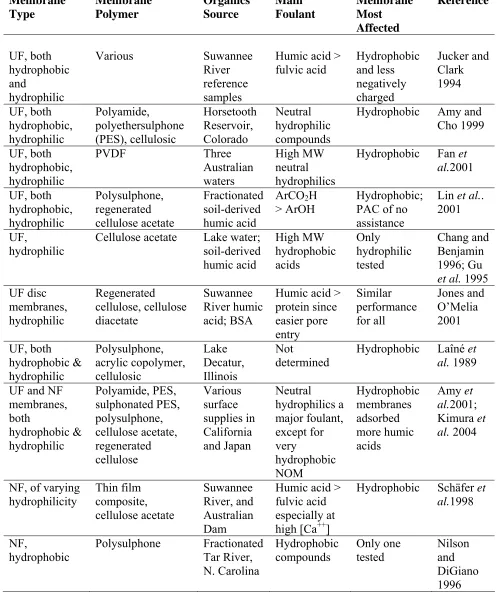
carried out on ultrafiltration (UF) and nanofiltration (NF) systems, some of which is summarised in Table 1.
In a study encompassing several membrane types, the present paper is aimed at understanding the fouling mechanism of each NOM fraction on membranes of varying composition, and when additional salt is added.
2. Experimental
89
91 92 93 94 95 96 97 98 99 100 101
2.1 Water Source
90
Reverse osmosis with a 5 μm pre-filter was used to concentrate NOM in water
from Lake Eppalock, Bendigo, that had TOC 7.9 mg/L, UV254 0.182 cm-1 and SUVA254 2.30
L/mg.m. Likewise a concentrate NOM was obtained from the Moorabool River at Anakie. The raw water had TOC 9.1 mg/L, UV254 0.154 cm-1 and SUVA254 1.69 L/mg.m. The use of RO to
102 103 104 105 106 107 108 109 110 111 112 113 114 115 116 117 118 119 120 121 122 123 124 125 126 127
polarity, charge density and isoelectric point were preserved with RO isolation, which gave an organics rejection of >99% (Kilduff et al., 2004).
Two methods, variations of the published procedure (Carroll et al. 2000), were used to isolate
different components from the NOM. Procedure A is identical to the fraction procedure used before except that it further divides the hydrophilic neutral fraction into two sub-fractions: hydrophobic bases (HB) and residual hydrophilics (Res).
A portion of the neutral hydrophilic fraction was retained from procedure A so that it could be compared to its sub-fractions. The other four fractions were: a strongly hydrophobic acids (SHA) fraction separated on Supelite DAX-8 at pH 2; a weakly hydrophobic acids (WHA) fraction separated on Amberlite XAD-4 at pH 2; a hydrophilic charged fraction (Char) of anionic material separated on Amberlite IRA-958 at pH 8; and a hydrophilic neutral fraction (Neut) which does not adsorb on any of the above. The hydrophobic bases were removed from the neutral hydrophilic fraction by adsorption on Supelite DAX-8 at pH 8, while the residual hydrophilics were not adsorbed on the Supelite DAX resin. Fractionation procedure B did not use the DAX 8 resin to isolate NOM, and all hydrophobic compounds were removed on the XAD 4 resin as hydrophobic acids (HA) (Gray et al. 2004).
The NOM fractions were removed from the DAX-8 and XAD-4 resins by elution with NaOH for the hydrophobic acids (SHA, WHA and HA) and by elution with HCl for the hydrophobic bases. The Char components were eluted from the Amberlite IRA-958 by acidic NaCl solution. Once eluted, NOM was de-salted by use of ultra-filtration.
128 129 130 131 132 133 134 135 136 137 138 139 140 141 142 143 144 145 146 147 148 149 150 151 152
Evidence from solid state 13C nuclear magnetic resonance spectra (Wong et al., 2002) has previously
shown the hydrophobic fractions to be high in aliphatic and aromatic carbon, while the weakly hydrophobic organics have more carbonyl and alkoxy carbon. Hydrophilic fractions show strong alkoxy signals attributable to carbohydrates, while for one water phenolic carbon was present. Generally, the SHA is considered to contain predominantly humic acids, WHA predominantly fulvic acids, Char predominantly fatty acids and carbohydrates and the neutral hydrophilics predominantly carbohydrates and polysaccharides. However, all fractions undoubtedly contain a mixture of the many compound types present in the original water (Owen et al., 1993).
The relative concentrations of colloidal NOM were characterized by liquid chromatography using an organic carbon detector (LC-DOC) at Curtin University. The Meredith water was shown to have
approximately twice as much colloidal NOM as the Bendigo water, although the absolute concentrations could not be determined. It was assumed that this component of NOM reports predominantly to the hydrophilic fraction of NOM as it is composed of polysaccharide based material (Croué, 2004 ). This is consistent with the previous NMR analysis of NOM (Wong et al., 2002).
2.2 Membranes
A single hollow fibre membrane filtration rig was used to examine the fouling characteristics of each NOM fraction, using the previously described procedure (Gray et al. 2004). The filtration
153 154 155 156 157 158 159 160 161 162 163 164 165 166 167 168 169 170
172 173 174 175 176 177 178
from the change in relative flux following backwashing (or the width of the line in the relative flux versus filtrate graph).
The membranes used were three Memcor products, a hydrophobic polypropylene (PP) membrane with a nominal pore size of 0.2 μm and contact angle of 160°, and hydrophobic (PVDF-1; contact angle 115°) and hydrophilic (PVDF-2; contact angle of 61°) polyvinylidene fluoride membranes, which had nominal pore sizes of 0.1 μm respectively. A poly(ether sulphone) membrane from Thames (PES-2) having a nominal pore size of 0.01 μm and a contact angle of 59° was tested also. All filtration experiments were conducted at pH 6, and the DOC concentrations were held constant for each water (ie. Bendigo or Meredith).
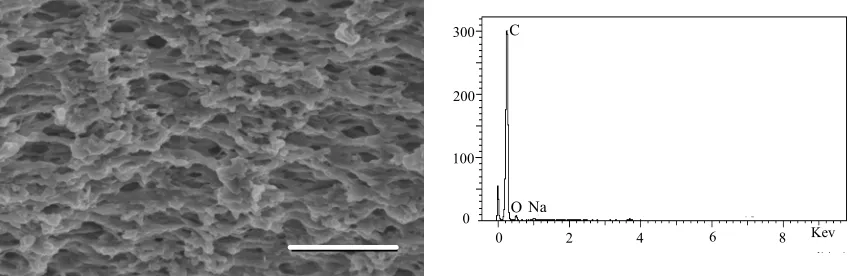
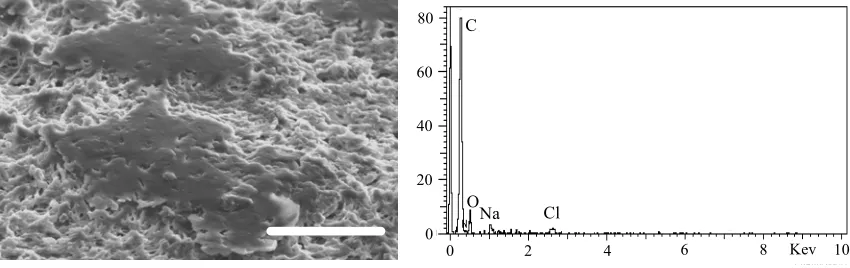
Following the filtration experiments, the microstructures of the PP membrane surfaces were characterised using a Philips XL30 field emission scanning electron microscope (SEM) in both the secondary and back-scattered electrons (BSE) modes operating at 5-15kV. Associated energy-dispersive X-ray spectroscopy (EDS) was also used to obtain chemical information.
3. Results and Discussion
3.1 NOM Fractions
171
179 180 181 182 183 184 185 186 187 188 189 190 191 192 193 194 195 196 197 198 199 200 201 202 203 204
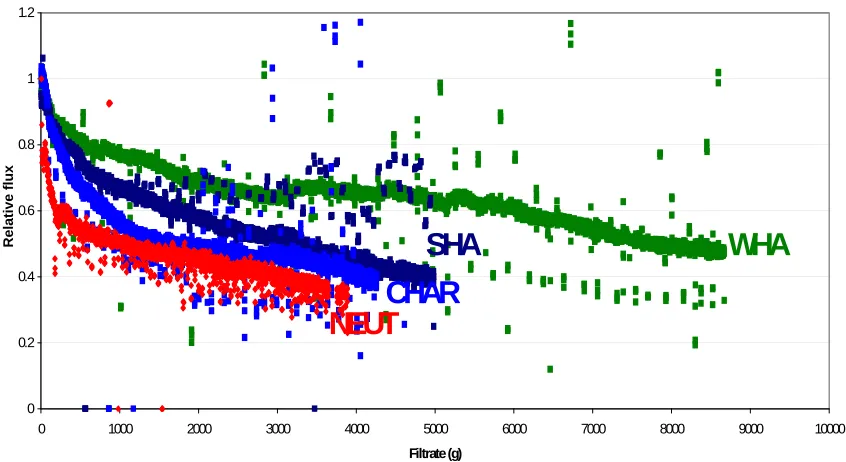
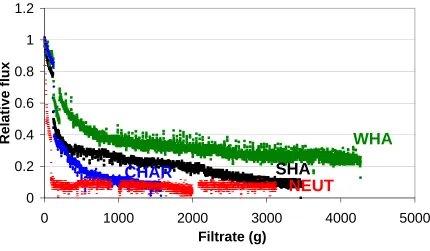
The fouling caused by the hydrophobic fractions (SHA and WHA) may be attributed to the adsorption of the hydrophobic acids on the hydrophobic PP membrane. The flux recovery on backwashing is small compared to the Char and Neut fractions (width of lines in Figures 1 and 2) and the SEM photographs following filtration with the WHA fraction has little surface fouling evident (Figure 5). These results are consistent with fouling via pore constriction.
In comparison, the flux decline curves for the Char and Neut fractions may be attributed to the formation of a cake or gel layer on the membrane surface. There is greater flux recovery upon backwashing for these fractions and the SEM photograph following filtration by the Char fraction (Figure 6) shows the presence of a gel layer.
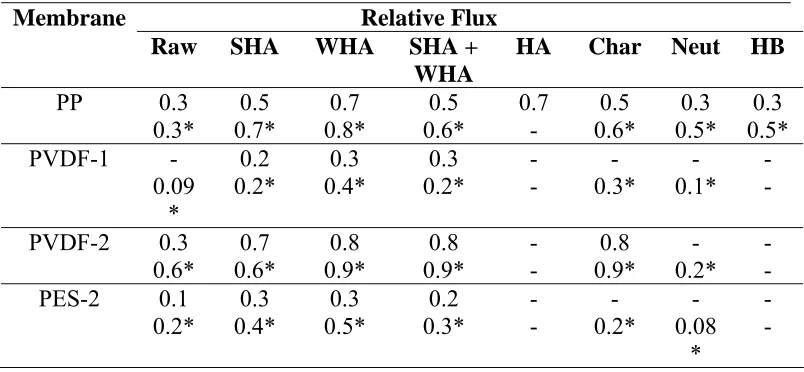
Table 3 shows the Bendigo flux results for all membranes after 3 L throughput of the raw water and its various NOM fractions. It is apparent generally that the Neut and HB fractions have the greatest effect on flux, and WHA the least. There was only enough HB material to test on the one membrane and the results were identical to those for the Neut fraction. The formation of the gel layer on the surface of the membrane by the Neut and Char fractions appears to lead to faster flux decline for these waters than pore constriction from the SHA and WHA fractions. The formation of the gel layer on the membrane surface might be regarded as being the result of filtering large particles or organic complexes that are too large to be filtered. While this may be possible, and the presence of large entities in the cake layer will lead to a faster formation of this layer, previous work has also shown that the flux decline of MF and UF membranes does not alter when the permeate is re-filtered through another clean membrane (Makdissy et al. 2004). If the cake layer were the result of entities
205 206 207 208 209 210 211 212 213 214 215 216 217 218 219 220 221 222 223 224 225 226 227 228 229 230
be formed on the surface by associations between organic compounds. Given the gel layer appeared for the Char and Neut fractions of NOM it is evident that the gel layer is the result of filtering polysaccharide material rather than humic substances.
Combining the SHA and WHA fractions (1:1; no salt addition) before passing them through the PES-2 membrane resulted in a greater flux decline than either of the two separate fractions, with nearly a halving of the flux at low throughputs. Pore blocking by what seem to be larger species may be occurring. There was little difference in behaviour with the two PVDF membranes. If there is association or clustering of the two hydrophobic fractions, it might be expected to have more
influence on the less polar membranes, which is observed to a small extent for the PP membrane, but not for PVDF-1. These results re-enforce the proposition that the hydrophobic compounds do not by themselves lead to the formation of a cake or gel layer except perhaps for the smaller pore size UF membranes.
The effect of the various Meredith NOM fractions on membrane behaviour is shown in Table 4. With the PP membrane the Char fraction has the greatest effect on flux, and the hydrophobic fractions the least, whereas for the PVDF-2 membrane the Char fraction fouls insignificantly. This is due to the greater flux recovery upon backwashing for the PVDF membrane compared to the PP membrane (see Figure 7 for a typical comparison of flux recoveries between PP and PVDF
membranes) when the Char fraction is filtered, and re-enforces the notion that the adhesion between the membrane and the gel layer is critical in determining the rate of flux decline.
231 232 233 234 235 236 237 238 239 240 241 242 243 244 245 246 247 248 249 250 251 252 253 254 255 256
The addition of salt to raw Meredith water and its NOM fractions had pronounced effects in some cases, as also shown in Table 4. For the hydrophobic PP membrane there was a dramatic reduction in flux for the WHA compounds, a similar effect but in the reverse direction for the Char fraction, a slight reduction in flux for the HA fraction and a negligible change for the raw water, SHA and Neut fractions. However for the Type B Neut fraction salt enhanced the flux markedly. Interactions that could account for the PP membrane results may involve calcium ion binding the WHA to the membrane. The presence of calcium, here at only 0.05 mM concentration, has been observed at 1 mM concentration to decrease the size of soil-derived NOM from 300 nm to ~100 nm, but at higher calcium levels a size increase was observed that was ascribed to chelation between the species, although a concentration of >2 mM was required (Xi et al. 2004). In the present work a flux
reduction at low calcium levels may result from calcium linking the WHA molecules to the membrane, which is not happening to the same extent with the SHA fraction, a fact that could be ascribed to the much greater content of carboxylic acid groups in the WHA molecules, estimated to be some 2.5 times for a French river NOM (Garnier et al.2004). This proposed mechanism is also
consistent with the formation of a gel layer with the WHA when the additional salt (NaCl and CaCl2) are added, as is shown in Figure 8. An analogous explanation has been proposed for an NOM surrogate in the form of a carboxylated latex particle, where it been shown that calcium ions greatly enhanced fouling of a thin film composite membrane made from a semi-aromatic piperazine based polyamide (Li and Elimelech 2004). The calcium ions complex to carboxylic acid groups on the solution NOM and the NOM deposited on the membrane, to form bridges between the two surfaces.
257 258 259 260 261 262 263 264 265 266 267 268 269 270 271 272 273 274 275 276 277 278 279 280 281 282
the Type B Neut fraction. This fraction also contains hydrophobic basic compounds, and adsorption of these compounds on the membrane, possibly initially by hydrophobic bonding of the basic moiety to hydrophobic patches on the membrane surface, will be more pronounced at the higher ionic strengths. The resulting increased hydrophilicity of the membrane as a result of adsorbing these compounds may be responsible for the higher flux. The effect should be more pronounced for the more hydrophobic PP membrane than for PVDF-2, and indeed the former membrane shows the greater flux increase, nearly threefold that for the PP membrane. This sort of surface modification has been achieved by coating membranes with surfactants (Maartens et al. 2000). Non-ionic
surfactants of the polyethylene oxide type increased the relative fluxes in UF of a natural brown water. Recovery from a flux decline in UF is also documented for distilled water-detergent systems (Bhattacharyya et al. 1979), and flux improvements have been obtained for UF of bovine serum
albumin through detergent-pretreated regenerated cellulose, polyacrylic and polyamide membranes (Fane et al. 1985).
For the hydrophilic and probably more negatively charged PVDF-2 membrane there appears to be minor changes in the opposite direction to that found for the PP membrane and the WHA fraction, suggesting that a disaggregation mechanism may dominate. But for the Char fraction there is a pronounced effect in the opposite direction, with salt encouraging flux decline. It could be that the greater negative charge on the membrane is enhancing calcium ion binding of the anionic species to the membrane. As with the PP membrane, the Type B Neut fraction enhances flow because of the increased hydrophilicity of the membrane, as organics adsorption is again strong.
283 284 285 286 287 288 289 290 291 292 293 294 295 296 297 298 299 300 301 302 303 304 305 306 307 308
while the hydrophilic compounds form surface layers. As FTIR only analyses the surface coatings, only the hydrophilic compounds will be detected, as the hydrophobic compounds are likely to be adsorbed within the membrane pores. Given the poor rejection of NOM by MF, the gel layers that form on the membrane surface are unlikely to reject hydrophobic compounds, so they would be available for adsorption and fouling within the membrane pores even when once the gel layer has formed.
Furthermore, coagulation is known to preferentially remove the hydrophobic and charged compounds and to remove very little of the hydrophilic neutral compounds (Tran et al, 2006).
Therefore, coagulation prior to MF acts to reduce pore blocking from the hydrophobic compounds, but will have little effect on the formation of a gel layer resulting from the filtration of the
hydrophilic neutral components.
4. Conclusions
Hydrophobic membranes fouled more readily then hydrophilic membranes, as did those of small pore size. The most potent foulants were the neutral and charged hydrophilic compounds, as they formed a gel layer on the membrane surface. The SHA compounds were next, then the WHA compounds, neither of which formed cake or gel layers on the surface. Interactions between hydrophobic components may be occurring in some instances, where the level of strongly hydrophobic compounds is high, while the addition of calcium to the WHA fraction led to the formation of a gel layer through associations between the WHA components.
309 310 311 312 313 314 315 316 317 318 319 320 321 322 323 324 325 326 327 328 329 330 331 332 333 334
of the gel layer. This was shown to be formed by the hydrophilic compounds, while the hydrophobic compounds fouled the membrane by adsorption within the pores.
The results also suggest that pre-treatment with coagulation will not prevent the formation of a gel layer but will reduce the level of pore constriction by hydrophobic compounds, as coagulation is known to preferentially remove the hydrophobic and charged compounds.
Acknowledgements
The authors would like to thank the Cooperative Research Centre for Water Quality and Treatment for financial assistance.
References
Amy, G., Cho, J. (1999) Interactions between natural organic matter (NOM) and membranes: Rejection and fouling. Water Sci. Technol.40[9], 131-139.
Amy, G., Cho, J., Yoon, Y., Wright, S., Clark, M. M., Molis, E., Combe, C., Wang, Y., Lucas, P., Lee, Y., Kumar, M., Howe, K., Kim, K.-S., Pelligrino, J., Irvine, S. (2001) NOM rejection by, and fouling of, NF and UF membranes. AwwaRF Report, AWWA Research Foundation,
Denver.
Bhattacharyya, D., Jumawan, A. B., Grieves, R. B. (1979) Ultrafiltration characteristics of oil-detergent-water systems: Membrane fouling mechanisms. Sep. Sci & Technol.14[6], 529-549.
Carroll, T., King, S., Gray, S., Bolto, B., Booker, N. (2000) The fouling of microfiltration membranes by NOM after coagulation treatment. Water Research34, 2861-2868.
Chang, Y., Benjamin, M. M. (1996) Iron oxide adsorption and UF to remove NOM and control fouling. J. Amer. Water Works Assocn.88[12], 74-88.
Croué, J.-P. (2004). Isolation of humic and non-humic NOM fractions: Structural characterisation.
335 336 337 338 339 340 341 342 343 344 345 346 347 348 349 350 351 352 353 354 355 356 357 358 359
Deo, P., Jockusch, S., Ottaviani, M. F., Moscatelli, A., Turro, N. J., Somasundaran, P. (2003) Interactions of hydrophobically modified polyelectrolytes with surfactants of the same charge.
Langmuir19, 10747-10752.
Fan, L., Harris, J. L., Roddick, F. A., Booker, N A. (2001) Influence of the characteristics of natural organic matter on the fouling of microfiltration membranes. Water Research35,
4455-4463.
Fane, A. G., Fell, C. J. D., Kim, K. J. (1985) The effect of surfactant pre-treatment on the ultrafiltration of proteins. Desalination 53, 37-55.
Farahbakhsh, K., Svrcek, C., Guest, R. K., Smith, D. W. (2004) A review of the impact of chemical pre-treatment on low-pressure water treatment membranes. J. Environ. Eng. Sci. 3,
237-253.
Garnier, C., Mounier, S., Benaïm, J. Y. (2004) Influence of dissolved organic carbon content on modelling natural organic matter acid-base properties. Water Research.38, 3685-3692.
Gole, A., Phadtare, S., Sastry, M., Langevin, D. (2003) Studies on interaction between similarly charged polyelectrolyte:fatty acid system. Langmuir19, 9321-9327.
Gray, S. R., Ritchie, C. B., Bolto, B. A. (2004) Effect of fractionated NOM on low pressure membrane flux declines. Wat. Sci. Technol. 4, 189-196.
Gu, B., Schmitt, J., Chen, Z., Liang, L., McCarthy, J. F. (1995) Adsorption and desorption of different organic matter fractions on iron oxide, Geochim. Cosmochim. Acta59, 219-229.
Howe, K. J., Clarke, M. M. (2002) Fouling of microfiltration and ultrafiltration membranes by natural waters. Environ. Sci. Technol.36, 3571-3576.
Jones, K. L., O’Melia, C. R. (2001) Ultrafiltration of protein and humic substances: effect of solution chemistry on fouling and flux decline. J. Membrane Sci.193, 163-173.
360 361 362 363 364 365 366 367 368 369 370 371 372 373 374 375 376 377 378 379 380 381 382 383 384 385
Kilduff, J. E., Mattaraj, S., Wigton, A., Kitis, M. and Karanfil, T. (2004) Effects of reverse osmosis isolation on reactivity of naturally opccurring dissolved organic matter in physicochemival processes. Water Research,38, 1026-1036.
Kimura, K., Hane, Y., Watanabe, Y., Amy, G., Ohkuma, N. (2004) Irreversible membrane fouling during ultrafiltration of surface water. Water Research,38, 3431-3441.
Laîné, J.-M., Hagstrom, J. P., Clark, M.M., Mallevialle, J. (1989) Effects of ultrafiltration membrane composition. J. Amer. Water Works Assocn.81[11], 61-67.
Li, Q., Elimelech, M. (2004) Organic fouling and chemical cleaning of nanofiltration membranes: Measurements and mechanisms. Environ. Sci. Technol. 38, 4683-4693.
Lin, C.-F., Liu, S.-H., Hao, O. J. (2001) Effect of functional groups of humic substances on UF performance. Water Research,35, 2395-2402.
Maartens, A., Swart, P., Jacobs, E. P. (2000) Membrane pre-treatment: A method for reducing fouling by natural organic matter. J. Colloid & Interface Sci.221,137-142.
Makdissy, G., Croué, J.P., Amy, G. and Buisson, H. (2004). Fouling of a polyethersulfone ultrafiltration membrane by natural organic matter. IWA Natural organic matter research: Innovations and applications for drinking water, Whalers Inn, victor Harbour, SA, March 2-5, (http://www.waterquality.crc.org.au/nom/NOM_conference/NOM_conference_website.htm) Maurice, P. A., Pullin, M. J., Cabaniss, S. E., Zhou, Q., Namejesnik-Dejanovic, K., Aiken, G. R.
(2002) A comparison of surface water natural organic matter in raw filtered water samples, XAD and revere osmosis isolates. Water Research36, 2357-2371.
Nilson, J. A., DiGiano,F. A. (1996) Influence of NOM composition on nanofiltration, J. Amer. Water Works Assocn.88[5], 53-66.
Ødegaard, H., Koottatep, S. (1982) Removal of humic substances from natural waters by reverse osmosis. Water Research16, 613-620.
386 387 388 389 390 391 392 393 394 395 396 397 398 399 400 401 402
Schäfer, A. I. (2001) Natural Organic Matter Removal Using Membranes: Principles, Performance and Cost. Technomic Publishing, Lancaster, Pennsylvania, p. 313.
Schäfer, A. I., Fane, A.G., Waite, T. D. (1998) Nanofiltration of natural organic matter: Removal, fouling and the influence of multivalent ions. Desalination118, 109-122.
Serkiz, S. M., Perdue, E. M. (1990) Isolation of dissolved organic matter from the Suwannee River using reverse osmosis. Water Research24, 911-916.
Taniguchi, M., Kilduff, J. E., Belfort, G. (2003) Modes of natural organic matter fouling during ultrafiltration. Environ. Sci. Technol.37, 1676-1683.
Tran, T., Gray, S.R., Naughton, R. and Bolto, B.A. (2006) Polysilicato-iron for improved NOM removal and membrane performance. J. Mem. Sci. 280, 560-571
Wong, S., Hanna, J. V., King, S. J., Carroll, T., Eldridge, R. J., Dixon, D. R., Bolto, B. A., Hesse, S., Abbt-Braun, G. and Frimmel, F. H. (2002) Fractionation of natural organic matter in drinking water and characterization by 13C cross polarisation magic angle spinning NMR spectroscopy and size exclusion chromatography. Environ. Sci. Technol.36, 3497-3503.
Xi, W., Rong, W., Fane, A. G., Fook-Sin, W. (2004) Influence of ionic strength on NOM size and removal by ultrafiltration. Proc. International NOM Conference, p. 94, Victor Harbor, South
403 404
Table 1 Summary of UF and NF membrane performance (hollow fibre systems) Membrane Type Membrane Polymer Organics Source Main Foulant Membrane Most Affected Reference UF, both hydrophobic and hydrophilic Various Suwannee River reference samples
Humic acid > fulvic acid Hydrophobic and less negatively charged Jucker and Clark 1994 UF, both hydrophobic, hydrophilic Polyamide, polyethersulphone (PES), cellulosic Horsetooth Reservoir, Colorado Neutral hydrophilic compounds
Hydrophobic Amy and Cho 1999 UF, both hydrophobic, hydrophilic PVDF Three Australian waters High MW neutral hydrophilics
Hydrophobic Fan et al.2001 UF, both hydrophobic, hydrophilic Polysulphone, regenerated cellulose acetate Fractionated soil-derived humic acid ArCO2H > ArOH Hydrophobic; PAC of no assistance
Lin et al..
2001 UF,
hydrophilic
Cellulose acetate Lake water; soil-derived humic acid High MW hydrophobic acids Only hydrophilic tested Chang and Benjamin 1996; Gu
et al. 1995
UF disc membranes, hydrophilic Regenerated cellulose, cellulose diacetate Suwannee River humic acid; BSA
Humic acid > protein since easier pore entry Similar performance for all Jones and O’Melia 2001 UF, both hydrophobic & hydrophilic Polysulphone, acrylic copolymer, cellulosic Lake Decatur, Illinois Not determined
Hydrophobic Laîné et al. 1989
UF and NF membranes, both hydrophobic & hydrophilic Polyamide, PES, sulphonated PES, polysulphone, cellulose acetate, regenerated cellulose Various surface supplies in California and Japan Neutral hydrophilics a major foulant, except for very hydrophobic NOM Hydrophobic membranes adsorbed more humic acids
Amy et al.2001;
Kimura et al. 2004
NF, of varying
hydrophilicity Thin film composite, cellulose acetate
Suwannee River, and Australian Dam
Humic acid > fulvic acid especially at high [Ca++]
406 407 408 409
Table 2
Amount of each NOM fraction in Meredith and Bendigo waters
NOM % TOC in each Fraction
Source SHA WHA Char Neut Res HB
Meredith 43.8 21.9 19.2 15.3 15.1 0.2
Bendigo 38.6 26.0 19.3 16.1 15.7 0.4
411 412 413
Table 3
The effect of Bendigo NOM fractions on flux, DOC 3.8 mg/L, 3 L throughput
Membrane Relative Flux Raw SHA WHA SHA +
WHA
HA Char Neut HB
PP 0.3
0.3* 0.7* 0.5 0.8* 0.7 0.6* 0.5 0.7 - 0.6* 0.5 0.5* 0.3 0.5* 0.3 PVDF-1 -
0.09 *
0.2
0.2* 0.4* 0.3 0.2* 0.3 - - 0.3* - 0.1* - - - PVDF-2 0.3
0.6* 0.6* 0.7 0.9* 0.8 0.9* 0.8 - - 0.9* 0.8 0.2* - - - PES-2 0.1
0.2* 0.4* 0.3 0.5* 0.3 0.3* 0.2 - - 0.2* - 0.08- *
- - * At 1 L throughput
416 417 418 419 420
Table 4
The effect of NOM fractions on flux, with and without added salts, DOC 3 mg/l, 1.5 L throughput
Membrane Added Relative Flux
Salts* Raw SHA WHA HA Char Neut**
PP N
Y
0.12 0.12
0.22 0.21
0.32 0.10
0.45 0.42
0.07 0.31
0.07 0.19
PVDF-2 N
Y
0.48 0.72
0.75 0.65
0.77 0.85
0.97 0.94
0.74 0.57
0.45 0.60 * Final concentration 50 mg/L NaCl and 5 mg/L CaCl2
421 422 423
424 425 426 427 428 429 430 431 432
Fig. 1 Bendigo NOM fractions and PP membrane (p. 19)
433
0 0.2 0.4 0.6 0.8 1 1.2
0 1000 2000 3000 4000 5000 6000 7000 8000 9000 10000
Filtrate (g)
Relative flux
SHA
WHA
CHAR
NEUT
434 435 436 437 438 439 440 441 442
443
0
0.2
0.4
0.6
0.8
1
1.2
0
1000
2000
3000
4000
500
Filtrate (g)
Relative flux
WHA
SHA
CHAR
NEUT
0
444 445 446 447
448
C
O Na
Kev
0 2 4 6 8
100 200 300
0 449
450 451 452
Figure 3: SEM micrograph (bar = 5 μm) and EDS spectrum of a fresh PP membrane, showing
453
250 200 150 100 100 50 0
0 2 4 6 8 Kev 10
C
O Al Si
454 455 456 457 458 459 460
Figure 4: SEM micrograph (bar = 10 μm) and EDS spectrum of a PP membrane following filtration
461 462
0 2 4 6 8 10
C
O Na
0 10 20 30
Kev 463
464 465 466 467 468 469
Figure 5: SEM micrograph (bar = 5 μm) and EDS spectrum of a PP membrane following filtration
470
Kev 0 2 4 6
0
Cl Na O C
8 10 20
40 60 80
471 472 473 474 475 476
Figure 6: SEM micrograph (bar = 10 μm) of a PP membrane following filtration of the Meredith
477
0 0.2 0.4 0.6 0.8 1
0 1000 2000 3000 4000 5000 6000
Filtrate (g)
Relative
flux
PVDF-2
Polypropylene
478 479 480 481 482
483 484
C
O
Kev 0 2
NaAl Si
S Cl Fe
4 6 8 10 0
5 10 15
O C
Ca
485 486 487 488 489 490 491
Figure 8: SEM micrograph (bar = 10 μm) and EDS spectrum of a PP membrane following filtration
of the Meredith WHA fraction with salt addition (50mg/L NaCl and 5 mg/L CaCl2). Note that