“ASSESS THE EFFECTIVENESS OF LAUGHTER THERAPY ON DEPRESSIVE SYMPTOMS AMONG ADULTS AT SELECTED TSUNAMI AFFECTED AREA IN KANYAKUMARI DISTRICT, TAMIL NADU”.
SHEJO.W, ASSISTANT PROFESSOR, AMITY COLLEGE OF NURSING,
GURGAON.
Abstract
Laughter is extremely therapeutic for depression as it helps to release certain neurotransmitters from the brain cells as well as help people to stay connected and share their feelings and emotional moments of life. It is every Nurses role to emphasize the importance of good laughter therapy for the welfare of patient society. The study aimed to assess effectiveness of laughter therapy on depressive symptoms among adults at selected Tsunami affected area in Kanyakumari District, Tamil Nadu. Quasi experimental one group pre test –post test design was used to find out the effectiveness of laughter therapy on depression. The mean depressive symptoms before laughter therapy was 35.7 16.2 and the score was reduced to 26.2 12.5 after undergoing the laughter therapy. The mean reduction of depressive symptoms was 9.4 10.7 and the same was statistically very highly significant. (P<0.001). The significant reduction was considered as the effectiveness of laughter therapy on depressive symptoms.
Introduction
Laughter is the best medicine having deep overtones. A good laugh is a valuable tool in the work place. Tension is unavoidable in business and laughter is an unexpected release of suspense. A good laugh is also looked upon as a motivational tool.
It is not easy to have a sense of laughter if we have to face so many problems every day. However, one has to cultivate it exactly because we live in a crazy world full of mistakes that stress us up continuously.
Laughter is the best relaxant as even one minute of laughter can give the body an effect of 45 minutes of Therapeutic relaxation 10 minutes of laughter is enough for the effects to last throughout the day (French Neurologist - Henri Ruben Stein)
Positive correlations were found between the positive humor styles and all the mental toughness factors". Which are comprised of challenge, confidence of abilities, commitment, control over life, emotional control and interpersonal confidence (Tulin Research and Human Genetics Journal, 2009)
A report published reveals that the child labourers and children affected by the Tsunami who attended a workshop sharing their experiences with the media in Bangalore are worrying about another tsunami (Hindu Newspaper, 2007)
Study results showed that Tsunami exposed people had severe property destruction and life destruction it explains, 15 % of them had PTSD and 10% of them had depressive symptoms, respectively. These findings emphasize the need for strengthening various grass root organizations in Tsunami affected communities (Wickrama, 2009)
Objectives
To assess the level of depressive symptoms among adults before laughter therapy.
To assess the level of depressive symptoms among adults after laughter therapy.
To compare the level of depressive symptoms before and after laughter therapy.
To find the association between level of depressive symptoms and the selected demographic variables such as age, sex, education, occupation and marital status.
Review of Literature
post-test levels of depression, quality of life and resilience. The results showed that laughter therapy was effective in increasing the quality of life and resilience in breast cancer survivors as p<0.05.
Nordentoft, (2007) A study conducted on Attitude toward humor in patients experiencing depressive symptoms. 200 subjects under went a structural interview using the Mini- international Neuro psychiatric interview and Svebak’s sense – of –Humor questionnaire was used to assess whether an individual liked or disliked humor. The findings of the study indicated humorous interventions, as many patients might appreciate humor in their treatment.
Shahict, 2010, A study conducted on laughter yoga and group exercise program in elderly depressed women. Seventy depressed old women were chosen by using Geriatric depression scale. Subjects were randomized into three groups of laughter therapy exercise therapy and control. Subsequently pre-test and post-test were done for all three groups. The finding shows that decrease in depression scores of both laughter yoga and exercise therapy group in comparison to control group as p<0.001 and p<0.01 respectively.
William, (2011), A study conducted on Attitude towards Humor in patients experiencing depressive symptoms. 200 individuals with depression received questionnaires to assess their sense of humor and attitude toward humor using the svebak’s humor questionnaire and quick inventory of depressive symptomatalogy. Scoring reveals that 16 of them had reduction in pain, 17 experienced reduction in stress and anxiety, 12 had better general health and 18 had relieved of tension. The findings brought to light that their existed a significant relationship between humor and depression and have a positive attitudes towards humor.
Jonitz, (2010), A study conducted on Humor therapy on the depressed elders. An empirical study selected 90 participants who had clinical depressive symptoms. 52 patients were participating in the humor group and 38 patients, in the control group Pre-test and Post – test were performed by using Geriatric depression scale and life satisfaction scale. The findings indicated positive effects of humor on older patients with depressive symptoms as p<0.05.
Methodology
Results
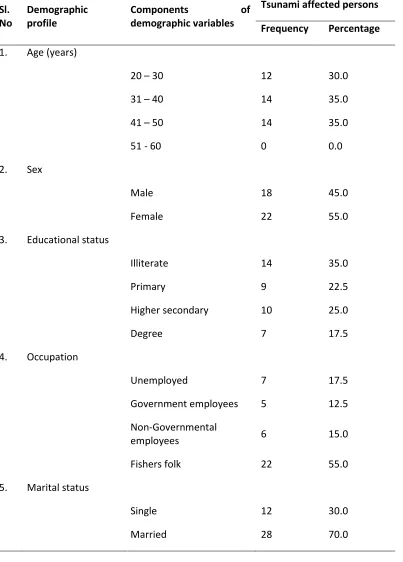
Table I Frequency and percentage distribution of selected demographic variables.
(N=40)
Sl. No
Demographic profile
Components of
demographic variables
Tsunami affected persons
Frequency Percentage
1. Age (years)
20 – 30 12 30.0
31 – 40 14 35.0
41 – 50 14 35.0
51 - 60 0 0.0
2. Sex
Male 18 45.0
Female 22 55.0
3. Educational status
Illiterate 14 35.0
Primary 9 22.5
Higher secondary 10 25.0
Degree 7 17.5
4. Occupation
Unemployed 7 17.5
Government employees 5 12.5
Non-Governmental
employees 6 15.0
Fishers folk 22 55.0
5. Marital status
Single 12 30.0
Figure – 1 : Bar diagram represents the percentage of distribution of level of depressive symptoms
Figure – 2 :Bar diagram represents the Percentage of Distribution of level of depressive symptoms after laughter therapy
0
10
20
30
40
50
60
Pre-test Score
0
5
10
15
20
25
30
35
Post-test Score
Minimal Mild Moderate Severe
0%
22.5% 25%
Table:2
Comparison of sample subjects with mean and standard deviation of before and after laughter therapy
Inter-vention
Before After Difference
‘t’ d.f
Signi-ficance
Mean S.D Mean S.D Mean S.D
Laughter
therapy 35.7 16.2 26.2 12.5 9.4 10.7 5.642 39 P<0.001
Table:3
Association between the level of depressive symptoms and demographic variables. (N=40)
Demographic variables
Component of
variables
Level of
depressive symptoms
2 d.f Significance
M ild M o d e ra te Se ve re To ta l Age
20 – 30 3 4 5 12
31 – 40 2 2 10 14 3.302 4 P>0.05
41 – 50 4 4 6 14
51 – 60 0 0 0 0
Sex
Male 6 4 8 18 2.213 2 P>0.05
Female 3 6 13 22
Education
Illiterate 3 6 5 14
Primary 3 3 3 9 8.838 6 P>0.05
Degree 1 0 6 7
Occupation
Un-employed 3 3 1 7
Government
employee 1 0 4 3 8.789 6 P>0.05
Non-Governmental
employee 5 6 11 22
Fishers folk 5 6 11 22
Marital status
Single 3 4 5 12 0.907 2 P>0.05
Married 6 6 1 2
The present study findings are well supported by Warren (2009), in his study revealed that among 40 adults, 9(22.5%) adults had mild depressive symptoms 10(25%) had moderate depressive symptoms and 21 (52.5%) had severe depressive symptoms. After undergoing laughter therapy among them 2 (5%) were minimal, 14(35%) had mild depressive symptoms, 10(25%) had moderate and 14(35%) had severe depressive symptoms .
The present study reveals that as age, sex, education, occupation and marital status had not any significant association with the depressive symptoms of adults.
Implications
Nursing practice
The findings would help the nurses in planning, organizing and implementing the healthy mental status.
Nurses working in psychiatric ward can follow this laughter therapy on a routine basis.
Disaster health workers can also adopt this method in disaster areas.
Nursing Education
Nurse educator can encourage the students to conduct inservice education regarding various techniques in laughter therapy.
Nurse educator can encourage creative activities among the student nurses to prepare awareness programmes regarding benefits of laughter therapy.
Nursing Administration
The nurse administrator should encourage the staff and students to implement the laughter therapy on different health needs in community areas.
It can also be included in practice in various settings like hospitals, Technological Institutions and other health organizations.
Laughter therapy is one of the best Interventions with less cost and more benefits for hospitalized adults and family.
Nursing Research
Extensive research can be conducted to find out the depressive symptoms in adults.
The nursing researcher can conduct similar studies related to laughter therapy. Extensive research can be done by psychiatric nurses to reduce the mental health problems.
Recommendations
The study can be done with large number of samples for better generalization.
There should be major initiative to spread the awareness among the general public by conducting periodic mass education.
A comparative study can be carried out among old age groups.
Can educate the public regarding benefits of laughter therapy.
Suggestions for Future Research
The study can be conducted on larger number of samples with control group.
Conclusion
The field study shows reduction in the level of depressive symptoms among adults at Prince Colony. The verbal response of the study participants, that laughter therapy is a useful and effective therapy, but it is more effective when practicing individually.
References
Basavanthappa B.T (1998). Nursing Research (1st edition.). New Delhi; Jaypee Brothers Medical Publishers. Page No: 49
Basavanthappa B.T (2007). Nursing Theories (1st edition.). New Delhi; Jaypee Brothers Medical Publishers. Page No:226-239.
Basavanthappa B.T (2007). Psychiatric Mental Health Nursing (1st edition.).NewDelhi; Jaypee Brothers Medical Publishers.
Benjamini.J (2002). A Comprehensive textbook of psychiatry(7th edition.). NewYork; Lippincott Williams and Wilkins.
Chrishart(2005) Doing Your Master’s Dissertation.(1st edition.).New Delhi; Vistar Publication Page No:348.
Fortinash (2008). Psychiatric Mental Health Nursing(2008). Psychiatric Mental Health Nursing(4th edition.). Missoure; Mosby Publication.
Gail W.S (2009). Principles and Practice of Psychiatric Nursing (9th edition.). Kundli; Rajkamal Electric Press. Page No: 506.
Kaplan and Sadock’s (2008). Concise Textbook of Clinical Psychiatry.(3rd edition.). Philadelphia; Lippincott Williams and Wilkins.Page No: 1094-1095.
Lalitha K (2007). Mental Health and Psychiatric Nursing in an Indian Perspective (1st edition.). Bangalore;V.M.G Book House. Page No:311.