International Journal of COPD
Dovepress
O r I g I n A L r e s e A r C h
open access to scientific and medical research
Open Access Full Text Article
relationships between repeated instruction
on inhalation therapy, medication adherence,
and health status in chronic obstructive
pulmonary disease
Masaya Takemura1
Katsumi Mitsui2
ryo Itotani1
Manabu Ishitoko1
shinko suzuki1
Masataka Matsumoto1
Kensaku Aihara1
Tsuyoshi Oguma1
Tetsuya Ueda1
hitoshi Kagioka1
Motonari Fukui1
1Division of respiratory Medicine, 2Division of Pharmacy, Tazuke Kofukai,
Medical research Institute, Kitano hospital, Osaka, Japan
Correspondence: Masaya Takemura Division of respiratory Medicine, respiratory Disease Center, Tazuke Kofukai, Medical research Institute, Kitano hospital, 2-4-20 Ohgimachi, Kita-ku, Osaka 530-8480, Japan Tel +81 6 6312 1221 Fax +81 6 6361 0588
email [email protected]
Purpose: Adherence to inhalation therapy is a critical determinant of the success of chronic obstructive pulmonary disease (COPD) management. However, in practice, nonadherence to inhalation therapy is very common in COPD patients. The effects of adherence to inhalation therapy in COPD have not been fully studied, and less is known about the relationship between medication adherence and quality of life in COPD. Our aim is to assess the factors that contribute to adherence to inhalation therapy and examine their correlation with quality of life.
Patients and methods: A cross-sectional analysis of 88 COPD patients was performed using a self-reported adherence questionnaire with responses on a 5-point Likert scale.
Results: Of the 88 patients who were potential participants, 55 (63%) responded with usable information. The only significant factor associated with the overall mean adherence score was receiving repeated instruction about inhalation techniques (P= 0.032). Of the 55 respondents, 22 (40.0%) were given repeated verbal instruction and/or demonstrations of inhalation technique by a respiratory physician. Significant correlations were found between the overall mean adherence score and the health-related quality of life score (St George’s Respiratory Questionnaire: total, r=−0.35, P= 0.023; symptoms, r=−0.43, P= 0.002; impacts, r=−0.35, P= 0.011). Further-more, patients with repeated instruction showed better quality of life scores than those who did not receive instruction (total, P= 0.030; symptoms, P= 0.038; impacts, P= 0.019).
Conclusions: Repeated instruction for inhalation techniques may contribute to adherence to therapeutic regimens, which relates to better health status in COPD.
Keywords: COPD, adherence, quality of life, repeated instruction
Introduction
Chronic obstructive pulmonary disease (COPD) is the fourth most common global cause of death. Its prevalence is expected to increase, and it results in substantial social and economic burdens.1 Numerous studies have shown that COPD therapy
achieves several of the goals of COPD management, including prevention and control of symptoms, reduction in the rates of exacerbation and hospitalization, and improve-ment of health-related quality of life (HRQL).2 Inhalation therapy plays a central role
in COPD therapy, but it is widely recognized that many patients do not always adhere to their inhalation regimens. Several studies have reported that an average of 60% of COPD patients do not adhere to prescribed therapy.3–5 Furthermore, patients make a
number of errors with inhaler handling, some of which are critical to the efficacy of inhalation treatment.6
International Journal of Chronic Obstructive Pulmonary Disease downloaded from https://www.dovepress.com/ by 118.70.13.36 on 22-Aug-2020
For personal use only.
Number of times this article has been viewed
This article was published in the following Dove Press journal: International Journal of COPD
Dovepress
Takemura et al
Adherence to inhaled medication in COPD may impact on clinical outcomes. Recently, Vestbo et al reported that among moderate to severe COPD patients enrolled in the Towards a Revolution in COPD Health study, there was a strong associa-tion between adherence to inhaled medicine and mortality, as well as risk of hospitalization due to exacerbations. They found that the mortality of nonadherent patients was more than twice that of adherent patients, with adherence defined as .80% use of study medication.7
Adherence to inhalation therapy is complex, influenced by multiple aspects, including patient factors (eg, sex, age, and comorbidities), different types of therapy regimens (eg, polypharmacy, frequency of dosing, and type of inhaler devices), and the quality of communication between health care providers and patients.8 We previously studied adherence
to inhalation therapy of adult patients with asthma and showed a significant relationship between repeated instruc-tion on inhalainstruc-tion technique and good adherence to inhalainstruc-tion therapy. Furthermore, patients who had good adherence to inhalation therapy showed better HRQL.9 COPD patients,
as well as asthmatic patients, have multiple factors that may affect adherence to therapy and therapeutic outcomes, but factors affecting adherence to inhalation therapy in COPD have not been fully addressed, and less is known regarding the relationship of medication adherence to quality of life, which is one of the important clinical outcomes that represent patient-centered measures of disease control in COPD.10
The aim of this study was to identify the factors that con-tribute to adherence to inhalation therapy and to investigate the relationships among these factors, adherence, and quality of life in patients with COPD.
Methods
study design
This was a cross-sectional questionnaire study. To elucidate the patient-related aspects of adherence to inhalation therapy in COPD patients, effects of age, sex, duration of COPD, presence of comorbidities, prescribed antipsychotic drugs, frequency of consultations, duration of inhaled medicine use, type of inhaler devices (dry powder inhaler [DPI] or metered-dose inhaler [MDI] or both DPI + MDI), frequency of administration of inhaled medicine, stage of COPD, and presence or absence of repeated instruction for inhalation tech-nique were examined. The relationship between adherence to inhalation therapy and health status assessed by a HRQL questionnaire was also examined. The survey for this study was performed from November 2006 through March 2007.
subjects
A total of 88 consecutive outpatients with COPD were recruited from the respiratory clinic of Kitano Hospital Medical Research Institute. Subjects were eligible for participation in the study if they met the following criteria: 1) current or former smoker (.10 pack-years); 2) regular visits to respiratory outpatient clinic every 1–3 months; 3) respiratory physician diagnosed COPD; 4) prescribed inhaled medicines (anticholinergic, β2 agonist, or inhaled corticosteroid) for at least 12 months; and 5) no change in COPD inhaler medication for 3 months. Patients’ data were obtained from their medical records. The diagnosis and staging of COPD were confirmed by the lung function criteria of the GOLD guideline.1
The research protocol was approved by the Institu-tional Review Board of Kitano Hospital Medical Research Institute.
Questionnaire on inhalation therapy
The questionnaire survey was carried out as previously described.9 Briefly, on the day of their appointment with
the respiratory physician, potential study participants were approached in the waiting room by the researcher and invited to answer a brief questionnaire prior to their appointment. The adherence questionnaire was a modification of a scale developed to measure self-reported adherence to inhaled medication.9,11,12 This scale included the four questions
given below concerning the use of inhaled controller medications. There were five response options for each question (Table 1).
The self-reported adherence score was calculated from the mean of the responses to the four questions.9,11,12 Higher
scores reflect better adherence to the inhalation regimen. For univariate and multivariate analysis, the patients were arbitrarily classified as having good adherence to inhaled therapy if the overall mean adherence score was $4.0, while a mean score ,4.0 indicated some level of poor adherence.9
Table 1 Adherence questionnaire During the last 3 months have you: 1. Been careless about using your inhaler? 2. ever forgotten to use your inhaler?
3. ever stopped using your inhaler because you felt better? 4. Used your inhaler less than your doctor prescribed because
you felt better? responses were as follows:
Most of the time some of the time none of the time
1 2 3 4 5
International Journal of Chronic Obstructive Pulmonary Disease downloaded from https://www.dovepress.com/ by 118.70.13.36 on 22-Aug-2020
Dovepress Medication adherence and quality of life in COPD
Previous research has shown that self-reported adherence using this questionnaire correlates well with adherence determined by pharmacy claims data.11
All participants were also asked the following question:9
Have you been given repeated instruction on inhalation technique by a physician at regular intervals? If yes, how? Multiple answers (verbal instruction, demonstration, written instruction (manufacturer’s pamphlet), and other methods of instruction) were acceptable. Improper responses to these five questions were excluded from the analysis.
HRQL questionnaire
The St George’s Respiratory Questionnaire (SGRQ) was used to measure the HRQL of COPD patients.13,14 The responses
to its 50 items can be aggregated into a total score and three subscores for symptoms (measuring distress caused by respiratory symptoms), activities (measuring the effect of disturbances to mobility and physical activity), and impacts (quantifying the psychosocial impact of the disease). Scores range from 0 to 100; higher scores reflect a worse health status.13,14 The Japanese version of the SGRQ has been
validated.15 The SGRQ and the adherence questionnaire were
given to the patients on the same day.
statistical analysis
All data were analyzed using SPSS for Windows 11.0 (SPSS Inc., Chicago, IL). Results are given as mean (±SD) or median values. Comparisons between groups used the Mann–Whitney U test, the χ2 test, or the Kruskal–Wallis
test for univariate analysis. Correlations between data were analyzed using Spearman’s rank correlation test. Multivariate analysis using the stepwise method was performed to deter-mine which of the independent variables were related to good adherence to inhalation therapy or good HRQL. Independent variables included age, sex (female = 1, male = 0), frequency of respiratory outpatient clinic visits, frequency of adminis-tration of inhaled medicine, use of DPI + MDI-type inhaler devices (yes = 1, no = 0), presence of comorbidities (yes = 1, no = 0), taking of antipsychotic drugs (yes = 1, no = 0), stage of COPD, and whether repeated instruction for proper inhalation technique (yes = 1, no = 0) was given. The level of significance was set at P, 0.05.
Results
Characteristics of respondents
Of the 88 patients who were potential participants, 55 responded with usable information (62.5% response rate). Thirty-three
responses had to be excluded due to unanswered items. There were no differences in demographic characteristics between respondents and nonrespondents (data not shown). The respondents’ data are given in Table 2. Patients were elderly, were more often male, and had mild to moderate COPD. Patients visited our respiratory outpatient clinic 4–18 times a year (median = 8). The mean disease duration was 9 years. Of the 55 patients, 37 (67%) had one or more comorbidities, and 13 (24%) had taken some kind of antipsychotic drugs. All COPD patients were under treatment with DPI or/and MDI, such as anticholinergic (MDI, or HandiHaler®; Boehringer Ingelheim,
Ridgefield, CT), long-acting β2 agonist (Diskhaler® or Diskus®;
GlaxoSmithKline, London, UK), short-acting β2 agonist via MDI, or inhaled corticosteroids (MDI or Diskhaler, Diskus, Turbuhaler®; AstraZeneca, London, UK). Thirty-six patients
(65.5%) used either DPI or MDI, and 19 patients (34.5%) used both DPI and MDI. The average frequency of administration of inhaled medicine was 2.4 times per day.
repeated instruction
for inhalation technique
Twenty-two (40.0%) of the 55 respondents were provided repeated instruction on inhalation technique. All 22 patients had their inhalation skills checked repeatedly at regular inter-vals and were taught how to inhale according to the specific characteristics for their particular device during a consultation. Of these 22 patients, 18 were given both verbal instructions and demonstrations related to inhalation techniques by their respiratory physician, and four patients were given only verbal instructions on inhalation technique. No patients were given written instructions by their respiratory physician.
Background of COPD patients
with and without good adherence
to inhaled therapy
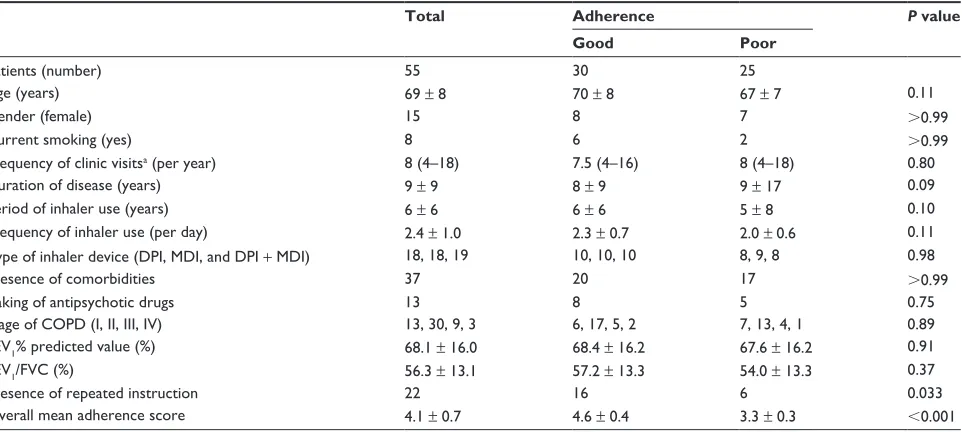
The overall mean adherence score in COPD patients was 4.1 ± 0.7. Of the 55 respondents, 30 (55%) COPD patients were classified as having good adherence to inhalation therapy, and 25 (45%) showed some levels of poor adherence (Table 2). Using univariate analyses, clinical characteristics of patients with good adherence to inhalation therapy were compared with those of patients with poor adherence. No significant differences were found between them regarding age, sex, duration of disease, the frequency of visits to the respiratory outpatient clinic, period of using inhaled medicines, frequency of administration of inhaled medicine,
International Journal of Chronic Obstructive Pulmonary Disease downloaded from https://www.dovepress.com/ by 118.70.13.36 on 22-Aug-2020
Dovepress
Takemura et al
the type of inhaler devices, presence of comorbidities, prescribed antipsychotic drugs, and COPD stage. Patients who received repeated instruction for proper inhalation technique were more prevalent in the group with good adherence than in the group with poor adherence (16/14 vs 6/19, P= 0.033, Table 2).
Multivariate analysis using the stepwise method identif ied which of the factors contributed to good adherence to inhalation therapy. The final regression analysis confirmed that only repeated instruction on inhalation technique was positively related to good adherence to inhalation therapy (multiple correlation coefficient, 0.28; standardized coefficient beta, 0.28;
P= 0.040, Table 3).
Comparison of the mean adherence
scores for individual items with
and without repeated instruction
for COPD patients
The patient group with repeated instruction had a significantly greater mean adherence score for the overall mean adherence score (4.4 ± 0.5 vs 3.9 ± 0.8; P= 0.032, Figure 1) and the item ‘stopped using inhaler because I felt better’ (4.6 ± 0.7 vs 4.0 ± 1.1; P= 0.049) and showed a marginally greater mean adherence score for the item ‘used inhaler less because I felt better’ (4.5 ± 0.7 vs 3.9 ± 1.2; P= 0.062) than the group with-out repeated instruction. There were no significant differences between the two groups for the mean adherence scores for the other two items of the adherence questionnaire (Table 4).
Correlations between the overall
mean adherence score and
COPD-related outcomes
The overall mean adherence score showed significant correlations with the SGRQ subscores except for activities: total:
r=−0.35, P= 0.023; symptoms: r=−0.43, P= 0.002; activities:
r=−0.17, P= 0.21; impacts: r=−0.35, P= 0.011 (Table 5).
Comparison of the sgrQ scores
for COPD patients with and without
repeated instruction
The group with repeated instruction had significantly lower SGRQ subscores for total (33.7 ± 20.0 vs 44.9 ± 19.2; P= 0.030),
Table 2 survey respondents’ background and characteristics of patients with and without adherence to inhalation therapy
Total Adherence P value
Good Poor
Patients (number) 55 30 25
Age (years) 69 ± 8 70 ± 8 67 ± 7 0.11
gender (female) 15 8 7 .0.99
Current smoking (yes) 8 6 2 .0.99
Frequency of clinic visitsa (per year) 8 (4–18) 7.5 (4–16) 8 (4–18) 0.80
Duration of disease (years) 9 ± 9 8 ± 9 9 ± 17 0.09
Period of inhaler use (years) 6 ± 6 6 ± 6 5 ± 8 0.10
Frequency of inhaler use (per day) 2.4 ± 1.0 2.3 ± 0.7 2.0 ± 0.6 0.11
Type of inhaler device (DPI, MDI, and DPI + MDI) 18, 18, 19 10, 10, 10 8, 9, 8 0.98
Presence of comorbidities 37 20 17 .0.99
Taking of antipsychotic drugs 13 8 5 0.75
stage of COPD (I, II, III, IV) 13, 30, 9, 3 6, 17, 5, 2 7, 13, 4, 1 0.89
FeV1% predicted value (%) 68.1 ± 16.0 68.4 ± 16.2 67.6 ± 16.2 0.91
FeV1/FVC (%) 56.3 ± 13.1 57.2 ± 13.3 54.0 ± 13.3 0.37
Presence of repeated instruction 22 16 6 0.033
Overall mean adherence score 4.1 ± 0.7 4.6 ± 0.4 3.3 ± 0.3 ,0.001
Notes: aMedian value. Good adherence was defined by an overall mean adherence score $4.0, and poor adherence means score ,4.0. Abbreviations: DPI, dry powder inhaler; MDI, metered-dose inhaler.
Table 3 Multiple stepwise regression of the variables related to the good adherence to inhalation therapy
Standardized
coefficients beta
t P value
Age 0.22 1.56 0.13
gender −0.06 −0.42 0.68
Frequency of clinic visits −0.01 −0.05 0.96 Frequency of inhaler use 0.19 1.39 0.17 Type of inhaler device −0.02 −0.14 0.89
Comorbidities −0.11 0.71 0.48
Antipsychotic drugs 0.06 0.42 0.68
stage of COPD 0.12 0.86 0.39
repeated instruction 0.28 2.13 0.040
Notes: Adjusted for female sex (yes = 1, no = 0), use of DPI + MDI-type inhaler (yes = 1, no = 0), presence of comorbidities (yes = 1, no = 0), taking of antipsychotic drugs (yes = 1, no = 0), and presence of repeated instruction (yes = 1, no = 0). Abbreviations: DPI, dry powder inhaler; MDI, metered-dose inhaler.
International Journal of Chronic Obstructive Pulmonary Disease downloaded from https://www.dovepress.com/ by 118.70.13.36 on 22-Aug-2020
Dovepress Medication adherence and quality of life in COPD
2 2.5 3 3.5 4 4.5 5
Overall mean
adherence score
(+) (−)
Repeated instruction
P = 0.032
Figure 1 Comparison of overall mean adherence scores between COPD patients with and without repeated instruction for inhalation technique.
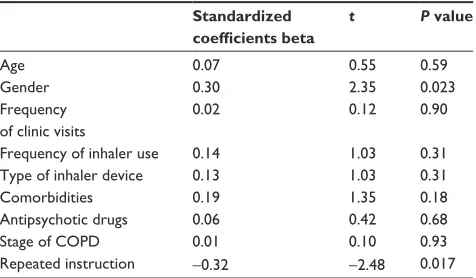
instruction were 0.30 and −0.32, P values were 0.023 and 0.017, respectively, Table 6).
Background of patients who received
repeated instruction of inhalation
therapy and those who did not
There were no significant differences between the 22 patients who received repeated instruction and the 33 patients who did not, regarding age (69.5 ± 9.0 vs 69.0 ± 7.6 years; P= 0.58), sex (female/male: 4/18 vs 11/22; P = 0.35), duration of COPD (8.0 ± 8.0 vs 8.1 ± 12.3 years; P= 0.59) and stage of COPD (I/II/III/IV: 4/13/3/2 vs 9/17/6/1; P= 0.65), presence of comorbidities (17 vs 20; P= 0.25), taking of antipsychotic drugs (6 vs 7; P= 0.84), frequency of clinic visits (7.9 ± 3.4 vs 7.8 ± 2.9; P= 0.93), duration of inhaled medicine use (7.3 ± 7.7 vs 5.0 ± 5.9 years; P = 0.27), type of inhaler devices (DPI/MDI/DPI + MDI: 5/9/8 vs 13/9/11; P= 0.38), symptoms (39.1 ± 24.3 vs 52.9 ± 25.8; P = 0.038), and
impacts (24.3 ± 21.4 vs 36.2 ± 21.3; P= 0.019) and showed a marginally lower subscore for activities (42.4 ± 22.9 vs 50.8 ± 20.9; P = 0.058) than the group without repeated instruction.
Factors associated with the total
sgrQ score in COPD patients
Multivariate analysis was performed to identify the contributing factors related to health status. Multiple stepwise regression analysis showed that sex and repeated instruction were the significant factors related to the total SGRQ score (multiple correlation coefficient was 0.41; and standardized coefficient betas for sex and repeated
Table 4 Comparisons of mean adherence scores for individual items between patients with and without repeated instruction
Repeated instruction P value
Yes No
Patients, no. 22 33
Overall mean adherence score 4.4 ± 0.5 3.9 ± 0.8 0.032 Questionnaire item
Careless about inhaler 4.3 ± 1.1 4.0 ± 1.1 0.16 Forgot to use inhaler 4.3 ± 1.0 4.0 ± 1.0 0.40 stopped using inhaler
because felt better
4.6 ± 0.7 4.0 ± 1.1 0.049
Used inhaler less because felt better
4.5 ± 0.7 3.9 ± 1.2 0.062
Table 5 Correlation between overall mean adherence score and sgrQ scores
R P value
SGRQ scores
Total −0.35 0.023
symptoms −0.43 0.002
Activities −0.17 0.21
Impacts −0.35 0.011
Abbreviation: sgrQ, st george’s respiratory Questionnaire.
International Journal of Chronic Obstructive Pulmonary Disease downloaded from https://www.dovepress.com/ by 118.70.13.36 on 22-Aug-2020
Dovepress
Takemura et al
frequency of administration of inhaled medicine (2.3 ± 0.7 vs 2.2 ± 0.7 per day; P= 0.49), and pulmonary function (forced expiratory volume in one second [FEV1]% predicted value: 67.3% ± 17.4% vs 68.6% ± 15.3%; P= 0.72).
Discussion
A cross-sectional study examined the factors related to adherence to inhalation regimens in 88 COPD patients using univariate and multivariate analyses. Compared to patients who did not have good adherence, patients who had good adherence to their inhalation regimens had been given repeated instruction on inhalation technique. In addition, patients who had been given repeated instruction showed better quality of life. Furthermore, better adherence to inha-lation therapy related to better quality of life status assessed by the SGRQ.
Adherence to inhalation therapy was found to be poor in the present study. Nearly half of the respondents were classified as nonadherent to inhalation therapy assessed by self-reported questionnaire. This is consistent with studies conducted in other countries. Several authors have reported that COPD patients were both intentionally and unintention-ally nonadherent to their therapeutic recommendations.16–18
Dolce et al investigated adherence to inhalation regimens using a self-report adherence questionnaire in 78 COPD patients and found that more than half of the patients reported missing or skipping doses of their medication.17 COPD
patients may be especially vulnerable to nonadherence to inhalation therapy. James et al examined medication patterns using a questionnaire in 185 patients with either asthma or COPD. They reported that both groups showed poor adherence and that COPD patients had significantly lower
adherence levels than asthmatic patients.19 Considering the
nature of COPD, which is characterized by poor reversibility of airflow limitation, COPD patients may have difficulty adhering to medications that do not provide immediate improvement of symptoms, unlike asthma.19
Several factors, including sociological, psychological, patient-related, and physician-based aspects, predis-pose COPD patients to nonadherence.20–22 Reasons for
nonadherence have been well studied in COPD, but reasons for good adherence are very limited. In the present study, there was a significant relationship between repeated instruction for inhalation technique and adherence to the inhalation regimen assessed by the overall mean adherence score in COPD. The clinical effects of educational programs for COPD have been widely studied. Recent studies have reported that repeated educational programs for COPD including instructions for proper inhalation techniques provided by trained nurses or general practitioner assistants improved inhalation technique and medication adherence.23,24
When considering the reason why repeated instruction on inhalation technique in COPD affects adherence to thera-peutic regimens, the patients’ beliefs and motivations may be key factors for inhalation therapy. In our study, when the adherence score of each questionnaire item was analyzed, patients with repeated instruction showed significantly better adherence scores for the question ‘stopped using inhaler because I felt better’ and marginally greater scores for the item ‘used inhaler less because I felt better’ compared to patients without repeated instruction. These two question-naire items likely represent intentional nonadherent behaviors that reflect patients’ beliefs and motivations for treatment and illness, in contrast to the other two items that reflect accidental nonadherence behavior.25,26 These data suggest
that repeated instruction may improve intentional nonad-herence by affecting the patients’ beliefs and motivations to adhere to the medication regimen. It has been recognized that the crucial role of patients’ perception and beliefs is under-lined in the medical management of COPD. George et al studied 525 COPD patients to identify the predictors of medi-cation adherence assessed by a self-reported questionnaire including 30 items relating to health beliefs, experiences, and behaviors. They reported that patients’ beliefs, experi-ences, and behaviors about both disease and treatment were more powerful predictors of medication adherence than sociodemographic and clinical factors in COPD patients. In multivariate analysis, they also found that the item, ‘I vary my recommended management based on how I am feeling’, was one of the significant independent predictors
Table 6 Multiple stepwise regression of the variables related to the total sgrQ score
Standardized
coefficients beta
t P value
Age 0.07 0.55 0.59
gender 0.30 2.35 0.023
Frequency of clinic visits
0.02 0.12 0.90
Frequency of inhaler use 0.14 1.03 0.31
Type of inhaler device 0.13 1.03 0.31
Comorbidities 0.19 1.35 0.18
Antipsychotic drugs 0.06 0.42 0.68
stage of COPD 0.01 0.10 0.93
repeated instruction −0.32 −2.48 0.017
Notes: Adjusted for female sex (yes = 1, no = 0), use of DPI + MDI-type inhaler (yes = 1, no = 0), presence of comorbidities (yes = 1, no = 0), taking of antipsychotic drugs (yes = 1, no = 0), and presence of repeated instruction (yes = 1, no = 0). Abbreviations: DPI, dry powder inhaler; MDI, metered-dose inhaler.
International Journal of Chronic Obstructive Pulmonary Disease downloaded from https://www.dovepress.com/ by 118.70.13.36 on 22-Aug-2020
Dovepress Medication adherence and quality of life in COPD
of nonadherence.27 Therefore, a patient’s conviction of the
necessity to use the drug is a key prerequisite for therapy adherence in COPD.
Our repeated instruction for inhalation technique may have had some advantages in terms of the quality of commu-nication between medical staff and patients, which reinforced patients’ beliefs and motivations to adhere to inhalation therapy. Of the 22 patients with repeated instruction, 18 were given both verbal instructions and demonstrations of inhalation technique by their respiratory physician. It has long been known that the inclusion of a physical demonstration of inhaler technique is more effective than written or verbal instructions alone.28,29 Furthermore, repeated instructions for
inhalation technique were given by respiratory physicians in this study. In this regard, not merely the instruction for inhala-tion technique, but also repeated advice given by physicians about inhaled medicines, such as the role of inhaled medi-cines and their necessity, as well as addressing the patient’s concerns about inhaled medicine, might reinforce adherence to the treatment regimen.30 In addition, adherence to
medica-tion increases if the prescribing physician is a specialist rather than a general practitioner.31
Better adherence to the therapeutic regimen is likely related to better clinical outcomes. In the present study, adherence to inhaled therapy correlated with the SGRQ scores. Furthermore, patients with repeated instruction on inhalation technique showed better quality of life scores than those who were not given repeated instruction. To clarify the relationships between repeated instruction, medication adherence, and health status, multivariate analysis using a stepwise method was performed to identify the contribut-ing factors related to the total SGRQ score. We found that repeated instruction was one of the significant factors related to better health status. Given that repeated instruction was the common contributing factor related to better adherence to inhalation therapy and better health status, the relationship between medication adherence and HRQL in COPD may be mediated through our repeated instruction on inhalation technique. However, the association between adherence to therapeutic regimen and quality of life in COPD is still a matter of debate. Most educational programs have found negative or inconclusive results regarding HRQL.24,32 Further
research needs to address this.
Some limitations of our study should be noted. Because of an observational, cross-sectional study, no cause-effect relationship can be established. Furthermore, other limita-tions of the present study are its small sample size and the fact that repeated instruction was neither randomized nor
controlled due to the cross-sectional nature of the study. There may have been a possible bias in the selection of periodic instruction for each patient. We tested the extent of selection bias by comparing the patients’ background characteristics for patients with and without repeated instruc-tion. There were no differences between them regarding all variables we investigated.
To assess medication adherence, there exists a variety of methods, such as medication counting, diaries, electronic monitoring, and analysis of pharmacy claims databases. However, there is no universal definition of adherence that could be used as a gold standard at present. The adherence data of the present study were based on self-reports from patients. Most investigations of self-reports indicate that patients bias information in a positive direction,22 suggesting
that it is more likely that adherence may have been overes-timated in this study.
Conclusion
The present study demonstrates the significant relation-ships between repeated instruction for inhalation technique, adherence to inhalation therapy, and HRQL in COPD. Iden-tification and management of adherence-related factors in COPD may improve the health status of patients with COPD. Prospective, longitudinal studies are needed to investigate the mechanisms of how repeated instruction for inhalation technique correlate with adherence to the inhalation regimen and clinical outcomes for COPD.
Acknowledgments
We thank the staff of the outpatient clinic of Kitano Hospital for data collection.
Disclosure
The authors report no conflicts of interest. The authors alone are responsible for the content and writing of the article.
References
1. National Institutes of Health. NHLBI/WHO Workshop Report: National Institutes of Health, National Heart, Lung and Blood Institute, Update 2008. Global strategy for the diagnosis, management, and prevention of chronic obstructive pulmonary disease. Bethesda, MD: National Institutes of Health; 2008.
2. Sin DD, McAlister FA, Man SF, Anthonisen NR. Contemporary manage-ment of chronic obstructive pulmonary disease: scientific review. JAMA. 2003;290(17):2301–2312.
3. Krigsman K, Nilsson JL, Ring L. Adherence to multiple drug therapies: refill adherence to concomitant use of diabetes and asthma/COPD medication. Pharmacoepidemiol Drug Saf. 2007;16(10):1120–1128. 4. Krigsman K, Moen J, Nilsson JL, Ring L. Refill adherence by the elderly
for asthma/chronic obstructive pulmonary disease drugs dispensed over a 10-year period. J Clin Pharm Ther. 2007;32(6):603–611.
International Journal of Chronic Obstructive Pulmonary Disease downloaded from https://www.dovepress.com/ by 118.70.13.36 on 22-Aug-2020
International Journal of COPD
Publish your work in this journal
Submit your manuscript here: http://www.dovepress.com/international-journal-of-copd-journal
The International Journal of COPD is an international, peer-reviewed journal of therapeutics and pharmacology focusing on concise rapid reporting of clinical studies and reviews in COPD. Special focus is given to the pathophysiological processes underlying the disease, intervention programs, patient focused education, and self management protocols.
This journal is indexed on PubMed Central, MedLine and CAS. The manuscript management system is completely online and includes a very quick and fair peer-review system, which is all easy to use. Visit http://www.dovepress.com/testimonials.php to read real quotes from published authors.
Dovepress
Dovepress
Takemura et al
5. Haupt D, Krigsman K, Nilsson JL. Medication persistence among patients with asthma/COPD drugs. Pharm World Sci. 2008;30(5):509–514. 6. Molimard M, Raherison C, Lignot S, Depont F, Abouelfath A, Moore N.
Assessment of handling of inhaler devices in real life: an observa-tional study in 3811 patients in primary care. J Aerosol Med. 2003; 16(3):249–254.
7. Vestbo J, Anderson JA, Calverley PM, et al. Adherence to inhaled therapy, mortality and hospital admission in COPD. Thorax. 2009; 64(11):939–943.
8. Bourbeau J, Bartlett SJ. Patient adherence in COPD. Thorax. 2008; 63(9):831–838.
9. Takemura M, Kobayashi M, Kimura K, et al. Repeated instruction on inhalation technique improves adherence to the therapeutic regimen in asthma. J Asthma. 2010;47(2):202–208.
10. Gross NJ. Chronic obstructive pulmonary disease outcome measure-ments: what’s important? What’s useful? Proc Am Thorac Soc. 2005; 2(4):267–271; discussion 290–291.
11. Erickson SR, Coombs JH, Kirking DM, Azimi AR. Compliance from self-reported versus pharmacy claims data with metered-dose inhalers. Ann Pharmacother. 2001;35(9):997–1003.
12. De Smet BD, Erickson SR, Kirking DM. Self-reported adherence in patients with asthma. Ann Pharmacother. 2006;40(3):414–420. 13. Jones PW, Quirk FH, Baveystock CM, Littlejohns P. A self-
complete measure of health status for chronic airflow limitation. The St George’s Respiratory Questionnaire. Am Rev Respir Dis. 1992; 145(6):1321–1327.
14. Bouchet C, Guillemin F, Hoang Thi TH, Cornette A, Briançon S. Validation of the St George’s questionnaire for measuring the quality of life in patients with chronic obstructive pulmonary disease. Rev Mal Respir. 1996;13(1):43–46.
15. Hajiro T, Nishimura K, Tsukino M, Ikeda A, Koyama H, Izumi T. Comparison of discriminative properties among disease-specific ques-tionnaires for measuring health-related quality of life in patients with chronic obstructive pulmonary disease. Am J Respir Crit Care Med. 1998;157(3 Pt 1):785–790.
16. Rand CS, Nides M, Cowles MK, Wise RA, Connett J. Long-term metered-dose inhaler adherence in a clinical trial. The Lung Health Study Research Group. Am J Respir Crit Care Med. 1995;152(2):580–588. 17. Dolce JJ, Crisp C, Manzella B, Richards JM, Hardin JM, Bailey WC.
Medication adherence patterns in chronic obstructive pulmonary disease. Chest. 1991;99(4):837–841.
18. Van Grunsven PM, van Schayck CP, van Deuveren M, van Herwaarden CL, Akkermans RP, van Weel C. Compliance during long-term treatment with fluticasone propionate in subjects with early signs of asthma or chronic obstructive pulmonary disease (COPD): results of the Detection, Intervention, and Monitoring Program of COPD and Asthma (DIMCA) Study. J Asthma. 2000;37(3):225–234.
19. James PN, Anderson JB, Prior JG, White JP, Henry JA, Cochrane GM. Patterns of drug taking in patients with chronic airflow obstruction. Postgrad Med J. 1985;61(711):7–10.
20. Tashkin DP. Multiple dose regimens. Impact on compliance. Chest. 1995;107(5 Suppl):176S–182S.
21. Hughes CM. Medication non-adherence in the elderly: how big is the problem? Drugs Aging. 2004;21(12):793–811.
22. DiMatteo MR. Variations in patients’ adherence to medical recom-mendations: a quantitative review of 50 years of research. Med Care. 2004;42(3):200–209.
23. Garcia-Aymerich J, Hernandez C, Alonso A, et al. Effects of an inte-grated care intervention on risk factors of COPD readmission. Respir Med. 2007;101(7):1462–1469.
24. Lemmens KM, Nieboer AP, Rutten-Van Molken MP, et al. Application of a theoretical model to evaluate COPD disease management. BMC Health Serv Res. 2010;10:81.
25. Cochrane GM, Horne R, Chanez P. Compliance in asthma. Respir Med. 1999;93(11):763–769.
26. Horne R. Compliance, adherence, and concordance: implications for asthma treatment. Chest. 2006;130(1 Suppl):65S–72S.
27. George J, Kong DC, Thoman R, Stewart K. Factors associated with medication nonadherence in patients with COPD. Chest. 2005; 128(5):3198–3204.
28. Basheti IA, Reddel HK, Armour CL, Bosnic-Anticevich SZ. Counseling about turbuhaler technique: needs assessment and effective strategies for community pharmacists. Respir Care. 2005;50(5):617–623. 29. Self TH, Brooks JB, Lieberman P, Ryan MR. The value of
demonstra-tion and role of the pharmacist in teaching the correct use of pressurized bronchodilators. Can Med Assoc J. 1983;128(2):129–131.
30. Ulrik CS, Backer V, Soes-Petersen U, Lange P, Harving H, Plaschke PP. The patient’s perspective: adherence or non-adherence to asthma controller therapy? J Asthma. 2006;43(9):701–704.
31. Lau HS, Beuning KS, Postma-Lim E, Klein-Beernink L, de Boer A, Porsius AJ. Non-compliance in elderly people: evaluation of risk factors by longitudinal data analysis. Pharm World Sci. 1996;18(2):63–68. 32. Monninkhof E, van der Valk P, van der Palen J, van Herwaarden C,
Partridge MR, Zielhuis G. Self-management education for patients with chronic obstructive pulmonary disease: a systematic review. Thorax. 2003;8(5):394–398.
International Journal of Chronic Obstructive Pulmonary Disease downloaded from https://www.dovepress.com/ by 118.70.13.36 on 22-Aug-2020