
Convolution Kernels for Opinion Holder Extraction
Michael Wiegand and Dietrich Klakow Spoken Language Systems
Saarland University D-66123 Saarbr¨ucken, Germany
{Michael.Wiegand|Dietrich.Klakow}@lsv.uni-saarland.de
Abstract
Opinion holder extraction is one of the impor-tant subtasks in sentiment analysis. The ef-fective detection of an opinion holder depends on the consideration of various cues on vari-ous levels of representation, though they are hard to formulate explicitly as features. In this work, we propose to use convolution kernels for that task which identify meaningful frag-ments of sequences or trees by themselves. We not only investigate how different levels of information can be effectively combined in different kernels but also examine how the scope of these kernels should be chosen. In general relation extraction, the two candidate entities thought to be involved in a relation are commonly chosen to be the boundaries of se-quences and trees. The definition of bound-aries in opinion holder extraction, however, is less straightforward since there might be sev-eral expressions beside the candidate opinion holder to be eligible for being a boundary.
1 Introduction
In recent years, there has been a growing interest in the automatic detection of opinionated content in natural language text. One of the more impor-tant tasks in sentiment analysis is the extraction of opinion holders. Opinion holder extraction is one of the critical components of an opinion question-answering system (i.e. systems which automatically answer opinion questions, such as “What does [X] like about [Y]?”). Such systems need to be able to distinguish which entities in a candidate answer sen-tence are the sources of opinions (=opinion holder)
and which are the targets.
On other NLP tasks, in particular, on relation extrac-tion, there has been much work on convolution
ker-nels, i.e. kernel functions exploiting huge amounts
of features without an explicit feature representa-tion. Previous research on that task has shown that convolution kernels, such as sequence and tree ker-nels, are quite effective when compared to manual feature engineering (Moschitti, 2008; Bunescu and Mooney, 2005; Nguyen et al., 2009). In order to effectively use convolution kernels, it is often nec-essary to choose appropriate substructures of a sen-tence rather than represent the sensen-tence as a whole structure (Bunescu and Mooney, 2005; Zhang et al., 2006; Moschitti, 2008). As for tree kernels, for ex-ample, one typically chooses the syntactic subtree immediately enclosing two entities potentially ex-pressing a specific relation in a given sentence. The opinion holder detection task is different from this scenario. There can be several cues within a sen-tence to indicate the presence of a genuine opinion holder and these cues need not be member of a par-ticular word group, e.g. they can be opinion words (see Sentences 1-3), communication words, such as
maintained in Sentence 2, or other lexical cues, such
as according in Sentence 3.
1. The U.S. commanders consideropinionthe prisoners to be un-lawful combatantsopinionas opposed to prisoners of war.
2. During the summit, Koizumi maintainedcommunication a clear-cut collaborative stanceopiniontowards the U.S. and em-phasized that the President was objectiveopinion and circum-spect.
3. Accordingcueto Fernandez, it was the worst mistakeopinionin the history of the Argentine economy.
Thus, the definition of boundaries of the structures for the convolution kernels is less straightforward in opinion holder extraction.
The aim of this paper is to explore in how far convo-lution kernels can be beneficial for effective opinion holder detection. We are not only interested in how far different kernel types contribute to this extraction task but we also contrast the performance of these kernels with a manually designed feature set used as a standard vector kernel. Finally, we also exam-ine the effectiveness of expanding word sequences or syntactic trees by additional prior knowledge.
2 Related Work
Choi et al. (2005) examine opinion holder extraction using CRFs with various manually defined linguis-tic features and patterns automalinguis-tically learnt by the AutoSlog system (Riloff, 1996). The linguistic fea-tures focus on named-entity information and syntac-tic relations to opinion words. In this paper, we use very similar settings. The features presented in Kim and Hovy (2005) and Bloom et al. (2007) resemble very much Choi et al. (2005). Bloom et al. (2007) also consider communication words to be predictive cues for opinion holders.
Kim and Hovy (2006) and Bethard et al. (2005) ex-plore the usefulness of semantic roles provided by FrameNet (Fillmore et al., 2003) for both opinion holder and opinion target extraction. Due to data sparseness, Kim and Hovy (2006) expand FrameNet data by using an unsupervised clustering algorithm. Choi et al. (2006) is an extension of Choi et al. (2005) in that opinion holder extraction is learnt jointly with opinion detection. This requires that opinion expressions and their relations to opinion holders are annotated in the training data. Seman-tic roles are also taken as a potential source of in-formation. In our work, we deliberately work with minimal annotation and, thus, do not consider any labeled opinion expressions and relations to opinion holders in the training data. We exclusively rely on entities marked as opinion holders. In many practi-cal situations, the annotation beyond opinion holder labeling is too expensive.
Complex convolution kernels have been success-fully applied to various NLP tasks, such as rela-tion extracrela-tion (Bunescu and Mooney, 2005; Zhang
et al., 2006; Nguyen et al., 2009), question an-swering (Zhang and Lee, 2003; Moschitti, 2008), and semantic role labeling (Moschitti et al., 2008). In all these tasks, they offer competitive perfor-mance to manually designed feature sets. Bunescu and Mooney (2005) combine different sequence ker-nels encoding different contexts of candidate en-tities in a sentence. They argue that several ker-nels encoding different contexts are more effective than just using one kernel with one specific context. We build on that idea and compare various scopes eligible for opinion holder extraction. Moschitti (2008) and Nguyen et al. (2009) suggest that differ-ent kinds of information, such as word sequences, part-of-speech tags, syntactic and semantic informa-tion should be contained in separate convoluinforma-tion ker-nels. We also adhere to this notion.
3 Data
As labeled data, we use the sentiment annotation of the MPQA 2.0 corpus1. Opinion holders are not ex-plicitly labeled as such. However sources of
pri-vate states and subjective speech events (Wiebe et
al., 2003) are a fairly good approximation of the task. Previous work (Choi et al., 2005; Kim and Hovy, 2005; Choi et al., 2006) uses similar approxi-mations.
4 Method
In this work, we consider all noun phrases (NPs) as possible candidate opinion holders. Therefore, the set of all data instances is the set of the NPs within the MPQA 2.0 corpus. Each NP is labeled as to whether it is a genuine opinion holder or not. Throughout this section, we will use Sentence 2 from Section 1 as an example.
4.1 The Different Levels of Representation
Several levels of representation are important for opinion holder extraction. Table 1 lists all the dif-ferent levels that are used in this work. Generalized sequences employ named-entity tags, an OPINION tag for opinion words and a COMM tag for
com-munication words2. Thus, in a generalized word
se-1www.cs.pitt.edu/mpqa/databaserelease 2Note that all candidate tokens are reduced to one generic
quence (W RDGN) a word is replaced by a general-ized token whereas in a generalgeneral-ized part-of-speech sequence (P OSGN) a part-of-speech tag is replaced. For augmented constituent trees (CON STAU G), the same sources of information are used. The differ-ence to generalizing sequdiffer-ences is that instead of re-placing words by generalized tokens, we add a node in the syntax tree with a generalized token so that it dominates the pertaining leaf node (see also nodes marked withAU Gin Figure 2). All sources used for this type of generalization are known to be predictive for opinion holder classification (Choi et al., 2005; Kim and Hovy, 2005; Choi et al., 2006; Kim and Hovy, 2006; Bloom et al., 2007).
Note that the grammatical relation paths, i.e.
GRAMW RD andGRAMP OS, can only be applied in case there is another expression in the focus in addition to the candidate of the data instance itself, e.g. the nearest opinion expression to the candidate. Section 4.4 explains in detail how this is done.
Predicate-argument structures (P AS) are repre-sented by PropBank trees (Kingsbury and Palmer, 2002).
4.2 Support Vector Machines and Kernel Methods
Support Vector Machines (SVMs) are one of the most robust supervised machine learning techniques in which training data instances~xare separated by a hyperplane H(~x) = w~ ·~x+b = 0wherew ∈ Rn
and b ∈ R. One advantage of SVMs is that
ker-nel methods can be applied which map the data to other feature spaces in which they can be separated more easily. Given a feature functionφ : O → R,
where O is the set of the objects, the kernel trick
allows the decision hyperplane to be rewritten as:
H(~x) = X
i=1...l
yiαi~xi !
·~x+b=
X
i=1...l
yiαi~xi·~x+b= X
i=1...l
yiαiφ(oi)·φ(o) +b
where yi is equal to 1 for positive and −1 for negative examples, αi ∈ R with αi ≥ 0, oi∀i ∈
{1, . . . , l}are the training instances and the product
K(oi, o) = hφ(oi)·φ(o)iis the kernel function as-sociated with the mappingφ.
case there are several tokens making up the candidate.
4.3 Sequence and Tree Kernels
A sequence kernel (SK) measures the similarity of two sequences by counting the number of com-mon subsequences. We use the kernel by Taylor and Christianini (2004) which has the advantage that it also considers subsequences of the original se-quence with some elements missing. The extent of these gaps in a sequence is suitably reflected by a weighting function incorporated into the kernel.
Tree kernels (T Ks) represent trees by their sub-structures. The feature space of these substructures, or fragments, is mapped onto a vector space. The kernel function computes the similarity of pairs of trees by counting the number of common fragments. In this work, we evaluate two tree kernels: Subset Tree Kernel (ST K) (Collins and Duffy, 2002) and Partial Tree Kernel (P T Kbasic) (Moschitti, 2006).
InST K, a tree fragment can be any set of nodes and edges of the original tree provided that every node has either all or none of its children. This straint makes that kind of kernel well-suited for stituency trees which have been generated by con-text free grammars since the constraint corresponds to the restriction that no grammatical rule must be broken. For example,ST Kenforces that a subtree, such as [VP [VBZ, NP]], cannot be matched with
[VP [VBZ]] since the latter VP node only possesses
one of the children of the former.
P T Kbasic is more flexible since the constraint of ST K on nodes is relaxed. This makes this type of tree kernel less suitable for constituency trees. We, therefore, apply it only to trees representing predicate-argument structures (P AS) (see Figure 1). Note that a data instance is represented by a set of those structures3 rather than a single structure. Thus, the actual partial tree kernel function we use for this task, P T K, sums over all possible pairs P ASl and P ASm of two data instances xi and xj: P T K(xi, xj) =
X
P ASl∈xi X
P ASm∈xj
P T Kbasic(P ASl, P ASm).
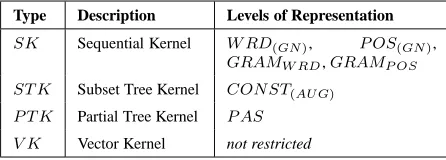
To summarize, Table 2 lists the different kernel types we use coupled with the suitable levels of rep-resentation. This choice of pairing has already been motivated and empirically proven suitable on other
3i.e. all predicate-argument structures of a sentence in which
Type Description Example
W RD sequence of words During the summit , KoizumiCAN Dmaintained a clear-cut collaborative stance. . .
W RDGN sequence of generalized words During the summit , CAND COMM OPINION. . . P OS part-of-speech sequence IN DET NN PUNC CAND VBD DET JJ JJ NN. . . P OSGN generalized part-of-speech sequence IN DET NN PUNC CAND COMM OPINION. . . CON ST constituency tree see Figure 2 without nodes markedAU G CON STAU G augmented constituency tree see Figure 2
GRAMW RD grammatical relation path labels with words KoizumiCAN DNSUBJ↑maintained DOBJ↓stance GRAMP OS grammatical relation path labels with part-of-speech tags CAND NSUBJ↑VBD DOBJ↓NN
P AS predicate argument structures see Figure 1(a)
[image:4.612.68.543.61.223.2]P ASAU G augmented predicate argument structures see Figure 1(b)
Table 1: The different levels of representation.
(a) plain
[image:4.612.78.304.269.411.2](b) augmented
Figure 1: Predicate-argument structures (P AS).
tasks (Moschitti, 2008; Nguyen et al., 2009).
Type Description Levels of Representation
SK Sequential Kernel W RD(GN), P OS(GN),
GRAMW RD,GRAMP OS ST K Subset Tree Kernel CON ST(AU G)
P T K Partial Tree Kernel P AS V K Vector Kernel not restricted
Table 2: The different types of kernels.
4.4 The Different Scopes
We argue that using the entire word sequence or syn-tax tree of the sentence in which a candidate opinion holder is situated to represent a data instance pro-duces too large structures for a convolution kernel. Since a classifier based on convolution kernels has to derive meaningful features by itself, the larger these structures are, the more likely noise is included
in the model. Previous work in relation extraction has also shown that the usage of more focused sub-structures, e.g. the smallest subtree containing the two candidate entities of a relation, is more effec-tive (Zhang et al., 2006). Unfortunately, in our task there is only one explicit entity we know of for each data instance which is the candidate opinion holder. However, there are several indicative cues within the context of the candidate which might be considered important. We identify three different cues being the nearest predicate, i.e. full verb or nominalization,
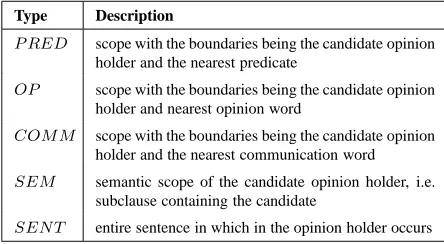
opinion word and communication word4. For each of these expressions, we define a scope where the boundaries are the candidate opinion holder and the pertaining cue. Given these scopes, we can define resulting subsequences/subtrees and combine them. We further add two background scopes, one being the semantic scope of the candidate opinion holder and the entire sentence. As semantic scope we con-sider the subclause in which a candidate opinion holder is situated5.
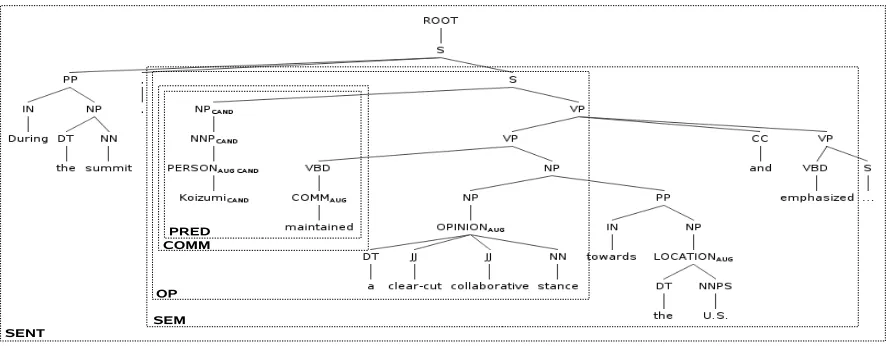
Figure 2 illustrates the different scopes. Abbre-viations are explained in Table 3. As already men-tioned in Section 4.1 for grammatical relation paths, a second expression in addition to the candidate opinion holder is required. These expressions can be derived from the different scopes, i.e. forP REDit
4These three expressions may coincide but do not have to. 5
[image:4.612.73.296.475.555.2]is the nearest predicate to the candidate, forOP it is the nearest opinion word and for COM M it is the nearest communication word. For the background scopesSEMandSEN T, however, there is no sec-ond expression in focus. Therefore, grammatical re-lation paths cannot be defined for these scopes.
Type Description
P RED scope with the boundaries being the candidate opinion holder and the nearest predicate
OP scope with the boundaries being the candidate opinion holder and nearest opinion word
COM M scope with the boundaries being the candidate opinion holder and the nearest communication word SEM semantic scope of the candidate opinion holder, i.e.
subclause containing the candidate
[image:5.612.315.538.63.289.2]SEN T entire sentence in which in the opinion holder occurs
Table 3: The different types of scope.
4.5 Manually Designed Feature Set for a Standard Vector Kernel
In addition to the different types of convolution ker-nels, we also define an explicit feature set for a vec-tor kernel (V K). Many of these features mainly de-scribe properties of the relation between the candi-date and the nearest predicate6 since in our initial experiments the nearest predicate has always been the strongest cue. Adding these types of features for other cues, e.g. the nearest opinion or commu-nication word, only resulted in a decrease in perfor-mance. Table 4 lists all the features we use. Note that this manual feature set employs all those sources of information which are also exploited by the con-volution kernels. Some of the information contained in the convolution kernels can, however, only be rep-resented in a more simplified fashion when using a manual feature set. For example, the first P AS
in Figure 1(a) is converted to just the pair of pred-icate and argument representing the candidate (i.e.
REL:maintain A0:Koizumi). The entireP ASis not used since it would create too sparse features. Con-volution kernels can cope with fairly complex struc-tures as input since they internally match substruc-tures. Manual features are less flexible since they do not account for partial matches.
6We select the nearest predicate by using the syntactic parse
tree. Thus, we hope to select the predicate which syntactically
headword/governing category of CAND
is CAND capitalized/a person?
is CAND subj|dobj|iobj|pobj of OPINION/COMM?
is CAND preceded by according to? (Choi et al., 2005)
does CAND contain possessive and is followed by OPIN-ION/COMM? (Choi et al., 2005)
is CAND preceded by by which is attached to OPINION/COMM? (Choi et al., 2005)
predicate-argument pairs in which CAND occurs
lemma/part-of-speech tag/subcategorization frame/voice of nearest predicate
is nearest predicate OPINION/COMM? does CAND precede/follow nearest predicate?
words between nearest predicate and CAND (bag of words) part-of-speech sequence between nearest predicate and CAND constituency path/grammatical relation path from predicate to CAND
Table 4: Manually designed feature set.
5 Experiments
We used 400 documents of the MPQA corpus for five-fold crossvalidation and133documents as a de-velopment set. We report statistical significance on the basis of a paired t-test using0.05 as the signif-icance level. All experiments were done with the
SVM-Light-TK toolkit7. We evaluated on the basis of exact phrase matching. We set the trade-off pa-rameterj = 5for all feature sets. For the manual feature set we used a polynomial kernel of third de-gree. These two critical parameters were tuned on the development set. As far as the sequence and tree kernels are concerned, we used the parameter settings from Moschitti (2008), i.e. λ = 0.4 and
µ = 0.4. Kernels were combined using plain sum-mation. The documents were parsed using the Stan-ford Parser (Klein and Manning, 2003). Named-entity information was obtained by the Stanford tag-ger (Finkel et al., 2005). Semantic roles were ob-tained by using the parser by Zhang et al. (2008). Opinion expressions were identified using the Sub-jectivity Lexicon from the MPQA project (Wil-son et al., 2005). Communication words were ob-tained by using the Appraisal Lexicon (Bloom et al., 2007). Nominalizations were recognized by looking
relates to the candidate opinion holder. 7
[image:5.612.73.295.154.276.2]Figure 2: Illustration of the different scopes on aCON STAU G; nodes belonging to the candidate opinion holder are
marked withC AN D.
up nouns in NOMLEX (Macleod et al., 1998).
5.1 Notation
Each kernel is represented as a triple
hlevelOfRepresentation (Table 1), Scope (Table 3), typeOfKernel
(Table 2)i, e.g. hCON ST, SEN T, ST Kiis a Subset
Tree Kernel of a constituency parse having the scope of the entire sentence. Note that not all com-binations of these three parameters are meaningful. In the following, we will just focus on important and effective combinations. The kernel composed of manually designed features is denoted by just
V K. The kernel composed of predicate-argument structures is denoted byhP AS, SEN T, P T Ki.
5.2 Vector Kernel (VK)
The first line in Table 7 displays the result of the vector kernel using a manually designed feature set. It should be interpreted as a baseline. Due to the high class imbalance we will focus on the compari-son of F(1)-Score throughout this paper rather than accuracy which is fairly biased on this data set. The F-Score of this classifier is at56.16%.
5.3 Sequence Kernels (SKs)
For both sequence and tree kernels we need to find out what the best scope is, whether it is worthwhile to combine different scopes and what different lay-ers of representation can be usefully combined.
The upper part of Table 5 lists the results of simple word kernels using the different scopes. The
perfor-mance of the kernels using individual scopes varies greatly. The best scope isP RED (1), the second best isSEM(2). The good performance ofP RED
does not come as a surprise since the sequence is the smallest among the different scopes, so this scope is least affected by data sparseness. Moreover, this re-sult is consistent with our initial experiments on the manual feature set (see Section 4.5).
Using different combinations of the word se-quence kernels shows that P RED and SEM (6) are a good combination, whereas OP, COM M, and SEN T (7;8;9) do not positively contribute to the overall performance which is consistent which the individual scope evaluation. Apparently, these scopes capture less linguistically relevant structure.
The next part of Table 5 shows the contribution of
P OSkernels when added toW RDkernels. Adding the correspondingP OS kernel to theW RDkernel withP RED scope (10) results in an improvement by more than 5% in F-Score. We get another im-provement by approx. 3% when the corresponding
SEM kernels (11) are added. This suggests that
P OSis an effective generalization and that the two scopesP REDandSEMare complementary.
For the GRAMW RD kernel, the P RED scope (12) is again most effective. We assume that this ker-nel most likely expresses meaningful syntactic rela-tionships for our task. Adding theGRAMP OS ker-nel (14) gives another boost by almost4%.
Adding the corresponding W RDGN kernels to the
W RDkernel withP REDandSEM scope results in an improvement from47.77% (1) to53.00% (15) which is a bit less than the combination of W RD
andP OS(GN)kernels (16). However, these types of kernels seem to be complementary since their com-bination provides an F-Score of56.06% (17). This kernel combination already performs on a par with the manually designed vector kernel though less in-formation is taken into consideration.
Finally, the best combination of sequence ker-nels (18) comprises W RD, W RDGN, P OS, and
P OSGN kernels with P RED and SEM scope combined with a GRAMW RD and a GRAMP OS kernel with P RED scope. The performance of
58.70% significantly outperforms the vector kernel.
5.4 Tree Kernels (TKs)
Table 6 shows the results of the different tree ker-nels. The table is divided into two halves. The left half (A) are plain tree kernels, whereas the right half (B) are the augmented tree kernels. As far as
CON ST kernels are concerned, there is a system-atic improvement by approximately 2% using tree augmentation. This proves that further non-syntactic knowledge added to the tree itself results in an im-proved F-Score. However, tree augmentation does not have any impact on theP ASkernels.
The overall performance of the tree kernels shows that they are much more expressive than sequence kernels. For instance, in order to obtain the same performance as of hCON STAU G, P RED, ST Ki (19B), i.e. a single kernel with an F-Score56.52, it requires several sequence kernels, hence much more effort. The performance of the different CON ST
kernels relative to each other resembles the results of the W RD kernels. The best scope is P RED
(19). By far the worst performance is obtained by theSEN T scope (23). The combination ofP RED
and SEM scope achieves an F-Score of 59.67% (25B) which is already slightly better than the best configuration of sequence kernels (18).
The performance of theP AS kernel (28A) with an F-Score of53.51% is slightly worse than the best single plainCON ST kernel (19A). TheP AS ker-nel and the CON ST kernels are complementary, since their best combination (29B) achieves an F-Score of 61.67% which is significantly better than
Combination Acc. Prec. Rec. F1
VK 93.63 53.28 59.37 56.16 best SKs 94.21 57.64 59.81 58.70 best TKs 94.16 56.18 68.36 61.67∗
VK + best SKs 94.34 58.44 61.27 59.82∗
VK + best TKs 94.33 57.41 68.03 62.27∗ best SKs + best TKs 94.49 59.22 63.96 61.49∗ VK + best SKs + best TKs 94.53 59.10 66.57 62.61∗†
Table 7: Results of kernel combinations (∗: significantly better than best SKs;†: significantly better than best TKs;
all convolution kernels are significantly better than VK).
the best combination ofCON ST kernels (25B) or sequence kernels (18).
5.5 Combinations
Table 7 lists the results of the different kernel type combinations. If VK is added to the best TKs, the best SKs, or both, a slight increase in F-Score is achieved. The best performance with an F-Score of
62.61%is obtained by combining all kernels.
6 Conclusion
In this paper, we compared convolution kernels for opinion holder extraction. We showed that, in gen-eral, a combination of two scopes, namely the scope immediately encompassing the candidate opinion holder and its nearest predicate and the subclause containing the candidate opinion holder provide best performance. Tree kernels containing constituency parse information and semantic roles achieve better performance than sequence kernels or vector kernels using a manually designed feature set. Best perfor-mance is achieved if all kernels are combined.
Acknowledgements
Michael Wiegand was funded by the German research council DFG through the International Research Training Group “IRTG” between Saarland University and Univer-sity of Edinburgh.
ID Kernel Acc. Prec. Rec. F1
1 hW RD, P RED, SKi 93.25 51.08 42.29 46.26 2 hW RD, OP, SKi 92.77 46.38 32.52 38.21 3 hW RD, COM M, SKi 92.42 43.70 35.99 39.46 4 hW RD, SEM, SKi 93.16 50.32 34.65 41.04 5 hW RD, SEN T, SKi 90.60 29.90 27.29 28.53 6 hW RD, P RED, SKi+hW RD, SEM, SKi 93.78 56.55 41.36 47.77
7 P
j∈{P RED,OP,COM M}hW RD, j, SKi 93.55 54.26 39.50 45.71
8 P
j∈Scopes\SEN ThW RD, j, SKi 93.82 57.21 40.28 47.26
9 P
j∈ScopeshW RD, j, SKi 93.63 55.15 39.52 46.03 10 hW RD, P RED, SKi+hP OS, P RED, SKi 93.03 49.39 53.53 51.37 11 P
i∈{P RED,SEM}(hW RD, i, SKi+hP OS, i, SKi) 93.86 55.60 53.22 54.38
12 P
i∈{P RED,SEM}hW RD, i, SKi+hGRAMW RD, P RED, SKi 94.01 58.19 45.88 51.29 13 P
i∈{P RED,SEM}hW RD, i, SKi+
P
j∈{P RED,OP,COM M}hGRAMW RD, j, SKi 93.83 56.28 45.64 50.40
14 X
i∈{P RED,SEM}
hW RD, i, SKi+hGRAMW RD, P RED, SKi+hGRAMP OS, P RED, SKi 93.98 56.59 53.92 55.21
15 P
i∈{P RED,SEM}(hW RD, i, SKi+hW RDGN, i, SKi) 93.97 57.08 49.46 53.00 16 P
i∈{P RED,SEM}(hW RD, i, SKi+hP OSGN, i, SKi) 93.97 56.60 52.42 54.42
17 X
i∈{P RED,SEM}
(hW RD, i, SKi+hW RDGN, i, SKi+hP OS, i, SKi+hP OSGN, i, SKi) 93.85 55.16 57.00 56.06
18
X i∈{P RED,SEM}
(hW RD, i, SKi+hW RDGN, i, SKi+hP OS, i, SKi+hP OSGN, i, SKi)
94.21 57.64 59.81 58.70
[image:8.612.73.541.76.384.2]+hGRAMW RD, P RED, SKi+hGRAMP OS, P RED, SKi
Table 5: Results of the different sequence kernels.
A B
i=CON ST, j=P AS i=CON STAU G, j=P ASAU G
ID Kernel Acc. Prec. Rec. F1 Acc. Prec. Rec. F1
19 hi, P RED, ST Ki 92.89 48.68 62.34 54.67 93.12 49.99 65.04 56.52 20 hi, OP, ST Ki 93.04 49.49 54.71 51.96 93.27 50.93 59.06 54.68 21 hi, COM M, ST Ki 92.76 47.79 55.89 51.50 92.96 49.03 58.85 53.47 22 hi, SEM, ST Ki 93.70 54.40 52.13 53.23 93.90 55.47 56.59 56.03 23 hi, SEN T, ST Ki 92.42 44.34 39.92 41.99 92.50 45.20 42.40 43.74 24 P
k∈{P RED,OP,COM M}hi, k, ST Ki 93.62 53.26 60.05 56.44 93.77 54.06 63.21 58.26
25 P
k∈{P RED,SEM}hi, k, ST Ki 93.90 55.26 59.50 57.30 94.13 56.57 63.12 59.67
26 P
k∈Scopes\SEN Thi, k, ST Ki 94.09 56.65 59.68 58.11 94.21 57.21 62.61 59.80 27 P
k∈Scopeshi, k, ST Ki 94.14 57.41 57.88 57.63 94.29 58.11 61.10 59.56 28 hj, SEN T, P T Ki 92.11 45.02 69.96 53.51 91.92 44.27 67.39 53.43
29 X
k∈{P RED,SEM}
hi, k, ST Ki+hP AS, SEN T, P T Ki 94.05 55.68 66.01 60.40 94.16 56.18 68.36 61.67
30 X
k∈Scopes\SEN T
[image:8.612.76.541.442.671.2]hi, k, ST Ki+hP AS, SEN T, P T Ki 94.30 57.95 62.62 60.19 94.36 58.07 64.94 61.31
References
Steven Bethard, Hong Yu, Ashley Thornton, Vasileios Hatzivassiloglou, and Dan Jurafsky. 2005. Extracting Opinion Propositions and Opinion Holders using Syn-tactic and Lexical Cues. In Computing Attitude and
Affect in Text: Theory and Applications. Springer.
Kenneth Bloom, Sterling Stein, and Shlomo Argamon. 2007. Appraisal Extraction for News Opinion Analy-sis at NTCIR-6. In Proceedings of NTCIR-6 Workshop
Meeting, Tokyo, Japan.
Razvan C. Bunescu and Raymond J. Mooney. 2005. Subsequence Kernels for Relation Extraction. In
Pro-ceedings of the Conference on Neural Information Processing Systems (NIPS), Vancouver, Canada.
Yejin Choi, Claire Cardie, Ellen Riloff, and Siddharth Patwardhan. 2005. Identifying Sources of Opinions with Conditional Random Fields and Extraction Pat-terns. In Proceedings of the Conference on Human
Language Technology and Empirical Methods in Nat-ural Language Processing (HLT/EMNLP), Vancouver,
Canada.
Yejin Choi, Eric Breck, and Claire Cardie. 2006. Joint Extraction of Entities and Relations for Opin-ion RecognitOpin-ion. In Proceedings of the Conference on
Empirical Methods in Natural Language Processing (EMNLP), Sydney, Australia.
Michael Collins and Nigel Duffy. 2002. New Ranking Algorithms for Parsing and Tagging. In Proceedings
of the Annual Meeting of the Association for Compu-tational Linguistics (ACL), Philadelphia, USA.
Charles. J. Fillmore, Christopher R. Johnson, and Miriam R. Petruck. 2003. Background to FrameNet.
International Journal of Lexicography, 16:235 – 250.
Jenny Rose Finkel, Trond Grenager, and Christopher Manning. 2005. Incorporating Non-local Information into Information Extraction Systems by Gibbs Sam-pling. In Proceedings of the Annual Meeting of the
Association for Computational Linguistics (ACL), Ann
Arbor, USA.
Soo-Min Kim and Eduard Hovy. 2005. Identifying Opinion Holders for Question Answering in Opin-ion Texts. In Proceedings of AAAI-05 Workshop
on Question Answering in Restricted Domains,
Pitts-burgh, USA.
Soo-Min Kim and Eduard Hovy. 2006. Extracting Opin-ions, Opinion Holders, and Topics Expressed in On-line News Media Text. In Proceedings of the ACL
Workshop on Sentiment and Subjectivity in Text,
Syd-ney, Australia.
Paul Kingsbury and Martha Palmer. 2002. From Tree-Bank to PropTree-Bank. In Proceedings of the 3rd
Confer-ence on Language Resources and Evaluation (LREC),
Las Palmas, Spain.
Dan Klein and Christopher D. Manning. 2003. Accurate Unlexicalized Parsing. In Proceedings of the Annual
Meeting of the Association for Computational Linguis-tics (ACL), Sapporo, Japan.
Catherine Macleod, Ralph Grishman, Adam Meyers, Leslie Barrett, and Ruth Reeves. 1998. NOMLEX: A Lexicon of Nominalizations. In Proceedings of
EU-RALEX, Li`ege, Belgium.
Alessandro Moschitti, Daniele Pighin, and Roberto Basili. 2008. Tree Kernels for Semantic Role Label-ing. Computational Linguistics, 34(2):193 – 224. Alessandro Moschitti. 2006. Efficient Convolution
Ker-nels for Dependency and Constituent Syntactic Trees. In Proceedings of the 17th European Conference on
Machine Learning (ECML), Berlin, Germany.
Alessandro Moschitti. 2008. Kernel Methods, Syn-tax and Semantics for Relational Text Categorization. In Proceedings of the Conference on Information and
Knowledge Management (CIKM), Napa Valley, USA.
Truc-Vien T. Nguyen, Alessandro Moschitti, and Giuseppe Riccardi. 2009. Convolution Kernels on Constituent, Dependency and Sequential Structures for Relation Extraction. In Proceedings of the
Confer-ence on Empirical Methods in Natural Language Pro-cessing (EMNLP), Singapore.
Ellen Riloff. 1996. An Empirical Study of Automated Dictionary Construction for Information Extraction.
Artificial Intelligence, 85.
John Taylor and Nello Christianini. 2004. Kernel
Meth-ods for Pattern Analysis. Cambridge University Press.
Janyce Wiebe, Theresa Wilson, and Claire Cardie. 2003. Annotating Expressions of Opinions and Emotions in Language. Language Resources and Evaluation, 1:2. Theresa Wilson, Janyce Wiebe, and Paul Hoffmann.
2005. Recognizing Contextual Polarity in Phrase-level Sentiment Analysis. In Proceedings of
Hu-man Language Technologies Conference/Conference on Empirical Methods in Natural Language Process-ing (HLT/EMNLP), Vancouver, Canada.
Dell Zhang and Wee Sun Lee. 2003. Question Classifi-cation using Support Vector Machines. In Proceedings
of the ACM Special Interest Group on Information Re-trieval (SIGIR), Toronto, Canada.
Min Zhang, Jie Zhang, and Jian Su. 2006. Explor-ing Syntactic Features for Relation Extraction usExplor-ing a Convolution Tree Kernel. In Proceedings of the
Hu-man Language Technology Conference of the North American Chapter of the ACL (HLT/NAACL), New
York City, USA.
Yi Zhang, Rui Wang, and Hans Uszkoreit. 2008. Hy-brid Learning of Dependency Structures from Het-erogeneous Linguistic Resources. In Proceedings of

![Ethyl 2 (4 hydroxy 3 methoxyphenyl) 1 [3 (2 oxopyrrolidin 1 yl)propyl] 1H benzimidazole 5 carboxylate monohydrate](data:image/gif;base64,R0lGODlhAQABAIAAAP///wAAACH5BAEAAAAALAAAAAABAAEAAAICRAEAOw==)