Abstr exten calcu calcu Curre Exasc the c perfo comp Exasc achie Keyw H comp perfo exten enterp a sing an HP proce execu applic proce super solve comp are frequ solve HPC Th behin hours hour b compu the re HPC Petasc
IMPR
Mu Depa Governmract: Today's nsiveparallel pr lations per sec lations per sec ent supercomp
cale performan hallenge of po rmance under prehensive anal cale computing ve HPC Exasc
words: HPC, Ex
High-Performan puting power rmance than a nsive enigmas
prise [1], [2]. A gle processing PC system em essor contains m ute a variety
cations. HPC s essing techniq rcomputing, th
extensive pr putation in whi accomplished ently be divid d at the same t
systems. he detailed exa d the HPC i.e to complete a by utilizing 200 uter might not esources collect system's perfo cale, to Exascal
Internati
ROVING
uhammad Usm artment of Com ment College W Sialkot, Pa
High-Perform rocessing appro cond). The nex cond-a remark uters can't ach nce can be ach ower consump
power consum lysis of existin g system. Cons cale system goa
xascale compu
I. INTROD
nce Computi in such a wa a traditional d in medicine, A traditional co
unit (a Centra mbodies a comm
multi-cores alo y of compli systems utilize ques to per housands of pr roblems. Paral ich many calcu concurrently ded into small time to enhanc
ample can exp e. a traditional
specific task wh 0 computers at o be as useful as tively as a comm
ormance from le constitute an
Volum
ional Journ
Avail
PERFOR
CONS
man Ashraf mputer Science Women Univer akistan Go mance Compu oaches for solv xt breakthroug kable achievemhieve such a h hieved by multi ption still pers mption limitatio ng strategies th sequently, we h als.
uting, Massive p
UCTION
ing (HPC) ay that can p desktop compu
engineering an omputer gener al Processing munity of CPU ong with its lo
cated tasks e supercompute rform extens rocessors work llel Computing ulations or exe y. Massive p
ler ones that ce the overall p
plain the funda desktop comp hile it could be once. In short, a s it could be wh munity. Every
GigaScale, to extraordinary i
me 10, No.
al of Advan
REVIEW
lable Onlin
RMANCE
UMPTIO
e rsity Rab Department of vernment Coll Sialko uting (HPC) ving complicat gh in the comp ment in compuhigh level of p iplying the num sists. However ons for emergi hat can be con have suggested
parallelism, Int
practice the provide greater uter to resolve nd commercia ally consists o Unit), whereas Us where each ocal memory to and software ers and paralle
ive jobs. In k in parallel to g is a sort o ecution of tasks
problems can could then be performance o
amental concep puter takes 200 e completed in 1 a single desktop hile utilizing al
advancement in o Terascale, to mprovement in
2, March-A
nced Resea
W ARTICLE
ne at www.i
IN HPC S
ONS LIMIT
bia Aslam f Computer Sci lege Women U
ot, Pakistan
systems req ted computatio puting revoluti uting that will performance un mber of cores r, the primary ing technologie nsidered to enh d a massive par
tra-node comm e r e al f s h o e el n o f s n e f pt 0 1 p ll n o n computing computing the secto enterprise high-end applicatio challenge prototypi making, performa Moreover developm support t products Similarly build an implemen Nowa solves co performin these Pet milestone towards outstandi high-perf will have Current s computat Although Petascale
April 2019
rch in Com
E
ijarcs.info
SYSTEM
TATIONS
Departme Government S ience, University quire significa onal tasks at th ion is the Exahave a fathom nder power di
according to E y focus of this es. Leading to hance performa
rallel programm
munication, Inte g performanc g has to turn o rs of educatio e and business.
designing ons under devel
s by providing ing and testing
enhancing the ance and fail r, HPC acts as ment process in to improve ex
to the market y, organization
nd examine ntation [6]. adays, the fast omplex problem
ng1015(quadril tascale system e in computin high-perform ing computing formance will e a fathomless supercomputer tion under t h developers e systems to
puter Scien
ISUNDER P
S
Amna Arsha ent of Comput t College Wom Sialkot, Pakist
ant usage of he Petascale le scale level of mless influenc issipation cons Exascale comp s study is to objectives, the ance and redu ming mechani
er-node comm ce. The usag out to be globa on & governm High-Perform and simulatio lopment to dea the facility to a g phases. And e quality and f
lure rate of promoting sup n science and xisting technol tplace more ef s and industrie their strateg
test supercomp ms using Peta llion) calculati ms are going w
ng advanceme mance Exasc g power. Thes reveal many s impact on ev rs cannot deliv the power c can extend th o devise a
nce
SSN No. 0976‐5
POWER
ad ter Science, men University an f "supercompu evel of perform performance t ce towards eve straints. Even puting system c analyse how t e current study cing power fo sm which is prmunication. ge of high-p ally significant ment and all th mance Computin on environme al with marketi accelerate or eve
d also, for the for predicting
the product pport for the re technology by ogies and to fficaciously an es use superco gies before t
puter at the g ascale systems ons each secon well in this era ent is to pace cale systems e advance and
scientific my veryday life [1 ver such a hig consumption he cores in t
way towards 5697
uters" and mance (1015
that is 1018 eryday life.
though the constraints, to enhance y presents a r emerging romising to
performance throughout he areas of
ng provides ent, helps ing delivery en get rid of e decision-the overall [5], [14]. esearch and y providing deliver the nd quickly. omputers to the actual global level capable of nd. Though a, the next e relatively
computing system, the challenge of power consumption still persists.
The rest of the paper has been presented in a way that Section II introduces HPC challenges for emerging Exascale computing systems. Section III defines the approaches to improve performance and reduce power consumption in HPC systems. Section IV has carried out a comparative analysis of these approaches. Section V has highlighted discussions and recommendations for the best approach and we have concluded the work in Section VI.
II. CHALLENGES IN EXASCALE COMPUTING
The roadmap towards Exascale computing systems, the United States Department of Energy (DOE) has pointed out some primary constraints taking into account the financial as well as power consumption limitations. These constraints include the power consumption not more than 25 to 30 Mega Watts, system development cost near about to 200 million USD, system time to delivery almost 2020 and integrated multi-cores no more than 100 million [7]. The major challenge in the way towards Exascale is that it does not exist yet and to meet the above-defined barriers current technologies are facing many challenges, from which power consumption is the most influential challenge [8]. These challenges are further elaborated and classified as follows:
A. Power Consumption Management
Exascale systems, which includes heaps of nodes drawing excessive Megawatt power, mandate a want for brand new, system-wide methodologies and strategies for power monitoring, controlling, and scheduling. The power consumption of both individual nodes and the overall system is, therefore, an essential issue to cope with [9]. However, new energy-efficient algorithms and devices are needed to manage power consumption.
B. Programming Models
The emerging Exascale systems can face many challenges as complex jobs make use of billions of threads, so there is a need for novel models to deal with thread management and synchronization overhead. Moreover, to utilize the power well there will be a need to handle all the significant resources for memory intensive operations. Failures can be expected in the novel architecture and therefore error handling can limit the computing performance. There is a need for a functional programming model that takes into account all the issues and make use of those resources that could be managed either at software end or compiler end and have a tremendous impact on the overall performance of the system. Furthermore, we cannot assume whether the emerging Exascale system is of a homogenous or heterogeneous environment. There is a need for such programming models that can support both the homogeneous and heterogeneous frameworks [10].
C. Novel Architectures
While Exascale computing remains a great challenge, it is most probably for incremental advances in current technology to attain performance 50x better than contemporary HPC systems [11]. While conventional computer systems continue to make substantial advances, it is argued that radical new architectures and frameworks might be needed for high-performance computing to attain Exascale-level of performance [12].
D.Massive Parallelism
The one conventional way to enhance the Petascale performance up to ExaFlops is to increase the clock speed of CPU. But shortly the clock speed could be restricted to 1G Hz. An alternative way towards Exascale is to extend the cores in current Petascale systems. But according to Exascale limitations defined by the United State Department of Energy, we can only exceed the number of cores up to 100 million. Moreover, the increase in computing resources (the number of cores) will ultimately consume much power. Therefore, another option in the way towards the Exascale level of performance is to achieve massive parallelism by takingadvantage of modern programming models, accelerated GPGPU devices and many-core processors [23].
E. Resiliency
There is a need for considerably new computing strategies for having the roadmap towards Exascale computing environment. Massive parallelism, delivered by many-core processors will open the way for massive computing with more than 1018 floating point operations per second. A considerable number of practical components (computing cores, memory chips, network interfaces) will extensively increase the possibility of partial disasters, load balancing and reliability issues [4]. Developers can't be intended to continually cope with load balancing and reliability issues. The operating system has to discover an efficient way that offers an effective way for load management and checkpointing while allowing software developers to complete control over the performance of the system.
F. Memory Management Mechanism
The cost of data movement has continually been a concerned subject matter in high-performance computing (HPC) systems. It has now a substantial effect on both power consumption and performance. Locality management has acquired a new urgency in emerging HPC systems providing massive parallelism and complicated memory hierarchy. Data locality abstractions with the goal to increase productivity without sacrificing overall performance are available in the varieties of libraries, data structures, languages and runtime systems. Because of the complex memory hierarchy of HPC systems, developers cannot persist with low-level solutions of data management. Novel memory management mechanisms are required to perform large tasks without compromising performance [13].
III. PERFORMANCE ENHANCEMENT MECHANISMS IN
HPC SYSTEMS
The one conventional way to enhance the Petascale performance up to ExaFlops is to increase the clock speed of CPU. But shortly the clock speed could be restricted to 1G Hz. Another way towards Exascale is to extend the cores in current Petascale systems, but the challenge is to achieve all under predefined Exascale computing constraints. This paper illustrates well the various approaches to improve performance using energy efficient models, performance efficient models and approaches to improve intra-node communication that will ultimately result in enhancing performance as discussed below:
A. Performance Efficient Models
master and slave process. The job of the master process is to distribute data to all the connected nodes via the slave processes [15]. It is used for distributed computing applications and provides an efficient and portable way to address parallel programs. Moreover, to distribute and parallelize data at the inter-node level MPI offers coarse-grained parallelism and maintains synchronization via blocking methods [16]. But the major limitation of this model is that MPI designer did not take into account the futureExascale systems that will require novel MPI configurations and runtimes.
OpenMP is a single hierarchical programming model used to parallelize and synchronize the threads by utilizing the shared memory-based architecture. It offers two primary principles: sequential equivalence and incremental parallelism [18], [19]. It provides fine-grained parallelism by parallelizing and distributing the data at the intra-node level via accelerated GPU devices. Synchronization among host CPUs and GPU cores along with GPU computation were improved to run the tasks concurrently [20]. It provides high-performance support for both heterogeneous and homogeneous systems for parallel applications. The primary limitation for this model is that it only supports shared memory architecture on a single node, and doesn't give the support for cluster system [21].
CUDA abbreviated as "Compute Unified Device Architecture" is an efficient hybrid model utilizing accelerated GPUs and threads for massive parallelism [23]. It makes use of the application comprising of a program referred to as "CUDA kernel" that helps out to execute the tasks concurrently on GPU devices. CUDA refers to as the most competent model for thread-level optimization that allows application flexibility. But GPUs supporting CUDA are rendered only by Nvidia and has interoperability with rendering languages such as OpenGL. It provides lesser performance as compared to OpenACC and supports heterogeneous computation where the application uses both the CPU and GPU devices [22].
OpenACC appeared as a high-level programming model that makes use of high-end and supportive directives to achieve parallel computing. It affords better performance than CUDA and enables portability to a broad field of computing architecture. However, it does not provide flexibility, thread management, thread synchronization and optimization for the programs, along with other high-level features available in the CUDA framework [24].
OpenCL refers to as "Open Computing Language" is an efficient parallel programming model for heterogeneous frameworks. OpenCL supports run-time compilation that excludes dependencies on instruction sets, allowing hardware providers to make remarkable changes to instruction sets, drivers, and supporting libraries. It grants portability and compatibility of kernels across multiple hardware and platforms [25], [26]. But the restriction is that OpenCL demands a complicated setup which includes preparation of settings, command queues, in addition to a compilation of kernel codes [26].
Later on, dual-hierarchical models were introduced to improve the performance for Petascale computing systems. In the hybrid of MPI + OpenMP, MPI provides coarse-grain parallelism by parallelizing and distributing the data at the inter-node level, whereas OpenMP provides fine-grain parallelism by parallelizing and distributing the data at the intra-node level. This hybrid of MPI and OpenMP for coarse-grained and fine-coarse-grained parallelism gives the best performance as opposed to single hierarchical models. But restriction for this model is that it uses a couple of threads in a hybrid model that will increase the thread management overhead and synchronization extensively. Also, this hybrid
only supports homogeneous frameworks and provides no support for heterogeneous frameworks [28], [29].
The hybrid of MPI + OpenACC programming model was proposed to resolve the portability and scalability issues for heterogeneous frameworks. The hybrid of these two models introduces unusual ine ciencies including excessive data transfer and configuration overhead among the models [24].
The hybrid model of MPI + CUDA was proposed for heterogeneous frameworks utilizing multi-cores embedded within accelerated GPU devices. MPI distributes work among multiple computers, each of which uses CUDA to execute its share of work. CUDA and MPI can be considered separate entities: CUDA handles process per GPU and accelerate the computational kernels with CUDA. This model achieves coarse grain parallelism through MPI and fine-grain parallelism through GPU computations. But the problem with this model is that it causes portability and scalability issues [22].
The hybrid of OpenCL-MPI makes use of Finite-difference Time-Domain (FDTD) technique primarily based on Open Computing Language (OpenCL) and the Message Passing Interface (MPI). OpenCL provides better portability and gives support for both the distributed shared memory clusters (typically based on multicore CPUs) and GPU-accelerated clusters. Because of the remarkable computational power of GPUs for massive enigmas, execution time could be equal to the communication time which leads to the decline of the scalability. Furthermore, this model does not support dynamic memory architecture [27].
An alternative to the MPI/OpenMP hybrid model is to use a Partitioned Global Address Space (PGAS) model, attempts to use the Single Program Multiple Data (SPMD) model generally support distributed memory systems. In this model, a portion of the memory could be exposed by one process to other processes, though each one has its memory address. PGAS languages propose a one-sided approach where a process locates instantly the remote memory of another process without disrupting its execution. Potential reduction in memory footprint is equal to the reduction in energy consumption. It provides explicit support for parallelism. But this model also has some drawbacks that it does not support distributed memory architecture as used in GPU clusters. Copies severely limit the performance. Further, Compiler can help the programmer with performance, scalability, and programmability is another challenge.
Toward massive parallel computing, a Tri-Hierarchy hybrid MOC (MPI + OpenMP + CUDA) model is proposed. MPI distributes data to overall connected nodes at inter-node and thus provides coarse-grain parallelism. OpenMP is used to achieve fine-grain parallelism and to parallelize CPU threads over intra-node. CUDA is used to achieve finer grain parallelism by executing data over accelerated GPU cores [23]. Though, the United State Department of energy has pointed out some primary constraints taking into account the financial as well as power consumption limitations. These constraints include the power consumption not more than 25 to 30 Mega Watts, system development cost near about to 200 million USD, system time to delivery almost 2020 and integrated multi-cores no more than 100 million [7]. MOC model does not provide an Exa-scale level of performance even by using all the resources mentioned above.
B. Energy Efficient Models
resources for the selection of optimal configuration for the job. By eliminating the overhead of finding the optimal configuration for the job it minimizes the power consumption and saves resources [30].
C. Models for communication reduction in intra- node Userspace memory copy-based design utilizes the advanced features of modern systems NUMA and CMP to promote MPI intra-node communication. It requires a shared memory area so that the processes can utilize it as a communication channel. The sending process copies its data and message to the shared memory region and consequently, the receiving process copies the data to its buffer from the shared memory. This technique is more portable than the kernel-assisted memory mapping scheme as it does not demand any services from the kernel thus providing high bandwidth and low latency among processes, offering better performance than the NIC-based loopback scheme. Some limitations of this approach include that it could not improve CPM latency for large message size and it wastes CPU cycles and bandwidth for large messages. It depends on a cache-block replacement scheme to complete its job [31].
Another approach is vShark which reduces the burden in clusters of SMPs for intra-node communication by utilizing thread-based design. Rather than utilizing the communication stack of the message-passing library, the vShark makes use of threads. Instead of starting many processes on SMP nodes, it starts the same number of threads that exist in the same memory location as the process does and thus provides a better communication environment among the processes. One benefit of this library is that it avoids deadlocks and additionalmemory necessities via the usage of communication protocol. The
limitations of vShark are, it uses an additional communication protocol and reduces the bandwidth for a more significant number of processors [32].
One more approach to reduce intra-node communication is Kernel-based memory mapping approach that takes advantage from the kernel of the operating system to copy messages directly from one user process space to another without utilizing any shared memory resource. The kernel copies the message from the sender buffer to the receiver buffer, only when the other process arrives at the exchange point taking into account the kernel-based memory mapping address space. Hence the advantage of this technique is, it entails only one copy and use fewer memory transactions and makes use of cache efficiently. But limitations of this approach are, it disturbs OS kernel and has memory mapping overhead [31].
The Network Interface Card offers NIC-level loopback. When the message is initiated from the source, NIC locates the position of the destination address. If the source and destination are the identical nodes, it merely loopback as opposed to injecting it into the network, therefore offer high latency and put off overheads on the network link. The limitations of NIC loopback are, it does not distinguish inter-node or intra-inter-node traffic and no longer utilize the cache impact, and relatively it depends on NIC to locate source and destination [31].
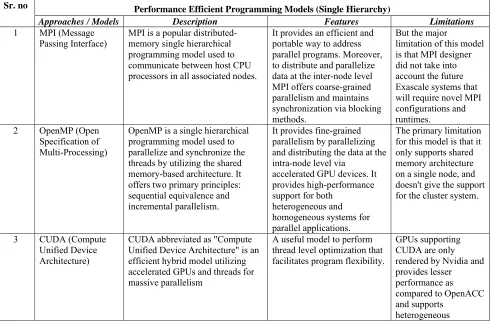
[image:4.612.63.554.411.736.2]We have studied various models and approaches for achieving performance indirectly by massive parallelism or by reducing communication overhead. In Table 1, we have done the critical analysis on all the above-discussed approaches to deciding the promising approach for future Exascale systems.
Table I. Models To Improve Performance In HPC System
Sr. no Performance Efficient Programming Models (Single Hierarchy)
Approaches / Models Description Features Limitations
1 MPI (Message
Passing Interface) MPI is a popular distributed-memory single hierarchical programming model used to communicate between host CPU processors in all associated nodes.
It provides an efficient and portable way to address parallel programs. Moreover, to distribute and parallelize data at the inter-node level MPI offers coarse-grained parallelism and maintains synchronization via blocking methods.
But the major
limitation of this model is that MPI designer did not take into account the future Exascale systems that will require novel MPI configurations and runtimes.
2 OpenMP (Open
Specification of Multi-Processing)
OpenMP is a single hierarchical programming model used to parallelize and synchronize the threads by utilizing the shared memory-based architecture. It offers two primary principles: sequential equivalence and incremental parallelism.
It provides fine-grained parallelism by parallelizing and distributing the data at the intra-node level via
accelerated GPU devices. It provides high-performance support for both
heterogeneous and homogeneous systems for parallel applications.
The primary limitation for this model is that it only supports shared memory architecture on a single node, and doesn't give the support for the cluster system.
3 CUDA (Compute
Unified Device Architecture)
CUDA abbreviated as "Compute Unified Device Architecture" is an efficient hybrid model utilizing accelerated GPUs and threads for massive parallelism
A useful model to perform thread level optimization that facilitates program flexibility.
GPUs supporting CUDA are only rendered by Nvidia and provides lesser performance as compared to OpenACC and supports
computation where application use both the CPU and GPU devices.
4 OpenACC ( Open
Accelerators) OpenACC appeared as a high-level programming version that makes use of high-level compiler
directives to detect parallelism within the code and parallelizing compiler.
It provides high performance than CUDA and facilitates portability to a variety of computing architecture.
However, it does not provide flexibility, thread management, thread synchronization and optimization for the programs, along with other high-level features available in the CUDA framework.
5 OpenCL (Open
Computing Language)
OpenCL refers to as "Open Computing Language" is an efficient parallel programming model for heterogeneous
frameworks that supports run-time compilation that excludes dependencies on instruction sets, allowing hardware providers to make remarkable changes to instruction sets, drivers, and supporting libraries.
This model provides the guarantee of correctness and portability of kernels over a variety of hardware.
OpenCL demands a confusing setup, for example, the formation of contexts, command queues, and
compilation of kernel codes. It doesn't guarantee that a selective kernel will gain peak performance on various
architectures.
Performance Efficient Programming Models (Dual Hierarchy)
6 MPI + OpenMP The hybrid model of MPI and OpenMP introduced to improve the performance for Petascale
computing systems. MPI parallelizes data at the inter-node level and provides coarse-grain parallelism, whereas OpenMP parallelizes data at the intra-node level and provide fine-grain parallelism.
This hybrid model shows good scalability as compared to single-hierarchy-level parallelism.
It gives support only for homogeneous systems, not for the heterogeneous cluster systems. This model makes use of multiple threads in the scheme that ultimately results in thread
synchronization and management overhead. 7 MPI + OpenACC The hybrid of MPI + OpenACC
programming model was
introduced to write the portable and scalable application for
heterogeneous accelerator clusters.
It provides high performance, scalability, and portability from MPI and
programmability & portability from OpenACC.
This hybrid model introduces some inefficiencies such as unnecessary data transfer and extreme synchronization between the models. 8 MPI + CUDA The hybrid of MPI + CUDA
supports heterogeneous cluster system in which multiple CPU processors are configured with high-speed NVIDIA GPU devices.
This hybrid model achieves coarse grain and fine-grain parallelism using MPI and GPU computations respectively.
The problem with this model is that it causes portability and scalability issues.
9 MPI + OpenCL The hybrid of OpenCL-MPI is a hybrid parallelization of the Finite-difference Time-Domain (FDTD) [27] technique primarily based on Open Computing Language (OpenCL) and the Message Passing Interface (MPI).
Due to the portability feature of OpenCL, the advanced code can not only be used for distributed shared memory clusters typically based on multicore CPUs but can also be used for GPU-accelerated clusters.
Due to the remarkable computational power of GPUs for massive enigmas, execution time could be equal to the communication time which leads to the decline of the
10 PGAS (PGAS) the model attempts to use the Single Program Multiple Data (SPMD) model generally support distributed memory systems.
PGAS languages introduced a one-sided approach where a process can access directly the remote memory of another process without interrupting its execution. This model provides explicit support for parallelism.
It does not support distributed memory architecture as used in GPU clusters. Copies severely limit the performance.
Performance Efficient Programming Models (Tri Hierarchy)
11 MOC (MPI + OpenMP
+CUDA) MPI is used to achieve coarse-grain parallelism and to distribute data overall connected nodes at inter-node. OpenMP is used to achieve fine-grain parallelism and to parallelize CPU threads over intra-node. CUDA is used to achieve finer grain parallelism by executing data over accelerated GPU cores.
It provides Coarse, Fine and Finer Granularity. This model minimizes energy
consumption and enables computing on inter-node, intra-node and accelerated GPU devices.
United States
Department Of Energy (DOE) has pointed out some primary
constraints that include power consumption not more than 25 to 30 Mega Watts, system development cost near about to 200 million USD, system time to delivery almost 2020 and integrated multi-cores no more than 100 million [7]. MOC model does not provide the Exa-scale level of performance even by using all the resources mentioned above.
Models To Reduce Intra-Node Communication
12 Userspace memory
copy Userspace memory copy-based design utilizes the advanced features of modern systems NUMA and CMP to promote MPI intra-node communication.
This technique is more portable than the kernel-assisted memory mapping scheme as it does not demand any services from the kernel thus providing high bandwidth and low latency among processes, offering better performance than the NIC-based loopback scheme.
Some limitations of this approach include that it could not improve CPM latency for large message size and it wastes CPU cycles and bandwidth for large messages. Further, it depends on a cache-block
replacement scheme to complete its job. 13 vShark, A C++ Library vShark introduces a thread-based
architecture to reduce the overhead of intra-node communication in clusters of SMPs. It entails a shared memory area so that the processes can utilize it as a communication channel.
One advantage of this library is that it avoids deadlocks and extra memory requirements through the use of
communication protocol.
The limitations of the vShark library are, it uses additional communication protocol and reduces the bandwidth for large number of processors. 14 Kernel-based memory
mapping A method to enhance intra-node communication is Kernel-based memory mapping which takes help from the operating system kernel to duplicate information without delay from one user process to any other without any shared memory region.
The benefits of this approach are, it involves only one message copy with fewer memory transactions and utilizes cache efficiently.
Limitations of this approach are, it disturbs OS kernel and has memory mapping overhead.
15 NIC Loopback The Network Interface Card offers NIC-level loopback. When the message is initiated from the source, NIC locates the position of the destination address. If the
NIC loopback provides high latency and eliminates overheads on the network link.
source and destination are the identical nodes, it merely loopback as opposed to injecting it into the network.
the cache effect, and somewhat it depends on NIC to locate source and destination.
IV. DISCUSSIONS AND RECOMMENDATIONS
The most challenging step towards Exascale computing systems is that it does not exist yet. However, the performance of HPC systems has been improved on the basis of current results and predictions to achieve Exascale performance. Also, it would require applications to take advantage of billion-way parallelism provided by an estimated Exascale system. The technology challenges mentioned in this paper would require targeted investments to acquire Exascale computing. This is about a quarter million-way parallelism in contrast with modern-day Petascale systems. Performance and power consumption are the two primary HPC metrics that have been taken into consideration the most challenging factors for Exascale computing systems. Node architectures are predicted to change dramatically within the subsequent decade with the increase of power and cooling constraints restriction in microprocessor clock speeds. Therefore, computer corporations are dramatically growing on-chip parallelism to enhance performance. The conventional doubling of clock speeds each eighteen to twenty-four months make the system less efficient. Moreover, doubling the number of cores increased the number of resources and as a result, it automatically increased the power consumption for computation. These techniques are being replaced by doubling of threads or different parallelism mechanisms. Exascale systems will be designed to gain excellent performance within both power and cost constraints. Additionally, hardware breakthroughs might be required to gain beneficial Exascale computing, at least within an affordable power and price range. In step with improvement to Exascale systems, it has been foretold that it will likely be created from a massive variety of heterogeneous systems in which each system will be configured with traditional multicore CPUs and many-core high-speed GPU devices.
The primary goal of Exascale computing systems is to handle massive data HPC applications. For this purpose, many Parallel Programming Models has been introduced to enhance the performance of HPC systems such as:
− Single Hierarchy Models: To attain Terascale (1012 calculations per second)
− Dual Hierarchy Models: To achieve Petascale (1015 calculations per second)
− Tri Hierarchy Models: To accomplish Exascale (1018 calculations per second)
Furthermore, different mechanisms come up expressly to limit the power consumption along with the performance improvement of HPC systems such as:
− User Space Memory Copy Mechanism − Vshark, A C++ Library
− Kernel-Based Memory Mapping Mechanism − NIC Loopback Mechanism
In this report, we have observed that a tri-level MOC (MPI+OpenMP+CUDA) model has achieved a tremendous performance by providing coarse-grained, fine-grained and finer granularity parallelism. This model has not only focused on inter-node and intra-inter-node level but also on accelerated GPU devices anticipated for Exascale performance. Many pioneers have critically analyzed the performance of the MOC model. The experimental results have shown that achieved performance is up to 1 Teraflops within 130W power consumption by using the MOC model. Though attaining 1TeraFlops is not a big deal but in
contrast, consuming just 130W is an efficient way of utilizing resources. If we try to find more approaches that work in parallel with the MOC model, performance could be enhanced. It could be a promising approach for the Exascale level of performance if the communication at inter-node or intra-node level is reduced to some extent that will reduce the power consumption and ultimately enhance the performance.
V. CONCLUSION
Towards the race of achieving Exascale performance, the power has been the most significant constrained resource among all the other constraints. Therefore, achieving practical Exascale computing with optimum performance will be under the control of power constraint. This advanced computing system will deliver a thousand-fold performance improvement contrasted to the current Petascale computing practice and mandate a need for new, system-wide methodologies and methods for power monitoring and administration. Although the novel programming models and programming methodologies are being proposed day-by-day in HPC culture; but the quest for enhanced programming models always exists. There are significant questions and research regarding the models that will be used at Exascale level to achieve better performance than the current Petascale systems. Contributing to the quest for the optimum programming model for Exascale systems, a comprehensive analysis has been conducted on the existing programming models and approaches. Based on a critical analysis, current study suggested that the MOC model (a tri-level hybrid of MPI +OpenMP + CUDA) a promising model which can be taken into consideration for emerging Exascale computing system to gain massive performance under the power consumption constraints.
VI. ACKNOWLEDGEMENT
This work was performed under the auspices of the Department of Computer Science and Information Technology, Govt. College Women University, Sialkot, Pakistan by Heir Lab-78. The Authors would like to thank Dr M. Usman Ashraf for his insightful, and constructive suggestions throughout the research.
VII. REFERENCES
[1] Perarnau, Swann, Rinku Gupta, and Pete Beckman. "Argo: An Exascale Operating System and Runtime." (2015).
[2] Shalf, John, Sudip Dosanjh, and John Morrison. "Exascale
computing technology challenges." International Conference on High Performance Computing for Computational Science. Springer Berlin Heidelberg, 2010. [3] B. S. J. E. A. R. D. ATKINSON, “The Vital Importance of
HighPerformance Computing to U.S. Competitiveness.” (2016).
[4] Reed, Daniel A., and Jack Dongarra. "Exascale computing
and big data."Communications of the ACM 58.7 (2015): 56-68. Cappello, Franck, et al. "Toward exascale resilience." International Journal of High Performance Computing Applications (2009).
[5] Zhou, Min. Petascale adaptive computational fluid
[6] Dongarra, Jack J., and David W. Walker. "The quest for
petascale computing." Computing in Science & Engineering 3.3 (2001): 32-39.
[7] Reed, Daniel, et al. DOE Advanced Scientific Computing Advisory Committee (ASCAC) Report: Exascale Computing Initiative Review. USDOE Office of Science (SC)(United States), 2015.
[8] M. Snir, R. W. Wisniewski, J. A. Abraham, S. V. Adve, S. Bagchi, P. Balaji, J. Belak, P. Bose, F. Cappello, B. Carlson, A. A. Chien, P. Coteus, N. A. Debardeleben, P. Diniz, C. Engelmann, M. Erez, S. Fazzari, A. Geist, R. Gupta, F. Johnson, S. Krishnamoorthy, S. Leyffer, D. Liberty, S. Mitra, T. Munson, R. Schreiber, J. Stearley, and
E. V. Hensbergen, “Addressing failures in exascale computing,” Tech. Rep. ANL/MCS-TM-332, Argonne National Laboratory, Mathematics and Computer Science Division, Apr. 2013
[9] DOE. Report from the Architectures and Technology for Extreme Scale Computing Workshop, 2009.
[10] K. Yoshii, K. Iskra, R. Gupta, P. Beckman, V. Vishwanath, C. Yu, and S. Coghlan. Evaluating power-monitoring capabilities on IBM Blue Gene/P and Blue Gene/Q. In Proceedings of the IEEE International Conference on Cluster Computing (CLUSTER ’12), Beijing, China, 2012. (to appear).
[11] Rajovic, Nikola, et al. "The low power architecture
approach towards exascale computing." Journal of Computational Science4.6 (2013): 439-443.
[12] P. M. Kogge and J. Shalf. “Exascale computing trends:
Adjusting to the new normal’ for computer architecture.” Computing in Science and Engineering, 15(6):16–26, 2013.
[13] P. Participants. “Workshop on programming abstractions
for data
locality,PADAL’15”.https://sites.google.com/a/lbl.gov/pa dalworkshop/,2015.
[14] Shafto, Mike, et al. "Modeling, simulation, information technology & processing roadmap." NASA, Washington, DC, USA, Tech. Rep 11 (2012).
[15] Gabriel, Edgar, et al. "Open MPI: Goals, concept, and
design of a next generation MPI implementation." European Parallel Virtual Machine/Message Passing Interface Users‟ Group Meeting. Springer Berlin Heidelberg, 2004.
[16] Message passing Interface,
https://computing.llnl.gov/tutorials/mpi/ , 20 June, 2017 [03 Aug, 2017]
[17] Dinan, James, et al. "An implementation and evaluation of
the MPI 3.0 onesided communication interface." Concurrency and Computation: Practice and Experience (2016).
[18] Jin, Shuangshuang, and David P. Chassin. "Thread Group
Multithreading: Accelerating the Computation of an Agent-Based Power System Modeling and Simulation Tool--C GridLAB-D." 2014 47th Hawaii International Conference on System Sciences. IEEE, 2014.
[19] Martineau, Matt, Simon McIntosh-Smith, and Wayne Gaudin. "Evaluating OpenMP 4.0's Effectiveness as a Heterogeneous PP Model." Parallel and Distributed Processing Symposium Workshops, 2016 IEEE International. IEEE, 2016.
[20] Terboven, C., Hahnfeld, J., Teruel, X., Mateo, S., Duran, A., Klemm, M., Olivier, S.L. and de Supinski, B.R., 2016, October. Approaches for Task Affinity in OpenMP. In International Workshop on OpenMP (pp. 102-115). Springer International Publishing.
[21] Podobas, Artur, and Sven Karlsson. "Towards Unifying
OpenMP Under the Task-Parallel Paradigm." International Workshop on OpenMP. Springer International Publishing, 2016.
[22] NVIDIAAcceleratedComputing
“developer.nvidia.com/cuda-downloads”, 02 Nov 2016. [23] Ashraf, Muhammad Usman, FadiFouz, and Fathy Alboraei
Eassa. “Toward Exascale Computing Systems: An Energy Efficient Massive Parallel Computational Model”, International Journal of Advanced Computer Science and Applications, 2018
[24] The OpenACC Application Programming Interface Version 1.0, 2011.[Online]. Available: http://openacc.org
[25] Khronos OpenCL Working Group, The OpenCL Specification Version 1.2, November 2011. [Online]. Available: http://www.khronos.org/
[26] NVIDIA Corporation, OpenCL Best Practices Guide,
2011.
[27] C. Ong, M. Weldon, D. Cyca, and M.Okoniewski, "Acceleration of large-scale FDTD simulations on high performance GPU clusters," in Proc. IEEE APS/URSI '09, 2009.
[28] Jin, Haoqiang, et al. "High performance computing using
MPI and OpenMP on multi-core parallel systems." Parallel Computing 37.9 (2011): 562-575.
[29] Mininni, Pablo D., et al. "A hybrid MPI–OpenMP scheme for scalable parallel pseudospectral computations for fluid turbulence." Parallel Computing 37.6 (2011): 316-326.
[30] E. T. U. S. P. L. V. K. e. Akhil Langer, “Energy-efficient
Computing for HPC Workloads on Heterogeneous Manycore Chips”, pp. 11-19, 2015.
[31] L. C. A. H. D. K. Panda, “Designing High Performance and Scalable MPI Intra-node Communication Support for Clusters”, 2006.
[32] S. H. a. T. Rauber, “Reducing the Overhead of Intra-Node