IJEDR1903005 International Journal of Engineering Development and Research (www.ijedr.org) 18
Power controlled Ad hoc On-Demand Distance
Vector (PC-AODV) Protocol
1R. Veeramani, 2Dr. R. Madhanmohan 1Assistant Professor, 2Associate Professor
1SRM University,Ramapuram,Chennai, 2Annamalai University, Annamalai nagar, India
_____________________________________________________________________________________________________ Abstract—This paper illustrates about that the power control mechanism which is applied to the ad hoc on-demand distance vector(AODV) protocol. The implemented PC-AODV protocol is compared with AODV protocol. The performance metrics of both protocols are analyzed and the results are compared effectively.
Index Terms— PC-AODV, Power Control, AODV
_____________________________________________________________________________________________________
I.INTRODUCTION
Wireless ad hoc networks are self-organizing networks without the use of any existing network infrastructure or centralized administration, which can be useful in a variety of applications including one-off meeting networks, disaster, military applications, and the entertainment industry and so on. Each node in ad hoc networks performs the dual task of being a possible source or destination of some packets while at the same time acting as a router for other packet relay. Traditional routing protocols can not be applied to ad hoc networks directly because ad hoc networks inherently have some special characteristics and unavoidable limitations such as dynamic topologies, bandwidth-constrained, variable capacity links, and energy-constrained operations compared with traditional networks. Consequently, research on routing protocols in ad hoc networks becomes a fundamental and challenging task. The existing popular routing protocols in ad hoc networks such as Dynamic Source Routing (DSR), Destination Sequenced Distance Vector (DSDV) and Ad hoc On demand Distance Vector (AODV)[1] are all the shortest paths, that is, the minimum hop count routings. Although these algorithms are easy to be implemented, they do not consider the network energy consumption. The minimum hop count routings could not guarantee that the packet reaches the destination node using minimum energy consumption. Designing an effective power control strategy to reduce network energy consumption is very important and useful in some application environments such as battlefield, where node battery recharging is usually impossible. The power control in ad hoc networks determines the quality of physical layer link, MAC layer bandwidth and degree of spatial reuse, while at the same time affects the network layer routing, transport layer congestion control and QOS of the application layer. In recent years, research on routing protocols based on the power control in ad hoc networks has received increasing attention. Power aware routing schemes try to find routes which consist of links consuming low energy or prolong the network.
II.POWER CONTROL
Transmit power control[9] is important in wireless ad hoc networks for at least two reasons: (i) It can have impact on battery life, and (ii) it can have impact on the traffic carrying capacity of the network. For the first point, note that there is no need for
N1 in Figure 1 to broadcast at 30mW to send a packet to the neighboring N2, since N2 is within range even at 1mW.
N 3
N1 N2
N4 Range at30mW
Range at 1mW
Fig.1. Need for Power Control
IJEDR1903005 International Journal of Engineering Development and Research (www.ijedr.org) 19
III.NETWORK MODEL
Power control[8] is a very complex issue, simplified it into an assignment of transmission ranges, short to as an RA problem (Range Assignment), and analyzed its computational complexity in the details. Let N = {Ul,··· ,Un} be a set of n points in the d-dimensional Euclidean space(d=I,2,3), denoting the positions of the network nodes and r(ui) be the transmission radius of node Ui, the network transmission power ƒ[r(ui)] can be expressed as:
=
N u i i iu
r
u
r
f
(
)
(
)
(1)Where: 2 <=α<=5.
RA problem is to minimize j[r(ui)] while maintaining the network connectivity, that is:
=
N u i i iu
r
u
r
f
(
)
minmin
(
)
(2)In the one-dimensional case, (2) can be solvable in O(n4) time, while it is shown to be NP-hard in the case of the two-dimensional and three-two-dimensional networks. The actual power control problem is more complex than RA problem. For the RA problem, in this paper we try to reduce packets transmission power based on cross-layer to reduce network energy consumption. Assume that the link is symmetric and the maximum transmission power Ptrnax is known and the same to all nodes which are capable of changing their transmission power below it, and the relation between the power
P
t used totransmit packets and the received power
P
r can be characterized as:r
-
P
d
=
t
cP
(3)Where, c is a constant, and α is a loss constant between 2 and 5 that depends on the wireless medium. For Free Space propagation model and Two-Ray Ground propagation model, α is 2 and 4 respectively. Suppose that in order to receive a packet, the received power must be at least
, i.e.,
d
-t
cP
(4)From (4) it comes out that:
d
c
T
P
t (5)In order to effectively support node mobility and reduce network energy consumption while simplify the network model, we only adjust the node's transmission power in a number of different discrete power levels.
IV.POWER AND DISTANCE CALCULATION
Power level is calculated from the hello replay from neighbor nodes.Each node calculates the power for sending packets to its neighbor and adds to the neighbor table. Finally add the total power for the entire route via RREP (Route Reply) from destination to source and add to the route table. If the packet is controlled packet then it takes the maximum power (. 28183815mW) to send, otherwise it reduces the power for the data packet.
Power and Distance calculation by HELLO replay from neighbor nodes.Create a Power Table and Alter the Neighbor table, Route Establishment and Route Table Alteration.Apply Route Policies,Route Selection, and Comparison with AODV. Power is calculated from the Received Signal Strength Indicator (RSSI).RSSI is calculated by (TrPwr*Gr*Gt*λ2) /((4πd)2L).Then the RSSI is converted to the dB by the equation 10log (RSSI/0.001).Then the RSSI is converted to the dB by the equation 10log (RSSI/0.001).
V.SIMULATION PARAMETERS
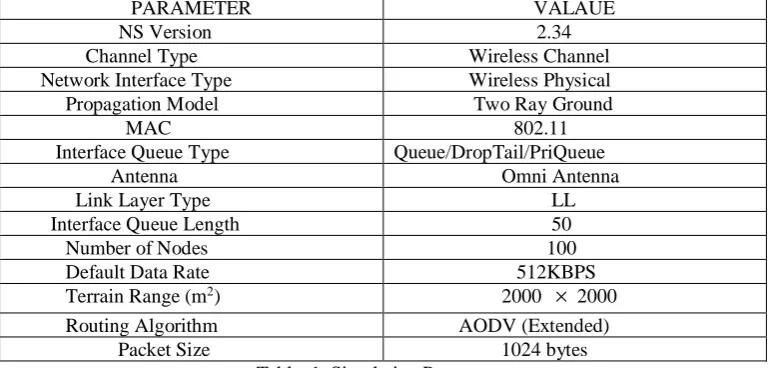
In the simulation, we randomly selected source node and destination node to simulate our scheme and PC-AODV on NS2[6] (Network Simulator). Detailed simulation parameters are listed below:
PARAMETER VALAUE
NS Version 2.34
Channel Type Wireless Channel Network Interface Type Wireless Physical Propagation Model Two Ray Ground MAC 802.11 Interface Queue Type Queue/DropTail/PriQueue
Antenna Omni Antenna
Link Layer Type LL
Interface Queue Length 50
Number of Nodes 100
Default Data Rate 512KBPS
Terrain Range (m2) 2000
2000Routing Algorithm AODV (Extended)
Packet Size 1024 bytes
IJEDR1903005 International Journal of Engineering Development and Research (www.ijedr.org) 20
VI.RESULTS AND DISCUSSIONS
Simulation is performed on the basis of simulation parameters. This is performed for comparing AODV and PC-AODV algorithms to evaluate the performance.
Average End-to-End Delay
Fig.1 End-To-End Delay
Fig.1 displays the average end-to-end delay of three algorithms with varying average traffic load. As the network average load increases, the average end-to-end delay of three algorithms increases. We can see that PC-AODV provides an obvious lower network delay compared with AODV. Under the same conditions, PC-AODV can reduce the delay from 9ms to 125ms compared with other protocols. This is due to the fact that PC-AODV uses smaller transmission power to send data packets along the route. In wireless Ad Hoc network, use of smaller transmission power to send data packets can reduce interference and collision which benefit to decrease the retransmission, thus reduce the responding queue and transmission delay. In addition, PC-AODV can update the routing table in time in a mobile environment, and thus, reduce the queue delay. These imply that PC-AODV can improve the network delay.
Packet Delivery Ratio
70 75 80 85 90 95 100 105
20 40 60 80 100
P
D
R
(
%
)
No of Nodes PACKET DELIVERY RATIO
PC-AODV AODV
Fig.2 Packet Delivery Ratio
Fig.2 indicates the packet delivery ratio of two algorithms for the case when the average load varies from l000 Kbps to 4000Kbps. For all approaches, there is a decrease in the packet delivery ratio when the load increases. The results shown in Fig.2 indicate that the packet delivery ratio of PC-AODV is higher than of AODV under the same conditions. Since the larger the transmission range has been, the serious the local conflicts become, thus maximum power transmissions result in degradation in packet delivery ratio. As the network load increases, the probability of one successful transmission will drastically reduce. PC-AODV exploit a power control scheme, and each node tries to send data packet at a lower power level, this can reduce local conflict and improve the packet delivery ratio. By comparison with PC-AODV additionally improves the packet delivery ratio because it also considers MAC layer power control. In addition, in mobile environments, PC-AODV updates the routing table in a real time manner. Thus PC-AODV can further improve the packet delivery ratio. From these we can see that PC-AODV can increase the network packet delivery ratio, and reduce the network packet loss ratio.
0 50 100 150 200 250 300
512 1024 1536 2048 2560
Delay(m s)
Data Rate(KB)
END-TO-DELAY
IJEDR1903005 International Journal of Engineering Development and Research (www.ijedr.org) 21 Network Lifetime and Residual Energy
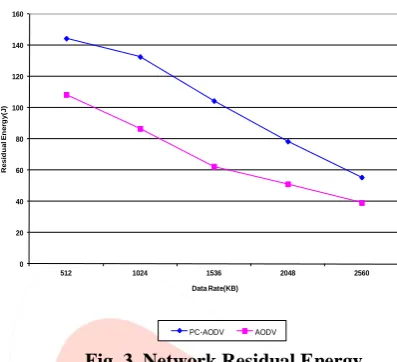
Fig.3 and Fig..4 show the network residual energy and the lifetime of two algorithms at different traffic load respectively. When there is only small traffic load, three protocols have almost achieved the same network lifetime and the residual energy. As the network average load increases, all the protocols are significantly degraded in both network lifetime and residual energy. The results in Fig.3 indicate that the network lifetime of PC-AODV is higher than AODV under the same conditions.
0 20 40 60 80 100 120 140 160
512 1024 1536 2048 2560
R
e
s
id
u
a
l
E
n
e
rg
y
(J
)
Data Rate(KB)
NETWORK RESIDUALENERGY
PC-AODV AODV
Fig .3. Network Residual Energy
At the same time, the results in Fig.3.7 indicate the residual energy of PC-AODV is more than of AODV in the same circumstances. This is because AODV does not take measures to network energy consumption, and just uses the default maximum power to transmit data, consuming more energy. Some nodes of burdening heavy flow excessively consume their energy, thus the corresponding residual energy is less and the network lifetime is shortened due to uneven energy consumption. However, PC-AODV consumes less energy because of using power control scheme. Comparing with AODV, PC-AODV further reduces network energy by integrating with MAC layer power control. These results show that PC-AODV can save the network energy consumption and prolong network.
0 100 200 300 400 500 600 700 800 900 1000
512 1024 1536 2048 2560
L
if
e
T
im
e
(S
e
c
)
Data Rate(KB)
NETWORK LIFE TIME
PC_AODV AODV
Fig. 4. Network lifetime
VII.CONCLUSION
IJEDR1903005 International Journal of Engineering Development and Research (www.ijedr.org) 22 transport, and affecting several key performance measures, including the trinity of throughput, delay and energy consumption. We will incorporate it with delay, and packet loss ratio and so on to optimize network performance.
REFERENCES
[1] Lu Han, October 8,2004, Wireless Ad-hoc networks.
[2] Johnson DJ, Maltz DA, and Hu Y C. lETF RFC4728, The dynamic source routing protocol for mobile ad hoc networks (DSR). http://www.ietf.orglrfclrfc4728.txt,2007.
[3] Pinki Nayak, Rekha Agarwal, and Seema Verma,An Overview of Energy Efficient Routing Protocols in Mobile Ad Hoc Network, International Journal of Research and Reviews in Ad hoc Networks (IJRRAN),2012.
[4] C.E. Perkins, and P. Bhagwat, Highly dynamic destination-sequenced distance vector routing (DSDV) for mobile computers. ACM SIGCOMM 94,London,UK, Oct 1994: 234-244.
[5] Perkins CE, and Royer EM. lETF RFC3561, Ad hoc on-demand
Distance vector routing(AODV). http://www.ietf.orglrfc/rfc3561.txt, 2003.
[6] Tan CW, and Bose SK, Modifying AODV for efficient power-aware routing in MANETs. TENCON 2005, Melbourne, Australia, 2005,1-6.
[7] Lee SH, Choi E, and Cho DH, Timer-Based broadcasting for power-aware routing in power-controlled wireless ad hoc networks. Communications Letters, 2005, 9 (3): 222-224.
[8] Kyungtae Woo, and Chansu Yu, Non-blocking localized routing algorithm for balanced energy consumption in mobile ad hoc networks. lEEE International Workshop Modeling,Analysis,and Simulation of Computer and Telecommunication Systems 2001, MASCOTS 2001, Ohio, USA, 2001:117-124.
[9] Narayanaswamy S, Kawadia Y, and Sreenivas RS, Power Control in Ad Hoc Networks Theory, Architecture, Algorithm and Implementation of the COMPOW Protocol. European Wireless Conference 2002, Florence, Italy, 2002: 156-162.