Procedural Text Generation from an Execution Video
Atsushi Ushiku Hayato Hashimoto Atsushi Hashimoto Shinsuke Mori
Yoshida-honmachi, Sakyo-ku, Kyoto University, Kyoto, Japan
[email protected] [email protected] [email protected] [email protected]
Abstract
In recent years, there has been a surge of interest in automatically describing images
or videos in a natural language. These
descriptions are useful for image/video search, etc. In this paper, we focus on pro-cedure execution videos, in which a human makes or repairs something and propose a method for generating procedural texts from them. Since available video/text pairs are limited in size, the direct application of end-to-end deep learning is not feasible. Thus we propose to train Faster R-CNN network for object recognition and LSTM for text generation and combine them at
run time. We took pairs of recipe and
cooking video as an example, generated a recipe from a video, and compared it with the original recipe. The experimental re-sults showed that our method can produce a recipe as accurate as the state-of-the-art scene descriptions.
1 Introduction
Massive effort has been done to develop a method for generating text from vision in the field of natural language processing and computer vision. More specifically, there are number of studies on generating captions for given images or videos (Yang et al.,2011;Rohrbach et al.,2013;Li et al.,
2015;Donahue et al.,2015;Karpathy and Fei-Fei,
2015;Shetty and Laaksonen,2016;Johnson et al.,
2016). Most of the existing researches for video
captioning, however, deal with simple and short
videos (Li et al.,2015;Donahue et al.,2015;Shetty
and Laaksonen,2016) such as a ten second video in which a man playing guitar in a park.
In this paper, we propose a new problem in this field: generating a procedural text from an
execu-tion video such as cooking or machine assembly. The goal is to develop a method that takes video of a chef cooking a dish from ingredients or a me-chanic assembling a machine from parts as the in-put, and outputs a procedural text that helps an-other person reproduce the same product.
We also give an initial solution to the problem, taking cooking recipe generation as an example. Because no large scale corpus consisting of re-lated execution video and procedural text is avail-able for now, we divide the problem into two sub-problems, object recognition and text generation, and train two modules independently using differ-ent resources as their training set. Then we com-bine them and search for the best text. The object recognition module is designed to spot the changes in state of progress of the procedure from video and texts are generated at each time. Finally, some of the generated sentences are selected to cover the entire procedure with discarding redundant sen-tences.
In the experiments, we use KUSK Dataset (Hashimoto et al., 2014), which consists of pairs of recipes submitted by users to a recipe hosting service Cookpad and video of cooking according to that recipe in a laboratory. The experimental results showed that our method is capable of pro-ducing a recipe of reasonable quality.
2 Related Work
Recent studies on automatic caption generation
have reported great results both in images (Xu
et al., 2015;Karpathy and Fei-Fei,2015;Johnson et al.,2016) and short video clips (Li et al.,2015;
Donahue et al.,2015;Shetty and Laaksonen,2016) by using convolutional neural network (CNN),
re-current neural network, and LSTM. (Venugopalan
et al.,2015) improved the accuracy with a sequence
to sequence model (Sutskever et al.,2014). In
tion, (Laokulrat et al.,2016;Guo et al.,2016) also improved the accuracy of automatic caption gen-eration by introducing an LSTM equipped with an attention mechanism. One of the features of these end-to-end models is that they directly generate sentences from videos without determining con-tent words such as subjects and predicates.
Com-mon datasets (Lin et al., 2014; Chen and Dolan,
2011; Torabi et al., 2015; Rohrbach et al., 2015) made research on automatic caption generation popular.
Before the above end-to-end models succeeded, many researchers concentrated models generating sentences via content words or intermediate states (Guadarrama et al., 2013;Rohrbach et al., 2013). As an advantage of the technique of using interme-diate states, object recognition or motion recogni-tion model can be diverted as it is. Thus data of pairs of a medium and a caption have not been par-ticularly required. These methods with intermedi-ate stintermedi-ates are inferior in accuracy to the end-to-end models using CNN and LSTM in case that enough size of training data are available. On the other hand, since creation of medium-caption pairs is ex-pensive, methods using intermediate states are also considered to be sufficiently practical for a prob-lem where we have insufficient size of data avail-able for model training.
Unlike conventional methods using intermedi-ate stintermedi-ates such as subjects, objects, and predicintermedi-ates, for procedure execution videos, there is a problem that the use of recognition results of general actions is not appropriate because of the abstraction level. It is considered preparing tailored data for motion recognition for each kind of procedure execution videos have high cost because it is often vague even for human annotators to assign every concrete mo-tions into text-level motion categories. In contrast, objects directly appear in texts and there is much less ambiguity than motions. Therefore, it is rea-sonable for the procedural text generation to focus more on object recognition than motion recogni-tion. In addition, the procedure execution videos generally show works performed by one person,
thus subject recognition is not necessary. It is
preferable to set the object recognition results as an intermediate state and generate sentences from it. Since predicates are not easy to be recognized, they are estimated or supplemented from recog-nized objects using language knowledge.
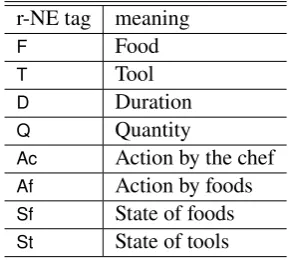
[image:2.595.342.487.83.215.2]Many studies generate a caption consisting of
Table 1: Definition of r-NE tags.
r-NE tag meaning
F Food
T Tool
D Duration
Q Quantity
Ac Action by the chef
Af Action by foods
Sf State of foods
St State of tools
one sentence for a video clip. Studies on the au-tomatic caption generation of documents consist-ing of multiple sentences like procedural text do not attract much attention as far as we know. One
similar study is done by (Kaufman et al., 2016),
which gives captions for a movie that is divided into scenes beforehand.
3 Task Definition
In this section, we describe our novel task in detail. Then we present prerequisites of our solution.
3.1 Procedural Text Generation from Video
We propose a task of generating a procedural text
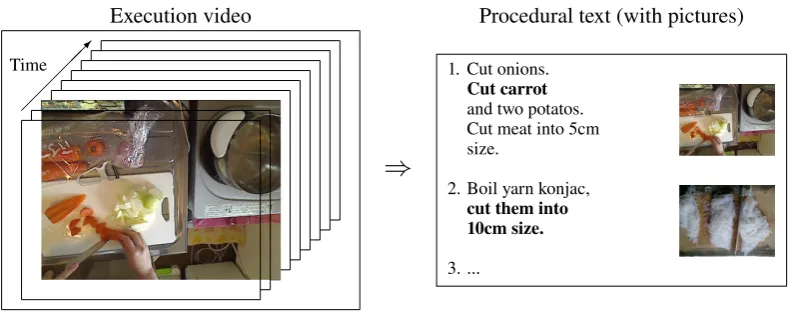
from an execution video. Figure 1 shows the
overview of the task. In general, an execution
video records a sequence of activities to make or repair something from the beginning to the end. As the first trial, we deal with cooking videos in which only one person appears (mainly the hands only). In the beginning, there are some ingredients and tools on the cooking table and some appear in the video later. Then it finishes with a completed dish. This is the input of the task.
The output of our task is a procedural text, con-sisting of some sentences in a natural language, which explains procedures to be conducted by workers to make or repair something. The counter-part of cooking videos of the first trial is recipes. A recipe describes how to cook a certain dish. In general, a recipe includes the dish name and an in-gredient list in addition to the instruction text part. In our task, however, we focus on generating the text part only. Thus, this is the output of the task. In the subsequent sections, we refer to that text part by the term recipe.
Execution video Procedural text (with pictures)
Time
⇒
1. Cut onions.
Cut carrot
and two potatos. Cut meat into 5cm size.
2. Boil yarn konjac,
cut them into 10cm size.
[image:3.595.100.497.61.221.2]3. ...
Figure 1: Task overview.
objective evaluation over the dishes produced by chefs reading the generated recipes. We propose, however, to adopt BLEU score as a metric of pro-cedural text for the convenience of automated eval-uation.
One of the advantages to choose the cooking do-main as a benchmark of procedural text genera-tion from video is that there are a huge number of recipes available on the Web. Therefore it is easy to develop a generative model of recipes for the task. In addition, there are recipe/video pairs available for various researches. For example, the KUSK
Dataset (Hashimoto et al.,2014), which we use in
the experiments, contains recipes and their ing videos. Note that the lengths of these cook-ing videos are about 20 minutes or more, which are much longer than video clips used in automatic video captioning researches. And also note that the texts are kinds of summaries mentioning only the necessary objects and actions to complete a certain mission. Such texts are intrinsically different from scene descriptions in automatic video (or image) captioning researches.
3.2 Prerequisites
To solve the problem above, we enumerate the pre-conditions necessary for our method in the recipe generation case.
3.2.1 Domain Specific Named Entity
First we assume a set of terms (word sequences)
called named entities (x-NEs) representing
impor-tant object names in the target domainx. They are
the objects to be recognized by computer vision (CV).
In the recipe case, noun phrases for ingredients and tools are important object names. In this paper,
we adopt the recipe named entities (r-NEs) defined
in (Mori et al.,2014), whose types are listed in
Ta-ble1. There are eight r-NE tag types, but our CV
part recognizes only foods (F) and tools (T). We use
the notation “チンゲン 菜/F” (“qing-geng-cai/F”) to
indicate that “チンゲン 菜” is an r-NE and its type
is food (F)1.
3.2.2 Named Entity Recognizer
In order to develop a useful generative model we
must locatex-NEs in given sentences. So-called
named entity recognizer (NER) is suitable for this
task. In this paper, we adopt NERs based on se-quence labeling techniques that can be trained by an annotated corpus.
3.2.3 Object Recognition
Our method requires the module that can detect the appearance and the disappearance of materials and tools involved in the procedure. In the
cook-ing video case, we use Faster R-CNN model (Ren
et al.,2015) fine-tuned with relatively small set of images of foods and cooking tools.
3.2.4 Procedural Text Examples
As we mentioned in Section 1, there is no large
amount of video/sentence pairs available for our problem. But instead, in some cases, large text-only corpus is available in the domain. The corpus will allow us to train a generative model of the in-struction sentences.
4 Proposed Method
In this section, we explain the proposed method for recipe generation from cooking videos. The
out-1The language resources used in our experiments are in
Time Cooking video (Frame sequence)
Recognition result
Recipe sentence candidate
包丁/T で 肉/F を 切る/Ac Cut/Ac meat/F with a knife/T.
Score: 0.5 Searching the recipe sentence sequence. (E)
Object recognition by Faster R-CNN (A) + r-NE recognition(B)
Generating r-NE sequence (C)
r-NE sequence
Generating recipe sentence candidate(D)
Recipe
r-NE Prob.
包丁/T (knife)
0.6
まな板/T
(cutting board) 0.3
r-NE Prob.
肉/F (meat) 0.6
包丁/T(0.6) 肉/F(0.4) (knife) (meat)
[image:4.595.87.508.61.340.2]まな板/T(0.6), 肉/F(0.4) (cutting board) (meat)
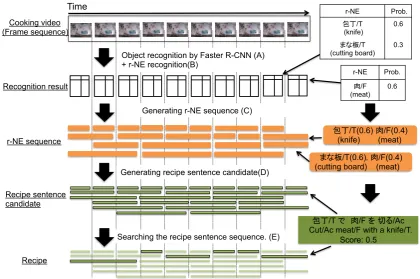
Figure 2: Overview of the proposed method.
line of this method is shown in Figure 2. First,
we recognize objects in the video as a sequence of frames with a CNN and give an r-NE tag to each
object (Figure2A, B). Next, we create an r-NE
se-quence from each partial frame sese-quence (Figure
2C) and generate a candidate recipe sentence for
each corresponding r-NE sequence (Figure 2 D).
Each candidate recipe sentence is the one which maximizes the score indicating the likelihood of a sentence as a procedural text within the partial frame sequence. Finally, we select the sequence of recipe candidate sequences that maximizes the to-tal score through the entire video based on Viterbi search. We output that sentence sequence as the procedural text for the input procedure execution
video (Figure2E).
4.1 Object Recognition
Object recognition is performed only on the frames at which the chef picks up an object or places it, that is provided in KUSK Object Dataset (Hashimoto et al., 2016) with the object regions. Note that the provided frames and regions can contain plural objects because the method used in (Hashimoto et al., 2016) is based on background
subtraction. To divide the detected region into
object-wise regions, we adopted Faster R-CNN
Figure 3: An example of object recognition by Faster R-CNN.
(Ren et al., 2015). This neural network outputs identified object region as a rectangular area while
recognizing its category (Figure2A). It also
pro-vides confidence as a probability. An example of visualization of object recognition is shown in
Fig-ure3, where a cutting board and a knife are in the
region detected by (Hashimoto et al.,2016) .
We utilized Faster R-CNN’s ability of object re-gion identification to suppress another type of false
detection. The regions provided in (Hashimoto
[image:4.595.309.521.392.551.2]slightly by coming in contact with the hands. Such objects should not be related to the procedure. To suppress such detection but spot only objects ob-viously related to the procedure, we compare the location of object-wise regions before and after the contact, and ignore object regions if they have the same object name and have a certain score in Jaccard index, which is general method to mea-sure the size of intersection of two regions. Af-ter the test of region inAf-tersection, only the ob-jects with an obvious location change are regarded
as procedure-related. This module passes only
procedure-related objects to the second module. Note also that we discarded objects whose name
is not listed inx-NEs before passing them to the
second module.
Hereafter, we only focus the frames with the
procedure-related objects listed inx-NEs, and
de-scribe the sequence of such frames as follows:
f =f1, f2, . . . , f|f|, (1)
wherefiis thei-th frame and |f|is the length of
the sequence.
4.2 Recipe Named Entity Recognition
We use the named entity recognizer (Sasada et al.,
2015) to the object in the i-th frame fi (Figure2
B). LetEi be the object set whose tags areF orT
infi. Then, we denote the number of elements in
this set as|Ei|. Thej-th r-NE ofEi is denoted as
eji. ThenP(eji|fi) denotes the conditional
proba-bility in which the elementeji (a food or a tool) is
estimated to exist in the framefi.
4.3 Recipe Named Entity Sequence
Let fii+(l−1) = fi, fi+1, ..., fi+(l−1) be a
sub-string, of lengthl, off that corresponds to a single
recipe sentence. A framefi may contain some
r-NEs Ei. Then a sequence of r-NEs contained in
fii+(l−1) can be expressed by e ∈ Ei × Ei+1 ×
...× Ei+(l−1). Note that the number of all the
pos-sible sequences is∏ik+(=il−1)|Ek|. For example in
Figure2,eis (cutting board/T, meat/F) or (knife/T,
meat/F).
In addition, in order to treat a sequence as a set, we introduce the following notation:
{e}={ejk
k |i≤k≤i+ (l−1)}. (2)
Note thatjkdepends onk.
LSTM
フライパン (pan)
に (in) LSTM
フライパン (pan)
LSTM
に (in)
茹で (boil)
…. r-‐NE set
C
B:
Word segmenta=on+ r-‐NE recogni=on
フライパンに茹でたパスタをいれる Put the boiled pasta in a pan. Recipe Sentence
A:
フライパン/T に/O 茹で/Ac た/O パスタ/F を/O いれ/Ac る/O
Extrac=ng r-‐NE set (フライパン/T, パスタ/F) (pan) (pasta)
[image:5.595.307.521.74.244.2](フライパン/T, パスタ/F) (pan) (pasta)
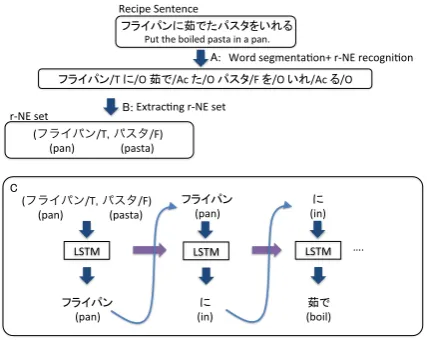
Figure 4: LSTM language model training. This model generates a sentence given an r-NE set.
Considering the likelihood of object recognition and the likelihood of a combination of r-NEs
in-cluded in the sequence, we set the likelihoodP(e)
thateappears as follows:
P(e) =P(e)×P({e})−l, (3)
whereP(e)is the average of the probability of the
result of object recognition:
P(e) = 1l i+(∑l−1)
k=i
P(ejk
k |fk). (4)
This value indicates the likelihood of object
recog-nition. AlsoP({e})−lis the likelihood of a
com-bination of r-NEs determined from the frequency
of a sentence in which all the elements of{e}
ap-pear in the corpus.
P({e}) = (
count({e}) C
)
, (5)
whereC is the number of sentences in the recipe
corpus and count({e}) is the frequency of
sen-tences in which all the elements of{e}appear at
the same time. Thus, this value indicates the like-lihood of the r-NE combination. In addition as the number of elements in the r-NE set increases, the frequency decreases. This is the reason why we
in-troduceP({e})−lconsidering the sequence length
l.
4.4 Recipe Sentence Candidate Generation
to the neighboring sentences. Some of these sen-tences may, however, be discarded in the next step. Thus we call it a recipe sentence candidate. The input to this process is the r-NE sequence and the scores of the r-NEs. And the output is the recipe sentence candidate that maximizes the score for the
given partial frame sequence (Figure2D).
For the sentence candidate generation we use an LSTM language model. It outputs a sentence and its likelihood. Different from the ordinary LSTM, it takes a set of r-NEs as the input, but not a se-quence. In addition, it is trained on the corpus in which NEs are recognized and replaced with
r-NE tags as summarized in Figure4. The first step
of its training is preprocessing, in which we
con-duct word segmentation (Neubig et al.,2011) (not
necessary for English or some other languages)
and r-NE recognition (Sasada et al.,2015) for each
recipe sentence in the recipe corpus (Figure 4
A). Then we filter out sentences containing r-NEs
other thanAc, F andT and delete Actags for the
reasons below:
• We cannot get information about r-NEs other
thanFandTby the object recognition module.
• A predicate denoting an action (Ac) is
neces-sary for a complete sentence.
Putting it in another way, our method guesses a suitable predicate (verb) from the objects (foods and/or tools) and the corpus. From each of the re-sultant sentences, we generate a sentence in which
F andT are replaced with tags and the set of the
r-NEs contained in it (Figure4B). Finally we train
the LSTM language model on the corpus. The LSTM can map a set of r-NEs to a recipe sentence
with its likelihood (Figure4C).
As the likelihood of this module, our method re-turns the following score:
Score(e) =PLSTM(rmax(e)|e)×P(e),
where r(e) is the sentence generated by the
LSTM language model given e as the input.
PLSTM(r(e)|e) is the generation probability of
r(e). rmax(e) is the sentence that maximizes
PLSTM(r(e)|e) with the beam search decoder
givene.
rmax(e) = argmax
r(e)∈R(e)PLSTM(r(e)|e),
whereR(e)is a set of sentences that can be
gener-ated by beam search wheneis the input andr(e)
is the sentence corresponding to it. The generation probability of a sentence is calculated by the fol-lowing formula:
PLSTM(r(e)|e) = Nd
∏
k=1
P(dk|d1, d2, ..., dk−1;e),
where r(e) = d1, d2, ..., dNd is a word string
and Nd is the length of the word string. And
P(dk|d1, d2, ..., dk−1;e) denotes the generation
probability of thek-th worddk, when the input ise.
The sentence is generated by the LSTM language model by beam search. The sentence is, however, aborted when the word length exceeds 20 or the
terminal symbol appears. P(e)is introduced to
re-flect the likelihood that the r-NE sequencese
ap-pear (see Equation (3)).
Calculating the above scores for all the possible
eof a partial frame sequence, we defineemax as
the r-NE sequences which maximize the score. At this stage, the generated sentence is no more than
a recipe sentence candidate rmax(emax), whose
score isScore(emax). When the scores earned by
partial frame sequences are all 0, no recipe sen-tence candidate is generated.
4.5 Generating Recipe
As we see above, a set of recipe sentence can-didates is generated from the partial frame se-quences. The frame sequence is divided into par-tial sequences so that the overall score of the
di-vision, which is the sum of theScore(e) in each
partial sequence, is maximized (Figure2E). The
partial sequences cover the entire video, thus the
corresponding sentences, sequences ofr(e), form
a complete recipe.
Since it is almost impossible for one chef to per-form two operations in parallel, the corresponding partial frame sequences of the recipe sentence can-didates must not overlap. In addition, in order to prevent the same recipe sentence from appearing more than once, the score of the recipe sentence candidate which has appeared once in the recipe is set to be 0. Under this condition, the score of a recipe sentence candidate can change. Although it should be totally searched for score maximization, we use the Viterbi algorithm for the calculation, because the change of the score is limited at the time of generation of the same sentence and it is considered that it does not occur so much.
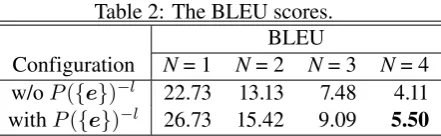
Table 2: The BLEU scores. BLEU
Configuration N= 1 N= 2 N= 3 N= 4
w/oP({e})−l 22.73 13.13 7.48 4.11
withP({e})−l 26.73 15.42 9.09 5.50
generated recipe sentence sequence is output as a recipe. The higher the score, the more recipe-like the sentences are.
5 Experiments and Evaluation
In this section we evaluate our method experimen-tally. We first describe the settings of the exper-iments, then report the experimental results, and
finally evaluate our method.2
5.1 Experimental Setting
We used the following dataset to train and evaluate our model.
5.1.1 Test Dataset
KUSK Dataset This dataset contains 20 recipes and corresponding cooking videos.
5.1.2 Train Dataset
KUSK Object Dataset This dataset contains 180 categories of objects in total, which comprise ingredients, cooking tools, and others (bottle cap, dish cloth, and so on), observed in cooking videos in KUSK Dataset. Since all videos are recorded at the same kitchen, exactly the same cooking tools appear through all videos, including ones in the test set. More detailed information and examples
are available in (Hashimoto et al.,2016).
Cookpad NII corpus This corpus contains 1720000 recipes collected from cookpad website. 187700 sentences are extracted for training.
Flow Graph Corpus This corpus contains ran-domly chosen 208 recipes (867 sentences) from Cookpad NII corpus. The text is annotated with
the r-NE tags. (Mori et al.,2014).
5.1.3 Training Faster-RNN and Named Entity Recognizer
As the first module, an object recognizer for
frames, we use Faster R-CNN(Ren et al., 2015).
2The code used in our experiment is
avail-able on our website. http://www.ar. media.kyoto-u.ac.jp/member/hayato/
procedural-text-generation/
We fine-tuned Faster R-CNN with KUSK Object Dataset. The dataset contains 180 categories in to-tal, but some categories, for example dish clothes or bottle caps, will not appear in recipe texts. Thus we ignored such categories and used 95 categories to fine-tune the Faster R-CNN model, which is done in the manner of leave-one-video-out.
Because this module is a pre-process of the sec-ond module, to achieve higher recall rather than a higher precision, we used any detection proposals from Faster R-CNN with more than 0.01% in con-fidence score, and set the intersection threshold of Jaccard Index 0.5. This setting earned 78.8% of re-call and 22.3% of the precision on average through the 95 categories.
For the second module we trained an NE
recog-nizer PWNER (Sasada et al.,2015), which is based
on support vector machines and Viterbi best path search, with Flow Graph Corpus. Its accuracy is
about 90% in F-measure (Mori et al.,2014).
5.1.4 Recipe Named Entity Sequence and Recipe Sentence Candidate Generation
When generating the r-NE sequences, we should
specify the sequence length l. Most of the
sen-tences in our recipe corpus contain no more than
three r-NEs ofForT3. So we set the length of frame
sequences asl= 1∼3.
The training data of the LSTM language model consists of 11,705 sentences and the number of r-NE tokens is 4,025. These training data are a set of recipe sentences extracted so as to satisfy the following conditions:
• The total number ofFandTis between 1 and
3,
• Each sentence does not contain any r-NE
other thanAc,F, andT(see Section4.4).
As a result the LSTM language model has a ten-dency not to generate sentences containing 4 or more r-NEs.
The setting of the LSTM language model train-ing is as follows. The epoch number is 100, the batch size is 100, and the number of units of LSTM is 1,000. The objective function is the softmax cross entropy and the optimization algorithm is
Adam (Kingma and Ba, 2014). The beam width
for recipe sentence candidate generation is set to be 1.
ミンチをいためて、色がかわったら、
Sauté the meat mince until the color changes,
他の野菜も入れていためて、
put another vegetable and sauté it.
火が通ったら小麦粉をいれて、
After heating them well, put the flour in the pan.
粘り気がすこしでるまでいためて、味をつける
Sauté it until it gets a little sticky, season it.
卵をといて、1をいれて、フライパンをクルってして、 まく。
Beat an egg, add 1 to the pan and start rolling it by the pan.
お皿にもりつけてできあがりぃ。
Serve the dish. It’s ready to eat.
フライパンに熱を入れ、炒めを炒 める。
Heat the pan, Stir-fry something fried.
ボウルを2つ用意。
Prepare two bowls.
包丁ですを使、
Use the knife.
油をしいて炒める
Sauté them after pour the oil in the pan.
挽肉を炒める。
Stir-fry minced meat.
お好みででる。
As you like, get out.
.
(砂糖を使う方は、ここで一緒に。
If you like sugar, please add it.
好みでコショウを加える。
If you like pepper, please add it.
お好みででをかけてもる。
(impossible to translate into English.)
キャベツはざく切り。
Cut the cabbage into pieces.
卵はほぐしておく。
Beat an egg.
フライパンに豆腐を入れ炒める。
Put tofu in frying pan and stir fry
[image:8.595.144.508.73.240.2]The original recipe The result of the proposed method
Figure 5: The original recipe for a cooking video and the generated recipe by the proposed method.
5.1.5 Evaluation Metrics
We generated a recipe for each of 16 cooking videos corresponding to seven recipes in KUSK
Dataset. As we mentioned in Section 3 they are
excluded from the training data. In order to
inves-tigate the effectiveness ofP({e})−l, we compared
the results of the models with and without it.
The evaluation metrics is BLEU (N = 1 ∼ 4)
(Papineni et al.,2002) taking the original
human-written recipes as the reference. The cooking
actions in the KUSK Dataset video part were performed with following these recipes. Unlike BLEU calculation in MT, we treat the entire recipe, a sequence of sentences, as the unit instead of a sin-gle sentence. This is because one can describe the same actions in various ways with different num-ber of sentences. An example pair is “cut onions and potatoes.” and “cut onions. then cut potatoes.”
5.2 Results and Discussion
Since our task is quite novel and existing end-to-end video captioning methods do not obviously work because of lack of large training data, there is no direct baseline. Thus we discuss absolute BLEU scores of some settings and examples of generated sentences.
Table2 shows the BLEU scores. The absolute
BLEU values (ex. 5.50 for N = 4) are much
higher than the results of cinema caption
gener-ation (Kaufman et al., 2016) (0.8 for N = 4),
which is regarded as one of the state-of-the-arts of text generation for videos longer than video clips. This result is worth noting considering that cooking videos are raw recording of execution and not edited nor divided into scenes, while input of
cinema caption generation is aneditedvideo and
scene segmentation is available. Our higher accu-racy may be due to a large amount of text data in the target domain.
We then examined generated recipes and the
original recipes. Figure5presents a recipe
exam-ple actually generated by the proposed method and its original recipe used in the cooking video recording. We see that there are suitable sentences
such as “挽肉を炒める。” (“Stir-fry minced
meat.”), “卵はほぐしておく。” (“Beat an egg.”)
in the result. These sentences correspond to
“ミンチをいためて、色がかわったら、”
(“Saute the meat mince until the color changes”)
and “卵をといて、” (“Beat an egg,”) in the
original recipe. On the other hand, the result
contains some unnecessary sentences. For
ex-ample, in the third line of the generation result,
“包丁ですを使” (“Use the knife is.”). The
sentence itself is semantically correct, but is not suitable for a recipe (and grammatically wrong). This is actually the difference from the existing video clip description research.
Even if the object recognition functions per-fectly, the sentence generation part has to ignore some objects focusing only on the actions to be taken. Such errors can be alleviated by consider-ing the recipe structure such as relations of r-NEs. There are also ungrammatical sentences such as “お好みででを” (”pour over it that if if you like and serve”) in the result. This sort of errors are caused by the LSTM language model. We may need a language model incorporating grammatical
structures (Chelba and Jelinek,2000).
solves the novel problem, procedural text genera-tion from execugenera-tion video in a certain accuracy. As it is clear from the explanation of our method, it has the correspondence between the sentence and the video frame region. Thus one can use our method for various practical multimedia applications, such as multimedia document generation from an exe-cution video.
6 Conclusion
In this paper, we have proposed a novel task of procedural text generation from an execution video and the first attempt at solving it. Contrary to the ordinary video captioning task, it requires some kind of abstraction, that is, selecting objects to be mentioned. In addition, no existing end-to-end method is applicable due to the limited amount of video/text pairs for training. Instead, our method decomposes the problem into object recognition and sentence generation. Then we train the mod-els for them independently with maximum avail-able resources for each one. Finally we search for the best procedural text referring to them at once. For evaluation, we conduct recipe generation from cooking videos as an example case. The quality was as good as or better than the state-of-the-art scenario description for cinemas. Thus we can say that our method is promising to solve this novel task. We also gave some error analyses to allow further improvements in solutions of this difficult but interesting task.
Acknowledgement
In this paper, we used recipe data provided by Cookpad and the National Institute of Informatics. The work is supported by JSPS Grants-in-Aid for Scientific Research Grant Number 26280084.
References
Ciprian Chelba and Frederick Jelinek. 2000. Struc-tured language modeling. Computer Speech and Language 14:283–332.
David L Chen and William B Dolan. 2011. Collect-ing highly parallel data for paraphrase evaluation. In
Proceedings of the 49th Annual Meeting of the Asso-ciation for Computational Linguistics: Human Lan-guage Technologies-Volume 1. Association for Com-putational Linguistics, pages 190–200.
Jeffrey Donahue, Lisa Anne Hendricks, Sergio Guadar-rama, Marcus Rohrbach, Subhashini Venugopalan, Kate Saenko, and Trevor Darrell. 2015. Long-term
recurrent convolutional networks for visual recogni-tion and descriprecogni-tion. In Proceedings of the IEEE conference on computer vision and pattern recogni-tion. pages 2625–2634.
Sergio Guadarrama, Niveda Krishnamoorthy, Girish Malkarnenkar, Subhashini Venugopalan, Raymond Mooney, Trevor Darrell, and Kate Saenko. 2013.
Youtube2text: Recognizing and describing arbitrary activities using semantic hierarchies and zero-shot recognition. InProceedings of the 14th International Conference on Computer Vision. Sydney, Australia, pages 2712–2719.
Zhao Guo, Lianli Gao, Jingkuan Song, Xing Xu, Jie Shao, and Heng Tao Shen. 2016. Attention-based lstm with semantic consistency for videos caption-ing. InProceedings of the 2016 ACM on Multimedia Conference. ACM, pages 357–361.
Atsushi Hashimoto, Shinsuke Mori, Masaaki Iiyama, and Michihiko Minoh. 2016. Kusk object dataset: Recording access to objects in food preparation. In
Proc. of IEEE International Conference on Multime-dia and Expo Workshops. IEEE.
Atsushi Hashimoto, Sasada Tetsuro, Yoko Yamakata, Shinsuke Mori, and Michihiko Minoh. 2014. KUSK Dataset: Toward a direct understanding of recipe text and human cooking activity. InWorkshop on Smart Technology for Cooking and Eating Activities. pages 583–588.
Justin Johnson, Andrej Karpathy, and Li Fei-Fei. 2016. Densecap: Fully convolutional localization networks for dense captioning. In Proceedings of the IEEE Conference on Computer Vision and Pattern Recog-nition. pages 4565–4574.
Andrej Karpathy and Li Fei-Fei. 2015. Deep visual-semantic alignments for generating image descrip-tions. In Proceedings of the IEEE Conference on Computer Vision and Pattern Recognition. pages 3128–3137.
Dotan Kaufman, Gil Levi, Tal Hassner, and Lior Wolf. 2016. Temporal tessellation for video annotation and summarization. arXiv preprint arXiv:1612.06950.
Diederik Kingma and Jimmy Ba. 2014. Adam: A method for stochastic optimization. arXiv preprint arXiv:1412.6980.
Natsuda Laokulrat, Sang Phan, Noriki Nishida, Raphael Shu, Yo Ehara, Naoaki Okazaki, Yusuke Miyao, and Hideki Nakayama. 2016. Generating video description using sequence-to-sequence model with temporal attention.
Tsung-Yi Lin, Michael Maire, Serge Belongie, James Hays, Pietro Perona, Deva Ramanan, Piotr Dollár, and C Lawrence Zitnick. 2014. Microsoft coco: Common objects in context. InEuropean Confer-ence on Computer Vision. Springer, pages 740–755.
Shinsuke Mori, Hirokuni Maeta, Yoko Yamakata, and Tetsuro Sasada. 2014. Flow graph corpus from recipe texts. In Proceedings of the Ninth International Conference on Language Resources and Evaluation.
Graham Neubig, Yosuke Nakata, and Shinsuke Mori. 2011. Pointwise prediction for robust, adaptable japanese morphological analysis. pages 529–533.
Kishore Papineni, Salim Roukos, Todd Ward, and Wei-Jing Zhu. 2002. Bleu: a method for automatic eval-uation of machine translation. In Proceedings of the 40th annual meeting on association for compu-tational linguistics. Association for Computational Linguistics, pages 311–318.
Shaoqing Ren, Kaiming He, Ross Girshick, and Jian Sun. 2015. Faster r-cnn: Towards real-time ob-ject detection with region proposal networks. In
Advances in neural information processing systems. pages 91–99.
Anna Rohrbach, Marcus Rohrbach, Niket Tandon, and Bernt Schiele. 2015. A dataset for movie description. InProceedings of the IEEE Conference on Computer Vision and Pattern Recognition.
Marcus Rohrbach, Wei Qiu, Ivan Titov, Stefan Thater, Manfred Pinkal, and Bernt Schiele. 2013. Translat-ing video content to natural language descriptions. InProceedings of the IEEE International Conference on Computer Vision. pages 433–440.
Tetsuro Sasada, Shinsuke Mori, Tatsuya Kawahara, and Yoko Yamakata. 2015. Named entity recognizer trainable from partially annotated data. In Pro-ceedings of the Eleventh International Conference Pacific Association for Computational Linguistics. 2015.. ACM, pages 10–17.
Rakshith Shetty and Jorma Laaksonen. 2016. Frame-and segment-level features Frame-and cFrame-andidate pool eval-uation for video caption generation. InProceedings of the 2016 ACM on Multimedia Conference. ACM, pages 1073–1076.
Ilya Sutskever, Oriol Vinyals, and Quoc V Le. 2014. Se-quence to seSe-quence learning with neural networks. In Advances in neural information processing sys-tems. pages 3104–3112.
Atousa Torabi, Christopher Pal, Hugo Larochelle, and Aaron Courville. 2015. Using descriptive video ser-vices to create a large data source for video annota-tion research. arXiv preprint arXiv:1503.01070.
Subhashini Venugopalan, Marcus Rohrbach, Jeffrey Donahue, Raymond Mooney, Trevor Darrell, and Kate Saenko. 2015. Sequence to sequence-video to text. InProceedings of the IEEE International Con-ference on Computer Vision. pages 4534–4542.
Kelvin Xu, Jimmy Ba, Ryan Kiros, Kyunghyun Cho, Aaron C Courville, Ruslan Salakhutdinov, Richard S Zemel, and Yoshua Bengio. 2015. Show, attend and tell: Neural image caption generation with visual at-tention. InICML. volume 14, pages 77–81.