Semantic role assignment for event nominalisations
by leveraging verbal data
Sebastian Pad´o Department of Linguistics
Stanford University 450 Serra Mall Stanford CA 94305, USA
Marco Pennacchiotti and Caroline Sporleder Computational Linguistics
Saarland University Postfach 15 11 50 66041 Saarbr¨ucken, Germany {pennacchiotti|csporled}@coli.uni-sb.de
Abstract
This paper presents a novel approach to
the task of semantic role labelling for event nominalisations, which make up a
consider-able fraction of predicates in running text, but are underrepresented in terms of train-ing data and difficult to model. We propose to address this situation bydata expansion. We construct a model for nominal role
la-belling solely from verbal training data. The
best quality results from salvaging gram-matical features where applicable, and gen-eralising over lexical heads otherwise. 1 Introduction
The last years have seen a large body of work on modelling the semantic properties of individual words, both in the form of hand-built resources like WordNet and data-driven methods like seman-tic space models. It is still much less clear how the combined meaning of phrases can be described.
Semantic roles describe an important aspect of phrasal meaning by characterising the relationship
between predicates and their arguments on a
seman-tic level (e.g., agent, patient). They generalise over
surface categories (such as subject, object) and
vari-ations (such as diathesis alternvari-ations). Two frame-works for semantic roles have found wide use in
the community, PropBank (Palmer et al., 2005) and FrameNet (Fillmore et al., 2003). Their corpora are
used to train supervised models for semantic role labelling (SRL) of new text (Gildea and Jurafsky, 2002; Carreras and Marquez, 2005). The resulting` analysis can benefit a number of applications, such
c
2008. Licensed under the Creative Commons Attribution-Noncommercial-Share Alike 3.0 Unported license (http://creativecommons.org/licenses/by-nc-sa/3.0/). Some rights reserved.
as Information Extraction (Moschitti et al., 2003) or Question Answering (Frank et al., 2007).
A commonly encountered criticism of seman-tic roles, and arguably a major obstacle to their adoption in NLP, is theirlimited coverage. Since manual semantic role tagging is costly, it is hardly conceivable that gold standard annotation will
ulti-mately be available for every predicate of English. In addition, thelexically specificnature of the
map-ping between surface syntax and semantic roles
makes it difficult to generalise from seen predicates
to unseen predicates for which no training data is
available. Techniques for extending the coverage of
SRL therefore address an important need.
Unfortunately, pioneering work in unsupervised SRL (Swier and Stevenson, 2004; Grenager and Manning, 2006) currently either relies on a small
number of semantic roles, or cannot identify equiva-lent roles across predicates. A promising alternative
direction is automatic data expansion, i.e., lever-aging existing annotations to classify unseen, but
similar, predicates. The feasibility of this approach was demonstrated by Gordon and Swanson (2007) for syntactically similar verbs. However, their ap-proach requires at least one annotated instance of each new predicate, limiting its practicability.
In this paper, we present a pilot study on the application of automatic data expansion toevent nominalisations of verbs, such asagreement for agreeordestructionfordestroy. While event nom-inalisations often afford the same semantic roles as verbs, and often replace them in written lan-guage (Gurevich et al., 2006), they have played a
largely marginal role in annotation. PropBank has
only annotated verbs.1FrameNet annotates nouns, but covers far fewer nouns than verbs. The same
1A follow-up project, NomBank (Meyers et al., 2004), has
since provided annotations for nominal instances, too.
situation holds in other languages (Erk et al., 2003).
Our fundamental intuition is that it is possible to increase the annotation coverage of event nominal-isations by data expansion from verbal instances, since the verbal and nominal predicates share a
large part of the underlying argument structure. We
assume that annotation is available for verbal in-stances. Then, for a given instance of a nominal-isation and its arguments, the aim is to assign
se-mantic role labels to these arguments. We solve this
task by constructingmappingsbetween the argu-ments of the noun and the semantic roles realised by the verb’s arguments. Crucially, unlike previous work (Liu and Ng, 2007), we do not employ a clas-sical supervised approach, and thus do not require any nominal annotations.
Structure of the paper. Sec. 2 provides back-ground on nominalisations and SRL. Sec. 3 pro-vides concrete details on our expansion-based
ap-proach to SRL for nominalisations. The second part
of the paper (Sec. 4–6) provides a first evaluation of different mapping strategies based on syntactic,
semantic, and hybrid information. Sec. 8 concludes.
2 Nominalisations
Nominalisations (ordeverbal nouns) are commonly
defined as nouns morphologically derived from verbs, usually by suffixation (Quirk et al., 1985). They have been classified into at least three cate-gories in the linguistic literature,event, result,and agent/patientnominalisations (Grimshaw, 1990).
Eventandresultnominalisations account for the
bulk of deverbal nouns. The first class refers to an
event/activity/process, with the nominal expressing
this action (e.g.killing,destruction). Nouns in the
second class describe the result or goal of an ac-tion (e.g. agreement). Many nominals have both an event and a result reading (e.g., selectioncan mean the process of selecting or the selected ob-ject). Choosing a single reading for an instance is
often difficult; see Nunes (1993); Grimshaw (1990).
A smaller class isagent/patientnominalisations. Agent nominals are usually identified by suffixes
such as-er, -or, -ant(e.g.speaker,applicant), while
patient nominalisations end with-ee,-ed(e.g.
em-ployee). While these nominalisations can be anal-ysed as events (the baker’s breadimplies that bak-ing has taken place), they more naturally refer to participants. In consequence, agent/patient
nomi-nals tend to realise fewer arguments – the average
in FrameNet is 1.46 arguments, compared to 1.74
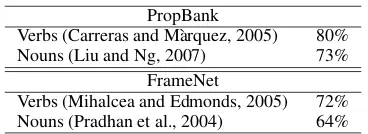
PropBank
Verbs (Carreras and M`arquez, 2005) 80% Nouns (Liu and Ng, 2007) 73%
FrameNet
[image:2.595.324.508.79.146.2]Verbs (Mihalcea and Edmonds, 2005) 72% Nouns (Pradhan et al., 2004) 64%
Table 1: F-Scores for supervised SRL (end-to-end)
for events/results. As our goal is nominal SRL, we concentrate on the event/results class.
SRL for nominalisations.Compared to the wealth
of studies on verbal SRL (e.g., Gildea and Juraf-sky (2002); Fleischman and Hovy (2003)), there is relatively little work that specifically addresses nominal SRL. Nouns are generally treated like verbs: the task is split into two classification steps, argument recognition (telling arguments from
non-arguments) and argument labelling (labelling
recog-nised arguments with a role). Nominal SRL also typically draws on feature sets that are similar to those for verbs, i.e., comprising mainly syntac-tic and lexical-semansyntac-tic information (Liu and Ng, 2007; Jiang and Ng, 2006).
On the other hand, there is converging evidence that nominal SRL is somewhat more difficult than verbal SRL. Table 1 shows some results for both verbal and nominal SRL from the literature. For both PropBank and for FrameNet, we find a differ-ence of 7–8% F-Score. Note, however, that these studies use different datasets and are thus not di-rectly comparable.
In order to confirm the difference between nouns
and verbs, we modelled a controlled dataset (de-scribed in detail in Sec. 4) of verbs and corre-sponding event nominalisations. We used Shal-maneser (Erk and Pado, 2006), to our knowledge´ the only freely available SRL system that handles nouns. SRL models were trained on verbs and nouns separately, using the same settings and fea-tures. Table 2 shows the results, averaged over 10 cross-validation (CV) folds. Accuracy was about equal in the recognition step, and 5% higher for verbs in the labelling step. We analysed these re-sults by fitting alogit mixed model. These models determine whichfixed factorsare responsible for differences in a response variable (here: SRL per-formance) while correcting for imbalances intro-duced byrandom factors(see Jaeger (2008)). We
modelled the training and test set sizes and the
pred-icates’ parts of speech as fixed effects, and frames and CV folds as random factors.
Step Verbs Nouns Arg recognition (F1, class FE) 0.59 0.60
[image:3.595.85.278.70.106.2]Arg labelling (Accuracy) 0.70 0.65
Table 2: FrameNet SRL on verbs and nouns amount of training data turned out to be a signifi-cant factor, i.e., more data leads to higher results. While the part of speech was not systematically linked to performance for argument recognition, it was a highly significant predictor of accuracy in the labelling step: Even when training set size was taken into account, verbal arguments were still significantly easier to label (z=4.5, p<0.001).
In sum, these results lend empirical support to claims that nominal arguments are less tightly cou-pled to syntactic realisation than verbal ones (Carl-son, 1984); their interpretation is harder to capture with shallow cues.
3 Data Expansion for Nominal SRL The previous section has established two observa-tions. First, the argument structures of verbs and
their event nominalisations correspond largely.
Sec-ond, nominal SRL is a difficult task, even given nominal training data, which is hard to obtain.
Our proposal in this paper is to take advan-tage of the first observation to address the sec-ond. We do so by modelling SRL for event nom-inalisations as a data expansion task — i.e., us-ing existus-ing verbalannotations to carry out SRL for novel nominal instances. In this manner, we do away completely with the need for manual annotation of nominal instances that is required for previous supervised approaches (cf. Sec. 2). Consider the following examples, given in format [constituent]grammatical function/SEMANTIC ROLE:
(1) a. [Peter]Subj/COGNIZERlaughs [about the joke]PP-about/STIMULUS b. [Peter]Subj/COGNIZERlaughs
[at him]PP-at/STIMULUS
(2) [Peter’s]Prenom-Gen/? [hearty]Prenom-Mod/? laughter[about the event]PP-about/?
The sentences with the verbal predicatelaugh in (1) are labelled with semantic roles, while the NP
containing the event nominalisationlaughter in (2)
is not. The question we face are what information
from (1) can be re-used to perform argument
recog-nition and labelling on (2), and how.
In this respect, there is a fundamental difference between lexical-semantic and syntactic information.
Lexical-semanticfeatures, such as the head word, are basically independent of the predicate’s part of
speech. Thus, the information from (1) thatPeteris a COGNIZERcan be used directly for the analysis of the occurrence ofPeterin (2). Unfortunately, pure lexical features tend to be sparse: the head word of the last role,event, is unseen in (1), and due to
its abstract nature, also difficult to classify through
semantic similarity. Therefore, it is necessary to
considersyntacticfeatures as well. However, these
vary substantially between verbs and nouns. When they are applicable to both parts of speech, some mileage can be apparently gained: the phrase in (2) headed byevent can be classified as STIMULUS
because it is anabout-PP like (1a). In contrast, no
direct inferences can be drawn about prenominal genitives or modifiers which do not exist for verbs. In the remainder of this paper, we will present experiments on different ways of combining
syn-tactic and lexical-semantic information to balance
precision and recall in data expansion. We address
argument recognition and labelling separately, since the two tasks require different kinds of information. We assume that the frame has been determined be-forehand with word sense disambiguation methods.
4 Data
The dataset for our study consists of the annotated FrameNet 1.3 examples. We obtained pairs of verbs and corresponding event/result nominalisations by intersecting the FrameNet predicate list with a list of nominalisations obtained from Celex (Baayen et al., 1995) and Nomlex (Macleod et al., 1998). We found 306 nominalisations with correspond-ing verbs in the same frame, but excluded some
pairs where either the nominalisation was not of the
event/result type, or no annotated FrameNet
exam-ples were available for either verb or noun. The final
dataset, consisting of 265 pairs exemplifying 117
frames, served for both the analysis in Section 2 and the evaluations in subsequent sections. For the
eval-uations, we used the 26,479 verbal role instances (2,066 distinct role types) as training data and the 6,502 nominal role instances (993 distinct role types) as test data. The specification of the dataset can be downloaded from http://www.coli.
uni-sb.de/∼pado/nom data.html.
5 Argument Recognition
Argument recognition is usually modelled as a
ar-NP PP NP
NP NP
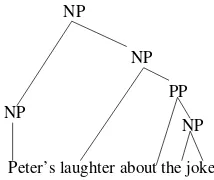
[image:4.595.123.230.70.160.2]Peter’s laughter about the joke
Figure 1: Parse tree for example sentence
gument recognition – at least within predicates – re-lies heavily on syntactic features, with the grammat-ical function (or alternatively syntactic path) feature as the single most important predictor (Gildea and Jurafsky, 2002). Since we are bootstrapping from verbal instances to nominal ones, and since there is typically considerable variation between nominal and verbal subcategorisation patterns, we cannot model argument recognition as a supervised task.
Instead, we follow up on an idea developed by Xue
and Palmer (2004) for verbal SRL, who charac-terise the set of grammatical functions that could
fill a semantic role in the first place. In our apppli-cation, we simply extract all syntactic arguments of the nominalisation, including any premodifiers. We
make no attempt to distinguish between adjuncts and compulsory arguments. Fig. 1 shows an exam-ple: in the NPPeter’s laughter about the joke, the
nounlaughterhas two syntactic arguments: the PP about the joke and the premodifying NPPeter’s. Both are extracted as (potential) arguments.
This method cannot identify roles that are syntac-ticallynon-local, i.e., those that are not in the
max-imal projection of the frame evoking noun. Such roles are more common for nouns than for verbs.
Example 3 shows that an “external” NP likeBillcan be analysed as filling theHELPERrole of the noun help. However, the overall proportion of non-local roles is still fairly small in our data (around 10%). (3) [Bill]HELPERofferedhelp in case of need.
Table 3 gives the argument recognition results for our rule-based system on all roles in the gold stan-dard and on the local roles alone. This simple ap-proach is surprisingly effective, achieving an over-all F-Measure of 76.89% on over-all roles, while on local roles the F-Measure increases to 82.83% due to the
higher recall. Precision is 82.01%, as not all syn-tactic arguments do fill a role. For example, modal modifiers such asheartyin (2) rarely fill a (core) role in FrameNet. False-negative errors, which
af-fect recall, are partly due to parser errors and partly
[image:4.595.323.508.71.106.2]Roles Precision Recall F-Measure all roles 82.01 72.37 76.89 local roles 82.01 83.66 82.83
Table 3: Argument recognition (local / all roles).
to role fillers that do not correspond to constituents
or that are embedded in syntactic arguments. For
in-stance, in (4) the PPin this country, which fills the
PLACErole ofcause, is embedded in the PPof
suf-fering in this country, which fills the role EFFECT. We extract only the larger PP.
(4) thecauses[of suffering
[in this country]PP-in]PP-of
6 Argument Labelling
Argument labelling presents a different picture from argument recognition. Here, both syntactic
and lexical-semantic information contribute to
suc-cess in the task. We present three model families for nominal argument labelling that take different stances with respect to this observation.
The first semantic) and the second
(naive-syntactic) model families represent extreme posi-tions that attempt to re-use verbal information as directly as possible. Models from the third fam-ily,distributional models infer the role of a noun’s arguments by computing the semantic similarity
between nominal arguments and semantic
represen-tations of the verb roles given by the role fillers’ semantic heads.2In thelexical-levelinstantiation,
the mapping is established between individual noun
arguments and roles. In thefunction-level
instantia-tion, complete nominal grammatical functions are
mapped onto roles.3
6.1 Naive semantic model
The naive semantic model (naive sem) implements
the assumption that lexical-semantic features pro-vide the same predictive epro-vidence for verbal and
nominal arguments (cf. Sec. 3). It can be thought of as constructing the trivialidentity mappingbetween
the values of nominal and verbal semantic features. To test the usefulness of this model, we train the Shalmaneser SRL system (Erk and Pad´o, 2006) on the verbal instances of the dataset described
2Usually, the semantic head of a phrase is its syntactic head.
Exceptions occur e.g. for PPs, where the semantic head is the syntactic head of the embedded NP.
3We compute grammatical functions as phrase types plus
in Sec. 4, using only the lexical-semantic features (head word, first word, last word). We then apply the resulting models directly to the corresponding nominal instances.
6.2 Naive syntactic model
The intuition of this model (naive syn) is that gram-matical functions shared between verbs and nouns are likely to express the same semantic roles. It maps all grammatical functions of a verbgv onto the identical functions of the corresponding noun gnand then assigns the most frequent role realised bygvto all arguments with grammatical function gn. For example, if PPs headed by aboutfor the verblaughtypically realise the STIMULUSrole, all arguments of the nounlaughterwhich are realised asPP-aboutare also assigned the STIMULUSrole.
We predict that this strategy has a “high precision–low recall” profile: It produces reliable mappings for those grammatical functions that are preserved across verb and noun, in particular
prepo-sitional phrases; however, it fails for grammatical functions that only occur for one part of speech.
This problem becomes particular pertinent for two prominent role types, namely AGENT-style
roles (deep subjects) and PATIENT-style roles (deep
objects). These roles are usually expressed via dif-ferent and ambiguous noun and verb functions (Gurevich et al., 2006). For verbs, the AGENT is typically expressed by the Subject, while for nouns it is expressed by aPre-Modifier. The PA-TIENT is commonly realised as the Object for verbs, and either as aPre-Modifieror as a PP-of
for nouns. As the noun’s Pre-Modifier is highly ambiguous, it is also ineffective to apply a non-identitymapping such as(subjectv,Pre-Modifiern) or(objectv,Pre-Modifiern).4
A final variation of this model is thegeneralised naive syntactic model(naive sem-gen), where we assign the role most frequently realised by a given function acrossallverbs in the frame. This method
alleviates data sparseness stemming from functions
never seen with particular verbs and is fairly safe, since mapping within frames tends to be uniform.
6.3 Distributional models
The distributional models construct mappings be-tween verbal and nominal semantic heads. In
con-4Lapata (2002) has shown that the mapping can be dis-ambiguated for individual nominalisations. Her model, using
lexical-semantic, contextual and pragmatic information, is out-side the scope of the present paper.
trast to the naive semantic model, they make use of some measure of semantic similarity to find map-pings, and optionally use syntactic constraints to guide generalisation. In this manner, distributional models can deal with unseen feature values more effectively. In sentences (1) and (2), for example, an ideal distributional model would find the head wordeventin (2) to be more semantically similar to the headjokein (1a) than to headhimin (1b). The resulting mapping(joke, event)leads to the assignment of the role STIMULUStoevent.
Semantic Similarity. Semantic similarity mea-sures are commonly used to compute similarity between two lexemes. There are two main types of similarity:Ontology-based, computed through the closeness of two lexemes in a lexical database (e.g., WordNet); anddistributional, given by some measure of the distance between the lexemes’ vec-tor representations in a semantic co-occurrence
space. We chose the latter approach because it tends
to have a higher coverage and it is knowledge-lean, requiring just an unannotated corpus.
We compute distributional-similarity with a semantic space model based on lexical co-occurrences backed by syntactic relations (Pado´ and Lapata, 2007).5The model is constructed from
the British National Corpus (BNC), using the 2.000 most pairs of words and grammatical functions as
dimensions. As similarity measure, we use cosine distance on log-likelihood transformed counts.
Lexical level model. The lexical level model
(dist-lex) assigns to each nominal argument the verb role that it is semantically most similar to. Each role
is represented by the semantic heads of its fillers. For example, suppose that the role STIMULUSof the verblaughhas been realised by the headsstory, scene, joke, and tale. Then, in “Peter’s laughter
about the event”, we analyseeventas STIMULUS,
sinceeventis similar to these heads.
Formally, each argument head lis represented
by a co-occurrence vector~l. A verb rolerv ∈Rv is
modelled by the centroid ~rvof its instances’ heads:
~rv = |L1 rv|
X
l∈Lrv ~l
Roles are assigned to nominal argument headsln∈
Lnby finding the semantically most similar roler
5We also experimented with bag-of-words based vector
while the grammatical functiongnis ignored:
r(ln, gn) =argmaxrv∈Rvsimcos(~ln, ~rv)
Function level model. The syntactic level model (dist-fun) generalises the lexical level model by
ex-ploiting the intuition that, within nouns, most se-mantic roles tend to be consistently realised by one specific grammatical function. This function can be identified as the one most semantically similar to the role’s representation. Following the exam-ple above, suppose that the grammatical function
PP-about oflaughter has as semantic heads the lexemes: event, story, news. Then, it is likely to
express the role STIMULUS, as its heads are
seman-tically similar to those of the verbal fillers of this role:story, scene, sentence, tale. For each
nomi-nalisation, this model constructs mappings(rv, gn)
between a verbal semantic rolerv and a nominal grammatical functiongn. The representations for roles are computed as described above. We com-pute the semantic representations for grammatical functions, in parallel to the roles’ definition above, as the centroid of their fillers’ representationsLgn:
~ gn= |L1
gn|
X
l∈Lgn ~l
The assignment of a role to a nominal arguments is now determined by the argument’s grammatical
functiongn; its lemmalnonly enters indirectly, via
the similarity computation:
r(ln, gn) =argmaxrv∈Rvsimcos(~rv, ~gn)
This strategy guarantees that each nominal gram-matical function is mapped to exactly one role. In the inverse direction, roles can be left unmapped or mapped to more than one function.6
6.4 Hybrid models
Our last class combines the naive and distributional
models with a back-off approach. We first attempt to harness the reliable naive syntactic approach whenever a mapping for the argument’s grammati-cal function is available. If this fails, it backs off to a
distributional model. This strategy helps to recover the frequent AGENT- and PATIENT-style roles that cannot be recovered on syntactic grounds.
6We also experimented with a global optimisation strategy
where we maximised the overall similarity between roles and
functions subject to different constraints (e.g., perfect
match-ing). Unfortunately, this strategy did not improve results.
System Accuracy
baseline random 17.09
BL baseline most common 42.97
naive syn 15.29
naive syn-gen 21.56
Nai
ve
naive sem 24.00
dist-lex 44.57
Dist dist-fun 52.00
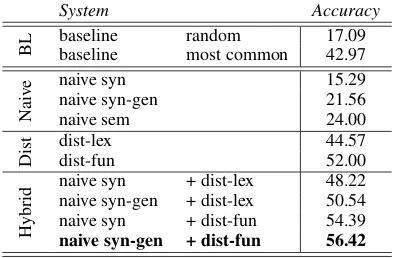
[image:6.595.317.515.71.200.2]naive syn + dist-lex 48.22 naive syn-gen + dist-lex 50.54 naive syn + dist-fun 54.39 Hybrid naive syn-gen + dist-fun 56.42
Table 4: Results for nominal argument labelling
In (2), a hybrid model would assign the role STIMULUS to the argument headed by
event, using the naive syntactic mapping (PP-aboutv,PP-aboutn)derived from (1a). For the
prenominal modifier, no syntactic mapping is avail-able; thus, it backs off to lexical-semantic evidence from (1a-b) to analysePeteras COGNIZER.
We experiment with two hybrid models: naive syntactic plus lexical level distributional (naive syn + dist-lex), and naive syntactic plus functional level
distributional (naive syn + dist-fun).
7 Experimental results
The results of our experiments are reported in Ta-ble 4. The models are compared against two
base-lines: Arandom baselinewhich randomly chooses
one of the verb roles for each of the arguments of the corresponding noun; amost common baseline
which assigns to each nominal argument the most frequent role of the corresponding verb – i.e. the role which has most fillers. All models with the exception ofnaive synsignificantly outperform the random baseline, but onlydist-funand all hybrid models outperform themost commonbaseline.
In general, the best performing methods are the hybrid ones, with best accuracy achieved bynaive syn-gen + dist-fun. Non-hybrid approaches always
have lower accuracy. This validates our main hy-pothesis in this paper, namely that the combination of syntactic information with distributional seman-tics is a promising strategy.
the 1,492 fillers for which a role was assigned, the model obtains an accuracy of 67%, indicating a
rea-sonably high, but not perfect, accuracy for shared grammatical functions. The remaining errors stem from two sources. First, many grammatical func-tions are ambiguous, causing wrong assignments
by a “syntax-only” model. For example,PP-incan indicate both TIMEand PLACEfor many nominal-isations.Second, a certain number of grammatical
functions do not preserve their role between verb to
noun (Hull and Gomez, 1996). For example,PP-to realises the MESSAGErole of the verbrequirebut
the ADDRESSEErole of the nounrequest.
Distributional models show in general better per-formance than the naive syntactic approach (ap-prox. +25% accuracy). They do not suffer from the coverage problem, since they assign a role to each
filler. Yet, the accuracy overassignedroles is lower
than for the syntactic approach (52% for dist-fun). We conclude that in the limited cases where a pure syntactic mapping is applicable, it is far more reliable than methods which are mainly based on
lexical-semantic information. The major limitation
of the latter is that lexical-semantics tend to fail when roles are semantically very similar. For ex-ample, for the nounannouncement, the syntactic-level distributional model wrongly builds the map-ping (ADDRESSEE,PP-by) instead of (SPEAKER,
PP-by), because the two roles are very similar se-mantically (the computed similarities of thePP-by
arguments to ADDRESSEE and SPEAKER in the semantic space are 0.94 and 0.92, respectively).
The syntactic-level distributional model
outper-forms the lexical-level, suggesting that generalising
the mapping at the argument level offers more
sta-ble statistical evidence to find the correct role, i.e. a set of noun arguments better defines the seman-tics of the mapping than asingleargument. This is mostly the case when the context vector of the
argument is not a good representation because the
semantic head is ambiguous, infrequent or atypical. Consider, for example, the following sentence for the nounviolation:
(5) Sterne’s Tristram Shandy consists of a series of violations [of literary conventions]PP-OF/NORM
The syntactic-level model builds the correct map-ping (NORM,PP-of), as the role fillers of the verb
violate(e.g.principle, right, treaty, law) are very similar to the noun’s category fillers (e.g.
conven-tion, rule, agreement, treaty, norm), causing the
cen-troids of NORMandPP-of to be close in the space. The lexical-level model, however, builds the incor-rect mapping (PROTAGONIST, convention). This
happens becauseconventionis ambiguous, and one of its senses (“a large formal assembly”) is
compat-ible with the PROTAGONISTrole, and happens to have a large influence on the position of the vector forconvention. Unfortunately, this is not the sense in which the word is used in this sentence.
8 Conclusions
We have presented a data expansion approach to SRL for event nominalisations. Instead of relying on manually annotated nominal training data, we harness annotated data for verbs to bootstrap a se-mantic role labeller for nouns. For argument recog-nition, we use a simple rule-based approach. For argument labelling, we profit from the fact that the argument structures of event nominalisations and the corresponding verbs are typically similar. This allows us to learn a mapping between verbal roles
and nominal arguments, using syntactic features, lexical-semantic similarity, or both.
We found that our rule-based approach for argu-ment recognition works fairly well. For arguargu-ment
labelling, our approach does not yet attain the per-formance of supervised models, but has the crucial
advantage of not requiring any labelled data for nominal predicates.
We achieved the highest accuracy with a hybrid syntactic-semantic model, which indicates that both
types of information need to be combined for op-timal results. A purely syntactic approach results in a high precision, but low coverage because
fre-quent grammatical functions in particular cannot be trivially mapped. Backing off to semantic similarity
provides additional coverage. However, semantic similarity has to be considered on the level of com-plete functions rather than individual instances to promote “uniformity” in the mappings.
In this paper, we have only considered nominal SRL bydata expansion, i.e. we only applied our approach to those nominalisations for which we have annotated data for the corresponding verbs. However, even if no data is available for the
corre-spondingverb, it might still be possible to bootstrap
from other verbs in the sameframe(assuming that the frame is known for the nominalisation) and we
the mapping constrained by additional syntactic
in-formation such as subcategorisation frames leads to better results. Finally, we will verify that our meth-ods, which we have evaluated on English FrameNet
data, carry over to other corpora and languages. Acknowledgments. Our work was partly funded
by the German Research Foundation DFG (grant PI 154/9-3).
References
Baayen, R., R. Piepenbrock, and L. Gulikers, 1995.The CELEX Lexical Database (Release 2). LDC. Carlson, G. 1984. Thematic roles and their role in
se-mantic interpretation.Linguistics, 22:259–279. Carreras, X. and L. M`arquez, editors. 2005.
Proceed-ings of the CoNLL shared task: Semantic role la-belling, Ann Arbor, MI.
Erk, K. and S. Pad´o. 2006. Shalmaneser – a flexible toolbox for semantic role assignment. In Proceed-ings of LREC, Genoa, Italy.
Erk, K., A. Kowalski, S. Pad´o, and M. Pinkal. 2003. Towards a resource for lexical semantics: A large German corpus with extensive semantic annotation. In Proceedings of ACL, pages 537–544, Sapporo, Japan.
Fillmore, C., C. Johnson, and M. Petruck. 2003. Back-ground to FrameNet. International Journal of Lexi-cography, 16:235–250.
Fleischman, M. and E. Hovy. 2003. Maximum entropy models for FrameNet classification. InProceedings of EMNLP, pages 49–56, Sapporo, Japan.
Frank, A., H.-U. Krieger, F. Xu, H. Uszkoreit, B. Crys-mann, B. J¨org, and U. Sch¨afer. 2007. Question an-swering from structured knowledge sources.Journal of Applied Logic, 5(1):20–48.
Gildea, D. and D. Jurafsky. 2002. Automatic label-ing of semantic roles. Computational Linguistics, 28(3):245–288.
Gordon, A. and R. Swanson. 2007. Generalizing semantic role annotations across syntactically simi-lar verbs. In Proceedings of ACL, pages 192–199, Prague, Czechia.
Grenager, T. and C. Manning. 2006. Unsupervised dis-covery of a statistical verb lexicon. InProceedings of EMNLP, pages 1–8, Sydney, Australia.
Grimshaw, J. 1990.Argument Structure. MIT Press. Gurevich, O., R. Crouch, T. King, and V. de Paiva.
2006. Deverbal nouns in knowledge representation. In Proceedings of FLAIRS, pages 670–675, Mel-bourne Beach, FL.
Hull, R. and F. Gomez. 1996. Semantic interpretation of nominalizations. InProceedings of AAAI, pages 1062–1068, Portland, OR.
Jaeger, T. 2008. Categorical data analysis: Away from ANOVAs and toward Logit Mixed Models. Journal of Memory and Language. To appear.
Jiang, Zheng Ping and Hwee Tou Ng. 2006. Semantic role labeling of NomBank: A maximum entropy ap-proach. InProceedings of EMNLP, pages 138–145, Sydney, Australia.
Lapata, M. 2002. The disambiguation of nominalisa-tions.Computational Linguistics, 28(3):357–388. Liu, C. and H. Ng. 2007. Learning predictive structures
for semantic role labeling of NomBank. In Proceed-ings of ACL, pages 208–215, Prague, Czechia. Macleod, C., R. Grishman, A. Meyers, L. Barrett, and
R. Reeves. 1998. Nomlex: A lexicon of nominaliza-tions. InProceedings of EURALEX, Li`ege, Belgium. Meyers, A., R. Reeves, C. Macleod, R. Szekely, V. Zielinska, B. Young, and R. Grishman. 2004. An-notating Noun Argument Structure for NomBank. In
Proceedings of LREC, Lisbon, Portugal.
Mihalcea, Rada and Phil Edmonds, editors. 2005.
Proceedings of Senseval-3: The Third International Workshop on the Evaluation of Systems for the Se-mantic Analysis of Text, Barcelona, Spain.
Moschitti, A., P. Morarescu, and S. Harabagiu. 2003. Open-domain information extraction via automatic semantic labeling. InProceedings of FLAIRS, pages 397–401, St. Augustine, FL.
Nunes, M. 1993. Argument linking in English de-rived nominals. In Valin, Robert D. Van, editor, Ad-vances in Role and Reference Grammar, pages 372– 432. John Benjamins.
Pad´o, S. and M. Lapata. 2007. Dependency-based con-struction of semantic space models. Computational Linguistics, 33(2):161–199.
Palmer, M., D. Gildea, and P. Kingsbury. 2005. The Proposition Bank: An annotated corpus of semantic roles.Computational Linguistics, 31(1):71–106. Pradhan, S., H. Sun, W. Ward, J. Martin, and D.
Ju-rafsky. 2004. Parsing arguments of nominaliza-tions in English and Chinese. In Proceedings of HLT/NAACL, pages 141–144, Boston, MA.
Quirk, R., S. Greenbaum, G. Leech, and J. Svartvik. 1985. A Comprehensive Grammar of the English Language. Longman.
Swier, R. and S. Stevenson. 2004. Unsupervised se-mantic role labelling. In Proceedings of EMNLP, pages 95–102.