Experiments on Semantic-based Clustering for Cross-document Coreference
Horacio Saggion
Department of Computer Science University of Sheffield
211 Portobello Street - Sheffield, England, UK, S1 4DP Tel: +44-114-222-1947
Fax: +44-114-222-1810 [email protected]
Abstract
We describe clustering experiments for cross-document coreference for the first Web People Search Evaluation. In our ex-periments we apply agglomerative cluster-ing to group together documents potentially referring to the same individual. The algo-rithm is informed by the results of two dif-ferent summarization strategies and an off-the-shelf named entity recognition compo-nent. We present different configurations of the system and show the potential of the ap-plied techniques. We also present an analy-sis of the impact that semantic information and text summarization have in the cluster-ing process.
1 Introduction
Finding information about people on huge text col-lections or on-line repositories on the Web is a com-mon activity. In ad-hoc Internet retrieval, a request for documents/pages referring to a person name may return thousand of pages which although containing the name, do not refer to the same individual. Cross-document coreference is the task of deciding if two entity mentions in two sources refer to the same indi-vidual. Because person names are highly ambiguous (i.e., names are shared by many individuals), decid-ing if two documents returned by a search engine such as Google or Yahoo! refer to the same individ-ual is a difficult problem.
Automatic techniques for solving this problem are required not only for better access to information
but also in natural language processing applications such as multidocument summarization, question an-swering, and information extraction. Here, we con-centrate on the Web People Search Task (Artiles et al., 2007) as defined in the SemEval 2007 Work-shop: a search engine user types in a person name as a query. Instead of ranking web pages, an ideal sys-tem should organise search results in as many clus-ters as there are different people sharing the same name in the documents returned by the search en-gine. The input is, therefore, the results given by a web search engine using a person name as query. The output is a number of sets, each containing doc-uments referring to the same individual. The task is related to the coreference resolution problem disre-garding however the linking of mentions of the tar-get entity inside each single document.
2 Evaluation Framework
The SemEval evaluation has prepared two sets of data to investigate the cross-document coreference problem: one for development and one for testing. The data consists of around 100 Web files per per-son name, which have been frozen and so, can be used as an static corpus. Each file in the corpus is associated with an integer number which indicates the rank at which the particular page was retrieved by the search engine. In addition to the files them-selves, the following information was available: the page title, the url, and the snippet. In addition to the data itself, human assessments are provided which are used for evaluating the output of the automatic systems. The assessment for each person name is a file which contains a number of sets where each set is assumed to contain all (and only those) pages that refer to one individual. The development data is a selection of person names from different sources such as participants of the European Conference on Digital Libraries (ECDL) 2006 and the on-line en-cyclopædia Wikipedia.
The test data to be used by the systems consisted of 30 person names from different sources: (i) 10 names were selected from Wikipedia; (ii) 10 names were selected from participants in the ACL 2006 conference; and finally, (iii) 10 further names were selected from the US Census. One hundred doc-uments were retrieved using the person name as a query using the search engine Yahoo!.
Metrics used to measure the performance of automatic systems against the human output were borrowed from the clustering literature (Hotho et al., 2003) and they are defined as follows:
Precision(A, B) =|A∩B| |A|
Purity(C, L) =
n
X
i=1
|Ci|
n maxjPrecision(Ci, Lj)
Inverse Purity(C, L) =
n
X
i=1
|Li|
n maxjPrecision(Li, Cj)
F-Scoreα(C, L) =
Purity(C, L)∗Inverse Purity(C, L)
αPurity(C, L) + (1−α)Inverse Purity(C, L) whereCis the set of clusters to be evaluated and Lis the set of clusters produced by the human. Note
that purity is a kind of precision metric which re-wards a partition which has less noise. Inverse pu-rity is a kind of recall metric. α was set to 0.5 in the SemEval 2007 evaluation. Two simple baseline systems were defined in order to measure if the tech-niques used by participants were able to improve over them. The all-in-one baseline produces one sin-gle cluster – all documents belonging to that cluster. The one-in-one baseline producesncluster with one different document in each cluster.
3 Agglomerative Clustering Algorithm
Clustering is an important technique used in areas such as information retrieval, text mining, and data mining (Cutting et al., 1992). Clustering algorithms combine data points into groups such that: (i) data points in the same group are similar to each other; and (ii) data points in one group are “different” from data points in a different group or cluster. In infor-mation retrieval it is assumed that documents that are similar to each other are likely to be relevant for the same query, and therefore having the doc-ument collection organised in clusters can provide improved document access (van Rijsbergen, 1979). Different clustering techniques exist (Willett, 1988) the simplest one being the one-pass clustering al-gorithm (Rasmussen and Willett, 1987). We have implemented an agglomerative clustering algorithm which is relatively simple, has reasonable complex-ity, and gave us rather good results. Our algorithm operates in an exclusive way, meaning that a doc-ument belongs to one and only one cluster – while this is our working hypothesis, it might not be valid in some cases.
The input to the algorithm is a set of document representations implemented as vectors of terms and weights. Initially, there are as many clusters as input documents; as the algorithm proceeds clus-ters are merged until a certain termination condi-tion is reached. The algorithm computes the similar-ity between vector representations in order to decide whether or not to merge two clusters.
two clusters are, but for the experiments reported here we have used the following approach: the sim-ilarity between two clusters (simC) is equivalent to
the “document” similarity (simD) between the two
more similar documents in the two clusters – this is known as single linkage in the clustering literature; the following formula is used:
simC(C1,C2)=
maxdi∈C1;dj∈C2simD(di,dj)
WhereCkare clusters,dlare document
represen-tations (e.g., vectors), and simD is the cosine metric
given by the following formula:
cosine(d1, d2) =
Pn
i=1wi,d1∗wi,d2
pPn
i=1(wi,d1)2∗
pPn
i=1(wi,d2)2
wherewi,dis the weight of termiin documentd
andnis the numbers of terms.
If this similarity is greater than a threshold – ex-perimentally obtained – the two clusters are merged together. At each iteration the most similar pair of clusters is merged. If this similarity is less than a certain threshold the algorithm stops. Merging two clusters consist of a simple step of set union, so there is no re-computation involved – such as computing a cluster centroid.
We estimated the threshold for the clustering al-gorithm using the ECDL subset of the training data provided by SemEval. We applied the clustering al-gorithm where the threshold was set to zero. For each document set, purity, inverse purity, and F-score were computed at each iteration of the algo-rithm, recording the similarity value of each newly created cluster. The similarity values for the best clustering results (best F-score) were recorded, and the maximum and minimum values discarded. The rest of the values were averaged to obtain an esti-mate of the optimal threshold. The thresholds used for the experiments reported here are as follows: 0.10 for word vectors and 0.12 for named entity vec-tors (see Section 5 for vector representations).
4 Natural Language Processing Technology
We rely on available extraction and summarization technology in order to linguistically process the doc-uments for creating document representations for
clustering. Although the SemEval corpus contains information other than the retrieved pages them-selves, we have made no attempt to analyse or use contextual information given with the input docu-ment.
Two tools are used: the GATE system (Cunning-ham et al., 2002) and a summarization toolkit (Sag-gion, 2002; Saggion and Gaizauskas, 2004) which is compatible with GATE. The input for analysis is a set of documents and a person name (first name and last name). The documents are analysed by the default GATE1ANNIE system which creates differ-ent types of named differ-entity annotations. No adap-tation of the system was carried out because we wanted to verify how far we could go using available tools. Summarization technology was used from single document summarization modules from our summarization toolkit.
The core of the toolkit is a set of summariza-tion modules which compute numeric features for each sentence in the input document, the value of the feature indicates how relevant the information in the sentence is for the feature. The computed values, which are normalised yielding numbers in the interval [0..1] – are combined in a linear for-mula to obtain a score for each sentence which is used as the basis for sentence selection. Sentences are ranked based on their score and top ranked sen-tences selected to produce an extract. Many fea-tures implemented in this tool have been suggested in past research as valuable for the task of identify-ing sentences for creatidentify-ing summaries. In this work, summaries are created following two different ap-proaches as described below.
The text and linguistic processors used in our sys-tem are: document tokenisation to identify different kinds of words; sentence splitting to segment the text into units used by the summariser; parts-of-speech tagging used for named entity recognition; named entity recognition using a gazetteer lookup module and regular expressions grammars; and named entity coreference module using a rule-based orthographic name matcher to identify name mentions considered equivalent (e.g., “John Smith” and “Mr. Smith”). Named entities of type Person, Organization,
Ad-dress, Date, and Location are considered relevant
1
document terms and stored in a special named en-tity called Mention as an annotation. The perfor-mance of the named entity recogniser on Web data (business news from the Web) is around 0.90 F-score (Maynard et al., 2003).
Coreference chains are created and analysed and if they contain an entity matching the target person’s surname, all elements of the chain are marked as a feature of the annotation.
We have tested two summarization conditions in this work: In one set of experiments a sentence be-longs to a summary if it contains a mention which is coreferent with the target entity. In a second set of experiments a sentence belongs to a summary if it contains a “biographical pattern”. We rely on a number of patterns that have been proposed in the past to identify descriptive phrases in text collec-tions (Joho and Sanderson, 2000). The patterns used in the experiments described here are shown in Ta-ble 1. In the patterns, dp is a descriptive phrase that in (Joho and Sanderson, 2000) is taken as a noun phrase. These patterns are likely to capture infor-mation which is relevant to create person profiles, as used in DUC 2004 and in TREC QA – to answer definitional questions.
These patterns are implemented as regular expres-sions using the JAPE language (Cunningham et al., 2002). Our implementation of the patterns make use of coreference information so that target is any name in text which is coreferent with sought person. In or-der to implement the dp element in the patterns we use the information provided by a noun phrase chun-ker. The following is one of the JAPE rules for iden-tifying key phrases as implemented in our system:
({TargetPerson}
({ Token.string == "is" } | {Token.string == "was" })
{NounChunk}):annotate --> :annotate.KeyPhrase = {}
where TargetPerson is the sought entity, and
NounChunk is a noun chunk. The rule states that
when the pattern is found, a KeyPhrase should be created.
Some examples of these patterns in text are shown in Table 4. A profile-based summarization system which uses these patterns to create person profiles is reported in (Saggion and Gaizauskas, 2005).
Patterns
target (is|was|...) (a|an|the) dp target, (who|whose|...)
target, (a|the|one ...) dp target, dp
target’s
[image:4.612.356.499.68.145.2]target and others
Table 1: Set of patterns for identifying profile infor-mation.
Dickson’s invention, the Kinetoscope, was simple:
a strip of several images was passed in front of an illuminated lens and behind a spinning wheel.
James Hamilton, 1st earl of Arran
James Davidson, MD, Sports Medicine
Orthope-dic Surgeon, Phoenix Arizona
As adjutant general, Davidson was chief of the State Police, qv which he organized quickly.
Table 2: Descriptive phrases in test documents for different target names.
4.1 Frequency Information
Using language resources creation modules from the summarization tool, two frequency tables are cre-ated for each document set (or person) on-the-fly: (i) an inverted document frequency table for words (no normalisation is applied); and (ii) an inverted fre-quency table for Mentions (the full entity string is used, no normalisation is applied).
Statistics (term frequencies (tf(Term)) and in-verted document frequencies (idf(Term))) are com-puted over tokens and Mentions using tools from the summarization toolkit (see examples in Table 3).
word frequencies Mention frequencies
[image:4.612.335.510.539.634.2]of (92) Jerry Hobbs (80) Hobbs (92) Hobbs (56) Jerry (90) Krystal Tobias (38) to (89) Texas (37) in (87) Jerry (36) and (86) Laura Hobbs (35) the (85) Monday (34) a (85) 1990 (31)
Table 3: Examples of top frequent terms (words and named entities) and their frequencies in the Jerry Hobbs set.
Baldwin, 1998)). We use the following formula to compute term weight (N is the number of documents in the input set):
weight(Term)=tf(Term)∗log2( N idf(Term))
These vectors are also stored in the GATE doc-uments. Two types of representations were con-sidered for these experiments: (i) full document or summary (terms in the summary are considered for vector creation); and (ii) words are used as terms or
Mentions are used as terms.
5 Cross-document Coreference Systems In this section we present results of six different con-figurations of the clustering algorithm. The config-urations are composed of two parts one which indi-cates where the terms are extracted from and the sec-ond part indicates what type of terms were used. The text conditions are as follows: Full Document (FD) condition means that the whole document was used for extracting terms for vector creation; Person
Sum-mary (PS) means that sentences containing the target
person name were used to extract terms for vector creation; Descriptive Phrase (DP) means that sen-tences containing a descriptive patterns were used to extract terms for vector creation. The term condi-tions are: Words (W) words were used as terms and
Mentions (M) named entities were used as terms.
Local inverted term frequencies were used to weight the terms.
6 SemEval 2007 Web People Search Results
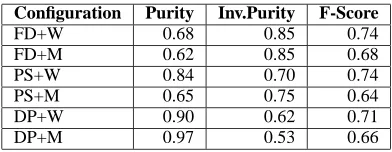
The best system in SemEval 2007 obtained an F-score of 0.78, the average F-F-score of all 16 partic-ipant systems is 0.60. Baseline one-in-one has an F-score of 0.61 and baseline all-in-one an F-score of 0.40. Results for our system configurations are pre-sented in Table 4. Our best configuration (FD+W) obtains an F-score of 0.74 (or a fourth position in the SemEval ranking). All our configurations obtained F-scores greater than the average of 0.60 of all par-ticipant systems. They also perform better than the two baselines.
Our optimal configurations (FD+W and PS+W) both perform similarly with respect to F-score.
While the full document condition favours “inverse purity”, summary condition favours “purity”. As one may expect, the use of descriptive phrases to create summaries has the effect of increasing purity to one extreme, these expressions are far too restric-tive to capture all necessary information for disam-biguation.
Configuration Purity Inv.Purity F-Score
FD+W 0.68 0.85 0.74
FD+M 0.62 0.85 0.68
PS+W 0.84 0.70 0.74
PS+M 0.65 0.75 0.64
DP+W 0.90 0.62 0.71
DP+M 0.97 0.53 0.66
Table 4: Results for different clustering configura-tions. These results are those obtained on the whole set of 30 person names.
7 Semantic-based Experiments
While these results are rather encouraging, they were not optimal. In particular, we were surprised that semantic information performed worst than a simple word-based approach. We decided to inves-tigate whether some types of semantic information might be more helpful than others in the cluster-ing process. We therefore created one vector for each type of information: Organization, Person,
Location, Date, Address in each document and
re-clustered all test data using one type at a time, with-out modifying any of the system parameters (e.g., without re-training). The results were very encour-aging.
7.1 Results
Results of semantic-based clustering per informa-tion type are presented in Tables 5 and 6. Each row
Semantic Type Purity Inv.Purity F-Score
[image:5.612.329.525.178.254.2]+/-Organization 0.90 0.72 0.78 +0.10 Person 0.81 0.72 0.75 +0.07 Address 0.82 0.64 0.69 +0.01 Date 0.58 0.85 0.67 -0.01 Location 0.55 0.85 0.64 -0.04
Semantic Type Purity Inv.Purity F-Score
[image:6.612.315.538.71.269.2]+/-Person 0.85 0.64 0.70 +0.06 Organization 0.97 0.57 0.69 +0.05 Date 0.87 0.60 0.68 +0.04 Location 0.82 0.63 0.67 +0.03 Address 0.93 0.54 0.65 +0.01
Table 6: Results for summary condition and differ-ent semantic information types. Improvemdiffer-ents over PS+M are reported.
in the tables reports results for clustering using one type of information alone. Table 5 reports results for semantic information with full text condition and it is therefore compared to our configuration FD+M which also uses full text condition together with se-mantic information. The last column in the table shows improvements over that configuration. Using
Organization type of information in full text
condi-tion, not only outperforms the previous system by ten points, also exceeds by a fraction of a point the best system in SemEval 2007 (one point if we con-sider macro averaged F-score). Statistical tests (t-test) show that improvement over FD+M is statisti-cally significant. Other semantic types of informa-tion also have improved performance, not all of them however. Location and Date in the full documents are probably too ambiguous to help disambiguating the target named entity.
Table 6 reports results for semantic information with summary text condition (only personal sum-maries were tried, experiments using descriptive phrases are underway) and it is therefore compared to our configuration PS+M which also uses sum-mary condition together with semantic information. The last column in the table shows improvements over that configuration. Here all semantic types of information taken individually outperform a system which uses the combination of all types. This is probably because all types of information in a per-sonal summary are somehow related to the target person.
7.2 Results per Person Set
Following (Popescu and Magnini, 2007), we present purity, inverse purity, and F-score results for all our configurations per category (ACL, US Census, Wikipedia) in the test set.
In Tables 7, 8, and 9, results are reported for full
Configuration Set Purity I.Purity F-Score
[image:6.612.72.302.71.138.2]FD+Address ACL 0.86 0.48 0.57 FD+Address US C. 0.81 0.71 0.75 FD+Address Wikip. 0.78 0.70 0.73 PS+Address ACL 0.96 0.38 0.50 PS+Address US C. 0.94 0.61 0.72 PS+Address Wikip. 0.88 0.62 0.71 FD+Date ACL 0.63 0.82 0.69 FD+Date US C. 0.52 0.87 0.64 FD+Date Wikip. 0.59 0.85 0.68 PS+Date ACL 0.88 0.49 0.59 PS+Date US C. 0.88 0.64 0.72 PS+Date Wikip. 0.84 0.67 0.72 FD+Location ACL 0.63 0.78 0.65 FD+Location US C. 0.52 0.86 0.64 FD+Location Wikip. 0.49 0.91 0.62 PS+Location ACL 0.87 0.47 0.54 PS+Location US C. 0.85 0.66 0.73 PS+Location Wikip. 0.74 0.75 0.72
Table 7: Results for clustering configurations per person type set (ACL, US Census, and Wikipedia) - Part I.
Configuration Set Purity I.Purity F-Score
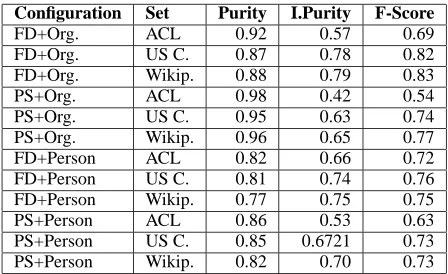
FD+Org. ACL 0.92 0.57 0.69 FD+Org. US C. 0.87 0.78 0.82 FD+Org. Wikip. 0.88 0.79 0.83 PS+Org. ACL 0.98 0.42 0.54 PS+Org. US C. 0.95 0.63 0.74 PS+Org. Wikip. 0.96 0.65 0.77 FD+Person ACL 0.82 0.66 0.72 FD+Person US C. 0.81 0.74 0.76 FD+Person Wikip. 0.77 0.75 0.75 PS+Person ACL 0.86 0.53 0.63 PS+Person US C. 0.85 0.6721 0.73 PS+Person Wikip. 0.82 0.70 0.73
Table 8: Results for clustering configurations per person type set (ACL, US Census, and Wikipedia) - Part II.
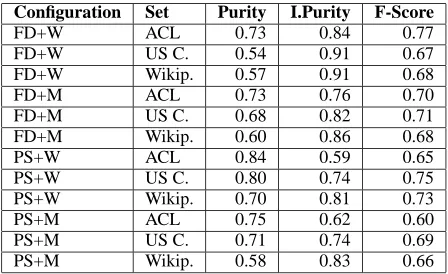
document condition(FD), summary condition (PS), word-based representation (W), mention representa-tion (M) – i.e. all types of named entities, and five different mention types: Person, Location, Organi-zation, Date, and Address.
[image:6.612.315.539.334.471.2]Configuration Set Purity I.Purity F-Score
FD+W ACL 0.73 0.84 0.77
FD+W US C. 0.54 0.91 0.67 FD+W Wikip. 0.57 0.91 0.68
FD+M ACL 0.73 0.76 0.70
FD+M US C. 0.68 0.82 0.71 FD+M Wikip. 0.60 0.86 0.68
PS+W ACL 0.84 0.59 0.65
PS+W US C. 0.80 0.74 0.75 PS+W Wikip. 0.70 0.81 0.73
PS+M ACL 0.75 0.62 0.60
[image:7.612.74.298.71.208.2]PS+M US C. 0.71 0.74 0.69 PS+M Wikip. 0.58 0.83 0.66
Table 9: Results for clustering configurations per person type set (ACL, US Census, and Wikipedia) - Part III.
needed before reaching any conclusions on the best document representation for our algorithm in this task.
8 Related Work
The problem of cross-document coreference has been studied for a number of years now. Bagga and Baldwin (Bagga and Baldwin, 1998) used the vector space model together with summarization techniques to tackle the cross-document coreference problem. Their approach uses vector representa-tions following a bag-of-words approach. Terms for vector representation are obtained from sentences where the target person appears. They have not pre-sented an analysis of the impact of full document versus summary condition and their clustering algo-rithm is rather under-specified. Here we have pre-sented a clearer picture of the influence of summary vs full document condition in the clustering process. Mann and Yarowsky (Mann and Yarowsky, 2003) used semantic information extracted from docu-ments referring to the target person in an hierarchical agglomerative clustering algorithm. Semantic infor-mation here refers to factual inforinfor-mation about a per-son such as the date of birth, professional career or education. Information is extracted using patterns some of them manually developed and others in-duced from examples. We differ from this approach in that our semantic information is more general and is not particularly related - although it might be - to the target person.
Phan el al. (Phan et al., 2006) follow Mann and
Yarowsky in their use of a kind of biographical in-formation about a person. They use a machine learn-ing algorithm to classify sentences accordlearn-ing to par-ticular information types in order to automatically construct a person profile. Instead of comparing biographical information in the person profile alto-gether as in (Mann and Yarowsky, 2003), they com-pare each type of information independently of each other, combining them only to make the final deci-sion.
Finally, the best SemEval 2007 Web People Search system (Chen and Martin, 2007) used tech-niques similar to ours: named entity recognition us-ing off-the-shelf systems. However in addition to semantic information and full document condition they also explore the use of contextual information such as the url where the document comes from. They show that this information is of little help. Our improved system obtained a slightly higher macro-averaged f-score over their system.
9 Conclusions and Future Work
We have presented experiments on cross-document coreference of person names in the context of the first SemEval 2007 Web People Search task. We have designed and implemented a solution which uses an in-house clustering algorithm and available extraction and summarization techniques to produce representations needed by the clustering algorithm. We have presented different approaches and com-pared them with SemEval evaluation’s results. We have also shown that one system which uses one specific type of semantic information achieves state-of-the-art performance. However, more work is needed, in order to understand variation in perfor-mance from one data set to another.
containing pronouns referring to the target entity af-fects performance, our current version only exploits name coreference. Our future work will also explore how (and if) the use of contextual information avail-able on the web can lead to better performance.
Acknowledgements
We are indebted to the three anonymous reviewers for their extensive suggestions that helped improve this work. This work was partially supported by the EU-funded MUSING project (IST-2004-027097).
References
J. Artiles, J. Gonzalo, and S. Sekine. 2007. The SemEval-2007 WePS Evaluation: Establishing a benchmark for Web People Search Task. In Proceed-ings of Semeval 2007, Association for Computational Linguistics.
A. Bagga and B. Baldwin. 1998. Entity-Based Cross-Document Coreferencing Using the Vector Space Model. In Proceedings of the 36th Annual Meeting of the Association for Computational Linguistics and the 17th International Conference on Computational Linguistics (COLING-ACL’98), pages 79–85.
Y. Chen and J.H. Martin. 2007. Cu-comsem: Explor-ing rich features for unsupervised web personal named disambiguation. In Proceedings of SemEval 2007, As-socciation for Computational Linguistics, pages 125– 128.
H. Cunningham, D. Maynard, K. Bontcheva, and V. Tablan. 2002. GATE: A Framework and Graphical Development Environment for Robust NLP Tools and Applications. In Proceedings of the 40th Anniversary Meeting of the Association for Computational Linguis-tics (ACL’02).
Douglass R. Cutting, Jan O. Pedersen, David Karger, and John W. Tukey. 1992. Scatter/gather: A cluster-based approach to browsing large document collec-tions. In Proceedings of the Fifteenth Annual Interna-tional ACM SIGIR Conference on Research and De-velopment in Information Retrieval, pages 318–329.
A. Hotho, S. Staab, and G. Stumme. 2003. WordNet im-proves text document clustering. In Proc. of the SIGIR 2003 Semantic Web Workshop.
H. Joho and M. Sanderson. 2000. Retrieving Descrip-tive Phrases from Large Amounts of Free Text. In Proceedings of Conference on Information and Know-eldge Management (CIKM), pages 180–186. ACM.
G. S. Mann and D. Yarowsky. 2003. Unsupervised per-sonal name disambiguation. In W. Daelemans and M. Osborne, editors, Proceedings of the 7th
Confer-ence on Natural Language Learning (CoNLL-2003), pages 33–40. Edmonton, Canada, May.
D. Maynard, K. Bontcheva, and H. Cunningham. 2003. Towards a semantic extraction of named entities. In G. Angelova, K. Bontcheva, R. Mitkov, N. Nicolov, and N. Nikolov, editors, Proceedings of Recent Advances in Natural Language Processing (RANLP’03), pages 255–261, Borovets, Bulgaria, Sep.
http://gate.ac.uk/sale/ranlp03/ranlp03.pdf.
X.-H. Phan, L.-M. Nguyen, and S. Horiguchi. 2006. Personal name resolution crossover documents by a semantics-based approach. IEICE Trans. Inf. & Syst., Feb 2006.
Octavian Popescu and Bernardo Magnini. 2007. Irst-bp: Web people search using name entities. In Proceed-ings of the Fourth International Workshop on Semantic Evaluations (SemEval-2007), pages 195–198, Prague, Czech Republic, June. Association for Computational Linguistics.
E. Rasmussen and P. Willett. 1987. Non-hierarchical document clustering using the icl distribution ar-ray processor. In SIGIR ’87: Proceedings of the 10th annual international ACM SIGIR conference on Research and development in information retrieval, pages 132–139, New York, NY, USA. ACM Press.
H. Saggion and R. Gaizauskas. 2004. Multi-document summarization by cluster/profile relevance and redun-dancy removal. In Proceedings of the Document Un-derstanding Conference 2004. NIST.
H. Saggion and R. Gaizauskas. 2005. Experiments on statistical and pattern-based biographical summariza-tion. In Proceedings of EPIA 2005, pages 611–621.
H. Saggion. 2002. Shallow-based Robust Summariza-tion. In Automatic Summarization: Solutions and Per-spectives, ATALA, December, 14.
H. Saggion. 2007. Shef: Semantic tagging and summa-rization techniques applied to cross-document corefer-ence. In Proceedings of SemEval 2007, Assocciation for Computational Linguistics, pages 292–295.
C.J. van Rijsbergen. 1979. Information Retrieval. But-terworths, London.