Available online at www.ijrat.org
An Internal Detection And Protection Frames For
Intrusion By Using Data Mining And Legal Techniques
M.A.Chakravarthi
1,N.Haritha
2, R.Navya Sree
3, Sk.Jani Basha
4, P.Papi Reddy
5.
1Asst. Prof, CSE, Tirumala Engineering College, Narasaraopet.2, 3, 4, 5
B. Tech Students, Tirumala Engineering College, Narasaraopet.
Abstract:Presently, most PC frameworks use client IDs and passwords as the login examples to confirm clients. Nonetheless, numerous individuals share their login designs with colleagues and demand these collaborators to help co-undertakings, subsequently making the example as one of the weakest purposes of PC security. Insider assailants, the substantial clients of a framework who assault the framework inside, are difficult to identify since most interruption recognition frameworks and firewalls distinguish and seclude malignant practices propelled all things considered universe of the framework as it were. Moreover, a few investigations asserted that breaking down framework calls (SCs) produced by directions can recognize these directions, with which to precisely distinguish assaults, and assault designs are the highlights of an assault. Accordingly, in this paper, a security framework, named the Internal Intrusion Detection and Security System (IIDPS), is proposed to identify insider assaults at SC level by utilizing information mining and legal systems. The IIDPS makes clients' close to home profiles to monitor clients' use propensities as their legal highlights and decides if a substantial login client is the record holder or not by looking at his/her present PC utilization practices with the examples gathered in the record holder's close to home profile. The test results illustrate that the IIDPS's client ID precision is 94.29%, while the reaction time is under 0.45 s, inferring that it can keep a shielded framework from insider assaults adequately and effectively.
1. INTRODUCTION
In the previous decades, PC frameworks have been generally utilized to furnish clients with less demanding and increasingly helpful lives. In any case, when individuals abuse incredible capacities and handling intensity of PC frameworks, security has been one of the major issues in the PC space since aggressors very as a rule attempt to infiltrate PC frameworks and carry on noxiously, e.g., taking basic information of an organization, making the frameworks out of work or notwithstanding decimating the frameworks. By and large, among all notable assaults, for example, pharming assault, dispersed forswearing of-administration (DDoS), listening stealthily assault, what's more, stick phishing assault, insider assault is a standout amongst the most troublesome ones to be identified in light of the fact that firewalls and interruption discovery frameworks (IDSs) as a rule safeguard against outside assaults. To validate clients, as of now, most frameworks check client ID and secret key as a login design. Be that as it may, aggressors may introduce Trojans to steal unfortunate casualties' login examples or issue a vast size of preliminaries with the help of a word reference to obtain clients' passwords. Whenever effective, they may then sign in to the framework, get to clients' private documents, or adjust or decimate framework settings. Luckily, most current host-based security frameworks and arrange based IDSs can find a known interruption in a constant way. In any case, it is very hard to recognize
Available online at www.ijrat.org
sorted out as pursues. Segment II presents the relatedwork of this paper. Area III portrays the system and calculations of the IIDPS. Trial results are appeared and talked about in Sections IV and V, individually. Area VI finishes up this paper.
2. RELATED WORKS
PC criminology science, which sees PC frameworks as wrongdoing scenes, expects to recognize, protect, recuperate, analyze, and present actualities and assessments on data gathered for a security occasion. It examines what aggressors have done such as spreading PC infections, malwares, and
[image:2.612.73.531.237.436.2]malignant codes what's more, leading DDoS assaults [8]. Most interruption location strategies center around how to discover pernicious system practices and secure the attributes of assault parcels, i.e., assault designs, in view of the accounts recorded in log records. Qadeer et all utilized self-created bundle sniffer to gather arrange bundles with which to segregate organize assaults with the assistance of system states and parcel dissemination. Shaughnessy and Gray, obtained system interruption and assault designs from framework log documents. These records contain hints of PC abuse.
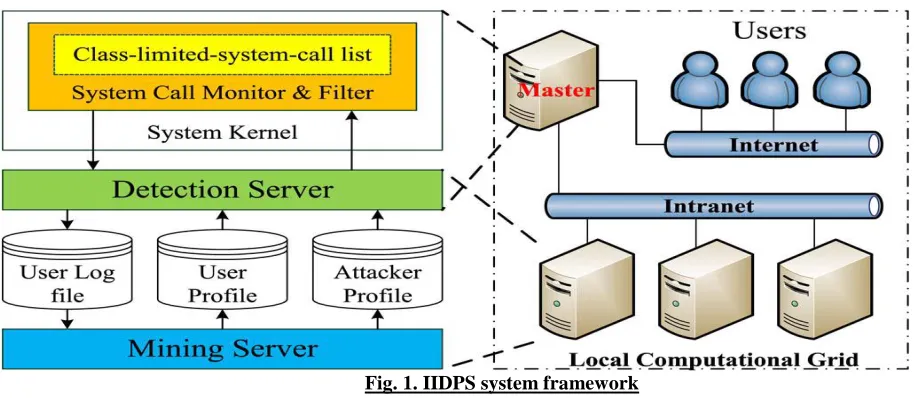
Fig. 1. IIDPS system framework
It implies that, from artificially created log documents, these follows or examples of abuse can be all the more precisely imitated. Wu and Banzhaf reviewed look into advancement of applying strategies for computational knowledge, including counterfeit neural systems, fluffy frameworks, transformative calculation, counterfeit insusceptible frameworks, furthermore, swarm knowledge, to recognize vindictive practices. The creators efficiently abridged and looked at changed interruption identification strategies, along these lines enabling us to obviously see those current research difficulties.
3. IIDPS
In this section, we first introduce the IIDPS framework and describe components of the IIDPS in detail. Two algorithms are also presented for generating a user habit file and detecting an internal intruder.
A. System Framework:
Available online at www.ijrat.org
who the attacker is in real time. When an intrusion isdiscovered, the detection server notifies the SC monitor and filter to isolate the user from the protected system. The purpose is to prevent him/her from continuously attacking the system.
B. SC Monitor and Filter
An SC in fact is an interface between a user application and services provided by the kernel.
Generally, a huge mount of SCs are generated during the execution of a job, i.e., a task or process. For example, when a user changes his/her password by submitting a ―passwd‖ shell command to a Linux operating system, up to 2916 SCs will be generated, including open(), close(), read(), write(), etc.
Therefore, it is hard for a system to monitor all SCs at the same time, particularly when many users
are running their programs. As a result, we need to filter out some commonly used safe SCs.
In the IIDPS, all collected data are analyzed by a data mining tool, iData Analyzer, in which class predictability and class predictiveness are two
[image:3.612.96.531.505.679.2]parameters utilized to evaluate intraclass and interclass weights, respectively, of an attribute among classified attribute classes
Available online at www.ijrat.org
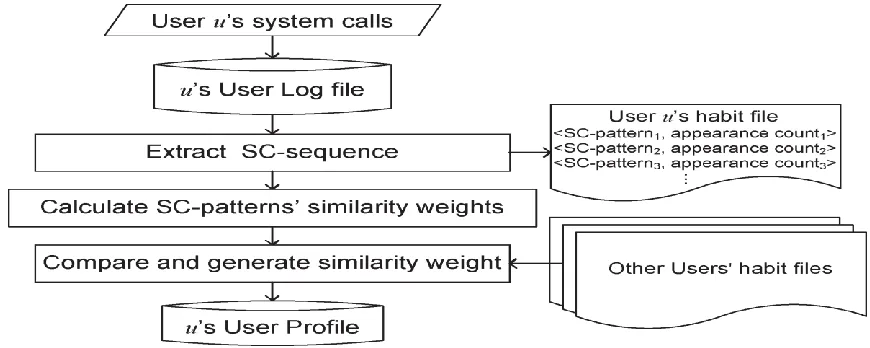
Fig. 4. Algorithm for generating a user u’s habit file
4. EXPERIMENTS
To verify the feasibility and accuracy of the IIDPS, three experiments were performed. The first defined the decisive rate threshold between the user profile established for u and each of other users’ user profiles. The second studied the accuracy for the online detection server when NCSu was submitted by u. The third compared the IIDPS with several state-of-the-art hostbased IDSs (HIDSs).
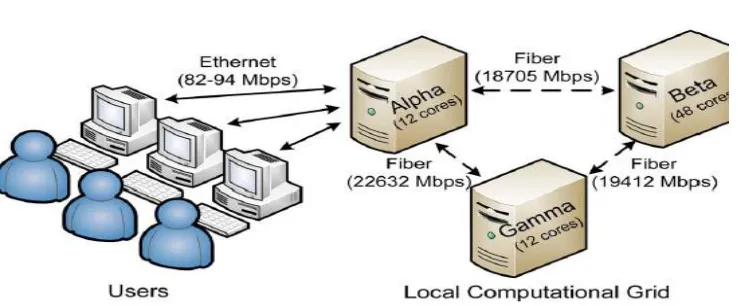
Fig. 8 illustrates the configuration of the experimental testbed, which consists of 12 users; one protected computer named Alpha; and another two members of the computational grid, named Beta with 48 processing cores and amma with 12 processing cores. All the computers operate with Linux operating system, and the memory size for each computer is at least 25 GB. The measured
bandwidths and network types between two arbitrary nodes of the omputational grid are also illustrated in Fig. 8.In the IIDPS testbed, the SC monitor and filter is first installed into the Alpha computer to obtain each user’s log file during the time period between February 1, 2014, and July 31,2014. The SCs from 12 different categories of users are collected as the experimental data, including the system (root), oracle, message queue (mq), reservation, ticketing, financial, operating strategy (os), backup, configuration management (cm), web application, business rule, and audit users. A total of 193 613 SCs have been collected from 12 log files, in which the length of a sliding window is 10.
.
Available online at www.ijrat.org
A. Decisive Rate Threshold
To determine the decisive rate threshold, 75% of log records are selected as the training data from each of the 12 log files to generate 12 corresponding user profiles, and the remaining 25% are the test data. Ten times of this experiment were performed. Given a known user u’s current input SC-sequence, i.e., NCSu, if the similarity score between NCSu and u’s user profile is ranked within the top y ∗ 100% among the similarity score between NCSu and each of the 12 users’ user profiles, as aforementioned, the decisive rate threshold is y. The experimental results of decisive rate are shown in Table IV, in which average decisive rate is 0.9312. Therefore, the threshold y is set to 0.9 to evaluate whether the underlying user u of an account is the account holder or not. Besides, the paragraph size is defined as 3 ∗ |Sliding window|, i.e., 30 SCs. This means that the detection server calculates the decisive rate for u when the length of u’s current input SCs achieves k times the length of a paragraph, where k is a positive integer. The purpose is to avoid continuously computing ranking on each input SC.
B. Detection Accuracy
In the second experiment, we again randomly chose 75% of users’ computer usage history as the training data for creating 12 user profiles, and the remaining 25% are the test data to simulate user u’s online inputs. The purpose is to gain the similarity scores between u and all the users so that the IIDPS can judge who the user u is in the intranet.
The statistical information for 12 user profiles generated by the mining server is listed in Table V, in which the ―Account ID‖ shows the user’s ID, |Training data| is the number of SCs in the training data, |Habit file| is the number of SC-patterns (rather than SCs) collected in a habit file, and |User profile| is the number of SC-patterns gathered in the user’s user profile. About 40% of users’ common patterns were removed since their similarity weights are less than the predefined threshold 0.001.
C. Comparison With Other HIDSs
The IIDPS is a typical HIDS that monitors internal events of a system. A HIDS often gathers and analyzes information issued by users within a system to identify possible threats. To investigate the system’s intrusion detection capability, in the thirdnexperiment, the IIDPS is compared with four HIDSs, including OSSEC, AIDE, SAMHAIN, and Symantec CSP. The OSSEC analyzes log data, checks file integrity, monitors set policies, detects
rootkits, alerts suspected attacks in real time, and responds actively. It has a collaboration learning agent that analyzes log files to identify simple Type-III attacks. AIDE (Tripwire) checks file and directors’ integrity for a predefined time interval given by the system administrator. SAMHAIN provides file integrity checking and log file monitoring and analysis. It also detects rootkits, monitors ports, identifies rogue root privilege executables, and figures out hidden processes that issue Type-I and Type-II attacks. Symantec CSP as a superset of the Symantec host IDS can detect part of the Type-III attacks and DDoS attacks launched by a system. It identifies DDoS attacks issued by a system by monitoring the system’s outbound traffic. However, this may also trigger false-positive alarms, particularly when users or normal programs upload data to the Internet.
5. DISCUSSION
Available online at www.ijrat.org
This can likewise recognize pernicious practices for frameworks utilizing GUI interfaces. In any case, numerous third party shell directions have been created, incorporating those utilized in Oracle Database, Oracle WebLogic, IBM Web Sphere MQ, and some client created applications. We have to examine the SCs created and the SC-designs delivered by these directions with the goal that the IIDPS can recognize thosemalicious practices issued by them and after that keep the shielded framework from being assaulted. Moreover, mining client profiles by utilizing an unsupervised group approach can likewise improve the execution of the mining procedure since handling huge information is without a doubt a building test. In addition, to distinguish an assault and diminish the comparing reaction time, we need a group remaining task at hand screen, a quicker channel, a proficient discovery calculation, and a blame tolerant condition given by a computational lattice. Besides, a scientific investigation on the IIDPS's practices is useful in inferring its formal execution and cost models, with which clients can anticipate execution and cost of the IIDPS before utilizing it. The model proposed in can be additionally used to expand discovery precision and improve the definitive rate.
6. CONCLUSION
In this paper, we have proposed a methodology that utilizes information mining and measurable methods to distinguish the agent SC-designs for a client. The time that a constant SCpattern shows up in the client's log record is checked, the most
normally utilized SC-designs are sifted through, and afterward a client's profile is set up. By recognizing a client's SC-designs as his/her PC utilization propensities from the client's present info SCs, the IIDPS opposes suspected assailants. The test results exhibit that the normal location precision is higher than 94% when the conclusive rate edge is 0.9, demonstrating that the IIDPS can help framework overseers to call attention to an insider
or on the other hand an assailant in a shut domain. The further examination will be finished by improving IIDPS's execution and exploring outsider shell directions.
REFERENCES
[1] S. Gajek, A. Sadeghi, C. Stuble, and M. Winandy, ―Compartmented security for browsers—Or how to thwart a phisher with trusted computing,‖ in Proc. IEEE Int. Conf. Avail., Rel. Security, Vienna, Austria, Apr. 2007,pp. 120–127.
[2] C. Yue and H. Wang, ―BogusBiter: A transparent protection against phishing attacks,‖ ACM Trans. Int. Technol., vol. 10, no. 2, pp. 1–31,May 2010.
[3] Q. Chen, S. Abdelwahed, and A. Erradi, ―A model-based approach to self-protection in computing system,‖ in Proc. ACM Cloud Autonomic Comput. Conf., Miami, FL, USA, 2013, pp. 1–10.
Available online at www.ijrat.org
J. Parallel Distrib.Comput., vol. 68, no. 4,pp. 427–442, Apr. 2008.
[5] H. Lu, B. Zhao, X. Wang, and J. Su, ―DiffSig: Resource differentiationbased malware behavioral concise signature generation,‖ Inf. Commun.Technol., vol. 7804, pp. 271–284, 2013.
[6] Z. Shan, X. Wang, T. Chiueh, and X. Meng, ―Safe side effects commitment tfor OS-level virtualization,‖ in Proc. ACM Int. Conf. Autonomic Comput., Karlsruhe, Germany, 2011, pp. 111–120.
[7] M. K. Rogers and K. Seigfried, ―The future of computer forensics: A needs analysis survey,‖ Comput. Security, vol. 23, no. 1, pp.12–16,Feb. 2004.
[8] J. Choi, C. Choi, B. Ko, D. Choi, and P. Kim, ―Detecting web based DDoSattack using Map Reduce operations in cloud computing environment,‖J. Internet Serv. Inf. Security, vol. 3, no. 3/4, pp. 28–37, Nov. 2013.
[9] Q. Wang, L. Vu, K. Nahrstedt, and H. Khurana, ―MIS: Malicious nodesidentification scheme in network-coding-based peer-to-peer streaming,‖in Proc. IEEE INFOCOM, San Diego, CA, USA, 2010, pp. 1–5.
[10] Z. A. Baig, ―Pattern recognition for detecting distributed node exhaustionattacks in wireless sensor networks,‖ Comput. Commun., vol. 34, no. 3,pp. 468–484, Mar. 2011.
[11] H. S. Kang and S. R. Kim, ―A new logging-based IP traceback approach using data mining techniques,‖ J. Internet Serv. Inf. Security, vol. 3,no. 3/4, pp. 72–80, Nov. 2013.
[12] K. A. Garcia, R. Monroy, L. A. Trejo, and C. Mex-Perera, ―Analyzing log files for postmortem intrusion detection,‖ IEEE Trans. Syst., Man,Cybern., Part C: Appl. Rev., vol. 42, no. 6, pp. 1690–1704, Nov. 2012.
[13] M. A. Qadeer, M. Zahid, A. Iqbal, and M. R. Siddiqui, ―Network traffic analysis and intrusion detection using packet sniffer,‖ in Proc. Int. Conf.Commun. Softw. Netw., Singapore, 2010, pp. 313–317.
[14] S. O’Shaughnessy and G. Gray, ―Development and evaluation of a data set generator tool for generating synthetic log files containing computer attack signatures,‖ Int. J. Ambient Comput. Intell., vol. 3, no. 2, pp. 64–76,Apr. 2011.
[15] S. X. Wu and W. Banzhaf, ―The use of computational intelligence in intrusion detection systems: A review,‖ Appl. Soft Comput., vol. 10,no. 1, pp. 1–35, Jan. 2010. [16] F. Y. Leu, K.W. Hu, and F. C. Jiang
―Intrusion detection and identification system using data mining and forensic techniques,‖ Adv. Inf. Comput. Security, vol. 4752, pp. 137–152, 2007.