A Comparative Study of Text Preprocessing Approaches for Topic Detection of
User Utterances
Roman Sergienko, Muhammad Shan and Wolfgang Minker
Institute of Telecommunication Engeneering, Ulm UniversityAlbert-Einstein-Allee 43, 89081, Ulm, Germany
{roman.sergienko, muhammad.shan, wolfgang.minker}@uni-ulm.de
Abstract
The paper describes a comparative study of existing and novel text preprocessing and classification techniques for domain detection of user utterances. Two corpora are considered. The first one contains customer calls to a call centre for further call routing; the second one contains answers of call centre employees with different kinds of customer orientation behaviour. Seven different unsupervised and supervised term weighting methods were applied. The collective use of term weighting methods is proposed for classification effectiveness improvement. Four different dimensionality reduction methods were applied: stop-words filtering with stemming, feature selection based on term weights, feature transformation based on term clustering, and a novel feature transformation method based on terms belonging to classes. As classification algorithms we usedk-NN and a SVM-based algorithm. The numerical experiments have shown that the simultaneous use of the novel proposed approaches (collectives of term weighting methods and the novel feature transformation method) allows reaching the high classification results with very small number of features.
Keywords:text classification, spoken language, term weighting
1.
Introduction
An example of a spoken language processing application is spoken dialogue systems (SDS). A standard SDS consists of subsequent processing steps including (Minker and Ben-nacef, 2004): speech recognition, semantic text analysis, dialogue management, text generation, and speech synthe-sis.
The specific semantic model is designed for the problem domain of the SDS. Nowadays, multi-domain spoken di-alogue systems constitute a breakthrough in the area of human-machine interfaces (Lee et al., 2009; Komatani et al., 2009). Multi-domain SDS include different specific se-mantic models for each problem domain. Prior to a de-tailed semantic analysis the general topic domain of user utterance needs to be determined. Domain detection can be formulated as a text classification problem based on a ”bag-of-words” model. Designing domain-related seman-tic models after a domain detection step based on text clas-sification may be more effective than designing a complex semantic model that applies for all domains.
Before text classification, it is necessary to perform text preprocessing which comprises three stages. The first one is the textual feature extraction based on raw document pre-processing. This includes procedures such as stop-words filtering (Fox, 1989) and stemming (Porter, 2001).
The second stage is the numerical feature extraction based on term weighting. The most well-known unsupervised term weighting method is TF-IDF (Salton and Buckley, 1988). The following supervised term weighting methods are also considered in our paper: Gain Ratio (GR) (Debole and Sebastiani, 2004), Confident Weights (CW) (Soucy and Mineau, 2005), Term Second Moment (TM2) (Xu and Li, 2007), Relevance Frequency (RF) (Lan et al., 2009), Term Relevance Ratio (TRR) (Ko, 2012), and Novel Term Weighting (NTW) (Gasanova et al., 2014a); these methods involve information about the classes of the documents. In
this paper we propose collectives of term weighting meth-ods that could improve classification effectiveness. As a rule, the dimensionality for text classification prob-lems is high even after stop-words filtering and stemming. Due to the high dimensionality, the classification may be in-appropriately time-consuming, especially for real-time spo-ken dialogue systems. The third stage of text preprocess-ing is dimensionality reduction based on numerical fea-tures performing using feature selection or feature trans-formation. In addition to existing approaches, we propose a novel feature transformation method for text classifica-tion that significantly reduces dimensionality; the number of features will be equal to number of classes.
The classification algorithms we use the are k-NN algo-rithm and the SVM-based Fast Large Margin (Fan et al., 2008). A lot of investigations (Han et al., 2001; Baharudin et al., 2010; Joachims, 2002; Morariu et al., 2005) have shown effectiveness of thek-NN algorithm and SVM-based algorithms for text classification.
The main goal of our work is to perform a comparative study of text preprocessing techniques (term weighting and dimensionality reduction methods) and to investigate novel approaches (collectives of term weighting methods and the novel feature transformation method) for user utterance classification.
This paper is organized as follows: In Section 2, we de-scribe the considered corpora. Section 3 dede-scribes the con-sidered term weighting approaches. The dimensionality re-duction methods for text classification are presented in Sec-tion 4. SecSec-tion 5 describes the classificaSec-tion stage. The re-sults of numerical experiments are presented in Section 6. Finally, we provide concluding remarks in Section 7.
2.
Considered Corpora
Problem 1. The first corpus consists of 292,156 user ut-terances recorded in English from caller interactions with commercial automated agents. Utterances contain only one phrase for further routing. The database is provided by the companySpeech Cycle(New York, USA). Utterances from this database are manually labelled by experts and divided into 20 classes (such as appointments, operator, bill, inter-net, phone and technical support). One of them is a special class TE-NOMATCH which includes utterances that can-not be put into acan-nother class or can be put into more than one class.
The database contains also 23,606 empty calls without any words. These calls were placed in the class TE-NOMATCH automatically and they were removed from the database. The average length of an utterance is 4.66 words, the max-imal length is 19 words. There are a lot of identical ut-terances in the database; the corpus contains only 24,458 unique non-empty classified calls. The corpus is unbal-anced.
For statistical analysis we performed 20 different divisions of the database into training and test samples randomly. This procedure was performed for two problem definitions separately. The train samples contain 90% of the calls and the test samples contain 10% of the calls. For each train-ing sample we have designed a dictionary of unique words which appear in the training sample. The average size of the dictionary equals 3,304.
Problem 2. The second corpus contains 337 operator an-swers that were collected from a call service (Rafaeli et al., 2008). The answers were categorized into five classes of customer orientation behaviours: anticipating customer requests, offering explanations/justifications, educating the customer, providing emotional support, and offering per-sonalized information. Such a user utterance classification problem may be also important in the field of spoken di-alogue system design. Due to the small size of the sec-ond corpus, we have performed the Leave-One-Out (LOO) cross-validation for feature extraction, dimensionality re-duction, and classification. The average dictionary size equals 802.
Therefore, we have one corpus with excess data and another corpus with scarce data for machine learning. It allows to test text classification approaches in different conditions.
3.
Term Weighting Methods
As a rule, term weighting is a multiplication of two parts: the part based on the term frequency in a document (TF) and the part based on the term frequency in the whole train-ing database. The TF-part is fixed for all considered term weighting methods and is calculated as following:
T Fij = log tfij+ 1
;tfij =nij Nj
,
wherenijis the number of times theithword occurs in the
jthdocument,N
j is the document size (number of words in the document).
The second part of the term weighting is calculated once for each word from the dictionary and does not depend on an utterance for classification. We consider seven
differ-ent methods for the calculation of the second part of term weighting.
3.1.
Inverse Document Frequency (IDF)
IDF is a well-known unsupervised term weighting method which was proposed in (Salton and Buckley, 1988). There are some modifications of IDF and we use the most popular one:
idfi = log|D| ni
,
where|D|is the number of documents in the training set andniis the number of documents that have theithword.
3.2.
Gain Ratio (GR)
Gain Ratio (GR) is mainly used in term selection (Yang and Pedersen, 1997), but in (Debole and Sebastiani, 2004) it was shown that it could also be used for weighting terms. The definition of GR is as follows:
GR(ti, cj) =
P
c∈{cj,¯cj}
P
t∈{tj,¯tj}M(t, c)
−P
c∈{cj,¯cj}P(c)·logP(c)
,
M(t, c) =P(t, c)·log P(t, c) P(t)·P(c),
whereP(t, c)is the relative frequency that a document con-tains the termtand belongs to the categoryc;P(t)is the relative frequency that a document contains the termtand
P(c)is the relative frequency that a document belongs to categoryc. Then, the weight of the termtiis the max value between all categories as follows:
GR(ti) = max cj∈C
GR(ti, cj),
whereCis a set of all classes.
3.3.
Confident Weights (CW)
This supervised term weighting approach has been pro-posed in (Soucy and Mineau, 2005). Firstly, the proportion of documents containing term t is defined as the Wilson proportion estimatep(x, n)by the following equation:
p(x, n) =
x+ 0.5z2 α/2
n+z2 α/2
,
wherexis the number of documents containing the termt
in the given corpus, nis the number of documents in the corpus andΦ zα/2
= α/2, whereΦis thet-distribution (Student’s law) whenn < 30and the normal distribution whenn≥30.
In this work α = 0.95 and0.5z2
α/2 = 1.96 (as recom-mended by the authors of the method). For each termtand each class c two functionsppos(x, n) andpneg(x, n)are calculated. For ppos(x, n)xis the number of documents which belong to the classcand have termt;nis the number of documents which belong to the classc. Forpneg(x, n)
The confidence interval(p−, p+)at 0.95 is calculated using the following equation:
M = 0,5z2α/2
s
p(1−p) n+z2
α/2
;p−=p−M;p+=p+M.
The strength of the termtin the categorycis defined as the follows:
str(t, c) =
log2
2p−pos
p−pos+p+neg
, ifp−pos> p+neg,
0, otherwise.
The maximum strength (Maxstr) of the termtiis calculated as follows:
M axstr(ti) = max cj∈C
str(ti, cj) 2
.
3.4.
Term Second Moment (TM2)
This supervised term weighting method was proposed in (Xu and Li, 2007). LetP(cj|t)be the empirical estimation of the probability that a document belongs to the category
cj with the condition that the document contains the term
t;P(cj)is the empirical estimation of the probability that a document belongs to the categorycj without any condi-tions. The idea is the following: the moreP(cj|t)is differ-ent fromP(cj), the more important the termti is. There-fore, we can calculate the term weight as the following:
T M2(ti) =
|C|
X
j=1
(P(cj|t)−P(cj)) 2
,
whereCis a set of all classes.
3.5.
Relevance Frequency (RF)
The RF term weighting method was proposed in (Lan et al., 2009) and is calculated as the following:
rf(ti, cj) = log2
2 + aj max{1,a¯j}
,
rf(ti) = max cj∈C
rf(ti, cj),
whereaj is the number of documents of the category cj which contain the term ti anda¯j is the number of docu-ments of all the other categories which also contain this term.
3.6.
Term Relevance Ratio (TRR)
The TRR method (Ko, 2012) usestf weights and it is cal-culated as the following:
T RR(ti, cj) = log2
2 +P(ti|cj) P(ti|c¯j)
,
P(ti|c) =
P|Tc| k=1tfik
P|V|
l=1
P|Tc| k=1tflk
,
T RR(ti) = max cj∈C
T RR(ti, cj),
wherecj is a class of the document, c¯j is all of the other classes ofcj,V is the vocabulary of the training data and
Tcis the document set of the classc.
3.7.
Novel Term Weighting (NTW)
This method was proposed in (Gasanova et al., 2014a). The details of the procedure are the following. Let Lbe the number of classes; ni is the number of documents which belong to theithclass; Nij is the number of occurrences of thejthword in all documents from theithclass. Tij =
Nij/ni is the relative frequency of occurrences of thejth word in theithclass;Rj = maxiTij;Sj = arg maxiTij is the class which we assign to the jth word. The term relevanceCjis calculated by the following:
Cj=
1
PL
i=1Tij ·
Rj−
1 L−1 ·
L
X
i=1,i6=Sj
Tij
.
3.8.
Collectives of Term Weighting Methods
As a novel approach we propose collectives of term weight-ing methods. In this case we organize a meta-classifier based on majority vote. The majority vote procedure does not require additional learning. We have designed the col-lectives with different numbers of included methods from 7 to 3, with consistent exception of the worst methods.4.
Dimensionality reduction methods
4.1.
Stop-word filtering and stemming
We consider stop-word filtering with stemming as a language-based dimensionality reduction method. It is per-formed before numerical feature extraction. We used spe-cial libraries (”tm”, ”SnowballC”) in the programming lan-guageRfor stop-word filtering and stemming for English.
4.2.
Feature selection based on term weights
Term weighting methods provide a natural feature selection as it is possible to ignore terms with the lowest weights. For RF, TM2, and TRR methods we decreased the dictio-nary size from 100% to 10% with the interval equals 10. This means deleting the corresponding number of the terms with the lowest weights. IDF and NTW provide getting a lot of terms with the equal highest value. For IDF the high-est weight means that the term occurs only in one document from the training sample, for NTW it means that the term occurs only in documents of one class. Therefore, for these two methods we used different constraints for the value of weights. CW and GR provide getting a lot of terms with zero weights; it means that these two methods provide fea-ture selection automatically. For the first problem we obtain 43.5% of the dictionary as terms with non-zero weights for GR and 20.4% for CW on the average; for the second prob-lem 43.6% and 6.0% correspondingly. We also decreased the size of the dictionary for CW and GR with the class-based approach only for problem 1.4.3.
Feature transformation based on term
clustering
similar weights are placed in the same cluster and one com-mon weight (a new feature) will be assigned to all words in this cluster.
In our study we use class-based term clustering by weights as described in (Gasanova et al., 2014b). Term clustering is performed for each class separately. Therefore, it is neces-sary to assign each term from the dictionary to one corre-sponding class. During supervised term weighting methods CW, GR, RF, NTW, and TRR such an assignment is per-formed automatically (see Section 3). With IDF and TM2 we can also assign one class for each term using the maxi-mal relative frequency of the word in classes:
Sj= arg max c∈C
njc
Nc
,
whereSjis the most appropriate class for thejthterm,cis an index of a class,Cis a set of all classes,njcis number of documents of thecthclass which contain thejthterm,
Ncis the number of all documents of thecthclass. In order to reduce the dictionary size we apply hierarchical agglomerative clustering (Ward Jr, 1963) with Euclidean metric. As a common weight of the cluster we calculate the arithmetic mean of all term weights from this cluster. We set the maximal number of clusters for each class 10, 20, 50 and 100.
The details of the feature transformation based on term clustering are the following:
1. Assign each term from the dictionary of the text classifi-cation problem to the most appropriate class.
2. For each class perform:
2.1. Set the maximal number of clustersN
2.2. Start with disjointed terms (each termaiof the current class forms its own clusterci).
2.3. Calculate all distances between pairs of clusters. In our case distance dij betweenith andjthclusters equals to:dij =|Ti−Tj|, whereTi andTjare weights of corre-sponding clusters.
2.4. Find two closest clustersciandcj(i < j).
2.5. Add clustercjto clusterci. Calculate the new weight of the joined cluster as arithmetical weight mean of all terms that belong to the new cluster. Incrementi,i=i+ 1. 2.6. Recalculate the distances between new cluster and other clusters.
2.7. If number of clusters less thanNgo to step 2.4. Other-wise END
4.4.
Novel feature transformation based on
terms belonging to classes
We propose a novel feature transformation method based on terms belonging to classes. After the assigning of each term to one class (see Section 4.3), we can calculate the sums of term weights in a document for each class sepa-rately. We can consider these sums as new features of the text classification problem. Therefore, such a method sig-nificantly reduces the dimensionality: it equals the number of classes. The details of the method are the following: 1. Assign each term from the dictionary of the text classifi-cation problem to the most appropriate class:
2. Give the documentDfor classification.
3. PutSi = 0,i=1..C, whereCis the number of classes (categories).
4. For each termtin the documentDdo:
4.1. Si =Si+wt, whereiis the class of thetthterm in correspondence with the assignment on the step 1,wtis the weight of thetthterm.
5. PutSi,i=1..Cas transformed features of the text classi-fication problem.
5.
Classification algorithms
For classification we use thek-NN algorithm with weight distance (k) and the SVM-based algorithm Fast Large Mar-gin (SVM-FLM) (Fan et al., 2008). RapidMinerwith stan-dard setting (Shafait et al., 2010) was used as software for classification algorithm application. The classification cri-terion is the macro F-score (Goutte and Gaussier, 2005) which is appropriate for classification problems with un-balanced classes. Fork-NN we performed validation ofk
from 1 to 15 on the validation sample. We used 80% of the train sample for the first level of learning and 20% for the validation.
6.
Results of numerical experiments
Tables 1-4 show the results of the numerical experiments for problems 1 and 2 with three situations: without dimen-sionality reduction (all terms are used), with stop-words filtering + stemming, and with the novel feature transfor-mation method (novel FT). The procedure with stop-words filtering and stemming was not combined with other dimen-sionality reduction methods. For all situations the ranking of term weighting methods was performed witht-test (the confidence probability equals 0.95). The ranks are illus-trated in brackets. Other comparisons were also performed witht-test. An asterisk * denotes the number of the best term weighting methods in the collectives. The best results in tables are bold.Term F-score
weighting All Stop-word+ Novel
method terms stemming FT
IDF 0.855 (6-8) 0.777 (7) 0.819 (7)
GR 0.851 (6-8) 0.766 (8) 0.841 (6)
CW 0.870 (2-4) 0.784 (4-6) 0.851 (3-4) RF 0.855 (6-8) 0.783 (4-6) 0.849 (5)
TM2 0.865 (5) 0.784 (4-6) 0.853 (3-4)
TRR 0.873 (2-4) 0.793 (1-2) 0.862 (2)
NTW 0.871 (2-4) 0.789 (3) 0.844 (5)
Collective 0.883 (1)*7 0.799 (1-2)*7 0.877 (1)*7
Table 1: Results for problem 1 withk-NN
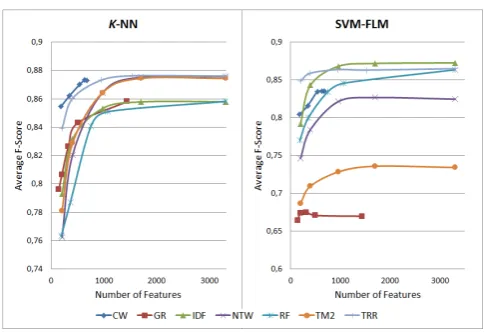
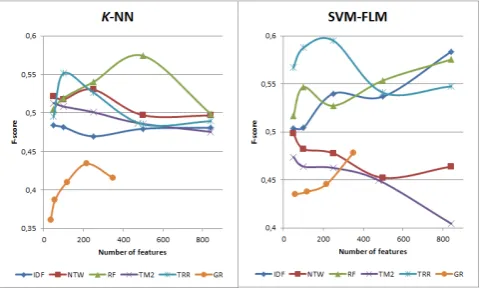
The results of feature selection are presented in Figures 1-2, the results for feature transformation based on term cluster-ing are illustrated in Figures 3-4.
Term F-score
weighting All Stop-word+ Novel
method terms stemming FT
IDF 0.873 (1) 0.836 (1) 0.544 (8)
GR 0.670 (8) 0.680 (7) 0.621 (5-7)
CW 0.835 (5) 0.749 (6) 0.747 (3-4)
RF 0.864 (3-4) 0.819 (4) 0.744 (5-7)
TM2 0.734 (7) 0.720 (7) 0.618 (3-4)
TRR 0.865 (3-4) 0.823 (2-3) 0.792 (1)
NTW 0.825 (6) 0.797 (5) 0.621 (5-7)
Collective 0.867 (2)*3 0.823 (2-3)*4 0.773 (2)*3
Table 2: Results for problem 1 with SVM-FLM
Term F-score
weighting All Stop-word+ Novel
method terms stemming FT
IDF 0.481 (5) 0.461 (5) 0.490 (4)
GR 0.416 (8) 0.395 (8) 0.182 (8)
CW 0.466 (7) 0.399 (7) 0.345 (7)
RF 0.499 (2) 0.496 (3) 0.547 (1)
TM2 0.475 (6) 0.458 (6) 0.480 (5)
TRR 0.489 (4) 0.510 (1-2) 0.527 (3)
NTW 0.497 (3) 0.483 (4) 0.471 (6)
Collective 0.540 (1)*6 0.521 (1)*5 0.543 (2)*3
Table 3: Results for problem 2 withk-NN
Term F-score
weighting All Stop-word+ Novel
method terms stemming FT
IDF 0.584 (2) 0.531 (2-3) 0.517 (3)
GR 0.478 (5) 0.378 (7) 0.211 (8)
CW 0.346 (8) 0.300 (8) 0.224 (7)
RF 0.575 (3) 0.531 (2-3) 0.555 (1)
TM2 0.404 (7) 0.452 (6) 0.487 (5)
TRR 0.548 (4) 0.512 (4) 0.506 (4)
NTW 0.464 (6) 0.471 (5) 0.481 (6)
[image:5.595.288.543.69.229.2]Collective 0.588 (1)*6 0.541 (1)*6 0.535 (2)*7
Table 4: Results for problem 2 with SVM-FLM
Stop-words filtering with stemming results in a significant decrease in classification effectiveness. A similar situation is observed when applying feature selection; we do not ob-serve a statistically significant decrease ofF-score only for GR (one of the worst methods) and for TRR with 90% of the dictionary. This means that useful information is lost. The reason lies in the fact that short utterances for classifi-cation are used.
The most effective dimensionality reduction method is fea-ture transformation based on term clustering. We obtain the best result for problem 1 only with 1532 features (TRR,
k-NN); for problem 2 it is possible to increase classifi-cation effectiveness with feature transformation based on term clustering.
The novel feature transformation method provides
appro-Figure 1: Feature selection for problem 1.
Figure 2: Feature selection for problem 2.
Figure 3: Feature transformation based on term clustering for problem 1.
priate classification results with a very compact feature set. For the first problem withk-NN the novel FT with collec-tives of term weighting methods provides the better result, than all other cases excluding the collective of term weight-ing methods with all words. Therefore, the novel FT is ap-propriate for real-time systems.
7.
Conclusion
[image:5.595.301.545.444.610.2]effec-Figure 4: Feature transformation based on term clustering for problem 2.
tiveness for domain detection of user utterances. The best dimensionality reduction method is feature transformation based on term clustering which is able to decrease dimen-sionality significantly without decrease of the classification effectiveness. The novel feature transformation method re-duces the dimensionality radically with appropriate classi-fication results and can be useful for real-time classiclassi-fication systems.
8.
Bibliographical References
Baharudin, B., Lee, L. H., and Khan, K. (2010). A re-view of machine learning algorithms for text-documents classification. Journal of advances in information tech-nology, 1(1):4–20.
Debole, F. and Sebastiani, F. (2004). Supervised term weighting for automated text categorization. InText min-ing and its applications, pages 81–97. Springer.
Fan, R.-E., Chang, K.-W., Hsieh, C.-J., Wang, X.-R., and Lin, C.-J. (2008). Liblinear: A library for large lin-ear classification. The Journal of Machine Learning Re-search, 9:1871–1874.
Fox, C. (1989). A stop list for general text. InACM SIGIR Forum, volume 24, pages 19–21. ACM.
Gasanova, T., Sergienko, R., Akhmedova, S., Semenkin, E., and Minker, W. (2014a). Opinion mining and topic cat-egorization with novel term weighting. InProceedings of the 5th Workshop on Computational Approaches to Subjectivity, Sentiment and Social Media Analysis, ACL 2014, pages 84–89.
Gasanova, T., Sergienko, R., Semenkin, E., and Minker, W. (2014b). Dimension reduction with coevolutionary ge-netic algorithm for text classification. InInformatics in Control, Automation and Robotics (ICINCO), 2014 11th International Conference on, volume 1, pages 215–222. IEEE.
Goutte, C. and Gaussier, E. (2005). A probabilistic inter-pretation of precision, recall and f-score, with implica-tion for evaluaimplica-tion. InAdvances in information retrieval, pages 345–359. Springer.
Han, E.-H. S., Karypis, G., and Kumar, V. (2001). Text Categorization Using Weight Adjusted k-Nearest Neigh-bor Classification. Springer.
Joachims, T. (2002). Learning to Classify Text Using Sup-port Vector Machines: Methods, Theory and Algorithms. Kluwer Academic Publishers.
Ko, Y. (2012). A study of term weighting schemes using class information for text classification. InProceedings of the 35th international ACM SIGIR conference on Re-search and development in information retrieval, pages 1029–1030. ACM.
Komatani, K., Kanda, N., Nakano, M., Nakadai, K., Tsu-jino, H., Ogata, T., and Okuno, H. G. (2009). Multi-domain spoken dialogue system with extensibility and robustness against speech recognition errors. In Pro-ceedings of the 7th SIGdial Workshop on Discourse and Dialogue, pages 9–17. Association for Computational Linguistics.
Lan, M., Tan, C. L., Su, J., and Lu, Y. (2009). Super-vised and traditional term weighting methods for auto-matic text categorization. Pattern Analysis and Machine Intelligence, IEEE Transactions on, 31(4):721–735. Lee, C., Jung, S., Kim, S., and Lee, G. G.
(2009). Example-based dialog modeling for practical multi-domain dialog system. Speech Communication, 51(5):466–484.
Minker, W. and Bennacef, S. (2004). Speech and human-Machine dialog. Springer Science & Business Media. Momtazi, S. and Klakow, D. (2009). A word clustering
approach for language model-based sentence retrieval in question answering systems. InProceedings of the 18th ACM conference on Information and knowledge man-agement, pages 1911–1914. ACM.
Morariu, D. I., Vintan, L. N., and Tresp, V. (2005). Meta-classification using svm classifiers for text documents.
Intl. Jrnl. of Applied Mathematics and Computer Sci-ences, 1(1).
Porter, M. F. (2001). Snowball: A language for stemming algorithms.
Rafaeli, A., Ziklik, L., and Doucet, L. (2008). The im-pact of call center employees’ customer orientation be-haviors on service quality. Journal of Service Research, 10(3):239–255.
Salton, G. and Buckley, C. (1988). Term-weighting ap-proaches in automatic text retrieval. Information pro-cessing & management, 24(5):513–523.
Shafait, F., Reif, M., Kofler, C., and Breuel, T. M. (2010). Pattern recognition engineering. In RapidMiner Com-munity Meeting and Conference, volume 9. Citeseer. Soucy, P. and Mineau, G. W. (2005). Beyond tfidf
weight-ing for text categorization in the vector space model. In
IJCAI, volume 5, pages 1130–1135.
Ward Jr, J. H. (1963). Hierarchical grouping to optimize an objective function.Journal of the American statistical association, 58(301):236–244.
Xu, H. and Li, C. (2007). A novel term weighting scheme for automated text categorization. InIntelligent Systems Design and Applications, 2007. ISDA 2007. Seventh In-ternational Conference on, pages 759–764. IEEE. Yang, Y. and Pedersen, J. O. (1997). A comparative study
[image:6.595.50.291.69.213.2]