Opinion Extraction Using a Learning-Based
Anaphora Resolution Technique
Nozomi Kobayashi Ryu Iida Kentaro Inui Yuji Matsumoto
Nara Institute of Science and Technology Takayama, Ikoma, Nara, 630-0192, Japan
{nozomi-k,ryu-i,inui,matsu}@is.naist.jp
Abstract
This paper addresses the task of extract-ing opinions from a given document collection. Assuming that an opinion can be represented as a tuple Subject, Attribute, Value, we propose a compu-tational method to extract such tuples from texts. In this method, the main task is decomposed into (a) the pro-cess of extracting Attribute-Value pairs from a given text and (b) the process of judging whether an extracted pair ex-presses an opinion of the author. We apply machine-learning techniques to both subtasks. We also report on the results of our experiments and discuss future directions.
1 Introduction
The explosive spread of communication on the Web has attracted increasing interest in technolo-gies for automatically mining large numbers of message boards and blog pages for opinions and recommendations.
Previous approaches to the task of mining a large-scale document collection for opinions can be classified into two groups: the document clas-sification approach and the information extrac-tion approach. In the document classification approach, researchers have been exploring tech-niques for classifying documents according to se-mantic/sentiment orientation such as positive vs. negative (e.g. (Dave et al., 2003; Pang and Lee, 2004; Turney, 2002)). The information extraction approach, on the other hand, focuses on the task of extracting elements which constitute opinions (e.g. (Kanayama and Nasukawa, 2004; Hu and Liu, 2004; Tateishi et al., 2001)).
The aim of this paper is to extract opinions that represent an evaluation of a products together with the evidence. To achieve this, we consider our task from the information extraction
view-point. We term the above task opinion extraction in this paper.
While they can be linguistically realized in many ways, opinions on a product are in fact often expressed in the form of an attribute-value pair. An attribute represents one aspect of a subject and the value is a specific language expression that qualifies or quantifies the aspect. Given this ob-servation, we approach our goal by reducing the task to a general problem of extracting four-tuples
Product, Attribute, Value, Evaluation from a large-scale text collection. Technology for this opinion extraction task would be useful for col-lecting and summarizing latent opinions from the Web. A straightforward application might be gen-eration of radar charts from collected opinions as suggested by Tateishi et al. (2004).
Consider an example from the automobile do-main, I am very satisfied with the powerful engine (of a car). We can extract the four-tupleCAR, en-gine, powerful, satisfiedfrom this sentence. Note that the distinction between Value and Evaluation is not easy. Many expressions used to express a Value can also be used to express an Evaluation. For this reason, we do not distinguish value and evaluation, and therefore consider the task of ex-tracting tripletsProduct, Attribute, Value. An-other problem with opinion extraction is that we want to get only subjective opinions. Given this setting, the opinion extraction task can be decom-posed into two subtasks: extraction of attribute-value pairs related to a product and determination of its subjectivity.
reso-lution to the opinion extraction problem and re-port on our experiments conducted on a domain-restricted set of Japanese texts excerpted from re-view pages on the Web.
2 Related work
In this section, we discuss previous approaches to the opinion extraction problem. In the pattern-based approach (Murano and Sato, 2003; Tateishi et al., 2001), pre-defined extraction patterns and a list of evaluative expressions are used. These ex-traction patterns and the list of evaluation expres-sions need to be manually created. However, as is the case in information extraction, manual con-struction of rules may require considerable cost to provide sufficient coverage and accuracy.
Hu and Liu (2004) attempt to extract the at-tributes of target products on which customers have expressed their opinions using association mining, and to determine whether the opinions are positive or negative. Their aim is quite sim-ilar to our aim, however, our work differs from theirs in that they do not identify the value corre-sponding to an attribute. Their aim is to extract the attributes and their semantic orientations.
Taking the semantic parsing-based approach, Kanayama and Nasukawa (2004) apply the idea of transfer-based machine translation to the ex-traction of attribute-value pairs. They regard the extraction task as translation from a text to a sen-timent unit which consists of a sensen-timent value, a predicate, and its arguments. Their idea is to replace the translation patterns and bilingual lexicons with sentiment expression patterns and a lexicon that specifies the polarity of expres-sions. Their method first analyzes the predicate-argument structure of a given input sentence mak-ing use of the sentence analysis component of an existing machine translation engine, and then ex-tracts a sentiment unit from it, if any, using the transfer component.
One important problem the semantic parsing approach encounters is that opinion expres-sions often appear with anaphoric expresexpres-sions and ellipses, which need to be resolved to accomplish the opinion extraction task. Our investigation of an opinion-tagged Japanese corpus (described below) showed that 30% of the attribute-value pairs we found did not have a direct syntactic dependency relation within the sentence, mostly due to ellipsis. For example1,
dezain-waahen-daga watashi-waφ-gasuki-dav
designa weird I [it] likev (The design is weird, but I like it.)
This type of case accounted for 46 out of 100
pairs that did not have direct dependency rela-tions. To analyze predicate argument structure robustly, we have to solve this problem. In the next section, we discuss the similarity between the anaphora resolution task and the opinion extraction task and propose to apply to opinion extraction a method used for anaphora resolution.
3 Method for opinion extraction
3.1 Analogy with anaphora resolution
We consider the task of extracting opinion tu-plesProduct, Attribute, Valuefrom review sites and message boards on the Web dedicated to pro-viding and exchanging information about retail goods. On these Web pages, products are often specified clearly and so it is frequently a trivial job to extract the information for the Product slot. We therefore in this paper focus on the problem of extractingAttribute, Valuepairs.
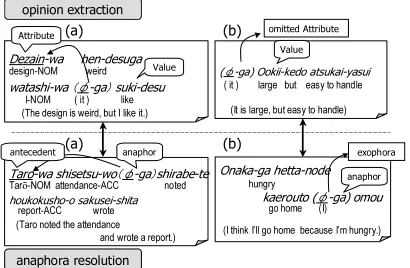
In the process of attribute-value pair identifi-cation for opinion extraction, we need to deal with the following two cases: (a) both a value and its corresponding attribute appear in the text, and (b) a value appears in the text while its at-tribute is missing since it is inferable form the value expression and the context. The upper half of Figure 1 illustrates these two cases in the auto-mobile domain. In (b), the writer is talking about the “size” of the car, but the expression “size” is not explicitly mentioned in the text. In addition, (b) includes the case where the writer evaluates the product itself. For example, “I’m very satis-fied with my car!”: in this case, a value expres-sion “satisfied” evaluates the product as a whole, therefore a corresponding attribute does not ex-ists.
For the case (a), we first identify a value ex-pression (like in Figure 1) in a given text and then look for the corresponding attribute in the text. Since we also see the case (b), on the other hand, we additionally need to consider the problem of whether the corresponding attribute of the identi-fied value expression appears in the text or not.
The structure of these problems is analogous to that of anaphora resolution; namely, there are ex-actly two cases in anaphora resolution that have a clear correspondence with the above two cases as illustrated in Figure 1: in (a) the noun phrase (NP) is anaphoric; namely, the NP’s antecedent appears in the text, and in (b) the noun phrase is non-anaphoric. A non-anaphoric NP is either
ex-1
adenotes the word sequence corresponding to the
Taro-wa shisetsu-wo(φ-ga)shirabe-te
houkokusho-o sakusei-shita
(a) (b)
Dezain-wa hen-desuga watashi-wa(φ-ga)suki-desu
(φ-ga) Ookii-kedo atsukai-yasui ( it ) large but easy to handle
(a) (b)
anaphora resolution opinion extraction
anaphor antecedent
Attribute
Value
(The design is weird, but I like it.)
omitted Attribute
(It is large, but easy to handle)
Tarō-NOM attendance-ACC noted report-ACC wrote
(Taro noted the attendance and wrote a report.) design-NOM weird
I-NOM ( it ) like
Value
Onaka-ga hetta-node kaerouto (φ-ga) omou
hungry go home (I)
exophora anaphor
[image:3.595.310.522.64.202.2](I think I’ll go home because I’m hungry.)
Figure 1: Similarity between opinion extraction and anaphora resolution
ophoric (i.e. the NP has an implicit referent) or in-definite. While the figure shows Japanese exam-ples, the similarity between anaphora resolution and opinion extraction is language independent. This analogy naturally leads us to think of apply-ing existapply-ing techniques for anaphora resolution to our opinion extraction task since anaphora reso-lution has been studied for a considerably longer period in a wider range of disciplines as we briefly review below.
3.2 Existing techniques for anaphora
resolution
Corpus-based empirical approaches to anaphora resolution have been reasonably successful. This approach, as exemplified by (Soon et al., 2001; Iida et al., 2003; Ng, 2004), is cost effective, while achieving a better performance than the best-performing rule-based systems for the test sets of MUC-6 and MUC-72.
As suggested by Figure 1, anaphora resolution can be decomposed into two subtasks: anaphoric-ity determination and antecedent identification. Anaphoricity determination is the task of judg-ing whether a given NP is anaphoric or non-anaphoric. Recent research advances have pro-vided several important findings as follows:
• Learning-based methods for antecedent identification can also benefit from the use of linguistic clues inspired by Centering The-ory (Grosz et al., 1995).
• One useful clue for anaphoricity determina-tion is the availability of a plausible candi-date for the antecedent. If an appropriate candidate for the antecedent is found in the preceding discourse context, the NP is likely to be anaphoric.
For these reasons, an anaphora resolution model performs best if it carries out the following
pro-2
The 7th Message Understanding Conference (1998):
www.itl.nist.gov/iaui/894.02/related projects/muc/
………interia ………seki…… Dezain-wa hen-desuga watashi-wa suki-desu ……
interior seat
design-NOM weird I-NOM like
candidates
design like interior like
seat like design like candidate attributes
real attribute
Select the best candidate attribute
Decide whether the candidate attribute stands for the real attribute or not design like
design like
real attribute
pairedness determination attribute
identification
opinionhood determination
Judge whether the pair expresses an opinion or not
opinion
Attribute
dictionary dictionaryValue
interior seat design
like good ….
target value
initialization
[image:3.595.78.283.65.199.2]pair extraction
Figure 2: Process of opinion extraction
cess in the given order (Iida et al., 2005): (1)
Antecedent identification: Given an NP,
iden-tify the best candidate antecedent for it, and (2)
Anaphoricity determination: Judge whether the
candidate really stands for the true antecedent of the NP.
3.3 An opinion extraction model inspired by
analogy with anaphora resolution
As illustrated in Figure 2, an opinion extraction model derived from the aforementioned analogy with anaphora resolution as follows:
1. Initialization: Identify attribute and value candidates by dictionary lookup
2. Attribute identification: Select a value and identify the best candidate attribute corre-sponding to the value
3. Pairedness determination: Decide whether the candidate attribute stands for the real at-tribute of the value or not (i.e. the value has no explicit corresponding attribute in the text)
4. Opinionhood determination: Judge wheth-er the obtained attribute-value pair3 ex-presses an opinion or not
Here, the attribute identification and pairedness determination processes respectively correspond to the antecedent identification and anaphoricity determination processes in anaphora resolution.
Note that our opinion extraction task requires an additional subtask, opinionhood determination — an attribute-value pair appearing in a text does not necessarily constitute an opinion. We elabo-rate on the notion of opinionhood in section 4.1.
From the above discussion, we can expect that the findings for anaphora resolution mentioned in 3.2 stated above apply to opinion extraction as well. In fact, the information about the candidate
3
attribute is likely to be useful for pairedness deter-mination. We therefore expect that carrying out attribute identification before pairedness determi-nation should outperform the counterpart model which executes the two subtasks in the reversed order. The same analogy also applies to opinion-hood determination; namely, we expect that opin-ion determinatopin-ion is bet performed after attribute determination. Furthermore, our opinion extrac-tion model also can be implemented in a totally machine learning-based fashion.
4 Evaluation
We conducted experiments with Japanese Web documents to empirically evaluate the perfor-mance of our opinion extraction model, focus-ing particularly on the validity of the analogy dis-cussed in the previous section.
4.1 Opinionhood
In these experiments, we define an opinion as fol-lows: An opinion is a description that expresses the writer’s subjective evaluation of a particular subject or a certain aspect of it.
By this definition, we exclude requests, factual or counter-factual descriptions and hearsay evi-dence from our target opinions. For example, The engine is powerful is an opinion, while a counter-factual sentence such as If only the engine were more powerful is not regarded as opinion.
4.2 Opinion-tagged corpus
We created an opinion-tagged Japanese corpus consisting of 288 review articles in the automo-bile domain (4,442 sentences). While it is not easy to judge whether an expression is a value or an attribute, we asked the annotator to identify at-tribute and value expressions according to their subjective judgment.
If some attributes are in a hierarchical rela-tion with each other, we asked the annotator to choose the attribute lowest in the hierarchy as the attribute of the value. For example, in a sound system with poor sound, only sound is annotated as the attribute of the value poor.
The corpus contains 2,191 values with an at-tribute and 420 values without an atat-tribute. Most of the attributes appear in the same sentence as their corresponding values or in the immediately preceding sentence (99% of the total number of pairs). Therefore, we extract attributes and their corresponding values from the same sentence or from the preceding sentence.
4.3 Experimental method
As preprocessing, we analyzed the opinion-tagged corpus using the Japanese morphological analyzer ChaSen4 and the Japanese dependency structure analyzer CaboCha5.
We used Support Vector Machines to train the models for attribute identification, pairedness de-termination and opinionhood dede-termination. We used the 2nd order polynomial kernel as the ker-nel function for SVMs. Evaluation was per-formed by 10-fold cross validation using all the data.
4.3.1 Dictionaries
We use dictionaries for identification of at-tribute and value candidates. We constructed a attribute dictionary and a value dictionary from review articles about automobiles (230,000 sen-tences in total) using the semi-automatic method proposed by Kobayashi et al. (2004). The data used in this process was different from the opinion-tagged corpus. Furthermore, we added to the dictionaries expressions which frequently appearing in the opinion-tagged corpus. The final size of the dictionaries was 3,777 attribute expres-sions and 3,950 value expresexpres-sions.
4.3.2 Order of model application
To examine the effects of appropriately choos-ing the order of model application we mentioned in the previous section, we conducted four ex-periments using different orders (AI indicates at-tribute identification,PDindicates pairedness de-termination andODindicates opinion determina-tion):
Proc.1: OD→PD→AI, Proc.2: OD→AI→PD Proc.3: AI→OD→PD, Proc.4: AI→PD→OD Note that Proc.4 is our proposed ordering.
In addition to these models, we adopted a base-line model. In this model, if the candidate value and a candidate attribute are connected via a de-pendency relation, the candidate value is judged to have an attribute. When none of the candidate attributes have a dependency relation, the candi-date value is judged not to have an attribute.
We adopted the tournament model for attribute identification (Iida et al., 2003). This model im-plements a pairwise comparison (i.e. a match) between two candidates in reference to the given value treating it as a binary classification prob-lem, and conducting a tournament which consists of a series of matches, in which the one that pre-vails through to the final round is declared the
4
http://chasen.naist.jp/
winner, namely, it is identified as the most likely candidate attribute. Each of the matches is con-ducted as a binary classification task in which one or other of the candidate wins.
The pairedness determination task and the opinionhood determination task are also binary classification tasks. In Proc.1, since pair identifi-cation is conducted before finding the best candi-date attribute, we used Soon et al.’s model (Soon et al., 2001) for pairedness determination. This model picks up each possible candidate attribute for a value and determines if it is the attribute for that value. If all the candidates are determined not to be the attribute, the value is judged not to have an attribute. In Proc.4, we can use the information about whether the value has a corresponding at-tribute or not for opinionhood determination. We therefore create two separate models for when the value does and does not have an attribute.
4.3.3 Features
We extracted the following two types of fea-tures from the candidate attribute and the candi-date value:
(a) surface spelling and part-of-speech of the target value expression, as well as those of its dependent phrase and those in its depended phrase(s)
(b) relation between the target value and can-didate attribute (distance between them, ex-istence of dependency, exex-istence of a co-occurrence relation)
We extracted (b) if the model could use both the attribute and the value information. Existence of a co-occurrence relation is determined by reference to a predefined co-occurrence list that contains attribute-value pair information such as “height of vehicle – low”. We created the list from the 230,000 sentences described in section 4.3.1 by applying the attribute and value dictionary and extracting attribute-value pairs if there is a de-pendency relation between the attribute and the value. The number of pairs we extracted was about 48,000.
4.4 Results
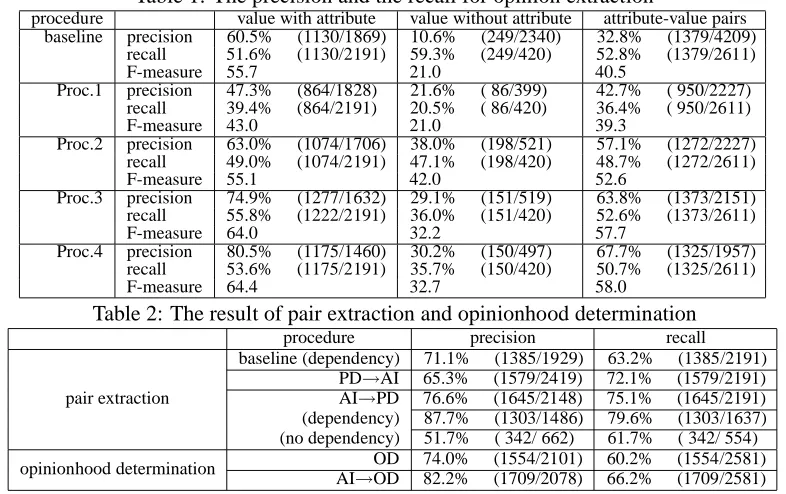
Table 1 shows the results of opinion extraction. We evaluated the results by recall R and preci-sionP defined as follows (For simplicity, we sub-stitute “A-V” for attribute-value pair):
R = correctly extracted A-V opinions total number of A-V opinions ,
P = correctly extracted A-V opinions
total number of A-V opinions found by the system.
In order to demonstrate the effectiveness of the information about the candidate attribute, we evaluated the results of pair extraction and opin-ionhood determination separately. Table 2 shows the results. In the pair extraction, we assume that the value is given, and evaluate how successfully attribute-value pairs are extracted.
4.5 Discussions
As Table 1 shows, our proposed ordering is out-performed on the recall in Proc.3, however, the precision is higher than Proc.3 and get the best F-measure. In what follows, we discuss the results of pair extraction and opinionhood determination.
Pair extraction From Table 2, we can see that
carrying out attribute identification before paired-ness determination outperforms the reverse order-ing by 11% better precision and 3% better recall. This result supports our expectation that knowl-edge of attribute information assists attribute-value pair extraction. Focusing on the rows la-beled “(dependency)” and “(no dependency)” in Table 2, while 80% of the attribute-value pairs in a direct dependency relation are successfully ex-tracted with high precision, the model achieves only 51.7% recall with 61.7% precision for the cases where an attribute and value are not in a di-rect dependency relation.
According to our error analysis, a major source of errors lies in the attribute identification task. In this experiment, the precision of attribute identifi-cation is 78%. A major reason for this problem was that the true attributes did not exist in our dictionary. In addition, a major cause of error in the pair determination stage is cases where an at-tribute appearing in the preceding sentence causes a false decision. We need to conduct further in-vestigations in order to resolve these problems.
Opinionhood determination Table 2 also
shows that carrying out attribute identification followed by opinionhood determination out-performs the reverse ordering, which supports our expectation that knowing the attribute information aids opinionhood determination.
Table 1: The precision and the recall for opinion extraction
procedure value with attribute value without attribute attribute-value pairs
baseline precision 60.5% (1130/1869) 10.6% (249/2340) 32.8% (1379/4209)
recall 51.6% (1130/2191) 59.3% (249/420) 52.8% (1379/2611)
F-measure 55.7 21.0 40.5
Proc.1 precision 47.3% (864/1828) 21.6% ( 86/399) 42.7% ( 950/2227)
recall 39.4% (864/2191) 20.5% ( 86/420) 36.4% ( 950/2611)
F-measure 43.0 21.0 39.3
Proc.2 precision 63.0% (1074/1706) 38.0% (198/521) 57.1% (1272/2227)
recall 49.0% (1074/2191) 47.1% (198/420) 48.7% (1272/2611)
F-measure 55.1 42.0 52.6
Proc.3 precision 74.9% (1277/1632) 29.1% (151/519) 63.8% (1373/2151)
recall 55.8% (1222/2191) 36.0% (151/420) 52.6% (1373/2611)
F-measure 64.0 32.2 57.7
Proc.4 precision 80.5% (1175/1460) 30.2% (150/497) 67.7% (1325/1957)
recall 53.6% (1175/2191) 35.7% (150/420) 50.7% (1325/2611)
F-measure 64.4 32.7 58.0
Table 2: The result of pair extraction and opinionhood determination
procedure precision recall
pair extraction
baseline (dependency) 71.1% (1385/1929) 63.2% (1385/2191)
PD→AI 65.3% (1579/2419) 72.1% (1579/2191)
AI→PD 76.6% (1645/2148) 75.1% (1645/2191)
(dependency) 87.7% (1303/1486) 79.6% (1303/1637)
(no dependency) 51.7% ( 342/ 662) 61.7% ( 342/ 554)
opinionhood determination OD 74.0% (1554/2101) 60.2% (1554/2581)
AI→OD 82.2% (1709/2078) 66.2% (1709/2581)
5 Conclusion
In this paper, we have proposed a machine learning-based method for the extraction of opin-ions on consumer products by reducing the prob-lem to that of extracting attribute-value pairs from texts. We have pointed out the similarity between the tasks of anaphora resolution and opinion ex-traction, and have applied the machine learning-based method designed for anaphora resolution to opinion extraction. The experimental results re-ported in this paper show that identifying the cor-responding attribute for a given value expression is effective in both pairedness determination and opinionhood determination.
References
K. Dave, S. Lawrence, and D. M. Pennock. 2003. Min-ing the peanut gallery: opinion extraction and semantic classification of product reviews. In Proc. of the 12th
In-ternational World Wide Web Conference, pages 519–528.
B. J. Grosz, A. K. Joshi, and S. Weinstein. 1995. Center-ing: A framework for modeling the local coherence of discourse. Computational Linguistics, 21(2):203–226. M. Hu and B. Liu. 2004. Mining and summarizing customer
reviews. In Proc. of the Tenth International Conference
on Knowledge Discovery and Data Mining, pages 168–
177.
R. Iida, K. Inui, H. Takamura, and Y. Matsumoto. 2003. In-corporating contextual cues in trainable models for coref-erence resolution. In Proc. of the EACL Workshop on the
Computational Treatment of Anaphora, pages 23–30.
R. Iida, K. Inui, Y. Matsumoto, and S. Sekine. 2005. Noun phrase coreference resolution in Japanese base on most
likely antecedant candidates. Journal of Information
Pro-cessing Society of Japan, 46(3). (in Japanese).
H. Kanayama and T. Nasukawa. 2004. Deeper sentiment analysis using machine translation technology. In
Pro-ceedings of the 20th International Conference on Com-putational Linguistics, pages 494–500.
N. Kobayashi, K. Inui, Y. Matsumoto, K. Tateishi, and T. Fukushima. 2004. Collecting evaluative expressions for opinion extraction. In Proc. of the 1st International
Joint Conference on Natural Language Processing, pages
584–589.
S. Murano and S. Sato. 2003. Automatic extraction of sub-jective sentences using syntactic patterns. In Proc. of the
Ninth Annual Meeting of the Association for Natural Lan-guage Processing, pages 67–70. (in Japanese).
V. Ng. 2004. Learning noun phrase anaphoricity to improve coreference resolution: Issues in representation and opti-mization. In Proc. of the 42nd Annual Meeting of the
As-sociation for Computational Linguistics, pages 152–159.
B. Pang and L. Lee. 2004. A sentiment education: Sen-timent analysis using subjectivity summarization based on minimum cuts. In Proc. of the 42nd Annual Meeting
of the Association for Computational Linguistics, pages
271–278.
W. M. Soon, H. T. Ng, and D. C. Y. Lim. 2001. A ma-chine learning approach to coreference resolution of noun phrases. Computational Linguistics, 27(4):521–544. K. Tateishi, Y. Ishiguro, and T. Fukushima. 2001. Opinion
information retrieval from the Internet. In IPSJ SIGNL
Note 144-11, pages 75–82. (in Japanese).
K. Tateishi, T. Fukushima, N. Kobayashi, T. Takahashi, A. Fujita, K. Inui, and Y. Matsumoto. 2004. Web opin-ion extractopin-ion and summarizatopin-ion based on viewpoints of products. In IPSJ SIGNL Note 163, pages 1–8. (in Japanese).
P. D. Turney. 2002. Thumbs up or thumbs down? semantic orientation applied to unsupervised classification of re-views. In Proc. of the 40th Annual Meeting of the