© 2015, IRJET ISO 9001:2008 Certified Journal Page 2439
OPINION MINING USING NEURAL LEARNING BASED FEATURE
EXTRACTION MODEL
S.SHUBHA
1, Dr.P.SURESH
21
Research Scholar, Research & Development Centre, Bharathiar University, Coimbatore - 641 046, Tamilnadu
& Head of the Department, GFGC, 18
thCross, Malleshwaram, Bangalore – 560012, Karnataka, India.
2
Research Supervisor & Head of the Department, Salem Soudeshwari College, Salem, Tamilnadu, India
---***---Abstract
In this paper, we have developed a NeuralLearning Based Opinion Feature Extraction (NLOFE) model that analyzes the customer’s reviews with the perspective of both subjective and linguistic characteristics. The model is divided into three stages. The first stage extracts the word from the review statements and is subjected to preprocessing, aiming at reducing the time to extract the opinions from reviewers. The subjective opinions of words are evaluated in second stage with hidden layer outcome on neural network training and therefore improving higher detection accuracy. The linguistic aspect of extracted words is analyzed with ontological repositories using associative mapping algorithm. The opinion words dictionary generated with neural trained words minimizes the false positive rate in a significant manner. The performance evaluation of NLOFE model is done with standard benchmark data sets of consumer product and services reviews extracted from Hotel Customer Service Reviews. The parameters used in evaluation are number of customer review words, size of opinion words, time to extract the opinions from reviewers, detection accuracy of subjective opinions of words and false positive rate. Experimental analysis shows that NLOFE model is able to reduce the time to extract the opinions from reviewers and reduce the false positive rate.
Key Words:
Opinion mining, Sentiment analysis,
Neural learning, Opinion feature extraction, Subjective
opinion.
1. INTRODUCTION
Sentiment analysis through opinion mining in recent past ascertained by the academicians have received significant and growing interest, is definitely a prosperous business for several industries including hotel, tourism, educations and so on. This emerging interest is specifically motivated by the ubiquitous need for opinion-based applications, like commercial product and mobile reviews, educational analysis and summarizing the opinion.
Economic impact of product reviews were ascertained [1] through data mining with the objective of analyzing the economic impact through random forest based classifiers. Based on intrinsic and extrinsic domain relevance [2], candidate features were generated aiming at improving the opinion features obtained through domain specific corpus were analyzed. However, both the above said methods lack subjective and linguistic characteristics which are addressed in the proposed work using NLOFE model. A review of mining opinion elements obtained through unstructured reviews was presented in [3].
Sentimental analysis and its impact on transfer learning, emotion detection and building resources was analyzed in [4]. However, the accuracy rate remained unaddressed. In [5], classification accuracy of the text being mined was improved by applying Training Label Cleaning, but at the cost of feature selection being compromised. In [6] using feature selection, accuracy of ordinal text classification was improved by applying chi-square.
A positive or negative nature of blog distillation was presented in [7] aiming at improving the substantial impact on retrieval. Another method for opinion mining in Twitter was analyzed in [8] using hybrid classification. The application of hybrid classification improved the accuracy of the data being classified in a substantial manner. In [9], integer linear programming was applied with the objective of improving the classification accuracy in opinion mining. Conditional random fields applied in [10] in the automatic annotation of text resulted in improved accuracy. However, the above said methods lack efficient mapping of subjective and linguistic characteristics which is provided in the NLOFE model through associative mapping algorithm.
© 2015, IRJET ISO 9001:2008 Certified Journal Page 2440 The correlation of sentiment score was analyzed in [12]
for online job search companies based on aspects set and opinion words set resulting in efficient classification. Fuzzy linguistic hedges were applied in [13] for fined grained classification and improving the classification accuracy through feature based classification approach. With the increase in the use of big data applications, enriching semantic knowledge is the need of the hour.
In [14], semantic knowledge was used to enrich the data obtained for domain specific training corpus. Another method called artificial neural network was applied in [15] aiming at improving the reasoning capabilities through natural language concepts. But the accuracy with respect to scalability remained unsolved. The detection accuracy is improved in the NLOFE model using feed backward propagation.
A novel sentiment analysis model was presented in [16] with the objective of improving the rate of accuracy. Naïve Bayes model was applied in [17] to improve the classification accuracy with the aid of bigram item response theory. In [18], MapReduce function was applied for sentiment information analysis from big data. By applying MapReduce function, efficient load balance was achieved. Several avenues opened up in sentiment and opinion mining was presented in [19]. Improved preprocessing techniques was applied in [20] for efficient handling of negation, integrated with sentiment lexicons with the purview of reducing the unwanted data.
Our model is different from these approaches in the sense that we expanded the opinion feature extraction with the help of Neural Learning model using Feed Backward Propagation for better coverage of the hotel reviews using Associative Mapping algorithm developed by us to determine the subjective and linguistic characteristics.
The paper is organized as follows. In Section 2 we developed a Neural Learning Based Opinion Feature Extraction (NLOFE) model to analyze customer’s reviews and then describe the user review methods using vector space depiction, feed backward propagation and associative mapping algorithm that we will use as test beds. Section 3 reports the results of experiments we have conducted using two opining mining-based learning methods with Trip Advisor dataset for hotel reviews. Section 4 discusses in detail using the table and graph form. Finally, Section 5concludes the paper.
2. DESIGN OF NEURAL LEARNING BASED OPINION
FEATURE EXTRACTION (NLOFE) MODEL
In this section the proposal work develops, a Neural Learning Based Opinion Feature Extraction (NLOFE) model, which analyzes the customer’s reviews with the
perspective of both subjective and linguistic
[image:2.595.314.554.134.346.2]characteristics. Figure 1 shows the block diagram of NLOFE model.
Figure 1 Block diagram of NLOFE model
The NLOFE model includes three components. The first component performs preprocessing by applying Vector Space Depiction with the objective of reducing the time to extract the opinions from reviewers. The second component applies feed backward propagation to extract subjective opinion of words and linguistic characteristics aiming at improving higher detection accuracy, and the third component applies associative mapping algorithm that efficiently analyses both subjective and linguistic characteristics. This in turn reduces the false positive rate in an extensive manner.
© 2015, IRJET ISO 9001:2008 Certified Journal Page 2441
Figure 2 Block diagram of Preprocessing of review statements
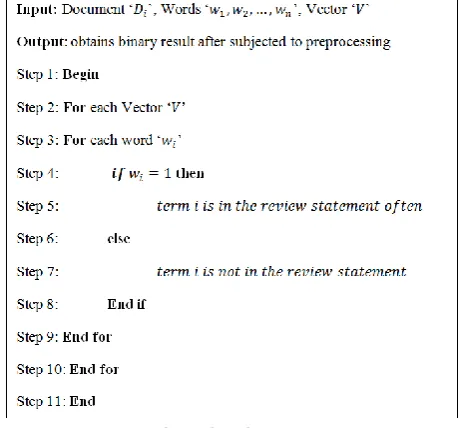
Figure 2 explains how unwanted data are removed during preprocessing using vector space depiction with the objective of reducing the time to extract the opinions from reviewers. Many of the words from review statements are worthless and are called as stop words. The objective of removal of stop words from review statements is to reduce the file size that in turn improves the efficiency of the model. On the other hand, stemming helps in the efficient identification of root/stem word that helps in matching similar words. Figure 3 shows the algorithmic description of preprocessing involved for stemming and removal of stop words.
Figure 3 Algorithm for preprocessing
As shown in the figure 3, let us consider a document ‘Di’ denoted by a vector ‘V’, where the vector includes the review statement consisting of words ‘w1,w2,...,wn’. The resultant vector space depiction includes binary result of either ‘wi=1’ or ‘wi=0’ and is mathematically formulated as given below.
Di → w1,w2,...,wn (1)
If wi = 1, the corresponding term i is in the review
statement of ten (2)
If wi = 0, the corresponding term i is not in the review
statement. (3)
From (2) and (3), the occurrence of the corresponding term in the review statement is measured in an efficient manner using the formulation as given below.
Ew = nfi * Stati * N (4)
From (4), the extracted words ‘Ew’ is obtained using the number of time ‘nfi’ the corresponding term occurred in the review statement ‘Stati’ and ‘N’ representing the total number of statements obtained from various reviewers. The extracted words are associated with neurons and lead to training based on Feed Backward Propagation.
2.2 Construction of Feed Backward Propagation
[image:3.595.311.560.467.648.2]The second stage in the design of NLOFE model is the design of Feed Backward Propagation. Feed Backward Propagation in NLOFE model implies that the data (i.e. extracted words) flow in one direction. In feed backward propagation, a constant factor ‘1’ is fed into the output layer and the Neural Network executes in a backward manner. Incoming information regarding the extracted words ‘Ew’ is added and multiplied by the value stored in the left portion. The result is transferred to the left portion and the result obtained at the input layer is the function with respect to ‘Ew’.
Figure 4 Block diagram of Feed Backward Propagation
© 2015, IRJET ISO 9001:2008 Certified Journal Page 2442 opinions of words are evaluated with hidden layer
outcome on neural network training and are formulated as given below.
(5)
From (5), the subjective opinions of words ‘SO’ through activation function ‘f’ is obtained based on the ‘ ’ that represents the ‘ith’ output from extracted words ‘ ’ whereas ‘N’ represents the total number of reviews obtained (i.e. hotel reviews made by the tourist). Finally, the output layer contains the measured values from the Hidden layer.
2.3
Design of NLP-based ontology repository
[image:4.595.308.551.181.406.2]Finally, the linguistic aspect of extracted words is analyzed with ontological repositories using NLP (i.e. based on decision tree model). Ontology repositories focuses on interesting events from reviewers point of view that build a hierarchy of concepts and measures the most common and unique relations between them. Figure 5 given below shows the Tree-based Tourist hotel review ontology that include object set (i.e. Rooms and Food) and verb list (i.e. Large, Clean, Nice, Good, Fresh, Delicious, Not ready, Not clean and Noisy).
Figure 5 Tourist hotel review ontology using NLP
Figure 5 shows the object set with its verb list that forms a hierarchy of concepts and is mathematically formulated as.
(6)
From equation (6), object set ‘Oi’ and verb list ‘Vi’ are stored in the opinion words dictionary with the neural trained words. Opinion words dictionary includes certain information including parts-of-speech, synonyms in an indexed manner. Based on the hierarchy of concepts, the most common and unique relations between them is identified by applying the associative mapping algorithm.
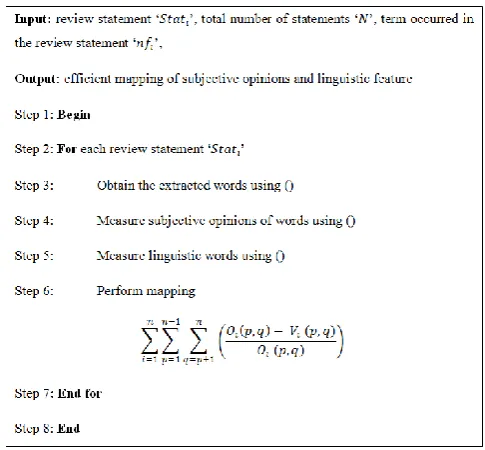
The subjective opinions and linguistic feature of the opinion words are mapped to the associated semantic words of the reviewer comments. Figure 6 shows the algorithmic description of associative mapping with respect to subject opinions and linguistic features of the opinion words.
Figure 6 Associative mapping algorithm
In the algorithm for each of the review statements, we extract opinion words. With the extracted words, subjective opinions and linguistic words are measured. Efficient mapping is performed subjective opinions and linguistic feature of the opinion words are associated with the semantic words of the reviewer comments.
3. EXPERIMENTAL SETUP
To validate the performance of Neural Learning Based Opinion Feature Extraction (NLOFE) model, experiments were conducted using JAVA platform with Weka tool. The performance evaluation of NLOFE model was performed using standard benchmark data sets of services reviews extracted from Hotel Customer Service Reviews (eg: OpinRank Dataset - Reviews from TripAdvisor). The dataset contains full reviews of hotels in 10 different cities (Dubai, Beijing, London, New York, New Delhi, San Francisco, Shanghai, Montreal, Last Vegas and Chicago) using Java platform that helps in analyzing the comments made by tourists about the Hotel rooms and food provided. Total number of reviews includes 250,000. For experimental purpose, we reviewed using 350 and the extracted field includes date of review, review title and review comments made by the tourists.
[image:4.595.47.276.423.609.2]© 2015, IRJET ISO 9001:2008 Certified Journal Page 2443 factors such as customer review words, size of opinion
words, time to extract the opinions from reviewers, review detection accuracy of subjective opinions of words and false positive rate.
4. RESULTS ANALYSIS OF NLOFE MODEL
4.1 Impact of Time to extract the opinions from
reviewers
Time to extract the opinions form reviewers is measured using the number of words (i.e. customer review words) and the time to extract single word. The mathematical formulation for execution time to extract the opinions from reviewers is given as below.
(7)
[image:5.595.307.558.70.241.2]From (7), the execution time ‘ET’ is measured using the number of words ‘Wi’ and measured in terms of milliseconds.
Table 1 Tabulation for Time to extract opinions from reviewers
Customer
review words Time to extract opinions from reviewers (ms) NLOFE MTRC FI-IEDR
50 19.23 23.75 31.42
100 24.89 33.85 37.87
150 31.35 40.31 44.33
200 27.27 36.23 40.25
250 34.58 43.54 47.56
300 40.23 49.19 54.21
350 38.52 47.48 51.50
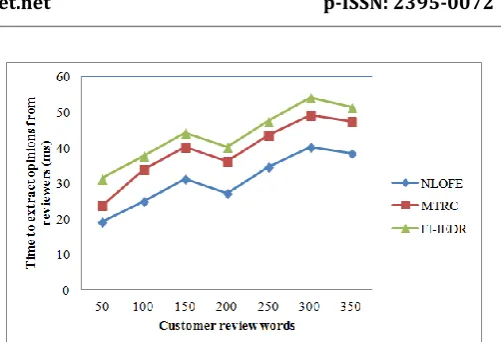
To assess the performance of NLOFE model it was compared with other two systems, namely, MTRC [1] and FI-IEDR [2]. All three methods were implemented using JAVA with Weka tool and the result is tabulated as shown in table 1. The results on NLOFE model are investigated with the small stage information which is obtained from experimental work.
Figure 7 Measure of Time to extract opinions from reviewers
To estimate the execution time to extract opinions from reviewers, the customer review words were combined and the product of the customer review words was performed based on the samples taken from different hotels in each city. The data were collected from Dubai, New York and New Delhi. The data were collected on the basis of the facilities provided in terms of room and food corresponding to each city. Figure 7 illustrates the impact of changes in the execution time on different sample periods. It shows that the execution time decreases for OpinionRank dataset using different sample periods.
Also from the figure 7, we find the graph is not linear which states that the review status reached its peak with higher review words collected from different customers (i.e. tourists). The execution time to extract opinions from reviewers is improved using NLOFE model by 29.13% compared to MTRC [1] that helps in better extraction of opinion from the reviewers using the Vector Space Depiction. Moreover, by applying Vector Space Depiction in NLOFE model the stemming and removal of stop words using preprocessing helps in removing the unwanted data and therefore reduces the execution time by 48.54% compared to FI-IEDR [2].
4.2 Impact of Detection accuracy
The review detection accuracy of subjective opinions of words is the ratio of number of correct review words to the total number of test cases made. The review detection accuracy of subjective opinions of words is formulated as given below.
(8)
© 2015, IRJET ISO 9001:2008 Certified Journal Page 2444
Table 2 Tabulation for review detection accuracy
Customer
review words NLOFE Review detection accuracy (%) MTRC FI-IEDR
50 83.14 71.29 59.35
100 87.21 76.18 71.13
150 80.35 69.32 64.27
200 82.18 71.15 66.10
250 84.35 73.32 68.27
300 86.15 75.12 70.07
350 88.24 77.21 72.16
[image:6.595.38.290.409.556.2]The review detection accuracy during each sample period that includes date, review title and full customer’s review is observed and in a similar manner, comparison is made with other methods to obtain the review detection accuracy. The review detection accuracy in table 2 is observed to increase with 100 customer review words. But with the increase in the review words, the review detection accuracy remains stable. In order to observe the review detection accuracy for achieving optimal accuracy rate, a scenario with default parameters value for seven different periods was run. For each implementation run, the review words obtained from each customer (i.e. tourists) was changed.
Figure 8 Measure of review detection accuracy
Figure 8 compares the review detection accuracy for different sample periods (i.e. for different hotels of three different cities) using NLOFE model to that of MTRC and FI-IEDR for the similar scenarios discussed above. In all scenarios, the NLOFE model outperforms all two systems. As illustrated in the graphs, the review detection accuracy for hotel reviews follows a decreasing trend when compared to the state-of-the-art methods from the start of the simulation.
It can be observed that during with the customer review words from 50 – 100, the review detection accuracy observed using all three methods increased whereas with customer review words in the range of 150 – 350, the review detection accuracy decreased using NLOFE model in comparison to two other methods [1] and [2]. This is
because of the application of Feed Backward Propagation. Using the Summation and activation function in Feed Backward Propagation, subjective opinions of words are evaluated with hidden layer outcome on neural network training resulting in maximizing the review detection accuracy. As a result, the maximum detection accuracy obtained on customer review word increases by 13.37% compared to MTRC and 23.41% compared to FI-IEDR respectively.
4.3 Impact of false positive rate
False positive rate is also known as false alarm rate which is the proportion of examples which were analyzed as positive reviews, but belong to a different class of Negative reviews, among all the total number of reviews made.
(9)
From equation (9), the false positive rate ‘FPR’ is measured in terms of percentage (%).
Table 3 Tabulation for false positive rate
Number of
reviews made NLOFE False positive rate (%) MTRC FI-IEDR
30 27.35 37.48 47.29
60 35.33 40.34 45.36
90 41.89 46.93 51.95
120 58.76 63.79 68.81
150 53.21 58.24 63.26
180 64.89 69.92 74.94
210 68.14 73.18 77.20
[image:6.595.308.560.562.710.2]Seven combinations of false positive rate observations collected from three different cities (Dubai, New York and New Delhi) are shown in Table 3.
Figure 9 Measure of false positive rate
© 2015, IRJET ISO 9001:2008 Certified Journal Page 2445 methods was observed to be increasing with the number
of reviews made in the range of 30 and 120. There was a fall off in the values of false positive rate when 150 reviews were made and then a rise in the false positive rate was observed. This is because of the involvement of high variations observed in the hotel industry, a steadiness was not observed and false positive rate varied accordingly. Comparatively, the proposed model observed a decreased false positive rate compared to MTRC and FI-IEDR. This is because of applying NLP-based ontology repository which analyses the user reviews with both subjective and linguistic characteristics that results in the decrease in the false positive rate by 22.39% compared to MTRC. Besides, using opinion words dictionary, the subjective and linguistic characteristics are efficiently mapped together using associative mapping algorithm forming a decrease in the false positive rate by 43.09% compared to FI-IEDR.
4.4 Impact of efficiency in terms of information
retrieval
In this section, the impact of efficiency in terms of information retrieval is compared using the three methods NLOFE, MTRC and FI-IEDR.
Table 4 Tabulation for efficiency in terms of information retrieval
Methods Efficiency in terms of information retrieval
NLOFE 78.35
MTRC 62.45
FI-IEDR 58.21
Figure 10 Measure of efficiency in terms of information retrieval
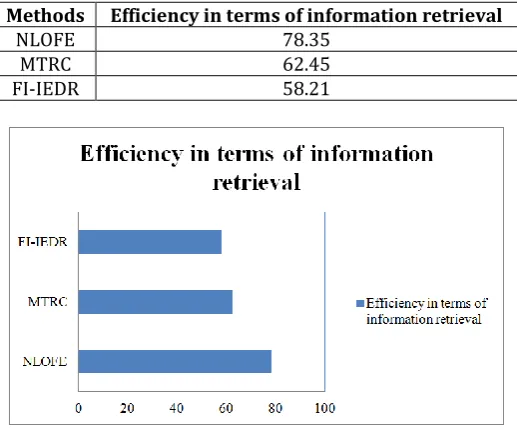
Table 4 and figure 10 shows the impact of efficiency in terms of information retrieval for the hotel review of three different cities. From the figure it is illustrative that the information retrieval is improved using the NLOFE than when compared to the MTRC [1] and FI-IEDR [2] respectively. This is because by applying neural learning, both subjective opinions of words and linguistic characteristics are extracted in an efficient manner.
Furthermore, with the associative mapping algorithm, the subjective opinions and linguistic feature of the opinion words are mapped to associated semantic words of the reviewer comments in a significant way improving the information retrieval by 20.29% compared to MTRC and 6.78% compared to FI-IEDR respectively.
5. CONCLUSIONS
This paper presented a novel model for analyzing the user reviews based on both subjective and linguistic characteristics using Neural Learning Based Opinion Feature Extraction (NLOFE) model. A key feature of this method is its ability to increase the review detection accuracy using Feed Backward Propagation as more reviews are obtained from the customers. Vector Space Depiction and binary result of Vector Space Depiction was applied in NLOFE model for efficient minimization of execution time for extracting the opinions from reviewers and to make profit out of it. Next, due to the change in government policy regarding taxes and market fluctuations, to improve the review detection accuracy rate for effective review results being analyzed, summation and activation function was applied to the extracted words in NLOFE model. Using NLP-based
ontology repository, subjective and linguistic
characteristics were extracted using associative mapping algorithm and was provided to the hotel owner in order to improve their facilitations and therefore increase the profit in hotel industry. Experimental evaluation analysis was conducted to analyze time to extract the opinions from reviewers, detection accuracy of subjective opinions of words and false positive rate. Performances results reveal that the proposed NLOFE model provides higher level of forecasting rate and improved review detection accuracy on various samples obtained from three different cities. Compared to the other opinion mining methods the proposed Neural Learning Based Opinion Feature Extraction model proved to be better in terms of detection accuracy by 18.39% compared to MTRC and FI-IEDR respectively.
REFERENCES
[1] Anindya Ghose, Panagiotis G. Ipeirotism,” Estimating the Helpfulness and Economic Impact of Product Reviews: Mining Text and Reviewer Characteristics”, IEEE TRANSACTIONS ON KNOWLEDGE AND DATA ENGINEERING, Vol. 23, Issue. 10, Aug 2011
[2]Zhen Hai, Kuiyu Chang, Jung-Jae Kim, and Christopher C. Yang,” Identifying Features in Opinion Mining via Intrinsic and Extrinsic Domain Relevance”, IEEE TRANSACTIONS ON KNOWLEDGE AND DATA ENGINEERING, Vol. 26, Issue. 3, MARCH 2014
[image:7.595.33.292.429.644.2]© 2015, IRJET ISO 9001:2008 Certified Journal Page 2446 [4] Walaa Medhat, Ahmed Hassan and Hoda Korashy,
“Sentiment analysis algorithms and applications: A survey”, Ain Shams University, Elsevier, Volume 5, Issue 4, December 2014, Pages 1093 – 1113.
[5] Andrea Esuli and Fabrizio Sebastiani, “Improving Text Classification Accuracy by Training Label Cleaning”, ACM Transactions on Information Systems (TOIS), Volume 31, Issue 4, November 2013, Article No. 19, 28 Pages.
[6] Stefano Baccianella, Andrea Esuli and Fabrizio Sebastiani, “Using micro-documents for feature selection: The case of ordinal text classification”, Elsevier, Volume 40, Issue 11, 1 September 2013, Pages 4687 – 4696.
[7] Giacomo Berardi, Andrea Esuli, Fabrizio Sebastiani and Fabrizio Silvestri, “Blog Distillation via Sentiment-Sensitive Link Analysis”, Natural Language Processing and Information Systems, Lecture Notes in Computer Science, Springer, Volume 7337, 2012, Pages 228 – 233.
[8] Farhan Hassan Khan, Saba Bashir and Usman Qamar, “TOM: Twitter opinion mining framework using hybrid classification scheme”, Elsevier, Volume 57, January 2014, Pages 245 – 257.
[9] Yanyan Zhao, Bing Qin, Ting Liu and Wei Yang, “Aspect-Object Alignment with Integer Linear Programming in Opinion Mining”, PLoS One, May 22, 2015, 18 pages. [10] Andrea Esuli, Diego Marcheggiani and Fabrizio
Sebastiani, “An enhanced CRFs-based system for information extraction from radiology reports”, Elsevier, Volume 46, Issue 3, June 2013, Pages 425 – 435.
[11] Xinmiao Li, Jing Li and Yukeng Wu, “A Global Optimization Approach to Multi-Polarity Sentiment Analysis”, PLoS One, April 24, 2015, 18 Pages.
[12] Marcelo Drudi Miranda and Renato José Sassi, “Using Sentiment Analysis to Assess Customer Satisfaction in an Online Job Search Company”, Business Information Systems Workshops, Springer, Lecture Notes in Business Information Processing, Volume 183, 2014, Pages 17 – 27.
[13] Mita K. Dalal and Mukesh A. Zaveri, “Opinion Mining from Online User Reviews Using Fuzzy Linguistic Hedges”, Hindawi Publishing Corporation, Applied Computational Intelligence and Soft Computing, 2014, Article ID 735942, 9 pages.
[14] A. Weichselbraun, S. Gindl and A. Scharl, “Enriching semantic knowledge bases for opinion mining in big data applications”, Elsevier, Volume 69, October 2014, Pages 78 – 85.
[15] Erik Cambria, Thomas Mazzocco and Amir Hussain, “Application of multi-dimensional scaling and artificial neural networks for biologically inspired opinion mining”, Elsevier, Volume 4, April 2013, Pages 41–53. [16] Basant Agarwal, Namita Mittal, Pooja Bansal and
Sonal Garg, “Sentiment Analysis Using Common-Sense and Context Information”, Hindawi Publishing
Corporation, Computational Intelligence and
Neuroscience, 2015, Article ID 715730, 9 pages. [17] M. Ravichandran, G. Kulanthaivel, and T.
Chellatamilan, “Intelligent Topical Sentiment Analysis for the Classification of E-Learners and Their Topics of Interest”, Hindawi Publishing Corporation, The Scientific World Journal, 2015, Article ID 617358, 8 pages
[18] Ilkyu Ha, Bonghyun Back, and Byoungchul Ahn, “MapReduce Functions to Analyze Sentiment Information from Social Big Data”, Hindawi Publishing Corporation, International Journal of Distributed Sensor Networks, 2015, Article ID 417502, 11 pages. [19] Erik Cambria, Björn Schuller , Yunqing Xia and
Catherine Havasi, “New Avenues in Opinion Mining and Sentiment Analysis”, IEEE Intelligent Systems, Volume 28, Issue 2, March-April 2013, Pages 15 – 21.
[20] Atika Qazi, Ram Gopal Raj, Muhammad Tahir, Erik Cambria and Karim Bux Shah Syed, “Enhancing Business Intelligence by Means of Suggestive Reviews”, Hindawi Publishing Corporation, The Scientific World Journal, 2014, Article ID 879323, 11 pages.
BIOGRAPHIES
Shubha S has 2 years of industrial experience and 16 years of teaching experience. She has authored two text books at UG level. She has also presented papers at National and International Conferences. Presently she is working as Assistant Professor and Head of the Department in Computer Science at Government First
Grade College, Malleshwaram,
Bangalore, Karnataka.