Temporal Feature Modification for Retrospective Categorization
Robert Liebscher and Richard K. Belew
Department of Cognitive Science
University of California, San Diego
{rliebsch|rik}@cogsci.ucsd.edu
Abstract
We show that the intelligent use of one small piece of contextual information–a document’s publication date–can improve the performance of classifiers trained on a text categorization task. We focus on academic research docu-ments, where the date of publication undoubt-edly has an effect on an author’s choice of words. To exploit this contextual feature, we propose the technique of temporal feature
mod-ification, which takes various sources of
lexi-cal change into account, including changes in term frequency, associative strength between terms and categories, and dynamic categoriza-tion systems. We present results of classifi-cation experiments using both full text papers and abstracts of conference proceedings, show-ing improved classification accuracy across the whole collection, with performance increases of greater than 40% when temporal features are exploited. The technique is fast, classifier-independent, and works well even when mak-ing only a few modifications.
1
Introduction
As they are normally conceived, many tasks relevant to Computational Linguistics (CL), such as text categoriza-tion, clustering, and information retrieval, ignore the
con-text in which a document was written, focusing instead on
the lexical content of the document. Numerous improve-ments have been made in such tasks when context is con-sidered, for example the hyperlink or citation structure of a document collection (Cohn and Hofmann, 2001; Getoor et al., 2001). In this paper, we aim to show that the intel-ligent use of another dimension of context–a document’s publication date–can improve the performance of classi-fiers trained on a text categorization task.
Traditional publications, such as academic papers and patents, have histories that span centuries. The World
Wide Web is no longer a new frontier; over a decade of its contents have been archived (Kahle, 2005); Usenet and other electronic discussion boards have been around for several decades. These forums continue to increase their publication rates and show no signs of slowing. A cur-sory glance at any one of them at two different points in time can reveal widely varying content.
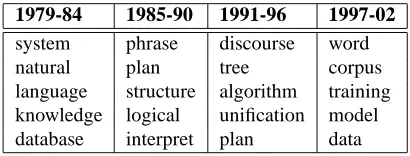
For a concrete example, we can ask, “What is Compu-tational Linguistics about?” Some topics, such as ma-chine translation, lie at the heart of the discipline and will always be of interest. Others are ephemeral or have reached theoretical upper bounds on performance. It is thus more appropriate to ask what CL is about at some point in time. Consider Table 1, which lists the top five unigrams that best distinguished the field at different six-year periods, as derived from the odds ratio measure (see Section 3.2) over the full text of the ACL proceedings.
1979-84 1985-90 1991-96 1997-02
system phrase discourse word
natural plan tree corpus
language structure algorithm training
knowledge logical unification model
[image:1.612.324.529.441.519.2]database interpret plan data
Table 1: ACL’s most characteristic terms for four time periods.
While these changes are interesting in their own right for an historical linguist, we aim to show that they can also be exploited for practical purposes. We focus on a fairly homogeneous set of academic research documents, where the time of publication undoubtedly has an effect both on an author’s choice of words and on a field’s defi-nition of underlying topical categories. A document must say something novel while building upon what has al-ready been said. This dynamic generates a landscape of changing research language, where authors and dis-ciplines constantly influence and alter the course of one another.
1.1 Motivations
Text Categorization (TC) systems are typically used to classify a stream of documents soon after they are pro-duced, based upon a set of historical training data. It is common for some TC applications, such as topic tracking (see Section 5.2), to downweight older features, or the feature vectors of entire documents, while placing more emphasis on features that have recently shown increased importance through changes in frequency and discrimi-native ability.
Our task, which we call retrospective categorization, uses historical data in both the training and test sets. It is retrospective from the viewpoint of a current user brows-ing through previous writbrows-ings that are categorized with respect to a “modern” interpretation. Our approach is mo-tivated by three observations concerning lexical change over time, and our task is to modify features so that a text classifier can account for all three.
First, lexical changes can take place within a category. The text collections used in our experiments are from var-ious conference proceedings of the Association of Com-puting Machinery, which uses a hierarchical classifica-tion system consisting of over 500 labels (see Secclassifica-tion 2). As was suggested by the example of Table 1, even if classification labels remain constant over time, the terms that best characterize them can change to reflect evolv-ing “meanevolv-ings”. We can expect that many of the terms most closely associated with a category like Computa-tional Linguistics cannot be captured properly without explicitly addressing their temporal context.
Second, lexical changes can occur between categories. A term that is significant to one category can suddenly or gradually become of interest to another category. This is especially applicable in news corpora (see examples in Section 3), but also applies to academic research doc-uments. Terminological “migrations” between topics in computer science, and across all of science, are common. Third, any coherent document collection on a par-ticular topic is sufficiently dynamic that, over time, its categorization system must be updated to reflect the changes in the world on which its texts are based. Al-though Computational Linguistics predates Artificial In-telligence (Kay, 2003), many now consider the former a subset of the latter. Within CL, technological and theo-retical developments have continually altered the labels ascribed to particular works.
In the ACM’s hierarchical Computing Classification System (see Section 2.1), several types of transforma-tions are seen in the updates it received in 1983, 1987,
1991, and 1998.1 In bifurcations, categories can be split
apart. With collapses, categories that were formerly more fine-grained, but now do not receive much attention, can
1http://acm.org/class/
be combined. Finally, entirely new categories can be in-serted into the hierarchy.
2
Data
To make our experiments tractable and easily repeatable for different parameter combinations, we chose to train and test on two subsets of the ACM corpus. One subset consists of collections of abstracts from several different ACM conferences. The other includes the full text col-lection of documents from one conference.
2.1 The ACM hierarchy
All classifications were performed with respect to the ACM’s Computing Classification System, 1998 version. This, the most recent version of the ACM-CCS, is a hi-erarchic classification scheme that potentially presents a wide range of hierarchic classification issues. Because the work reported here is focused on temporal aspects of text classification, we have adopted a strategy that effec-tively “flattens” the hierarchy. We interpret a document
which has a primary2 category at a narrow, low level in
the hierarchy (e.g.,H.3.3.CLUSTERING) as also
classi-fied at all broader, higher-level categories leading to the
root (H,H.3, H.3.3). With this construction, the most
refined categories will have fewer example documents, while broader categories will have more.
For each of the corpora considered, a threshold of 50 documents was set to guarantee a sufficient number of in-stances to train a classifier. Narrower branches of the full ACM-CCS tree were truncated if they contained insuf-ficient numbers of examples, and these documents were associated with their parent nodes. For example, if H.3.3 contained 20 documents and H.3.4 contained 30, these would be “collapsed” into the H.3 category.
All of our corpora carry publication timestamp infor-mation involving time scales on the order of one to three decades. The field of computer science, not surprisingly, has been especially fortunate in that most of its pub-lications have been recorded electronically. While ob-viously skewed relative to scientific and academic pub-lishing more generally, we nevertheless find significant “micro-cultural” variation among the different special in-terest groups.
2.2 SIGIR full text
We have processed the annual proceedings of the Associ-ation for Computing Machinery’s Special Interest Group in Information Retrieval (SIGIR) conference from its in-ception in 1978 to 2002. The collection contains over 1,000 documents, most of which are 6-10 page papers, though some are keynote addresses and 2-3 page poster
2Many ACM documents also are classified with additional
Corpus Vocab size No. docs No. cats
SIGIR 16104 520 17
SIGCHI 4524 1910 20
SIGPLAN 6744 3123 22
[image:3.612.84.290.56.206.2]DAC 6311 2707 20
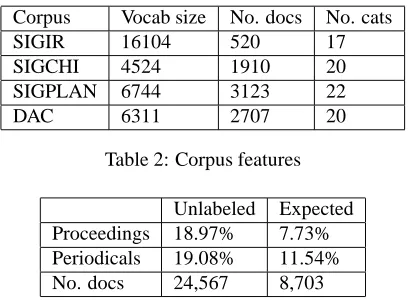
Table 2: Corpus features
Unlabeled Expected
Proceedings 18.97% 7.73%
Periodicals 19.08% 11.54%
No. docs 24,567 8,703
Table 3: Missing classification labels in ACM
summaries. Every document is tagged with its year of publication. Unfortunately, only about half of the SIGIR documents bear category labels. The majority of these omissions fall within the 1978-1987 range, leaving us the remaining 15 years to work with.
2.3 Conference abstracts
We collected nearly 8,000 abstracts from the Special In-terest Group in Programming Languages (SIGPLAN), the Special Interest Group in Computer-Human Interac-tion (SIGCHI) and the Design AutomaInterac-tion Conference (DAC). Characteristics of these collections, and of the SI-GIR texts, are shown in Table 2.
2.4 Missing labels in ACM
We derive the statistics below from the corpus of all doc-uments published by the ACM between 1960 and 2003. The arguments can be applied to any corpus which has categorized documents, but for which there are classifi-cation gaps in the record.
The first column of Table 3 shows that nearly one fifth of all ACM documents, from both conference proceed-ings and periodicals, do not possess category labels. We define a document’s label as “expected” when more than half of the other documents in its publication (one confer-ence proceeding or one issue of a periodical) are labeled, and if there are more than ten total. The second column lists the percentage of documents where we expected a label but did not find one.
3
Methods
Text categorization (TC) is the problem of assigning doc-uments to one or more pre-defined categories. As Section 1 demonstrated, the terms which best characterize a cate-gory can change through time, so it is not unreasonable to assume that intelligent use of temporal context will prove useful in TC.
Imagine the example of sorting several decades of articles from the Los Angeles Times into the
cate-goriesENTERTAINMENT,BUSINESS,SPORTS,
POL-ITICS, and WEATHER. Suppose we come across the termschwarzeneggerin a training document. In the 1970s, during his career as a professional bodybuilder, Arnold Schwarzenegger’s name would be a strong
indica-tor of aSPORTSdocument. During his film career in the
1980s-1990s, his name would be most likely to appear in anENTERTAINMENTdocument. After 2003, at the
out-set of his term as California’s governor, thePOLITICS
andBUSINESScategories would be the most likely
can-didates. We refer toschwarzeneggeras a temporally
perturbed term, because its distribution across categories
varies greatly with time.
Documents containing temporally perturbed terms hold valuable information, but this is lost in a statistical analysis based purely on the average distribution of terms across categories, irrespective of temporal context. This information can be recovered with a technique we call
temporal feature modification (TFM). We first outline a
formal model for its use.
3.1 A term generator framework
One obvious way to introduce temporal information into the categorization task is to simply provide the year of publication as a new lexical feature. Preliminary exper-iments (not reported here) showed that this method had virtually no effect on classification performance. When the date features were “emphasized” with higher frequen-cies, classification performance declined.
Instead, we proceed from the perspective of a simpli-fied language generator model (e.g. (Blei et al., 2003)). We imagine that the first step in the production of a
doc-ument involves an author choosing a categoryC. Each
termk(word, bigram, phrase, etc.) is accorded a unique
generator G that determines the distribution ofkacross
categories, and therefore its likelihood to appear in
cat-egoryC. The model assumes that all authors share the
same generator for each term, and that the generators do not change over time. We are particularly interested in identifying temporally perturbed lexical generators that violate this assumption.
External events at time t can perturb the generator ofk,
causing Pr(C|k) to be different relative to the background
Pr(C|k) computed over the entire corpus. If the
perturba-tion is significant, we want to separate the instances ofk
at time t from all other instances.
Returning to our earlier example, we would treat
a generic, atemporal occurrence of
schwarzeneg-gerand the pseudo-term “schwarzenegger+2003”
our estimates of the true Pr(C|k), both in 2003 and in other years.
3.2 TFM Procedure
The generator model motivates a procedure we outline below for flagging certain lexemes with explicit temporal information that distinguish them so as to contrast them with those generated by the underlying atemporal alter-natives. This procedure makes use of the (log) odds ratio for feature selection:
!#" $&%('*)",+ )" $-%'.! " +
where p is Pr(k|C), the probability that term k is
present, given categoryC, and q is Pr(k|!C).
The odds ratio between a term and a category is a mea-sure of the associated strength of the two, for it meamea-sures the likelihood that a term will occur frequently within a category and (relatively) infrequently outside. Odds ratio happens to perform very well in feature selection tests; see (Mladenic, 1998) for details on its use and variations. Ultimately, it is an arbitrary choice and could be replaced by any method that measures term-category strength.
The following pseudocode describes the process of temporal feature modification:
VOCABULARY ADDITIONS: for each class C:
for each time (year) t:
PreModList(C,t,L) = OddsRatio(C,t,L) ModifyList(t) =
DecisionRule(PreModList(C,t,L) for each term k in ModifyList(t):
Add pseudo-term "k+t" to Vocab
DOCUMENT MODIFICATIONS: for each document:
t = time (year) of doc for each term k:
if "k+t" in Vocab: Replace k with "k+t" Classify modified document
PreModList(C,t,L) is a list of the top L terms that, by
the odds ratio measure, are highly associated with
cate-goryCat time t. (In our case, time is divided annually,
because this is the finest resolution we have for many of the documents in our corpus.) We test the hypothe-sis that these come from a perturbed generator at time t, as opposed to the atemporal generator G , by comparing the odds ratios of term-category pairs in a PreModList at time t with the same pairs across the entire corpus. Terms which pass this test are added to the final ModifyList(t) for time t. For the results that we report, DecisionRule is a simple ratio test with threshold factor f. Suppose f is
2.0: if the odds ratio betweenCandkis twice as great at
time t as it is atemporally, the decision rule is “passed”.
0 2 4 6 8 10 12 14 16 18 20 22 −5
0 5 10 15 20 25 30 35 40 45
Percent terms modified
Percent accuracy improvement
SIGPLAN SIGCHI
DAC
[image:4.612.314.530.59.235.2]Atemporal baseline
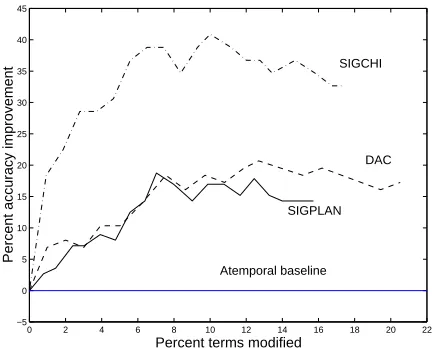
Figure 1: Improvement in categorization performance with TFM, using the best parameter combinations for each corpus.
The generator G is then considered perturbed at time t
andkis added to ModifyList(t). In the training and
test-ing phases, the documents are modified so that a termkis
replaced with the pseudo-term "k+t" if it passed the ratio test.
3.3 Text categorization details
The TC parameters held constant in our experiments are: Stoplist, Porter stemming, and Laplacian smoothing. Other parameters were varied: four different classifiers, three unique minimum vocabulary frequencies, unigrams and bigrams, and four threshold factors f. 10-fold cross validation was used for parameter selection, and 10% of the corpus was held out for testing purposes. Both of these sets were distributed evenly across time.
4
Results
Table 4 shows the parameter combinations, chosen by ten-fold cross-validation, that exhibited the greatest in-crease in categorization performance for each corpus.
Using these parameters, Figure 1 shows the improve-ment in accuracy for different percentages of terms mod-ified on the test sets. The average accuracies (across all parameter combinations) when no terms are modified are less than stellar, ranging from 26.70% (SIGCHI) to 37.50% (SIGPLAN), due to the difficulty of the task (20-22 similar categories; each document can only belong to one). Our aim here, however, is simply to show improve-ment. A baseline of 0.0 in the plot indicates accuracy without any temporal modifications.
Corpus Improvement Classifier n-gram size Vocab frequency min. Ratio threshold f
SIGIR 33.32% Naive Bayes Bigram 2 2.0
SIGCHI 40.82% TF.IDF Bigram 10 1.0
SIGPLAN 18.74% KNN Unigram 10 1.5
[image:5.612.95.520.57.123.2]DAC 20.69% KNN Unigram 2 1.0
Table 4: Top parameter combinations for TFM by improvement in classification accuracy. Vocab frequency min. is the minimum number of times a term must appear in the corpus in order to be included.
0 0.1 0.2 0.3 0.4 0.5 0.6 0.7 28
30 32 34 36 38 40
Percent terms modified
Percent accuracy
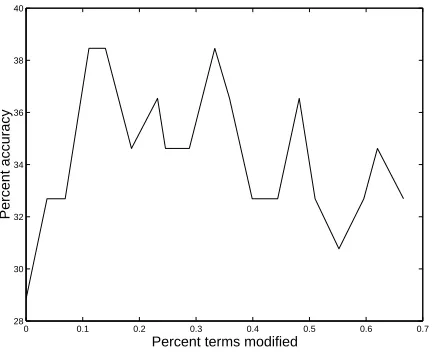
Figure 2: Absolute categorization performance with
TFM for the SIGIR full text corpus.
correct to a maximum of 38.46% when only 1.11% of the terms were modified. The ModifyLists for each category and year averaged slightly fewer than two terms each.
In most cases, the technique performs best when mak-ing relatively few modifications: the left sides of each figure show a rapid performance increase, followed by a gradual decline as more terms are modified. After re-quiring the one-time computation of odds ratios in the training set for each category/year, TFM is very fast and requires negligible extra storage space. This is important when computing time is at a premium and enormous cor-pora such as the ACM full text collection are used. It is also useful for quickly testing potential enhancements to the process, some of which are discussed in Section 6.
The results indicate that L in PreModList(C,t,L) need
not exceed single digits, and that performance asymp-totes as the number of terms modified increases. As this happens, more infrequent terms are judged to have been produced by perturbed generators, thus making their true distributions difficult to compute (for the years in which they are not modified) due to an insufficient number of examples.
4.1 General description of results
A quantitative average of all results, using all parameter combinations, is not very meaningful, so we provide a qualitative description of the results not shown in Table 4 and Figures 1 and 2. Of the 96 different parameter combi-nations tested on four different corpora, 83.33% resulted in overall increases in performance. The greatest increase peaked at 40.82% improvement over baseline (atempo-ral) accuracy, while the greatest decrease dropped perfor-mance by only 8.31%.
5
Related Work
The use of metadata and other complementary (non-content) information to improve text categorization is an interesting and well-known problem. The specific use of temporal information, even if only implicitly, for tasks closely related to TC has been explored through adaptive information filtering (AIF) and topic detection and track-ing (TDT).
5.1 Adaptive Information Filtering
There exists a large body of work on information filter-ing, which “is concerned with the problem of delivering useful information to a user while preventing an overload of irrelevant information” (Lam et al., 1996). Of partic-ular interest here is adaptive information filtering (AIF), which handles the problems of concept drift (a gradual change in the data set a classifier must learn from) and concept shift (a more radical change).
Klinkenberg and Renz test eight different classifiers on their abilities to adapt to changing user preferences for news documents (Klinkenberg and Renz, 1998). They try different “data management techniques” for the concept drift scenario, selectively altering the size of the set of examples (the adaptive window) that a classifier trains on using a heuristic that accounts for the degree of dissimi-larity between the current batch of examples and previous batches. Klinkenberg and Joachims later abandon this ap-proach because it relies on “complicated heuristics”, and instead concentrate their analysis on support vector ma-chines (Klinkenberg and Joachims, 2000).
[image:5.612.74.291.173.349.2]instead relies on a voting system for decision trees (Stan-ley, 2001). The weight of each classifier’s vote (classifi-cation) is proportional to its record in predicting classi-fications for previous examples. He notes that this tech-nique does not rely on decision trees; rather, any combi-nation of classifiers can be inserted into the system.
The concept drift and shift scenarios used in the pub-lished literature are often unrealistic and not based upon actual user data. Topic Detection and Tracking, described in the following section, must work not with the behavior of one individual, but with texts that report on real exter-nal events and are not subject to artificial manipulation. This multifaceted, unsupervised character of TDT makes it a more appropriate precursor with which to compare our work.
5.2 Topic Detection and Tracking
Franz et al. note that Topic Detection and Tracking
(TDT) is fundamentally different from AIF in that the “adaptive filtering task focuses on performance improve-ments driven by feedback from real-time human rele-vance assessments. TDT systems, on the other hand, are designed to run autonomously without human feedback” (Franz et al., 2001). Having roots in information retrieval, text categorization, and information filtering, the initial TDT studies used broadcast news transcripts and writ-ten news corpora to accomplish tasks ranging from news story clustering to boundary segmentation. Of most rel-evance to the present work is the topic tracking task. In this task, given a small number (1-4) of training stories known to be about a particular event, the system must make a binary decision about whether each story in an incoming stream is about that event.
Many TDT systems make use of temporal information, at least implicitly. Some employ a least recently used (Chen and Ku, 2002) or decay (Allan et al., 2002) func-tion to restrict the lexicon available to the system at any given point in time to those terms most likely to be of use in the topic tracking task.
There are many projects with a foundation in TDT that go beyond the initial tasks and corpora. For example, TDT-inspired language modeling techniques have been used to train a system to make intelligent stock trades based upon temporal analysis of financial texts (Lavrenko et al., 2000). Retrospective timeline generation has also become popular, as exhibited by Google’s Zeitgeist fea-ture and browsers of TDT news corpora (Swan and Allan, 2000; Swan and Jensen, 2000).
The first five years of TDT research are nicely summa-rized by Allan (Allan, 2002).
6
Summary and Future Work
In this paper, we have demonstrated a feature modifi-cation technique that accounts for three kinds of
lexi-cal changes in a set of documents with category labels. Within a category, the distribution of terms can change to reflect the changing nature of the category. Terms can also “migrate” between categories. Finally, the catego-rization system itself can change, leading to necessary lexical changes in the categories that do not find them-selves with altered labels. Temporal feature modification (TFM) accounts for these changes and improves perfor-mance on the retrospective categorization task as it is ap-plied to subsets of the Association for Computing Ma-chinery’s document collection.
While the results presented in this paper indicate that TFM can improve classification accuracy, we would like to demonstrate that its mechanism truly incorporates
changes in the lexical content of categories, such as those
outlined in Section 1.1. A simple baseline comparison would pit TFM against a procedure in which the corpus is divided into slices temporally, and a classifier is trained and tested on each slice individually. Due to changes in community interest in certain topics, and in the structure of the hierarchy, some categories are heavily represented in certain (temporal) parts of the corpus and virtually ab-sent elsewhere. Thus, the chance of finding every cat-egory represented in a single year is very low. For our corpora, this did not even occur once.
The “bare bones” version of TFM presented here is in-tended as a proof-of-concept. Many of the parameters and procedures can be set arbitrarily. For initial feature selection, we used odds ratio because it exhibits good performance in TC (Mladenic, 1998), but it could be re-placed by another method such as information gain, mu-tual information, or simple term/category probabilities. The ratio test is not a very sophisticated way to choose which terms should be modified, and presently only de-tects the surges in the use of a term, while ignoring the (admittedly rare) declines.
In experiments on a Usenet corpus (not reported here) that was more balanced in terms of documents per cate-gory and per year, we found that allowing different terms to “compete” for modification was more effective than the egalitarian practice of choosing L terms from each category/year. There is no reason to believe that each category/year is equally likely to contribute temporally perturbed terms.
We would also like to exploit temporal contiguity. The present implementation treats time slices as independent entities, which precludes the possibility of discovering
temporal trends in the data. One way to incorporate
Acknowledgements
Many thanks to the anonymous reviewers for their helpful comments and suggestions.
References
J. Allan, V. Lavrenko, and R. Swan. 2002. Explorations within topic tracking and detection. In J. Allan, editor,
Topic Detection and Tracking: Event-based Informa-tion OrganizaInforma-tion, pages 197–224. Kluwer Academic
Publishers.
J. Allan. 2002. Introduction to topic detection and track-ing. In J. Allan, editor, Topic Detection and
Track-ing: Event-based Information Organization, pages 1–
16. Kluwer Academic Publishers.
David M. Blei, Andrew Y. Ng, and Michael I. Jordan. 2003. Latent dirichlet allocation. The Journal of
Ma-chine Learning Research, 3:993–1002.
H. Chen and L. Ku. 2002. An nlp & ir approach to topic detection. In J. Allan, editor, Topic Detection
and Tracking: Event-based information organization,
pages 243–264. Kluwer Academic Publishers.
D. Cohn and T. Hofmann. 2001. The missing link: a probabilistic model of document content and hyperlink connectivity. In Advances in Neural Information
Pro-cessing Systems, pages 430–436. MIT Press.
M. Franz, T. Ward, J.S. McCarley, and W. Zhu. 2001. Unsupervised and supervised clustering for topic tracking. In Proceedings of the Special Interest Group
in Information Retrieval, pages 310–317.
L. Getoor, E. Segal, B. Taskar, and D. Koller. 2001.
Probabilistic models of text and link structure for
hy-pertext classification (2001). In Proceedings of the
2001 IJCAI Workshop on Text Learning: Beyond Su-pervision.
Brewster Kahle. 2005. The internet archive.
http://www.archive.org/.
Martin Kay. 2003. Introduction. In Ruslan Mitkov, ed-itor, The Oxford Handbook of Computational
Linguis-tics, pages xvii–xx. Oxford University Press.
R. Klinkenberg and T. Joachims. 2000. Detecting con-cept drift with support vector machines. In
Proceed-ings of the Seventeenth International Conference on Machine Learning (ICML), page 11. Morgan
Kauf-mann.
R. Klinkenberg and I. Renz. 1998. Adaptive information filtering: Learning in the presence of concept drifts. In
AAAI/ICML workshop on learning for text categoriza-tion.
W. Lam, S. Mukhopadhyay, J. Mostafa, and M. Palakal.
1996. Detection of shifts in user interests for
per-sonalized information filtering. In Proceedings of the
Special Interest Group in Information Retrieval, pages
317–326.
V. Lavrenko, M. Schmill, D. Lawrie, P. Ogilvie, D. Jensen, and J. Allan. 2000. Mining of concurrent text and time series. In 6th ACM SIGKDD
Interna-tional Conference on Knowledge Discovery and Data Mining, Text Mining Workshop, pages 37–44.
D. Mladenic. 1998. Machine Learning on
non-homogeneous, distributed text data. Ph.D. thesis,
Uni-versity of Ljubljana, Slovenia.
K.O. Stanley. 2001. Learning concept drift with a com-mittee of decision trees. Computer Science Depart-ment, University of Texas-Austin.
R. Swan and J. Allan. 2000. Automatic generation of overview timelines. In Proceedings of the Special
In-terest Group in Information Retrieval, pages 47–55.
R. Swan and D. Jensen. 2000. Timemines: Construct-ing timelines with statistical models of word usage. In ACM SIGKDD International Conference on