Volume 2010, Article ID 327041,14pages doi:10.1155/2010/327041
Research Article
Combined Distributed Turbo Coding and Space Frequency
Block Coding Techniques
V. Bota,
1Zs. A. Polgar,
1A. Silva,
2S. Teodoro,
2M. P. Stef,
1A. Moc¸o,
2A. Botos,
1and A. Gameiro
21Communications Department, Technical University of Cluj Napoca, 400027 Cluj Napoca, Romania 2Institute of Telecommunications, University of Aveiro, 3800-193 Aveiro, Portugal
Correspondence should be addressed to V. Bota,[email protected]
Received 30 March 2010; Revised 26 July 2010; Accepted 7 November 2010
Academic Editor: Mohamed Hossam Ahmed
Copyright © 2010 V. Bota et al. This is an open access article distributed under the Creative Commons Attribution License, which permits unrestricted use, distribution, and reproduction in any medium, provided the original work is properly cited.
The distributed space-time (frequency) coding and distributed channel turbo coding used independently represent two cooperative techniques that can provide increased throughput and spectral efficiency at an imposed maximum Bit Error Rate (BER) and delay required from the new generation of cellular networks. This paper proposes two cooperative algorithms that employ jointly the two types of techniques, analyzes their BER and spectral efficiency performances versus the qualities of the channels involved, and presents some conclusions regarding the adaptive employment of these algorithms.
1. Introduction
Most of the services that should be provided by future wireless networks require low or very low BER and delay values and high data rates. The cooperative transmission techniques represent one of the most promising solutions in wireless networks for provisioning the increased capacity, extended coverage, and improved fairness [1–3] required by such services. They could ensure low BER, while still inserting limited transmission delays, and also significantly improve the spectral efficiency of wireless systems.
Another technique that could fulfill the above require-ments is the Multiple Input Multiple Output-Orthogonal Frequency Division Multiplexing (MIMO-OFDM) [4, 5], which has already been adopted in high rate wireless commu-nications standards, such as WiMAX and LTE. However, con-sidering a conventional cellular architecture with colocated antennas, there is significant correlation between channels in some environments; moreover, the use of an antenna array at the user terminals (UTs) may not be feasible due to size, cost, and hardware limitations. The OFDM-MIMO could be also implemented through cooperation of users, which share their antennas and thereby create a Virtual Antenna Array (VAA) or a Virtual MIMO (VMIMO) system. In this context, the concept of Distributed Space-Time Coding (DSTC) was introduced in [6, 7]. This approach allows single-antenna
devices to gain some benefits from spatial diversity without the need for physical antenna arrays. Several recent works [8, 9] have considered either the design of DSTC or Distributed Space-Frequency Coding (DSFC) or the application of the existing space-time/frequency codes in a distributed manner for the wireless relay-based systems. The use of Space-Time Block Coding (STBC) based on Alamouti schemes [10] implemented in a distributed manner in OFDM-based cooperative schemes has been discussed in [11,12], while a full-rate and full-diversity quasiorthogonal STBC scheme to be applied in virtual antenna arrays was proposed in [13]. In [14], Distributed Space-Frequency Block Coding (DSFBC) schemes for OFDM-based cellular systems which use an antenna array at the BS and a single antenna at both the UT and RN have been proposed.
in [16, 17], while some algorithms are provided in [18] and throughput maximization methods are provided in [19]. Niu and Lu [20] have combined the OFDM flexible subcarrier allocation with distributed coding, extending the cooperative communication strategy from the time domain to the time-frequency domain, by incorporating the Orthogonal Frequency-Division Multiple Access (OFDMA) concept. Practical distributed coding protocols that use Rate-Compatible Punctured Convolutional Codes (RCPCC) were proposed and investigated in [21]. This approach ensures high performances both for Amplify & Forward (AF) and Decode & Forward (DF) relaying schemes, while maintaining a low complexity.
One step further is the joint use of cooperative tech-niques, such as DST(F)BC or DFEC, with Network Coding (NC), which combines the advantages provided by each of the involved techniques and diminishes their shortcomings. Recent papers, such as [22–25], propose various versions of combining these techniques which provide results that are more than promising. Nevertheless, the employment of NC-based techniques involves more elaborate cluster-selection techniques which seem to be difficult to implement in the present mobile cellular systems.
Therefore, this paper proposes two cooperation algo-rithms, serving one UT, that employ in a joint manner the distributed space frequency coding and distributed FEC, analyzes their performances and compares these per-formances with those of DSFC and DFEC cooperation algorithms used independently. The paper is structured as follows: Section 2 explains briefly the motivation of this study, while Section 3 presents the cooperation protocol and topologies used and briefly arguments their selection. Section 4describes the DSFC and DFEC cooperative algo-rithms and the proposed combined DSFC+DFEC coop-eration algorithms, while Section 5 briefly discusses the evaluation of their spectral efficiency. Section 6 describes the performance metrics employed and the test scenarios used for performance evaluation; it presents the simula-tion results obtained and analyzes these results. Finally, Section 7 presents some conclusions regarding the selec-tion of the cooperative algorithm according to the given topology, scenario, and type of service that has to be provided.
2. Motivation and Objectives
The performances of the cooperative algorithms, BER, Bloc Error Rate (BLER), and spectral efficiency, are strongly affected by the combining method of the signals received on the source—destination and on the relay (relays)—destination links. Two main categories of message-combining methods could be used:
(i) symbol-level combining, which is specific to space-time/space-frequency coding and to maximum ratio combining. These message combining techniques provide diversity gain,
(ii) bit-level combining, that is, bit-LLRs addition and/or concatenation, which is characteristic to distributed
FEC. These message combining techniques provide less diversity gain, but they provide coding gain.
These combining methods exhibit different degrees of flexibility, when employed in different cooperative transmis-sion scenarios. Symbol-level combining requires the same constellation on each transmission link, regardless of the significantly different qualities of the channels employed by each cooperation phase. Bit-level combining has a greater flexibility, allowing the use of different constellations on different transmission links, according to each channel state, fact that has significant impact upon the spectral efficiency.
The joint use of the two types of message combining could ensure both improved BER and flexibility, thus providing greater spectral efficiency. One way to achieve this mix of message combining in cooperative networks would be to employ in a joint manner distributed FEC and distributed diversity techniques, thus providing both coding and diversity gains.
The main objective of the paper is to analyze the performances of some particular cooperation algorithms combining DSFC and DFEC within a topology containing a virtual MIMO scheme that uses the antennae of one or two relay nodes (RNs), to compare their BER and spectral effi -ciency performances to those of cooperation schemes using independently either the DSFC or DFEC techniques, and to identify scenarios within which these combined distributed coding schemes provide greater spectral efficiencies at an imposed BER. The applicability of these algorithms to several types of services, according to the BER and spectral efficiency requirements, will also be briefly considered.
3. Cooperation Protocol and Topologies
This paper considers a test topology, with single-antenna equipments, where two dedicated relay nodes (RN1, RN2), fixed or nomadic, assist the communication between the Base Station (BS) and the UT. The access scheme is OFDMA, the constellations used are QPSK, 16, and 64 QAM and all point-to-point transmissions are Single Input Single Output (SISO) ones.
The cooperative algorithms studied employ the classical two-phase cooperation protocol, which are supposed to occur successively in time, but might not use the same signal constellation.
(1) In the “broadcast phase”, the source node (BS or UT) sends its message to the RN and to the destination node (UT or BS, resp.). The content of the broadcast message is specific to the cooperation algorithm employed.
(2) In the “relaying phase”, the RNs decode the received message, perform the processing specific to the coop-eration algorithm employed and send their messages to destination (UT or BS).
Information bitsNi and check bitsNc
Information bitsNiand/or additional check bitsNa
Information bitsNiand/or additional check bitsNa
Information bitsNiand/or additional check bitsNa Broadcast-phase I DSTC or DSFC-phase II
RN1
BS
RN2
UT
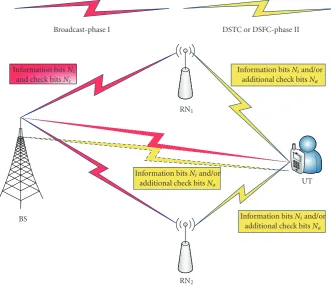
Figure1: Topologies for DSFC-based cooperation algorithms: with two RNs (solid line); with one RN (dashed line).
The two phases of the cooperation protocol applied to this topology are illustrated in Figure 1 for the downlink (DL) connection; that is, the broadcast message is trans-mitted to the RNs and UT, while the relay message, which depends on the DFEC algorithm employed, is transmitted jointly by the two RNs using a cooperative diversity scheme, like DSTC or DSFC. The message sent during the broadcast phase might be employed or not by the destination’s receiver. Since the number of RNs is limited by relay assignment, resource allocation and signaling issues, the test topology can be simplified by imposing the source to act as one of the RNs and transmit both during the broadcast phase, as source, and during the relaying phase, as one of the RNs, as shown in Figure 1.
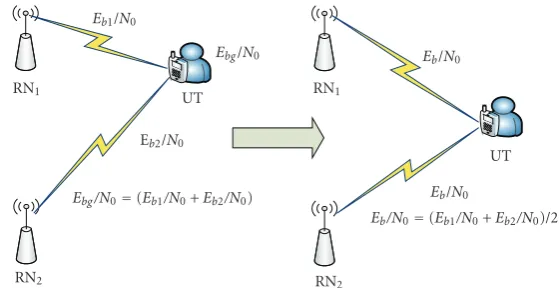
The asymmetrical two-RN topology, with differentEb/N0 ratios received from the two RNs, could be transformed into a symmetrical topology for easier analysis and simulation, by considering an equivalent Eb/N0 value that is received from each RN on the RN-destination links, as shown in Figure 2.
4. Cooperative Distributed Coding Algorithms
This section gives a short overview of the cooperation algorithms employing Alamouti-based DSFC and Turbo Coding (TC)-based DFEC techniques and describes the proposed combined DSFC-DFEC cooperation algorithms.4.1. Distributed Space-Frequency Coding (DSFC). The topol-ogy with two RNs contains five links; namely, the direct
BS-UT link, defined by the hbu channel, the BS-RNi links
(i = 1, 2), defined by thehbri(i = 1, 2) channels, and the
RNi-UT links, defined by channelshriu(i = 1, 2), as shown
inFigure 1. Within the topology with one RN, the BS-RN2 link is an ideal one, while the RN2-UT link is represented by another realization of thehbuchannel.
The operations performed by this DSFC algorithm during cooperation are briefly described below.
(1) In the broadcast phase, the source node transmits the coded block (Niinformation bits andNccheck bits)
towards the RNs and destination, using a modulation adapted to the channels involved.
(2) In the relaying phase, the RNs decode and re-encode the message with the same FEC code, apply a DSFC-Alamouti scheme [10] and transmit their per-fectly synchronized messages on the RNi-destination
channels using the same signal constellation (not necessarily the same as in the first phase).
RN1
Figure2: Nonsymmetrical (left) and symmetrical (right) DSFC topologies with two RNs.
To point out the effects of the direct link transmission upon the performance of the DSFC scheme, an alternative version, called simple DSFC (s-DSFC), which does not use the direct link at the receiver’s end, is also considered. Hence, different signal constellations might be used during the two cooperation phases.
In the subsequent sections, we consider that all channels involved are complex flat Rayleigh-faded channels, and the noise samples have zero-mean and variance equaling σ2
u.
We also consider that the OFDM subcarrier separation is significantly lower than the channel’s coherence bandwidth, and so, the fading over two adjacent subcarriers can be considered flat.
Considering the c-DSFC algorithm, the instantaneous SNR on subcarrier p obtained after the MRC-combining performed at destination between the symbols received on the direct link and those provided by the Alamouti decoding of the DSFC signals on the RNi-destination links is [14,26]
SNRp= Rayleigh faded BS-UT channel, during the broadcast phase, for thepth subcarrier with an average power E{|hbup (b)|
ri,u denotes the RNi-UT channel during relaying
phase, for the pth subcarrier with an average power of E{|hrpiu|
2
} = δ2
ri,u, in the assumption that the fading over
two adjacent subcarriers can be considered flat; that is,hrpiu
is equal tohrpi+1,u. We also assume that the noise variance of
the signals received at the UT during the two phases to be equal, that is,σ2
u(b)=σu2(r)=σu2.
If the topology with one RN is considered, seeFigure 1, then the BS acts as the second RN (in the DL), and therefore, in relation (1),hrp2ushould be replaced byh
p bu(r),
the complex flat Rayleigh BS-UT channel’s realization for the
pth subcarrier during the relaying phase.
If the direct link is not used in the decoding process at the receiving end (the s-DSFC algorithm) the instantaneous SNR on subcarrierpis expressed in a similar manner by (2)
[14,26] and is smaller that the one ensured by the c-DSFC algorithm, see(1)
If the channels are correctly equalized, we may assume that the LLRs of all bits of the FEC codeword are extracted from the same equivalent channel, with SNRs expressed by (1) for the algorithm which employ the source-destination link, respectively, by (2) for topologies which do not employ this link.
4.2. Distributed FEC Cooperation Algorithms. Distributed FEC algorithms use the classical two-phase cooperation protocol [16,17], applied within a topology with one RN, for example, RN1, which is particularized inFigure 3. Most of distributed FEC algorithms use the same encoder both at source and at RN, some of them employing different puncturing patterns for the two transmissions. Usually, Con-volutional Turbo Codes (CTCs) or Low Density Parity Check (LDPC) codes are employed to implement the distributed FEC.
4.2.1. Distributed FEC with Incremental Redundancy. The Incremental Redundancy DFEC (IR-DFEC) algorithm that uses CTCs is briefly described below and represented in Figure 3.
(i) Broadcast Phase. The UT (or the BS) encodes the Ni
information bits using a CTC code with a coding rateRm(the
mother code rate). The resulted check bits are appropriately punctured according to a rate matching algorithm [27], to obtain a desired coding rateRc. The resulted coded blocks of
lengthNi+Nc = Ni/Rc are then sent by the source (UT or
BS) over the source-destination and source-RN links.
pattern corresponding to a coding rateRa, and these bits are
transmitted over the RN-destination link. The two coding ratesRaandRcare chosen so that the global coding rate,Rg,
which is expressed by (3), would equal the rate of the mother code
Rg= Ni
Ni+Nc+Na =
Ra·Rc
Ra+Rc−Ra·Rc =Rm. (3)
(iii) Decoding. At destination, before turbodecoding, the blocks received both from source and RN are assembled and completed according to the employed puncturing rules. The
Niinformation and theNccheck bits generated by the source
are received at smaller equivalent SNR values, SNRdp,than the
Nacheck bits generated by the relay, SNRrp, as shown by (4),
fact that represents the main disadvantage of IR-DFEC
SNRdp=
The advantage of the IR-DFEC scheme consists of the relatively small amount of time-frequency resources required by the relaying phase, which increase the spectral efficiency, and the possibility to build distributed Hybrid Automatic Repeat Request (H-ARQ) schemes based on this cooperation scheme.
4.2.2. Hybrid Distributed FEC with Incremental Redundancy.
The effects of small SNRs on the direct link might be over-come by a Hybrid IR-DFEC (HIR-DFEC) algorithm based both on repetition and incremental redundancy encoding. The HIR-DFEC algorithm is similar to the IR-DFEC one, see Figure 3, but in the relaying phase the RN sends, besides the
Nacheck bits, the decoded information bitsNi. The coding
rate obtained in the relaying phase isRa=Ni/(Ni+Na).
The decoding performed at the destination node is schematically represented inFigure 4. The destination node combines the LLRs corresponding to the information bits received over the direct and relay links, then it reorders the check bits received on the two links and concatenates them in order to restore the LLR-flow of the complete Rg-rate
codeword, which is fed into the turbo decoder.
The global coding rate Rg is the same as the one of
the IR-DFEC algorithm, (3), but this algorithm involves the transmission of two sets of Ni information bits, and
therefore, in the computation of the payload bit rate and spectral efficiency, a transmission rate, Rt, given by (5)
should be considered
Rt= Ni
2·Ni+Nc+Na =
Rc·Ra
Rc+Ra. (5)
The spectral efficiency of this algorithm is smaller, but theNiinformation bits are better protected, since they are
transmitted both on the direct and on the relay links, and therefore, they are received under an equivalent SNR, SNRp,
expressed by (6), which is greater than the one ensured by the IR-DFEC for these bits. As for theNcandNacheck bits,
they are received on similar conditions as in the IR-DFEC algorithm
4.2.3. Combined DSFC+DFEC Cooperation Algorithms. Dis-tributed turbo coding algorithms (IR-DFEC or HIR-DFEC) are able to provide increased spectral efficiency, system flexibility but also significant coding gains if the source-RN and source-RN-destination links have good qualities. These conditions cannot be ensured only by positioning the relay, while the employment of powerful channel codes decreases the spectral efficiency and increases the complexity.
The quality of the transmission between the RN and destination can be significantly improved by using one or two RNs to implement a DSFC (or DSTC) algorithm, due to the diversity provided on the uncorrelated RNi-destination
links. In the same time, a small BER could be ensured in the broadcast phase by placing the RNs closer to the source. Therefore, the combined use of DFEC and DSFC algorithms could provide improved performances and allow the use of simplified relay selection algorithms.
The combined s-DSFC+DFEC algorithms proposed are schematically represented inFigure 1for the DL connection in the particular case when only 2 relays are used to imple-ment the s-DSFC in the relaying phase. A brief description of the operations performed is presented below.
(i)Broadcast phase.The source (BS) broadcasts the Ni
information bits encoded with a CTC of rateRc(Nc
check bits) over the BS-UT and BS-RNilinks.
(ii)Relaying phase.The RNs performs the DFEC decod-ing, followed by the HIR-DFEC or IR-DFEC encod-ing. Then, the two RNs perform the DSFC encoding, that is, Alamouti scheme, described in Section 4.1, using the same QAM constellation, which might be different from the one employed during the broadcast phase.
(iii)Decoding at destination.The destination performs the following operations:
(1) demodulates and extracts the LLRs of theNi +
Ncbits transmitted during the broadcast phase,
(2) extracts the symbols transmitted during relay phase by SFC-decoding and extracts the LLRs of theNi+Na(for HIR-DFEC) orNa(for IR-FEC)
received bits; note that the message received on the direct link, during the broadcast phase, is not used in this operation,
(3) combines the LLRs of theNi bits received on
both broadcast and relay phase (only for HIR-DFEC),
Base station/ user terminal
Data source Turbo encoder Puncture I
UT/BS -RN channel
Relay node Turbo decoder
Turbo encoder Puncture II
Info.bitsNi Check bitsNc BS-UT/UT-BS
channel
RN-UT/BS channel Check bitsNa
Unpuncture I (check bits)
Unpuncture II (check bits)
Bit ordering Turbo decoder
User teminal/base station
Figure3: Block diagram of IR-DFEC algorithm that employs CTCs.
Unpuncture I
Unpuncture II Info. bitsNi
Info. bitsNi
Check bitsNc BS-UT/UT-BS
channel
RN-UT/BS channel
Check bitsNa User teminal/base station LLR sumation
bit ordering
Turbo decoder
Figure4: Hybrid-distributed turbo coding. Processing performed at destination.
4.3. Some Considerations Regarding the Effects of the Errors on the Source-Relays Links. The qualities of the source-relay links have a significant effect upon the global BER provided by the cooperative algorithms. In order to evaluate their effects upon the BER performance of the proposed algorithms, we assume that if the block received by the one of the RNs is decoded with errors, the RN re-encodes the decoded bits and apply the corresponding cooperation algorithm. Another option would be to make the RN stop transmitting any message and to signalize this fact to destination. But this second approach would require additional signaling and adaptive use of the cooperation algorithm at destination.
Denoting by PERxthe block error probability at
destina-tion provided by the algorithmx,if the messages transmitted by RNs are correct, and by PERS−R1and PERS−R2the block error probabilities after the RNidecoding, the global block
error probability of the whole cooperative algorithm, PERgx,
can be expressed using the probability of a correct decoding at destinationPcgx, by
Pcgx=(1−PERx)·(1−PERS−R1)·(1−PERS−R2) ≈(1−PERx)·(1−PERS−R1−PERS−R2)=⇒
PERgx=PERx+ PERS−R1+ PERS−R2
−PERx·(PERS−R1+ PERS−R2).
(7)
the PERx provided by the cooperative algorithm x at the
UT. For the UL connection, the error probabilities of the UT-RNi links cannot be neglected and the global PERgx
and BERgxare dictated by both the cooperative decoding in
the BS (destination), that is, PERgx and BERx, and by the
error probabilities of the UT-RNilinks, that is, PERS−Riand BERS−Ri. Therefore, the BERgx and PERgx are expected to
be greater on the UL than on the DL connection, in such a topology.
5. Computation of the Spectral Efficiency
Provided by the Proposed Algorithms
The spectral efficiency is one of the main criteria used to select the appropriate cooperative transmission algorithm. The spectral efficiency Bx provided by the cooperative
algorithm x is expressed by (8) in terms of the nominal bit rate Dn−x, bit error probability BERx, which define the
throughputΘx, and the employed bandwidthBx
βx= Dn−x
The nominal bit rate and the bandwidth are dependent on the cooperation algorithm’s structure and the parameters of the transmission scheme. The bit error probability is expressed in terms of an equivalent Eb/N0 at the decoder’s input, which includes the values of theEb/N0on the source-destination and RN-source-destination channels. This equivalent
Eb/N0 depends on the cooperation algorithm and on the combining method employed.
5.1. Spectral Efficiency of the IR-DFEC Algorithm. We con-sider that during the broadcast phase the number of bits/QAM symbol isnd, while during the relaying phase it
is nr. Then, the numberNsQ of QAM symbols required to
transmit the messages during the two cooperation phases is computed using the considerations of Section 4.2.1 and is expressed by
We assume that theNsQ symbols are transmitted in an
OFDM system that hasSsubcarriers andEOFDM-symbol periods per resource allocation unit, with an fs separation
frequency between subcarriers and a guard interval ofg% of the symbol period. Considering further that the nominal bit rate is obtained by dividing the number of information bits
Nito the time required to transmit all coded bits and that the
bandwidth occupied equalsB= fs·Sthe spectral efficiency
provided by this algorithm is given by, as shown in [28]
βIR-DFEC= nd·Rc
phases different QAM constellations are used, while (1−Rc)
indicates that in the relaying phase only a fraction of the first message’s length is transmitted.
5.2. Spectral Efficiency of the HIR-DFEC Algorithm. Assum-ing again that durAssum-ing the broadcast phase, the number of bits/QAM symbol isnd, and during the relaying phase, it is
nr, and using the considerations ofSection 4.2.2, the number
NsQ of QAM symbols required transmitting the messages
during the two cooperation phases equals
NsQ= Ni
Then, using a similar reasoning as above, the spectral efficiency of the transmission that employs HIR-DFEC is expressed by
The nominal spectral efficiency of the IR-DFEC is greater than the one of HIR-DFEC due to the smaller number of additional bits transmitted during the relaying phase. Nevertheless, the spectral efficiency is also influenced by BER, which should be smaller for the HIR-DFEC.
5.3. Spectral Efficiency of the DSFC Algorithms. The spectral efficiency of the s-DSFC algorithm could be derived by using the same reasoning as for the HIR-DFEC algorithm. The spectral efficiencyβs-DSFChas expressions similar to (12), in which the bit error rate should be the one provided by this algorithm, that is, BERs−DSFC.
For the c-DSFC algorithm, since the combining is per-formed at QAM symbol-level, the two phases of cooperation should employ the same number nd of bits/QAM symbol.
The spectral efficiency βc-DSFC of this algorithm can be computed using (13), where Rc denotes the coding rate of
the FEC used
5.4. Spectral Efficiency of the Combined DSFC+DFEC Algo-rithms. Since the two combined DSFC-DFEC algorithms are obtained superimposing the s-DSFC over the IR-DFEC or HIR-DFEC algorithms, their spectral efficiencies should be computed using (10) for DSFC+IR-DFEC and (12) for the DSFC+HIR-DFEC. In these relations, the BER used should be the one provided by the respective combined algorithm.
6. Performance Evaluation of the DSFC and
DFEC Cooperation Algorithms
previous section. The performances are evaluated in the assumption that the RNs are perfectly synchronized and that perfect Channel State Information (CSI) is available in all network nodes.
6.1. Performance Metrics and Simulation Scenarios. The performance metrics employed are the BER and the spec-tral efficiency. The global BER of the studied algorithms is obtained by computer simulations, while the spectral efficiency is obtained by computation using the relations presented inSection 5. Both performance metrics provided by each algorithm are evaluated in terms of Eb/N0 of the direct BS-UT link, while theEb/N0of the other links are equal to, or greater with a constant value than the current value of
Eb/N0of the direct link.
The channel model employed on all links is briefly summarized below:
(i) propagation loss with a path loss exponent of 2, (ii) multipath propagation power delay profile: ITU-T
pedestrian B,
(iii) quasistatic Rayleigh small scale fading,
(iv) the additive noise is complex Gaussian noise with zero mean value (AWGN).
The broadcast phase uses QPSK, while the relaying phase uses either QPSK or 16 QAM or 64 QAM. The channel codes employed by the DFEC algorithms are obtained by puncturing a mother turbo code of rateRm = 1/3 defined
in [27], generated by the feedback polynomial 138 and the feedforward polynomial 158. For the c-DSFC algorithm, the FEC code employed has a rateRc =0.5. The coded block is
7200-bit long, with 3600 information bits. The IR-DFEC and HIR-DFEC transmissions use additionally a group of 3600 check bits computed and transmitted by the RN (or RNs), the global coding rate beingRg =1/3.
The scenarios selected for performance evaluation con-sider the cooperative topologies with two RNs and with one RN (seeFigure 1) and are described below; they are meant to point out the differences between the performances provided in the DL and UL connections. The relations between the
Eb/N0 values of the component channels are presented in Table 1.
(1)Scenario D1 is defined for the DL connection; it considers that the qualities of the RNi-UT links are
comparable to the one of the direct BS-UT link, while the BS-RNi links have better qualities due to the
higher BS antenna and appropriate selection of the fixed and dedicated RNs.
(2)Scenario D2is also defined for the DL connection, but it is an asymmetrical one which considers that one of the RNi-UT links has better quality than the
direct BS-UT link. This scenario describes a situation when one of the relays could be better positioned relatively to the destination. The same scenario could be employed for the topology with one RN, as well.
(3)Scenario U, is defined to point out the effects of potential shadowing that might affect the UT-RNi
transmissions, upon the UL cooperative connection. Therefore, theEb/N0values of both UT-RNichannels
(Scenario U1), or the Eb/N0 value of one of these channels (Scenario U2), were set to be smaller than that the one of the RNi-BS channels.
In all scenarios, the DFEC algorithms (using one RN) employ the UT-RNilink that has the highestEb/N0.
6.2. BER Performances on the Downlink Connection. The BER provided by the studied algorithms in the DL connection within scenarios D1 and D2 are shown in Figures 5 and 6. These results, obtained from extensive computer simulations, lead to the following conclusions.
(1) The c-DSFC cooperative algorithm, using the signal received on the direct BS-UT link in the combined MRC decoding, ensures a significantly smaller BER (seeFigure 5). This can be explained by the greater equivalent SNR, see (1), provided by the use of the BS-UT signal in the combing process at destination.
The increase of theEb/N0of the RNi-UT links, scenario
D2, leads to a small influence of the direct link for low values of the referenceEb/N0, while for greater values of the
reference Eb/N0 the influence of the direct link increases, as results from comparing the c-DSFC and s-DSFC curves between (−4; 0) dB and above 2 dB, respectively, inFigure 6. This behavior is explained by (1).
There should also be noted the decrease of the BER provided by the s-DSFC algorithm in scenario D2, compared to scenario D1, due to the increased equivalent SNR, see (2). (2) The DFEC algorithms, when are not combined with DSFC, provide poorer BER performance than the c-DSFC algorithm, and in some cases (seeFigure 6) poorer perfor-mances than the simple DSFC. This is mainly explained by three facts:
(i) DFEC algorithms employ only one RN, so there is no diversity for theNc and Na check bits (see Figures
3and4), while for theNiinformation bits only the
HIR-DFEC provides diversity,
(ii) the turbo-decoder “combines” the LLRs of all received bits, providing only a coding gain,
(iii) the LLRs of the bits within a coded block have different levels of reliability since they are obtained from two different links, with differentEb/N0, and by
different processing.
As expected, HDFEC ensures smaller BER than IR-DFEC. A comparison between Figures5and6shows that the improvement of the RNi-UT links does not bring significant
decrease of the BER provided by the DFEC algorithms. (3) The use of s-DSFC algorithm in the relaying phase of the DFEC algorithms; that is, s-DSFC+IR-DFEC or HIR-DFEC leads to a significant improvement of their BER performances. The s-DSFC provides diversity for the bits transmitted during the relaying phase, that is, Na or Ni+
Table1: Relation between theEb/N0link parameters of the defined test scenarios.
Scenario Source-destination Source-RN1 Source-RN2 RN1-destination RN2-destination D1 Eb/N0 Eb/N0+ 10 dB Eb/N0+ 10 dB Eb/N0 Eb/N0 D2 Eb/N0 Eb/N0+ 10 dB Eb/N0+ 10 dB Eb/N0+ 10 dB Eb/N0 U1 Eb/N0 Eb/N0 Eb/N0 Eb/N0+ 10 dB Eb/N0+ 10 dB
U2 Eb/N0 Eb/N0+ 10 dB Eb/N0
Eb
N0+ 10 dB
Eb/N0+ 10 dB
10−5 10−4 10−3 10−2 10−1 100
BER
−4 −2 0 2 4 6 8 10
Eb/N0(dB)
c-DSFC (with direct link) s-DSFC (no direct link) DSFC + HIR-DFEC
HIR-DFEC DSFC + IR-DFEC IR-DFEC
Figure 5: BER versus Eb/N0-directlink; DSFC, DFEC, and
DSFC+DFEC algorithms—scenario D1.
by the turbodecoder into an additional coding gain. The improvement of the RNi-UT links in scenario D2 (see
Figure 6) brings no significant variation of the BER provided by these algorithms compared to the ones ofFigure 5. This could be explained by the fact that only a part of the coded bits are transmitted on the better RNi-UT channels, and
their more reliable LLRs do not improve significantly the performance of the FEC turbo decoding process.
The BER performances of the combined algorithms are still poorer than the ones of c-DSFC because the use of s-DSFC improves only the quality of theNa(IR) orNiandNa
(HIR) received LLRs. Still, due to the bit-level combining and especially to the effects of the poorly receivedNcbits, the
cod-ing gain brought is smaller than the diversity gain provided by the c-DSFBC algorithm, which uses the direct link.
6.3. BER Performances on the Uplink Connection. The BER performances provided by the studied cooperative algo-rithms within scenario U1 are presented inFigure 7and lead to the following conclusions.
(1) The c-DSFC algorithm provides lower BER than s-DSFC, due to the same reasons as for the DL connection. Nevertheless, the values of BER provided by the two algo-rithms for the sameEb/N0values of the component channels
10−5 10−4 10−3 10−2 10−1 100
BER
−4 −2 0 2 4 6 8 10
Eb/N0(dB)
c-DSFC (with direct link) s-DSFC (no direct link) DSFC + HIR-DFEC
HIR-DFEC DSFC + IR-DFEC IR-DFEC
Figure 6: BER versus Eb/N0-directlink; DSFC, DFEC, and
DSFC+DFEC algorithms—scenario D2.
are significantly greater than the ones provided in the D1 scenario, see Figure 5. These poorer performances are due to the worse source (UT)-RNilinks and could be explained
by using relation (7), where probabilitiesPS-R1andPS-R2are no longer negligible and so the global BERg and PERg are
not depending only on the BERx(or PERx) provided by the
DSFC decoder at destination. Another effect of the errors on the UT-RNi links is the decrease of the diversity gain,
expressed by a smaller slope of the BER versusEb/N0curves of these algorithms.
(2) The DFEC algorithms provide BER values that are comparable to the ones of the s-DSFC, but greater than the ones of the c-DSFC. The differences in the BER performances are significantly smaller than in the downlink case.
(3) The combination of the DFEC techniques with the s-DSFC leads to lower BER values, due to the same reasons as in the DL case, but the performance improvement brought by this combination is significantly smaller than in the DL connection, due to the poorer source (UT)-RNi links. The
10−5 10−4 10−3 10−2 10−1 100
BER
−4 −2 0 2 4 6 8 10
Eb/N0(dB)
c-DSFC (with direct link) s-DSFC (no direct link) DSFC + HIR-DFEC
HIR-DFEC DSFC + IR-DFEC IR-DFEC
Figure 7: BER versus Eb/N0-directlink; DSFC, DFEC, and
DSFC+DFEC algorithms—scenario U1.
this scenario is that the DFEC algorithms provide better performances if they are not combined with s-DSFC. This is because they need to use only the good UT-RN2link during the relaying phase, while the s-DSFC employs both UT-RNi
links, out of which one is of poor quality. The BER increase can be explained by using (7).
The main conclusion is that in the UL connection, the insertion of the s-DSFC in the DFEC algorithms is beneficial only if the two UT-RNi links have about the same quality;
otherwise, the DFEC algorithms used alone could provide smaller BER, because they could employ only the best UT-RNilink.
6.4. Spectral Efficiency Performances. The spectral efficiency performances of the studied algorithms were evaluated only for the DL connection, since according to (10), (12), and (13), the only factor differing for the two ways of transmission is the bit error rate, which was analyzed in the previous section.Figure 9shows the spectral efficiencies computed for the studied algorithms in the D1 scenario whennr = nd = 2. The main conclusions drawn are the
following.
(i) The two algorithms that use the IR-DFEC (combined or not with s-DSFC) provide the highest spectral efficiencies due to the small redundancy inserted, see (10). The HIR-DFEC-based algorithms provide smaller spectral efficiencies due to their greater redundancy during the relaying phase, which cannot be compensated by the smaller BER provided, see (12). The flat parts (zones) of the curves exhibited by DFEC algorithms are extended with approxi-mately 2 dB by combining them with the s-DSFC algorithm.
10−5 10−4 10−3 10−2 10−1 100
BER
−4 −2 0 2 4 6 8 10
Eb/N0(dB)
c- DSFC (with direct link) s- DSFC (no direct link) DSFC + HIR-DFEC
HIR-DFEC DSFC + IR-DFEC IR-DFEC
Figure 8: BER versus Eb/N0-directlink; DSFC, DFEC, and
DSFC+DFEC algorithms—scenario U2.
(ii) The c-DFSC algorithm ensures about the same spec-tral efficiency as the HIR-DFEC algorithm, because they both transmit about the same redundancy, see (13) and (12), while the differences in BER are not big enough to affect significantly the spectral efficiency. The s-DSFC provides a narrower flat zone, due to the greaterEb/N0needed to ensure a negligible BER, for example, 103, as shown inFigure 5.
Concluding, the IR-DFEC algorithm provides the great-est spectral efficiency and should be preferred for applica-tions where the target BER is not set to small values, while the c-DSFC should be used in applications which require small BER values.
The spectral efficiencies of all algorithms described above, except for the c-DSFC, can be increased by using a higher modulation on the RNi-destination link(s) during the
relaying phase, as results by increasing nr in (10) or (12).
For a fair comparison, the increase of nr requires that the
higher constellation should ensure the same BER on the RNi
-UT links as the one ensured by QPSK. This would require an Eb/N0 increased with 4 dB for 16 QAM (nr = 4) and
with 8.3 dB for 64 QAM (nr = 6). Such an improvement
of the RN-UT channels could be accomplished either by changing the positions of the two RNs or by increasing the RN’s transmitted power or by both. The spectral efficiencies provided by the studied algorithms versusEb/N0-directwithin the D1 scenario modified according to the above values, are presented in Figures10and11. The figures also present the spectral efficiency provided by c-DSFC algorithm fornr =
nd =2 andEb/N0-direct=Eb/N0-RN-UT, as reference.
The major difference between Figures10and11and the curves ofFigure 9 lies in the greater values of the spectral efficiencies in the flat zones, due to the higher nr which
0
c-DSFC (with direct link) s-DSFC (no direct link) DSFC + HIR-DFEC
HIR-DFEC DSFC + IR-DFEC IR-DFEC
Figure9: Spectral efficiency versusEb/N0-direct—scenario D1—nd=
nr=2.
efficiency of c-DSFC withnd=nr=2, the spectral efficiency
of IR-DFEC-based algorithms is increased in the flat zones by a factorFIR−DFECexpressed by (14a). The values ofFIR−DFEC equal 1.6 fornd=4 and 1.72 fornd=6. A similar factor for
the algorithms that use the HIR-DFEC, computed using (12) and (13) is expressed by (14b); it equals 1.33 fornd =4 and
The spectral efficiencies provided by these cooperative algorithms in the D2 scenario are presented inFigure 12, for
nd=nr=2. The significant extension of the flat zone of the
s-DSFC algorithm, compared toFigure 9, can be explained by its significantly smaller BER (see Figure 6) though the maximum value of its spectral efficiency has not changed, see (12). The rest of the algorithms exhibit similar perfor-mances to the ones provided for poorer RNi-UT channels
of scenario D1, Figure 9, but their flat zones are slightly extended due to the better RN-UT channel available in this scenario.
Finally, Figures13and14 show the spectral efficiencies provided in the modified D2 scenarios defined above, when higher order modulations, that is, nr = 4 andnr = 6, are
used in the relaying phase. Due to the employment of a larger constellation on the RNi-UT links with correspondingly
increasedEb/N0, the values of the spectral efficiencies of all
algorithms are greater than the ones ofFigure 12, except for c-DSFC algorithm which should usenr=nd=2.
c-DSFC (with direct link) s-DSFC (no direct link) DSFC + HIR-DFEC
HIR-DFEC DSFC + IR-DFEC IR-DFEC
Figure10: Spectral efficiency versusEb/N0-direct—modified D1—
nd=2,nr=4.
c-DSFC (with direct link) s-DSFC (no direct link) DSFC + HIR-DFEC
HIR-DFEC DSFC + IR-DFEC IR-DFEC
Figure11: Spectral efficiency versusEb/N0-direct—modified D1—
nd=2,nr=6.
The spectral efficiencies provided by these algorithms in UL connections, scenarios U1 and U2, have similar behaviors in terms of theEb/N0of the direct link, but their flat zones are narrower than the corresponding ones in the DL, due to the greater BER values occurring in the uplink, seeSection 6.3.
7. Conclusions
0
c-DSFC (with direct link) s-DSFC (no direct link) DSFC + HIR-DFEC
HIR-DFEC DSFC + IR-DFEC IR-DFEC
Figure12: Spectral efficiency versusEb/N0-directlink—scenario D2—
nd=nr=2.
c-DSFC (with direct link) s-DSFC (no direct link) DSFC + HIR-DFEC
HIR-DFEC DSFC + IR-DFEC IR-DFEC
Figure13: Spectral efficiency versusEb/N0-direct—modified D2—
nd=2,nr=4.
by two algorithms that employ in a joint manner the DSFC and DFEC cooperation algorithms. Their performances were compared to the ones provided by the constituent DSFC and, respectively, DFEC algorithms used independently. The combination of these two types of cooperation algorithms exploits both the flexibility of DFEC and the diversity provided by DSFC, while simplifying the relay assignment issue. The diversity provided by DSFC on the RN-destination links allows the placement of the RNs closer to the source and
0
c-DSFC (with direct link) s-DSFC (no direct link) DSFC + HIR-DFEC
HIR-DFEC DSFC + IR-DFEC IR-DFEC
Figure14: Spectral efficiency versusEb/N0-direct—modified D2—
nd=2,nr=6.
so the source-RN transmissions would not require the high redundancy of small-rate channel codes. The use of DFEC algorithms involves the direct link that brings an extra coding gain to compensate the decrease of the RN-destination link’s quality due to the positioning of the relay closer to the source.
The results obtained in scenarios with good source-RN and relatively poor RN-destination channels, that is, scenario D1, show that combined s-DSFC+DFEC algorithms could provide the best tradeoffbetween BER and spectral efficiency performances. This tradeoff could be “fine-tuned” by the amount of redundancy employed in the relaying phase of cooperation, by using either the HIR-DFEC algorithm that provides lower BER values, or the IR-DFEC one, which provides the greatest spectral efficiency. Even if the c-DSFC algorithm, which uses the direct link at destination, provides the smallest BER out of all studied algorithms in all scenarios considered, its spectral efficiency and link-adaptation flexibility are small due to the combining at symbol level, which in its turn provides a greater diversity gain. If the RN-destination link’s quality could be improved by relay-assignment while still ensuring good source-RN links, for example, scenario D2, the s-DSFC algorithm is the best choice considering both BER and spectral efficiency performances, but the greatest spectral efficiency could be provided by IR-DFEC algorithms.
The results obtained also indicate how these cooperative algorithms should be used adaptively to match the perfor-mance requirements (BER and spectral efficiency) of various services. For highly interactive applications which require low or very low BER values and not a great spectral efficiency, for example, video conferences, the best option would be the c-DSFC, due to its symbol-level combining. For widely used applications requiring relatively low BER, for example, audio and video streaming, the s-DSFC+HIR-DFEC algorithm is one of the best options, since it ensures a relatively low BER and a high spectral efficiency. For popular applications that accept higher BER values, for example, telephony or messaging, the IR-DFEC combined with s-DSFC on the RNi
-destination links would be advisable, since it ensures the highest spectral efficiency, which is an important factor for this type of services.
Acknowledgment
The authors wish to acknowledge the support of the ICT-FP7 European project “Enhanced Wireless Communica-tion Systems Employing Cooperative Diversity—CODIV”, FP7/ICT/2007/215477.
References
[1] F. H. P. Fitzek and M. D. Katz, Eds.,Cooperation in Wireless Networks: Principles and Applications, Springer, New York, NY, USA, 2006.
[2] K. J. Ray Liu, A. K. Sadek, W. Su, and A. Kwasinski,Cooperative Communications and Networking, Cambridge University Press, New York, NY, USA, 2009.
[3] “CODIV- Enhanced Wireless Communication Systems Employing Cooperative Diversity,” FP7-ICT-2007-215477-CODIV project,http://www.ict-codiv.eu/.
[4] G. J. Foschini and M. J. Gans, “On limits of wireless com-munications in a fading environment when using multiple antennas,”Wireless Personal Communications, vol. 6, no. 3, pp. 311–335, 1998.
[5] H. Liu and G. Li,OFDM-Based Broadband Wireless Networks, John Wiley & Sons, Hoboken, NJ, USA, 2005.
[6] M. Dohler,Virtual antenna arrays, Ph.D. thesis, King’s College London, London, UK, November 2003.
[7] J. N. Laneman and G. W. Wornell, “Distributed space-time-coded protocols for exploiting cooperative diversity in wireless networks,”IEEE Transactions on Information Theory, vol. 49, no. 10, pp. 2415–2425, 2003.
[8] Y. Jing and B. Hassibi, “Distributed space-time codes in wireless relay networks,” inProceedings of Sensor Array and Multichannel Signal Processing Workshop (SAM ’04), pp. 249– 253, Barcelona, Spain, July 2004.
[9] T. Kiran and B. S. Rajan, “Distributed space-time codes with reduced decoding complexity,” in Proceedings of IEEE International Symposium on Information Theory (ISIT ’06), pp. 542–546, Seatle, Wash, USA, July 2006.
[10] S. M. Alamouti, “A simple transmit diversity technique for wireless communications,”IEEE Journal on Selected Areas in Communications, vol. 16, no. 8, pp. 1451–1458, 1998. [11] B. Sirkeci-Mergen and A. Scaglione, “Randomized distributed
space-time coding for cooperative communication in self organized networks,” inProceedings of the 6th IEEE Workshop
on Signal Processing Advances in Wireless Communications (SPAWC ’05), pp. 500–504, New York, NY, USA, June 2005. [12] O. S. Shin, A. M. Chan, H. T. Kung, and V. Tarokh, “Design
of an OFDM cooperative space-time diversity system,”IEEE Transactions on Vehicular Technology, vol. 56, no. 4, pp. 2203– 2215, 2007.
[13] M. Hayes, S. K. Kassim, J. A. Chambers, and M. D. Macleod, “Exploitation of quasi-orthogonal space time block codes in virtual antenna arrays—part I—theoretical capacity and throughput gains,” inProceedings of the 67th IEEE Vehicular Technology Conference-Spring (VTC ’08), pp. 349–352, Singa-pore, May 2008.
[14] S. Teodoro, A. Silva, J. M. Gil, and A. Gameiro, “Virtual MIMO schemes for downlink space-frequency coding OFDM systems,” inProceedings of the 20th Personal, Indoor and Mobile Radio Communications Symposium (PIMRC ’09), Tokyo, Japan, September 2009.
[15] T. E. Hunter and A. Nosratinia, “Cooperative diversity through coding,” inProceedings of IEEE International Sympo-sium on Information Theory (ISIT ’02), Lausanne, Switzerland, July 2002.
[16] T. E. Hunter and A. Nosratinia, “Coded cooperation under slow fading, fast fading, and power control,” inProceedings of the 36th Asilomar Conference on Signals Systems and Computers, vol. 1, pp. 118–122, Pacific Grove, Calif, USA, November 2002.
[17] Z. Lin, E. Erkip, and A. Stefanov, “An asymptotic analysis on the performance of coded cooperation systems,” inProceedings of the 60th IEEE Vehicular Technology Conference (VTC ’04), pp. 1333–1337, Los Angeles, Calif, USA, September 2004. [18] S. J. Kim, P. Mitran, and V. Tarokh, “Performance bounds for
bidirectional coded cooperation protocols,”IEEE Transactions on Information Theory, vol. 54, no. 11, pp. 5235–5241, 2008. [19] Z. Lin, E. Erkip, and M. Ghosh, “Adaptive modulation
for coded cooperative systems,” in Proceedings of the 6th IEEE Workshop on Signal Processing Advances in Wireless Communications (SPAWC ’05), pp. 615–619, New York, NY, USA, June 2005.
[20] J. Niu and I.-T. Lu, “Coded cooperation in OFDMA systems,” inProceedings of the 40th Annual Conference on Information Sciences and Systems (CISS ’06), pp. 300–305, Princeton, NJ, USA, March 2006.
[21] K.-L. Noh, B. Suter, and E. Serpedin, “A practical cooperative coding scheme and its optimum level of cooperation for wireless ad-doc networks,” in Proceedings of Texas Wireless Symposium, Austin, Tex, USA, 2005.
[22] C. Yuen, W. H. Chin, Y. L. Guan, W. Chen, and T. Tee, “Bi-directional multi-antenna relay communications with wireless network coding,” in Proceedings of the 67th IEEE Vehicular Technology Conference-Spring (VTC ’08), pp. 1385– 1388, Singapore, May 2008.
[23] T. Cui, F. Gao, T. Ho, and A. Nallanathan, “Distributed space-time coding for two-way wireless relay networks,”IEEE Trans-actions on Signal Processing, vol. 57, no. 2, pp. 658–671, 2009. [24] S. K. Kuek, C. Yuen, and W. H. Chin, “Four-node relay
network with Bi-directional traffic employing wireless network coding with pre-cancellation,” inProceedings of the 67th IEEE Vehicular Technology Conference-Spring (VTC ’08), pp. 1201–1205, Singapore, May 2008.
[26] D. Castelain et al., “Preliminary advanced PHY layer algorithm selection and results,” Deliverable 3.3a, FP7-ICT-2007-215477-CODIV “Enhanced Wireless Communication Systems Employing COoperative DIVersity”, pp. 14–42, 2009,
http://www.ict-codiv.eu/deliverables/D3.3a.pdf.
[27] “Technical Specification Group Radio Access Network, Multiplexing and Channel Coding,” 3GPP Standard TS 25.212 V6.3.0, 2004.