Numerical simulation of soft missile impact small scale tests
P. VarpasuoFortum Nuclear Services Ltd., Espoo, Finland ABSTRACT
This paper describes numerical simulation of a selected soft missile impact small scale test. The main aim of the testing program is to provide data for the calibration and verification of the numerical simulation models for soft missile impact time-history simulation. The experiments are conducted both with dry and fluid filled missiles. The objective of the tests with fluid filled missiles is to investigate the release speed and the droplet size of the fluid spray release in the impact. The spray release velocity and droplet size are needed as an input data for numerical simulation methods to assess the spread of the liquid in the impact. The second object of the testing program is to develop the numerical methods for predicting the response of reinforced concrete structures to impacts of soft missiles. The pre-test and post-test analyses are used for simulating the impact load time-history and structural behavior of both the missile and the target with the aid non-linear finite element method.
INTRODUCTION
The events of September 11th have emphasized the need to design protective structures for important constructions against external impact loads, caused e.g. by colliding vehicles, and to analyze carefully the possible consequences of such events, taking into account the existing experience and information. In the open literature there are some fairly well documented test results on the subject of deformable missiles to be used as references in developing and calibrating the finite element simulation models and assessing the obtained numerical results. However, test results for fluid filled soft projectiles are not available in the open literature. In order to get any confidence with the simulation results, experimental, recorded data is needed for verification. The main objective of the small scale test program is to develop and calibrate finite element simulation models for reinforced concrete structures impacted by deformable missiles filled with fluid.
SPECIFICATION OF THE TESTS TO BE SIMULATED
The missile of the test #643 is the dry aluminum pipe with 1.5 meter length and 50 kilograms mass and 250 millimeter cross-section diameter. The impact velocity is 128 m/s. The impact target is the square simply supported reinforced concrete slab of 150 millimeters thickness and with side length of 2 meters. There is only longitudinal reinforcement in the slab with reinforcement ratio of 0.70 % in each surface and in each direction.
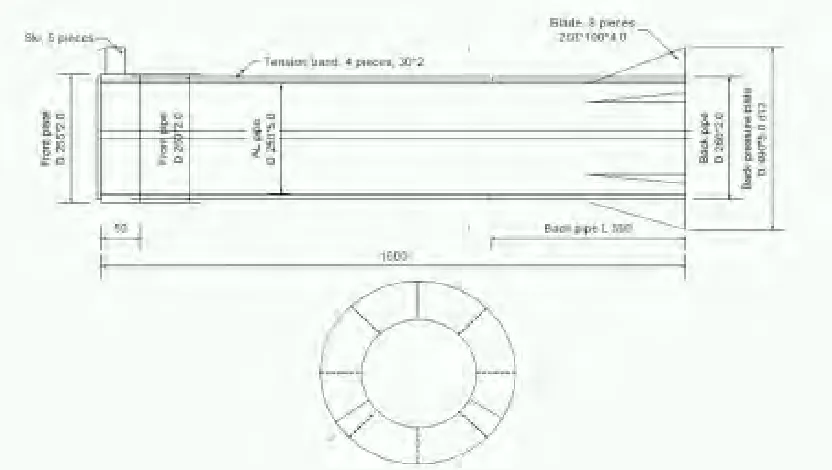
Fig. 1. Schematic presentation of the aluminum projectile used in simulated test #629.
To simulate the test numerically the finite element model of the missile was constructed. The number of degrees of freedom in the model was about 15000. The ABAQUS/EXPLICIT and MSC/DYTRAN programs were used for the simulation. The reaction force time history in the impact direction from one point of the impacting front edge of the missile is determined. Also the displacement and velocity time histories in the impact direction of one point in the rear edge of the missile are determined. The deformed shape of the missile at end of the impact is also determined in the numerical simulation task.
The test set-up has been used during the year 2005 to obtain preliminary information on the missile impact. The purpose of the preliminary tests was to gain experience and proficiency in the monitoring of the and in numerical simulation methods in order to calculate the reaction force time-history during impact. In the preliminary tests a wide spectrum of different impact velocities and masses were used. The weights of the missiles varied between 22 and 95 kilograms and the impact speeds of the missiles varied between 70 and 170 meters per second. The first sixteen missiles in 2005 were spiral-welded steel pipes and the last four were aluminum pipes. Seven of the missiles shot during the year 2005 were filled with water.
Table 1. Summary table of tests conducted during 2005.
Test
No Date
Velocity
(m/s) Missile
Weight of the missile
(kg)
614 1.6.2005 150 Spiral-welded pipe 47.5
615 1.6.2005 179 Spiral-welded pipe 47.5
616 17.6.2005 143 Original steel pipe 22.7 617 17.6.2005 130 Spiral-welded pipe 47.8 618 17.6.2005 145 Spiral-welded pipe 47.8 619 17.6.2005 167 Spiral-welded pipe 47.8
620 1.9.2005 120 Spiral-welded pipe 90
621 1.9.2005 175 Spiral-welded pipe 90
622 3.10.2005 119 Spiral-welded pipe water tank around
95 (30 kg,H2O) 623 3.10.2005 120 Spiral-welded pipe
water tank around
95 (30 kg,H2O) 624 7.10.2005 70 Spiral-welded pipe
water tank around
95 (30 kg,H2O) 625 7.10.2005 177 Spiral-welded pipe
water tank around
95 (30 kg,H2O) 626 28.10.2005 112 Spiral-welded pipe
water tank around 65 kg 627 28.10.2005 150 Spiral-welded pipe
water tank around
95 kg (30 kg,H2O) 628 28.10.2005 120 Spiral-welded pipe
water tank around 65 kg
629 16.12.2005 136.0 Al pipe 39.3 kg
630 16.12.2005 161.8 Al pipe 39.3 kg
631 16.12.2005 190.4 Al pipe 39.3 kg
632 22.12.2005 96.0 Al pipe
Filled with water
108.1 kg (67.8 kg,H2O) 633 12.01.2006 145.4 Al pipe
Filled with water
109.8 kg (67.8 kg,H2O)
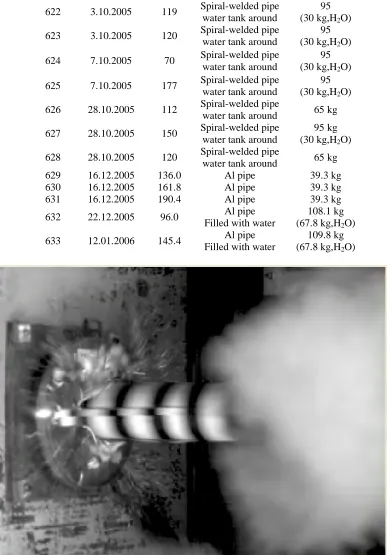
Fig. 2. Frame #51 of the total of 324 frames of the avi video of the missile crash test #629. The total length of the video is 0.324 seconds
NUMERICAL SIMULATION OF TEST #629 WITH THE AID OF MSC/DYTRAN
According to the Table 1 the basic data for the test #629 is as follows: The mass of the missile was 39.3 kilograms and the impact velocity was 136 meters per second. The missile type was plain aluminum pipe and test was conducted on 16th of December, 2005. To simulate the test numerically the finite element pipe model was utilized. The number of degrees of fredom was about 15000. The von Mises material properties for the aluminum were adopted with the following parameter values: Young's modulus was selected to 72000 megapascals and the Poisson ratio was selected to be 0.01. For the yield strength of the material the value of 160 megapascals was chosen. The mass density of the material was selected to be 0.00270 gigagrams per cubic meter The reaction force time history of one node of the impacting front edge of the missile is given in Figure 3. The reaction force measured as an average of the recordings of sensors is given in Figure 4.
aluminum pipe missile test #629 msc/dytran simulated reaction force at node 2 in meganewtons time axis in seconds
-0.1 -0.08 -0.06 -0.04 -0.02 0 0.02 0.04 0.06
0 0.0001 0.0002 0.0003 0.0004 0.0005 0.0006 0.0007 0.0008 0.0009 0.001
Fig. 3. Aluminum pipe missile test #629 MSC/DYTRAN simulated reaction force at node 2 in MN:s. Time axis is in seconds
Fig. 4. Aluminum pipe missile test #629. Measured reaction force.
TEST #629 ALUMINUM PIPE MISSILE SHOT AT CONCRETE SLAB TARGET
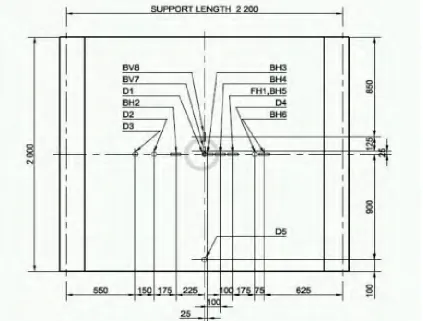
The aluminum pipe missile shown in Fig. 5 is impacted on reinforced concrete plate shown in Fig 6. The missile is the dry aluminum pipe with 1.5 meter length and 50 kilograms mass and 250 millimeter cross-section diameter with 5mm wall thickness. The impact velocity is 128 m/s. The target plate, with a thickness of 0.15 m, is line supported on vertical sides with a support length of 2.2 m, while the vertical plate dimension is 2.0 m.
Fig. 5. Schematic presentation of the aluminum projectile used in test #643 at concrete slab
Fig. 6. The impact target of the test #643 is the square simply supported reinforced concrete slab of 150 millimeters thickness and with side length of 2.2 meters. There is one way longitudinal reinforcement in the slab with reinforcement ratio of 0.70 %.
The failure mode of the concrete plate in test #643 was bending failure.
CONCLUSIONS
The paper describes the soft missile small scale tests conducted in the framework of SAFIR research project in the State Research Center (VTT) in Finland. The numerical simulation calculations for raction force were carried out for test #629, where the aluminum missile was shot rigid target. The test set up and test parameters for the test #643 where dry aluminum pipe missile was shot against one way reinforced plate target were given and failure mode explained.
REFERENCES
Riera, J. On the stress analysis of structures subjected to Aicraft impact forces. Nuclear Engineering and Design, 8, 1968, 41.5-426.
Johnson, W., Impact Strength of Materials. Edward Arnold Ltd, London 1972, 361 p.
Hakola, Ilkka, Kärnä, Tuomo: IMPACT TESTs Testing Facility. SAFIR Report December 2005.
ABAQUS/EXPLICIT, User's manual, Abaqus Inc.,2004.
MSC/DYTRAN, User's manual, MSC Software Corp., 2004.