Delay Management
A Fast Track Mitigation Strategy Using ERP
Sudeesh Thembalath1, Jeena Mathew2
P.G Student, Department of Civil Engineering, SNGCE, Kadayiruppu, Kerala, India1 Associate Professor, Department of Civil Engineering, SNGCE, Kadayiruppu, Kerala, India2
ABSTRACT: This study investigates the causes of delay in building construction projects in Ernakulam, Kerala and determine the most significant factors affecting construction project. Possible causes of delay identified from the literature survey and by face to face interviews with experts in the industry. Questionnaire survey was conducted for the identification of the most important factors causing delay. The range of survey includes contractors, clients, consultants, project managers, site engineers etc. Analysis of questionnaire survey was done using SPSS software. The relative importance of the individual causes and the groups are calculated and ranked by their relative importance index. The most significant delay causing factors found in the research are client, consultant, labour, managerial and contractor issues. Case studies has been conducted in the locality as a validation for the results obtained in the survey and the factors from case study showed maximum resemblance with the survey result. Root cause study was done on the significant factors by interviewing the experts in the field and it was understood that an ERP system can control significant delay causing factors. Implementation of a six dimensional ERP system is suggested as the best possible remedy to control delay, the statement is supported with case study on a normal project and ERP implemented project
.
KEYWORDS: Causes of delay, 6D ERP,SPSS, Questionnaire, Survey, Managerial issues
I. INTRODUCTION
Construction is the second largest industry in India and therefore having a proper control on the complexities of construction project is the area of interest for all in construction sector. The industry plays a vital role in developing the country’s infrastructure, a pre-requisite for high level of economic growth. During the construction planning process as well as during the subsequent construction phase a large number of technical planners, engineers, architects, companies, craftsmen, consultants, public authorities and supporting public bodies are involved. As the complexity is high, the chances for delay are inevitable. Construction projects are often delayed by unforeseen conditions and managerial issues [10]. This problem can be sorted out only by highly experienced people in the field and the efficiency depends on the talent of the person handling the project. Handling multiple and complex issues manually is time consuming and is of high risk. A successful project is the one which completes the targets as per planned schedule and minimum cost. A variety of software packages have become available to support the application project control methods, for example Microsoft Project, Asta Power Project, Primavera, etc [11].The project delivery system is a key factor in enabling successful implementation of a building project [12]. A standardized approach to explore the possibilities and advancement in project management can be done through Enterprise resource planning.
II. RESEARCHOBJECTIVE
The main objectives of this study are:
1. To identify the significant factors causing delay in construction. 2. To evaluate delays factors, its significance and related issues.
3. To measure the impacts of significant factors causing delays on completion and cost of the project. 4. To do root cause study on top five delay causing factors.
5. To prove the efficiency of an ERP system to control delay. III.LITERATUREREVIEW
A construction project delay is defined as the time during which part of the construction project has been extended beyond what was originally planned due to unanticipated circumstances or the time overrun beyond project delivery date. The factors causing delay varies to location, the is the reason for delay in India can be different from that of United States. Phaniraj K and K S Sreekumar(2014) says “a construction project is successful only if the target(s) is/are achieved as per schedule”[2]. As per Owolabi James, AmusanLekan et al (2014)“project management problem, mistake and discrepancies in contract document, equipment availability and failure, mistakes during construction, bad weather, fluctuation in prices of building materials, inappropriate overall organizational structure linking to the project and labour are the significant factors causing delay”[3]. As per K. L.Ravisankar, S. AnandaKumar et al(2014) “Shortage of unskilled & skilled labour, Design changes by owner or his agent during construction, Fluctuation of prices, High waiting time for availability of work teams and Rework due to errors are the top five delay factors which affect construction project”[4].
MoutazHaddara (2014) says “Enterprise resource planning (ERP) systems are large and comprehensive packaged information systems (IS) aimed at integrating business processes and functions”[5].SadraAhmadi (2015) says the readiness of any organisation for accepting an ERP system is an important issue in the pre-implementation stage[9].According to HongyiSun(2015) a significant way to overcome ERP delay is the administration of critical success factors[8]. As per E. W. T. Ngai, C. C. H Law et al (2008) “ Top management support, training and education are the most important critical success factors of an ERP system” [6].As per M. Moazzami, R. Dehghan et al (2011) ”Fast tracking is generally defined as the compression of the design and/or construction schedule through overlapping of activities or reduction in activity durations”[7].
IV.RESEARCHMETHODOLOGY
In the first phase, a literature search and a detailed study on the working strategy of a construction organisation was conducted. The literature review was conducted through books, internet and international project management journals that resulting in identifying 52 causes factor of delay grouped into 12 major groups which are further categorised as internal factors causing delay and external factors causing delay.The internal factors causing delay are Contractor related, Client related and Consultant related issues and external factors causing delay are Climate related, Geotechnical, Material related, Political related, Equipment related, Area condition, Labour related, Managerial issues, and other aspects. The first part of questionnaire compose of collection of general information concerning respondents and the second part include the list of identified causes of delay in construction projects. The respondents were requested to give their response to each factor based on their experience. Each 52 factors were to be answered for both probability of occurrence of delay and severity of impact of delay factor on cost in five point Likert scale. The Likert scale values were as follows: (0: no probability to happen, 1: unlikely, 2: Likely, 3: Almost certain, 4: Certain). One hundred questionnaires were distributed in Ernakulam and its premises, Kerala. Sixty five of them responded correctly. The collected data was checked for reliability of research using Cronbatch Alpha value in SPSS. The collected data are then ranked using Relative Importance Index (RII).
V. DATAANALYSIS 5.1 Reliability Test
Cronbach’s alpha reliability test is used for ensuring reliability of the questionnaire responses. When using Likert-type scales it is imperative to calculate and report Cronbach’s alpha coefficient for internal consistency reliability for any scales or subscales may be using. The alpha value is inflated by a larger number of variables; so there is no set interpretation as to what is an alpha value. A rule of thumb that applies to the most situations is ‘≥ .9
:
Excellent’, ‘≥ .8:
Good’, ‘ ≥ .7:
Acceptable’, ‘≥ .6:
Questionable’, ‘≥ .5:
Poor’ and ‘< .5: Unacceptable”. To make sure that the responses will be comparable if the questionnaire is used twice, a reliability test was performed. The value of reliability was obtained by using SPSS software. Cronbach’s alpha is designed as a measure of internal consistency.5.2 Relative Importance Index (RII)
The questionnaire survey asked the respondents to rate the probability of occurrence and severity of its impact on cost. The Likert scales provided ranged from 0 to 4. The quantitative measures of the probability of occurrence and the severity were obtained using the same scale that was assigned to them. But for some factors severity range is not equal to frequency range, as some factors which cause very often cause extreme severity. In such cases severity range is reversed so that the analysis will be more accurate when severity of impact on cost is considered.
The RII was calculated by using the formula as below: RII = ∑ ∗
Where, w = weight of scale; A = highest weight (‘4’ in this case); N = total number of respondent. The Relative Importance Index was important in identifying the major causes of delay and severity of its impact on cost. RII helped to rank the factors which are the main causes for time and cost overrun. Higher the value of RII, higher the importance for factor causing delay.
VI. RESULTS
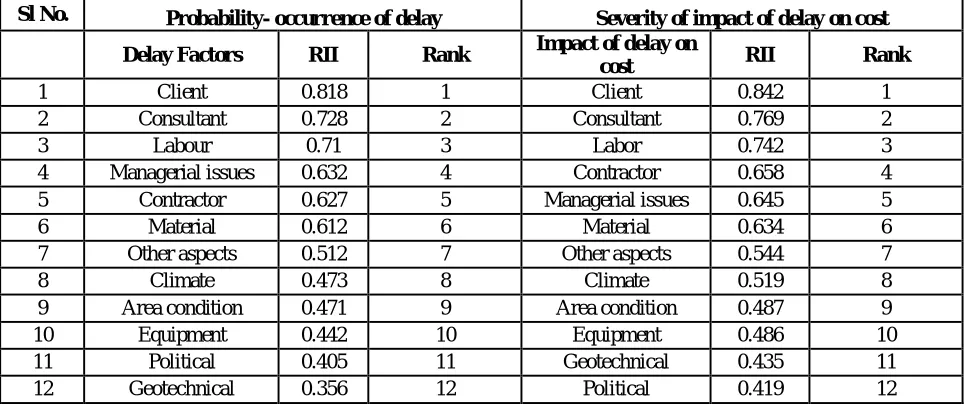
The Cronbach’s Alpha value is calculated as 0.965 for probability of occurrence of delay factor and 0.955 for severity of its impact on cost. As the Cronbach’s value is greater than 0.9, the results of questionnaire survey is excellent and can be used as genuine data for the research. The top delay causing factors that has maximum probability of occurrence and has maximum severity of impact on cost are ranked in table 1.
Table 1: Ranking of delay factors
Sl No. Probability- occurrence of delay Severity of impact of delay on cost
Delay Factors RII Rank Impact of delay on
cost RII Rank
VI. CASESTUDY
Taking just one method to collect data may not help the research study to be conducted well and that using other methods will assist in collecting enough and accurate information. Even though there are strength and weakness in using those strategies above for data collection, they provided better solutions to the research study in question than other methods that I have come across. In this project case study was conducted to correlate with the collected data. Survey results can consider as almost reliable data, even though, to have more idea about the present situation in construction industry, case studies were been conducted.
7.1 Case study on Residential Appartment, Trippunittura
AB Tower is an ongoing Apartment project in Trippunittura, Ernakulum with basement and ground floor for parking and first to thirteenth floor for residential purposes. The structure is a little complicated one as all the exterior columns are floating on Basement floor beams, the work was started in June 2015. It was identified that the estimated cost of the project was about 15 Cr and planned completion time was June 2017. But the project was delayed by about 6 months at the primary stage itself and the loss so far is calculated around one crore, i.e. till May 2016. So to collect the details about the building, a detailed enquiry had been done with the project engineers and identified some of the major causes which leads to time as well as cost overrun in that residential building. Change in decision by the Client:
All the works were assigned to appropriate consultants, contractors etc. But at the time of first floor casting the drawing provided by the structural consultant was found risky to take complete load acting on it and as the client was not ready to take any risk the Structural consultant was changed at the stage when the basement floor was almost completed.
Change in design by the consultant:
As per the new structural drawing in order to maintain the structural stability, eight additional piles are to be casted and all the existing columns were to be retrofitted by jacketing. Major portion of the slab which was already casted for basement was removed for the requirement of eight additional piles. Micro concreting was done as concreting is difficult in retrofitting process which is around three times expensive. Dynamic load test was done again on the basis of new drawing.
Contractor related issues in delay:
As the structural drawing got changed, the rate for additional works like demolition etc was quoted again by the contractor. Contractor was paid around twenty lakhs as compensation. The project was completely stopped for two months and it took another four months to reach back into the same level where inconsistency was felt once.
Managerial issues:
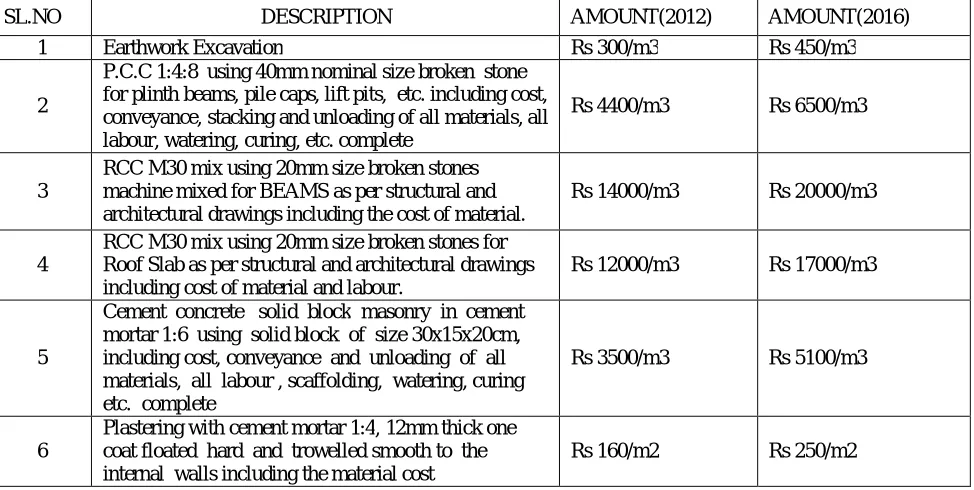
Table 2: Comparison of contract rate
SL.NO DESCRIPTION AMOUNT(2012) AMOUNT(2016) 1 Earthwork Excavation Rs 300/m3 Rs 450/m3 2
P.C.C 1:4:8 using 40mm nominal size broken stone for plinth beams, pile caps, lift pits, etc. including cost, conveyance, stacking and unloading of all materials, all labour, watering, curing, etc. complete
Rs 4400/m3 Rs 6500/m3
3
RCC M30 mix using 20mm size broken stones machine mixed for BEAMS as per structural and architectural drawings including the cost of material.
Rs 14000/m3 Rs 20000/m3
4
RCC M30 mix using 20mm size broken stones for Roof Slab as per structural and architectural drawings including cost of material and labour.
Rs 12000/m3 Rs 17000/m3
5
Cement concrete solid block masonry in cement mortar 1:6 using solid block of size 30x15x20cm, including cost, conveyance and unloading of all materials, all labour , scaffolding, watering, curing etc. complete
Rs 3500/m3 Rs 5100/m3
6
Plastering with cement mortar 1:4, 12mm thick one coat floated hard and trowelled smooth to the internal walls including the material cost
Rs 160/m2 Rs 250/m2
6.3 Case study on Commercial cum Residential building, Kakkanad
RKS is an ongoing commercial cum residential project in Kakkanad, Ernakulam with basement to sixth floor for parking and shopping purpose and from seventh to thirteenth floor for residential purposes. It was a takeover project which was left incomplete at the primary stage. The work was started in July 2013. It was identified that the estimated cost of the project was about 16.5 Cr and planned completion time was March 2016. But the project was delayed by about 6 months and as per the corrected schedule, the expected date for completion is September 2016 and the expected cost at the time of completion is 18cr. So to collect the details about the building, a detailed enquiry had been done with the project engineers and identified some of the major causes of delay.
Cash flow from client:
There was a delay in payment by the client as two new projects were launched by the client in the meantime. The loan amount which was promised by the bank and the stage wise payment by the customer was not made in time as there was a delay from the builder to complete the level as per the contract with the bank and the customers.
Design Changes:
Initially the building was designed as first eight floor for parking and shopping, remaining for residential purpose. The building was left abandon by the former builder and then was taken over by Blue Berry. Small changes were made of the architectural and structural drawings. As per the new first six floors were allotted for shopping and parking, remaining for residence. Plumbing consultant prepared drawing as per the old drawing on which the tender was quotedwhich was different from the actual. Around four months were delayed in order to recognize the mistake and make new drawings.
Labour Issues:
complete 8 hours output from North Indian labour’s. When the salary is compared, for eg. Mason, the labor charge for North Indian mason is Rs 600 per day whereas Rs 900 is the daily labour charge of a local mason. Union labours created problems on their payment and the tile and electrical works were delayed from scheduled date.
Contractor related:
Work was stopped about one week due to complaints on quality of work and there was a delay in progress of work when the quality control from client side got strict. Ex. The shuttering sheets which were used four cycles were not allowed to use in fifth cycle etc. The rate quoted was in the year 2012 and the present rate is too high on which the contractor was not possible to go ahead with the contract and there created an issue at the completion time of the contract period, that is on march 2016 and the client was forced to increase contract rate. The drawings for outside car parking, sump tank, septic tank etc where prepared after the quote by contractor, but when considered from client side, unit rate is quoted and so will be the same for additional drawings too which was prepared immediately after quote.
Managerial issues:
Managerial issues were severe as it was a takeover project. Electrical and ACP contractor left the work without completion. Old drawing and new drawings with different consultants and contractors created confusion. Cash flow management was affected in the fast completion of the work. Management failed to attach the unit rate quoted in 2012 for the building with the parking facilities near to it, which made the client to pay on 2016 local market rate basis to the contractor which is around 30 percent more than that of 2012. Delays were occurred when the consultant staff is late to the site for site inspection and mistakes marked on the day of concrete.
VII. VALIDATION
The case study can be considered as a validation of questionnaire survey. The results obtained from both studies are comparable. Case study mainly pointed out the client issues, consultant issues, labour issues, managerial issues and contractor issues as the top most factors lead to delay and the impact on delay on cost was clearly explained in AB Tower, Trippunittura. While reviewing it’s identified that the identified factors in case study are included in the identified top ranked factors in questionnaire survey. So it’s able to say that the questionnaire survey done was reliable and the identified top five ranked factors of delay as well as impact of delay on cost can be consider as the major causes for delay and loss in building construction.
VIII.ROOTCAUSESTUDY
After finding the top five delay causing factors, root cause study was conducted in the form of a semi-structured interview with experts (Client, Consultant, Contractor) having a minimum of 25 years’ experience in the industry. The key points from root cause study are: Client related- Decision change, lack of clear cut image of complete project.Consultant related- Design changes,Systematic management of digital data is either missing or discontinuing. Labour related- Lack of labour productivity measuring techniques, Labour satisfaction measures to control absenteeism. Managerial issues- Planning, Inadequate techniques to make sudden changes of scheduled work for facing unexpected scenarios. Contractor issues-Contractors overbooked on other projects, usage of old construction techniques.
From root cause study it is clear that simultaneous solutions are required for multiple issues to have a proper control on delay which can be obtained by a well-structured ERP system.
IX. SOLUTION
10.1Addspro ERP
done by management firms. Eg.Structural software like RCDC by Bently gives complete reinforcement detailing and detailed estimate of the structure with high range of accuracy, but this output from structural firm is less often carried to the management firm and complete estimate is again done manually which is time consuming.
The advantages of using Aadspro ERP system are:Integrate the output from fast track software, Make a workflow structure by connecting a time factor,Create data for managing the works at site,Integrating all the works and inventory, Managing the stock of materials and labour,Managing Human Resource,The Gantt chart used in the ERP system can be exported to other programs like MSP etc for resource crushing and smoothening,The data from the site is directly entered into the system by the site engineer and therefor time lag can be controlled and quality can be improved.
10.2 Case Study on ERP Implemented Project
A case study was conducted of two similar projects one on which Addspro ERP was implemented which is located at Kaloor and another with normal construction method which is at Kadavanthra. Table 3 shows time schedule of each project and it is seen that the ERP implemented work is completed in 370 days and the work in Kadavanthra took 591 days for completion. Here approximately around 200 days are saved by the implementation of ERP system. For a project with Rs 2500 per square feet land cost and Rs 2500 per square feet construction cost the total investment comes Rs 5000 per square feet. If such a project is delayed by one year the losses to be faced are 10 percent interest amount as most of investments are on bank loan, 7 percent inflation cost and 3 to 5 percent rate of return together makes a loss of 20 percent which is Rs 1000 per square feet. In addition to this an ERP implemented project can make a profit of 10 percent on the material and labour expenses which comes around Rs250 per square feet. That is the loss on actual construction cost reaches Rs6500. This proves that an ERP implemented construction project can reduce the total cost of the project by 30 percent.
Table 4: Time comparison with and without ERP implementation
Project Normal Project ERP Implemented Project
Contractor APP Constructions APP constructions
Project details
Location Kadavantra Kaloor Floors B+G+4 B+G+4 Floor Area 15610 14730 Foundation Pile+Raft Pile+Raft Pile Depth(Approx.) 33 47 No. of Piles 27 20 Raft slab depth 30cm 30cm Floor Height 4m 4m Project Starting Time 10/4/2014 2/5/2015 Project Finishing Time
(Structural) 7/2/2016 1/6/2016 ERP implementation No Yes Planning Yes Yes Scheduling Yes Yes
Duration Days Days
Pre-Construction
Architectural Planning/ Working
drawing/Approval/ BOQ 30 20 Structural Design
Detailing 12 3
Estimation 15 2
BBS Preparation 5 1
Total 69 33
Construction (Structural)
Work Planning 21 3
Piling 39 37
Basement 45 23
Ground Floor 42 21
Second Floor 35 32
Third Floor 37 24
Fourth Floor 37 25
Fifth Floor 45 24
Terrace 41 28
Total 342 217
Finishing and furnishing
Total 180 120
GRAND TOTAL 591 370
X. CONCLUSION
A successful project is the one which completes the targets as per planned schedule and minimum cost. Construction schedule delays in a project can cause major problems for all the project participants. Occurrence of delay varies from project to project which emphasis the necessity of defining the reason behind delay. In my study 52 delay causing factors were found out and was grouped into 12 major factors. The factors causing delay were analysed using SPSS software and was ranked using relative importance index(RII). The top five delay causing factors which has maximum probability of occurrence using RII are Client related, Consultant related, Labour related, Managerial issues and contractor related. The case study conducted in three different delayed projects justify that major delay occurred due to this top five delay factors. From root cause study it was clear that a well-structured ERP system can have simultaneous control on multiple tasks been carried out for the project.
Implementation of a well-structured six dimensional ERP system is suggested as the best possible remedy for delay management and to minimize the impact of delay causing factors. It was proved from the study that a wastage of 30 percent of actual cost can be saved by the implementation of ERP system.
REFERENCES
[1] Kumar NeerajJha, K. C. Iyer, "Critical Factors Affecting Schedule Performance: Evidence from Indian Construction Projects”, Journal of Construction Engineering and Management, August 2006.
[2] Phaniraj K, K S Sreekumar, “Practical Factors Affecting Delay in High Rise Construction – A Case Study in a Construction Organization.”, International Journal of Engineering Research & Technology, vol. 3, 2014.
[3] Owolabi James, AmusanLekan et al “Causes And Effect Of Delay On Project Construction Delivery Time”, International Journal of Education and Research, vol. 2, No. 4, 2014.
[4] K. L. Ravisankar, S. AnandaKumar et al, “Study on the Quantification of Delay Factors in Construction Industry”,International Journal of Emerging Technology and Advanced Engineering, vol. 4, No. 1, 2014
[5] MoutazHaddara“ERP Selection: The SMART Way”, Science direct, 2014.
[7] M. Moazzami, R. Dehghan et al, “Contractual Risks in Fast-Track Projects”, Science direct, 2011.
[8] Hongyi Sun, Wenbin N et al, “A Step-By-Step Performance Assessmentand Improvement Method for ERP Implementation: Action Case Studies In Chinese Companies”, Science direct, 2015
[9] SadraAhmadi,ElpinikiPapageorgiou,Chung-HsingYeh et al, “Managing Readiness-Relevant Activities For The Organizational Dimension Of ERP Implementation”,Science Direct (2015).
[10] Michail Chester, Chris hendrickson, “Cost impact, schedule impact and the claim process during construction”. JournalOf Construction Engineering And Management © Asce / January 2005.
[11] Olawale, Y., and Sun M. “Cost and time control of construction projects: Inhibiting factors and mitigating measures in practice.” Construction Management and Economics, 28 (5), 509 – 526,2010.