ISSN(Online): 2319-8753 ISSN (Print): 2347-6710
International Journal of Innovative Research in Science,
Engineering and Technology
(An ISO 3297: 2007 Certified Organization)
Website: www.ijirset.com Vol. 6, Issue 9, September 2017
Architecture for Accessibility Support System
of E-Learning for Higher Education
Sunil Kumar Sharma1, Raghav Mehra2
Research Scholar, Bhagwant University, Ajmer, Rajasthan, India 1
Associate Professor, Department ofComputer Science & Engineering, Bhagwant University, Ajmer Rajasthan, India 2
ABSTRACT: E-Learning is proficient, errand important and in the nick of time taking in developed from the learning necessities of the new and powerfully evolving world. In this paper, we propose a web based development architecture for accessing the e-learning system in the context of higher education information services for the students of MCA in the selected university of Uttar Pradesh by the use of ontology to effectively combine information from multiple heterogeneous sources. The purpose of which is to provide a common platform of education to all those students of different universities or institutes, by which an unbelievable change in the level of their education.
KEYWORDS:E-Learning, Ontology, Meta data, W3C, WAI, API, RDF, RDQL, NPL, XML
I. INTRODUCTION
The evolution of information has prompted the rise of new educational technologies and environment. A standout amongst the most critical necessities to such conditions is the fast access to the applicable information that addresses client's issues as exactly and completely as conceivable [1]. As of late the huge advance has been accomplished in formation of eLearning frameworks in light of Web advances. Online courses offer clear focal points to students by permitting quickly, without a moment to spare, applicable, and whenever or put access to instructive assets. However the conventional Web innovations in light of a grammatical increase of data don't give the semantic inquiry and route inside a dispersed information condition. This limitation essentially limits the capacity of far reaching instructive conditions to adjust instructional administrations for a specific client and block from raising the proficiency of figuring out how to a subjectively new level. To actualize such administrations, the production of open smart instructive conditions in view of Semantic Web is required [2].
II. HOLISTIC APPROACH
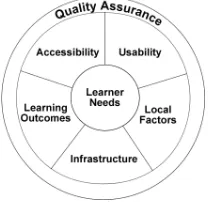
The holistic Approach for e-learning accessibility, Rather than relying purely on the guidelines developed by W3C WAI, the authors feel that these guidelines should form part of a broader approach to the provision of accessible e-learning resources. There is a need to address the usability of e-e-learning resources, the pedagogic aims of the e-e-learning resources, infrastructural and resources issues and to provide solutions, which are appropriate to the needs of the learner. We feel that a quality assurance framework is needed to support this model, which ensures that documented policies are provided and systematic procedures for ensuring compliance with the policies are implemented.
ISSN(Online): 2319-8753 ISSN (Print): 2347-6710
International Journal of Innovative Research in Science,
Engineering and Technology
(An ISO 3297: 2007 Certified Organization)
Website: www.ijirset.com Vol. 6, Issue 9, September 2017
Figure 1: Holistic Model for E-Learning Accessibility
Another limitation of our approach may be its lack of a universal model, which is implicit in its inclusion of institutional and local factors. This criticism may, in fact, be regarded in some quarters as a strength of the model, as it does not seek to mandate a single global solution, but rather welcomes diversity and a learner-centric approach to E-learning Our work is still in its early stages. There is still a need to refine our model and to provide examples of how it could be applied in a variety of circumstances, including differing learning environments, students with a variety of disabilities, use of various technologies and in a variety of different organisations. [5]
III.PROPOSED ARCHITECTURE
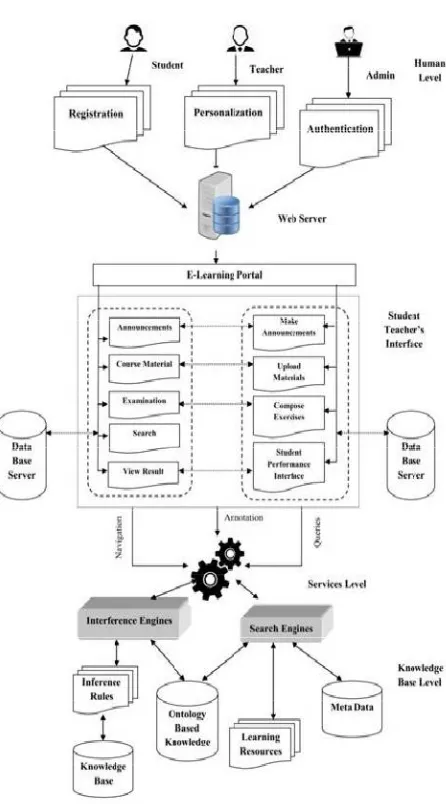
The proposed advancement design gives abnormal state administrations to individuals searching for proper online data. The essential levels of this engineering are the human levels created by the Students, Teachers and the Administrator, the entrance level that concede access to understudies and educators into the framework, the interface level that give different offices, the administration level that handles the foundation forms, the middleware level comprises of web crawlers and induction motors and the learning base level involving different archives. In the base of this reasonable design, we have delineated the key components of a semantic E-Learning stage.
A. Knowledge Base
It is where ontologies, metadata, deduction rules, instructive assets and course depictions, client profiles, and so forth are put away. The metadata might be set inside the archive itself or in some outer metadata vault [6]. In the Figure the metadata are put away remotely in the learning base since it is less demanding to check a different Meta portrayal put away in a database and it consumes less room to store it. The second preferred standpoint is that the perspective may shift as indicated by various creators who reuse a similar learning material. It implies that it is conceivable to have diverse portrayals of the learning material as indicated by the distinctive settings.
B. Search Engine
It furnishes an API with techniques for questioning the learning base [7]. RDQL (RDF Data Query Language) can be utilized as metaphysics inquiry dialect.
C. Access Layer
It goes about as a security layer between the clients and the framework. It gives an interface and allows access into the framework.
D. Interface Layer
ISSN(Online): 2319-8753 ISSN (Print): 2347-6710
International Journal of Innovative Research in Science,
Engineering and Technology
(An ISO 3297: 2007 Certified Organization)
Website: www.ijirset.com Vol. 6, Issue 9, September 2017
E. Ontology Based Knowledge Base
In an E-Learning condition the circumstance can without much of a stretch emerge that diverse instructors utilize distinctive phrasings, in which case the mix of learning materials ends up noticeably troublesome. The recovery issue is moreover exacerbated by the way that commonly educators and understudies have altogether different foundations and levels of learning. Hence, some instrument for building up a mutual comprehension is required. Ontologies are an intense component for accomplishing this errand. Truth be told, metaphysics obliges the arrangement of conceivable mapping amongst images and their full implications mapping of assets to ideas. The explanation can be manual or programmed. A few methodologies have been proposed for programmed semantic explanation, established in two primary research fields: common dialect handling and machine learning. Regular dialect handling (NLP) depends on the identification of average human develops in literary data and tries to delineate sentence synthesis principles to semantic rich depictions. The other approach to give semantic descriptors as of now under scrutiny is machine learning. Fundamentally machine learning implies separating affiliation principles and practices to enable machines to finish particular assignments and additionally their human partners [8].
F. Metadata
ISSN(Online): 2319-8753 ISSN (Print): 2347-6710
International Journal of Innovative Research in Science,
Engineering and Technology
(An ISO 3297: 2007 Certified Organization)
Website: www.ijirset.com Vol. 6, Issue 9, September 2017
Figure 2: Proposed Development Architecture of Accessibility Support System of E-Learning
IV.METHODOLOGY
The present architecture is quite simple and general in nature in a way that it can be applied to any higher education system. However, while designing the architecture, main focus was on the requirements of the students of the MCA students of different universities (both private as well as government) and easy access.
V. DATA ANALYSIS AND FINDINGS
ISSN(Online): 2319-8753 ISSN (Print): 2347-6710
International Journal of Innovative Research in Science,
Engineering and Technology
(An ISO 3297: 2007 Certified Organization)
Website: www.ijirset.com Vol. 6, Issue 9, September 2017
This section is divided into four major sections i.e. A) Single Factor Analysis B) Cross Factor Analysis i.e. Basic Degree Qualification and University C) Feedback Analysis D) Hypothesis Testing based on Chi Square Analysis Technique. There are two types of questionnaires that have been used for collecting primary data in this research study as per the plan selected in the research methodology. The survey method is being applied for data collection through structured questionnaire data collection technique. The respective questions have been composed by considering the research statement and objectives. Both the questionnaire set plays vital role in the present research study to understand the varied opinion given by the respondents from MCA, BCA, and BCS Institutes of UP State.
The first questionnaire set is divided into two sections i.e. Section A and Section B. Section A includes the questions about the personal details i.e. name of respondent, address, phone, mobile number, email id, institute name, semester, name of affiliated university, gender, etc. Section B includes the questions about E-Learning technology, challenges, opportunities, etc. Initially, first questionnaire was presented before the respondent i.e. MCA, BCA student for getting the respective information. The collected information has been analysed and then E-learning model is created by considering the opinions and suggestions given by the respondent.
Firstly the primary data has been collected from the respondents. It is analysed and interpreted by using quantitative analysis technique. E-learning model has been proposed by using certain web based programming tools. The suggestions have been considered regarding E-learning concepts from the respondents in the model. The SDLC (System Development Life Cycle) methodology has been used for the development of the present E-learning Model. After successful testing of the model it was presented before the respondents. While presenting the model, they have been asked to use the proposed E-learning model and their responses about the same. These responses have been recorded by giving them second set of questionnaire immediately after using the proposed model. The same set of questionnaire is referred as feedback form.
The population of the study is 126 units. In the present research study 30 units are selected by random sampling method. From each unit i.e. institute, data has been collected from any 10 respondent i.e. student of MCA (Master of Computer Application) course. So total sample size is i.e. 30 x 10 = 300. The selected units are those institutes who are running MCA (Master of Computer Application) professional post graduate degree course which is affiliated to respective university of the state and approved by AICTE (All India Council for Technical Education, New Delhi), DTE (Directorate of Technical Education, UP)
The proposed architecture includes different modules based on the common subjects offered by the MCA Institutes in UP.
VI.CONCLUSION
In the present research contemplate the respondents from BCA, BSC and MCA foundations of UP state have been taken for the investigation. These establishments are partnered to individual colleges. In this investigation 540 respondents have contributed their supposition through polls. Two sorts of poll sets were utilized i.e. 1) Questionnaire 2) Feedback. The principal poll set was presented for gathering individual points of interest and sentiment about the E-learning ideas. It is appropriately topped by 300 respondents from Off state. The reactions were broke down and deciphered by utilizing quantitative investigation system. It incorporates the investigation and understandings of the respondents' perspectives, aptitudes, information, premium, and so forth. These reactions have been considered in the new improvement engineering of availability emotionally supportive network of E-Learning. The proposed E-learning model was exhibited before the respondents for getting their reactions. The second kind of survey set i.e. criticism has been utilized to get their reactions and it is reacted by 240 respondents.
ISSN(Online): 2319-8753 ISSN (Print): 2347-6710
International Journal of Innovative Research in Science,
Engineering and Technology
(An ISO 3297: 2007 Certified Organization)
Website: www.ijirset.com Vol. 6, Issue 9, September 2017
dominant part of respondents is BCA trailed by BCS and BSC degree qualified. Just 5 respondents have finished essential degree from different resources.
Every one of the respondents are pressing together MCA proficient degree course in particular foundations which is associated to the state University. Most of the respondents 70 are from University-2 took after by 50 respondents from University-1 and University-7 is at least number.
The examination ponders uncovered that most of the respondents are visit clients of E-learning instruments for learning MCA course. Different clients utilized E-learning devices at intermittent premise.
It is established that, respondents are utilizing different sorts of gadgets like desktop, PDA, portable workstation, tabs, and so on for getting to the E-learning offices. The investigation found that dominant part of the respondent liked to utilize desktop gadget for their scholastic and in addition getting to E-learning material.
Research uncovered that all the respondent have conceded the significance of E-Learning in MCA course and it is established that Programming in C and C++, Networking and Java writing computer programs are most favoured PC subjects proposed by the respondents in E-learning model.
The present research contemplate investigated the feeling of the respondents about the E-Learning instruments assumes a compelling part in learning process. Along these lines, all respondents have demonstrated their acknowledgment in such manner. This recommends, E-learning instrument has turned out to be successful learning process.
The present examination found that every one of the respondents conceded that E-learning offices help in understanding complex marvel in basic way.
It is watched that respondents are getting different offices at establish level. Out of them email is the most prominent office opined by the respondent. There are some different offices like online examination, person to person communication sites, video conferencing, visit room, web-based interfaces, and so forth that are given by the organizations.
The respondents have communicated their conclusion about incorporating different highlights in E-Learning model. The most appraised highlight is E-book which is trailed by online examination. There are different highlights like notes, online syllabus, sound video bolster, designs, calculation, projects and input frames. What's more, there is ID of different components to be utilized as a part of proposed engineering. The most favoured component is synchronous technique took after by electronic apparatuses, class and workshop.
In the investigation different key difficulties were investigated by the respondents. Out of that expanding specialized help and keeping up current specialized foundation are significant issues for executing E-learning framework in MCA establishments of UP state.
In the present investigation it is discovered that most of the respondents trusted that E-Learning enhances maintenance capacity. The examination likewise found that half of the respondents wished to learn by customary and in addition E-learning apparatuses both.
In the exploration contemplate it is investigated that most of the respondents conceded that E-Learning devices assumes a vital part and backings for quality training and trusted E-Learning is an empowering agent of higher execution. Lion's share of respondents is happy with the general nature of present proposed E-learning model.
16.67
23.33
10 10 10
6.67 3.33 6.67 6.67 6.67 0 5 10 15 20 25 U n iv er si ty -1 U n iv er si ty -2 U n iv er si ty -3 U n iv er si ty -4 U n iv er si ty -5 U n iv er si ty -6 U n iv er si ty -7 U n iv er si ty -8 U n iv er si ty -9 U n iv er si ty -1 0 P er ce n ta g e
ISSN(Online): 2319-8753 ISSN (Print): 2347-6710
International Journal of Innovative Research in Science,
Engineering and Technology
(An ISO 3297: 2007 Certified Organization)
Website: www.ijirset.com Vol. 6, Issue 9, September 2017
The examination uncovers the reactions about the different highlights incorporated into the proposed engineering of E-learning model. Most of the respondents preferred the online examination highlight which is trailed by downloading office, simplicity of adapting, speedy access, assessment report office, and so on.
In the exploration it is discovered that the online examination office in the proposed engineering of E-learning model has been valued by every one of the respondents. It is seen that every one of the respondents conceded that the inquiries included for online examination in the proposed engineering of E-learning model were pertinent and proper with concerned subject.
It is watched that the online examination assessment report highlight has been recognized by every one of the respondents where they get the score card on their email id quickly after consummation of the examination. It gives the total examination of the inquiries.
The present research contemplate demonstrated that E-learning frameworks are more powerful than customary learning frameworks. The given explanation has been acknowledged by every one of the respondents and furthermore found that proposed engineering of E-learning model causes students to expand their insight.
After effectively execution of the proposed design of E-learning model every one of the respondents have concurred for prescribing the model to different clients and they feel the protection and security issues is great in the proposed engineering of E-learning model. Just 10% respondents have demonstrated from time to time acknowledgment in such manner.
The investigation found that the respondents embraced the view that the proposed engineering of E-learning Model has been acknowledged by whole understudy group and they are completely happy with the same.
VII. FUTURE SCOPE
The suggestions are based on the study presented below:
1. E-learning instruments and method may give different offices to the understudies from learning perspective. These systems give portability to the clients to get to the course related material from removed place. The MCA course educational programs may incorporate this kind of engineering of E-Learning model.
14.58 35.42 17.5 32.5 0 20 40 Complete study material
All formal support Prompt evaluation & feedback
Report on mail id
P er ce n ta g e
Remark on Features in Present Proposed E-Learning Model
57.08 42.92
0 0 0
50 100
Very Good Good Average Not Satisfactory P er ce n ta g e
Feedback about Online Exam Evaluation Report
58.75 41.25
0 0 0
100
Very Good Good Average Not Satisfactory
P er ce n ta g e
Respondents View about Online Examination Facility in the Model 18.75 71.67 9.58 0 0 50 100
Excellent Good Average Not Satisfactory P er ce n ta g e
Ratings about Security & Privacy issues in present proposed E-learning Model
79.58 20.42 0 0 0 50 100
Yes, fully Somewhat Neutrally Not much
P er ce n ta g e
ISSN(Online): 2319-8753 ISSN (Print): 2347-6710
International Journal of Innovative Research in Science,
Engineering and Technology
(An ISO 3297: 2007 Certified Organization)
Website: www.ijirset.com Vol. 6, Issue 9, September 2017
2. The online examination office is accessible to the respondents where they can choose their favoured subject and go for online examination. The target sort exam is accessible to the respondents. Inquiries are exhibited before the respondents arbitrarily from the inquiry bank of E-learning. The after effect of the exam is given instantly after the accommodation of exam on particular email id with points of interest. Along these lines, this may help the possibility for self assessment. This sort of far reaching assessment apparatus can be created by college and the online examination for MCA course might be directed.
3. The applicants may contribute their sentiment, perspectives and course materials in the proposed engineering of E-Learning model. So this may help the understudies for being more dynamic and get refreshed on consistently premise.
REFERENCES
[1] B. Ruttenbur, G. Spickler, and S. Lurie, “eLearning – The Engine of the Knowledge Economy”, Morgan Keegan &Co. Inc. eLearning Industry Report, 2001, 109 p.
[2] L. Stojanovic, S. Staab, and R. Studer, “eLearning basedon the Semantic Web”, Web Net 2001 – World Conference on the WWW and Internet, Orlando, Florida, USA, 2001
[3] Cooper, Martyn, Rebecca Ferguson, and Annika Wolff. "What can analytics contribute to accessibility in e-learning systems and to disabled students' learning?." Proceedings of the Sixth International Conference on Learning Analytics & Knowledge. ACM, 2016.
[4] Kelly, Brian, Lawrie Phipps, and Elaine Swift. "Developing a holistic approach for e-learning accessibility." Canadian Journal of Learning and Technology/La revue canadienne de l’apprentissage et de la technologie 30.3 (2004).
[5] Liebowitz, Jay, and Michael Frank, eds. Knowledge management and e-learning. CRC press, 2016.
[6] Rani, Monika, Riju Nayak, and O. P. Vyas. "An ontology-based adaptive personalized e-learning system, assisted by software agents on cloud storage." Knowledge-Based Systems 90 (2015): 33-48.
[7] Rinciog, Octavian, and Vlad Posea. "LODRo: using cultural Romanian open data to build new learning applications." The International Scientific Conference eLearning and Software for Education. Vol. 1. " Carol I" National Defence University, 2016.
[8] Villanueva, Daniel, et al. "SMORE: Towards a semantic modeling for knowledge representation on social media." Science of Computer Programming 121 (2016): 16-33
[9] Kostolányová, Kateřina, and Jana Šarmanová. "Individualisation and personalisation of education-modern trend of eLearning." International Journal of Continuing Engineering Education and Life Long Learning 26.1 (2016): 90-104.
[10] Truong, Huong May. "Integrating learning styles and adaptive e-learning system: Current developments, problems and opportunities." Computers in Human Behaviour 55 (2016): 1185-1193.
[11] Gros, Begoña, and Francisco J. García-Peñalvo. "Future trends in the design strategies and technological affordances of e-learning." Learning, Design, and Technology: An International Compendium of Theory, Research, Practice, and Policy (2016): 1-23.