DOI: 10.1534/genetics.106.057919
Evolutionary Divergence of Exon Flanks: A Dissection of
Mutability and Selection
Yi Xing, Qi Wang and Christopher Lee
1Molecular Biology Institute, Center for Genomics and Proteomics, Department of Chemistry and Biochemistry, University of California, Los Angeles, California 90095-1570
Manuscript received March 6, 2006 Accepted for publication May 1, 2006
ABSTRACT
The intronic sequences flanking exon–intron junctions (i.e., exon flanks) are important for splice site recognition and pre-mRNA splicing. Recent studies show a higher degree of sequence conservation at flanks of alternative exons, compared to flanks of constitutive exons. In this article we performed a detailed analysis on the evolutionary divergence of exon flanks between human and chimpanzee, aiming to dissect the impact of mutability and selection on their evolution. Inside exon flanks, sites that might reside in ancestral CpG dinucleotides evolved significantly faster than sites outside of ancestral CpG dinucleotides. This result reflects a systematic variation of mutation rates (mutability) at exon flanks, depending on the local CpG contexts. Remarkably, we observed a significant reduction of the nucleotide substitution rate in flanks of alternatively spliced exons, independent of the site-by-site variation in mutability due to different CpG contexts. Our data provide concrete evidence for increased purifying selection at exon flanks associated with regulation of alternative splicing.
T
HE intronic sequences that flank exon–intron junctions play a critical role in exon recognition and pre-mRNA splicing (Fairbrother and Chasin2000; Sunand Chasin2000; Zhanget al.2003). These
intronic sequences, referred to as ‘‘exon flanks’’ (Zhang et al.2005), contain important splicing regulatory signals such as intronic splicing enhancers and silencers. Zhang and colleagues performed a genomewide study on the splicing signals in 50-nt exon flanks. They showed that exon flanks displayed a bimodal distribution of GC content, and high-GC and low-GC exon flanks might be associated with different mechanisms of exon recog-nition (Zhang et al. 2005). Some important splicing
regulatory motifs are phylogenetically conserved in exon flanks (Kolet al.2005; Minovitsky et al.2005).
Mutations at exon flanks frequently cause disruption of normal splicing patterns, such as the recognition of a cryptic splice site or the skipping of an entire exon (Eng et al. 2004; Costa et al. 2005; Coutinho et al.
2005). Such splicing mutations are one of the major causes for various human diseases (Garcia-Blancoet al.
2004). Therefore, although noncoding, exon flanks experience negative selection during evolution due to constraints of splicing regulation.
Recent comparative genomic analyses indicate a reduced nucleotide substitution rate at flanks of alter-natively spliced exons. Sorek and Ast analyzed the 100-nt
flanks of exons that were alternatively spliced in human and mouse transcripts. They observed a nearly 20% increase of percentage of sequence identity at 30-nt exon flanks of alternatively spliced exons, compared to flanks of constitutive exons (Sorekand Ast2003). The
average lengths of conserved sequences were 103 nt for upstream flanks of alternative exons and 94 nt for downstream flanks of alternative exons (Sorekand Ast
2003). Other studies reported similar results (Sugnet et al. 2004, 2006; Xing and Lee 2005). In fact, the
increased sequence identity at flanks of alternative exons has been successfully used to predict alternative splicing from raw genomic sequences (Philipps et al.
2004; Soreket al. 2004b; Yeoet al. 2005). It has been
suggested that such a higher sequence conservation re-flects stronger negative selection associated with regu-lation of alternative splicing (Sorekand Ast2003; Itoh et al.2004).
However, there are other factors that affect the nucle-otide substitution rate in a genomic region. One im-portant factor is the mutation rate. It is well known that the mutation rate varies significantly across the entire genome, leading to mutational hot spots and cold spots (Chuang and Li 2004). Even within the same gene,
there can be remarkable site-by-site variations of the mutation rate. For instance, CpG dinucleotides are highly mutable due to methylation effects (Li et al. 2002).
Keightleyet al.analyzed the substitution rate in rodent genomes. They found that the substitution rate was significantly higher in CpG-susceptible sites (i.e., sites preceded by C or followed by G, which thus were likely
1Corresponding author:Molecular Biology Institute, Center for Genomics
and Proteomics, Department of Chemistry and Biochemistry, University of California, Los Angeles, CA 90095-1570. E-mail: [email protected]
to be parts of ancestral CpG dinucleotides) compared to non-CpG-susceptible sites (Keightley and Gaffney
2003; Gaffneyand Keightley2005). A similar
observa-tion was made through genomewide human–chimpanzee comparisons (Ebersbergeret al.2002; Hellmannet al.
2003) and more recently at distant intronic sites and fourfold redundant synonymous sites using human– chimpanzee genome alignments (Kondrashov et al.
2006). These data indicate the heterogeneity of muta-tion rate even within a small region of a gene, depend-ing on CpG contexts.
In this article, we performed an in-depth analysis on the evolutionary divergence of exon flanks. We are interested in the following questions. First, how does the local CpG context affect substitution rates at flanks of constitutive and alternative exons? Second, what is the major cause for the increased sequence conservation at flanks of alternative exons? Is it reduced mutability or increased selection or both? Since multiple substitu-tions at a single site can obscure the impact of ancestral CpG dinucleotides, it is important to compare closely related species, where multiple substitutions are un-likely to occur (Ebersbergeret al.2002). The human
and chimpanzee exon flanks are the most suitable for our comparison, because these two species diverged only5 million years ago (Hedges2002). The goal of
our analysis is to dissect the contribution of mutability and selection to the evolutionary rate of exon flanks. We divided sites within exon flanks into distinct types according to their local CpG contexts. Windows ranging from 50 to 350 nt were used in previous analyses of exon flanks (Sorek and Ast 2003; Kaufmann et al. 2004;
Sugnetet al.2004, 2006; Xingand Lee2005; Yeoet al.
2005). Throughout this article, following the consensus choice in the current literature (Sorek and Ast2003;
Sugnetet al.2004, 2006), we defined our exon flanks as
the 100-nt intronic sequences immediately upstream (upstream exon flanks) or downstream (downstream exon flanks) of the exon–intron junctions. A different definition (e.g., 50-nt exon flanks) produced very similar results (data not shown).
MATERIALS AND METHODS
We identified alternatively spliced exons in the human and mouse genome, by aligning expressed sequences (mRNA/ EST) to the genomic sequences (Modrek et al. 2001). We
matched orthologous exons as previously described (Modrek
and Lee 2003). We compiled a set of ancestral alternatively
spliced exons between human and mouse,i.e., exons whose inclusion and skipping forms were observed in both human and mouse transcripts (Xing and Lee2005). The
indepen-dent observation of alternative splicing in two species is widely adopted as a criterion for functional alternative splicing events (Sorek et al. 2004a; Yeo et al. 2005). For such an exon,
alternative splicing is likely to be present in the common ancestor of human and mouse, therefore affecting the rate of nucleotide substitutions throughout subsequent evolution. We also used the data of Pan and colleagues to compile an
independent set of ancestral alternatively spliced exons (Pan
et al.2004). Pan and colleagues identified mouse alternative exons that were also alternatively spliced in human, using EST–genome alignments and microarray data. For each mouse exon, we mapped it to the human genome (hg17, http:// hgdownload.cse.ucsc.edu/goldenPath/hg17/bigZips/) using BLAST (Altschulet al.1997), requiring a match to the exon
over its entire length and an expectation value of,1e 4. Last,
we compiled a set of exons that were constitutively spliced in human and mouse.
For each ancestral alternative or constitutive exon, we cal-culated the evolutionary divergence of its flanks between human and chimpanzee. We extracted the alignment of its flanks between human and chimpanzee using the UCSC human– chimpanzee pairwise genome alignments (http://hgdownload. cse.ucsc.edu/goldenPath/hg17/vsPanTro1/axtNet/) (Kent
et al.2003; Schwartzet al.2003). We divided the nucleotide
sites at exon flanks into four distinct types on the basis of the local CpG context: sites preceded by a C and followed by a G (postCpreG), sites followed by a G but not preceded by a C (preG), sites preceded by a C but not followed by a G (postC), and sites neither preceded by a C nor followed by a G (nonCpG) (Keightley and Gaffney 2003; Kondrashov
et al.2006). The first three types of sites were CpG susceptible according to the definition of Keightley and Gaffney,i.e., they were likely to be parts of ancestral CpG dinucleotides (Keightleyand Gaffney2003). We required each site to be
flanked by two conserved nucleotides in the alignment and excluded sites that corresponded to insertions or deletions. For each nucleotide site, we checked the alignment to see whether it was conserved or substituted between human and chimpanzee. For each type of CpG sites, we counted the number of substituted sites and the total numbers of sites. The alignment data can be accessed at http://www.bioinformatics. ucla.edu/yxing/cpg/.
RESULTS AND DISCUSSION
We investigated the evolutionary divergence of exon flanks between human and chimpanzee. The complica-tion of multiple substitucomplica-tions at single sites is minimal because of the close relationship of human and chim-panzee (Ebersberger et al. 2002; Hedges 2002),
al-lowing an accurate inference for the ancestral CpG dinucleotides. We extracted the alignments of 141 up-stream flanks of ancestral alternatively spliced exons from the UCSC human–chimpanzee pairwise alignment. We also extracted the alignments of 40,638 upstream flanks of constitutive exons. We divided all nucleotide sites into four distinct types according to the local CpG contexts (seematerials and methods).
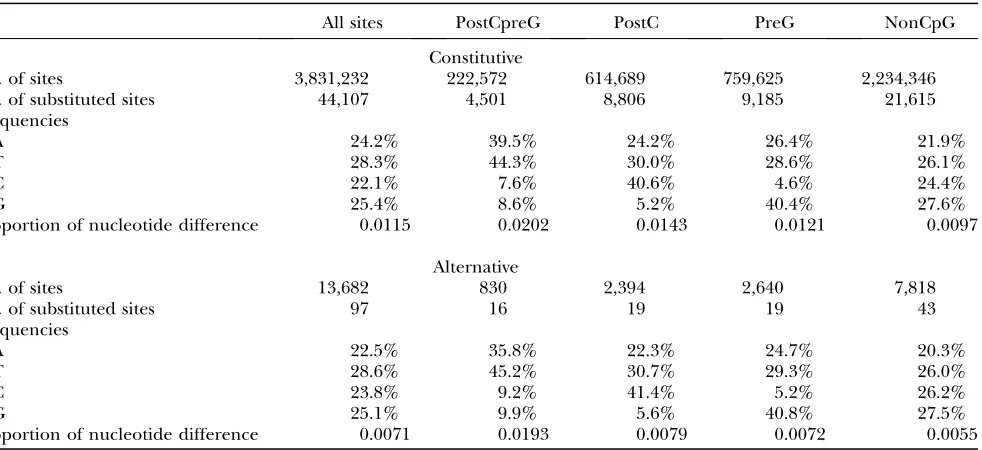
had a very low frequency of G; preG sites had a very low frequency of C; while postCpreG sites were strongly depleted of both C and G. We observed a similar trend at upstream flanks of ancestral alternatively spliced exons. The overall nucleotide substitution rate was 0.0075. The rate was the lowest (0.0063) for non-CpG-susceptible sites (nonCpG sites, compared to CpG-susceptible sites including postCpreG, postC, and preG sites) (see Table 1). Analyses of downstream exon flanks yielded very similar results (see Table 2). Our results were consistent
with human–chimpanzee analyses on distant intronic sites and fourfold redundant synonymous sites in exons (Kondrashov et al. 2006). These data indicate
in-creased mutability at CpG-susceptible sites compared to non-CpG-susceptible sites in exon flanks, regardless of constitutive splicing or alternative splicing.
Comparing upstream flanks of alternative and consti-tutive exons, we observed a significant reduction of nucle-otide substitution rate associated with alternative splicing (see Table 1). The overall nucleotide substitution rate at
TABLE 1
The nucleotide substitution rates at upstream exon flanks
All sites PostCpreG PostC PreG NonCpG
Constitutive
No. of sites 3,825,522 231,695 701,611 620,871 2,271,345
No. of substituted sites 43,207 3,996 9,412 7,685 22,114
Frequencies
A 22.9% 41.1% 21.6% 25.3% 20.8%
T 31.3% 44.7% 33.3% 32.5% 29.0%
C 24.2% 7.4% 40.4% 4.9% 26.1%
G 21.5% 6.7% 4.7% 37.3% 24.0%
Proportion of nucleotide difference 0.0113 0.0172 0.0134 0.0124 0.0097
Alternative
No. of sites 13,412 749 2,801 2,078 7,784
No. of substituted sites 101 7 26 19 49
Frequencies
A 21.1% 36.8% 20.1% 24.8% 19.1%
T 32.4% 44.3% 33.5% 34.0% 30.4%
C 26.2% 9.6% 41.7% 6.1% 27.5%
G 20.3% 9.2% 4.7% 35.1% 23.0%
Proportion of nucleotide difference 0.0075 0.0093 0.0093 0.0091 0.0063
TABLE 2
The nucleotide substitution rates at downstream exon flanks
All sites PostCpreG PostC PreG NonCpG
Constitutive
No. of sites 3,831,232 222,572 614,689 759,625 2,234,346
No. of substituted sites 44,107 4,501 8,806 9,185 21,615
Frequencies
A 24.2% 39.5% 24.2% 26.4% 21.9%
T 28.3% 44.3% 30.0% 28.6% 26.1%
C 22.1% 7.6% 40.6% 4.6% 24.4%
G 25.4% 8.6% 5.2% 40.4% 27.6%
Proportion of nucleotide difference 0.0115 0.0202 0.0143 0.0121 0.0097
Alternative
No. of sites 13,682 830 2,394 2,640 7,818
No. of substituted sites 97 16 19 19 43
Frequencies
A 22.5% 35.8% 22.3% 24.7% 20.3%
T 28.6% 45.2% 30.7% 29.3% 26.0%
C 23.8% 9.2% 41.4% 5.2% 26.2%
G 25.1% 9.9% 5.6% 40.8% 27.5%
upstream flanks was 0.0075 for alternative exons, a 33.6% reduction compared to constitutive exons (0.0113). Remarkably, all four types of sites experienced a re-duced substitution rate at flanks of alternative exons (see Table 1), ranging from a reduction of 45.9% (at postCpreG sites) to 26.6% (at preG sites). We also com-pared the substitution rate at downstream flanks of alternative and constitutive exons and observed a similar trend. The overall substitution rate had a 38.3% re-duction at downstream flanks of alternative exons. All four types of CpG sites had reduced substitution rates (see Table 2). These data suggest that alternative splic-ing is associated with a universal increase in the strength of negative selection at exon flanks, independent of the site-by-site variation of mutation rates due to different CpG contexts (see Figure 1, solid barsvs.open bars).
To rule out the possibility of artifacts due to potential sampling biases in our alternative splicing data set, we analyzed an independent set of ancestral alternatively spliced exons. This data set included 289 exons, which were identified using EST–genome alignments and microarray data (Panet al.2004). We observed the same
trend in this data set (see Figure 1). All four types of CpG sites had a statistically significant reduction in their substitution rates, compared to constitutive exons (see Figure 1, shaded barsvs.open bars). We also observed the same trend when we restricted our analysis to 50-nt exon flanks. These data demonstrate that our reported finding is a confident result.
Our study extended previous comparative analyses of intronic sites flanking alternatively spliced exons (Sorek
and Ast2003; Sugnetet al.2004; Xingand Lee2005).
Instead of analyzing the evolutionary divergence of the entire exon flanks, we divided all nucleotide sites at exon flanks into distinct types, according to their local
CpG contexts. Such treatment allowed us to separate the contribution of mutability and selection, two most important factors that affect the divergence rate of exon flanks. Our study indicates significant site-by-site varia-tions of mutability in the exon flanks, depending on the local CpG context. Such a phenomenon was observed in flanks of both alternative and constitutive exons. How-ever, the site-by-site variation of mutability is not the major contributor to the increased conservation at flanks of alternative exons. The higher sequence conservation is not due to a reduced fraction of hypermutable sites (i.e., CpG-susceptible sites). In fact, at all types of CpG sites (with different propensities for mutation) inside flanks of alternative exons, we observed a significant reduction of the nucleotide substitution rate (see Figure 1). This consistent pattern, independent of the variation in mutability due to different CpG contexts, strongly argues for an increased selection at flanks of alternative exons. Such a strong purifying selection might reflect RNA sequence motif (Itoh et al. 2004) or secondary
structure (Meyer and Miklos2005) requirements for
proper controls of alternative splicing. Our study pro-vides concrete evidence for widespread selection pres-sure in mammalian genomes that is associated with alternative splicing (Sorek and Ast 2003; Baek and
Green 2005; Xing and Lee2005). Understanding
se-lection pressure at exon flanks will shed light on the regulation of alternative splicing and how it evolves.
We thank Fyodor Kondrashov for key discussions that led to this analysis and for sharing one manuscript prior to its publication. We thank Sandy Pan and Benjamin Blencowe for sharing mouse splicing microarray data and Xiang Zhang and Alex Alekseyenko for helpful comments and suggestions. This work was supported by National Institutes of Health grant U54-RR021813, a Teacher–Scholar award to C.J.L. from the Dreyfus Foundation, a Department of Energy grant DE-FC02-02ER63421, and a Ph.D. dissertation fellowship to Y.X. from University of California, Los Angeles.
LITERATURE CITED
Altschul, S. F., T. L. Madden, A. A. Scha¨ ffer, J. Zhang, Z. Zhang
et al., 1997 Gapped BLAST and PSI-BLAST: a new generation of protein database search programs. Nucleic Acids Res. 25:
3389–3402.
Baek, D., and P. Green, 2005 Sequence conservation, relative
iso-form frequencies, and nonsense-mediated decay in evolution-arily conserved alternative splicing. Proc. Natl. Acad. Sci. USA
102:12813–12818.
Chuang, J. H., and H. Li, 2004 Functional bias and spatial
organi-zation of genes in mutational hot and cold regions in the human genome. PLoS Biol.2:E29.
Costa, D. B., L. Lozovatsky, P. G. Gallagherand B. G. Forget,
2005 A novel splicing mutation of the {alpha}-spectrin gene in the original hereditary pyropoikilocytosis kindred. Blood
106:4367–4369.
Coutinho, G., J. Xie, L. Du, A. Brusco, A. R. Krainer et al.,
2005 Functional significance of a deep intronic mutation in the ATM gene and evidence for an alternative exon 28a. Hum. Mutat.25:118–124.
Ebersberger, I., D. Metzler, C. Schwarzand S. Paabo, 2002
Genome-wide comparison of DNA sequences between humans and chim-panzees. Am. J. Hum. Genet.70:1490–1497.
Eng, L., G. Coutinho, S. Nahas, G. Yeo, R. Tanouyeet al., 2004
Non-classical splicing mutations in the coding and noncoding regions
Figure1.—The nucleotide substitution rates over the 100-nt
upstream and 100-nt downstream exon flanks of constitutive and alternative exons. Error bars represent 95% confidence in-tervals (calculated by assuming a binomial distribution). Alterna-tive (set 1), ancestral alternaAlterna-tively spliced exons from Xingand
Lee (2005); Alternative (set 2), ancestral alternatively spliced
of the ATM gene: maximum entropy estimates of splice junction strengths. Hum. Mutat.23:67–76.
Fairbrother, W. G., and L. A. Chasin, 2000 Human genomic
se-quences that inhibit splicing. Mol. Cell. Biol.20:6816–6825. Gaffney, D. J., and P. D. Keightley, 2005 The scale of
muta-tional variation in the murid genome. Genome Res.15:1086– 1094.
Garcia-Blanco, M. A., A. P. Baraniakand E. L. Lasda, 2004
Alter-native splicing in disease and therapy. Nat. Biotechnol.22:535– 546.
Hedges, S. B., 2002 The origin and evolution of model organisms.
Nat. Rev. Genet.3:838–849.
Hellmann, I., S. Zollner, W. Enard, I. Ebersberger, B. Nickel
et al., 2003 Selection on human genes as revealed by compari-sons to chimpanzee cDNA. Genome Res.13:831–837. Itoh, H., T. Washioand M. Tomita, 2004 Computational
compar-ative analyses of alterncompar-ative splicing regulation using full-length cDNA of various eukaryotes. RNA10:1005–1018.
Kaufmann, D., O. Kenner, P. Nurnberg, W. Vogeland B. Bartelt,
2004 In NF1, CFTR, PER3, CARS and SYT7, alternatively in-cluded exons show higher conservation of surrounding intron sequences than constitutive exons. Eur. J. Hum. Genet.12:139– 149.
Keightley, P. D., and D. J. Gaffney, 2003 Functional constraints
and frequency of deleterious mutations in noncoding DNA of rodents. Proc. Natl. Acad. Sci. USA100:13402–13406. Kent, W. J., R. Baertsch, A. Hinrichs, W. Millerand D. Haussler,
2003 Evolution’s cauldron: duplication, deletion, and rearrange-ment in the mouse and human genomes. Proc. Natl. Acad. Sci. USA100:11484–11489.
Kol, G., G. Lev-Maorand G. Ast, 2005 Human-mouse comparative
analysis reveals that branch-site plasticity contributes to splicing regulation. Hum. Mol. Genet.14:1559–1568.
Kondrashov, F. A., A. Y. Ogurtsov and A. S. Kondrashov,
2006 Selection in favor of nucleotides G and C diversifies evo-lution rates and levels of polymorphism at mammalian synony-mous sites. J. Theor. Biol.240:616–626.
Li, W. H., S. Yiand K. Makova, 2002 Male-driven evolution. Curr.
Opin. Genet. Dev.12:650–656.
Meyer, I. M., and I. Miklos, 2005 Statistical evidence for conserved,
local secondary structure in the coding regions of eukaryotic mRNAs and pre-mRNAs. Nucleic Acids Res.33:6338–6348. Minovitsky, S., S. L. Gee, S. Schokrpur, I. Dubchak and J. G.
Conboy, 2005 The splicing regulatory element, UGCAUG,
is phylogenetically and spatially conserved in introns that flank tissue-specific alternative exons. Nucleic Acids Res. 33:
714–724.
Modrek, B., and C. Lee, 2003 Alternative splicing in the human,
mouse and rat genomes is associated with an increased rate of exon creation / loss. Nat. Genet.34:177–180.
Modrek, B., A. Resch, C. Grassoand C. Lee, 2001 Genome-wide
analysis of alternative splicing using human expressed sequence data. Nucleic Acids Res.29:2850–2859.
Pan, Q., O. Shai, C. Misquitta, W. Zhang, A. L. Saltzmanet al.,
2004 Revealing global regulatory features of Mammalian alter-native splicing using a quantitative microarray platform. Mol. Cell
16:929–941.
Philipps, D. L., J. W. Parkand B. R. Graveley, 2004 A
computa-tional and experimental approach toward a priori identification of alternatively spliced exons. RNA10:1838–1844.
Schwartz, S., W. J. Kent, A. Smit, Z. Zhang, R. Baertschet al.,
2003 Human-mouse alignments with BLASTZ. Genome Res.
13:103–107.
Sorek, R., and G. Ast, 2003 Intronic sequences flanking
alterna-tively spliced exons are conserved between human and mouse. Genome Res.13:1631–1637.
Sorek, R., R. Shamirand G. Ast, 2004a How prevalent is functional
alternative splicing in the human genome? Trends Genet.20:68–71. Sorek, R., R. Shemesh, Y. Cohen, O. Basechess, G. Ast et al.,
2004b A non-EST-based method for exon-skipping prediction. Genome Res.14:1617–1623.
Sugnet, C. W., W. J. Kent, M. Ares, Jr. and D. Haussler, 2004
Tran-scriptome and genome conservation of alternative splicing events in humans and mice. Pac. Symp. Biocomput, 66–77. Sugnet, C. W., K. Srinivasan, T. A. Clark, G. O’Brien, M. S. Cline
et al., 2006 Unusual intron conservation near tissue-regulated exons found by splicing microarrays. PLoS Comput. Biol.2:e4. Sun, H., and L. A. Chasin, 2000 Multiple splicing defects in an
in-tronic false exon. Mol. Cell. Biol.20:6414–6425.
Xing, Y., and C. Lee, 2005 Evidence of functional selection pressure
for alternative splicing events that accelerate evolution of protein subsequences. Proc. Natl. Acad. Sci. USA102:13526–13531. Yeo, G. W., E. VanNostrand, D. Holste, T. Poggioand C. B. Burge,
2005 Identification and analysis of alternative splicing events conserved in human and mouse. Proc. Natl. Acad. Sci. USA
102:2850–2855.
Zhang, X. H., K. A. Heller, I. Hefter, C. S. Leslieand L. A. Chasin,
2003 Sequence information for the splicing of human pre-mRNA identified by support vector machine classification. Genome Res.13:2637–2650.
Zhang, X. H., C. S. Leslieand L. A. Chasin, 2005 Dichotomous
splicing signals in exon flanks. Genome Res.15:768–779.