Au Courant Water Controller
N. Leela1, G.Valarmathy2, D. Prasanth3, S.P.Sandisarathy4, .S.R.Sanjeev 5
Assistant Professor, Department of ECE, GKMCET. Perungalathur, Chennai, India1,2
UG Students, Department of ECE, GKMCET. Perungalathur, Chennai, India3,4,5
ABSTRACT: This research brings out the important of water and its conservation for our future generation. There are increasing concerns about water scarcity as water is one of the nonrenewable resources. Consequently we ought to take some necessary precaution to save water for future sake. At the time of overflow the wastage of water can be controlled by using automatic valve and motor controller. By implementing this automatic valve controller there will be no wastage of water. The main process is to control the multiple valves whenever is required. If we implement this process Human Error can be controlled. In the existing system the water level will be detected and depends on the water level Pump motor will be shuts ON/OFF. The system is implemented for single home alone but for the apartments or multi complex building, the system is not efficient. To overcome this, it is suggested to use AU COURANT WATER CONTROLLER. Hence Processor is used to Control the multiple Valves placed nearer to the overhead tanks. Depends on the Water Level the Valve will get opened or else closed. Simultaneously, the multiple valves can be operated together with Pump Motor.
KEYWORDS: Importance of water, Controlling Overflow in tanks and Human Error, Stepper Motor, Sensor, New Valve Design, Coupling Motor with Valve, Power Supply Circuit for Converting DC into AC, Processor For Interfacing, Driver IC For Stepper Motor.
I. INTRODUCTION
The basic problem that more or less all the households face is the wastage of water because of the water tank overflow. . According to a study, we waste around 45% of water because of the tank overflow. To remove this problem, many tanks are perfectly designed to prevent any sort of water wastage by reducing the overflow of water. The water sensor board that actually detects water after it has reached a certain level to prevent the overflow. In the overflow structure of the tank, a special sensing mechanism is installed that properly sends the water level in the overhead tank. But for multiple tanks the system is not efficient. To overcome this proposed system is being implemented.
II. LITERATURE SURVEY Sanam Pudasain (prescribed in the year 2011)
Ejiofor Virginia Ebere (PhD) (prescribed in the year 2013)
Water scarcity is one of the major problems facing major cities of the world and wastage during transmission has been identified as a major culprit; this is one of the motivations for this research, to deploy computing techniques in creating a barrier to wastage in order to not only providemore financial gains and energy saving, but also help the environment and water cycle which in turn ensures that we save water for our future. We presented our research in embedding a control system into an automatic water pump controller through the use of different technologies in its design, development, and implementation. The system used microcontroller to automate the process of water pumping in an over-head tank storage system and has the ability to detect the level of water in a tank, switch on/off the pump accordingly and display the status on an LCD screen. This research has successfully provided an improvement on existing water level controllers by its use of calibrated circuit to indicate the water level and use of DC
S. M. Khaled Reza (prescribed in the year 2014)
In this paper we introduce the notion of water level monitoring and management within the context of electrical conductivity of the water. More specifically, we investigate the microcontroller based water level sensing and controlling in a wired and wireless environment. Water Level management approach would help in reducing the home power consumption and as well as water overflow. Furthermore, it can indicate the amount of water in the tank that can support Global Water types including cellular data loggers, satellite data transmission systems for remote water monitoring system. Moreover, cellular phones with relative high computation power and high quality graphical user interface became available recently. From the users perspective it is required to reuse such valuable resource in a mobile application. Finally, we proposed a web and cellular based monitoring service protocol would determine and senses water level globally.
III. PRESENTATION OF THE MAIN CONTRIBUTION OF THE PAPER/SCOPE OF RESEARCH
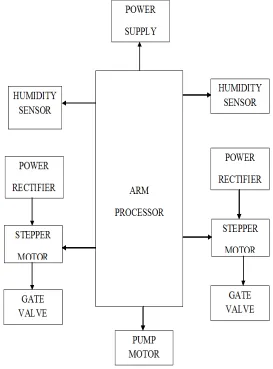
The main goal of our project is to stop the overflow in apartments and the places where multiple tanks are used. The valve is made automatic to open and close. Hence, Humans are not needed to open and close the valve. This technique automatically stops the overflow by sending the signals to the processor. Here the Stepper motor is used to control the valve. The Stepper motor is coupled with valve.
IV. PROPOSED SYSTEM
In the proposed system, haul off the existing system multiple valves have been controlled using PROCESSOR. The stepper motor is directly coupled with Screw Valve. When the humidity sensor obtains low value, it will be sending a signal to the PROCESSOR. Then, With the help of stepper motor, the valve will be rotate in clockwise direction and makes the way for water to flow continuously. The process will terminate until the humidity sensor reaches the HIGH value. Once the humidity sensor reaches the HIGH value, the stepper motor rotates in the anticlockwise direction and stops the flow of water. This technique will control the overflow of water. And it is applicable for multiple tanks simultaneously.
V. WORKING PRINCIPLE OF AU COURANT WATER CONTROLLER
pumped upsimultaneously,the tank which get the HIGH from the Humidity sensor Valve will be rotated in the respective direction to close the Valve and then if the next tank reach HIGH Automatically valve will be closed and Water PUMP Will be Shut OFF.
The advantages of the existing system is
There will be no Overflow of water from tank.
Automatic ON/OFF Water Pump Motor will be controlled. So Power Wastage Reduced
Cost effective
Human Resource is not required for Monitoring.
VI. RESULT
CASE 1
WHEN BOTH TANKS ARE AT THRESHOLD LEVEL
The tanks are already filled with water. So, the valves will be in CLOSED condition.
CASE 2
WHEN ONE OF THE NEED WATER
CASE 3
WHEN MORE THAN ONE TANK NEEDS WATER
The process will be similar to case 2. When more than one tank needs water, the number of tanks that need water, the stepper motor connected with valve near to the tank will rotate in respective direction and switch ON pump motor.
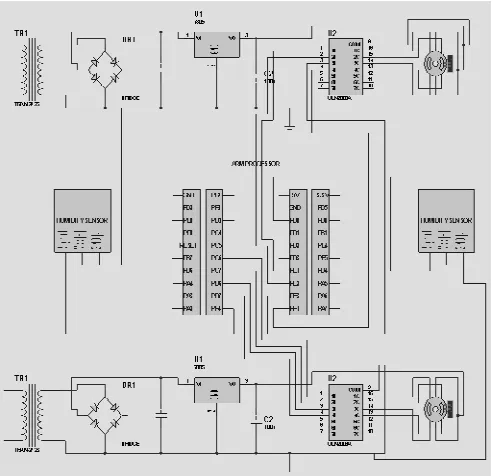
FIG 2 SCHEMATIC DIAGRAM OF AU COURANT WATER CONTROLL VII. CONCLUSION
The AU COURANT Water Controller been successfully developed by processor, motor, sensor and by haul off existing system. So, the water wastage due to overflow have been controlled in this system. Entire system was automatically controlled using Processor and no need of monitoring the water tank Level and switching the motor pumps.
REFERENCES
1. Sanam Pudasaini, Anuj Pathak “Automatic Water Level Controller With Short Messaging Service (SMS) Notification” 2. Sukirti Dhakal, Milan Paudel“WATER LEVEL CONTROLLER”
3. Ejiofor Virginia Ebere (PhD) 1, Oladipo Onaolapo Francisca (PhD) 2 Lecturer, Department of Computer Science, Nnamdi Azikiwe University, Awka, Nigeria)“Microcontroller Based Automatic Water Level Control System”
4. S. M. Khaled Reza, Shah Ahsanuzzaman Md. Tariq “Microcontroller Based Automated Water Level Sensing And Controlling: Design And Implementation Issue” 5. S.M. Mohsin Reza “Construction Of Automatic Water Level Controller For Both Overhead And Underground Tanks”
6. WWW.ENGINEERINGGARAGE.COM
7. WWW.BHARATHELECTRONIC.COM
8. HTTP://IEEEXPLORE.IEEE.ORG/DOCUMENT/7295855