Original Research Article
Study of role of Magnesium sulfate in prevention of eclampsia
Shrinivas N. Gadappa, Pratibha V. Dixit*
INTRODUCTION
Hypertensive disorders are among the leading cause of morbidity and mortality in pregnancy. In India, eclampsia is the second most common cause of maternal mortality.1
Preeclampsia is a multisystem disorder of pregnancy usually associated with raised blood pressure and proteinuria, complicates about 2-8% of pregnancies.2
Eclampsia is defined as the occurrence of one or more convulsions superimposed on preeclampsia, which cannot be attributed to other cause. In developing countries, it affects around 1 in 100 to 1in 1700 deliveries.
In developed it affects around 1 in 2000 deliveries.2
Eclampsia is preventable by careful observation and prompt delivery when severe preeclampsia is present.
Magnesium sulfate is drug of choice for women with eclampsia for control of convulsions. Magnesium sulfate had central anticonvulsant activity by inhibiting the N-methyl-D-aspartate receptor in brain.3 In this study we
compared maternal and perinatal outcome in
preeclampsia patients who had received and who had not received seizure prophylaxis with magnesium sulfate.
METHODS
It is randomized clinical trial conducted at Department of
Obstetrics and Gynecology Government Medical
College, Aurangabad, Maharashtra after getting clearance from Institutional Ethical Committee and scientific committee.
ABSTRACT
Background: Hypertensive disorders of pregnancy have a clinical spectrum ranging from non-severe to severe
preeclampsia and then potentially to eclampsia. Magnesium sulfate is drug of choice for women with eclampsia and now adapted for prophylaxis of seizures in women with preeclampsia.
Methods: It is randomized clinical trial, including 876 patients with preeclampsia fulfilling inclusion criteria. Patients with severe preeclampsia received anticonvulsant prophylaxis with magnesium sulfate. Patients with non-severe preeclampsia were randomized in two groups study group and control group. Patients in study group had received anticonvulsant prophylaxis with magnesium sulfate. The data obtained was analyzed with respect to maternal and perinatal outcome, severity of disease progression and adverse reactions of magnesium sulphate in each group.
Results: In this study statistically, significant difference was seen with respect to severity of disease progression and
incidence of eclampsia among study and control group.
Conclusions: Administration of Magnesium sulfate in patients with non-severe preeclampsia does not affect the
progress of labour or perinatal outcome, on contrary it improves maternal outcome by reducing incidence of eclampsia and progression of disease, without significant side effect of drug.
Keywords: Anticonvulsant, Eclampsia, Hypertensive disorders of pregnancy
Department of Obstetrics and Gynecology, Government Medical College Aurangabad, Maharashtra, India
Received: 27 September 2017
Accepted: 30 October 2017
*Correspondence:
Dr.Pratibha V. Dixit,
E-mail: [email protected]
Copyright: © the author(s), publisher and licensee Medip Academy. This is an open-access article distributed under
the terms of the Creative Commons Attribution Non-Commercial License, which permits unrestricted non-commercial use, distribution, and reproduction in any medium, provided the original work is properly cited.
Inclusion criteria
Pregnant patient coming to labour room included in study if
• Their blood pressure was equal to or more than 140 mmHg systolic (SBP) or equal to or more than 90 mmHg diastolic (DBP), on at least two occasions
• Have proteinuria of at least 1+ on dipstick.
Depending upon the severity of preeclampsia, they were further divided into 2 groups, A and B as follows:
Group A:This group includes patients with non-severe preeclampsia, defined when SBP equal to or more than 140 mmHg but less than 160 mmHg and DBP equal to or more than 90 mmHg but less than 110 mmHg and not associated with any of the following:
• Frontal headache
• Clonus
• Visual disturbance
• Epigastric pain
• Pain in right upper abdominal quadrant
• Oliguria
• Pulmonary edema
• Elevated liver enzyme (SGOT, SGPT >40 IU/L)
• Increased serum creatinine >1.5 mg/Dl
• Evidence of hemolysis
• Thrombocytopenia.
Group B: This group includes all women of severe preeclampsia defined as SBP ≥160 mmHg and DBP ≥110 mmHg and associated with any of the above (1-11) feature.
These patients had received magnesium sulfate prophylaxis and not divided in any subgroup.Patients of non-severe preeclampsia included in group A are further randomized in to subgroups to receive magnesium sulfate prophylaxis as:
• Group A1: This subgroup includes all those women with non-severe preeclampsia who had received magnesium sulfate prophylaxis and labeled as study group.
• Group A2: This subgroup includes all those women of non-severe preeclampsia who had not received magnesium sulfate prophylaxis and labeled as control group.
Injection Magnesium sulfate was administered to patient as per Pritchard regime.9
Exclusion criteria
Patients excluded from study that have any of the following
• Hepatic coma with risk of renal failure,
• Myasthenia gravis
• Associated medical disorder (anemia, heart disease, epilepsy, asthma, thyroid disorder etc).
Data obtained was analyzed using chi square test.
RESULTS
The study role of Magnesium sulfate in prevention of eclampsia was carried out in department of obstetrics and gynaecology GMCH Aurangabad for a period of two years. During this period 22,881 deliveries took place. Among these 1,346 patients had preeclampsia so, the incidence was 5.88%. Out of these 1,346 patients 470 had other associated medical disorder hence excluded from the study.
[image:2.595.49.544.608.683.2]Thus 876 patients with preeclampsia were studied. During the study period 429 patients had eclampsia so incidence was 1.87%. The baseline characteristics of patients who were included are shown below. The average age of distribution in all three groups was 22.73 year. As shown in Table 1, majority of patients in study were primigravidae.
Table 1: The distribution of patients based on parity index.
Parity Severe preeclampsia
Non-severe preeclampsia
Total
Study group Control group
Number % Number % Number %
Primigravidae 216 60.67 168 65.62 182 68.93 566
Multigravida 140 39.32 88 34.37 82 31.06 310
Total 356 100 256 100 264 100 876
Near about half of the patients (48.05%) in the three groups were ANC registered. As shown in Table 2, out of 876 patients, 755 (86.18%) were 37-40 weeks of gestational age and mean gestational age was 37.92 weeks. Maximum gestational age observed was 43
As shown in Table 3, associated pregnancy complications were present in 240 patients (27.3%) and most common
[image:3.595.50.545.148.246.2]complication was intrauterine growth restriction present in 168 patients (19.17%).
Table 2: The distribution of patients based on their gestational age at which they were included in the study.
Gestational age in weeks
Severe preeclampsia Non-severe preeclampsia
Total
Study group Control group
Number % Number % Number %
26-33 23 6.46 4 1.56 7 2.65 34
34-36 21 5.89 6 2.34 11 4.16 38
37-40 303 85.11 222 86.71 230 87.12 755
41 weeks ≥ 9 2.52 24 9.37 16 6.06 49
[image:3.595.54.540.278.400.2]Total 356 100 256 100 264 100 876
Table 3: The distribution of patients based on associated pregnancy complication.
Associated pregnancy complication
Severe preeclampsia Non-severe preeclampsia
Total
Study group Control group
Number (%) % Number (%) % Number (%) %
IUGR 122 (34.26) 64.21 24 (9.37) 92.3 22 (8.33) 91.6 168
IUFD 33 (9.26) 17.36 0 0 1 (0.37) 4.16 34
Abruptio placentae 17 (4.77) 8.94 0 0 0 0 17
Partial HELLP 12 (3.37) 6.31 0 0 0 0 12
Oligohydramnios 3 (0.84) 1.57 2 (0.78) 7.69 1 (0.37) 4.16 6
HELLP 3 (0.84) 1.57 0 0 0 0 3
Total 190 (53.37) 100 26 (10.15) 100 24 (9.09) 100 240 (27.3)
Observation for disease progression and maternal deaths
Out of 876 patients 41 progressed to eclampsia (4.68%). In group B out of 356 patients 16 (4.68%) had eclampsia. In group A incidence of eclampsia was 3 out of 256 (1.17%) in study group as compared to 22 in 264 (8.33%) in control group. the difference was statistically significant (p value was 0.0001).
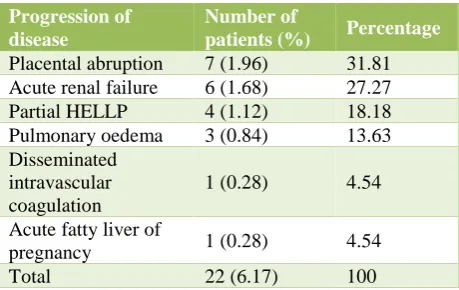
Table 4: Patient distribution on the basis of progression of disease in patients with severe
preeclampsia (Group B).
Progression of disease
Number of
patients (%) Percentage
Placental abruption 7 (1.96) 31.81
Acute renal failure 6 (1.68) 27.27
Partial HELLP 4 (1.12) 18.18
Pulmonary oedema 3 (0.84) 13.63
Disseminated intravascular coagulation
1 (0.28) 4.54
Acute fatty liver of
pregnancy 1 (0.28) 4.54
Total 22 (6.17) 100
As shown in Table 4 most common complication was abruption placentae in 31.81% followed by acute renal
failure. Out of 6 cases of ARF, three had abruption also but all patients recovered. One patient of ARF required peritoneal dialysis but expired. Out of 6 patients who developed ARF, three expired.
As shown in Table 5 in study group out of 256 patients, 17 (6.64%) progressed to severe disease as compared to 37 (14.01%) in control group and the difference was statistically significant (p=0.005). In study group only one patient developed placental abruption as compared to 11 in control group and the difference was statistically significant (p=0.003).
Out of 876 patients 5 died (0.57%) during the study period. there were 4 maternal deaths in group B, no maternal death was observed in study group (A1), and one patient died in control group (A2).
Observation for adverse effects and toxicity of Magnesium sulfate
[image:3.595.53.283.585.730.2]Table 5: Patient distribution on the basis of progression of disease in patients with non- severe preeclampsia (group A).
Progression of disease
Non-severe preeclampsia
Total
Study group N=256 Control group N=264
Number (%) % Number (%) %
Severe preeclampsia 17 (6.64) 94.44 37 (14.01) 68.51 54 (10.38)
Abruption placentae 1 (0.39) 5.55 11 (4.16) 20.37 12 (2.30)
Acute renal failure 0 0 3 (1.13) 5.55 3 (0.57)
Pulmonary oedema 0 0 1 (0.37) 1.85 1 (0.19)
Disseminated intravascular
coagulation 0 0 1 (0.37) 1.85 1 (0.19)
Eclampsia coma 0 0 1 (0.37) 1.85 1 (0.19)
[image:4.595.62.538.271.395.2]Total 18 (7.03) 100 54 (20.45) 100 72 (13.84)
Table 6: Distribution of side effects and adverse effects of magnesium sulfate.
Adverse effects Severe preeclampsia (N=356)
Non-severe preeclampsia
Total Study group (N=256)
Number (%) % Number %
Flushing 48 (13.48) 41.02 34 (13.28) 39.08 82 (13.39)
Pain at injection site 24 (6.74)) 20.52 27 (10.54) 31.03 51 (8.33)
Hypotension 28 (7.86) 23.93 22 (8.59) 25.28 50 (8.16)
Respiratory depression 6 (1.68) 5.12 3 (1.17) 3.44 9 (1.47)
Absent reflexes 5 (1.40) 4.27 1 (0.39) 1.14 6 (0.98)
ARF 6 (1.68) 5.12 0 0 6 (0.98)
Total 117 (32.86) 100% 87 (33.98) 100 205 (33.33)
Table 7: Distribution of patients on the basis of cause for omission of magnesium sulfate.
Adverse effects
Severe preeclampsia (N = 356)
Non-severe preeclampsia
Total Study group (N=256)
Number (%) % Number (%) %
Respiratory depression 6 (1.68) 35.2 3 (1.17) 75 9 (42.85)
Absent reflexes 5 (1.40) 29.4 1 (0.39) 25 6 (28.57)
ARF 6 (1.68) 35.2 0 0 6 (28.57)
Total 17 (4.77) 100% 4 (1.56) 100 21 (3.43)
Magnesium sulfate was omitted in 21 (3.43%) patients and 17 out of 21 were in group B (severe preeclampsia) and the difference was not statistically significant (p>0.05).
Observation for labour characteristics, mode of delivery
Out of 876 patients in trial 711 (81.16%) delivered vaginally. In patients with severe preeclampsia vaginal delivery was observed in 276 patients (77.52%). In 256 patients in study group 46 (17.96%) delivered by LSCS as compared to 49 (18.56%) in 264 controls and the difference was statistically not significant. There was no statistically significant difference in duration of labour in study and control group (p=0.58). Out of 876 patients, 102 (11.64%) required blood transfusion. In study group (group A1) 18 patients (7.03%) required blood transfusion as compared to 36 patients (13.63%) in control group and the difference was statistically significant (p=0.01).
Observation for perinatal outcome
Out of 900 babies born in the study, 747 were live birth. In study group 254 (96.57%) babies were live birth out of 263 babies as compared to 257 (94.13%)out of 273 in controls. There was no statistically significant difference between two groups with respect to Apgar score at 1 minute and 5 minutes, NICU admission and neonatal deaths.
DISCUSSION
[image:4.595.53.543.426.513.2]preeclampsia divided in to study group and control group. In study group all patients received seizure prophylaxis with inj. Magnesium sulfate as per Pritchard regime. The incidence of preeclampsia was 5.88%.
Characteristics of patients in the study
The mean age of all patients in the present study was 22.7 year. In group of severe preeclampsia, it was 23 years and is comparable to that observed in the study by Atkinson.4
The mean age was less than that observed in the studies of Moodley and Moodley, Magpie trial and Dayicioglu et al.2,5,6 This variation in the mean age may be explained by
the early marriage and early onset of reproductive life in India. In non-severe preeclampsia group the mean age in our study is comparable to that observed in the study of Livingston et al.7 The percentage of primigravidae in the
present study was 64.61%, and is comparable to that observed in study of Atkinson et al.4 The mean
gestational age of patients in study and control group was respectively 38.38 and 38.09 weeks which was comparable to that observed in the randomized control trial in women with mild preeclampsia by Livingston et al.7
Comparison of associated pregnancy complication
In the present series, IUGR is observed in women with severe preeclampsia in 34.26%, and is more than twice as compared to that observed by Dayicioglu et al.6 This
difference is explained because high proportion of unregistered pregnancies in the present study in whom early onset preeclampsia remain unnoticed and resultant IUGR come into picture when patient reported during labour at our hospital. In the present study 9.26% patients had IUFD that was similar to what observed by Dayicioglu that is 7%.6 HELLP syndrome was observed
in the present study in 4.21% women with severe preeclampsia which was lower than that observed in study of Moodley and Moodley and Dayicioglu et al that was 8% and 7.7% respectively.5,6 In patients with severe
preeclampsia received Magnesium sulfate prophylaxis, incidence of eclampsia was 4.49% and it was comparable to that observed by Dayicioglu et al in their study, which was 3.62%.6 Reti, Girard et al and Singh et al in their
studies of severe preeclampsia treated with magnesium sulfate did not notice eclampsia in their patients.8-10
Alexander et al studied the incidence of eclampsia in patients with non-severe preeclampsia when only patients with severe preeclampsia were given magnesium sulfate prophylaxis.11 They observed that the overall incidence of
eclampsia was increased by around 50% as compared to previous 5-year record when every patient with preeclampsia was receiving magnesium sulphate.
In the present study patients with non-severe
preeclampsia in study group incidence of eclampsia was 1.17% as compared to 8.33% in control group. This difference is statistically highly significant (p=0.0001).
This implies that there is a significant association of not having eclampsia with magnesium sulfate prophylaxis. Among patients of non-severe preeclampsia, the incidence of placental abruption was lower in the study group as compared to controls, 0.3% versus 4.16% (p=0.003). This was similar to that observed in the Magpie trial.2
Acute renal failure was observed in 1% of patients in the present study, similar result was observed by Magpie trial that is ARF was noted in 1% patients in study group and 1.2% in control group.2 In the present study maternal
mortality was 0.57% in severe preeclampsia patients which was slightly higher than that observed in the Magpie trial, where it was 0.2% in study group and 0.4% in control group.2 In non-severe preeclampsia group no
death was reported in study group but it was 0.27% in control group. No maternal death was reported by Moodley and Moodley and Livingston et al in their study.5,7
Comparison of adverse effects of drug and indications for omission of drug
In the present study adverse effects of drug were observed in 33.33% of patients. Incidence of flushing observed in the present study was 13.39% and is less than that observed in Magnesium sulfate group in Magpie trial, which was 19.74%.2 Respiratory depression was
observed in the present study in 1.47 % of patients and is slightly higher than 1.02% as observed in the Magpie trial.2 Absent reflexes was observed in 0.98% in the
present study which was less than 1.18% as noted in the Magpie trial.2 In the present study 3.43% of women
magnesium sulfate treatment was stopped which is much less than 16% as observed in the Magpie trial.2 In the
present study most common indication for omitting magnesium sulfate was respiratory depression in 1.47% of patients which was slightly higher than 0.51% as observed in the Magpie trial.2
Comparison of labour characteristics and perinatal outcome
In the present study caesarean delivery was required in 18.84% of women with preeclampsia, which is much lower than 50% and 48% seen in the Magpie trial in study and control group respectively.2 The mean duration
of labor in severe preeclampsia was 6.01 hours, which is less than half (13.7 hours) of that observed by Atkinson et al in 1995 and 12.5 hours in Magpie trial and also less than 10.9 hours as observed by Szal et al.2,4,12
CONCLUSION
In the present study, we observed that Magnesium sulfate administered to patients with non-severe preeclampsia is associated with statistically significant trend towards lower incidence of eclampsia and also disease progression. Also, there was no significant side effect of drug noted in those who received Magnesium sulfate and were very less as compared to other studies. There was no significant difference in duration of labour, incidence of LSCS and postpartum haemorrhage in both the study group and control group in women with mild preeclampsia in the present study. Perinatal outcome was also similar in study and control group. Hence, administration of Magnesium sulfate in patients with non-severe preeclampsia does not affect the progress of labour or perinatal outcome, on contrary it improves maternal outcome by reducing incidence of eclampsia and progression of disease, without significant side effect of drug.
Funding: No funding sources Conflict of interest: None declared
Ethical approval: The study was approved by the Institutional Ethics Committee
REFERENCES
1. Sardesai S, Maira S, Patil A, Patil U. Low dose magnesium sulfate therapy for eclampsia and imminent eclampsia; Regime tailored for Indian women. J Obstet Gynecol India. 2003;53(6):540-6. 2. Altman D, Carroli G, Duley L, Farrell B, Moodley J,
Neilson J, et al. Do women with preeclampsia and their babies benefit from magnesium sulfate? The Magpie trial: a randomized placebo trial. Lancet 2002;359:1877-90.
3. Cotton DB, Janusz CA, Berman RF. Anticonvulsant effect of magnesium sulfate on hippocampal seizures: therapeutic implications in preeclampsia-eclampsia. Am J Obstet Gynaecol. 1992;166:1127. 4. Atkinson MW, Guinn D, Owen J, Hauth JC. Does
magnesium sulfate the length of labour induction in
women with pregnancy associated hypertension? Am J Obstet Gynaecol. 1995:173;1219-22.
5. Moodley J, Moodley VV. Prophylactic
anticonvulsant therapy in hypertensive crises of pregnancy: the need for a large randomized trial. 1994;13:245-52.
6. Dayicioglu V, Sahino Z, Kola E, Kucukbas M. The use of standard dose of magnesium sulfate in prophylaxis of eclamptic seizures: Do body mass index alterations have any effect on success?. Hypertension in Pregnancy. 2003;22(3):257-65. 7. Livingston JC, Livingston LW, Ramsey R, Mabie
BC, Sibai BM. Magnesium sulfate in women with mild preeclampsia: a randomized controlled trial. J Obst Gynecol. 2003;101:217-20.
8. Red LL, Ross A, Kloss M, Paull J, Markman L. The
management of severe preeclampsia with
intravenous magnesium sulphate, hydralazine and central venous catheterization. Au N Z J Obstet Gynaecol. 1987;27(2):102-5.
9. Girard B, Beucher G, Muris C, Simonet T, Dreyfus M. Magnesium sulfate and severe preeclampsia: its use in current practice. J Gynecol Obstet Biol Reprod. 2005;34:17-22.
10. Singh J, O’Donovan M, Coultersmith SD, Geary M.
An audit of the use of magnesium sulphate in severe preeclampsia and eclampsia. J Obstet Gynecol 2005;25(1):15-7.
11. Alexander JM, McIntire DD, Leveno KJ,
Cunningham FG. Selective magnesium sulfate prophylaxis for the prevention of eclampsia in women gestational hypertension. Obstet Gynecol. 2006;108(4):826-32.
12. Szal ES, Croughan-Minihane MS, Kilpatrick SJ. Effects of magnesium prophylaxis and preeclampsia on the duration of labor. Am J Obstet Gynecol. 1999;180:1475-9.
Cite this article as: Gadappa SN, Dixit PV.Study of
role of Magnesium sulfate in prevention of