Comparing Information Extraction Pattern Models
Mark Stevenson and Mark A. Greenwood
Department of Computer Science University of Sheffield Sheffield, S1 4DP, UK
{marks,m.greenwood}@dcs.shef.ac.uk
Abstract
Several recently reported techniques for the automatic acquisition of Information Extraction (IE) systems have used depen-dency trees as the basis of their extrac-tion pattern representaextrac-tion. These ap-proaches have used a variety of pattern models (schemes for representing IE pat-terns based on particular parts of the de-pendency analysis). An appropriate model should be expressive enough to represent the information which is to be extracted from text without being overly compli-cated. Four previously reported pattern models are evaluated using existing IE evaluation corpora and three dependency parsers. It was found that one model, linked chains, could represent around 95% of the information of interest without gen-erating an unwieldy number of possible patterns.
1 Introduction
A common approach to Information Extraction (IE) is to use patterns which match against text and identify items of interest. Patterns are applied to text which has undergone various levels of lin-guistic analysis, such as phrase chunking (Soder-land, 1999) and full syntactic parsing (Gaizauskas et al., 1996). The approaches use different defini-tions of what constitutes a valid pattern. For exam-ple, the AutoSlog system (Riloff, 1993) uses pat-terns which match certain grammatical categories, mainly nouns and verbs, in phrase chunked text while Yangarber et al. (2000) use subject-verb-object tuples derived from a dependency parse. An appropriate pattern language must encode enough
information about the text to be able to accurately identify the items of interest. However, it should not contain so much information as to be complex and impractical to apply.
Several recent approaches to IE have used pat-terns based on a dependency analysis of the input text (Yangarber, 2003; Sudo et al., 2001; Sudo et al., 2003; Bunescu and Mooney, 2005; Stevenson and Greenwood, 2005). These approaches have used a variety of pattern models (schemes for rep-resenting IE patterns based on particular parts of the dependency tree). For example, Yangarber (2003) uses just subject-verb-object tuples while Sudo et al. (2003) allow any subpart of the tree to act as an extraction pattern. The set of patterns al-lowed by the first model is a proper subset of the second and therefore captures less of the informa-tion contained in the dependency tree. Little anal-ysis has been carried out into the appropriateness of each model. Sudo et al. (2003) compared three models in terms of their ability to identify event participants.
The choice of pattern model has an effect on the number of potential patterns. This has impli-cations on the practical application for each ap-proach, particularly when used for automatic ac-quisition of IE systems using learning methods (Yangarber et al., 2000; Sudo et al., 2003; Bunescu and Mooney, 2005). This paper evaluates the ap-propriateness of four pattern models in terms of the competing aims of expressive completeness (ability to represent information in text) and com-plexity (number of possible patterns). Each model is examined by comparing it against a corpus an-notated with events and determining the propor-tion of those which it is capable of representing.
The remainder of this paper is organised as fol-lows: a variety of dependency-tree-based IE
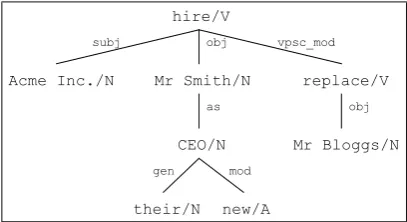
Figure 1: An example dependency tree.
tern models are introduced (Sections 2 and 3). Section 4 describes experiments comparing each model and the results are discussed in Section 5.
2 Pattern Models
In dependency analysis (Mel’ˇcuk, 1987) the syn-tax of a sentence is represented by a set of directed binary links between a word (the head) and one of its modifiers. These links may be labelled to in-dicate the grammatical relation between the head and modifier (e.g. subject, object). In general cyclical paths are disallowed so that the analysis forms a tree structure. An example dependency analysis for the sentence “Acme Inc. hired Mr
Smith as their new CEO, replacing Mr Bloggs.”
is shown Figure 1.
The remainder of this section outlines four mod-els for representing extraction patterns which can be derived from dependency trees.
Predicate-Argument Model (SVO): A simple
approach, used by Yangarber (2003) and Steven-son and Greenwood (2005), is to use subject-verb-object tuples from the dependency parse as extrac-tion patterns. These consist of a verb and its sub-ject and/or direct obsub-ject1. An SVO pattern is ex-tracted for each verb in a sentence. Figure 2 shows the two SVO patterns2which are produced for the dependency tree shown in Figure 1.
This model may be motivated by the assump-tion that many IE scenarios involve the extracassump-tion
1Yangarber et al. (2000) and Sudo et al. (2003) used a slightly extended version of this model in which the pattern also included certain phrases which referred to either the sub-ject or obsub-ject.
2
The formalism used for representing dependency pat-terns is similar to the one introduced by Sudo et al. (2003). Each node in the tree is represented in the formata[b/c]
(e.g. subj[N/bomber]) where c is the lexical item (bomber),bits grammatical tag (N) andathe dependency relation between this node and its parent (subj). The rela-tionship between nodes is represented asX(A+B+C)which indicates that nodesA,BandCare direct descendents of node
X.
of participants in specific events. For example, the MUC-6 (MUC, 1995) management succession scenario concerns the identification of individuals who are changing job. These events are often de-scribed using a simple predicate argument struc-ture, e.g. “Acme Inc. fired Smith”. However, the SVO model cannot represent information de-scribed using other linguistic constructions such as nominalisations or prepositional phrases. For ex-ample, in the MUC6 texts it is common for job ti-tles to be mentioned within prepositional phrases, e.g. “Smith joined Acme Inc. as CEO”.
Chains: A pattern is defined as a path between
a verb node and any other node in the dependency tree passing through zero or more intermediate nodes (Sudo et al., 2001). Figure 2 shows the eight chains which can be extracted from the tree in Fig-ure 1.
Chains provide a mechanism for encoding in-formation beyond the direct arguments of predi-cates and includes areas of the dependency tree ig-nored by the SVO model. For example, they can represent information expressed as a nominalisa-tion or within a preposinominalisa-tional phrase, e.g. “The
resignation of Smith from the board of Acme ...”
However, a potential shortcoming of this model is that it cannot represent the link between arguments of a verb. Patterns in the chain model format are unable to represent even the simplest of sentences containing a transitive verb, e.g. “Smith left Acme
Inc.”.
Linked Chains: The linked chains model (Greenwood et al., 2005) represents extraction patterns as a pair of chains which share the same verb but no direct descendants. This model gen-erates 14 patterns for the verb hire in Figure 1, examples of which are shown in Figure 2. This pattern representation encodes most of the infor-mation in the sentence with the advantage of being able to link together event participants which nei-ther of the SVO or chain model can, for example the relation between “Smith” and “Bloggs”.
Subtrees: The final model to be considered is
previ-SVO Chains
[V/hire](subj[N/Acme Inc.]+obj[N/Mr Smith]) [V/hire](subj[N/Acme Inc.]) [V/replace](obj[N/Mr Bloggs]) [V/hire](obj[N/Mr Smith])
[V/hire](obj[N/Mr Smith](as[N/CEO]))
[V/hire](obj[N/Mr Smith](as[N/CEO](gen[N/their]))) [V/hire](obj[N/Mr Smith](as[N/CEO](mod[A/new]))) [V/hire](vpsc mod[V/replace])
[V/hire](vpsc mod[V/replace](obj[N/Mr Bloggs])) [V/replace](obj[N/Mr Bloggs])
Linked Chains
[V/hire](subj[N/Acme Inc.]+obj[N/Mr Smith])
[V/hire](subj[N/Acme Inc.]+obj[N/Mr Smith](as[N/CEO]))
[V/hire](obj[N/Mr Smith]+vpsc mod[V/replace](obj[N/Mr Bloggs]))
Figure 2: Example patterns for three models
ous models form a proper subset of the subtrees. By choosing an appropriate subtree it is possible to link together any pair of nodes in a tree and consequently this model can represent the relation between any set of items in the sentence.
3 Pattern Enumeration and Complexity
In addition to encoding different parts of the de-pendency analysis, each pattern model will also generate a different number of potential patterns.
A dependency tree, T, can be viewed as a set ofN connected nodes. Assume thatV, such that
V ⊆N, is the set of nodes in the dependency tree labelled as a verb.
Predicate-Argument Model (SVO): The
num-ber of SVO patterns extracted fromT is:
Nsvo(T) =|V| (1)
Chain Model: A chain can be created between
any verb and a node it dominates (directly or indi-rectly). Now assume that d(v) denotes the count of a nodevand all its descendents then the number of chains is given by:
Nchains(T) =
X
v∈V
(d(v)−1 ) (2)
Linked Chains: LetC(v)denote the set of di-rect child nodes of node v and vi denote the i-th child, soC(v) =
v1, v2, ...v|C(v)| . The number of possible linked chains inT is given by:
Nlinked chains(T) =
X
v∈V |C(v)|
X
i=1
|C(v)|
X
j=i+1
d(vi)d(vj)
(3)
Subtrees: Now assume that sub(n) is a func-tion denoting the number of subtrees, including single nodes, rooted at node n. This can be
de-fined recursively as follows:
sub(n) =
1 ifnis a leaf node |C(n)|
Q
i=1
(sub(ni) + 1) otherwise
(4) The total number of subtrees in a tree is given by:
Nsubtree(T) =
X
n∈N
sub(n) !
− |N| (5)
The dependency tree shown in Figure 1 gener-ates 2, 8, 14 and 42 possible SVO, chain, linked chain and subtree patterns respectively. The num-ber of SVO patterns is constant on the numnum-ber of verbs in the tree. The number of chains is gener-ally a linear function on the size of the tree but, in the worst case, can be polynomial. The linked chain model generates a polynomial number of patterns while the subtree model is exponential.
There is a clear tradeoff between the complex-ity of pattern representations and the practicalcomplex-ity of computation using them. Some pattern rep-resentations are more expressive, in terms of the amount of information from the dependency tree they make use of, than others (Section 2) and are therefore more likely to produce accurate extrac-tion patterns. However, the more expressive mod-els will add extra complexities during computation since a greater number of patterns will be gen-erated. This complexity, both in the number of patterns produced and the computational effort re-quired to produce them, limits the algorithms that can reasonably be applied to learn useful extrac-tion patterns.
model to be as computationally tractable as pos-sible. The ideal model will then be one with suffi-cient expressive power while at the same time not including extra information which would make its use less practical.
4 Experiments
We carried out experiments to determine how suit-able the pattern representations detailed in Section 2 are for encoding the information of interest to IE systems. We chose a set of IE corpora anno-tated with the information to be extracted (detailed in Section 4.1), generated sets of patterns using a variety of dependency parsers (Section 4.2) which were then examined to discover how much of the target information they contain (Section 4.3).
4.1 Corpora
Corpora representing different genres of text were chosen for these experiments; one containing newspaper text and another composed of biomed-ical abstracts. The first corpus consisted of Wall Street Journal texts from the Sixth Message Un-derstanding Conference (MUC, 1995) IE evalu-ation. These are reliably annotated with details about the movement of executives between jobs. We make use of a version of the corpus pro-duced by Soderland (1999) in which events de-scribed within a single sentence were annotated. Events in this corpus identify relations between up to four entities: PersonIn(the person start-ing a new job), PersonOut (person leaving a job), Post(the job title) and Organisation (the employer). These events were broken down into a set of binary relationships. For exam-ple, the sentence “Smith was recently made
chair-man of Acme.” contains information about the
new employee (Smith), post (chairman) and or-ganisation (Acme). Events are represented as a set of binary relationships, Smith-chairman, chairman-Acme and Smith-Acme for this example.
The second corpus uses documents taken from the biomedical domain, specifically the train-ing corpus used in the LLL-05 challenge task (N´edellec, 2005), and a pair of corpora (Craven and Kumlien, 1999) which were derived from the Yeast Proteome Database (YPD) (Hodges et al., 1999) and the Online Mendelian Inheritance in Man database (OMIM) (Hamosh et al., 2002). Each of these corpora are annotated with binary
relations between pairs of entities. The LLL-05 corpora contains interactions between genes and proteins. For example the sentence “Expression
of the sigma(K)-dependent cwlH gene depended on gerE” contains relations between sigma(K) and cwlH and between gerE and cwlH. The YPD
cor-pus is concerned with the subcellular compart-ments in which particular yeast proteins localize. An example sentence “Uba2p is located largely in
the nucleus” relates Uba2p and the nucleus. The
relations in the OMIM corpora are between genes and diseases, for example “Most sporadic
colorec-tal cancers also have two APC mutations”
con-tains a relation between APC and colorectal
can-cer.
The MUC6 corpus contains a total of six pos-sible binary relations. Each of the three biomedi-cal corpora contain a single relation type, giving a total of nine binary relations for the experiments. There are 3911 instances of binary relations in all corpora.
4.2 Generating Dependency Patterns
Three dependency parsers were used for these ex-periments: MINIPAR3 (Lin, 1999), the Machinese Syntax4 parser from Connexor Oy (Tapanainen and J¨arvinen, 1997) and the Stanford5 parser (Klein and Manning, 2003). These three parsers represent a cross-section of approaches to produc-ing dependency analyses: MINIPAR uses a con-stituency grammar internally before converting the result to a dependency tree, Machinese Syn-tax uses a functional dependency grammar, and the Stanford Parser is a lexicalized probabilistic parser.
Before these parsers were applied to the various corpora the named entities participating in rela-tions are replaced by a token indicating their class. For example, in the MUC6 corpus “Acme hired
Smith” would become “Organisation hired
PersonIn”. Each parser was adapted to deal with these tokens correctly. The parsers were ap-plied to each corpus and patterns extracted from the dependency trees generated.
The analyses produced by the parsers were post-processed to make the most of the information they contain and ensure consistent structures from which patterns could be extracted. It was found
3
http://www.cs.ualberta.ca/˜lindek/ 4http://www.connexor.com/software/syntax/ 5
Parser SVO Chains Linked chains Subtrees
MINIPAR 2,980 52,659 149,504 353,778,240,702,149,000
[image:5.595.143.458.62.105.2]Machinese Syntax 2,382 67,690 265,631 4,641,825,924 Stanford 2,950 76,620 478,643 1,696,259,251,073 Table 1: Number of patterns produced for each pattern model by different parsers
that the parsers were often unable to generate a de-pendency tree which included the whole sentence and instead generate an analysis consisting of sen-tence fragments represented as separate tree struc-tures. Some fragments did not include a verb so no patterns could be extracted. To take account of this we allowed the root node of any tree fragment to take the place of a verb in a pattern (see Sec-tion 2). This leads to the generaSec-tion of more chain and linked chain patterns but has no effect on the number of SVO patterns or subtrees.
Table 1 shows the number of patterns generated from the dependency trees produced by each of the parsers. The number of subtrees generated from theMINIPAR parses is several orders of magnitude higher than the others because MINIPAR allows certain nodes to be the modifier of two separate nodes to deal with phenomena such as conjunc-tion, anaphora and VP-coordination. For exam-ple, in the sentence “The bomb caused widespread
damage and killed three people” the bomb is the
subject of both the verbs cause and kill. We made use of this information by duplicating any nodes (and their descendants) with more than one head.6 Overall the figures in Table 1 are consistent with the analysis in Section 3 but there is great variation in the number of patterns produced by the differ-ent parsers. For example, the Stanford parser pro-duces more chains and linked chains than the other parsers. (If we did not duplicate portions of the MINIPAR parses then the Stanford parser would also generate the most subtrees.) We found that the Stanford parser was the most likely to gen-erate a single dependency tree for each sentence while the other two produced a set of tree frag-ments. A single dependency analysis contains a greater number of patterns, and possible subtrees, than a fragmented analysis. One reason for this may be that the Stanford parser is unique in allow-ing the use of an underspecified dependency rela-tion, dep, which can be applied when the role of the dependency is unclear. This allows the
Stan-6One dependency tree produced by
MINIPAR, expanded in
this way, contained approximately1×1064subtrees. These are not included in the total number of subtrees for theMINI
-PARparses shown in the table.
ford parser to generate analyses which span more of the sentence than the other two.
4.3 Evaluating Pattern Models
Patterns from each of the four models are exam-ined to check whether they cover the information which should be extracted. In this context “cover” means that the pattern contains both elements of the relation. For example, an SVO pattern extracted from the dependency parse of “Smith
was recently made chairman of Acme.” would be
[V/make](subj[N/Smith]+obj[N/chairman]) which covers the relation between Smith and
chairman but not the relations between Smith
and Acme or chairman and Acme. The coverage of each model is computed as the percentage of relations in the corpus for which at least one of the patterns contains both of the participating entities. Coverage is related to the more familiar IE evaluation metric of recall since the coverage of a pattern model places an upper bound on the recall of any system using that model. The aim of this work is to determine the proportion of the relations in a corpus that can be represented using the various pattern models rather than their performance in an IE system and, consequently, we choose to evaluate models in terms of their coverage rather than precision and recall.7
For practical applications parsers are required to generate the dependency analysis but these may not always provide a complete analysis for every sentence. The coverage of each model is influ-enced by the ability of the parser to produce a tree which connects the elements of the event to be ex-tracted. To account for this we compute the cov-erage of each model relative to a particular parser. The subtree model covers all events whose enti-ties are included in the dependency tree and, con-sequently, the coverage of this model represents the maximum number of events that the model can
7
represent for a given dependency tree. The cover-age of other models relative to a dependency anal-ysis can be computed by dividing the number of events it covers by the number covered by the sub-tree model (i.e. the maximum which can be cov-ered). This measure is refered to as the bounded coverage of the model. Bounded coverage for the subtree model is always 100%.
5 Results
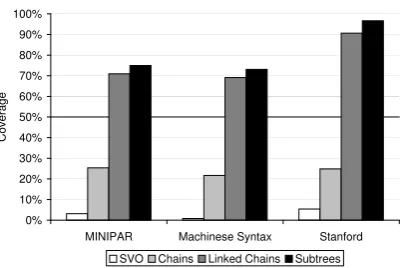
Coverage and bounded-coverage results for each pattern representation and parser combination are given in Table 2. The table lists the corpus, the total number of instances within that corpus and the results for each of the four pattern models. Re-sults for the subtree model lists the coverage and raw count, the bounded-coverage for this model will always be 100% and is not listed. Results for the other three models show the coverage and raw count along with the bounded coverage. The coverage of each parser and pattern representa-tion (combined across both corpora) are also sum-marised in Figure 3.
The simplest representation, SVO, does not per-form well in this evaluation. The highest bounded-coverage score is 15.1% (MUC6 corpus, Stanford parser) but the combined average over all corpora is less than 6% for any parser. This suggests that the SVO representation is simply not expres-sive enough for IE. Previous work which has used this representation have used indirect evaluation: document and sentence filtering (Yangarber, 2003; Stevenson and Greenwood, 2005). While the SVO representation may be expressive enough to allow a classifier to distinguish documents or sentences which are relevant to a particular extraction task it seems too limited to be used for relation extrac-tion. The SVO representation performs notice-ably worse on the biomedical text. Our analysis suggests that this is because the items of interest are commonly described in ways which the SVO model is unable to represent.
The more complex chain model covers a greater percentage of the relations. However its bounded-coverage is still less than half of the relations in ei-ther the MUC6 corpus or the biomedical texts. Us-ing the chain model the best coverage which can be achieved over any corpus is 41.07% (MUC6 corpus, MINIPAR and Stanford parser) which is unlikely to be sufficient to create an IE system.
Results for the linked chain representation are
0% 10% 20% 30% 40% 50% 60% 70% 80% 90% 100%
MINIPAR Machinese Syntax Stanford
C
o
v
e
ra
g
e
[image:6.595.317.519.58.192.2]SVO Chains Linked Chains Subtrees
Figure 3: Coverage of various pattern representa-tion models for each of the three parsers.
much more promising covering around 70% of all relations using theMINIPAR and Machinese Syn-tax parsers and over 90.64% using the Stanford parser. For all three parsers this model achieves a bounded-coverage of close to 95%, indicating that this model can represent the majority of re-lations which are included in a dependency tree. The subtree representation covers slight more of the relations than linked chains: around 75% us-ing theMINIPARor Machinese Syntax parsers and 96.62% using the Stanford parser.
A one-way repeated measures ANOVA was car-ried out to analyse the differences between the re-sults for each model shown in Table 2. It was found that the differences between the SVO, chain, linked chain and subtree models are significant (p <0.01). A Tukey test was then applied to iden-tify which of the individual differences between pairs of models were significant. Differences be-tween two pairs of models were not found to be significant (p < 0.01): SVO and chains; linked chains and subtrees.
These results suggest that the linked chains and subtree models can represent significantly more of the relations which occur in IE scenarios than ei-ther the SVO or chain models. However, ei-there is little to be gained from using the subtree model since accuracy of the linked chain model is com-parable and the number of patterns generated is bounded by a polynomial rather than exponential function.
5.1 Analysis and Discussion
# of SVO Chains Linked Chains Subtrees
Parser Corpus Relations %C %B-C %C %B-C %C %B-C %C
MUC6 1322 7.49 (99) 9.07 41.07 (543) 49.73 81.92 (1083) 99.18 82.60 (1092)
MINIPAR Biomed 2589 0.93 (24) 1.30 17.38 (450) 24.44 65.31 (1691) 91.85 71.11 (1841)
Combined 3911 3.14 (123) 4.19 25.39 (993) 33.86 70.93 (2774) 94.58 74.99 (2933) Machinese MUC6 1322 2.12 (28) 2.75 35.70 (472) 46.41 76.32 (1009) 99.21 76.93 (1017) Syntax Biomed 2589 0.19 (5) 0.27 14.56 (377) 20.47 65.47 (1695) 92.02 71.15 (1842) Combined 3911 0.84 (33) 1.15 21.71 (849) 29.70 69.14 (2704) 94.58 73.10 (2859) MUC6 1322 15.05 (199) 15.10 41.07 (543) 41.20 94.78 (1253) 95.07 99.70 (1318) Stanford Biomed 2589 0.46 (12) 0.49 16.53 (428) 17.39 88.52 (2292) 93.13 95.06 (2461) Combined 3911 5.40 (211) 5.58 24.83 (971) 25.69 90.64 (3545) 93.81 96.62 (3779)
Table 2: Evaluation results for the three different parsers.
PersonOut and Organisation in the frag-ment “Organisation’sPost, PersonOut, resigned yesterday morning”. Certain
nominal-isations may also cause problems for the linked chains representation, e.g. in biomedical text the relation between Agent and Targetin the nominalisation “the Agent-dependent assembly of Target” cannot be represented by a linked
chain. In both cases the problem is caused by the fact that the dependency tree generated includes the two named entities in part of the tree domi-nated by a node marked as a noun. Since each linked chain must be anchored at a verb (or the root of a tree fragment) and the two chains can-not share part of their path, these relations are can-not covered. It would be possible to create another representation which allowed these relations to be captured but it would generate more patterns than the linked chain model.
Our results also reveal that the choice of depen-dency parser effects the coverage of each model (see Figure 3). The subtree model coverage scores for each parser shown in Table 3 represent the per-centage of sentences for which an analysis was generated that included both items from the bi-nary relations. These figures are noticably higher for the Stanford parser. We previously mentioned (Section 4.2) that this parser allows the use of an underspecified dependency relation and suggested that this may be a reason for the higher cover-age. The use of underspecified dependency re-lations may not be useful for all applications but is unlikely to cause problems for systems which learn IE patterns provided the trees generated by the parser are consistent. Differences between the results produced by the three parsers suggest that it is important to fully evaluate their suitability for a particular purpose.
These experiments also provide insights into the more general question of how suitable dependency
trees are as a basis for extraction patterns. De-pendency analysis has the advantage of generat-ing analyses which abstract away from the sur-face realisation of text to a greater extent than phrase structure grammars tend to. This leads to the semantic information being more accessible in the representation of the text which can be use-ful for IE. For practical applications this approach relies on the ability to accurately generate depen-dency analyses. The results presented here sug-gest that the Stanford parser (Klein and Manning, 2003) is capable of generating analyses for almost all sentences within corpora from two very differ-ent domains. Bunescu and Mooney (2005) have also demonstrated that dependency graphs can be produced using Combinatory Categorial Grammar (CCG) and context-free grammar (CFG) parsers.
6 Conclusions
This paper compares four IE pattern models: SVO, chains, linked chains and subtrees. Us-ing texts from the management succession and biomedical domains it was found that the linked chains model can represent around 95% of the possible relations contained in the text, given a de-pendency parse. Subtrees can represent all the re-lations contained within dependency trees but their use is less practical because enumerating all pos-sible subtrees is a more complex problem and the large number of resulting patterns could limit the learning algorithms that can be applied. This re-sult should be borne in mind during the design of IE systems.
Acknowledgements
described in this paper was funded by the En-gineering and Physical Sciences Research Coun-cil via the RESuLT project (GR/T06391) and par-tially funded by the IST 6th Framework project X-Media (FP6-26978).
References
Razvan Bunescu and Raymond Mooney. 2005. A shortest path dependency kernel for relation extrac-tion. In Proceedings of the Human Language
Tech-nology Conference and Conference on Empirical Methods in Natural Language Processing, pages
724–731, Vancouver, B.C.
Mark Craven and Johan Kumlien. 1999. Construct-ing Biological Knowledge Bases by ExtractConstruct-ing In-formation from Text Sources. In Proceedings of the
Seventh International Conference on Intelligent Sys-tems for Molecular Biology, pages 77–86,
Heidel-berg, Germany. AAAI Press.
Robert Gaizauskas, Takahiro Wakao, Kevin Humphreys, Hamish Cunningham, and Yorick Wilks. 1996. Description of the LaSIE system as used for MUC-6. In Proceedings of the Sixth
Message Understanding Conference (MUC-6),
pages 207–220, San Francisco, CA.
Mark A. Greenwood, Mark Stevenson, Yikun Guo, Henk Harkema, and Angus Roberts. 2005. Au-tomatically Acquiring a Linguistically Motivated Genic Interaction Extraction System. In
Proceed-ings of the 4th Learning Language in Logic Work-shop (LLL05), Bonn, Germany.
Ada Hamosh, Alan F. Scott, Joanna Amberger, Carol Bocchini, David Valle, and Victor A. McKusick. 2002. Online Mendelian Inheritance in Man (OMIM), a knowledgebase of human genes and ge-netic disorders. Nucleic Acids Research, 30(1):52– 55.
Peter E. Hodges, Andrew H. Z. McKee, Brian P. Davis, William E. Payne, and James I. Garrels. 1999. The Yeast Proteome Database (YPD): a model for the or-ganization and presentation of genome-wide func-tional data. Nucleic Acids Research, 27(1):69–73.
Dan Klein and Christopher D. Manning. 2003. Ac-curate Unlexicalized Parsing. In Proceedings of the
41st Annual Meeting of the Association for Compu-tational Linguistics (ACL-03), pages 423–430,
Sap-poro, Japan.
Dekang Lin. 1999. MINIPAR: A Minimalist Parser. In Maryland Linguistics Colloquium, University of Maryland, College Park.
Igor Mel’ˇcuk. 1987. Dependency Syntax: Theory and
Practice. SUNY Press, New York.
MUC. 1995. Proceedings of the Sixth Message
Un-derstanding Conference (MUC-6), San Mateo, CA.
Morgan Kaufmann.
Claire N´edellec. 2005. Learning Language in Logic -Genic Interaction Extraction Challenge. In
Proceed-ings of the 4th Learning Language in Logic Work-shop (LLL05), Bonn, Germany, August.
Ellen Riloff. 1993. Automatically constructing a dic-tionary for information extraction tasks. pages 811– 816.
Stephen Soderland. 1999. Learning Information Ex-traction Rules for Semi-structured and free text.
Ma-chine Learning, 31(1-3):233–272.
Mark Stevenson and Mark A. Greenwood. 2005. A Semantic Approach to IE Pattern Induction. In
Pro-ceedings of the 43rd Annual Meeting of the Associa-tion for ComputaAssocia-tional Linguistics, pages 379–386,
Ann Arbor, MI.
Kiyoshi Sudo, Satoshi Sekine, and Ralph Grishman. 2001. Automatic Pattern Acquisition for Japanese Information Extraction. In Proceedings of the
Hu-man Language Technology Conference (HLT2001).
Kiyoshi Sudo, Satoshi Sekine, and Ralph Grishman. 2003. An Improved Extraction Pattern Representa-tion Model for Automatic IE Pattern AcquisiRepresenta-tion. In
Proceedings of the 41st Annual Meeting of the As-sociation for Computational Linguistics (ACL-03),
pages 224–231, Sapporo, Japan.
Pasi Tapanainen and Timo J¨arvinen. 1997. A Non-Projective Dependency Parser. In Proceedings of
the 5th Conference on Applied Natural Language Processing, pages 64–74, Washington, DC.
Roman Yangarber, Ralph Grishman, Pasi Tapanainen, and Silja Huttunen. 2000. Automatic Acquisition of Domain Knowledge for Information Extraction. In
Proceedings of the 18th International Conference on Computational Linguistics (COLING 2000), pages
940–946, Saarbr¨ucken, Germany.
Roman Yangarber. 2003. Counter-training in the Dis-covery of Semantic Patterns. In Proceedings of the
41st Annual Meeting of the Association for Compu-tational Linguistics (ACL-03), pages 343–350,