Volume 2, No. 5, Sept-Oct 2011
International Journal of Advanced Research in Computer Science
RESEARCH PAPER
Available Online at www.ijarcs.info
Applying Wavelet Transform for High Speed Shot Boundary Detection & Key Frame
Extraction
Prof.Shruti Bhargava
Department of Electronics and Communication TIT, Bhopal, Bhopal, India.
Shilpa.R.Jadhav*
Department of Electronics and Communication TIT, Bhopal, Bhopal, India.
Anup.V.Kalaskar
Department of Electronics and Communication TIT, Bhopal, Bhopal, India.
Abstract: This paper present novel algorithm by applying wavelet transform for high speed boundary detection and key frame extraction. The algorithm differs from conventional methods mainly in the use of image segmentation and image compression.. Matching difference between two consecutive frames is computed with different weight. Shot boundaries are detected with automatic threshold. Key frame is extracted by using reference frame-based approach. Experimentalresults show high speed performance of shot boundary detection by using the proposed algorithms, and key frames represent shot content.
Keywords: shot boundary detection; x2
I. INTRODUCTION
histogram; automatic threshold; key frame; wavelet transform.
The accurate segmentation of shots in a video sequence is fundamental and an essential functionality for numerous video retrieval and management tasks [1]. Many researchers have proposed algorithms to perform shot boundary detection based on certain features extracted from video frames, such as pixel differences, edge differences, color histograms, etc. Moreover, comparative surveyshave also from a learning theory perspective, it is a natural approach to combine such promising features in order to decide whether a boundary exists or not within a given video sequence. Researchers have actively developed different approaches for intelligent video management, including shot transition detection, key frame extraction, video retrieval, etc.
Many approaches used different kinds of featuresto detect shot boundary, including histogram, shapeInformation, and motionactivity [2-5]. Among these approaches, histogram is the popular approach. However, in these histogram-based approaches, pixels’ space distribution was neglected. Different frames may have the same histogram [3-5]. In view of this, Change at aldivided[6] each frame into r blocks, and the difference of the corresponding block of consecutive frame was computed by color histogram; the difference(i,i+1)of the twoframes was obtained by adding up all the blocks’ difference; in the meanwhile, the difference
V(i.i+1)between two frames i and i+1 was measured
again without using blocks. Based on D(i.i+1) and V(i,i+1)
short boundary was determined Getting over the drawback of the paper, we propose more efficient algorithms for shot boundary detection and key frame extraction with automatic threshold.
II. IDEA OF SHOT BOUNDARY DETECTION
A. Image Segmentation:
Each frame is divided into blocks with mrow and n Colum. Then the difference of the Corresponding blocks between two consecutive frames is computed finally, the final difference of two frames is calculated by adding up all the difference through different weights
B. Wavelet Transform:
The linear one-dimensional wavelet transform w (a, τ) of a signal function s (t) L2 (R) is given by
W (a. τ) = <s, ψ> = ψ* dt Where the symbol L2
C. Matching Difference:
(R) is the symbol of square enterable functions and ψ is fixed function called “The Mother Wavelet”, well localized both in time and
frequency. ψ* stands for the complex conjugate of ψ ,the variable a is the scale parameter and τ is the shift parameter
of wavelet function. Analysis by wavelet transformation can be viewed as a decomposition of the given frame into sub frame. Wavelet based image compression technique is one of the transform coding method in which the given image is first transformed to a different domain and then quantized. The Embedded zero-free wavelet coding algorithm exploits these properties to give excellent compression result.
III. ALGORITHMS DESCRIPTION
Let F(k) be the k th frame in the video sequence k=1,2…..Fv ( Fv denotes the total number of videos) The algorithm of shot boundary detection isdescribed as follows.
A. Algorithm 1: Shot Boundary Detection:
Step 1:
Partitioning a frame into blocks with mrows and n columns, and B(i,j,k) stands for the blockat (i,j) in k th
frame
Step 2:
Computing x2 histogram matching difference between the corresponding blocks between consecutive frames in video sequence.H(i,j,k) and H(i,j,k+1) stands for histogram of block at (i,j) in the k th and k+1th frame respectively. Block’sdifference is measured by the following equation:
where L is the number of gray in an image;
Step 3:
Computing x2
Where Wij stands for the weight of block at (i,j);
Histogram difference between two consecutive frames
Step 4:
Computing threshold automatically:
Computing the mean and standard variance of x2 Histograms difference over the whole video sequence [7]. Mean and standard variances are defined as follows.
Step 5:
Shot boundary detection:
Let threshold T=M D +a × STD.Shot candidate detection if D (i,i+1 )≥ T ,the ithframe is the end frame of previous shot, and the (i+1)th frame is the end frame of next shot.
a. Final Shot Detection:
Shots may be very long but not much short, because those shots with only several frames cannot be captured by people and they cannot convey a whole message. Usually, a shortest shot should last for 1 to 2.5 s. For the reason of fluency, frame rate is at least 25 fps, (it is 30 fps in most cases), or flash will appear. So, a shot contains at least a minimum number of 30 to 45 frames. In our experiment, video sequences are downs amp led at 10 fps to improve simulation speed. On this condition, the shortest shot should contain 10 to 20 frames. 20 is selected for our experiment. We formulate a “shots merging principle”: if a detected shot contain fewer frames than 20 frames, it will be merged into previous shot, or it will be thought as an independent one.
Definition 1:
Reference Frame: it is the first frame of each shot; General
Frames: all the frames except for reference frame; “Shot Dynamic Factor” max(i):the maximum x2
b. Dynamic Shot and Static Shot:
Histogram within shot i ;
A shot will be declared as dynamic shot, if its max(i) is bigger than MD ; otherwise it is shot; Fc(k) : The k the frame within the current shot, k=1,2,3…………FCN (k) (FCN
B. Algorithm 2: Key Frame Extraction:
(k) is the total number of current shot.)The algorithm of key frame extraction is described as follows.
Step 1:
Computing the difference between all the general frames and reference frame with the above algorithm:
Step 2:
Searching for the maximum difference within a shot:
Step 3:
Determining“ShotType” according to therelationship between max (i) and MD: StaticShot(0) or DynamicShot:
Step 4:
Determining the position of key frame: if ShotTypeC=0, with respect to the odd number of a shot’s frames, the frame in the middle of shot is chose as key frame; in the case of the even number, any one frame between the two frames in the middle of shot can be chose as key frame. If ShotTypeC=1, the frame with the maximum difference is declared as key frame.
III. EXPERIMENT RESULTS AND ANALYSIS
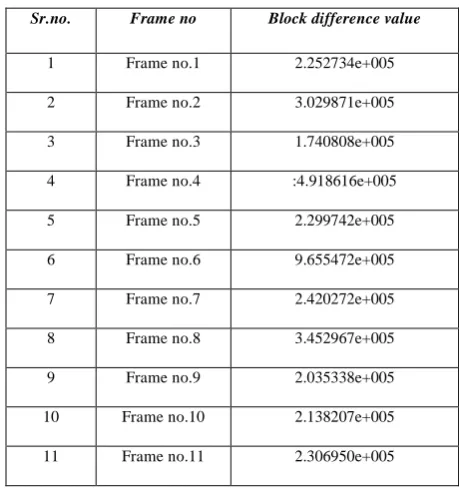
[image:2.595.321.551.525.770.2]These algorithms are tested with shots of different Videos and found result follows:
Table I: Shot Boundary Output
Sr.no. Frame no Block difference value
1 Frame no.1 2.252734e+005
2 Frame no.2 3.029871e+005
3 Frame no.3 1.740808e+005
4 Frame no.4 :4.918616e+005
5 Frame no.5 2.299742e+005
6 Frame no.6 9.655472e+005
7 Frame no.7 2.420272e+005
8 Frame no.8 3.452967e+005
9 Frame no.9 2.035338e+005
10 Frame no.10 2.138207e+005
12 Frame no.12 1.043614e+006
13 Frame no.13 1.545241e+006
14 Frame no.14 9.570712e+005
15 Frame no.15 2.300548e+006
16 Frame no.16 2.232479e+006
17 Frame no.17 1.643245e+006
18 Frame no.18 3.115060e+007
19 Frame no.19 2.238738e+006
20 Frame no.20 4.988129e+006
21 Frame no.21 3.637578e+007
22 Frame no.22 9.083900e+006
Sr.no. Frame no Block difference value
23 Frame no.23 4.059998e+006
24 Frame no.24 6.239042e+006
25 Frame no.25 3.184043e+006
26 Frame no.26 2.128465e+007
27 Frame no.27 4.234818e+006
28 Frame no.28 1.517516e+007
29 Frame no.29 9.038847e+005
30 Frame no.30 9.291212e+005
31 Frame no.31 1.816369e+006
32 Frame no.32 1.377436e+006
33 Frame no.33 2.366793e+006
34 Frame no.34 2.499197e+006
35 Frame no.35 4.265971e+006
36 Frame no.36 4.664410e+006
37 Frame no.37 1.645068e+007
38 Frame no.38 :2.491203e+007
39 Frame no.39 2.655367e+007
40 Frame no.40 3.462600e+007
41 Frame no.41 6.263576e+006
42 Frame no.42 3.812128e+007
43 Frame no.43 3.823555e+007
44 Frame no.44 3.300014e+007
45 Frame no.45 3.445289e+007
46 Frame no.46 3.606135e+007
47 Frame no.47 :1.312662e+006
48 Frame no.48 2.046394e+006
49 Frame no.49 2.479815e+006
50 Frame no.50 3.438300e+006
Sr.no. Frame no Block difference value
51 Frame no.51 :1.741411e+006
52 Frame no.52 1.660074e+006
53 Frame no.53 1.407927e+006
54 Frame no.54 1.806781e+006
55 Frame no.55 1.556794e+006
56 Frame no.56 6.257250e+005
57 Frame no.57 4.741886e+005
58 Frame no.58 8.067111e+005
59 Frame no.59 8.242188e+005
60 Frame no.60 1.019812e+006
61 Frame no.61 1.279052e+006
62 Frame no.62 1.089395e+006
63 Frame no.63 :1.080301e+006
64 Frame no.64 1.494956e+006
65 Frame no.65 1.529653e+007
66 Frame no.66 2.561012e+006
67 Frame no.67 3.227772e+006
68 Frame no.68 3.426323e+006
69 Frame no.69 4.467072e+006
70 Frame no.70 5.090183e+006
71 Frame no.71 :6.058270e+006
72 Frame no.72 :4.459274e+006
73 Frame no.73 1.645334e+007
74 Frame no.74 2.056309e+007
75 Frame no.75 6.206481e+006
76 Frame no.76 2.683221e+007
77 Frame no.77 3.083760e+007
78 Frame no.78 2.422882e+007
Sr.no. Frame no Block difference value
79 Frame no.79 3.405632e+006
80 Frame no.80 2.789725e+007
81 Frame no.81 :3.033992e+007
83 Frame no.83 9.183184e+005
84 Frame no.84 6.327894e+005
85 Frame no.85 7.926676e+005
86 Frame no.86 7.424013e+005
87 Frame no.87 7.223795e+005
88 Frame no.88 :7.930851e+005
89 Frame no.89 :1.136819e+006
90 Frame no.90 2.802542e+006
91 Frame no.91 3.241871e+006
92 Frame no.92 3.743190e+006
93 Frame no.93 :2.640398e+006
94 Frame no.94 2.253193e+006
95 Frame no.95 3.129525e+006
96 Frame no.96 1.731097e+007
97 Frame no.97 6.908658e+006
98 Frame no.98 2.756800e+007
99 Frame no.99 6.642552e+006
100 Frame.no.100 1.704278e+007
101 Frame no.101 1.828782e+006
102 Frame no.102 :4.445243e+007
103 Frame no.103 2.719461e+007
104 Frame no.104 2.154940e+006
105 Frame no.105 7.612865e+005
Sr.no. Frame no Block difference value
106 Frame no.106 9.674090e+005
107 Frame no.107 6.521334e+005
108 Frame no.108 1.169921e+006
109 Frame no.109 1.626765e+006
110 Frame no.110 1.856963e+006
111 Frame no.111 1.327165e+006
112 Frame no.112 1.612671e+006
113 Frame no.113 2.237268e+006
114 Fram no.114 3.684151e+006
115 Frame no.115 3.752450e+006
116 Frame no.116 1.805379e+006
117 Frame no.117 :1.434608e+006
118 Frame no.118 1.498452e+006
119 Frame no.119 1.359151e+006
Mean:7711831.886797,
Std Deviation:11187076.248366 Threshold:18898908.135163
Writing key frame to file
After Determining “Shot Type” according to the relationship between max(i) and MD.Extracted Key Frames are follows
Frame 18 has a block difference threshold Writing key frame to file
Frame 21 has a block difference threshold Writing key frame to file
Frame 26 has a block difference threshold Writing key frame to file
Frame 38 has a block difference threshold Writing key frame to file
Frame 39 has a block difference threshold Writing key frame to file
Frame 40 has a block difference threshold Writing key frame to file
Frame 42 has a block difference threshold Writing key frame to file
Frame 43 has a block difference threshold Writing key frame to file
Frame 44 has a block difference threshold Writing key frame to file
Frame 45 has a block difference threshold Writing key frame to file
Frame 46 has a block difference threshold Writing key frame to file
Frame 74 has a block difference threshold Writing key frame to file
Frame 76 has a block difference threshold Writing key frame to file
Frame 77 has a block difference threshold Writing key frame to file
Frame 78 has a block difference threshold Writing key frame to file
Frame 80 has a block difference threshold Writing key frame to file
Frame 81 has a block difference threshold Writing key frame to file
IV. CONCLUSION
We proposed new model to improve the high speed shot boundary detectionand key frame extraction.We also compress the image by using wavelet transform. We first segmented each frame, and then employed differentweights to compute the matching difference and threshold. By using the automatic threshold, wedetected boundary, and by using image compression image get compress. Next, reference frame-basedapproach was provided to extract key frame. Our experimental results show that the proposedboundary detection algorithm can provide accurate and reduced boundary result with image compression. The extracted key framescan satisfactorily represent the content of video In order to further improve accuracy and clearity.
V. REFERENCES
[1]. L. Zhu, M .S Guido, and Aggelos K.K., “MIMAX optimal video summarization”, IEEE Transaction on Circuits and System for Video Technology, Vol.15, No.10, October 2005, pp. 1245-1256 .
[2]. A.Hanjalic, “Shot-boundary detection: Unraveledand resolved?”, IEEE Transaction on Circuits and System for Video Technology., Vol.12, No.2, February, 2002, pp. 90-105
[3]. Z.Cernekova, I. Pitas, and C Nikou, “Information theory-based shot cut/fade detection and video summarization”, IEEE Transaction on Circuits and System for Video Technology, Vol.16, No.1 January 2006, pp. 82-91
[4]. N. Babaguchi, Y. Kawai,T. Ogura, and T. Kitahashi“Personalized abstraction of broadcasted Americanfootball video b y highlight selection”, IEEE Transaction On Multimedia, Vol.6,No.4, August 2004, pp. 575-586
[5]. A. Hanjalic, “Multimodal approach tomeasuring excitement in video”, Proceedings of International Conference on Multimedia and Expo ICME 03[C] Vol.2, July 2003, pp. 289-292
[6]. Y. Chen g, X. Yang, and D. Xu, “A method for shot boundary detection with automatic threshold”, TENCON’02.Proceedings. 2002 IEEE Region10conferenceonComputers, Communication, Control and Power Engineering[C], Vol.1, October 2002
[7]. Y. Zhuang, Y. Rui, T.S. Huang, and S. Mehrotra“Adaptive key frame extraction using unsupervised clustering”, Proceeding.ICIP’98[C], Chicago, IL, 1998, Vol.1, pp. 866-870.