R E S E A R C H
Open Access
An analytical expression for the BER of optimal
single user detection of a BPSK signal
contaminated by multiple CCIs
Kyuhyuk Chung
Abstract
We derive an analytical expression for the bit-error rate (BER) of optimal single user detection of a binary phase-shift keying signal corrupted by multiple cochannel interferers. The channel capacity is also calculated to investigate the BER performance.
Keywords:multiple cochannel interference, channel capacity, error probability, maximum likelihood detection
1. Introduction
The problem of detecting a binary phase-shift keying (BPSK) signal corrupted by a single cochannel interferer (SCI) and additive white Gaussian noise (AWGN) has been investigated [1-11]. In [1], a suboptimal receiver is derived that utilizes the carrier frequency difference. In [2], an optimal BPSK receiver is derived assuming Rayleigh fading and no receiver knowledge of signal parameters. In [3], a suboptimal BPSK receiver structure is proposed for a non-faded channel. In [4], the optimum receiver is derived for a two-user synchronous BPSK channel. The bit-error rate (BER) performance of the optimum receiver was com-pared with that of the conventional matched-filter receiver in [4] and the jointly optimal receiver (JOR) in [5]. The exact probability of error of an SCI-JOR was first obtained in [6,7]. An exact expression for the BER of an individually optimal receiver (IOR) used to detect a BPSK signal corrupted by a similar SCI and AWGN was derived in [10]. When a BPSK signal corrupted by an SCI and AWGN is detected, the IOR is the optimal multiuser detector [8]. The JOR is also analyzed in [9]. On the other hand, the optimal single user detection (OSUD) in an SCI and AWGN is investigated and the BER of the OSUD is calculated in [11]. However, the number of cochannel interferers (CCIs) can increase for multiuser communica-tions such as cellular mobile systems, in which the domain degradation is the interference due to other users
communicating on the same channel, as the number of users increases. In this article, we propose the OSUD for a BPSK signal detection in the presence of AWGN and mul-tiple cochannel interferers (MCIs). In addition, while in [11], the real roots were obtained by the equation of the product tanh functions, we solve the equation specifically, which is obtained by equating log-likelihood ratios (LLRs) with zero. The channel capacity is also calculated to inves-tigate the BER performance.
2. Signal model and MCI-OSUD derivation
We consider an MCI model. Assume that the baseband received signal is given by
r(t) =A0b0s0(t) + NI
i=1
Aibisi(t) +n(t) (1)
wherebi,Ai, andsi(t),i= 0, 1,...,NI, are the information bit, amplitude, and signal waveform of the ith user, respectively, the number of interferers isNI,n(t) is an AWGN noise with zero mean and double-sided power spectral densitys2=N0/2, andA0b0s0(t) is the desired user’s transmitted signal. The cross correlations are defined as ρi
T
0 s0(t)si(t)dt,i= 0, 1,...,NI, whereTis
the symbol duration. Similar to [10], we assume zero tim-ing error, zero intersymbol interference (ISI), and unit energy for signals. Then, the sampled output of the recei-ver filter matched tos0(t) is given by
Correspondence: [email protected]
Dankook University, Natural Science Building 501 ho, 126 Jukjeon-dong, Suji-gu, Yongin-si, Gyeonggi-do 448-701 Republic of Korea
r0=b0A0+ we consider the observation noise which is defined as wNI
i=1biIi+n0. If binary bits are transmitted with
equal probability and independent of each other and also independent of the RV n0, then the probability den-sity function (PDF) ofwcan be calculated as follows
fW(w) = representation of an integerd, i.e.,
d
optimum decision for the desired user’s information bit can be obtained from the following hypothesis testing problem,
H1 : r0=A0+w, H0 : r0=−A0+w. (5)
Using LLRs, the binary decision is given by
ˆ
and sgn(·) denotes signum function. Substituting (3) in (5) and after some algebraic manipulation, the OSUD in the presence of AWGN and MCIs is given by
ˆ
It is easy to show that the MCI-OSUD of (7) simplifies to the SCI-OSUD in [4] forI1≠0 andIk= 0,k= 2, 3,...,
NI.
3. BER derivation and channel capacity calculation
In order to evaluate the BER, we need to find the intervals forΛ(r0) > 0 orΛ(r0) < 0. We observe that the numerator and the denominator of the argument of the logarithm in
Λ(r0) are the sums of the bell-shaped curves, respectively. The centers of bell curves are numbered as
d+ 1μ rootr0 = 0. It is very difficult to obtain the exact real roots except a real root r0 = 0. Therefore, we use the Jacobian logarithm to obtain the approximate real roots as follows, conditions, whereNc is the number of cases. Then the setRiof real roots corresponding to Cican be obtained by solving (11). We order 2N(i)r + 1 real rootspj(i)Î Ri,
Then, given the case Ci, the decision intervals for
For the case Ci, 2 ≤ i ≤ Nc, and the center -c-1,
−2NI ≤ −c−1≤ −1, we can obtain the following
con-dition
pj−2(i)<pj−1(i)< μ−1(−c−1)<pj(i)<pj+1(i).(15)
Then the conditional BER is calculated as follows
P(i) BER P(i)b is calculated as follows
Pb(i) ≈
We continue our derivation forNI= 2 and without loss of generality, we assumeI1≥I2. Then we can obtain the real roots solving (11) as follows
0
Then, the BER can be calculated by (14) or (17).
2",1,0,1,0,0pc,0pc,0pc,0pc>3.2. BER derivation forNI> 2 Next, we continue the derivation for NI > 2, which is more complicated than the previous case because the number Nc of cases increases rapidly. To make the pro-blem tractable, we assume the following condition
A0>I1>2I2>· · ·>2NI−1INI >0. (19)
In the above condition, a practical situation, in which the interference of the CCIs is not severe, can be assumed. Then the possible marginal conditions for var-ious real roots are given by
μ−1(−c−1)−μ−1(d+ 1)<0,
−μ−1(−c−1) +μ−1(d+ 1)<0, (20)
where d,c= 0,1,. . .,2NI−1. These conditions can be
written as greatly simple forms with ternary numbers, which are the ternary representation of an integert. The left-hand sides in (20) are numbered as
3NI−tλ
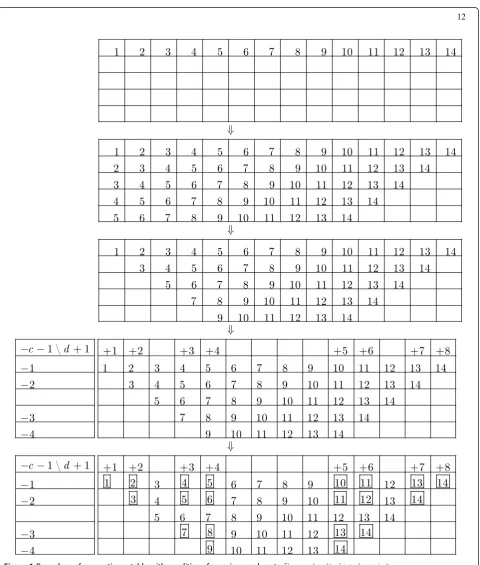
ious real roots can efficiently be represented as a table. Now, we explain the procedure to create the table. The first step is to draw a table with
(11· · ·1){3,NI−2} rows and (11· · ·1){3,NI−1} columns.
Fill the first row with the decimal numbers from left to right, starting with 1 and ending with
(11· · ·1){3,NI−1}. Then copy the one-cell left-shifted
version of the first row into the second row, the one-cell left-shifted version of the second row into the third row, and so on. Remove the entries below the main diagonal. On the first row, find the numbers for inequalities corresponding to μ- 1(d+1) <μ- 1(-c-1), where d= 0, 1,. . ., 2NI−1−1 and c = 0. Write -c-1 on
a new additional column, following the same pattern as d+1 with the opposite sign, where c= 0, 1,. . ., 2NI−2−1. Finally, mark the entries at the
intersection of -c-1 rows and d+1 columns. Figure 1 shows the procedure for generating the table with NI = 4 interferers. The number of columns is the number of conditions for various real roots, which are num-bered as 1 to 1 + (11· · ·1){3,NI−1}. Then the set Ci with Nc= 1 + (11· · ·1){3,NI−1} is defined as
Ci=
λ−1−m(−c−1)<0,λ−1n(−c−1)<0c= 0, 1,. . ., 2NI−2−1 (23)
wherem(-c-1) is the biggest and nearest marked num-ber from i including i and n(-c-1) is the smallest and nearest marked number fromiexcludingion each row -c-1, where −2NI−2≤ −c−1≤ −1. Ifmdoes not exist,
there is no corresponding marginal condition. The set
Diof candidates for real roots corresponding to the case
Ei=
(−c1−1), (−c2−1)(dm(−c1−1)+ 1) = (dm(−c2−1)+ 1) ,
c1,c2= 0, 1,. . ., 2NI−2−1,c1=c2
, (25)
the updated set Fi is obtained from the set Di by removing ±(μ-1(dm(-c-1)+1)-μ-1(-c-1))/2, except the
biggest element (-b-1)ÎEi, for (-c-1)≠(-b-1), (-c-1)ÎEi, and the updated set Ri is obtained from the set Fi by removing ±μ−1(−c−1)−μ−1(dn(−c−1)+ 1)
/2, except the smallest element (-s-1)ÎEi, for (-c-1)ÎEi, (-c -1)≠(-s-1).
12
7
1
2
3
4
5
6
8
9
10
11
12
13
14
7
1
2
3
4
5
6
8
9
10
11
12
13
14
7
2
3
4
5
6
8
9
10
11
12
13
14
7
3
4
5
6
8
9
10
11
12
13
14
7
4
5
6
8
9
10
11
12
13
14
7
5
6
8
9
10
11
12
13
14
7
1
2
3
4
5
6
8
9
10
11
12
13
14
7
3
4
5
6
8
9
10
11
12
13
14
7
5
6
8
9
10
11
12
13
14
7
8
9
10
11
12
13
14
9
10
11
12
13
14
1 \
1
1
1
2
3
4
c
d
2
3
4
5
6
7
8
7
1
2
3
4
5
6
8
9
10
11
12
13
14
7
3
4
5
6
8
9
10
11
12
13
14
7
5
6
8
9
10
11
12
13
14
7
8
9
10
11
12
13
14
9
10
11
12
13
14
1 \
1
1
2
3
4
5
6
7
8
1
2
4
5
7
10
11
13
14
1
3
6
8
9
12
3
5
6
7
11
12
14
2
4
8
9
10
13
7
5
6
8
9
10
11
12
13
14
7
8
13
14
3
9
10
11
12
9
14
4
10
11
12
13
c
d
−10 −5 0 5 10 15 20 10−3
10−2 10−1 100
Eb/N0 (dB)
BER
−10 −5 0 5 10 15 200.1
0.2 0.3 0.4 0.5 0.6 0.7 0.8 0.9 1
Upper bound (Matched Filter) Analytic BER
Simulation
Lower bound (No Interferer) Channel Capacity
Capacity
Figure 2The left axis is the BER and the right axis is the capacity (in bit/channel use) forI1=6.0 andI2=3.0 withN0=2.0.
20 10−3
10−2 10−1 100
Eb/N0 (dB)
BER
16 17 18 19 20 21 22 230.4
0.5 0.6 0.7 0.8 0.9 1
Upper bound (Matched Filter) Analytic BER
Simulation Channel Capacity
Figure 1. Procedure of generating a table with condi-tions for various real roots. The number NI of inter-ferers is 4.
In summary, with the set Ciof marginal conditions, we obtain the setRiof real roots corresponding toCiby solving (11). For the caseCi, 1≤i≤Nc, the real rootspj(i) ÎRi, j=−N(i)r ,. . .,Nr(i), and the center -c-1, −2NI ≤ −c−1≤ −1, we obtain the conditionp
j-1(i)<μ -1
(-c-1)<pj(i). Then conditional BER P−(i)c−1 is calculated by (16) and the BER P(i)b is calculated by (14) or (17).
In addition, we calculate the channel capacity. We consider the channel of (4) with possible inputsA0 or
-A0. The capacity of this channel in bit/channel use is given by [12]
C= 1−1 2
∞
−∞fR0(r0|H1)log2
1 +e−(r0) dr 0
−1 2
∞
−∞fR0(r0|H0)log2
1 +e(r0) dr 0
(26)
where by using (3) and (4), fR0(r0|H1) =fW(r0−A0)
and fR0(r0|H0) =fW(r0+A0). Then the capacity is
com-puted by (26).
4. Results
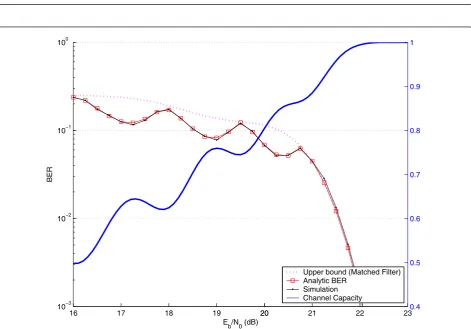
Figure 2 shows analytical BERs, simulations, and channel capacity of the proposed MCI-OSUD for NI= 2. We define the signal-to-noise ratio (SNR) asEb/N0A20/N0.
The upper bound, which is the hard decision for the out-puts of the matched filter, is also shown. When there is no interferer, the BER is a lower bound. As the SNR changes, i.e., the amplitudeA0 of the desired user, the conditionCisatisfied also changes even thoughIk’s are fixed. The analytical BER coincides with the simulation. This validates our approximation. For the low SNR region, the BER performance of the MCI-OSUD approaches that of no interferer case. After fluctuations due to multiple interferers, the MCI-OSUD BER perfor-mance approaches that of the matched filter. The chan-nel capacity is also in good agreement with the
MCI-(a)
(b)
(c)
OSUD BER, i.e., the higher the capacity is, the lower the BER is and vice versa. We note that while analytical BERs, simulations, and the channel capacity of the SCI-OSUD in [11] have a single local minimum, those of the
proposed MCI-OSUD have multiple local minima, which show the existence of multiple interferers. Similar results are obtained forNI= 4, shown in Figure 3. Note that for
NI>2, we assume (19). Therefore, the leftmost SNR, i.e.,
2
(a)
(b)
(c)
(d)
(e)
(f)
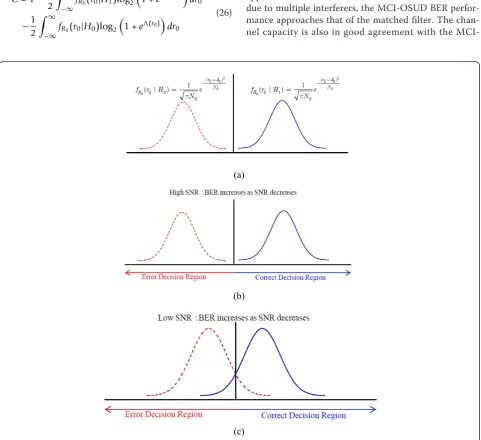
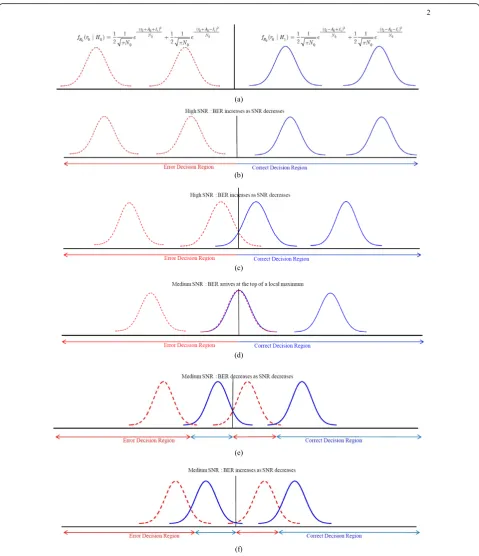
16 dB, in Figure 3 is the minimum SNR, which satisfies (19). Note that the leftmost SNR is not a limitation because we can changeN0so that the different leftmost SNR is obtained. For simulations, we used Monte Carlo simulators. Then, we averaged over 50,000 trials at each SNR. In addition, we define the maximum mismatch as the maximum value of absolute differences between the simulations and the analytical results. For the simulations in Figures 2 and 3, we obtained the maximum mis-matches of 0.014 and 0.0081, respectively. Usually, the BER is non-increasing and the capacity is non-decreasing as the SNR increases. However, with CCIs, generally these are not true. This phenomenon can be explained clearly with the simplest case, i.e., a single interferer case. Before we explain a single interferer case, let us first review no interferer case. For this case, the conditional PDFs are given as in Figure 4a. Then at high SNRs, the BER increases as the SNR decreases. The decision region is shown in Figure 4b. For this case, the BER increases monotonically until the SNR reaches at the low SNR as shown in Figure 4c. However, with CCIs, generally the BER does not increase monotonically as the SNR decreases. For this case, the conditional PDFs are given in Figure 5a. Then at high SNRs, the BER increases as the SNR decreases. The decision region is shown in Figure 5b. The BER increases monotonically until the SNR reaches at some SNR as shown in Figure 5c. Then the BER arrives at the top of a local maximum shown in Fig-ure 5d. After the BER reaches the local maximum, the BER decreases as the SNR decreases over the medium SNR region shown in Figure 5e. Then after the BER reaches the local minimum, the BER increases as the SNR decreases as usual shown in Figure 5f. As shown above, the physical interpretation is now clear. When there exists CCIs, they can interfere constructively as well as destructively. Therefore, the BER (and in turn the capacity) is not always monotonically increasing or decreasing for the cochannel interference case.
5. Conclusion
We derived an analytical expression for the BER of the MCI-OSUD. The effect of MCIs on the BER was ana-lyzed. To investigate the BER performance, the channel capacity was also calculated. The capacity, the analytical result, and the simulation are in good agreement.
Competing interests
The author declares that they have no competing interests.
Received: 7 January 2012 Accepted: 8 June 2012 Published: 8 June 2012
References
1. MJ Wilmut, Signal detection in the presence of co-channel interference and noise, (Queen’s University, 1970)
2. H Camkerten, Optimum one-shot BPSK receiver design for multiple access mobile radio channels with Rayleigh fading, inProc IEEE VTC 1992, Denver.
1, 447–450 (May 1992)
3. GJM Janssen, Receiver structure for simultaneous reception of two BPSK modulated cochannel signals. Electron Lett.29(12), 1095–1097 (1993). doi:10.1049/el:19930731
4. R Kwan, C Leung, Optimal detection of a BPSK signal contaminated by interference and noise. IEEE Commun Lett.6(2), 225–227 (2002) 5. TV Poon, NC Beaulieu, Jointly and individually optimum receivers for BPSK
signals in cochannel interference plus noise, inProc IEEE Pacific Rim Conf
Commun, Comput, Signal Process, Victoria, BC, Canada,2, 530–532 (August
2003)
6. TV Poon, NC Beaulieu, Performance analysis of a jointly optimal BPSK receiver in cochannel interference, inProc IEEE Global Telecommn Conf, San Francisco, USA,3, 1721–1725 (December 2003)
7. TV Poon, NC Beaulieu, Error performance analysis of a jointly optimal single cochannel-interferer BPSK receiver. IEEE Trans Commun.52(7), 1051–1054 (2004). doi:10.1109/TCOMM.2004.831359
8. S Verdú,Multiuser Detection, 1st edn. (Cambridge University Press, New York, 1998)
9. AM Rabiei, NC Beaulieu, A simple, intuitive expression for the BER of a jointly optimal single cochannel interferer BPSK receiver. IEEE Commun Lett.
9(3), 201–203 (2005). doi:10.1109/LCOMM.2005.03030
10. AM Rabiei, NC Beaulieu, An analytical expression for the BER of an individually optimal single cochannel interferer BPSK receiver. IEEE Trans Commun.55(1), 60–63 (2007)
11. SM Saberali, H Amindavar, AR Moghaddamjoo, BER calculation and investigation of optimal single user detector for a BPSK signal
contaminated by cochannel interferer. IEEE Commun Lett.12(10), 705–707 (2008)
12. JG Proakis,Digital Communications, 4th edn. (McGraw-Hill, New York, 2001)
doi:10.1186/1687-1499-2012-190
Cite this article as:Chung:An analytical expression for the BER of optimal single user detection of a BPSK signal contaminated by multiple CCIs.EURASIP Journal on Wireless Communications and Networking
20122012:190.
Submit your manuscript to a
journal and benefi t from:
7Convenient online submission
7Rigorous peer review
7Immediate publication on acceptance
7Open access: articles freely available online
7High visibility within the fi eld
7Retaining the copyright to your article