R E S E A R C H
Open Access
1-bit quantization and oversampling at
the receiver: Sequence-based communication
Lukas T. N. Landau
1,2*, Meik Dörpinghaus
2and Gerhard P. Fettweis
2Abstract
Receivers based on 1-bit quantization and oversampling with respect to the transmit signal bandwidth enable a lower power consumption and a reduced circuit complexity compared to conventional amplitude quantization. In this work, the achievable rate for systems using such analog-to-digital conversion with different modulation schemes is studied. The achievable rate and the spectral efficiency with respect to a given power containment bandwidth are considered. The proposed sequence-based communication approach outperforms the existing methods known from the literature on noisy channels with 1-bit quantization and oversampling at the receiver. It is demonstrated that the utilization of 1-bit quantization and oversampling can be superior in terms of the spectral efficiency in comparison to conventional amplitude quantization using a flash converter with the same number of comparator operations per time interval.
Keywords: 1-bit quantization, Oversampling, ADC, Faster-than-Nyquist signaling, Achievable rate, Markov capacity
1 Introduction
The achievable rate in case of Nyquist rate sampling is lim-ited by the quantization resolution of the analog-to-digital converter (ADC). In this regard, a flash converter consist-ing ofNCompcomparators limits the maximum achievable rate to log2(NComp + 1) bits per Nyquist interval [1]. Differently, by time interleavingNCompcomparator oper-ations per Nyquist interval, 2NComp quantization regions exist, which enhances the limit of the achievable rate to NCompbits per Nyquist interval. In this regard, employ-ing 1-bit quantization and oversamplemploy-ing at the receiver is promising in terms of the achievable rate. Moreover, a 1-bit ADC at the receiver is robust against amplitude uncertainties such that the automatic gain control can be simplified, and linearity requirements of the analog fron-tend are relaxed. Last but not least, a 1-bit ADC requires only simple circuitry and does not need much headroom for amplitude processing, which makes it appropriate for low supply voltages and with this low energy consump-tion. All these motivate us to study the achievable rate of
*Correspondence:[email protected]
Parts of this paper have been published at SPAWC 2014, ICUWB 2014, and ICUWB 2015
1Centro de Estudos em Telecomunicações, Pontifícia Universidade Católica do
Rio de Janeiro, CEP 22453-900, Rio de Janeiro, Brazil
Full list of author information is available at the end of the article
channels with 1-bit output quantization and oversampling at the receiver.
A first study of the achievable rate with 1-bit quanti-zation and oversampling at the receiver has been carried out by Gilbert [2] showing a marginal benefit in terms of the achievable rate by oversampling. Subsequently, by using a Zakai bandlimited channel input processes, Shamai [3] has shown that oversampling can significantly increase the achievable rate. Both of these works consider a noiseless channel. For noisy channels, in [4] a benefit of oversampling has been proven in the low signal-to-noise ratio (SNR) regime by studying the capacity per unit cost. Moreover, in [5] the achievable rate at high SNR has been studied by considering generalized mutual information, which did not confirm the high rates promised in [3].
Besides these papers on strictly bandlimited channels, also cases with less strict spectral constraints on the trans-mit signal have reported benefits from 1-bit quantization and oversampling. For example, in [6,7], where the chan-nel is treated as memoryless, it has been observed that random processes such as additive noise and intersym-bol interference can yield an increase of the achievable rate due to dithering. The same strategy, namely treating the channel as memoryless, has been applied for the uti-lization of faster-than-Nyquist (FTN) signaling [8,9] for channels with 1-bit quantization and oversampling at the
receiver [10]. An alternative strategy for communication with 1-bit quantization and oversampling at the receiver is to transmit sequences which generate a unique output signal after 1-bit quantization. In this regard, a waveform design supporting a unique detection of symbols with 16 quadrature amplitude modulation (16-QAM) has been proposed in [11]. Without being exhaustive, the named papers show some benefit of oversampling when using 1-bit channel output quantization. Nevertheless, none of these approaches provide achievable rates comparable to those which are presented in [3] for the noiseless channel. In addition, 1-bit quantization—not necessarily with oversampling—received increased attention in the con-text of multiple-input multiple-output (MIMO) systems, where the low SNR regime is discussed in [12,13], and the high SNR case is investigated in [14]. It is shown that the power penalty for the 1-bit quantization in the low SNR regime is less than 2 dB. For the high SNR regime, channel state information can be exploited at the transmitter for a channel inversion strategy for the construction of receive signals appropriate for 1-bit quantization. Moreover, the sequence design approach described in [11] for the single-input single-output channel has been recently extended for the massive multiple-input single-output scenario in [15] and for the massive MIMO scenario in [16].
Furthermore, 1-bit quantization is considered in the context of phase quantization [17] and a related con-cept named overdemodulation [18], where the received signal is down-converted with more than two carrier phases, different to 90 degrees. The increased number of carrier phases provides additional information in cases where a coarse quantization at the receiver is consid-ered. Another study is presented in [19], where mul-tidimensional quantizer designs are investigated in the context of channels with memory. The proposed quan-tizers in [19] are optimized for channels with memory whose quantization regions incorporate multiple receive samples.
The channel with 1-bit quantization and oversampling at the receiver is implicitly a channel with memory. In this regard, we have to consider sequence detection based receivers to approach the channel capacity [20]. As the capacity of finite state channels can be approached by Markov sequences [21], we consider different channel input processes of this class. In this regard, we study sequences based on:
• QAM and phase-shift keying (PSK) symbols at Nyquist rate
• Faster-than-Nyquist signaling with quadrature phase-shift keying (QPSK) and QAM symbols
i.e., we either design transmit sequences correspond-ing to a conventional modulation or with an increased
signaling rate. Moreover, we study specific signal design approaches, (1) reconstructible 4 amplitude-shift keying (4-ASK) / 16-QAM sequences for conventional signal-ing rate and (2) runlength-limited (RLL) sequences for FTN signaling. We also propose a sequence optimization strategy, based on the approach in [22], which maximizes the achievable rate by optimizing the transition probabil-ities of a Markov source model. The present work goes clearly beyond the studies we have presented before on this subject. The main extensions are the consideration of PSK signaling, the consideration of the spectral effi-ciency with different out-of-band power thresholds, the extended description of the sequence optimization strat-egy including the explanation of the lower bound on the achievable rate and the overall performance compar-ison for a large number of transmit signaling schemes under the same conditions. Moreover, in the present work, we describe the constraints on the waveform for the reconstructable 16-QAM sequences and discuss the zero-crossings in sequences composed of weighted cosine pulses.
In [23], we treat the channel with 1-bit quantization and oversampling at the receiver and root-raised-cosine (RRC) transmit and receive filters with infinite memory. The study serves as a proof of concept for strictly bandlimited channels. The results in [23] in terms of the achievable rate are comparable to [3]. However, the utilization of RRC filters is impractical for many applications. In this regard, consider that the use of RRC filters implies an exten-sive memory of the channel when having 1-bit quantiza-tion and oversampling at the receiver, which dramatically increases the computational complexity of the sequence demapping, e.g., by utilizing a trellis receiver. Differently to [23], in the present work, we consider transmit pulses with a shorter length in time domain such as the cosine pulse and the Gaussian pulse. These waveforms provide a good trade-off between spectral efficiency and channel memory. We rely on the assumption that the residual out-of-band radiation can be tolerated for specific applications such as board-to-board communication at sub-Terahertz carrier frequencies and intra-chipstack communications, e.g., using through-silicon vias. Our results show that the proposed methods outperform the existing methods in terms of the spectral efficiency. Furthermore, our results show that 1-bit quantization with oversampling at the receiver can yield comparable and even superior spectral efficiency than conventional methods based on ampli-tude quantization when operating in the low quantization regime with the same number of comparator operations per time interval.
with a lower complexity are presented in our prior work [24,25].
The rest of the paper is organized as follows. Section2
introduces the system model. In Section 3, we recall a method to lower-bound the achievable rate for channels with memory, which we will subsequently apply to eval-uate the performance of the studied signaling schemes. Afterwards, in Section4, we present an approach to gen-erate reconstructible 4-ASK/16-QAM sequences. More-over, the application of RLL sequences, which are used in combination with FTN signaling, is described in Section5. In Section6, we propose an optimization strat-egy for sequence design, which maximizes the given lower bound on the achievable rate. We discuss the numerical results in Section7, and finally, a conclusion is given in Section8.
Notation:Bold symbols, e.g.,yk, denote vectors, where kindicates thek-th symbol, or more specifically, the sam-ples which belong to thek-th input symbol time interval.
yk is a column vector with M entries, where M is the oversampling factor w.r.t. a transmit symbol. Sequences are indicated with xn =[x1,. . .,xn]T, and sequences of vectors are denoted asyn = yT1,. . .,yTnT. A segment of a sequence is written as xkk−L =[xk−L,. . .,xk]T and
ykk−L = yTk−L,. . .,yTkT. Random quantities are denoted by upright letters, e.g., yk is random vector. A simpli-fied notation for probabilities of random quantities is used with Pyn|xn = Pyn=yn|xn=xn. Exceptions are explicitly declared.
2 System model
We consider the single carrier communication system model shown in Fig. 1. The digital-to-analog converter (DAC) in Fig. 1is considered as ideal such that its out-put is described by a sequence of weighted Dirac delta pulses ∞k=−∞xkδ t−k Ts
MTx
, with xk being the k-th
channel input symbol and MTx
Ts describes the symbol rate depending on the unit time interval Ts and the integer parameterMTx. The complex baseband receive signal r(t) corresponds to the complex transmit signal x(t), which is given as a weighted sum of time shifted transmit pulses h(t), disturbed by additive white Gaussian noise n(t). At the receiver, r(t)is processed by the receive filter with the impulse responseg(t)such that the ADC input signal is given by faster-than-Nyquistsignaling following the principle in [8,
9]. In this regard, a compression of channel input symbols in time is given, such thatMTxchannel input symbols are emitted in the unit time intervalTs. The compression of input symbols in time provides additional degrees of free-dom which can be exploited for the waveform design. In order to avoid extensively complex trellis-based receivers, a transmit filterh(t)with short impulse response is favor-able. In this context, different standard pulses (Gaussian pulse, cosine pulse, and rect pulse) will be examined in terms of the spectral efficiency for the considered channel.
Instead of considering matched filtering,1 we consider an integrate-and-dump receiver, whose integrator over the time intervalTsserves as the receive filter
g(t)= 1
Ts, 0≤t<Ts
0, otherwise, (2)
whose short impulse response is favorable for a trellis-based sequence detection. The system impulse response is denoted asv(t)=(h∗g)(t).
Finally, the output signal of the low-pass filter z(t) is sampled at rateMMTx
Ts and quantized by the ADC. Here,M denotes the oversampling factor with respect to the trans-mit symbol rate. The channel with the transtrans-mit symbols xk as input symbols and the output of the ADCyk is a discrete-time channel. For describing the input and out-put relations, we express the length of the overall impulse response v(t) of the channel in terms of input symbol durations. The length of the impulse responsev(t) is by definitionL+1 symbol durations. The noise n(t)is just fil-tered by the receive filterg(t)whose impulse response has a length ofξ symbol durations. Considering the receive filter in (2) with the length ofTscorresponds toξ =MTx. Perfect synchronization is assumed, such that one of the Msamples at the receiver includes the peak of the system impulse response. With this, the sampling time instances are case sensitive, such that the sampling vector zk =
zk,1,. . .,zk,M
T
is described by
zk,m= where M is the oversampling factor with respect to a transmit symbol. Accordingly, the vector zk con-tains the M samples corresponding to the transmit symbol xk. The subsequent quantization is denoted by yk,m = Q tization operator applies element-wise with Q{zk} =
The channel input symbols xk are taken from discrete modulation alphabets, specifically, a QPSK, QAM, or PSK symbol alphabet X with the cardinality |X|. While for QAM we use the standard constellation, for PSK
constel-lations, the input symbols are given by xk = ej2π mk+12
|X|
with mk∈ {0,. . .,|X| −1}.2The channel including trans-mit and receive filtering and quantization is a discrete input discrete output channel with memory, for which it is known that the channel capacity can be asymptoti-cally achieved by a stationary Markov source [21]. Thus, we consider a stationary Markov source model, such that each channel input symbol xk depends on Lsrc previ-ous symbolsPxk|xk−1 where for the latter, we use the state variable sk = xkk−L
src+1 to describe the current state of the source. To simplify the notation, we use the shorthand notation Pi,j = Psk =j|sk−1=i
. We denote the stationary dis-tribution of the source states byμi = P(sk=i)fori = 1,. . .,|X|Lsrc.
Due to transmit and receive filtering, the channel output depends on previous channel inputs and outputs. Accord-ingly, later in Section3, we introduce an auxiliary channel law, which accounts for for the dependency on N pre-vious channel outputs ykk−−1N. Thus, we are interested in the description ofN+1 subsequent channel output sig-nals ykk−N. The parameter N can be understood as the trace-back of the sequence, which corresponds to the truncation length in the receiver processing, i.e., it lim-its the dependency on prior channel outputs conditioned on the channel inputs. In the following, we use a matrix-vectornotationof the channel input/output relation given by
ykk−N =Qzkk−N=QV(N)U(N)xkk−N−L (3) +D(N)G(N)nkk−N−ξ
,
cf. the notation introduced at the end of Section1. Due to the memory of the channel introduced by transmit and receive filtering, the subsequence of channel outputsykk−N depends on the transmit symbols xkk−N−L. An individual
The convolution with the system impulse responsev(t)is reflected by the multiplication with V(N) and the con-volution with the receive filter impulse response (2) is reflected by multiplication withG(N). The filter matrices V(N)andG(N)with dimensions(M(N+1))×((L+N+2) M−1)and(MD(N+1))×(MD(1+N+ξ)), respectively, are structured as follows
V=
where the receive filter gr is normalized to unit energy3. The system impulse response function is sampled in reverse order with rate MMTx
Ts to express the convolution. With this, the vector inV is given byvr =
when(L+1)Mis odd. Moreover, the impulse response of the receive filter sampled in reverse order with the rate MMTxD sampling rate allows to model the aliasing effects which possibly occur when considering receive filters with a larger bandwidth as can be described with the sampling rate of the receiver MMTx
Ts .
4 Accordingly, the
vector nkk−N−ξ in (3) contains N + ξ + 1 vectors each containing MD independent and identically distributed (i.i.d.) complex Gaussian samples with zero mean and varianceσn2modeling n(t). In order to merge the differ-ent sampling rate domains, the input xkk−N−L isM-fold upsampled by matrix multiplication with U(N)and the filtered noise is D-fold decimated by the matrix multi-plication withD(N). The matrixU(N) with dimensions
3 Achievable rate
The considered channel in (3) has memory. A channel outputyk depends on previous input symbols and previ-ous channel outputsyk−1, where the latter is induced by the correlation of the noise samples. Considering block-wise stationarity and ergodicity with respect to yk, the simulation-based methods in [26–29] can be applied for computing the achievable rate.
3.1 Lower-bounding by considering an auxiliary channel law
According to [26, 29], the achievable rate for a channel with memory can be computed with
lim
where the right hand side (RHS) can be numerically eval-uated based on “very long” sequence realizationsyn and xngenerated with respect to the distributionsP(xn)and Pyn|xn. An auxiliary channel lawW(·|·)is introduced which approximates the actual channel law by limiting the memory of the channel toNprevious channel output symbolsykk−−1N, i.e.,Pyk|yk−1,xk≈Wyk|yk−1,xkwith W yk!!!yk−1,xk=P yk!!!ykk−−1N,xkk−N−L. (9) According to the Auxiliary-Channel Lower Bound in [29], by employing (9), we get
where the limit on the RHS can be numerically approached based on very long sequences. The probabili-tiesWynandWyn|xnare computed recursively with the forward recursion of the Bahl-Cocke-Jelinek-Raviv (BCJR) algorithm [30]. Taking into account the memory of the auxiliary channel lawL+Nand the memory of the source modelLsrcthe system state sk, cf. Sec.2(including channel and source) becomes sk = xk
k−max(Lsrc,L+N)+1. In this regard, the probability of the output sequenceW(yn)
is computed with the recursion given by
W(yk)= the conditional probabilityW(yn|xn)is computed with the recursion given by Using Bayes’ rule, we can write the conditional proba-bility in (12) and (13) as Numerator and denominator in (14) can be computed directly when considering a specific system model.
3.2 Transition probabilities
Because the computation of the transition probabilities incorporates an integration over a multivariate circularly symmetric Gaussian distribution, it is favorable in terms of computational complexity to decompose them into statistically independent real-valued components. With Re{zk} = ´zk and Im{zk} = `zk, a shorthand notation is used, which is also applied for the xkandnk.
The real part of the received signal before the quan-tization follows a multivariate Gaussian distribution described by
The transition probabilities for the quantized signal in (3) are given by the integration over the corresponding quantization regions5, i.e.,
sequences. In case of a PSK input alphabet, the real and imaginary part of the received signal are independent when they are conditioned on the input, which allows to write the probability distribution as a product.
4 Reconstructible ASK sequences
In this section, we discuss the construction of ASK6 sequences which can be distinguished by a receiver using 1-bit quantization and oversampling. For illustration of our approach, we consider a triangular waveform, i.e.,
v(t)=tri
t−Ts Ts
=
⎧ ⎨ ⎩
t
Ts, 0≤t<Ts 2−Tt
s, Ts ≤t<2Ts 0, otherwise.
(17)
Note that the principle can be applied for all waveforms which fulfill the constraints described in Appendix A, e.g., whenh(t) is a cosine pulse with length 2Ts. For the illustrating example, we consider a 4-ASK input alphabet, 3-fold oversampling (M = 3), and a signaling rate with MTx=1.
4.1 The reconstruction issue of sequences with i.i.d. symbols
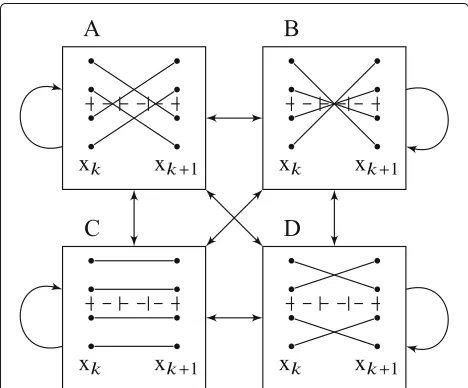
The symbol transitions xkto xk+1can be classified regard-ing their properties on sequence reconstruction. The states A to D in the state machine in Fig.2cover all pos-sible signal evolutions, e.g., when considering sequences of i.i.d. input symbols xk. The classification of the 16 symbol transitions into the four subclasses is a favorable illustration, because transmit symbol sequences can be modeled by arbitrarily combining the states A to D, while symbol transitions within the subclasses have identical properties for sequence reconstruction. The illustrations within the boxes show possible evolutions of the received
A
B
C
D
Fig. 2State machine for unconstrained 4-ASK symbol transitions
symbol over the time duration kTs ≤ t ≤ (k +1)Ts. The (M+1) sampling instances within this time inter-val are indicated by the vertical bars on the x-axis. The sequence reconstruction properties are determined by the corresponding channel output patterns given by the signs at the sampling instances. In this regard, the four states of the machine themselves represent classes of symbol transitions which are associated with different properties regarding sequence reconstruction:
A: xkandxk+1can be directly reconstructed based on the currentM+1ADC output samples in the time intervalkTs≤t≤(k+1)Ts(“decision”)
B: xk+1can be reconstructed based on the current M+1ADC output samples in casexkis known at the receiver, orxkcan be reconstructed in casexk+1 is known (“forward”)
C: Possible ambiguity with transitions in state D (“ambiguity1”)
D: Possible ambiguity with transitions in state C (“ambiguity2”).
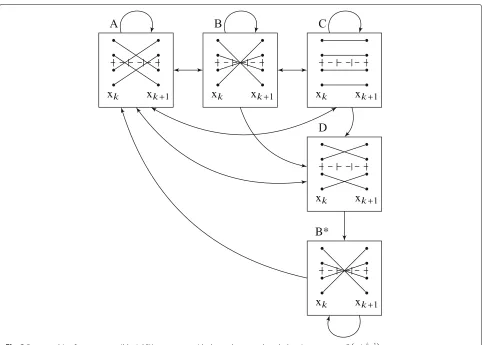
4.2 A state machine representation for reconstructible ASK sequences
A
B
C
D
Fig. 3State machine for reconstructible 4-ASK sequences, with dependency on the whole prior sequence,Pxk|xk−1
matrix, describing the directed connections of the states, is given by
Aadj= ⎡ ⎢ ⎢ ⎢ ⎢ ⎣
1 1 1 1 0 1 1 1 1 0 1 1 1 1 0 1 0 0 0 1 1 0 0 0 1
⎤ ⎥ ⎥ ⎥ ⎥
⎦, (18)
where the first three rows account for the outgoing con-nections for states A, B, and C, and the last two rows account for the outgoing connections from the states D and B*. The columns represent the incoming states in the order A, B, C, D, and B*. According to [31], the maximum entropy rate of sequences generated by this state machine can be computed with
Hmax=nlim→∞ 1 nlog2
i,j
Anadj
i,j=log2(λmax) (19)
=1.7716 [bit per symbol], (20)
whereλmax is the largest real-valued eigenvalue ofAadj, andAnadjdescribesAadjraised to the power ofn. Further-more, according to [31] the transition probabilities that maximize the source entropy are computed with
Pi,j= bj bi ·
Aadj
i,j λmax
, (21)
Table 1Source entropy rates of reconstructible sequences
Sequence property Lsrc=1 Lsrc=2 Lsrc=3 Lsrc=4
limn→∞1nH(xn)[bit/symbol] 1.585 1.7237 1.7583 1.7678
5 Runlength-limited sequences
An alternative approach to model transmit sequences which can be uniquely reconstructed at a receiver with a 1-bit ADC is to use runlength-limited (RLL) sequences [32] in combination with FTN signaling. RLL sequences are a natural choice because they convey the information in the distances of zero-crossings or runlengths. As the temporal positions of a change of the signal should be controlled on a more fine-grained time-grid thanTs, we have to choose MTx>1 in (1), which corresponds to FTN signaling.
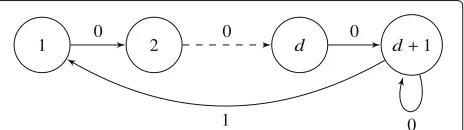
RLL sequences can be obtained from the so-called (d,k)-sequences, wheredandkare the parameters which constrain binary sequences. In a (d,k)-sequence a 1 is followed by at least d and at most k 0s. The k prop-erty is introduced for practical purpose such as clock recovery which is neglected in this work, i.e., we assume k = ∞. The corresponding state machine for a d-constrained sequence is illustrated in Fig. 4. The (d,k) sequence is subsequently transformed into a runlength-limited sequence by non-return-to-zero inverted (NRZI) encoding. An example is given as follows
(d)-seq. . . . 1 0 0 1 0 1 0 1 . . . rll-seq. . . . 1 1 1−1 −1 1 1 −1 . . .,
whered = 1. According to [31], the maximum entropy rate of such a sequence, which limits the corresponding achievable rate, depends on the adjacency matrix Aadj of the state machine and can be calculated by (19). The adjacency matrix describing the state machine in Fig.4is given by
where the rows correspond to the current states and the columns correspond to the following state. Furthermore, the transition probabilities for the source with maximum entropy are computed with (21). With this, the maximum achievable rates per symbol are given in Table2.
Fig. 4State machine describingd-constrained sequences
Table 2Maximum entropy ofd-constrained sources
Run-length constraint d=1 d=2 d=3
Max entropy rate [bit/symbol] 0.6942 0.5515 0.4650
Thedconstraint implies redundancy within the chan-nel input sequence. However, in combination with a higher signaling rate, the RLL sequences can yield a benefit in terms of spectral efficiency for the case of 1-bit quantization at the receiver, which is different from the unquantized FTN [33]. This is due to the fact that the FTN-caused intersymbol interference cannot be cor-rected by the trellis-based receivers because of the loss of the additional amplitude information due to the 1-bit ADC. In this regard, the sequences need to be well shaped, such that the intersymbol interference does not induce a flip of the sign of current symbols. In this regard, the RLL sequences can tolerate some intersymbol interfer-ence, e.g., of the considered channel, at a relatively low cost in redundancy. In addition, the RLL sequences yield a higher concentration of the signal power of the transmit symbol sequence at lower frequencies. Depending on the bandwidth criterion, this might further increase the spec-tral efficiency. For complex transmit symbol sequences, we consider independent RLL sequences for the real and the imaginary part.
6 Maximization of a lower bound on the achievable rate using an expectation-based Blahut-Arimoto algorithm
In this section, we study a numerical input sequence opti-mization approach with respect to the achievable rate. In this regard, we discuss a strategy to optimize the transi-tion probabilities of a given Markov source which models the channel input sequences. The set of transmit symbols
where we use sk=xkk−L−N+1on the RHS and with
The inequality in (24) holds as conditioning can only decrease entropy and the inequality in (25) holds accord-ing to the auxiliary channel lower bound, seeAppendixC. The second term on the RHS of (25) can be expressed as
where the RHS can be practically evaluated with very long sequences. Considering a very long sequence, the argu-ment of the limit on the RHS of (26) can be rewritten with the symbol transition probabilitiesPi,jand the stationary distribution7μias
1
where (·) denotes the average over the specific state or state transition based on the number of their occurrences in the very long sequence realization. The second sum on the RHS of (27) can be also written asi,jμiPi,j(·),
where the denominators account for the number of spe-cific state transitions and states, respectively, occurring in the sequence xn. The quantities Wsk,sk−1|yn
and Wsk−1|yn
are computed with the BCJR algorithm [30]. Based on theTiˆ,jnotation, the lower bound on the achiev-able rate in (25) is rewritten as
In the following, it is described how to chosePi,jfor max-imizing the RHS of (29). In this regard, the so-callednoisy adjacency matrixis given by
With (30), the transition probabilities which maximize the achievable rate are given by
Pi,j=
λmax , if the transition occurs inx n
0, else,
(31)
where λmax is the largest real eigenvalue of A˜adj andbi andbj are entries of the corresponding eigenvector. The method is applied iteratively as Tˆi,j itself is a function of Pi,j, where each iteration involves the generation of xnandyn.
Note that this optimization procedure does not take into account the power spectral density (PSD) of the result-ing channel input signal. Moreover, the optimization has an influence on the average transmit power and, thus, on the SNR.
7 Numerical results
In this section, we numerically evaluate the achievable rate based on the lower bound in (10). The simulation-based computation of the RHS of (10), i.e., of the argument of the limit, is carried out based on a sequence of length n=106symbols. Whenever the proposed sequence opti-mizaton strategy is applied, 19 iterations of the loop in the algorithm described in Section6have been carried out. The power containment bandwidth and the SNR are post-computed as the transmit signal bandwidth depends on the individual Markov source.
The correlation of the sequence of input symbols xn depends on the used Markov source and determines the power spectral density of the transmit signal. The coeffi-cients of the discrete-time auto-correlation function of the transmit symbol sequence xnare given by
ck=E
with the stationary input state distribution μi. Hence, the corresponding PSD is given by the Fourier transform
Sx(f) = MTTxs ∞k=−∞ckej2π
kTs
MTxf, where the infinite sum
10% (or 5%), of the transmit power is emitted outside the nominal bandwidth8.
The power containment bandwidth, e.g.,B90%, is used for computing the spectral efficiency as
spectral eff.= Ibpcu·MTx Ts·B90%
, (33)
whereIbpcuis the achievable rate w.r.t. one symbol sym-bol duration Ts
MTx. For numerical evaluation, we define the oversampling factor w.r.t. the power containment band-width, e.g.,B90%, as
Moversampling=
M·MTx Ts·B90%
. (34)
Moreover, also the SNR depends on the power contain-ment bandwidth, e.g.,B90%, and is defined as
SNR= limT→∞
Note that the transmit power depends on the Markov source modeling the input sequence xn and the transmit filterh(t). In the sequel, if not otherwise stated, we assume the 90% power containment bandwidth (B90%).
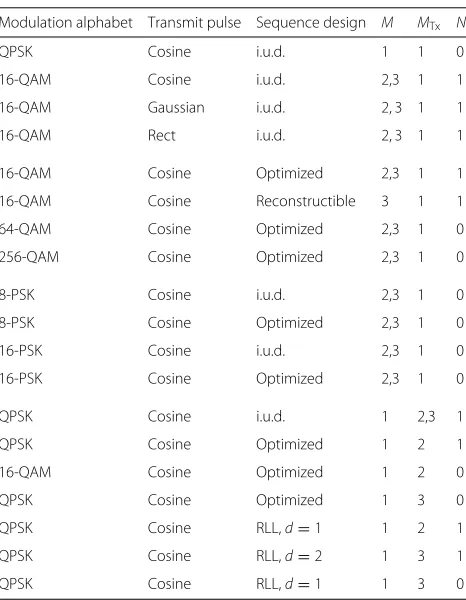
For different simulations, we use auxiliary channels with different memory N, cf. (9), as the computational complexity scales with the number of states sk which itself increases exponentially withN.9 For computation-ally extensive cases, e.g., when the length of the channel impulse responseL+1 is large because of a high signaling rate as is forMTx =3 or when the input symbol alphabet is large as is forMQAM=256, it is essential to consider an auxiliary channel law with a smallN, e.g.,N=0, to retain the computability. For the considered scenarios, we have observed that the achievable rate practically approaches its maximum when considering an auxiliary channel law withN ≥ ξ = MTx. ConsideringN = ξ = MTx implies that the condition in the channel law corresponds to the exact channel outputsykk−−1N, whose time instances match to the noise samplesnkk−−1ξwhich influence the current out-putyk, cf. (4). Moreover, from our experience, e.g., from [20], the impact on the lower bound of the achievable rate, e.g., when choosingN < ξ, is marginal at medium SNR and vanishes with increasing SNR, which is reasonable because the channel memory on the channel output arises from the noise process. An overview on the considered scenarios with 1-bit quantization at the receiver is given in Table3.
To evaluate the burden for the use of 1-bit quantiza-tion and oversampling, we compare our approach with the channel without output quantization and RRC filter-ing with a roll-off factor of 0.3. In terms of FTN signalfilter-ing, we compare with a reference system without quantization and with a roll-off factor equal to 1 and with various com-pression factors τT, cf. the notation in [33]. Moreover,
Table 3Overview on considered scenarios with 1-bit quantization at the receiver
Modulation alphabet Transmit pulse Sequence design M MTx N
QPSK Cosine i.u.d. 1 1 0
16-QAM Cosine i.u.d. 2,3 1 1
16-QAM Gaussian i.u.d. 2, 3 1 1
16-QAM Rect i.u.d. 2, 3 1 1
16-QAM Cosine Optimized 2,3 1 1
16-QAM Cosine Reconstructible 3 1 1
64-QAM Cosine Optimized 2,3 1 0
256-QAM Cosine Optimized 2,3 1 0
8-PSK Cosine i.u.d. 2,3 1 0
8-PSK Cosine Optimized 2,3 1 0
16-PSK Cosine i.u.d. 2,3 1 0
16-PSK Cosine Optimized 2,3 1 0
QPSK Cosine i.u.d. 1 2,3 1
QPSK Cosine Optimized 1 2 1
16-QAM Cosine Optimized 1 2 0
QPSK Cosine Optimized 1 3 0
QPSK Cosine RLL,d=1 1 2 1
QPSK Cosine RLL,d=2 1 3 1
QPSK Cosine RLL,d=1 1 3 0
we compare our results on the spectral efficiency with the AWGN channel capacity, normalized with the power containment bandwidth, assuming a flat spectrum.
7.1 Transmit pulse
Before considering the sequence design, the impact of the transmit pulse shapeh(t)is examined in this section. The complexity of the trellis-based receiver scales exponen-tially with the length of the memory of the channel. In this context, transmit pulses with short duration in time domain are favorable and considered in this work explic-itly. Standard transmit pulses are considered, such as the cosine pulse described by
hcos(t)=
-∞
−∞p2Gauss(t)dt −1
2 p
Gauss(t). As a reference, also the rectangular pulse shape given by
hrect(t)= 1
Ts, 0≤t<Ts
0, otherwise, (38)
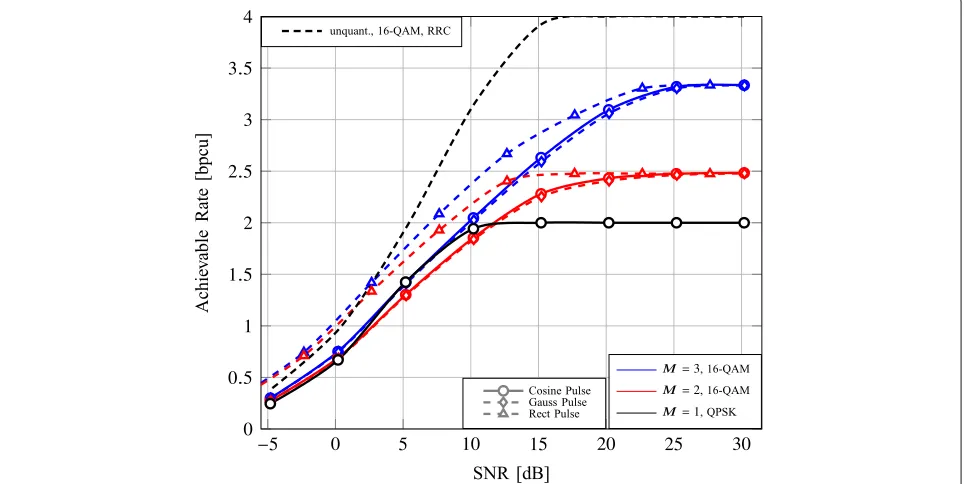
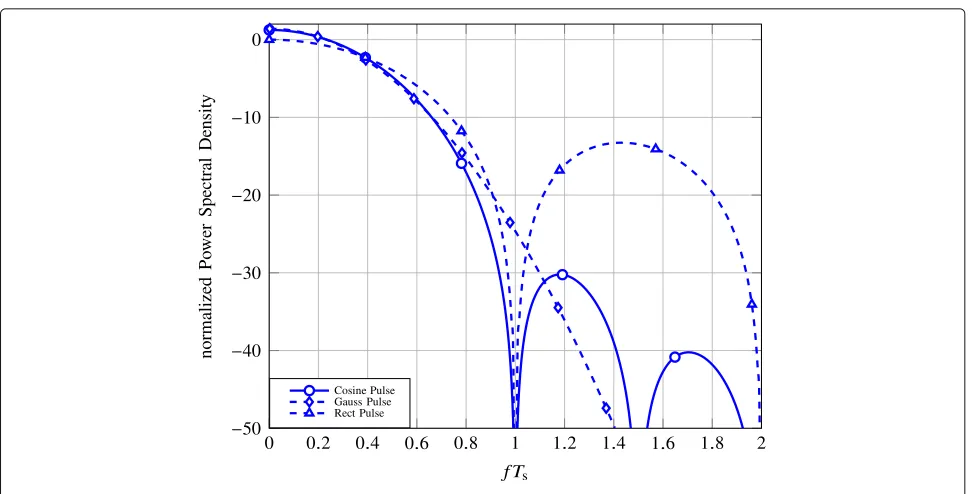
is considered. The achievable rate for 16-QAM modula-tion with independent and uniformly distributed (i.u.d.) transmit symbols is illustrated in Fig. 5 10. Taking into account the power spectral density shown in Fig.6, the spectral efficiency can be computed. The spectral effi-ciency w.r.t. B90% and w.r.t. B95% are shown in Figs. 7 and 8, respectively. In terms of spectral efficiency the Gaussian pulse and the cosine pulse show a compara-ble performance. Because the cosine pulse has a shorter duration in time domain, it is considered in the sequel.
7.2 QAM
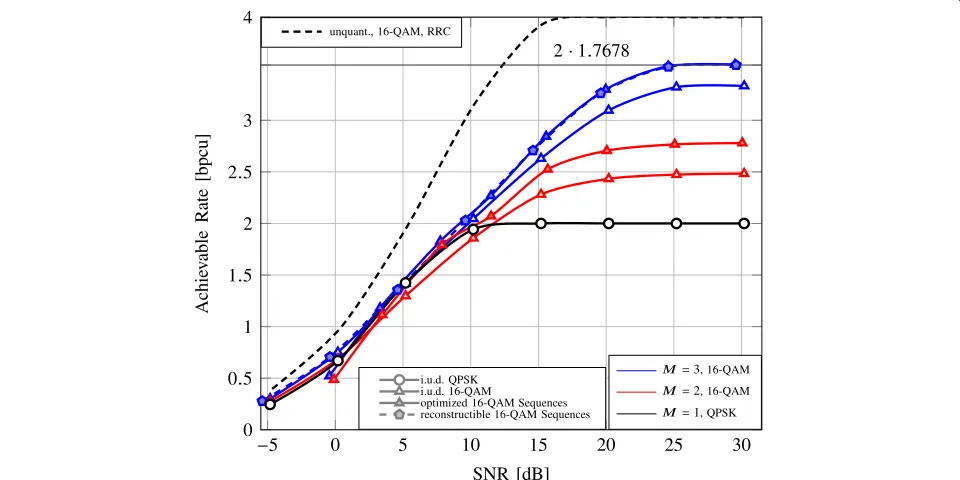
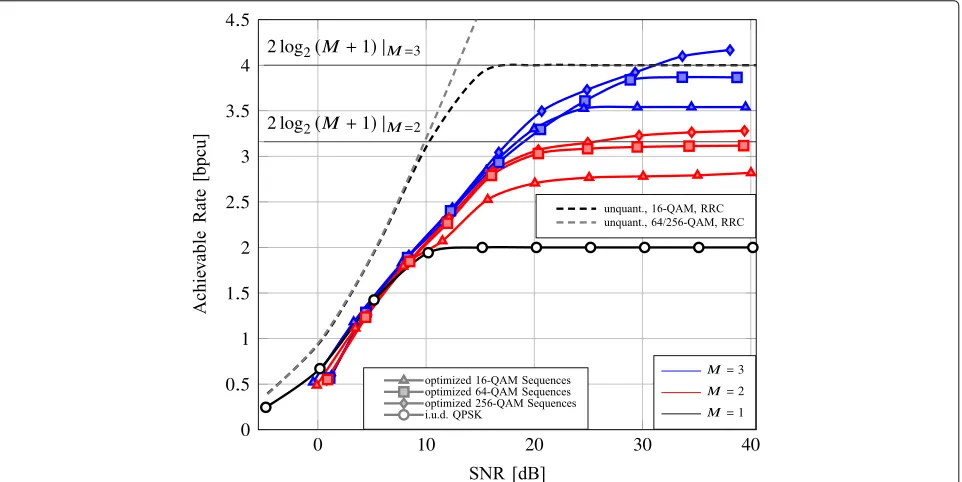
Based on the lower bound on the achievable rate in (10), Fig. 9 shows that the use of a higher order transmit symbol alphabet, namely 16-QAM, is beneficial. While with 1-bit quantization and without oversampling just 2 bits per channel use can be achieved (1 bit in the real and 1 bit in the imaginary component), with an increas-ing oversamplincreas-ing factorMthe achievable rate increases. Moreover, it is illustrated that a sophisticated sequence design can further improve the achievable rate signifi-cantly compared to i.u.d. input symbols. In this regard, it is shown that the proposed method to model recon-structible sequences (Section 4), which is described for
M=3, achieves an achievable rate fairly close to the opti-mized sequences (Section6). With the approach based on reconstructible sequences, the achievable rate approaches the input entropy rate of 2·1.7678[bpcu], cf. Table1, in the high SNR regime, where the factor 2 is due to the use of a complex modulation. The corresponding PSDs are shown in Fig.10. Note that the sequence optimiza-tion depends on the SNR and that the illustrated spectra consider high SNR (30 dB). Figure 11 shows that the achievable rate can be further increased by utilizing even larger modulation alphabets, e.g., 64-QAM or 256-QAM. In this regard, note that the achievable rate for a 256-QAM alphabet is larger than 2 log2(M+1), forM = 2 and M = 3.11 This is remarkable, because it is higher than the upper limit for the noiseless channel without receive filter described inAppendixD. We explain this by the circumstance that with the receive filter the system impulse response is enlarged, such that new signal evolu-tions are enabled, leading to more zero-crossing patterns. This is in line with the data processing lemma because the subsequent quantization is a suboptimal processing step. Moreover, it is also remarkable, because 2 log2(M+1)is the maximum achievable rate for flash ADC based sam-pling withMcomparators. For 64-QAM and 256-QAM, the achievable rate is lower-bounded by the utilization of a simplifying auxiliary channel model with N = 0. The sequence optimization only considers a peak power constraint and no bandwidth constraint. Because of this and the circumstance that our SNR definition involves the bandwidth, we expect that at low SNR the actual capacity is higher than that computed with our approach.
Fig. 6Power spectral density for different transmit pulses
The spectral efficiency as defined in (33) is shown in Fig.12. It can be observed that the spectral efficiency of i.u.d. input sequences might be higher than with opti-mized input sequences (Section6) or with reconstructible sequences designed according to the approach presented in Section 4. This effect happens as we do not con-sider any spectral shaping during the sequence design approaches besides the choice of the pulse shape. In this regard, the bandwidth depends on the sequence design
and the spectral efficiency can decrease. However, as the oversampling factor inversely scales with the bandwidth, the sequence design is still superior in comparison to sequences of i.u.d. symbols, as we will point out in detail in Section7.5.
7.3 PSK
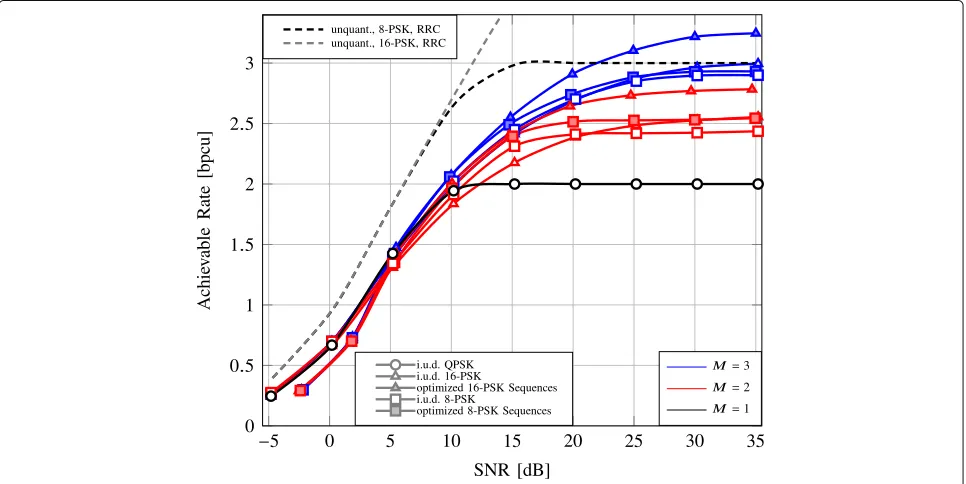
Figure13shows the lower bound on the achievable rate in (10) for PSK symbol alphabets and 1-bit quantization
Fig. 8The spectral efficiency w.r.t.B95%for different transmit pulses
and oversampling at the receiver. The PSK input alphabet deserves special attention because the corresponding transmit signal has a relatively low peak to average power ratio, which is favorable in terms of linearity require-ments of the transmit power amplifier. The case of 8-PSK modulation is remarkable, because at high SNR, the maximum input entropy of 3 bpcu is almost achievable withM=3.
Unlike as for QAM, due to the constant modulus trans-mit symbols, the average transtrans-mit power is not strongly influenced by the applied sequence optimization strategy. However, as discussed for QAM modulation, the nominal bandwidth depends on the PSD of the transmit signal and, thus, on the applied Markov source which describes the transmit symbol sequences. Thus, the SNR in (35) depends on the chosen sequence design, which explains
Fig. 10Power spectral density for different sequence designs based on cosine transmit pulses
the slight horizontal shift of corresponding markers in Fig.13.
The corresponding spectral efficiency (B90%) is shown in Fig.14. In some exceptional cases i.u.d. channel input symbols yield a higher spectral efficiency in comparison to the optimized sequences design. As explained in Section 7.2, in these cases sequence optimization
(Section 6) yields an increased bandwidth implying a reduced effective oversampling factor Moversampling. The relation between the effective oversampling factor and the spectral efficiency is evaluated later in Section 7.5. Comparing 16-PSK and 16-QAM in terms of the spectral efficiency, it can be observed that 16-QAM is superior for M=2 andM=3.
Fig. 12Spectral efficiency (B90%) versus SNR considering QAM transmit symbols
7.4 Faster-than-Nyquist signaling
In the following, we evaluate the achievable rate with FTN signaling, i.e., MTx > 1, on the one hand for RLL sequences as discussed in Section5and on the other hand also for transmit sequences with i.u.d. symbols and for optimized sequences (Section6) with QPSK and 16-QAM input alphabets. Here, we choose an equal signaling and sampling rate, i.e.,M=1.
Regarding the auxiliary channel law utilized for lower-bounding the achievable rate, the maximum can be practically approached by considering N = ξ = MTx. However, we have considered memories ofN =1 orN= 0, not necessarilyN = MTx, to limit the computational complexity.
In Fig.15, based on (10), lower bounds on the achiev-able rate per channel use are shown, where a channel use
Fig. 14Spectral efficiency (B90%) versus SNR considering PSK transmit symbols
corresponds to a transmit symbol duration Ts
MTx. In gen-eral, it can be observed that the achievable rate decreases with an increasing compression factorMTx. This behavior is a consequence of the fact that the duration of one chan-nel use is scaled down withMTx. In this regard, the benefit of FTN is not reflected in Fig.15. However, Fig.15allows a comparison of the achievable rate with different sequence design approaches for an equalMTx.
Figure15confirms that the maximum achievable rate for RLL sequences, cf. Table2, can be achieved. For a RLL sequence withd=1 andMTx=3, we have observed that the achievable rate does not approach the source entropy rate when using the receive filter in (2) (not shown in Fig. 15). For this special case, we choose a receive filter with a shorter impulse response
g(t)=
MTx
Ts , 0≤t< Ts MTx
0, else, (39)
which corresponds to a larger receive bandwidth. In the figures, we refer to this exception by the notation wide-band Rx. In this case, the achievable rate converges to the source entropy rate. However, due to the larger bandwidth of the receive filter, more noise is captured such that the achievable rate saturates at higher SNR.
Moreover, it can be observed that the optimized sequences (Section6) yield a slightly larger achievable rate than RLL sequences. Compared to the RLL sequences, the
sequence optimization strategy has more degrees of free-dom for the construction of zero-crossings. Surprisingly, MTx =3 yields an even larger achievable rate in the high SNR as compared toMTx =2, which is counter intuitive. On one hand, increasing the signaling rate implies a rela-tive expansion of the system impulse response w.r.t. Ts
MTx which in our case strongly attenuates fast signal transi-tions. This is why at low SNR,MTx =2 holds a benefit in the achievable rate w.r.t. to a channel use in comparison to MTx = 3. At high SNR, utilization ofMTx = 3 can effec-tively exploit more bandwidth for communication. This is possible due to the fact that the considered transmit pulse is not strictly bandlimited. Finally, the expansion of the system impulse response provides more degrees of free-dom which is in general favorable for the construction of zero-crossings.
In addition, a 16-QAM alphabet has been considered for sequence optimization (Section6) withMTx=2. Due to the additional degrees of freedom, this approach shows a much better performance in terms of achievable rate compared to the other waveforms withMTx=2.
Fig. 15Achievable rate with FTN signaling,M=1, a channel use corresponds to time interval Ts MTx
system impulse response of length (L + 1) = 3, 5, and 6, respectively.
The PSDs of the different sequence designs are shown in Fig.16. The consideration of runlength-limited sequences implies that the signal energy is concentrated at lower frequencies. To show the benefits of FTN signaling, we evaluate its performance in terms of the spec-tral efficiency (B90%) in Fig. 17. This presentation also enables a fair comparison for different compression fac-tors MTx, as the achievable rate is normalized with respect to the 90% power containment bandwidth. In Fig.17, it can be observed that with increasingMTx and, hence, also equally increasing sampling rate, the spec-tral efficiency significantly increases for all approaches for the transmit symbol sequence generation. Moreover, Fig. 17 shows that for a given MTx, RLL sequences show a superior performance in comparison to the other approaches in terms of spectral efficiency. This holds even in comparison to the case where the large 16-QAM modulation alphabet is used. The additionally required transmit power in comparison to the unquan-tized FTN is less than 4 dB when operating at an SNR below 15 dB.
Moreover, by the comparison of Figs. 17 and 12, we make the important observation that the communication based on the FTN signaling scheme requires a signifi-cantly lower SNR. This can be explained by the fact that the transmit filter h(t) in (36) is not strictly bandlim-ited. In this regard, the spectral copies at a signaling rate
of T1
s when MTx = 1 implicitly restrict the sequence
design which cannot be compensated by a large input alphabet. The faster signaling rate offers more degrees of freedom for the sequence design at higher frequencies. However, in a scenario with strict bandlimitation [23], e.g., by considering Nyquist pulses, this effect vanishes.
7.5 Relation of the spectral efficiency and the oversampling factor in the high SNR limit
Fig. 16Power spectral density for different FTN sequence designs
over noisy channels with 1-bit quantization at the receiver [5–7] which indicates only moderate benefits from over-sampling, the proposed communication schemes show a clear advantage of oversampling in terms of the spectral efficiency. The results are also comparable with the recent results which are based on strictly bandlimited channels with RRC filtering [23]. Moreover, the proposed methods
are compared to the maximum achievable rate for systems with a standard flash ADC with Nyquist rate sampling at the receiver with the same number of comparator opera-tions per time interval. For a strictly bandlimited channel, its achievable rate is given by 2 log2Moversampling+1, which we normalize w.r.t. the power containment band-width based on a frequency flat spectrum. Some of the
Fig. 18Spectral efficiency (B90%) versus effective oversampling factor (B90%) in the high SNR limit; for FTN (MTx>1), it holds thatM=1
approaches given in the present work are comparable and even superior in terms of achievable rate in comparison to the flash ADC approach and the analytical results on the noiseless channel given in [3]. Note that pipelined ADCs require less comparators in comparison to the flash ADCs. However, because of the additional inter-stage processing in pipelined ADCs, a comparison is not straightforward.
8 Conclusions
We have studied the achievable rate for an additive Gaus-sian noise channel with 1-bit output quantization and oversampling at the receiver, which is promising in terms of a simplification of circuitry and a reduction of the energy consumption at the receiver. As the transmit signal is not strictly bandlimited, we have considered power con-tainment bandwidth criteria with 90% and alternatively 95% power containment. The transmit sequences are con-structed based on various QAM and PSK input symbol alphabets and various signaling rates. Concrete sequence designs, namely reconstructible 4-ASK (and with this 16-QAM) sequences and runlength-limited sequences for faster-than-Nyquist signaling rates, are proposed. Fur-thermore, a sequence optimization strategy is studied which approaches the Markov capacity in the high SNR regime. The performance is evaluated in terms of the achievable rate and the spectral efficiency. We have observed that the proposed approaches outperform the existing methods on communication with 1-bit quanti-zation and oversampling at the receiver. For a number of methods, it has been shown that 1-bit quantization and oversampling at the receiver yields a comparable or even superior spectral efficiency than conventional ampli-tude quantization using a flash converter with the same number of comparator operations per time interval.
One key observation is that among the proposed meth-ods, the spectral efficiency is maximized by FTN sig-naling. This suggests that for the channel input signal, the resolution in time is preferable in comparison to the resolution in amplitude. However, it is known for the unquantized case that FTN exploits the excess bandwidth [33], such that it can be expected that the advantage of FTN vanishes for more strict spectral constraints, cf. [23]. In summary, the results show that the use of receivers with oversampled 1-bit quantization is promising. The proposed ideas are a first step to a more complete under-standing of the achievable rate and of an optimal trans-mit sequence design for such channels. Aspects like the robustness of these signaling schemes towards jitter and timing synchronization errors remain for further study. It is shown that the presented methods based on 1-bit quantization and oversampling at the receiver require only 2−3 dB more transmit energy (at 5−10 dB SNR and 90% power containment bandwidth) in comparison to a
conventional communication system design with Nyquist sampling and high resolution in amplitude.
Endnotes
1A matched filter would also depend on the sequence
design, i.e., on the statistical dependencies of the individ-ual xk.
2Thus, the input symbols are not placed on the real and
imaginary axes which are the thresholds of the applied 1-bit quantizer.
3The system impulse response v(t) is normalized
implicitly, because it is considered that h(t) has unit energy normalization.
4The considered integrate-and-dump receiver is an
exceptional case, where the noise correlation can be per-fectly described on the sampling grid (D = 1), although there is no bandlimitation.
5For the computation, symmetries in the input
sequences can be exploited to reduce the number of integrations.
6The case of QAM sequences follows by using the
concept for the real as well as for the imaginary axis. 7The stationary distributionμican be computed based
onPi,j.
8In case of asymmetric spectra, it is considered that the
power of the out-of-band radiation is equally splitted into the frequency range towards f = ∞and the frequency range towardsf = −∞.
9This is true as long asL+N>L
srcholds, cf. the state definition in Sec.3.1.
10Note that the SNR definition contains the bandwidth,
which then yields a relatively low SNR for scenarios with hrect(t).
11We expect that for M > 3 a larger input
alpha-bet is required to obtain an achievable rate larger than 2 log2(M+1).
Appendix A
The system impulse response for reconstructible sequences
We consider a symmetric system impulse response rang-ing over 3Ts. With the parametersM= 3 andMTx = 1, the discrete system impulse response can be described by nine coefficients, by v = [v4,. . .,v0,. . .,v4]T. The out-put patterns displayed in the different states in Fig. 2
xk−1 and xk+2 are also considered. For the interference from xk−1 and xk+2, we assume a maximum amplitude and distinguish between positive and negative sign. For each transition type A. . .D, inequalities can be formu-lated which describe the signal shape according to the desired pattern at the output of the ADC (assuming no noise). Exploiting the symmetry of the impulse response
v, its coefficients have to fulfill the following inequali-ties to be able to apply the state representation in Fig.3:
BTconstr. i[v0,. . .,v4]T > 0, for i = {A,. . ., D}, where 0 denotes a column vector containing 8 zeros and where the
Bconstr. i express the state transition specific constraints and are given by
Bconstr. A=
which describe the combinations of the input sym-bols. Note that some of the constraints are redun-dant. Moreover, symmetries have been exploited. Besides the illustrated triangular waveform with [v0,. . .,v4] = [1, 0.666, 0.333, 0, 0], the waveform with the transmit pulse given in (36) jointly with the assumptions on the receive filter in Section 2 corresponding to the coefficients [v0,. . .,v4] = [0.9449, 0.759, 0.387, 0.1037, 0.0042] fulfills these constraints.
Appendix B
Reconstructable 4-ASK sequences with finite memory
The system model introduced in Section2relies on chan-nel input sequences defined by a Markov process where
the states correspond to sk = xkk−Lscr+1, i.e., the source has finite memory. Differently, in the state machine in Fig. 3, a channel input symbol depends on an infinite number of previous channel input symbols. Thus, we will modify the state machine such that an output sym-bol just depends on a finite number ofLscr past output symbols. For this purpose, we exclude the state transi-tion from B* to B* in the state machine in Fig. 3. The loss in terms of the source entropy rate can be compen-sated by introducing further states like B**, B***, etc. This implies that the process returns to state A after passing state D with a maximum number of transitions which can be easily translated into the state representation used for Markov sources in this work. The dashed boxes in Fig. 20 show the state machines for reconstructible sequences for Lscr=1,. . ., 4. The corresponding adjacency matrices are given by
A lower bound based on the auxiliary channel law (reverse)
I(sk;yn|sk−1)−IW(sk;yn|sk−1)
=
skk−1,yn
P skk−1,yn
.
log2
+
Psk,yn|sk−1
Psk|sk−1Pyn|s k−1
,
−log2
+
W(sk|yn,sk−1) Psk|sk−1
,/
=
skk−1,yn
P skk−1,yn
log2
+
Psk,yn|sk−1
W(sk|yn,sk−1)Pyn|sk−1
,
=
sk Psk−1
DPsk,yn|sk−1
Wsk|yn,sk−1
×Pyn|sk−1
≥0,
(45)
whereD(··)is the Kullback-Leibler divergence [35] which is always non-negative [36, Th. 8.6.1].
Appendix D
Upper-bounding the capacity of the noiseless channel without receive filter
We consider a special case with the transmit pulseh(t)= hcos(t), a receive filter with g(t) = δ(t) and n(t) = 0, such that the input signal of the ADC is x(t), which is a weighted sum of time shifted transmit pulsesh(t). We consider a conventional signaling rate withMTx =1 such that the transmit signal is denoted by
x(t)= n
k=1
xk·h(t−k·Ts). (46)
With this, the signal in a time interval of two consecutive symbols xk−1and xkis given by
x(kTs+τ)=
which describes a raised or lowered cosine function in the interval with the running time variableτ. Its frequency is such that x(t)has at max one zero-crossing per time inter-valkTs ≤τ < (k+1)Ts. Now, we consider that this signal is quantized with 1-bit and sampling rateTM
s. The fact that there is at most one zero-crossing in the time intervalTs implies that the maximum output entropy and with this also the capacity are upper-bounded by 2 log2(M+ 1), where the factor 2 accounts for the complex equivalent.
Acknowledgements
We thank the referees for very useful comments. Funding
This work has been supported in part by the German Research Foundation (DFG) within the Collaborative Research Center SFB 912 “Highly Adaptive Energy-Efficient Computing.”
Availability of data and materials Not applicable.
Authors’ contributions
All authors contributed to the conception and design of the study. LL drafted the manuscript and did the simulation work. All authors contributed to the interpretation of the results. MD reviewed and edited the manuscript and helped with the revisions. All authors read and approved the final manuscript. Competing interests
The authors declare that they have no competing interests. Publisher’s Note
Springer Nature remains neutral with regard to jurisdictional claims in published maps and institutional affiliations.
Author details
1Centro de Estudos em Telecomunicações, Pontifícia Universidade Católica do
Rio de Janeiro, CEP 22453-900, Rio de Janeiro, Brazil.2Vodafone Chair Mobile
Communications Systems and SFB 912 - HAEC, Technische Universität Dresden, 01062 Dresden, Germany.
Received: 24 August 2017 Accepted: 2 March 2018
References
1. J Singh, O Dabeer, U Madhow, On the limits of communication with low-precision analog-to-digital conversion at the receiver. IEEE Trans. Commun.57(12), 3629–3639 (2009)
2. EN Gilbert, Increased information rate by oversampling. IEEE Trans. Inf. Theory.39(6), 1973–1976 (1993)
3. S Shamai (Shitz), Information rates by oversampling the sign of a bandlimited process. IEEE Trans. Inf. Theory.40(4), 1230–1236 (1994) 4. T Koch, A Lapidoth, inProc. of the IEEE Convention of Electrical and
Electronics Engineers in Israel. Increased capacity per unit-cost by oversampling, (Eilat, 2010)
5. W Zhang, A general framework for transmission with transceiver distortion and some applications. IEEE Trans. Commun.60(2), 384–399 (2012) 6. S Krone, GP Fettweis, inProc. of the IEEE Sarnoff Symp. Capacity of
communications channels with 1-bit quantization and oversampling at the receiver, (Newark, 2012)
7. S Krone, GP Fettweis, inProc. of the IEEE International Symposium on Personal, Indoor, and Mobile Radio Communications. Communications with 1-bit quantization and oversampling at the receiver: benefiting from inter-symbol-interference, (Sydney, 2012)
8. JE Mazo, Faster-than-Nyquist signaling. Bell Syst. Tech. J.54(1), 1451–1462 (1975)
9. JB Anderson, F Rusek, V Öwall, Faster-than-Nyquist signaling. Proc. IEEE. 101(8), 1817–1830 (2013)
10. T Hälsig, L Landau, GP Fettweis, inProc. of the IEEE Vehicular Technology Conference (Spring). Information rates for faster-than-Nyquist signaling with 1-bit quantization and oversampling at the receiver, (Seoul, 2014) 11. L Landau, S Krone, GP Fettweis, inProc. of the International ITG Conference
on Systems, Communications and Coding. Intersymbol-interference design for maximum information rates with 1-bit quantization and oversampling at the receiver, (Munich, 2013)
12. A Mezghani, JA Nossek, inProc. IEEE Int. Symp. Inform. Theory (ISIT). On ultra-wideband MIMO systems with 1-bit quantized outputs:
performance analysis and input optimization, (Nice, 2007), pp. 1286–1289 13. A Mezghani, JA Nossek, inProc. IEEE Int. Symp. Inform. Theory (ISIT).
Capacity lower bound of MIMO channels with output quantization and correlated noise, (Cambridge, 2012), pp. 1732–1736
14. J Mo, RW Heath Jr, Capacity analysis of one-bit quantized MIMO systems with transmitter channel state information. IEEE Trans. Sign. Process. 63(20), 5498–5512 (2015)
15. A Gokceoglu, E Björnson, EG Larsson, M Valkama, inProc. IEEE Int. Conf. Commun. (ICC). Waveform design for massive MISO downlink with energy-efficient receivers adopting 1-bit ADCs, (Kuala Lumpur, 2016), pp. 1–7
16. A Gokceoglu, E Björnson, EG Larsson, M Valkama, Spatio-temporal waveform design for multi-user massive MIMO downlink with 1-bit receivers. IEEE J. Sel. Top. Signal Process.11(2), 347–362 (2016) 17. J Singh, U Madhow, Phase-quantized block noncoherent
communication. IEEE Trans. Commun.61(7), 2828–2839 (2013) 18. M Stein, S Theiler, JA Nossek, Overdemodulation for high-performance
receivers with low-resolution ADC. IEEE Wirel. Commun. Lett.4(2), 169–172 (2015)
19. G Zeitler, AC Singer, G Kramer, Low-precision A/D conversion for maximum information rate in channels with memory. IEEE Trans. Commun.60(9), 2511–2521 (2012)
20. L Landau, GP Fettweis, inProc. of the IEEE Int. Workshop on Signal Processing Advances in Wireless Communications. Information rates employing 1-bit quantization and oversampling, (Toronto, 2014) 21. J Chen, PH Siegel, Markov processes asymptotically achieve the capacity
of finite-state intersymbol interference channels. IEEE Trans. Inf. Theory. 54(3), 1295–1303 (2008)
22. A Kavcic, inProc. IEEE Glob. Comm. Conf. (GLOBECOM). On the capacity of Markov sources over noisy channels. vol .5, (San Antonio, 2001), pp. 2997–3001
23. L Landau, M Dörpinghaus, GP Fettweis, 1-Bit quantization and oversampling at the receiver: communication over bandlimited channels with noise. IEEE Commun. Lett.21(5), 1007–1010 (2017)
24. T Hälsig, L Landau, GP Fettweis, inProc. of the IEEE Vehicular Technology Conference (Fall). Spectral efficient communications employing 1-bit quantization and oversampling at the receiver, (Vancouver, 2014) 25. G Singh, L Landau, GP Fettweis, inProc. of the International ITG Conference
on Systems, Communications and Coding. Finite length reconstructible ask-sequences received with 1-bit quantization and oversampling, (Hamburg, 2015)
26. HD Pfister, JB Soriaga, PH Siegel, inProc. IEEE Glob. Comm. Conf. (GLOBECOM). On the achievable information rates of finite state ISI channels, (San Antonio, 2001)
27. D Arnold, HA Loeliger, inProc. IEEE Int. Conf. Commun. (ICC). On the information rate of binary-input channels with memory. vol. 9, (Helsinki, 2001), pp. 2692–26959
28. Z Zhang, TM Duman, EM Kurtas, Information rates of binary-input intersymbol interference channels with signal-dependent media noise. IEEE Trans. Magn.39(1), 599–607 (2003)
29. DM Arnold, H-A Loeliger, PO Vontobel, A Kavcic, W Zeng,
Simulation-based computation of information rates for channels with memory. IEEE Trans. Inf. Theory.52(8), 3498–3508 (2006)
30. L Bahl, J Cocke, F Jelinek, J Raviv, Optimal decoding of linear codes for minimizing symbol error rate (corresp.) IEEE Trans. Inf. Theory.20(2), 284–287 (1974)
32. KA Schouhamer Immink, Runlength-limited sequences. Proc. IEEE.78(11), 1745–1759 (1990)
33. F Rusek, JB Anderson, Constrained capacities for faster-than-Nyquist signaling. IEEE Trans. Inf. Theory.55(2), 764–775 (2009)
34. L Landau, M Dörpinghaus, GP Fettweis, inProc. of the IEEE Int. Conf. on Ubiquitous Wireless Broadband. Communications employing 1-bit quantization and oversampling at the receiver: faster-than-Nyquist signaling and sequence design, (Montreal, 2015)
35. S Kullback, RA Leibler, On information and sufficiency. Ann. Math. Statist. 22(1), 79–86 (1951)
36. TM Cover, JA Thomas,Elements of Information Theory, 2nd edn.