R E S E A R C H
Open Access
Population-adaptive differential
evolution-based power allocation algorithm
for cognitive radio networks
Xiu Zhang
1,2and Xin Zhang
1,2*Abstract
Cognitive radio (CR) networks have drawn great attention in wireless communication fields. Efficient and reliable communication is a must to provide good services and assure a high-quality life for human beings. Resource allocation is one of the key problems in information transmission of CR networks. This paper studies power allocation in cognitive multiple input and multiple output (MIMO) orthogonal frequency division multiplexing (OFDM) systems. Power allocation is modeled as a minimization problem with three practical constraints. To deal with the problem, a population-adaptive differential evolution (PADE) algorithm is proposed. All algorithmic parameters are adaptively controlled in PADE. In numerical experiment, three test cases are simulated to study the performance of the proposed algorithm. Particle swarm optimization, differential evolution (DE), an adaptive DE, and artificial bee colony algorithms are taken as baseline. The results show that PADE presents the best performance among all test algorithms over all test cases. The proposed PADE algorithm can also be used to tackle other resource allocation problems.
Keywords: Cognitive radio networks, Differential evolution, Power allocation, Resource allocation, Parameter control
1 Introduction
In radar networks [1–3], power allocation is important to ensure the quality of services (QoS) under the limited power resources. In [1], the power allocation and sen-sor selection scheme in radar networks was studied based on opportunistic sensing. In [4], knowledge-based radar sensor network was studied to improve threat assess-ment based on different antecedents where higher power was allocated for suspicious scenario. Waveform design and diversity in radar networks to maximize the receiv-ing power was studied in [5]. Similarly, power allocation could be applied to cognitive radio networks to increase spectrum efficiency without losing QoS.
With the development of wireless communication tech-niques, advanced radio interface technology and code modulation mode provide good support for utilizing radio-wave spectrum. However, recent study reports reveal that radio-wave spectrum becomes scarce resource
*Correspondence: [email protected]
1College of Electronic and Communication Engineering, Tianjin Normal
University, Tianjin, China
2Tianjin Key Laboratory of Wireless Mobile Communications and Power
Transmission, Tianjin Normal University, Tianjin, China
with the sharp increase of mobile users and services. On the other hand, researchers observe that the allocated spectrum resources were not fully used and the utilization ratio is usually between 15 and 85 % [6]. The imbal-ance problem of spectrum utilization becomes more and more prominent. For example, some unauthorized fre-quency bands are often crowded and congested, while some authorized frequency bands are often in idle sta-tus. Thus, how to effectively enhance the utilization ratio of radio-wave spectrum becomes a tough problem in the next-generation wireless communication.
Cognitive radio (CR) technology is invented to realize dynamically the share of spectrum resources. It is able to lower the utilization ratio problem and generates a new era of spectrum allocation. Many researchers have studied CR networks and typical techniques are as follows:
(1) Spectrum pooling system was proposed by Jondral et al. [7]. It is a centralized network architecture based on orthogonal frequency division multiplexing (OFDM). Its suitable scenarios include spectrum share in OFDM wireless local area network (WLAN) and global system for mobile communication (GSM)
network. The architecture involves both authorized and unauthorized users, in which unauthorized users could detect authorized users through sensors and send collected information to base station so that base station could periodically broadcast the usage conditions to all users.
(2) Zheng and his collaborators sponsored the Nautilus project [8]. It emphasizes the spectrum share in a distributed and cooperated manner. They provide three spectrum access patterns including
cooperation-based access, local bargaining
distributed access, and priori negotiation access. This project focuses on selecting optimal data transmission channel in the foundation of architecture.
(3) The next-generation (XG) project sponsored by defense advanced research projects agency of USA planned to provide a complete solution for dynamic spectrum access in order to realize dynamic spectrum access and share [9]. The network architecture of this project is divided to main network and XG network, where XG network supports heterogeneous.
It is observed that self-adaptive OFDM technology is capable to enhance spectrum efficiency and system trans-mission speed. CR system supported by self-adaptive OFDM technology is a must in next-generation mobile communication system. In the CR system, available fre-quency bands are usually discontinuous, while OFDM technology could flexibly combine or split available bands. This property promotes the usage of OFDM in power allocation in CR system. Given secondary users did not disturb the communication of main users, secondary users could opportunistically occupy available bands of main users. Based on the damping of every carrier channel, OFDM would reallocate the power energy assigned to each subcarrier. Thus, the utilization ratio of spectrum and system efficiency are improved, and the throughput capacity of secondary users can then be maximized.
To use spectrum resource more wisely and improve data transmission rate and reliability, dynamic resource allo-cation in OFDM-based CR systems is the key technique. Observe that computational intelligence algorithms have been successfully applied to deal with optimization prob-lems in wireless communication. This paper concentrates on tackling dynamic power allocation problem in OFDM-based CR systems. The allocation problem is optimized by evolutionary computing (EC) approaches. Moreover, a population-adaptive differential evolution algorithm is proposed to gain a better allocation solution than stan-dard EC approaches.
The organization of this paper is as follows: Section 2 reports the power allocation problem and related works. Section 3 gives three popular EC approaches and the proposed algorithm. Section 4 shows the numerical
simulation results and discussions. Section 5 concludes the paper.
2 Problem overview and related works
As above mentioned, dynamic power allocation is a key problem in CR networks. Specifically, when some fre-quency bands of main users are not in use or exist spectrum holes, OFDM-based CR systems have to wisely allocate transmitting power so that idle spectrum could be efficiently utilized. Existing allocation algorithms include water-filling algorithm [10], transmit power adaptation method [11], and linear programming relaxation method of integer programming [12]. Femenias et al. presented a unified framework for quality of service guaranteed cross-layer scheduling and resource allocation in orthogo-nal frequency division multiple access (OFDMA) wireless networks [13]; a new quasioptimal algorithm was pro-posed to handle allocation problem and simulation results demonstrated the goodness of the framework. Chen et al. studied adaptive resource allocation in downlink OFDM wireless systems by using a three-round subcarrier assign-ment step [14]. Wang et al. investigated the maximization of energy efficiency of CR networks under practical con-straints [15].
Recently, EC approaches are taken to assist to tackle resource allocation issue in CR networks. A novel genetic algorithm (GA) aided subchannel allocation method is proposed to maximize the system capacity [16]. Sharma and Anpalagan apply a differential evolution (DE) com-bined with multiobjective optimization algorithm to do resource allocation in OFDMA systems [17]; the pro-posed algorithm obtains high sum capacities compared with previous works. Xu et al. attempt to maximize the average weighted sum rate throughput for power and sub-carrier allocation problem [18]; particle swarm optimiza-tion (PSO) and support vector machine are combined to compute probabilistic interference constraint condition.
OFDM is helpful to exploit frequency domain and space domain resources.
System resource management in MIMO-OFDM is more flexible both in the third- and the fourth-generation mobile communication technology. This is crucial for resource allocation in slot times and frequency channels of multi-users. As to resource management in cogni-tive MIMO-OFDM, the combined technique is capable to allocate power and bit number in slot times and fre-quency channels based on the needs of main users and secondary users. In the next-generation mobile commu-nication system binding MIMO-OFDM techniques, the use of available wireless resource could be extended from one dimension to multidimension. Based on cross layer design after considering quality of service requirements of multi-users, the next-generation system would employ alterable code rate in transmitting end, multifold modula-tion system, variable power, and adaptable system channel bandwidth. It would adaptively manage complex wireless resource allocation through adding or removing of multi-ple sending and receiving antennas or various collections of antennas. Therefore, dynamic resource management of MIMO-OFDM is essential to enhance the system’s spectrum efficiency.
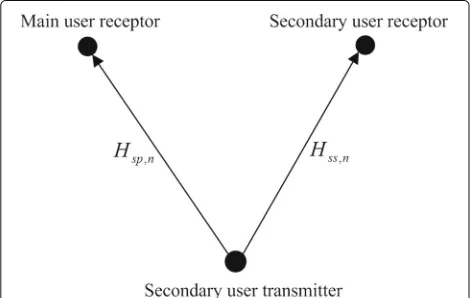
Currently, most researches focus on power allocation techniques in cognitive MIMO systems and cognitive OFDM systems, subcarrier division, and subcarrier power division. The target of these researches is to maximize the throughput of whole system. This article considers the minimization of total allocated power under the condition that it satisfies all requirements in MIMO-OFDM wireless communication system, which is detailed in the following. Figure 1 gives an example of cognitive MIMO-OFDM system. Suppose there is a receiving antenna in main user end, the number of transmitting antennas in sec-ondary users isMT, and these antennas are numbered in order {1, 2,. . .,MT}. The number of receiving antennas
Fig. 1An example of cognitive ratio system
in secondary users is MR with MR ≥ MT. The num-ber of subcarriers is denoted asN, hence all subcarriers are indexed in order {1, 2,. . .,N}. The minimum trans-mission rate of secondary user is denoted asRmin. The transmission power of secondary user over antenna m subcarriernis denoted aspm,n. DenoteHss,n as the fre-quency domain channel response of subcarrier n from secondary user’s transmitter to secondary user’s receptor, σ2is noise power, andBis the bandwidth of subcarrier. DenoteHsp,nas the channel gain of subcarriernfrom sec-ondary user’s transmitter to main user’s receptor, andImax is the maximum tolerable average interference power.
When the data information produced by secondary user’s transmitter passes through wireless communica-tion channel, it would interfere the signal recepcommunica-tion of main user. For subcarriern, the signal interferenceInthat impacts on main user’s receptor is
In= MT
m=1
Hsp,n2pm,n. (1)
As main user’s receptor is affected by any information transmission on subcarriers started from secondary user, the average interference power is expressed as
IAIP=
In CR networks, transmission rate of secondary user must be greater than a threshold to send information out. Also, the information transfer could not cause heavy impact to main users, which is assessed byIAIP. The target is to min-imize the transmission power of the secondary user. Thus, the system is modeled as
min
whereB is the subcarrier bandwidth andgss,m,n denotes equivalent channel gain of signal flowing on antenna m subcarrier n for secondary user. The minimum thresh-old requirement of secondary user’s transmission speed corresponds to the first constrained condition of (3). The second condition restricts the average interference power over all subcarriers caused by secondary user to main user. This assures that no severe disruption is imposed on main users. The last constraint requires that the power assigned to subcarriers must be non-negative, which is a physically meaningful constraint.
the transmission power of the secondary user is too low, this directly results in the decrease of channel capacity. Therefore, proper power allocation for the secondary user is very meaningful in CR networks.
3 Optimization algorithms
Power allocation techniques in CR systems can roughly be classified to equal power allocation methods and unequal power allocation ones. The former means each subcarrier is allowed the same power energy, which is very simple and commonly used in reality. Clearly, equal power allo-cation methods do not effectively exploit channel status and thus its resulting system performance is not satis-factory. Unequal power allocation could overcome this shortcoming and draw great attention in present research field. Water-filling algorithm is the most famous unequal power allocation methods. The finding of optimal water-filling factor is the essential work in water-water-filling algo-rithm. The near optimal factor could be obtained by line search methods, though the computational cost may rapidly grow in case line search method did work properly. Many researchers attempt to modify water-filling method to attain good solution.
EC approaches are applied to deal with problem (3) including PSO, DE, and artificial bee colony (ABC). PSO and ABC are typical swarm intelligence paradigms where the standard algorithms do not contain recombination operators. DE was not inspired from observation of natu-ral species. In fact, it was proposed based on the empirical experience of Storn and his collaborators [19]. DE con-sists of both mutation and recombination operators. So far, various operators have been proposed for the three paradigms [20–23].
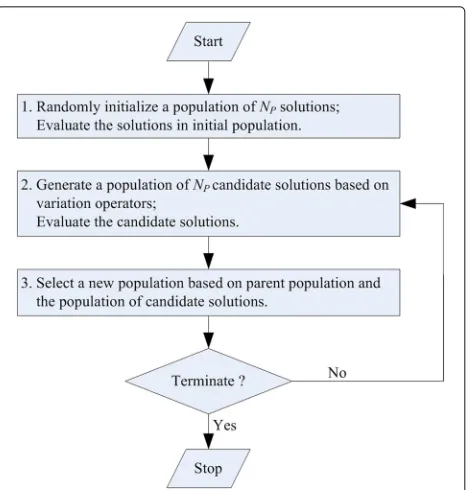
3.1 Three classical evolutionary computing algorithms
The paradigms of PSO, DE, and ABC can be expressed in Fig. 2, whereNpdenotes population size. EC algorithms start by a randomly created population in predefined search space. Then, some variation operators are in charge of modifying current solutions which is usually called par-ent solutions and their group called parpar-ent population. Variation in PSO is mainly comprised by a move velocity update as follows
xt+1=xt+vt+1, (4) wherevt+1is the particle move velocity and computed by
vt+1=wvt+c1r1
plt−xt
+c2r2 pgt−xt
, (5)
wherewis inertia weight factor,c1andc2are learning fac-tor,r1andr2are two randomly numbers between 0 and 1.
pltis the local best solution associated withxt, whilepgt is the global best solution of whole population.
Fig. 2Flow chart of evolutionary computing algorithms
The variation in DE contains both mutation and crossover operators. For mutation operator, randomly choose three solutions from current population, sayxr1,
xr2andxr3, wherer1=r2=r3=t.
vt+1=xr1+F·(xr2−xr3) (6) where F is scale factor which needs to be provided by users. For crossover operator, randomly choose an inte-ger k, where 1 ≤ k ≤ D(Dis the number of problem variables).
xt+1,j=
vt,j ifrand(0, 1)≤Crorj=k
xt,j otherwise ,j=1, 2,· · ·,D, (7)
whererand(0, 1)returns a randomly number∈ (0, 1);Cr is crossover rate which needs to be provided by users.
The variation in ABC is a one dimension mutation as follows
xt+1,j=
xt,j+φt,j1(xt,j−xr1,j) ifj=j1
xt,j otherwise ,j=1, 2,· · ·,D,
(8)
where φt,j1 ∈[−1, 1] is a random real number, andj1 ∈ [ 1,D] is a random integer.xr1has to be a different solution fromxt.
Survivor selection step of the three algorithms is quite similar. Candidate solutionxt+1competes with its parent
recorded so that it can be returned once the algorithm terminates.
3.2 Population-adaptive differential evolution algorithm
In the viewpoint of algorithmic parameters, PSO contains the largest number of parameters to be tuned by users than DE and ABC, while ABC has the least number of parameters (i.e., two parameters). Algorithmic parame-ter brings notorious impression to EC approaches since users have to think out how to set them before using the algorithms. Some parameters may be sensitive to the performance of the algorithm [24].
To alleviate the overhead of algorithmic parameter set-ting, a population-adaptive method is proposed for DE, which is called PADE algorithm. As suggested in [19], the initial population sizeNpinitis set to 4D(i.e.,Np=Npinit in the beginning). At each generation, the search status of the algorithm is monitored. If the best solution so far is improved at generation t, population size should not be changed as the population performs good in finding good solutions; otherwise, population size is reduced by size 2. When eliminating a solution from population, a binary tournament selection is used. That is randomly choosing two solution and the one with less fitness is discarded. In this way, the best solution so far always sur-vives in population. This progress continues untilNp=4. Observed from (6), the mutation of DE needs at least 4 solutions; hence,Npmust not be less than 4. OnceNp=4, population size starts to increase by size 2 under the con-dition that fitness is not improved at a generation. Two new solutions are randomly created in search space as in initialization. In the population size increase stage, a maximum threshold Npinit/2 is set based on empirical experience [25].
Moreover, scale factorFand crossover rateCr are also adapted in the PADE algorithm. Because problem (3) in CR networks needs to be resolved as soon as possible, a simple yet effectiveF andCr adaptation scheme is used [26]. Mathematically, the two parameters are calculated as follows pled random numbers,τ1andτ2are probabilities to adjust the control parameters,Fl =0.1 andFu=0.9 delimit the range ofFvalues∈[ 0.1, 1]. Brest et al. usedτ1=τ2=0.1 and named the adaptive algorithm as jDE. In this scheme, each solution is extended by two dimensions standing for F andCr. Then, both parameters are modified the same as candidate solutions. The main procedures of the PADE algorithm are given in Algorithm 1.
Algorithm 1Main procedures of the PADE algorithm
Require: f(·),D,,Np=Npinit,feval=0
Ensure: optimal solution found by the algorithm 1: randomly createNpsolutions,feval=feval+Np; 2: evaluate function values of initial solutions; 3: repeat
9: until mutation and crossover step finishes in a generation cycle
10: updateNpbased on the fitness improvement con-dition;
11: updateFandCrbased on (9) and (10); 12: untiltermination criteria are met
Observed from Algorithm 1, all algorithmic parame-ters are adapted. This saves the effort of users to set any parameter except their own optimization problem. Unlike the existing algorithms as in [27–29], the PADE algo-rithm does not introduce any new parameter and does not increase the burden of algorithmic parameter control.
4 Numerical experiment
In this section, the proposed PADE algorithm is applied to deal with problem (3).
4.1 Simulation setting
Simulation configuration is described as follows. Suppose the number of transmitter antennas of secondary user is MT = 4, the number of receptor antennas of secondary user isMR = 4, and main user has a receptor antenna. The number of subcarriers is 128, i.e.,N = 128. Noise power σ = 0.001; subcarrier interval is 1000 Hz. The channel gain noise ratio from secondary user’s transmit-ter to its receptor is 10 dB. The channel gain noise ratio from secondary user’s transmitter to main user’s receptor is 15 dB.
Given thresholdsRminandImax, the channel matrixHss,n of subcarrier n from transmitter of secondary user to receptor could be decomposed by singular value decom-position (SVD) method
Hss,n=UnDnVnH, (11) whereUnandVnare unitary matrix of sizeMR×MRand MT×MT, respectively.Dnis a diagonal matrix
Thus, the gain of separate subchannel flow over subcarrier n isgss,n =
g2ss,1,n,. . .,gss,MT,n2 . The total channel gain
over all subcarriers is g = gss,1,gss,2,. . .,gss,N. Hence, the objective function valuef could be computed given an allocationpm,n.
PSO, DE, ABC, jDE, and the proposed PADE algorithms are applied to tackle the above power allocation problem. The configurations of the test algorithms are shown in Table 1. Clearly, PADE algorithm contains the least algo-rithmic parameters among all test algorithms. Moreover, Npis related with problem dimensionD, which is auto-matically defined as the optimization problem is fixed by users. Thus, the proposed algorithm is a fully adaptive one compared with PSO, DE, ABC, and jDE.
Each algorithm terminates when either the following conditions is met:
(1) The maximum number of function evaluations (MFE) is reached, where MFE=1000;
(2)f(xbest)is stagnated for an interval of five, where f(xbest)stands for the best value found by an algorithm.
The CR system and algorithms are implemented in MATLAB and executed on a personal computer with 4-core 2.50 GHz CPU and 4 GB of memory. Thus, a fair comparison can be conducted under the same running environment.
4.2 Simulation results
Case 1:suppose in a CR system,Rmin = 150 Mbps and Imax = 8.0e−4 W, problem (3) is instantiated given the above configuration. The system is simulated 100 times to obtain an overall performance of each algorithm. The results are shown in Table 2. It can be seen that the proposed PADE algorithm attains the minimumf(xbest)
value among all test algorithms. So are the transmission rate of secondary user and tolerable average interfer-ence power impact on main user. In terms of function evaluations (FEs), PSO consumes less than the other algo-rithms; PADE is the second, which is close to that of PSO. Although PSO costs less FEs than PADE, it is outper-formed by PADE on other measurements. PADE and jDE use the sameFandCradaptation scheme, whereas PADE
Table 1Configuration of PSO, DE, ABC, jDE, and PADE algorithms
Algorithm Parameters
PSO Np=10 ,c1=c2=1.49,wmin=0.4,wmax=0.9,K=3
DE Np=10 ,F=0.5,Cr=0.9
ABC Np=4, limit=0.5NpD
jDE Np=10 ,Fl=0.1 ,Fu=0.9,τ
1=τ2=0.1
PADE Npinit=4D
Table 2Results found by the test algorithms withRmin=150 Mbps andImax=8.0e−4 W
Algorithm f xbest R I f
eval
PSO 1.7976 164.20 4.449e−04 105.52
DE 1.6108 151.81 3.998e−04 110.20
ABC 1.6112 151.76 3.889e−04 116.24
jDE 1.6173 153.60 3.9253e−04 130.00
PADE 1.5825 150.58 3.875e−04 106.26
Rmeans the transmission rate of secondary user,Iis the tolerable average interference power caused by secondary user to main user, andfevalis the function evaluations cost by an algorithm
costs fewer FEs than jDE and reaches smaller f(xbest)
than jDE. Thus, the PADE algorithm presents good per-formance compared with the four test algorithms in this case.
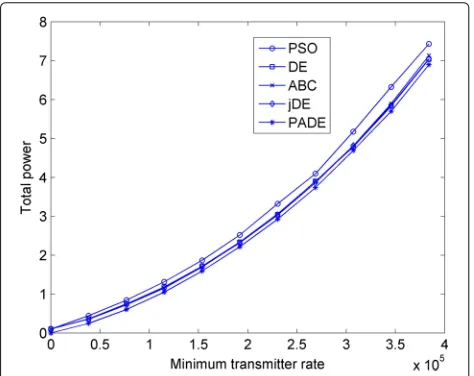
Case 2:supposeImaxis set to 2.0e−3 W,Rminequally increases from 0 to 375 Mbps with ten intervals. The total power allocated by each algorithm is shown in Fig. 3. Observed from the figure, the total power produced by each algorithm increases along with the increase of mini-mum transmission rateRmin. Among the test algorithms, PSO requires the greatest power energy; the total power associated with DE, ABC, and jDE is nearly the same as their curves almost coincides; PADE allocates the least power energy with all constraints satisfied.
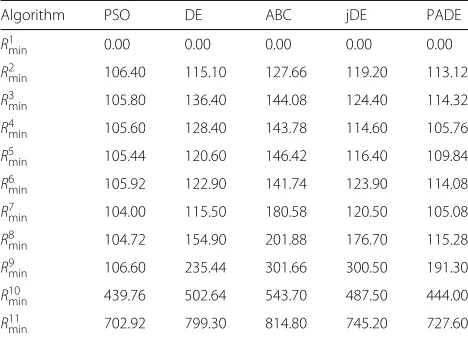
Table 3 gives the average number of FEs cost by the test algorithms to return a promising allocation solution. In this table, R1min, R2min, . . ., R11min are respectivelyRmin = 0, 37.5,. . ., 375 Mbps. Clearly, for each instance PSO costs the least FEs among the four algorithms, PADE is the sec-ond, followed by jDE, DE, and ABC. Although PSO saves
Table 3The average number of function evaluations cost by the test algorithms to deal with power allocation instances
Algorithm PSO DE ABC jDE PADE
R1
min 0.00 0.00 0.00 0.00 0.00
R2
min 106.40 115.10 127.66 119.20 113.12
R3
min 105.80 136.40 144.08 124.40 114.32
R4
min 105.60 128.40 143.78 114.60 105.76
R5
min 105.44 120.60 146.42 116.40 109.84
R6min 105.92 122.90 141.74 123.90 114.08
R7min 104.00 115.50 180.58 120.50 105.08
R8min 104.72 154.90 201.88 176.70 115.28
R9min 106.60 235.44 301.66 300.50 191.30
R10min 439.76 502.64 543.70 487.50 444.00
R11min 702.92 799.30 814.80 745.20 727.60
some FEs, the resulting allocation solutions are the worst as shown in Fig. 3. Overall, the proposed PADE algorithm performs better than PSO, DE, jDE, and ABC in this test case.
Case 3:supposeRminis set to 150 Mbps,Imax equally increases from 8.0e−4 W to 2.0e−3 W with six intervals. The total power allocated by each algorithm is shown in Fig. 4. It is observed from the figure, the curves of power consumed by each algorithm are roughly flat except the PSO algorithm. This indicates that PSO is less reliable than other algorithms. The power curve of ABC tends to raise up with the increase of maximum tolerable interfer-ence power. The power curve of PADE is the most smooth one, which means this algorithm is more reliable than oth-ers. Although the curve of jDE is also very smooth, it locates above the curve of PADE indicating that jDE has a
Fig. 4The total power needed by each algorithm for satisfying different interference powers under the condition that transmitter rate is fixed
greater total power consumption than PADE. Thus, PADE outperforms the other algorithms in this test case.
In case 3, the result comparison of FEs’ cost by each algorithm is similar to that in case 2. That is, PSO con-sumes the least FEs among the four algorithms, though its allocation solution is the worst; PADE costs less FEs than DE, ABC, and jDE; its solution is the best compared with PSO, DE, jDE, and ABC. Therefore, the above three cases demonstrate that the proposed PADE algorithm is very useful to tackle power allocation problems in cognitive MIMO-OFDM systems.
5 Conclusions
Efficient and robust communication networks require strong resource allocation schemes, especially for ad hoc networks or sensor networks in which power energy is rare and limited. Self-adaptive OFDM technology is capa-ble to enhance spectrum efficiency and system transmis-sion speed. Moreover, the combination of MIMO and OFDM is useful to exploit frequency domain and space domain resources. Hence, this paper focuses on power allocation in cognitive MIMO-OFDM systems.
Power allocation problem is formulated to a minimiza-tion under the condiminimiza-tions that a minimal speed bound is set for secondary user’s data transmission and a max-imal threshold is set to restrict the average interference power caused by secondary user to main user. Also, the power energy allocated on each subcarrier has to be non-negative.
The main contribution of this paper is to propose a population-adaptive differential evolution (PADE) algo-rithm for tackling power allocation problem. PADE is a fully adaptive algorithm and saves user efforts to set algo-rithmic parameters. Moreover, PSO, DE, jDE, and ABC are also taken as baseline in numerical experiments. Three test cases are illustrated to study the performance of the proposed algorithm. Based on the results, we can con-clude that the PADE algorithm is good at dealing with power allocation problems than PSO, DE, jDE, and ABC.
The same termination condition is used for all test algo-rithms for a fair comparison. In practical applications, users could revise the criterion based on their empiri-cal experience, computational time, or any other prior knowledge. The expected running time of PADE could be reduced by using more powerful mutation formula or by identifying search patterns in archive solutions, which we would investigate further in the future.
Acknowledgements
This research was supported in part by the Tianjin Thousand Youth Talents Plan Project of Tianjin Normal University (ZX110023), the National Science Foundation of China (61603275, 61601329), and the Applied Basic Research Program of Tianjin (15JCYBJC51500, 15JCYBJC52300).
Competing interests
Received: 14 July 2016 Accepted: 6 September 2016
References
1. Q Liang, X Cheng, S Huang, D Chen, Opportunistic sensing in wireless sensor networks: theory and applications. IEEE Trans. Comput.63(8), 2002–2010 (2014)
2. Q Liang, Radar sensor wireless channel modeling in foliage environment: UWB versus narrowband. IEEE Sensors J.11(6), 1448–1457 (2011) 3. Q Liang, Situation understanding based on heterogeneous sensor
networks and human-inspired favor weak fuzzy logic system. IEEE Syst. J. 5(2), 156–163 (2011)
4. Q Liang, X Cheng, KUPS: Knowledge-based ubiquitous and persistent sensor networks for threat assessment. IEEE Trans. Aerosp. Electron. Syst. 44(3), 1060–1069 (2008)
5. Q Liang, X Cheng, S Samn, NEW: Network-enabled electronic warfare for target recognition. IEEE Trans. Aerosp. Electron. Syst.46(2), 558–568 (2010) 6. NK Hoven, On the feasibility of cognitive radio. Master of science,
University of California, Berkeley (2005)
7. TA Weiss, FK Jondral, Spectrum pooling: an innovative strategy for the enhancement of spectrum efficiency. IEEE Commun. Mag.42(3), 8–14 (2004)
8. H Zheng, C Peng, inIEEE International Conference on Communications (ICC) 2005. Collaboration and fairness in opportunistic spectrum access, vol. 5 (IEEE, Coex, 2005), pp. 3132–3136
9. P Leaves, K Moessner, R Tafazolli, D Grandblaise, D Bourse, R ToNjes, M Breveglieri, Dynamic spectrum allocation in composite reconfigurable wireless networks. IEEE Commun. Mag.42(5), 72–81 (2004)
10. R Knopp, PA Humblet, inIEEE International Conference on Communications (ICC’95). Information capacity and power control in single-cell multiuser communications, vol. 1 (IEEE, Seattle, 1995), pp. 331–335
11. J Jang, KB Lee, Transmit power adaptation for multiuser OFDM systems. IEEE J. Sel. Areas Commun.21(2), 171–178 (2006)
12. I Kim, H Leem Lee, B Kim, YH Lee, Use of linear programming for dynamic subcarrier and bit allocation in multiuser OFDM. IEEE Trans. Veh. Technol. 55(4), 1195–1207 (2006)
13. G Femenias, B Danobeitia, F Riera-Palou, Unified approach to cross-layer scheduling and resource allocation in OFDMA wireless networks. EURASIP J. Wirel. Commun. Netw.2012(7), 1–19 (2012)
14. S Chen, Z Ren, B Hu, W Ma, Resource allocation in downlink OFDM wireless systems with user rate allowed regions. Wirel. Pers. Commun. 80(1), 429–445 (2015)
15. S Wang, W Shi, C Wang, Energy-efficient resource management in OFDM-based cognitive radio networks under channel uncertainty. IEEE Trans. Commun.63(9), 3092–3102 (2015)
16. N Sharma, AS Madhukumar, Genetic algorithm aided proportional fair resource allocation in multicast ofdm systems. IEEE Trans. Broadcast. 61(1), 16–29 (2015)
17. N Sharma, A Anpalagan, Differential evolution aided adaptive resource allocation in OFDMA systems with proportional rate constraints. Appl. Soft Comput.34, 39–50 (2015)
18. L Xu, J Wang, YP Li, Q Li, X Zhang, Resource allocation algorithm based on hybrid particle swarm optimization for multiuser cognitive OFDM network. Expert Syst. Appl.42(20), 7186–7194 (2015)
19. KV Price, RM Storn, JA Lampinen,Differential Evolution: A Practical Approach to Global Optimization. (Springer, New York, 2005). Natural Computing 20. AK Qin, VL Huang, PN Suganthan, Differential evolution algorithm with
strategy adaptation for global numerical optimization. IEEE Trans. Evol. Comput.13(2), 398–417 (2009)
21. Y Lou, J Li, Y Shi, in2011 IEEE Symposium on Differential Evolution (SDE). A Differential Evolution based on sorting and individual-sampling strategies (IEEE, Paris, 2011), pp. 33–40
22. X Zhang, SY Yuen, Improving artificial bee colony with one-position inheritance mechanism. Memet. Comput.5(3), 187–211 (2013) 23. X Zhang, X Zhang, SL Ho, WN Fu, A modification of artificial bee colony
algorithm applied to loudspeaker design problem. IEEE Trans. Magn. 50(2), 737–740 (2014)
24. SW Leung, SY Yuen, KC Chi, Parameter control system of evolutionary algorithm that is aided by the entire search history. Appl. Soft Comput. 12(9), 3063–3078 (2012)
25. X Zhang, X Zhang, A novel artificial bee colony algorithm for radar polyphase code and antenna array designs. EURASIP J. Wirel. Commun. Netw.2016(1), 40 (2016)
26. J Brest, S Greiner, B Boskovic, M Mernik, V Zumer, Self-adapting control parameters in differential evolution: a comparative study on numerical benchmark problems. IEEE Trans. Evol. Comput.10(6), 646–657 (2006) 27. J Zhang, AC Sanderson, JADE: Adaptive differential evolution with
optional external archive. IEEE Trans. Evol. Comput.13(5), 945–958 (2009) 28. ZH Zhan, J Zhang, O Liu, Orthogonal learning particle swarm
optimization. IEEE Trans. Evol. Comput.15(6), 1763–1764 (2011) 29. Q-K Pan, L Wang, J-Q Li, J-H Duan, A novel discrete artificial bee colony
algorithm for the hybrid flowshop scheduling problem with makespan minimisation. Omega.45, 42–56 (2014)
Submit your manuscript to a
journal and benefi t from:
7Convenient online submission
7Rigorous peer review
7Immediate publication on acceptance
7Open access: articles freely available online
7High visibility within the fi eld
7Retaining the copyright to your article