A
s
teroid
s
and the origin of life—two
s
tep
s
of chemical evolution on the
s
urface
of the
s
e object
s
M. B. Simakov
Group of Exobiology, Institute of Cytology RAS, Tikhoretsky Av., 4 St. Petersburg, 194064, Russia
(Received September 1, 2006; Revised November 19, 2007; Accepted November 23, 2007; Online published February 12, 2008)
It is now well-known that carbonaceous chondrites contain large quantities of prebioticmolecules, including amino acids, carbohydrates, and heterocyclic bases of nucleic acids. It has become evident that the chemical evolution proceeds under conditions of open space, which serves as a huge chemical reactor. The extraterrestrial origin of these prebioticmolecules has been established on the basis of diversity,molecular structure, and iso-topic composition. Themolecular composition of ameteorite’s organics resembles abiotic processes governed by physico-chemical processes that occurred on the parent bodies, including asteroids. The synthesis of soluble compounds in carbonaceous chondrites consists of amulti-step process in which organic precursors were formed in the interstellar cloud, incorporated withmany volatiles into icy planetesimals and, upon aqueous processing produced the variety of compounds which can formcomplexes under space energy sources. We show experim en-tally that the solidmixtures of biologically significant compounds (nucleosides and amino acids) producemore complex compounds when they are exposed to either vacuumUV photons or ionizing radiation.
Key words:Chemical evolution, abiogenic synthesis, amino acids, nucleotides.
1.
Introduction
It is well-known that carbonaceous chondrites contain large quantities of prebioticmolecules (Croninet al., 1988), including amino acids (Botta and Bada, 2002), carbohy-drates (Cooperet al., 2001), and heterocyclic bases of nu-cleic acids (Stocks and Schwartz, 1981). Chondrites con-tain amuch wider variety of amino acids than is normally found in terrestrial organisms, and their isotopic com posi-tion suggests space origin. The amino acids share a deu-terium enrichment found in other meteoritic organic ex-tracts, such as kerogen, strongly hinting at synthesis by pro-cesses operating in the interstellarmediumor the Solar neb-ula.
UV-radiation probably causes significant photochemistry within themixed-molecular ices found in space. This pro-cess has been simulated in the laboratory using high-tech gadgetry. By simulating the photochemistry of interstellar and cometary ices in the laboratory, we were able to pro-duce a host of organic compounds (i.e. compounds com -posed primarily of carbon, the kinds of molecules from
which we and all living things aremade). We suggest that this processmay be responsible for the richness of the or-ganics seen in the diffuse and dense interstellar medium, comets, andmeteorites.
Simple organic compounds were formed originally as products of low temperature reactions that occurred in the interstellarmolecular clouds, under radiation processing of astrophysical ices, and by gas-phase reactions in the
pri-mordial solar nebula (Fisher-Tropsch-type reactions), and
Copyright cThe Society of Geomagnetismand Earth, Planetary and Space Sci-ences (SGEPSS); The Seismological Society of Japan; The Volcanological Society of Japan; The Geodetic Society of Japan; The Japanese Society for Planetary Sci-ences; TERRAPUB.
they entered the parent bodies at the time of their accretion. Such reactions may have been involved in the production of interstellarmolecules, organic compounds inmeteorites, and prebiotic organicmatter on planets. The production of organic compounds on asteroids as parent bodies of them e-teoritesmay have been catalyzed by theminerals found on the surface of these bodies.
There aremany environments in space in which it is pos-sible to find solid bodies subjected to UV-irradiation and particle bombardment. McDonald et al. (1996) reported the production of a large diversity of organic compounds by experimental simulation. Alkanes, ketones, esters, and other complexmolecules have been detected by gas
chro-matography/mass spectrometry following the irradiation of the mixture H2O:CH3OH:CO2:C6H6 (80:16:3.2:0.8) with
heliumplasma. A wide variety of the initial amino acids were also found following the irradiation of an ice m ix-ture of propane (ormethane, or carbonmonoxide), amm o-nia, and water with 3 MeV protons. Dr. Kobayashi with co-workers identified such compounds as glycine (themost abundant), alanine and aminobutyric acid (Takahashiet al., 1999). Amino acids were formed fromcarbonmonoxide, nitrogen, and water, which are possible constituents of ex-traterrestrial atmospheres, following irradiation with high-energy particles (protons, heliumnuclei, and electrons, all components of cosmic rays). Glycine, aspartic acid, ser-ine, alanser-ine, threonser-ine, glutamic acid, aminobutyric acids, aminoisobutyric acid, valine, norvaline, sarcosine and pro-line were detected (Kobayashi et al., 1998). These com -pounds were identified after irradiation of different gasm ix-tures (CH4-N2-H2O; CO-NH3-H2O; CO-N2-H2O) by X-ray
(Takahashiet al., 1999) and visible-ultraviolet (VUV) irra-diation (Takahashiet al., 2005).
Among several energy sources available for abiogenic synthesis of biomolecules in space, UV-light with different wavelengths and cosmic rays are two of themost abundant. Some extraterrestrialmaterial exhibits strong evidence that irradiation by H and He ions is an important process on solids throughout the interstellar and interplanetarymedium
(Bradley, 1994). Strazzulla and Johnson (1991) dem on-strated the formation of non-volatile organic polymers from
proton-irradiated simulated cometary ices. The synthesis of simple oligopeptides (Gly-Trp and Gly-Tyr) froma solid
mixture of single amino acids under the action of vacuum
UV-radiation (λ <200 nm) was reported by Simakovet al. (1996). Kobayashiet al.(1995) showed that some amino acids, such as glycine and alanine, were detectable in hy-drolysates when amixture of simple inorganic compounds (CO, NH3 and H2O) was irradiated in a cryostat at 10 K
(simulated cometary ices) with high-energy protons. Our experiment indicates that oligopeptides are also produced from mixtures of amino acids irradiated with high-energy charged particles.
In order to simulate the process of chemical evolu-tion that takes place in the interstellar and interplanetary
medium, some experimentalmixtures have been placed into the space environment onboard the BION-type sputnik. The full range of the solar light spectrumand the primary com -ponents of cosmic rays are available in space at high den-sity. In contrast, the flux and energy range of light radia-tion are limited in laboratory exposure experiments on the ground. UV-light and cosmic rays can work together on or-ganic molecules in space, but it is difficult to apply these two energy sources together in laboratory. The scientific aim of this experiment was to expose simulated organic films to interstellar dust andmeteoritic (asteroid) surfaces. To this end, (1) the efficiency of abiotic synthesis of com -plex organic compounds, such as nucleotides and dipep-tides, fromnucleosides and simple amino acids deposited on grains was evaluated in a quantitativemanner; (2) the role of each energy source in this synthesis was assessed; (3) the role ofmineral surface on abiogenic synthesis was evaluated.
All young Solar systemobjects are subjected to energetic processing by photons and ions. As a result, the chemical and physical properties of the materials composing these objects will change significantly over time. Energetic pro-cessing of organic compounds into more complex species can be driven by a significantly enhanced UV-field in star-forming regions, high-energy particle bombardment, and UV-radiation fromthe T-Tauri phase in stellar birth; at the early stage of evolution and at the present, UV-radiation of different wavelengths, protons of the Solar wind, and flares can drive this process. The surviving remnants of the pop-ulation of planetesimals which filled the inner early Solar systemduring the late stages of collapsing solar nebula had a tremendous total surface, and the reactions of complex organic compounds could have taken place on the solid sur-face of those bodies. It is therefore important to test exper-imentally how far the process of chemical evolution could have taken place on the surface of space bodies under the action of energy sources available during that period and how it could take place at the present time.
Meteorites and other small bodies which orbit the Sun are presently exposed to high-energy particles in quantities large enough to produce ameasurable effect of abiogenic synthesis within a fewmillion years. At the present time, the Sun is the largest source of protons which impinge upon
meteorites or interplanetary dust grains (Sandstrom, 1965). Protons emanating fromthe Sun are divided into two princi-pal groups: solar-wind protons, with energies of a few keV and fluxes of roughly 1016particles/cm2per year, and
solar-flare protons, with energies ofmore than 0.5 MeV and aver-age fluxes of 1011particles/cm2per year. The third group of protons is those which have their source within the galaxy but outside the Solar system; these have average energies of about 1 GeV and average fluxes of about 108particles/cm2
per year. These particles do not normally enter into chem -ical reactions themselves, but they can produce at least ten secondary protons which could react chemically. Estimated fluxes of energy for ice processing environments are given in Colangeliet al.(2004).
The chemical evolution of the simple molecules would continue on the surface of these bodies under the action of the energy sources available in open space. Simple oligopeptides can be formed on solidmaterial not only by proton radiation as described here but also by vacuum UV-light, heat, andγ-radiation (Simakovet al., 1996). Thus, it can be assumed that the chemical evolution would have taken place during the early stage of the Solar systemorigin and reached the stage of polymerization before the end of planet accretion. Such complex biomolecules as oligopep-tides would have been brought onto the primordial Earth with comets, carbonaceous chondrites, and interplanetary dust particles (Chyba and Sagan, 1992). The next stage of evolution would be the origin of the first protoliving organ-isms.
Chondriticmaterial would have been a common com po-nent of the inner Solar systemshortly after its formation, and the biologically useful products of claymineral-organic
matter interactions would have also widespread and deliv-ered to planetary surfaces through the accretion of carbona-ceous asteroids. A large amount ofmeteoriticmaterial has undoubtedly showered the Earth through time. The organic compounds which have been delivered to the primordial Earth would have had a very complex structure and reached the second stage of chemical evolution-polymerization.
Meteorites, being remnants of asteroids, may have im -ported prebiotic elements to the early Earth which, when
mixed with liquid water, would have enabled the synthesis of allmolecules thought to be necessary for the origin of life.
2.
Experiment
s
abiogenic synthesis of dipeptides from mixtures of simple amino acids. The reactionmixture in the formof a solid film
contains (1) nucleoside and dihydrogen phosphate; (2) two different amino acids. Seven different nucleosides (thym i-dine, cytii-dine, uracil, adenosine or deoxyadenosine, guano-sine or deoxyguanoguano-sine) and four mixtures of aromatic (tyrosine or triptophan) and aliphatic (glycine or alanine) amino acids were investigated. Mixtures were irradiated as solid films with different sources of energy: (1) VUV-light of 145 nm; (2) high-energy protons (2–6 MeV); (3) the ac-tion of all spectra of the open space energy sources during the entire time of flight (327 h; an outstanding container was installed on the surface of biosputnik).
The thin solid films, which simulated the surface of such solar system bodies as comets, carbonaceous chondrites, and interplanetary dust particles, were irradiated with high-energy protons, which are the predominant components in cosmic ray, in order to verify the possibility of forming complex amino acids together with the formation oligopep-tides.
2.1 Abiogenicsynthesisof nucleotides
Nucleosides, nucleotides, phosphate, andmethanol were used as received fromcommercial available sources. All compounds were of the highest purity commercially avail-able. The investigated compounds were irradiated as solid thin films prepared by air drying an aqueous solution (300 mL) of an equimolar mixture of adenosine with in-organic phosphate (NaH2PO4). The area of the filmwas
∼1 cm2. The films contained 1.3 mM nucleoside and 1.3mM NaH2PO4. The H2PO4−ion was chosen as a source
of phosphate based on the results of Kuzichevaet al.(1993), which showed that the ability to phosphorylate decreases in the order H2PO4−>HPO42−PO43− but that the
pro-cess takes place in all cases. When the effect of a substrate was being studied, an aqueous solution of the reagents was added to 3 mg of mineral component and the suspension was dried as above. The followingminerals were used as a substrate: kaolinite (Al2)(Si2)O5(OH)4,montmorillonite
(Mx(Al2−xMgx)(Si4)O10(OH)2×nH2O), and ash from the
Tyatya volcano. Homoionic Na+montmorillonite was pre-pared by titration (Baninet al., 1985). The exchange capac-ity (CEC) of the cations Na+-montmorillonite used in this study was 92meq/100 g clay.
2.2 Abiogenicsynthesisof dipeptides
The investigated mixtures of amino acids were irradi-ated as solid thin films, which were prepared by air dry-ing an aliquot of aqueous or acetic solution of sdry-ingle amino acids, dipeptides or a mixture of different amino acids on a specially cutmicroscopic cover-glass (area∼1 cm2) and
set in a sample holder for irradiation. Such amino acids as glycine, alanine, tyrosine and tryptophan and dipep-tides as glycyl-glycine (Gly-Gly), tyrosyl-glycine (Tyr-Gly), glycyl-tyrosine (Gly-Tyr), tyrosyl-tyrosine (Tyr-Tyr), tryptophyl-tryptophan (Trp-Trp), glycyl-tryptophan (Gly-Trp), tryptophyl-glycine (Trp-Gly), alanyl-tryptophan Trp), tryptophyl-alanine (Trp-Ala) and alanyl-alanine (Ala-Ala) were investigated.
2.3 Irradiation
A lamp with a barrier discharge in Kr (145 nm), a MgF2
window, and a radiation power of 10 mW was used as
a source of VUV radiation. The quantumefficiency was about 1015quanta/cm2per second. The irradiation time was
1–9 h. The total doses, the incident energy per area, and the absorbed doses were virtually the same—1.5–14×107J/m2.
A low-pressure mercury lamp LB-30 (254 nm) with a radiation capacity of 6mW/cm2 or 8×10¹⁴quants/cm2per
second being absorbed by the sample and measured by a radiometer (UVX Digital Radiometer, USA) was used as a source of UV-radiation.
The films were irradiated with protons froma cyclotron U-120 of the Institute of Physics, St. Petersburg University. The beamof protons, with an initial energy of 6.75 MeV, was directed into a dispersion chamber with diameter about 1 mand then dissipated on a gold target with a thickness of 11.2mg/cm2. The irradiating samples were arranged in
dissipated beamof protons under angle 6◦. The energy of the protons acting on the reactionmixture was 6.6 MeV. In order to avoid a heat influence on the sample, themaximal flow did not exceed 3×10⁷protons/cm2 per second. Beam
intensities were monitored with a semiconductor detector which has a small diaphragm. The doses were 2×10⁹–
5×10¹¹protons/cm2. 2.4 Space experiments
The systemis an outstanding container (OC), which is a large pan with a deployable lid fixed to the exterior of a Rus-sian BION satellite. Closed and sealed during launch and reentry operations, the system is opened upon command during the Earth orbit. Before flight and after integration of the experiments, the systemwas flushed with nitrogen in order to protect the samples fromoxygen and humidity. The spacecraft was launched on December 24, 1996 and landed back on Earth on January 07. The duration of the flight was 13.5 days with a lid-opening time of 10 days. The orbit was not synchronous; it had a 225 kmperigee altitude and a 401 kmapogee altitude. The spacecraft eccentricity was 0.01239 and its inclination was 62.8◦. The lid-bearing ex-periments were not thermally controlled during the flight. The temperature in the cavities oscillated between−31◦C and+26◦C. The lid was programmed to close autom ati-cally at temperatures below−35◦C. The UV flux wasm ea-sured with a 260–400 nmspectral response UV-sensor (G36 14, Hamamatsu). After landing, vacuumwas maintained in BIOPAN until the instrument was vented with nitrogen. The samples were recovered 4 days after landing. During pre- and post flight operations, the experiments were pro-tected against light and humidity.
The reactionmixture in the formof a solid filmcontained 1.3 mM of nucleoside and 1.3 mM of NaH2PO4. Four
differentmixture samples, consisting of equimolar quanti-ties of nucleoside (thymidine, cytidine, adenosine, or de-oxyadenosine) and inorganic phosphate, were investigated. Mixtures were prepared by air drying of aqueous solutions on a piece of glass. The area of the filmwas∼1 cm2. The
3.
Analy
s
i
s
3.1 Nucleotides
Following the irradiation of the solid films, the resulting products were dissolved in water and analyzed on a Varian-5000 high performance liquid chromatograph (HPLC). The sample volume was 10mL. A reverse phase column (MZ-RP 18; 4×250 mm; particle size 10mm) was used, and a buffer solution of 0.05 M KH2PO4 containing 5% of
methanol was employed as themobile phase. The elution rate was 1mL/min, and the pressure in the column was ap-proximately 160 atm. Thismethod shows a good separation of different nucleotides. The products were identified by co-injection with authentic samples, and yields are expressed as amole % relative to reactants.
3.2 Dipeptides
Following irradiation, the resulting products were dis-solved in water and analyzed with Varian-5000 HPLC. A reverse phase column (MZ-RP 18; 4×250mm; 10mm) was used, and a 40% solution ofmethanol in 0.005 M amm o-niumacetate was employed. The elution rate was 1ml/min, the pressure in the column was approximately 160 atm, and the chromatographic sample volume was 10mL. For each run a solution of known concentration was used for calibra-tion. Product yields were measured fromelution profiles
monitored at 275 nm.
4.
Re
s
ult
s
and Di
s
cu
ss
ion
4.1 Polymerization of amino acidsThe reactions of the amino acids in solid films was the primary objective of this investigation—primarily, the abiogenic synthesis of dipeptides from mixtures of simple amino acids. Fourmixtures of aromatic (tyrosine or trypto-phan) and aliphatic (glycine or alanine) amino acids were investigated. These mixtures were prepared by air dry-ing aqueous solutions and irradiatdry-ing these with different sources of energy: (1) VUV-light of 145 nm; (2) UV-light of 254 nm; (3) high energy protons (2–6 MeV).
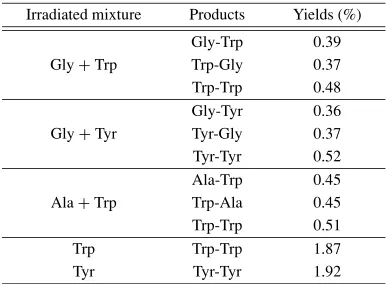
Films containing a mixture of amino acids have been shown to yield various oligopeptides after being exposed to VUV-radiation and protons (Simakovet al., 1996, 1997a). Such dipeptides as Trp-Trp, Trp-Gly, Gly-Trp, Ala-Trp, Trp-Ala, Tyr-Tyr, Tyr-Gly, and Gly-Tyr were detected as products of irradiation with summary yields of∼2% in the case of VUV-irradiation (Table 1) and∼2.5% for proton ir-radiation (Table 2).
When thin solid films of single amino acids—tyrosine or tryptophan—were irradiated with protons, dipeptides, such as tryptophyl-tryptophan and tyrosil-tyrosine, were found. The yields of dipeptides were 2.43% for Trp-Trp and 2.38% for Tyr-Tyr under amaximal dose of irradiation (5×10¹¹ protons/cm2). In the case of amixture consisting
of aromatic and aliphatic amino acids (tyrosine+glycine), the yields of synthetic reactions did not essential differ from
those for single amino acid. Dipeptides Gly-Tyr and Tyr-Gly were formed with the equal probability, together with Tyr-Tyr and, possibly, Gly-Gly. This last dipeptide was not found with themethod of analysis used in the present in-vestigation. The control experiments without irradiation did not yield any trace of oligopeptides.
These values suggest that dipeptide formation does not
Table 1. The abiogenic synthesis of dipeptides under action of VUV-radiation (dose 3×10⁶J/m2).
Irradiatedmixture Products Yields (%)
Gly-Trp 0.39
Gly+Trp Trp-Gly 0.37
Trp-Trp 0.48
Gly-Tyr 0.36
Gly+Tyr Tyr-Gly 0.37
Tyr-Tyr 0.52
Ala-Trp 0.45
Ala+Trp Trp-Ala 0.45
Trp-Trp 0.51
Trp Trp-Trp 1.87
Tyr Tyr-Tyr 1.92
Table 2. The abiogenic synthesis of dipeptides under action of protons (6.6 MeV).
Irradiatedmixture Products Yield (%) at doses protons/cm 2
2×10⁹ 8×10⁹ 500×109
Trp Trp-Trp 0.47 0.98 2.43
Tyr Tyr-Tyr 0.54 1.08 2.38
Gly-Trp 0.09 0.31 0.71
Trp+Gly Tyr-Gly 0.10 0.31 0.67
Tyr-Tyr 0.16 0.33 0.62
depend on the type of side chain residue. The super-excited state that is produced during the interaction of high-energy particles with amino acidsmay play amajor role in these processes. Free radicals are formed due to the collision of protons withmolecules, and these free radicals could react with each other.
The initial amino acids are able to undergo processes of destruction as well as the process of abiogenic synthesis of olygopeptides. Of the amino acids tested, glycine is the
most resistant to decomposition by UV-photons. The rate of decomposition for aromatic amino acids (tyrosine, tryp-tophan and phenylalanine) is significantly accelerated under these conditions,mostly due to the strong UV-absorption of the aromatic group (Orzechowskaet al., 2007).
Polymerization is an essential step in prebiological evo-lution, and the results reported here show that this process probably could take place even at an early stage of the Solar systemformation, before planet accretion, on the surface of small bodies.
4.2 Synthesisof nucleotides
VUV-irradiation of the mixture of nucleoside and in-organic phosphate resulted in the production of the nat-ural monophosphates of the corresponding nucleosides. The main products were nucleoside-5-monophosphates (5NMP) and some small amount of by-products (2- and 3
Table 3. The abiogenic synthesis of nucleotides under action of VUV-radiation (dose: 3×10⁶J/m2).
Nucleoside Nucleotide’s yield (%)
5 2 3 23c 35c Sum
Ado 0.36 0.21 0.20 0.20 traces 0.97
Guo 0.30 0.21 0.22 0.27 0.05 1.05
dAdo 0.13 — 0.15 — 0.02 0.30
dGuo 0.23 — 0.13 — traces 0.36
Urd 2.80 1.21 1.07 2.13 0.56 7.77
Cyd 3.75 1.32 1.67 2.46 0.86 9.46
dThd 2.59 — 2.00 — 0.84 5.43
Ado, adenosine; Guo, guanosine; dAdo, deoxyadenosine; dGuo, de-oxyguanosine; Urd, uridine; Cyt, cytidine; dThy, deoxythymidine.
Table 4. The abiogenic synthesis of nucleotides under space conditions.
Nucleoside Nucleotide yields (%)
5 2 3 23c 35c Sum
Ado 3.28 0.82 0.71 1.12 0.01 5.94
dAdo 1.87 — 0.48 — traces 2.35
Cyd 2.68 0.61 0.55 0.94 traces 4.78
dThd 1.70 — 0.36 — traces 2.06
driving action of VUV.
The dominant formation of 5-adenosinemonophosphate (5-AMP) indicates that the hydroxyl group in the 5 -position of the carbohydrate residue ismost reactive under these conditions. A similar regularity was also observed un-der the integral influence of extraterrestrial energy sources on dry films of nucleoside and inorganic phosphate.
The solid filmsmade ofmixtures of different nucleosides and inorganic phosphate were exposed to space conditions during the space flight experiment onboard the BION-11 satellite. The abiogenic synthesis of the full set of the natural nucleotides was observed, with yields of up to 6%.
After returning back to Earth the experimental films were dissolved in water and analyzed by HPLC. The abiogenic synthesis of nucleotides was observed. Such nucleotides as 5-, 3-, and 2-monophosphates of adenosine, deoxyadeno-sine, cytidine, and thymidine were detected together with cyclomonophosphates of these nucleosides.
In the case of purines and pyrimidines, themain prod-ucts of the reactions were 5-monophosphates of the corre-sponding nucleosides. The preference to 5-monophosphate formation is indicative of themore advantageous spatial po-sition of the 5-hydroxyl group in the carbohydrate residue in comparison with the 2- and 3-hydroxyl groups. The summary nucleotides yields were: for adenosine, 5.8%; for cytidine, 4.7%; for deoxyadenosine, 2.3%; for thymidine; 2.0%. The yield of products was calculated in relation to the initial amount of nucleoside.
The yield of phosphorylated nucleoside is dependent on the kind of sugarmoiety. Compounds which have ribose in its structure form5-nucleotides twofoldmore frequently than those with deoxyribose. For example, the yield of 5AMP was 3.23%, while for that 5dAMP was 1.87%. This result is related to the higher reaction capability of the ribose in the ribonucleosides. Purine nucleosides react slightly more easily than the pyrimidine ones. Thus, the
yield of 3AMP was 0.71% while that of 3CMP was 0.55%. In general, however, it can be concluded that the formation of nucleotides in the space environment does not depend significantly on the nature of the nucleic acid base.
The 2, 3-cyclomonophosphates were formed on the solid films under open space energy sources as well (if it was possible based on the structure of nucleo-sides). It is interesting to note that the yield of 2, 3 -cyclomonophosphates is more than those of 2- and 3
-monophosphates. There have been previous reports of an interaction between all three nucleotides under VUV-radiation (Kuzicheva et al., 1996; Simakovet al., 1997b) andγ-radiation (Kuzichevaet al., 1993). This possibility can be extended to the open space condition as well.
It is possible that the temperature variations (which were about 130◦C) on the satellite surface during its rotation also contribute noticeably to abiogenic synthesis. Despite the fact that UV-radiation is themost abundant energy source in space, the heat used in the ground experiments (Kuzicheva et al., 1992), is themost soft and plausible factor for the abiogenic synthesis of biochemical compounds. The ra-diation level was as much as 6 Gy (600 rad) per day and up to 80 Gy (8000 rad) per 15-daymission (depending on solar activity), and solar electromagnetic radiation was on the order of 40 solar constant hours permission. The to-tal dose of solar light (including UV) radiation during the pace mission was 1.83 (109 J/m2 at a UV-photon flow of
1.03×10²¹photons/cm2.
Both the destruction of the initial compounds as well as the synthesis of products were observed. The ribose residue was more resistant to the action of destructive influences than the deoxyribose residue. This was observed for both the purine as well as the pyrimidine nucleotides. This is confirmed by earlier received data for adenosine and de-oxyadenosine (Kuzichevaet al., 1996). On the other hand, the double ring of purine nucleotides ismore stable than the pyrimidine ring. During the flight time, 66% of the cytidine was destroyed, which is the maximal value of decom po-sition of all nucleosides. Adenosine was themost stable nucleotide in the open space environment, with 54% of the initial nucleoside surviving the flight time. Reactions in-volving the decomposition of the heterocyclic rings, cleav-age of the N-glycoside bond, and destruction of the sugar
moiety were observed in the investigatedmixtures. About 20% of each nucleoside was decomposed with a cleavage of the glycoside bond and the elimination of a free nu-cleic acid base. In such reactions, VUV-radiation at wave-lengths below 200 nmhas the greatest effect (Kuzichevaet al., 1996). UV-light at wavelengths of about 254 nmcould be observed to be a factor in the destruction of the hete-rocyclic rings. Broad spectrumUV-light fromthe Sun is the principal source of energy for the destruction of organic
molecules. In the ground experiments, quanta yields of nu-cleosides as a result of photochemical destruction have been found. For cytidine, these are 4×10⁻³ for VUV-radiation
and 4×10⁻⁵for UV (254 nm)-radiation.
formation, the destruction of the initial adenosine, such as depurination (base release) and decomposition of the base
moiety, alsomay take place.
The results of our laboratory experiments and
experi-ments in open space show thatmany kinds of energy were effective in the chemical evolution on the surface of aster-oids. Hydratedminerals are found within a chondritem a-trix ofmeteorites together with significant amounts of or-ganic matter. Clays are likely to have formed when wa-ter was presented on the parentmeteoritic bodies. In order to verify the existence of a relationship between the abio-genic synthesis of nucleotides and the inorganic com po-nents of themeteorites, possible abiogenic reactions in the presence of different clayminerals (montmorillonite, kaoli-nite) and the basaltic sample (Tjatja’s volcanic ash) were investigated in the presence of open space energy sources for modeling of different exobiological environments on the surface of small space bodies (Simakov and Kuzicheva, 2005). Claymineralsmay have concentrated organic com -pounds, thereby also promoting polymerization reactions. An adsorption/binding of nucleic acid components by clay crystals could change the electron distribution and/or the conformation of themolecules.
The irradiation of dry adenosine and inorganic phosphate films with VUV in the presence ofmineral substrates (kaoli-nite,montmorillonite, volcanic ash) produced 5-, 2-, and 3-adenosine phosphates along with cyclic products, such as 2, 3- and 3, 5-cycloadenosinemonophosphates. Under themaximal used irradiation dose (4×10⁵J/m2), the total yields of nucleotides were 5.96%, 5.55%, and 3.88% in the presence ofmontmorillonite, Tjatja’s ash, and kaolinite, re-spectively. In the absence of themineral substrate, the yield was 2.12%. The results clearly demonstrate that, depend-ing on themineral substrate used, increases in the yield of nucleotides can vary by 1.8–2.8 times. Kaolinite andm
ont-morillonite are clayminerals, whereas the Tjatja’s ash is compositionally very similar to terrestrial and extraterres-trial basalts (e.g. Martian soil).
The whole spectrumof natural nucleotides is present in the reaction products. Themaximal yield of themain prod-uct, 5AMP, was 3.48% after irradiation in the presence of
montmorillonite. The yield increased with increasing ir-radiation dose in the presence or absence of the mineral substrate. The second major reaction product was 2, 3 -cycloadenosinemonophosphate (2, 3cAMP). Themaximal yields were 0.33% without themineral substrate and 0.89% withmontmorillonite; i.e., themineral component increases the nucleotide yield as in the case of 5AMP synthesis. It is interesting to note the yield of 2, 3cAMP is greater than those of the 2- and 3-monophosphates, respectively.
The yields fromnucleoside decay are 11% (Tjatja), 13% (kaolinite), 15% (without themineral), and 18% (montm o-rillonite). Here we can see a shielding effect of the volcanic ash and catalytic effect of themontmorillonite. The clay facilitates the destruction of the initial adenosine.
In the case of using the mineral substrate, a maximal influence on the reaction yield is typical of the montm o-rillonite. This clay gave the highest yields, both in terms of nucleotide formation and adenosine destruction. The
mineral is composed of unitsmade up of two silica
tetra-hedral sheets and an alumina octahedral sheet. There are isomorphic substitutions in both tetrahedral and octahedral sheets, which result in charge deficiency. This charge de-ficiency is counterbalanced by themetal ions, called inter-layer cations or exchangeablemetal ions, held between the layers. In contemporary clays these aremainly Na+ and Ca2+. The hydration or dissolving of thesemetal ions
re-sult in the expansion of the layers (increase of the inter-layer distance), thereby permitting the entrance of organic
molecules into the interlayer. The isomorphic substitutions aremuch less in kaolinite than inmontmorillonite, result-ing in fewer numbers of interlayer cations and, therefore, less expansion and a shorter interlayer distance. This struc-ture can adsorb not only inorganic ions, but also organic
material. For example, 1 g of thismineral can absorb up to 5×10¹⁰ mol of adenine (El Amri et al., 2002). It is
precisely this property thatmakesmontmorillonite different fromkaolinite, another claymineral used in our experiment. Kaolinite possesses layers consisting of a 1:1 pair of octa-hedral and tetraocta-hedral sheets. The shorter distance between the layers prevents any accumulation of organicmolecules into the kaolinite. Consequently, nucleosidemolecules can be adsorbed only by its surface. The specific surface area of both clays is also different:montmorillonite has 78m2/g
and kaolinite, 8m2/g. The higher catalytic activity ofm
ont-morillonite, relative to kaolinite, has also been established by several other researchers studying the synthesis of abio-genic BSCs such as amino acids (Yushkin, 1999). Ash from
the Tjatja volcano represents an erupted silicate product with an extremely porous texture and various oxides of dif-ferent elements. The abiogenic synthesis of many organic compounds occurs precisely at the surface of ash particles in the ash-gas volcanic channels (Markhinin, 1980; Basiuk and Navarro-Gonzalez, 1996). On the other hand, thism ate-rial could serve as an analogue of Martian soil, and ash from
Hawaiian volcanoes is often used for such purpose (ten Kate et al., 2006).
When adenosine associates with the mineral substrate, its behavior depends on the properties of this material. Ash particles are almost nontransparent to VUV-radiation, whereas clayminerals are sufficiently permeable to VUV radiation (Boillot et al., 2002). The influence of mineral substrates on the abiogenic synthesis may depend on the followingmechanisms: (1) the protective function of the
mineral, which prevents the decay of both the initial com -ponents and newly formed reaction products; the screening effect of clays has been studied earlier (Bonneret al., 1984), and it has been found that the clays provided a significant protection against photolysis; (2) catalytic properties of the
space. The discovery that meteoritic organic compounds
may be trapped and protected within a claymineralmatrix has implications for our understanding of prebioticm olecu-lar evolution in the early Soolecu-lar system(Pearsonet al., 2002). Claymineralsmay have concentrated organic compounds, thereby also promoting polymerization reactions. This idea was first proposed by Bernal (1949). Organicmolecules can then enter the interlayer region and interact with the nega-tively charged basal surfaces ofmontmorillonite. The inter-action between the adsorbedmolecules and the clay surface
may be via simple electrostatic attraction, van der Waals forces, the formation of hydrogen bonding, or a com bina-tion of any two or three of the above. Adsorpbina-tion of the compounds in the interlayer brings themolecules into close proximity of each other. Furthermore, itmay orient them
into a favorable position, thereby enabling intermolecular interactions. An adsorption/binding of nucleic acids com -ponents by clay crystals could change the electron distribu-tion and/or the conformation of themolecules. The rem -nant watermolecules in the clay sheets could also influence the course of the reaction. In addition, an immobilization of phosphate on clay also could play an important role in our reaction (Goldberg and Sposito, 1985). Chondriticm a-terial would have been a common component of the inner Solar systemshortly after its formation and the biologically useful products of claymineral-organicmatter interactions would have also been widespread and ultimately delivered to planetary surfaces through the accretion of carbonaceous asteroids. Themineral components selected for substrates can serve as amodel for the surface ofminor bodies in the Solar.
5.
Exobiological Implication
s
The problemof the origins of life is a very intriguing question of contemporary science. Geological data indicate that complex photosynthetic organisms possibly related to cyanobacteria existed 3.5 billion years (Gyr) ago (Schopf, 1993). There is also evidence of biologicallymediated car-bon isotope fractionation in the 3.85 Gyr old Isuam etased-iments, which indicate that the photoautotrophy biochem i-cal processesmust have existed at that time (Mojzsiset al., 1996).
All Solar systemobjects, such as planets, satellites, rings, comets, asteroids,meteorites, and interplanetary dust parti-cles (IDPs), are subjected to energetic processing by dif-ferent kinds of open space energy. The study of the role of charged particles, UV-radiation of different wavelengths, and other energy sources in the abiogenic synthesis of bi-ologically significant compounds (BSCs) is closely related to exobiological investigations in the Earth’s orbit related to chemical evolution and the issue of the origin of life on Earth and throughout the Universe.
According to recent views, themajority of biologically significant compounds may have been introduced to the primeval Earth bymicrometeorites,meteorites, and comets (Chyba and Sagan, 1992). These cosmic objects contain large quantities of complex organic compounds, includ-ing carbohydrates, amino acids, and heterocyclic bases of nucleic acids (Cottin et al., 1999; Cooper et al., 2001; Botta and Bada, 2002). Evidently, the chemical
evolu-tion proceeds under condievolu-tions of open space, which serves as a huge chemical reactor. “Simulated space ice con-ditions” experiments have shown the synthesis of simple BSC in the formof the precursors of amino acids (Bern-stein et al., 2002; Munos Caro et al., 2002) and pyrim -idine bases (uracil, cytosine and thymine) of the nucleic acids (Kobayashiet al., 2004). The present investigation dealt with the subsequent reaction of the nucleic acid com -ponents to nucleotides, which are themain components of RNA and DNA. Abiogenic synthesis of nucleotides has been reported to take place under conditions of space flight (Kuzicheva and Simakov, 1999) in the presence of differ-ent types of energy-proton beams (Simakovet al., 2002), VUV- (Kuzichevaet al., 1996; Simakovet al., 1997b), UV-andγ-radiation (Kuzichevaet al., 1993).
In contrast, just before that period the surface of Earth
may have beenmelted by high intensive comet andm ete-oritic bombardment, and any structures related to lifemay have been killed off by such catastrophic events (Sleepet al., 1989). Life would therefore arise rapidly on Earth once conditions became clement, and this process could have been very rapid, almost instantaneous on the geolog-ical time scale. Only 300 million years (fromthe end of the late-heavy bombardment, 4–3.8 billion years ago, up to the first well-evolved living organisms at 3.5 billion years ago) appear to be left for terrestrial chemical evolution to lead to primitive, yet fully developed organisms. There is a very short time interval for producing the biochemical com -pounds in the atmosphere and on the surface of planet, but this type ofmatter evolution had to occur before the biolog-ical one.
It can be suggested that the chemical evolution which had proceeded at the early stages of the Solar system ori-gin would lead to the appearance of very complex organic compounds. The compounds synthesized under these con-ditions could have survived inside comets andmeteorites, the last witnesses of the formation of our Solar system, and have been delivered to early Earth at the stage of the “late heavy bombardment” and later. The comets, carbona-ceous chondrites, and other primitive bodies of the Solar system, including interplanetary and interstellar dust parti-cles, are responsible for essentially all carbon compounds and water currently present in our planet. Therefore, these highly complex organic molecules have been proposed as the starting material for early biological activity on Earth and on other planets in the Universe (Oro et al., 1992; Flynn, 1996).
Anders (1989) estimated the flux of intact organic m at-ter reaching the contemporary Earth in IDPs. Our planet is currently accreting ∼3.2×10⁵ kg/year of intact
organ-ics. An additional source of exogenous organics on early Earth would have been the terrestrial accretion of dust as the Solar systempassed through interstellar clouds. Green-berg (2002) that during its first 7×10⁸years, Earth should
have passed through approximately four to five such clouds, thereby accreting organicmolecules during each
approxi-mately 6×10⁵year passage at a rate 106–107kg/year.
References
342, 255, 1989.
Banin, A., J. G. Lawless, J. Mazzurco, F. M. Church, L. Margulies, and J. B. Orenberg, pH profile of the adsorption of nucleotides onto montmo-rillonite,Orig. Life Evol. Biosphere,15, 89–101, 1985.
Basiuk, V. and R. Navarro-Gonzalez, Possible role of volcanic ash-gas clouds in the Earth’s prebiotic chemistry,Orig. Life Evol. Biosphere, 26, 173–194, 1996.
Bernal, J. D., The physical basis of life,Proc. Roy. Soc. Lond. A,357, 537–558, 1949.
Bernstein, M. P., J. P. Dworkin, S. A. Sandford, G. W. Cooper, and L. J. Allamandola, Racemic amino acids fromthe ultraviolet photolysis of interstellar ice analogues,Nature,416, 401–403, 2002.
Boillot, F., A. Chabin, C. Bure, M. Venet, F. Belsky, M. Bertrand-Urbaniak, F. Delmas, A. Brack, and B. Barbier, The Perseus exobiologymission on Mir: Behaviour of amino acids and peptides in Earth orbit,Orig. Life Evol. Biosphere,32, 359–385, 2002.
Bonner, W. A., H. Hall, and Y. Liang, Racemization of amino acids on clays,Orig. Life Evol. Biosphere,15, 103–114, 1984.
Botta, O. and J. L. Bada, Extraterrestrial organic compounds inmeteorites,
Surv. Geophys.,23, 411–467, 2002.
Bradley, J. P., Chemically anomalous, preaccretionally irradiated grains in interplanetary dust fromcomets,Science,265, 925, 1994.
Chyba, C. F. and C. Sagan, Endogenous production, exogenous delivery, and impact-shock synthesis of organicmolecules: An inventory for the origins of life,Nature,355, 125–132, 1992.
Colangeli, L., J. R. Brucato, A. Bar-Nun, R. L. Hudson, and M. H. Moore, Laboratory experiments on cometarymaterials, inComets II, edited by M. C. Festou, H. U. Keller, and H. A. Weaver, pp. 695–717, University of Arizona Press, Tucson, AZ, 2004.
Cooper, G. W., N. Kimmich, W. Belisle, J. Sarinana, K. Brabham, and L. Garrel, Carbonaceousmeteorites as a source of sugar-related organic compounds for the early Earth,Nature,414, 879–883, 2001.
Cottin, H., M. C. Gazeau, and F. Raulin, Cometary organic chemistry: a re-view fromobservation, numerical and experimental simulation,Planet. Space Sci.,47, 1141–1162, 1999.
Cronin, J. R., S. Pizzarello, and D. P. Cruickshank, Organicmatter in carbonaceous chondrites, planetary satellites, asteroids and comets, in
Meteorites and the Early Solar System, edited by J. R. Kerridge and M. S. Mattews, pp. 819–857, University of Arizona Press, Tucson, 1988. El Amri, A. G., M.-H. Baron, and M. C. Maurel, Adenine inmineral
sam-ples: development of amethodology based on surface enhanced Raman and Ramanmicroscopy for picomole detection, inProceedings of the 2nd European Workshop on Exo/Astrobiology (Graz, 2002), edited by Lacoste, H., pp. 449–450, ESA Publication Division, Noordwijk, The Netherlands, 2002.
Flinn, G. J., The delivery of organicmatter fromasteroids and comets to the early surface of Mars,Earth, Moon and Planets,72, 469, 1996. Goldberg, S. and G. Sposito, On themechanismof specific phosphate
adsorption by hydroxylatedmineral surfaces: a review,Commun. Soil Sci. Plant. Anal.,16, 801–821, 1985.
Greenberg, J. M., Cosmic dust and our origins,Surface Science,500, 793– 822, 2002.
Kobayashi, K., T. Kasamatsu, T. Kaneko, J. Koike, T. Oshima, T. Saito, T. Yamamoto, and H. Yanagawa, Formation of amino acid precursors in cometary ice environments by cosmic radiation,Adv. Space Res.,16(2), 21–26, 1995.
Kobayashi, K., T. Kaneko, T. Saito, and T. Oshima, Amino acid formation in gasmixtures by high energy particle irradiation, Orig. Life Evol. Biosphere,28, 155–165, 1998.
Kobayashi, K., Y. Takano, H. Masuda, H. Tonishi, T. Kaneko, H. Hashimoto, and T. Saito, Possible cometary organic compounds as sources of planetary biospheres,Adv. Space Res.,33, 1277–1281, 2004. Kuzicheva, E. A. and M. B. Simakov, Abiogenic synthesis of nucleotides in conditions of space flight of the biosputnik “BION-11”,Adv. Space Res.,23, 387–391, 1999.
Kuzicheva, E. A., V. F. Chernova, and O. S. Veselkina, Abiogenic synthesis of adenine nucleotides in presence of lunar soil,Zhurn. Evol. Biokhimii i Fisiologii,28, 281, 1992 (in Russian).
Kuzicheva, E. A., V. F. Zhukova, and M. B. Simakov, Role of UV andγ -radiation in the abiogenic synthesis of nucleotides in solid state,Zhurn. Evol. Biokhimii i Fisiologii,29, 339–343, 1993 (in Russian).
Kuzicheva, E. A., M. B. Simakov, I. L. Malko, N. Ya. Dodonova, and N.
B. Gontareva, Role of vacuumultraviolet (VUV) radiation in abiogenic synthesis of adenine nucleotides,Adv. Space Res.,18, 65–68, 1996. Markhinin, E. K.,Volcanoes and Life, Mysl, Moscow, 1980 (in Russian). McDonald, G. D., L. J. Whited, C. Deruiter, B. N. Khare, A. Patnaik, and
C. Sagan, Production and chemical analysis of cometary ice tholins,
Icarus,122, 107–117, 1996.
Mojzsis, S. J., G. Arrhenius, K. D. McKeegan, T. M. Harrison, A. P. Nutman, and C. R. Friend, Evidence for life on Earth before 3,800 million years ago,Nature,384, 55–59, 1996.
Munoz Caro, G. M., U. J. Meierhenrich, W. A. Schutte, B. Barbier, A. Arcones Segovia, H. Rosenbauer, W. H.-P. Thiemann, A. Brack, and J. M. Greenberg, Amino acids fromultraviolet irradiation of interstellar ice analogues,Nature,416, 403–406, 2002.
Orzechowska, G. E., J. D. Goguen, P. V. Johnson, A. Tsapin, and I. Kanik, Ultraviolet photolysis of amino acids in a 100 K water icematrix: Application to the outer Solar Systembodies,Icarus,187, 584–591, 2007.
Otroshchenko, V. A., V. A. Alekseev, and V. K. Ryabchuk, Non-equilibriumprocesses of organic substances synthesis in interstellar gas-dust clouds, inAstrobiology in Russia, Proceedings of the International Workshop, edited by Simakov, M. B. and A. K. Pavlov, pp. 63–92, 23– 29 March 2002, St. Petersburg, 2002.
Oro, J., T. Mills, and A. Lazcano, Comets and the formation of biochem-ical compounds on the primitive Earth—a review,Origins Life Evol. Biosphere,21, 267, 1992.
Pearson, V. K., M. A. Sephton, A. T. Kearsley, P. A. Bland, I. A. Franchi, and I. Gilmor, Claymineral—organicmatter relationships in the early Solar system,Meteor. Planet. Sci.,37, 1829–1833, 2002.
Sandstrom, A. D.,Cosmic Ray Physics, North-Holland Publ. Co., 1965. Schopf, J. W., Microfossils of the early Archean Apex chert: new evidence
of the antiquity of life,Science,260, 640–644, 1993.
Simakov, M. B. and E. A. Kuzicheva, Abiogenic photochemical synthesis on surface ofmeteorites and other small space bodies,Adv. Space Res., 36, 190–194, 2005.
Simakov, M. B., E. A. Kuzicheva, I. L. Mal’ko, and N. Ya Dodonova, Abio-genic synthesis of oligopeptides in solid state under action of vacuum ultraviolet light (100–200 nm),Adv. Space Res.,18, 61–64, 1996. Simakov, M. B., E. A. Kuzicheva, N. Y. Dodonova, and A. E. Antropov,
Formation of oligopeptides on the surface of small bodies in solar sys-temby cosmic radiation,Adv. Space Res.,19, 1063–1066, 1997a. Simakov, M. B., E. A. Kuzicheva, and I. L. Malko, Abiogenic synthesis
of pyrimidine nucleotides in solid state by vacuumultraviolet radiation,
Adv. Space Res.,19, 1059–1062, 1997b.
Simakov, M. B., E. A. Kuzicheva, A. E. Antropov, and N. Ya. Dodonova, Abiogenic synthesis of nucleotides on the surface of small space bodies with high energy particles,Adv. Space Res.,30, 1489–1494, 2002. Sleep, N. H., K. J. Jahnle, J. F. Kasting, and H. J. Morowitz, Annihilation
of ecosystems by large asteroids impacts on the early Earth,Nature, 342, 139–142, 1989.
Stocks, P. G. and A. W. Schwartz, Nitrogen-heterocyclic compounds in meteorites: significance andmechanisms of formation,Geochim. Cos-mochim. Acta,45, 563–566, 1981.
Strazzulla, G. and R. E. Johnson, Irradiation effects on comets and cometary debris, inComets in the Post-Halley Era, edited by Newburn Jr., R., M. Neugebauer, and J. Rahe, pp. 243–275, Kluwer, Dordrecht, 1991.
Takahashi, J., T. Hosokawa, H. Masuda, T. Kaneko, K. Kobayashi, T. Saito, and U. Utsumi, Abiotic synthesis of amino acids by X-ray irradiation of simple inorganic gases,Appl. Phys. Lett.,74, 877–879, 1999. Takahashi, J., H. Masuda, T. Kaneko, K. Kobayashi, T. Saito, and T.
Hosokawa, Photochemical abiotic synthesis of amino-acid precursors fromsimulated planetary atmospheres by vacuumultraviolet light,J. Appl. Phys.,98, 024907, 2005.
ten Kate, I. L., J. R. C. Garry, Z. Peeters, B. Foing, and P. Ehrenfreund, The effects of Martian near surface conditions on the photochemistry of amino acids,Planet. Space Sci.,54, 296–302, 2006.
Yushkin, N. P., Hydrocarbon crystallization of life,Earth Sci. Frontiers,6, 71–78, 1999.