Dimorphic development in Streblospio benedicti: genetic
analysis of morphological differences between larval types
CHRISTINA ZAKAS and MATTHEW V. ROCKMAN*
Department of Biology and Center for Genomics & Systems Biology, New York University, New York, NY, USA
ABSTRACT The marine polychaete Streblospio benedicti exhibits two distinct larval types, making it a model for the study of developmental evolution. Females produce either large eggs or small ones, which develop into distinct lecithotrophic or planktotrophic larvae with concomitant morpho-logical and life-history differences. Here, we investigate the inheritance of key morphomorpho-logical traits that distinguish the larval types. We used genetic crosses to establish the influence of maternal and zygotic differences on larval phenotypes. We found a large maternal effect on larval size and the number of larval chaetae, while the number and length of these chaetae were also strongly influenced by zygotic genotype. Interestingly, the distribution of larval phenotypes produced by these crosses suggests traits intermediate to the two parental types should not be uncommon. Yet, despite gene flow between the types in natural populations, such intermediates are rarely found in nature, suggesting that selection may be maintaining distinct larval modes.
KEY WORDS:
Streblospio benedicti, poecilogony, quantitative genetics, life-history evolution
Introduction
The evolution of development couples molecular and cytological processes with ecological and population-genetic phenomena such as dispersal and life-history strategies. Benthic marine animals are particularly well suited to studies of developmental evolution in an ecological context, because while lineages exhibit a broad diversity of adult forms, their pelagic larvae fit loosely within one of two suites of correlated life-history characteristics (Thorson, 1950): planktotrophic larvae are small, obligately feeding larvae that spend days to months developing in the plankton before reach-ing metamorphic competence; lecithotrophic larvae generally lack complex feeding structures and are able to metamorphose and settle to the benthos soon after their release, provisioned only by maternal yolk (Strathmann, 1985).
How and why this developmental dichotomy occurs has been a subject of longstanding debate and inquiry (Marshall and Morgan, 2011; McEdward, 2000; Moran and McAlister, 2009; Pechenik, 1999; Vance, 1973). While divergent developmental modes are common across pairs of sister species (Strathmann, 1978; Wray and Raff, 1991), most species exhibit only one mode, precluding genetic analysis of differences between offspring morphs and confounding larval mode with all other interspecific differences. Little is known about how, at the population level, suites of life history traits related to larval mode vary and evolve.
www.intjdevbiol.com
*Address correspondence to: Matthew Rockman. 12 Waverly Place, 8th Floor, New York, NY 10003, USA. Tel: + 212-998-8490. Fax: + 212-995-4015.
e-mail: [email protected] - web: https://files.nyu.edu/mr176/public
Accepted: 20 June 2014.
ISSN: Online 1696-3547, Print 0214-6282
© 2014 UBC Press Printed in Spain
The phenomenon of poecilogony, whereby a single species produces distinct types of embryos and thus two distinct life-history strategies, offers a route toward answering these questions (Knott and McHugh, 2012). Poecilogony provides a microevolutionary model for the pervasive macroevolutionary pattern of larval life-history evolution, enabling forward genetic dissection of develop-mental and life-history traits and their genetic correlations. Here we use the polychaete Streblospio benedicti, the best characterized case of poecilogony from a genetic perspective, to explore the genetic basis for several characters that distinguish planktotrophic and lecithotrophic larvae.
S. benedicti is a common spionid polychaete that inhabits muddy
estuarine sediments. Adults live in the sediment and dispersal is primarily, if not exclusively, achieved in the larval phase. Females produce either clutches of tens of lecithotrophic embryos, each ~200 mm diameter, or clutches of hundreds of planktotrophic embryos
of, each ~100 mm diameter (Bridges, 1993; Levin, 1984; Levin
and Bridges, 1994; McCain, 2008). Classical quantitative genetic studies indicate that poecilogony is a heritable polymorphism in S.
benedicti, and that larval mode is unaffected by large differences in
life history mode.
Females of both offspring types can co-occur in small spatial areas, although generally populations tend to consist of only one offspring type (Zakas and Wares, 2012). Both mitochondrial and nuclear loci indicate recent gene flow between the two morphs (Rockman, 2012; Schulze et al., 2000; Zakas and Wares, 2012). The rare occurrence of contrasting suites of heritable larval traits within a single species provides an opportunity to determine the genetic components of phenotypic variance associated with life history.
Here we use experimental crosses to disentangle the roles
of zygotic genetic effects and maternal effects. We use a mating design with replicate families of reciprocal crosses to identify the genetic components of phenotypic variation associated with the two larval types. We extend our crosses to F2 and four classes of
backcross, and we describe, for the first time, larval morphological variation within genetically segregating families in S. benedicti.
We focus our study on a few key morphological differences between the two larval types. First, alternative types of S. benedicti larvae differ dramatically in size as a result of their difference in egg volume. We ask whether the anterior-posterior axis length of a larva depends only on the oocyte cytoplasm or whether it is influenced as well by the larval genome. Second, we focus on a striking morphological difference between the two types: the larval chaetae. Chaetae are epidermal structures made of b−chitin in a
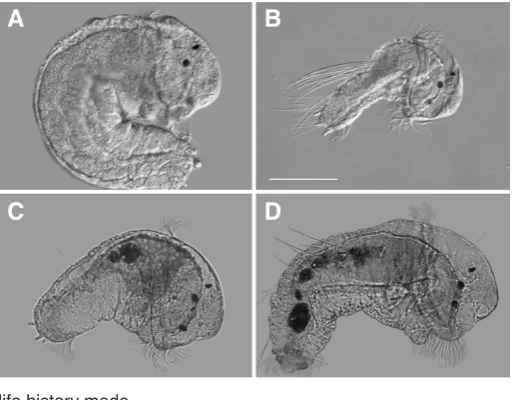
protein matrix, and are ancestral characters of annelids and name-defining for polychaetes (Hausen, 2005). Spionid larvae typically have many long larval chaetae protruding from two chaetal sacs on either side of the first segment. Though lecithotrophic larvae develop chaetal sacs, the larval chaetae themselves are absent (Gibson et al., 2010, and Fig. 1). Planktotrophic larvae spend a long period developing in the plankton where predation mortality is large and chaetae can confer an advantage by deterring pre-dation (Pennington and Chia, 1984; Pernet et al., 2002; Vaughn and Allen, 2010). In lecithotrophic larvae, these chaetae may be unnecessary or disadvantageous.
Results
Egg size, estimated as the average of two orthogonal measure-ments of the diameter, falls into three discrete classes. The eggs of Bayonne planktotrophs averaged 102 mm, with a standard deviation
of 7.5 mm (n=8), those of Long Beach lecithotrophs averaged 205.1 ± 4.9 mm, (n=8) and the F1 eggs averaged 137.1 ± 5.4 mm (n=30).
The planktotrophic and lecithotrophic eggs thus differ in volume by a factor of 8, and the F1 eggs are closer in volume to those of
the planktotrophs than to those of the lecithotrophs.
Inheritance of larval body length at release, measured as
Fig. 1. S. benedicti larvae upon release from the maternal brood
pouches. All are shown at the same magnification. (A,B) DIC images of
parental (wild-type) larvae. (A) A Long Beach lecithotrophic larva (cross type LxL). (B)A Bayonne planktotrophic larva (cross type BxB). (C,D) Brightfield views of representative F2 larvae. The larva in (C) has no chaetae originat-ing from the chaetal sac, similar to the LxL larva in (A). Scale bar, 100 mm.
Cross Class θMA θS θH θMD
B x B (Bayonne, BB) -1 1 -1 0
B x F1 (BackcrossBF1) -1 ½ 0 0
B x L (F1BL) -1 0 1 0
F1 x B (BackcrossF1B) 0 ½ 0 1
F1 x F1 (F2) 0 0 0 1
F1 x L (BackcrossF1L) 0 -½ 0 1
L x B (F1LB) 1 0 1 0
L x F1 (BackcrossLF1) 1 -½ 0 0
L x L (Long Beach, LL) 1 -1 -1 0 TABLE 2
COEFFICIENTS FOR ANALYSIS OF LINE-CROSS MEANS
In each cross class, the first named line is the mother. Refer to Materials and Methods for an explanation of the coefficients and models.
Cross Name Female Parent Male Parent Larvae Sampled
BB1 B* B 55
BB2 B B 73
BL1 B* La 58
BL2 B* Lb 89
BL3 B* Lb 27
F1 B* L 35
BL4 B L 45
BCB1 B F1†a 104
BCB2 B F1†b 40
BCB3 F1† B*a 38
F2-1 F1† F1† 34
F2-2 F1† F1† 29
F2-3 F1† F1†c 54
F2-4 F1† F1†c 23
BCL1 F1† L 58
BCL2 F1† L 35
LB1 L B*a 12
LB2 L B* 71
LB3 L B 18
LB4 L B*a 5
LB5 L B* 14
BCL3 L F1†a 24
BCL4 L F1†b 41
LL1 L Lb 16
LL2 L La 40
LL3 L L 13
LL4 L L 21
TABLE 1
EXPERIMENTAL CROSSES
B, Bayonne; L, Long Beach. The asterisks indicate Bayonne individuals that are full siblings, and the crosses indicate F1 individuals that are full siblings. Superscripts a, b, and c indicate that the same male was used in multiple crosses.
A
B
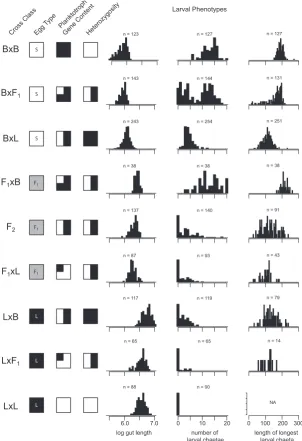
larval gut length, is almost completely governed by maternal effects (Fig. 2). The nine classes of line cross are ordered in the figure so that the first three derive from small eggs, the next three from F1 eggs,
and the last three from large eggs. Within each of these groups of three, the crosses are ordered from most Bayonne genome content to least. Statistical analysis (Table 3) confirms the graphical impression from Fig. 2, that the three sets of three differ sub-stantially from one another, with smaller differences within each set. The best-fitting model incorporates additive maternal effects and additive and dominant zygotic effects. However, additive zygotic effects are not significant on their own and the zygotic effects are small in magnitude. As suggested by Fig. 2, the direction of the zygotic effects is inconsistent between the egg-size classes, suggesting that cytoplasmic factors may modulate zygotic effects. An alternative model parameterization that includes aM, aZ, and an explicit maternal-by-zygotic interaction term (aM x aZ
) fits almost as well as the model with aM, aZ, and
dZ (Table 3). We can conclude that zygotic gene
ac-tion influences larval gut length, but that little of that influence is additive, at least in composite across the genome.
Inheritance of larval chaetae number is markedly different (Fig 2). Zygotic effects are pronounced. Within each of the egg-size classes, increasing pro-portions of Bayonne alleles increase chaetae number. However, maternal effects are also pronounced. This
is clear from contrasts between reciprocal crosses that differ only in egg size (F1BL vs F1LB, BackcrossBF1 vs BackcrossF1B, BackcrossLF1
vs BackcrossF1L). Segregation variance is visible in these data, as
more variation in chaetae number is present in the backcross and F2 classes due to genetic variation, as discussed below. Variation in
penetrance is also evident in chaetae number: within F1LB families
all larvae are identical in their Bayonne genetic content, but only 30% are lacking chaetae. Our full model, incorporating additive and dominance maternal and zygotic effects, is favored by the data, with additive zygotic effects the largest (Table 4).
We modeled the length of the longest measured chaeta for each larva, excluding zero-chaetae animals from consideration. We found no evidence of maternal effects, but there is strong support for additive zygotic effects (Table 5; p < 10-5). Thus our
data suggest that chaetal length is inherited zygotically, but that the penetrance of chaetal growth (i.e., the presence or absence of chaetae) depends on maternal effects as well.
BxB
Egg Type PlanktotrophGene ContentHeterozygosity
length of longest
Fig. 2. Larval phenotype distributions depend on
ma-ternal and zygotic constitution. Each row represents a
class of cross. The crosses are grouped into three sets by Egg Type: small eggs, F1 eggs, and large eggs. Within each egg type category, crosses are ordered by Bayonne Gene Content. The cross classes also vary in the proportion of individuals that are heterozygous for alleles from the two populations, as shown in the Heterozygosity column. The number (n) of individual larvae measured for each phenotype is reported above each histogram.
Model Df AIC BIC logLik Chisq DF Pr(>Chisq)
Effect Estimate Std. Error
µ Mean 6.299 0.019
LARVAL GUT LENGTH MODEL FIT AND EFFECT ESTIMATES
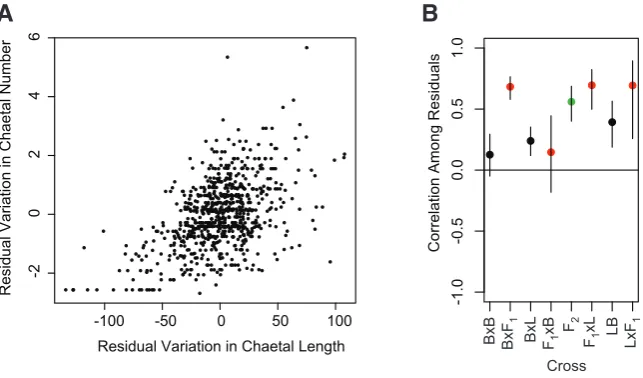
Moreover, conditional on chaetal presence, number and length are correlated. In Fig. 3A, we show the correlation between the residual variation in chaetal number and the residual variation in chaetal length, after the effects of aM, aZ, dZ, dM, and family have
been accounted for. This correlation (r = 0.49, p < 10-15) may be
due to the segregation of genetic factors within families or to com-mon microenvironmental effects influencing both traits in individual larvae. Tentative evidence for genetic correlation comes from the generally higher correlation among the residuals of F2s and
Backcross populations, which are genetically heterogeneous with respect to alleles that differ between Bayonne and Long Beach, than among the residuals of the other populations, which are genetically homogeneous (Fig. 3B).
Given the additive zygotic nature of the inheritance of chaetal length, we can employ classical biometrical techniques to crudely estimate the underlying genetic architecture. Although the absence of chaetae from one of the parental classes complicates the analy-ses, Lande (1981) showed that segregation variance, ss2, can be
estimated from the phenotypic variances of F2 and reciprocal
backcross populations:
ss2 = 2s2
F2 - s2F1B - s2F1L
Note that these three classes of larvae occur on the same maternal-effect background (F1 oocytes). We estimated variances
for these three line-cross classes using the residuals of the linear mixed-effect model. The effective number of factors (independently segregating genes of equivalent effect size) accounting for this amount of segregation variance (2,679 mm2) can be estimated by
nE = (mBB - mLL)2/(8ss2)
where BB and LL are the parental (Bayonne and Long Beach) crosses. Here, mLL is unknown, because the lecithotrophic larvae
lack chaetae. We can use an alternative estimator for the parental phenotypic difference: twice the additive effect of Bayonne alleles, as estimated from our linear model. That estimate gives a
pre-Fig. 3.The length and number of larval chaetae are correlated within families.(A) The
distribution of residual chaetae length and number for all larvae. (B) Mean and confidence intervals of the correlation among residuals within each class of cross. The correlation coef-ficients are generally higher in populations in which two genotypes are segregating at a locus (backcrosses, red) or three genotypes (F2s, green) than for populations that are not segregat-ing (parentals and F1s, black). The LxL cross is not shown because it lacks larval chaetae.
dicted Bayonne chaetal length of 202.3 mm and a
predicted Long Beach chaetal length of 47.5 mm
(i.e., if Long Beach larvae had chaetae; though theoretical, this is the chaetal length the model predicts for a Long Beach genome in a Bayonne egg). We conclude that, conditional on the pres-ence of chaetae, chaetal length is influpres-enced by 1.12 additive genetic factors.
Discussion
The three larval developmental traits we mea-sured differ in their underlying genetic architecture. Larval gut length is almost entirely maternally determined with a small, non-additive zygotic con-tribution. The presence of larval chaetae and their number involve substantial effects of both egg type and larval genome. Remarkably, the length of the chaetae — in larvae that have chaetae — appears to depend exclusively on additive zygotic effects. The genetic contribution to chaetae number and length is also correlated within families; larvae with long chaetae tend to have many (>10) while larvae with short chaetae only have a few (1-5).
We find that larvae originating from the same
-100 -50 0 50 100
Residual Variation in Chaetal Number -1.0
-0.5
Effect Estimate Std. Error
µ Mean 0.509 0.103
Effect Estimate Std. Error
µ Mean 124.879 8.698
LARVAL CHAETAE NUMBER MODEL FIT AND EFFECT ESTIMATES
Number of chaetae (Poisson mean)
TABLE 5
LONGEST LARVAL CHAETA MODEL FIT AND EFFECT ESTIMATES
egg class are generally of the same size at release, as assessed by body length measured along the gut. F1 mothers produce
larvae that are intermediate in size to the two parental lines (Fig. 2). Although lecithotrophic gut development is delayed by about a day relative to planktotrophs (Pernet and McHugh, 2010), the gut is fully formed before release in both larval morphs. Small dif-ferences in gut length within egg-size classes relate to features of the zygotic genome, but the direction of this zygotic effect is not consistent across egg size classes. This may be due to greater variability in the larval stage, and thus size, at which lecithotropic females released their larvae (results not shown). As larvae age, they increase the number of setigers and begin to develop adult features such as branchiae and palps. We observed that the same lecithotrophic mother could release subsequent broods at earlier or later stages, although larvae within a release were at the same developmental stage. This difference in developmental stage at release could be due to microenvironmental differences between clutches (such as longer days or temperature variation), random chance, or a response to physical perturbance. While lecithotrophic mothers showed variation in larval sizes across clutches, larvae from F1 mothers tended to have variability in larval size within a
clutch, which was especially noticeable in the F2s (Fig. 1 C-D).
Planktotrophic mothers, on the other hand, released larvae at the same stage consistently.
We observe that a large egg does not necessarily result in a “phenotypically lecithotrophic” offspring lacking chaetae. While the size of a larva is almost entirely maternally specified, there is variation in the penetrance of chaetal development. Development of the larval chaetae begins a few days after fertilization, consistent with an important role for zygotic gene activity, and the chaetae are fully formed by the time the larvae are released. While chaetal sacs occur in all larvae, the presence and number of chaetoblasts, the cells responsible for generating chaetae, are not known for each morph. Approximately 70% of F1LB larvae develop some chaetae,
though these larvae all carry one copy each of the Long Beach and Bayonne genomes. Further, ~23% of BackcrossLF1 larvae,
which are homozygous for Long Beach alleles across 50% of the genome and heterozygous at the other 50%, also develop chaetae. Additionally, our estimate of the additive affect of Bayonne alleles on chaetal length suggests that a larva with a pure Long Beach genome in a small egg would produce moderate-length chaetae. This indicates that a switch in both maternal specification and zygotic gene action has to occur to produce a phenotypically leci-thotrophic larva from a planktotrophic background. This pattern is particularly interesting in the context of life-history evolution from small to large egged larvae that has been described in most marine invertebrate groups. It demonstrates that simply increas-ing maternal allocation to egg size is not sufficient to produce a phenotypically lecithotrophic larvae.
Previous work in S. benedicti showed that many of the traits associated with life history strategy are highly heritable. Levin et al., (1991) estimated heritability from crosses between populations of planktotrophic and lecithotrophic parents within Bogue Sound, NC. While our phenotypes also show a strong genetic component, our results are not directly comparable to theirs as the only overlapping measurement is presence of larval chaetae. However, Levin et al., (1991) measured a different phenotype: proportion of families within a cross that had chaetae present, whereas we measured variation in chaetae number within a family. They found that the presence
of chaetae is highly heritable (93.9%), but they did not recover a significant maternal effect for chaetal presence.
S. benedicti evolved poecilogony from an ancestor with a single
life-history strategy, most likely planktotrophy (Mahon et al., 2009). Lecithotrophy could have evolved through the accumulation of small-effect changes throughout the genome, but our results sug-gest that only one or a few genes (genomic regions) of large effect can account for major reduction in the length of larval chaetae. A complete accounting of this trait’s evolution requires genetic dis-section of the maternal effects, which awaits analysis of F3 and
subsequent generations.
Reconciling the phenoptypic results from F1 and F2 populations
with the persistence of poecilogony is challenging. Our results show that random mating in S. benedicti would result in heterogeneous populations that include intermediate larval phenotypes, which are absent from most natural populations (with rare exceptions: Levin and Huggett, 1990). Our study and others (Levin et al., 1991; Schulze et al., 2000) show that planktotrophic and lecithotrophic worms can freely mate in the lab. Further, gene flow is occurring in natural populations (Zakas and Wares, 2012). The ultimate explanation may involve ecologically structured metapopulation dynamics and directional gene flow (Zakas and Hall, 2012), and discovery of the causal genes for lecithotrophy will facilitate our dissection of its ecological genetic basis. In the meantime, our data show that a fraction of F1 larvae are indistinguishable in gut
length and chaetal traits from their pure-morph parents, with the variable penetrance of chaetal growth playing a central role. In LxB crosses (lecithotrophic mothers and planktotrophic fathers), ~30%
of F1LB larvae are phenotypically similar to LL larvae. Assuming
these individuals are subject to the same selection pressures as LL larvae, this could account for gene flow in the face of strong selection against intermediate phenotypes. F1BL larvae
(plankto-trophic mothers and lecitho(plankto-trophic fathers) have less phenotypic overlap with BB larvae, but some overlap occurs. Occasional F1
larval migrants could provide the gene flow required to homogenize the genomic background among populations while strong selection preserves differentiation at the loci directly responsible for larval phenotypes. Genetic analysis offers the prospect of eventually discovering those loci.
Materials and Methods
Crosses
bi-weekly. Virgin females were placed with reproductive males (determined by the presence of spermatophores in the well) and checked daily for broods. Egg size was measured for a representative female of each type by remov-ing oocytes or early embryos from brood pouches and imagremov-ing them on a slide at 20x magnification as described below for the larvae. Crosses were performed in both directions to assess maternal effects. Animals from a single F1 family were used as parents in the backcross and F2 families to
minimize genetic variation. Each class of cross is represented by larvae from one to five full-sib families as listed in Table 1.
Measurements
Larvae were collected and measured at release from maternal brood pouch, prior to larval feeding, and imaged on a Zeiss Axio Imager A2 microscope with achromatic 10x and 20x dry objectives. Because larvae were measured prior to feeding, differences in phenotypes are due strictly to maternal and zygotic developmental factors. Pictures were taken of live larvae, which were slightly compressed under a coverslip on a depression slide coated with 400 ml of 0.2% agarose in artificial seawater, which limited their movement and allowed for image capture (Fig. 1). Some larvae were fixed prior to measurement. These were relaxed in 7% MgCl2 and
trans-ferred to 4% formaldehyde in seawater overnight, followed by transfer to PBS. Comparative measurements between fixed and live larvae showed fixation did not have an effect on larval size or chaetal measurements. Measurements of larval gut length, chaetal length, and number of chae-tae per chaetal sac were recorded in ImageJ (Schneider et al., 2012). To account for possible variation due to focal plane, three pictures of each larva were taken in different focal planes so that replicate measurements of each trait could be averaged.
Gut length was measured by tracing the dorsal edge of the gut in ImageJ. We averaged three replicate measurements (focal planes) for each larva, and we log-transformed these averages to generate a normally-distributed variable. The gut length dataset includes observations for 1,041 larvae. The number of larval chaetae was determined by counting chaetae on one side of each of 1,070 larvae. The length of the longest observed chaeta was studied in a dataset including only the 674 larvae that have chaetae.
Fitting models of inheritance and estimating maternal and zygotic effects
With data on nine distinct classes of cross between lecithotrophic Long Beach animals (L) and planktotrophic Bayonne animals (B), we can separately estimate the effects of maternal and zygotic differences between the two populations on each phenotype. Our approach to this line-cross dataset follows the line-cross mean analysis laid out by Lynch (1991) and references therein, and described in Lynch and Walsh (1998, chapter 9), with modifications to incorporate maternal effects. Briefly, we model the mean larval phenotype of each class of cross as a function of the fraction of its genome that derives from the Bayonne population, the fraction of the animals in the line-cross that are expected to be heterozygous for alleles that differ between B and L, and the type of egg that the larva develops from (Fig. 2).
To isolate line-cross means from family-level effects (e.g., shared environment), we used mixed-effect linear models, incorporating family as a random effect. Family includes maternal effects that are unique to individual females. We estimate the composite additive effect of zygotic gene action, aZ, by regressing phenotype on each family’s Bayonne gene content (the source index, qS), using the F2 population as a reference point.
In this formulation, qS is 0 in the F2 and other populations that carry equal
proportions of Bayonne and Long Beach alleles, -1 in pure Long Beach animals, 1 in pure Bayonne animals, and -0.5 and 0.5 in each backcross. We extend this regression approach to estimate dominance effects, dZ. The expected fraction of heterozygotes in each population, relative to the F2 population, is the variable qH (the hybridity index). In this formulation, F2
and backcross populations, which are expected to be 1/2 heterozygous, have a hybridity index of 0, while F1s (completely heterozygous) have an
index of 1 and the parental populations have an index of -1.
To estimate maternal effects that are due to egg type, we modeled an additive maternal effect, aM. Larvae derived from large eggs carry an aM coefficient (which we term qMA) of 1, F1 eggs 0, and small eggs -1. To
ac-commodate nonadditivity (i.e., F1 eggs conferring maternal effects that are
not perfectly intermediate to large and small eggs), we also considered a dominant maternal effect, dM. Its coefficient (qMD) is 1 in F1-derived eggs
and 0 in large and small eggs. Coefficients for the nine cross class line means are shown in Table 2 and schematized in Fig. 2.
We examined nested models incorporating the random effect of family only (null) and successively adding the additive and dominant maternal and zygotic effects, aM, aZ, dZ, and dM in the order of their anticipated effect size. The complete model for a measured phenotype of y of larva j in family i is
yij = m + qMAaM + qSaZ + qH dZ + qMDdM + familyi (random) + error.
All analyses were performed in R (R Core Development Team, 2011), version 2.14.1. Models for the chaetal length and log gut length pheno-types were fit by REML using the R function lmer (Bates et al., 2011). The chaetal number phenotype includes a large number of observations of zero chaetae, and the data are not conducive to analysis with Gaussian assumptions about error. We instead fit a Poisson generalized linear mixed-effect model using the glmer function, proceeding otherwise as above. Model fit was tested by comparing log likelihoods with a chi-square test. We also report alternative model-fit criteria (AIC and BIC), which support identical conclusions.
The maternal effects are themselves heritable, as both Bayonne planktotrophs and Long Beach lecithotrophs breed true in the common environment in the lab (and as documented by Levin et al., 1991). How-ever, our crosses do not allow segregation of egg-size or other maternal effects, as we observed larvae only through F2 and backcross generations.
As a result, maternal effects are correlated with zygotic effects; across the three egg size classes, larvae derived from planktotrophic eggs have more Bayonne genes than larvae derived from lecithotrophic eggs (see Fig. 2). Consequently, we can only compare zygotic and maternal effects when both terms are simultaneously included in our models. Reported effect estimates therefore derive from the full model, even in cases where individual terms did not achieve formal significance.
We estimated the effective number of segregating factors affecting lar-val chaeta length using Lande’s (1981) modifications of the Castle-Wright estimator (Wright, 1968), adapted to the peculiarities of the phenotype as described in the results.
Acknowledgements
We thank Bruno Pernet for sending us animals he collected in Long Beach, Jenn Deutscher for assistance with animal husbandry and imaging, imaging, and Max Bernstein, Vicky Cattani, Taniya Kaur, Annalise Paaby, and Luke Noble for comments on the manuscript. We thank NYU, the Zegar Family Foundation, and NSF award IOS-1350926 for financial support.
References
BATES, D., MAECHLER, M. and BOLKER, B. (2011). lme4: Linear mixed-effect models using S4 classes. Version 0.999375-42. http://lme4.r-forge.r-project.org/ BRIDGES, T.S. (1993). Reproductive investment in four developmental morphs of
Streblospio (Polychaeta, Spionidae). Biol Bull 184: 144-152.
GIBSON, G., MACDONALD, K. and DUFTON, M. (2010). Morphogenesis and phenotypic divergence in two developmental morphs of Streblospio benedicti (Annelida, Spionidae). Invertebr Biol 129: 328-343.
HAUSEN, H. (2005). Chaetae and chaetogenesis in polychaetes (Annelida).
Hydro-biologia 535: 37-52.
KNOTT, K.E. and MCHUGH, D. (2012). Poecilogony — a window on larval evolutionary transitions in marine invertebrates. Integr Comp Biol 52: 120-127.
LEVIN, L.A. (1984). Multiple patterns of development in Streblospio benedicti Webster (Spionidae) from three coasts of North-America. Biol Bull 166: 494-508. LEVIN, L.A. (1986). Effects of enrichment on reproduction in the opportunistic
poly-chaete Streblospio benedicti (Webster) - a mesocosm study. Biol Bull 171: 143-160. LEVIN, L.A. and BRIDGES, T.S. (1994). Control and consequences of alternative
developmental modes in a poecilogonous polychaete. Am Zool 34: 323-332. LEVIN, L.A. and CREED, E.L. (1986). Effect of temperature and food availability on
reproductive responses of Streblospio benedicti (Polychaeta, Spionidae) with planktotrophic or lecithotrophic development. Mar Biol 92: 103-113.
LEVIN, L.A. and HUGGETT, D.V. (1990). Implications of alternative reproductive modes for seasonality and demography in an estuarine polychaete. Ecology 71: 2191-2208.
LEVIN, L.A., ZHU, J. and CREED, E. (1991). The genetic basis of life-history characters in a polychaete exhibiting planktotrophy and lecithotrophy. Evolution 45: 380-397. LYNCH, M. (1991). The genetic interpretation of inbreeding depression and
outbreed-ing depression. Evolution 45: 622-629.
LYNCH, M. and WALSH, B. (1998). Genetics and analysis of quantitative traits. Sinauer, Sunderland, MA.
MAHON, A.R., MAHON, H.K., DAUER, D.M. and HALANYCH, K.M. (2009). Discrete genetic boundaries of three Streblospio (Spionidae, Annelida) species and the status of S. shrubsolii. Mar Biol Res 5: 172-178.
MARSHALL, D.J. and MORGAN, S.G. (2011). Ecological and evolutionary conse-quences of linked life-history stages in the sea. Curr Biol 21: R718-R725. MCCAIN, E.R. (2008). Poecilogony as a tool for understanding speciation:
Early development of Streblospio benedicti and Streblospio gynobranchiata (Polychaeta:Spionidae). Invertebr Repr Dev 51: 91-101.
MCEDWARD, L.R. (2000). Adaptive evolution of larvae and life cycles. Semin Cell
Dev Biol 11: 403-409.
MORAN, A.L. and MCALISTER, J.S. (2009). Egg size as a life history character of marine invertebrates: Is it all it’s cracked up to be? Biol Bull 216: 226-242. PECHENIK, J.A. (1999). On the advantages and disadvantages of larval stages in
benthic marine invertebrate life cycles. Mar Ecol Prog Ser 177: 269-297. PENNINGTON, J.T. and CHIA, F.S. (1984). Morphological and behavioral defenses of
trochophore larvae of Sabellaria cementarium (Polychaeta) against four planktonic predators. Biol Bull 167: 168-175.
PERNET, B., and L. MCARTHUR (2006). Feeding by larvae of two different de-velopmental modes in Streblospio benedicti (Polychaeta: Spionidae). Mar Biol 149: 803-811.
PERNET, B., QIAN, P.Y., ROUSE, G., YOUNG, C.M. and ECKELBARGER, K.J. (2002). Phylum Annelida: Polychaeta. In Atlas of Marine Invertebrate Larvae, (Ed. Young, C. M.). Academic Press, New York, pp. 209-243.
R CORE DEVELOPMENT TEAM. (2011). R: A language and environment for statistical computing. Vienna, Austria: R Foundation for Statistical Computing.
ROCKMAN, M.V. (2012). Patterns of nuclear genetic variation in the poecilogonous polychaete Streblospio benedicti. Integr Comp Biol 52: 173-180.
SCHNEIDER, C.A., RASBAND, W.S. and ELICEIRI, K.W. (2012). NIH Image to ImageJ: 25 years of image analysis. Nat Methods 9: 671-675.
SCHULZE, S.R., RICE, S.A., SIMON, J.L. and KARL, S.A. (2000). Evolution of poe-cilogony and the biogeography of North American populations of the polychaete
Streblospio. Evolution 54: 1247-1259.
STRATHMANN, R.R. (1978). Evolution and loss of feeding larval stages of marine invertebrates. Evolution 32: 894-906.
STRATHMANN, R.R. (1985). Feeding and nonfeeding larval development and life-history evolution in marine invertebrates. Annu Rev Ecol Syst 16: 339-361. THORSON, G. (1950). Reproductive and larval ecology of marine bottom
inverte-brates. Biol Rev 25: 1-45.
VANCE, R.R. (1973). Reproductive strategies in marine benthic invertebrates. Am
Nat 107: 339-352.
VAUGHN, D. and ALLEN, J.D. (2010). The peril of the plankton. Integr Comp Biol 50: 552-570.
WRAY, G.A. and RAFF, R.A. (1991). The evolution of developmental strategy in marine invertebrates. Trends Ecol Evol 6: 45-50.
WRIGHT, S. (1968). Evolution and the Genetics of Populations. Volume 1: Genetics
and Biometric Foundations. University of Chicago Presss, Chicago.
ZAKAS, C. and HALL, D.W. (2012). Asymmetric dispersal can maintain larval polymor-phism: a model motivated by Streblospio benedicti. Integr Comp Biol 52: 197-212. ZAKAS, C. and WARES, J.P. (2012). Consequences of a poecilogonous life history
for genetic structure in coastal populations of the polychaete Streblospio benedicti.
Brachyury, Tbx2/3 and sall expression during embryogenesis of the indirectly developing polychaete Hydroides elegans
Cesar Arenas-Mena
Int. J. Dev. Biol. (2013) 57: 73-83 http://dx.doi.org/10.1387/ijdb.120056ca
On the origin of pattern and form in early Metazoans
Frederick W. Cummings
Int. J. Dev. Biol. (2006) 50: 193-208 http://dx.doi.org/10.1387/ijdb.052058fc
Ecological regulation of development: induction of marine invertebrate metamorphosis
Daniel Jackson, Sally P Leys, Veronica F Hinman, Rick Woods, Martin F Lavin and Bernard M Degnan Int. J. Dev. Biol. (2002) 46: 679-686
http://www.intjdevbiol.com/web/paper/12141457
Cell lineage analysis of pattern formation in the Tubifex embryo. II. Segmentation Cytoskeletal mechanisms of ooplasmic segrega-tion in annelid eggs.
T Shimizu
Int. J. Dev. Biol. (1999) 43: 11-18
http://www.intjdevbiol.com/web/paper/10213078
Formation and localization of cytoplasmic domains in leech and ascidian zygotes.
J Fernández, F Roegiers, V Cantillana and C Sardet Int. J. Dev. Biol. (1998) 42: 1075-1084
http://www.intjdevbiol.com/web/paper/9879704
Formation of polar cytoplasmic domains (teloplasms) in the leech egg is a three-step segregation process.
J Fernandez, N Olea, A Ubilla and V Cantillana Int. J. Dev. Biol. (1998) 42: 149-162
http://www.intjdevbiol.com/web/paper/9551860
Morphological evidence for a morphogenetic field in gastropod mollusc eggs.
S E Tyler, R D Butler and S J Kimber Int. J. Dev. Biol. (1998) 42: 79-85
http://www.intjdevbiol.com/web/paper/9496789
Effects of some cytoskeleton inhibitors on ooplasmic segregation in the Nereis virens egg.
A K Dondua, R P Kostyuchenko and Z E Fedorova Int. J. Dev. Biol. (1997) 41: 853-858
http://www.intjdevbiol.com/web/paper/9449461
Metabolism of oocyte construction and the generation of histospecificity in the cleaving egg. Lessons from nereid annelids.
A Fischer, A W Dorresteijn and U Hoeger