Volume 2008, Article ID 194828,12pages doi:10.1155/2008/194828
Research Article
Models for Call Acceptance Based on Handoff Guarantees
Mostafizur Rahman and Attahiru Sule Alfa
Department of Electrical and Computer Engineering, University of Manitoba, Winnipeg, MB, Canada R3T 5V6
Correspondence should be addressed to Mostafizur Rahman,[email protected]
Received 1 November 2007; Accepted 6 August 2008
Recommended by Weihua Zhuang
Call admission control (CAC) is important for cellular wireless networks to provide quality-of-service (QoS) requirements to users. Static and adaptive CAC schemes, respectively, make unrealistic assumptions about the distributions of the handoffcall arrival process and the number of users in a cell. Handoffarrivals are usually assumed to follow Poisson process in static CAC schemes for Poisson new call arrivals and exponentially distributed call holding and cell residence times. We use a simple proof to show that this assumption of Poisson handoffarrival process is not justified for a two-cell wireless network. In general, we find that the handoffprocess can be captured by a dimensional Markov chain. We propose a novel adaptive CAC scheme for the two-cell system which accepts a new call if it can guarantee, with a certain probability, that a user’s call will be maintained irrespective of its (his/her) movement in the system. Then, we extend this adaptive scheme for multiple-cell network. We develop another variant of this adaptive scheme which we call fractional adaptive scheme. Both the adaptive and fractional adaptive schemes are found to outperform the guard channel scheme in controlling the handofffailure probability in a cellular wireless network.
Copyright © 2008 M. Rahman and A. S. Alfa. This is an open access article distributed under the Creative Commons Attribution License, which permits unrestricted use, distribution, and reproduction in any medium, provided the original work is properly cited.
1. INTRODUCTION
Call admission control (CAC) is a strategy to provide high QoS to users by limiting the number of call connections into a communication network, to a profitable level, while reducing network congestion, depending on the availability of resources. In cellular wireless networks, another factor comes into play, the possibility of dropping a connected call due to the mobility of users. It is more irritating for a user’s call not to be completed due to handoff failure than the call to be blocked during the new call attempt. Therefore, handoff calls are prioritized over new calls. It has been found that prioritizing handoffcalls over new calls results in the decrease of the number of handoff failures and the call dropping probabilities. However, prioritizing handoffcalls over new calls results in the increase of the new call blocking probability. A good CAC scheme for a wireless cellular network has to balance the call blocking and the call dropping probabilities in order to provide the desired QoS requirements. The design of CAC algorithms for mobile cellular wireless networks is especially challenging given the limited and highly variable resources, and the mobility of users encountered in such networks.
CAC schemes for cellular wireless networks have been extensively studied in the literature. Those studies can be broadly classified into two categories—static schemes and distributed schemes. In the literature, static CAC schemes, which are mainly guard channel schemes, are generally stud-ied for a single cell [1–4]. On the other hand, in distributed CAC schemes [5–9], which are also called adaptive CAC schemes, a call is accepted in the target cell depending on the number of calls in the target cell and the number of calls in the neighboring cells. Ahmed [10] and Ghaderi and Boutaba [11] provided comprehensive surveys on static and adaptive CAC schemes.
(FGCS), where a new call is accepted in a cell with a particular probability depending on the number of calls in the cell. Leong et al. [3, 12] analyzed integration of voice and data calls for fractional guard channel scheme with bandwidth allocation and update of the number of guard channels with traffic variation. The approximation of higher-dimensional Markov chains to lower-higher-dimensional Markov chains in [3,12] may cause inaccuracy. Alfa and Li [1,13] studied guard channel schemes where new and handoffcalls are assumed to follow MAP distribution and cell residence times, and call holding durations are assumed to follow phase type distribution. However, their models [1,13] are computationally demanding and actually intractable using reasonable computing resources as they keep track of the phase of the channel holding time of each call which makes the state-space large. Chou and Shin [14] developed and analyzed a cutoffpriority scheme for supporting multilevel QoS by introducing upgrade/degrade frequency (UDF). UDF is generated based on approximation using a discrete time absorbing Markov chain which could be exactly deter-mined using a continuous time absorbing Markov chain. Chen et al. [15] proposed dynamic multiple thresholds for new/handoffreal-time and nonreal-time calls with periodic exchange of information between neighboring base-stations for providing relative QoS priority. The thresholds in [15] are computed assuming fixed numbers of arrivals and departures in a period of time which has no justification. In some of the guard channel schemes such as schemes of Guerin [16], Lau and Maric [17], Hong and Rappaport [2], Lin et al. [18], Li and Alfa [19], Tekinay and Jabbari [20], Yoon and Un [21], and Haung et al. [22], calls queue when they cannot be allocated free channels, which reduces new call blocking and handoffdropping probabilities. Gavish and Sridhar [23] and Fang and Zhang [24] analyzed the new call bounding scheme which accepts a new call if the number of ongoing new calls is below some threshold value and there is a free channel in the cell.
Naghshineh and Schwartz [8] developed a distributed scheme for only voice calls whereas Miˇsi´c et al. [7], Epstein and Schwartz [25], and Ghaderi and Boutaba [5] developed distributed schemes for multiple classes of calls. In these schemes, a new call is accepted in a cell after determining the probabilities of successful handoffof calls in the current and the neighboring cells in some time ahead. The binomially distributed number of ongoing calls in a cell is approximated with normal distribution in [5, 8,25] and Poisson distri-bution in [7]. The approximation of binomial distribution by normal distribution may cause inaccuracy as normal distribution has negative tail. The approximation of the binomial distribution by Poisson distribution is unrealistic when the mean and variance of the binomial distribution differ more than ten percent. In the scheme of Levine et al. [6], new calls are admitted in a cell by computing the influence of the ongoing calls in the current and neighboring cells using shadow cluster concept which is complex. In [5,9], time is divided into control periods. In the scheme of Wu et al. [9], new calls are accepted in a control period with some probability which is computed by solving a diffusion equation. Calls accepted in a control period with some
probability in the schemes of Ghaderi and Boutaba [5] and Wu et al. [9] can result in under utilization of the channels in a cell.
In static CAC schemes, a cell is studied to approximate the whole cellular network. In static schemes, a new call is admitted in the target cell depending only on the number of calls in that cell. On the other hand, in distributed CAC schemes, the numbers of calls in the target cell and the neighboring cells are considered for accepting a new call in the target cell. In this paper, we first study a cellular system which consists of two cells. We study the two-cell wireless network to understand how the two-cell system works with the goal in mind to use the results in approximating a cellular network consisting of more than two cells.
off if it moves to the neighboring cell. We carry out the transient analysis for our proposed two-cell system using matrix geometric method [32] to compute the probability of dropping the candidate call in the neighboring cell if the candidate call needs to handoffin the neighboring cell. These dropping probabilities are computed for different number of ongoing calls in the current cell and the neighboring cell. These values of handoffdrop probabilities for candidate call in the neighboring cell are stored in a table. Using simulation study, we determine the thresholds for accepting a new call for exponentially distributed new call interarrival time, call holding, and cell residence times to provide the required QoS of handofffailure probabilities. Our method is designed for offline computation since our schemes are mainly suitable for designing call admission controller whereas other distributed schemes can be considered as operational schemes as they use online computation. Our CAC algorithm needs to look up a table for the handoff dropping probability of a candidate call being dropped for unavailability of a free channel in the neighboring cell if the candidate call is accepted. Checking the table, the CAC algorithm can decide about the acceptance of the call. We find that our adaptive CAC scheme for the two-cell system better controls the admission of new calls by keeping lower the new call blocking probability and better channel utilization than the guard channel scheme for maintaining the handoffcall dropping probability below some threshold value.
We extend our adaptive CAC scheme for two-cell wireless network to a cellular wireless network consisting of multiple cells. We approximate the neighbors of the target cell with one cell and the target cell as another cell for the two-cell system. We find that this approximation better controls the handoff call dropping probability than the guard channel scheme. We develop another variant of this adaptive scheme which we call fractional adaptive scheme for a cellular wireless network consisting of more than two cells. Our schemes for a multiple-cell wireless network are found to outperform the guard channel scheme in controlling handoff failure probability. Fractional adaptive scheme is found to better control the handoff failure probability than the adaptive scheme.
The rest of the paper is organized as follows. InSection 2, we show the steady-state analysis of guard channel scheme for the two-cell system. Our proposed adaptive model for the two-cell system, the approximation model and its variant fractional adaptive scheme for a multiple-cell wireless network are explained in Section 3.Section 4presents our analytical and simulation results, andSection 5concludes the paper.
2. STEADY-STATE ANALYSIS OF GUARD CHANNEL SCHEME FOR TWO-CELL SYSTEM
A cellular wireless network consists of many cells. If a Markov chain is used to model the whole cellular wireless network, the state-space of the Markov chain becomes exponentially large. In the literature, a cell is generally studied to approx-imate the whole network with the assumption that both
1 2
Figure1: The two-cell system.
the new and handoffcalls are of same distributions such as Poisson, phase type, or MAP. However, we study a two-cell system to understand how the two-cell system works with the goal in mind to use the modeling technique for developing adaptive schemes inSection 3.
In this section, we develop and analyze the guard channel scheme for the two-cell system. We assume that a call is completed in the cell where it is generated or in the neighboring cell. We denote the two cells as cell 1 and cell 2 as shown inFigure 1. We assume that a user can only move from cell 1 to cell 2 and from cell 2 cell 1. These two cells are identical and each cell has C channels.g (0 ≤ g < C) number of channels are reserved as guard channels for only handoffcalls in each cell. A handoffcall is accepted in a cell if there is any free channel in that cell. On the other hand, a new call is accepted in a cell if the number of ongoing calls in that cell is less than K = C−g. Moreover, we assume that the new call arrival to a cell follows Poisson distribution with meanλn. Both call holding time (the time duration a
completed call needs) and cell residence time (the time a caller spends in a cell) are assumed to follow exponential distribution with means 1/μand 1/η, respectively. Channel holding time (the time a call occupies a channel in a cell) of a call in a cell is the minimum of the cell residence time and the call holding duration. As a result, the channel holding time of a call in a cell is also exponentially distributed with mean 1/μc = 1/(μ+η). We follow these assumptions about the
total number of channels in a cell and statistical distributions of new call arrival process, call holding duration, and cell residence time throughout this paper.
We consider a continuous time Markov chain (CTMC) for the two-cell system. The state space of this CTMC is {(i,j) : 0≤i, j ≤C}, whereiandjrepresent, respectively, the total number of calls in cells 1 and 2. The summation of the number of calls in both cells cannot be more than 2C−g=C+K(i.e., 0≤i+j≤2C−g) as there aregnumber of guard channels in both cells 1 and 2. An example of the CTMC and possible transitions in the CTMC are shown in [33]. The CTMC has the following generator matrix:
Q= ⎡ ⎢ ⎢ ⎢ ⎢ ⎢ ⎢ ⎢ ⎢ ⎢ ⎣
B0 U0 D1 B1 U1
D2 B2 U2 . .. ... . ..
DC−1 BC−1 UC−1 DC BC
⎤ ⎥ ⎥ ⎥ ⎥ ⎥ ⎥ ⎥ ⎥ ⎥ ⎦
. (1)
Here,Bi(0≤i≤C) is anLi×Limatrix, whereLi=C+1
for 0≤i≤K andLi =2C−i−g+ 1=C+K−i+ 1 for
K+ 1≤i≤C.Di (1≤i≤C) andUi (0≤i≤C−1) are
represent, respectively, no change, a decrease by one, and an increase by one in the number of ongoing calls in cell 1.
The structure ofBi is shown in Table 1. The diagonal
elementBi(j,j) for 0 ≤ j < Li ofBirepresents no change
in the number of ongoing calls in cells 1 and 2. The super-diagonal elementBi(j,j+ 1) for 0≤ j < K ofBirepresents
an increase in the number of ongoing calls in cell 2 by one for accepting a new call. The subdiagonal elementBi(j,j−1)
for 0≤i < C, 0< j < Li−1 ofBirepresents a decrease in the
number of ongoing calls in cell 2 by one for a call completion. On the other hand, the subdiagonal elementBC(j,j−1) for
0 < j < LC−1 ofBCrepresents a decrease in the number
of ongoing calls in cell 2 by one for a call completion or an unsuccessful handoffto cell 1.
The diagonal elementDi(j,j) ofDifor 1≤i ≤K, 0 ≤
j≤C−1 orK+ 1≤i≤C, 0≤j≤Li−1 represents a call
completion in cell 1. On the other hand, the diagonal element Di(C,C) ofDifor 1 ≤ i ≤ K represents a call completion
in cell 1 or an unsuccessful handoffto cell 2. The handoff from cell 1 to cell 2 is captured by the super-diagonal element Di(j,j+ 1) ofDifor 1≤i≤K, 0≤j≤C−1, orK+ 1≤i≤
j≤Crepresents an increase in the number of ongoing calls in cell 1 by acceptance of a new call. The handofffrom cell 2 to cell 1 is captured by the subdiagonal elementUi(j,j−1)
ofUifor 0≤i≤C−1, 1≤ j≤Li−1.Ui(0≤i≤K−1)
has the following structure:
Ui=
probability vector for the CTMC Q in (1) which satisfies xQ = 0T andx1 = 1. Here, 0 and1 are column vectors
of zeros and ones, respectively. On the other hand,xi (0 ≤
i ≤ C) is a row vector having Li scalar elements. xi =
[xi,0,xi,1,. . .,xi,Li−1], where xi,j represents the steady-state
probability of havingiongoing calls in cell 1 and jongoing calls in cell 2. If we letni=1βi =β1,β2,. . .,βnfor matrices
In our two-cell system, we capture handoffcall arrivals to cells 1 and 2 as subdiagonal ofUi (0≤ i ≤ C−1) and
super-diagonal of Di(1 ≤ i ≤ C) matrices, respectively.
The handoff rate due to an individual user from a cell to the neighboring cell is η. For l(1 ≤ l ≤ C) users in a cell, the handoff rate to the neighboring cell is lη and this l varies with the number of users in that cell (i.e., with the state of the Markov chain). On the other hand, for exponentially distributed interarrival time or Poisson distributed arrival process the transition to another state occurs with a fixed rate. However, the handoffarrival process from and to a cell in our two-cell system does not remain fixed. For hyperexponential distribution, the change from one state to another state can occur with any rate of the fixed number of exponential distributions that constitute the hyperexponential distribution. However, the change between handoffgeneration rates is correlated for our two-cell system. The handoff generation rate can switch from lη to (l −1)η but not to the rate (l−2)η (for l ≥ 2) directly. Similarly, the handoffgeneration rate cannot change directly from lη to (l + 2)η (for l+ 1 < C). Therefore, the handoffinterarrival time from and to a cell is neither exponentially nor hyperexponentially distributed. Hence, the assumption of Poisson distributed handoff arrival process or exponentially distributed handoffinterarrival time is not justified.
Table1: Structure ofBiin cutoffpriority guard-channel handoffscheme for two-cell system.
from cell 1 to cell 2 are same, that is, the mean handoffarrival rate to a cell isλh=λh1=λh2. We can expressλh1andλh2as
We can compute the handoff failure probabilities in cells 1 and 2 using the approach of Poisson arrivals see time averages (PASTA) [35]. For the duration of time T, an outside observer sees Ci=1iηxi1T =
from cell 1 to cell 2 and from cell 2 to cell 1, respectively. The outside observer also notices that Lj=C−11jηxC,jT and
K
i=1iηxi,CT calls are dropped on average in cell 1 and cell
2, respectively, for time T. Therefore, the handoff failure probabilitiesPhf1in cell 1 andPhf2in cell 2 can be expressed as
Phf1=
Similarly, the new call blocking probabilitiesPb1of cell 1 andPb2of cell 2 can be expressed as
The two cells are identical with respect to total number of channels, number of guard channels, new call arrival rate, cell residence time, and call holding duration. Hence, they have the same handofffailure probabilities and the same new call blocking probabilities which we can be written asPhf1 = Phf2=Phf, andPb1=Pb2=Pb.
We now have the expressions for new call blocking and handofffailure probabilities. We can now compute the optimum number of guard channelsgthat we require to keep the new call blocking probability minimum and the handoff call failure probability within a threshold. We can write this optimization problem as
computeg which minimizes Pb
subject toPhf≤Pth.
Enumeration technique can be used to solve the above optimization problem to obtain the optimum value ofg.
We can find the mean number of calls in a cell for the two-cell system with guard channel scheme. The mean number of calls in cell 1 is N1 =
both the cells are identical, the mean number of calls in both the cells are same which we can write asN =N1 =N2. On the other hand, the expected channel utilization for the two-cell system with the guard channel scheme isN/C.
Nonprioritized handoffscheme for the two-cell system is a special case of guard channel scheme with no guard channels, that is, g = 0, Li = C + 1 (0 ≤ i ≤ C),
and K = C. Distribution of average number of calls, new call blocking probability, handoff failure probability, distribution of handoff call arrival process, and average handoffcall arrival rate for nonprioritized handoffscheme can be computed in the same fashion like the guard channel scheme.
3. AN ADAPTIVE CALL ADMISSION CONTROL SCHEME FOR TWO-CELL AND MULTIPLE-CELL SYSTEMS
In this section, we first develop an adaptive call admission control scheme for the two-cell system. In our adaptive scheme, we try to ensure, with some probability, that if a call is considered for acceptance in a cell then the call gets a handoffchannel in the neighboring cell if it needs one. Moreover, we guarantee, with some probability, that the acceptance of the new call in the target cell will not have adverse effect on calls seeking handoffto the target cell. We propose a set of constraints for acceptance of calls in the two cells of our system which implicitly prioritizes handoff calls over new calls. If we assume thatiandjrepresent total number of calls in cells 1 and 2, respectively, then a new call is accepted in cell 1 with this set of rules when the following constraints are satisfied.
(i) There is at least one free channel in cell 1 for accepting the new call, that is,i < C.
(ii) We can guarantee with at least probability PE that
the call will get a free channel in cell 2 if it needs to handoff.
We can compute the probability of a call getting a free channel in the neighboring cell if it needs to handoff. We can perform the transient analysis to compute the average probabilityPE(T) of dropping a candidate call in cell 2 in
T time ahead when it comes to cell 1 for acceptance. If the candidate call is accepted in cell 1, then we have to consider the remainingC−1 channels of cell 1 andCchannels of cell 2. We can consider a CTMC for both cells as inSection 2. The state-space of this CTMC for the adaptive scheme has C(C+ 1) elements. The state space of this CTMC can be represented as{(i,j) : 0 ≤i≤ C−1, 0≤ j ≤C}, where
irepresents total number of calls in theC−1 channels of cell 1, andjrepresents total number of calls inCchannels of cell
2. An example of the CTMC and all possible transitions in the CTMC are shown in [33]. The generator matrix of the CTMC is shown in the following equation:
an increase by one, and a decrease by one in the number of ongoing calls in (C−1) channels of cell 1 when the number of ongoing calls in (C−1) channels of cell 1 is i.Bi(0 ≤
i ≤ C−1),Ui (0 ≤ i ≤ C−2), andDi(1 ≤ i ≤ C−1)
are (C+ 1)×(C+ 1) matrices.Bihas nonzero elements in
the diagonal, subdiagonal, and super diagonal. The diagonal elements ofBirepresent the rate of no change in the number
of ongoing calls in both cells 1 and 2. The super-diagonal elements of Bi represent the rate of a new call connection
in cell 2. The subdiagonal elements of Bi show the rate of
completion of an ongoing call in cell 2. Ui has nonzero
elements in the diagonal and subdiagonal. The diagonal of
Uiindicates the rate of a new call connection in cell 1. The
subdiagonal elements ofUirepresent the rate of a successful
handoffcall from cell 2 to cell 1.Dihas nonzero elements in
the diagonal and super diagonal. The diagonal elements of
Di show the rate of a call completion in cell 1. The super
diagonal elements of Di represent the rate of a successful
Table2: Structure ofBiin adaptive call admission control scheme for two-cell system. that the system is in stater at timetgiven the initial state r0 at time zero. If we consider the system at time t, we have xr(t) = Pr{x(t) = r}which is conditioned on the initial state. These transient probabilities are the elements of x(t) = [x0(t),x1(t),. . .,xC−1(t)], wherexi(t) (0 ≤ i≤
C −1) is a (C + 1)-element row vector representing the probability vector for total i calls in the C −1 channels of cell 1 at time t. xi(t) can be represented as xi(t) =
[xi,0(t),xi,1(t),xi,2(t),. . .,xi,C(t)]. Here, xi,j(t) denotes the
probability of seeingicustomers inC−1 channels of cell 1 andjcustomers inCchannels of cell 2 at timet. To calculate
x(t), we have to solve the Kolmogorov-forward equations which can be expressed in the matrix form as follows:
dx(t) (with the assumption of counting begins from the starting position as 0th position) of x(0) is one and all other elements of x(0) are zero. Now, exploiting the special structure of
Q has negative elements in the diagonal which makes the computation of eQt unstable as this computation involves
repeated multiplication and addition of negative and positive quantities. Therefore, uniformization technique of Jensen [36] is used for computingeQt which is a general and efficient
way to obtain the solution from the above (17) as it does not involve repeated multiplication and addition of negative
and positive quantities. In this technique, the new transition probability matrixPis defined as
P=Q
Λ+I, (18)
whereΛ≥ max(−Bi(j,j), 0≤ i≤C−1, 0≤ j ≤C). If
the arrival rate of new call is greater than the inverse of mean channel holding time (i.e.,λn> μc), we useΛ=2λn+ (2C−
The infinite summation in (19) is truncated at some valuen = Msuch that the truncation error remains below εwhich can be expressed mathematically as
The probability of an accepted user in cell 1 that needs handoff at time t is (1−e−ηt)e−μt. Now, the probability
of all the channels in cell 2 being occupied at time t is C−1
i=1 xi,C(t). Therefore, the candidate call accepted at cell 1
will be dropped at timetif at that moment the call needs to handoffto cell 2 and finds all the channel occupied which occurs with probability pe(t) = e−μt(1−e−ηt)
C−1
i=1 xi,C(t).
Now, the average probabilityPE(T) of an accepted call in cell
1 of not finding any empty channel in cell 2 if it requires handoffis
PE(T)= 1
T T
The integration of (21) is carried out numerically using Simpson’s method of numerical integration. In this method, the range [0,T] is divided into r subintervals of equal lengthl =T/r, wherer is an even number. The numerical integration can be expressed as
PE(T)
= l 3T
f0+ 4f1+ 2f2+ 4f3+ 2f4+· · ·+ 2fr−2+ 4fr−1+ fr
= 1 3r
f0+ 4f1+ 2f2+ 4f3+ 2f4+· · ·+ 2fr−2+ 4fr−1+ fr ,
(22)
where fk=pe(kT/r), 0≤k≤r.
For differentC(C+ 1) values ofx0we can compute values of PE(T). The threshold value PE is one of the C(C+ 1)
values for different initial states ofx0. We can determine this threshold value ofPE for accepting a new call by running
simulation experiments with the goal of minimizing the new call blocking probability while keeping the handoff failure probability below a prespecified value. The admission controller can keep the table of PE(T) and the threshold
values ofPEin memory. Whenever a new call comes to cell
1, then the admission controller needs to check whether the (i(C+ 1) + j)th entry of the table storing values ofPE(T)
is not more thanPE. If this condition is satisfied the call is
accepted in cell 1. On the other hand, when a call comes to cell 2 for admission it needs to check that the (j(C+ 1) +i)th entry of the table storing values ofPE(T) is not more than
PE. If this condition is satisfied, the call is accepted in cell
2. We conjecture that acceptance of new call in our model guarantees a successful handoff for the accepted call with some probability. Guard channel scheme fails to guarantee this handoff in a cell for different number of calls in the neighboring cells.
The advantage of our model is that we can compute PE(T) inTtime ahead for different values ofx(0) and keep
these values in a table. Whenever a new call attempt is made in a cell, the CAC algorithm needs to get the value ofPEto
decide about accepting the call.
3.1. Extension to multiple-cell wireless network
We can extend our adaptive CAC scheme for the two-cell system to multiple-cell wireless network. Here, each cell contains C channels, new call arrival process to each cell is Poisson distributed with meanλn, cell residence time in
each cell is exponentially distributed with mean 1/η, and call holding duration is exponentially distributed with mean 1/μ. In this approximation, let us assume that our target cellFt
has i calls, and the target cell has J immediate neighbors Fn1,Fn2,. . .,FnJ havingln1,ln2,. . .,lnJcalls, respectively. A new call is blocked ifi = C. On the other hand, we can use the values in the table for accepting a call in the target cell for i < Cand j = J
k=1lnk/J using the table which contains values for probability of dropping a candidate call in the target cell if it needs to handoff the neighboring cell. We need to determine the threshold valuePE by carrying out
1 2 3 4
6 5
7
8 9 10
Figure2: Hexagonal structure of cellular wireless network.
simulation to keep the handofffailure probability below that value. When a call comes to the target cell with at least one free channel, we can consideri=iandj= j. The admission controller needs to check whether the (i(C+1)+j)th entry of the table storing values ofPE(T) is not more thanPE. If this
condition is satisfied, the call is accepted in the target cell. Otherwise, the new call is blocked. In lower load, the handoff failure probability is very low and needs no prioritization of handoffcalls over new calls. As a result, the value of PE is
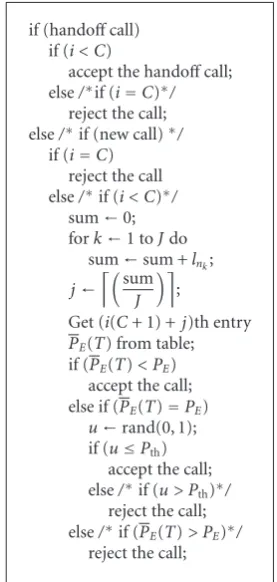
the highest value of the values of handofffailure probabilities of candidate call in the neighboring cell stored in the table. An example of hexagonal cell structure of cellular wireless network is shown inFigure 2. If a new call comes to cell 1, then cell 1 is the target cell. If there is at least one free channel in cell 1, theniis the value of the number of calls in cell 1 and the value of jis computed as the ceiling of the average number of calls in the immediate neighboring cells 2, 3, 4, 5, 6, and 7. We show the adaptive CAC algorithm for the target cell in the multiple-cell system usingPseudocode 1.
In Section 4, we find that it is not always possible to get the exact desired handoffcall failure probability using adaptive algorithm in higher load. We develop another variant of this adaptive algorithm which we call fractional adaptive algorithm using the approach similar to fractional guard channel scheme [4]. In this algorithm, we select the threshold valuePEwhich is the immediate higher value than
the threshold value used in adaptive scheme from the table of the adaptive scheme. In the fractional adaptive scheme, a new call is always accepted in a target cell if the (i(C + 1) + j)th entry of the table storing values ofPE(T) is less
than PE. On the other hand, a new call is accepted with
some probability Pth when the (i(C + 1) + j)th entry of the table storing values of PE(T) is equal to PE. We can
choose the value of Pth by simulation in such a way that the handofffailure probability is approximately equal to the desired handofffailure probability value. Adaptive scheme can be considered as a special case of fractional adaptive scheme, where Pth = 1, and PE is chosen in such a way
that handofffailure probability is not more than the desired handofffailure probability. We show the fractional adaptive CAC algorithm for target cell in the multiple-cell system usingPseudocode 2.
4. NUMERICAL EXAMPLES
if (handoffcall) if (i < C)
accept the handoffcall; else/∗if (i=C)∗/
reject the call; else/∗if (new call)∗/
if (i=C) reject the call else/∗if (i < C)∗/
sum←0; fork←1 toJdo
sum←sum +lnk;
j←sum
J
;
Get (i(C+ 1) +j)th entry
PE(T) from table;
if (PE(T)≤PE)
accept the call; else/∗if (P
E(T)> PE)∗/
reject the call;
Pseudocode1: Adaptive algorithm.
1 2
4 3
5 6 7
8 9
10 11 12 13 14 15 16 17 18
19
Figure3: Cellular network consisting of nineteen cells with wrap-around structure.
Figure 3with wrap-around structure. We assume that there are ten channels in each cell. The cell residence time and call holding duration are assumed to be exponentially distributed with means 1.0 unit time and 0.25 unit time, respectively. New call arrival process is assumed to follow Poisson dis-tribution. Mean call arrival rate is varied from 4.0/unit time to 48.0/unit time. We assume that our goal is to minimize the new call blocking probability while keeping handoffcall failure probability below 0.015. We use T = 5.0 unit time for our adaptive admission control scheme in numerical examples. 100000.0 unit time is chosen as warm-up time for the simulation. Ten independent replications of length 50000.0 unit time are performed in the simulation studies. We discuss numerical examples for two-cell and multiple-cell wireless networks in Sections4.1 and4.2, respectively. In the figures, we denote analytical and simulation results for nonpriority handoff scheme as “Guard0 Analytical” and “Guard0 Simulation,” respectively. We denote analytical results for guard channel schemes with one and two guard channels as “Guard1 Analytical” and “Guard2 Analytical,” respectively. Similarly, we denote simulation results for guard channel schemes with one and two guard channels as
if (handoffcall) if (i < C)
accept the handoffcall; else/∗if (i=C)∗/
reject the call; else/∗if (new call)∗/
if (i=C) reject the call else/∗if (i < C)∗/
sum←0; fork←1 toJdo
sum←sum +lnk;
j←sum
J
;
Get (i(C+ 1) +j)th entry
PE(T) from table;
if (PE(T)< PE)
accept the call; else if (PE(T)=PE)
u←rand(0, 1); if (u≤Pth)
accept the call; else/∗if (u > P
th)∗/
reject the call; else/∗if (PE(T)> PE)∗/
reject the call;
Pseudocode2: Fractional adaptive algorithm.
“Guard1 Simulation” and “Guard2 Simulation,” respectively. The simulation results for adaptive and fractional adaptive scheme are represented as “adaptive simulation” and “frac-tional adaptive simulation,” respectively.
4.1. Numerical result for two-cell system
Analytical studies are carried out on nonpriority handoff scheme and guard channel scheme with one and two guard channels. Simulation studies are performed on nonpriority handoff scheme, guard channel scheme with one and two guard channels, and our adaptive CAC scheme.
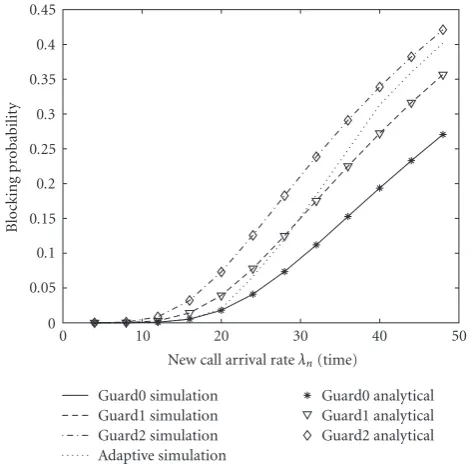
Analytical and simulation results of channel utilization, new call blocking probability, and handoff call failure probability are shown in Figures4,5, and6, respectively. We can see that our analytical and simulation results agree well for nonpriority handoffscheme and guard channel scheme with one and two guard channels from these figures.
0 0.1 0.2 0.3 0.4 0.5 0.6 0.7 0.8 0.9
U
tilization
0 10 20 30 40 50
New call arrival rateλn(time) Guard0 simulation
Guard1 simulation Guard2 simulation Adaptive simulation
Guard0 analytical Guard1 analytical Guard2 analytical
Figure4: Analytical and simulation results of channel utilization for the two-cell system.
0 0.05 0.1 0.15 0.2 0.25 0.3 0.35 0.4 0.45
Bloc
king
pr
obabilit
y
0 10 20 30 40 50
New call arrival rateλn(time) Guard0 simulation
Guard1 simulation Guard2 simulation Adaptive simulation
Guard0 analytical Guard1 analytical Guard2 analytical
Figure 5: Analytical and simulation results of new call blocking probability for the two-cell system.
4.2. Numerical result for multiple-cell system
Channel utilization, new call blocking probability, and handofffailure probability are studied using simulation for guard channel scheme. The guard channel schemes are with zero, one, and two guard channels. Simulation is also carried out for adaptive and fractional adaptive CAC schemes for the wrapped around nineteen-cell wireless network of
Figure 3 where each cell has six neighbors (e.g., cell 12
0 0.05 0.1 0.15 0.2 0.25 0.3 0.35
Ha
n
d
o
ff
fail
ur
e
p
ro
babilit
y
0 10 20 30 40 50
New call arrival rateλn(time) Guard0 simulation
Guard1 simulation Guard2 simulation Adaptive simulation
Guard0 analytical Guard1 analytical Guard2 analytical
Figure 6: Analytical and simulation results of handoff failure probability for the two-cell system.
0 0.1 0.2 0.3 0.4 0.5 0.6 0.7 0.8 0.9
U
tilization
0 10 20 30 40 50
New call arrival rateλn(time) Guard0 simulation
Guard1 simulation Guard2 simulation
Adaptive simulation Fractional adaptive simulation
Figure7: Simulation results of channel utilization for nineteen-cell wrap around structure.
has neighboring cells 4, 11, 13, 17, 18, and 19). Results of simulation studies for channel utilization, new call blocking, and handofffailure probabilities are presented in Figures7,
8, and9, respectively.
0 0.05 0.1 0.15 0.2 0.25 0.3 0.35 0.4 0.45
Bloc
king
pr
obabilit
y
0 10 20 30 40 50
New call arrival rateλn(time) Guard0 simulation
Guard1 simulation Guard2 simulation
Adaptive simulation Fractional adaptive simulation
Figure8: Simulation results of new call blocking probability for nineteen-cell wrap around structure.
With respect to channel utilization and new call blocking probabilities, the remaining schemes can be ordered in decreasing order as guard channel scheme with one guard channel, fractional adaptive scheme, adaptive scheme, and guard channel scheme with two-guard channels. Figure 9
shows that handofffailure probability is lower than 0.015 for all the schemes in lower loads. However, at higher loads only adaptive, fractional adaptive, and guard channel scheme with two-guard channels can keep the handofffailure probability below 0.015. We can see from Figure 9 that the handoff
failure probability can be kept quite close to 0.015 by adaptive scheme at higher loads. On the other hand, fractional adaptive scheme keeps the handofffailure probability almost equal to 0.015. It is clear that at higher loads adaptive and fractional adaptive schemes better control handoff failure probability than the guard channel scheme, and fractional adaptive scheme is better than adaptive scheme in controlling the handofffailure probability to a threshold value.
5. CONCLUSION
In this paper, steady-state analysis of guard channel scheme is performed for two-cell system. It is shown that the assumption of exponentially or hyperexponentially dis-tributed handoffinterarrival time is not justified. We propose an adaptive call admission control scheme for the two-cell system which provides a guarantee with some probability that if a user is admitted the call will be completed irrespective of its movement in the two-cell system. The advantage of our scheme is that the computations are performed offline. We extend the adaptive scheme for the two-cell wireless network to develop the adaptive call admis-sion control scheme for multiple-cell wireless network. We develop fractional adaptive scheme for multiple-cell wireless system—a variant of our adaptive scheme for
multiple-0 0.05 0.1 0.15 0.2 0.25 0.3 0.35
Ha
n
d
o
ff
fail
ur
e
p
ro
babilit
y
0 10 20 30 40 50
New call arrival rateλn(time) Guard0 simulation
Guard1 simulation Guard2 simulation
Adaptive simulation Fractional adaptive simulation
Figure9: Simulation results of handoffcall failure probability for nineteen-cell wrap around structure.
cell system. Our adaptive and fractional adaptive schemes are found to better control the handofffailure probability than the guard channel scheme. Our next directions are to develop the adaptive scheme for multiple class traffic. We will also study the sensitivity of adaptive and fractional adaptive schemes to the value of T.
ACKNOWLEDGMENT
This research is partially supported by grants from NSERC to A. S. Alfa.
REFERENCES
[1] A. S. Alfa and W. Li, “A homogeneous PCS network with Markov call arrival process and phase type cell residence time,”
Wireless Networks, vol. 8, no. 6, pp. 597–605, 2002.
[2] D. Hong and S. S. Rappaport, “Traffic model and performance analysis for cellular mobile radio telephone systems with prioritized and nonprioritized handoff procedures,” IEEE Transactions on Vehicular Technology, vol. 35, no. 3, pp. 77–92, 1986.
[3] C. W. Leong, W. Zhuang, Y. Cheng, and L. Wang, “Optimal resource allocation and adaptive call admission control for voice/data integrated cellular networks,”IEEE Transactions on Vehicular Technology, vol. 55, no. 2, pp. 654–669, 2006. [4] R. Ramjee, D. Towsley, and R. Nagarajan, “On optimal call
admission control in cellular networks,” Wireless Networks, vol. 3, no. 1, pp. 29–41, 1997.
[5] M. Ghaderi and R. Boutaba, “Call admission control for voice/data integration in broadband wireless networks,”IEEE Transactions on Mobile Computing, vol. 5, no. 3, pp. 193–207, 2006.
[7] J. Miˇsi´c, S. T. Chanson, and F. S. Lai, “Event based resource estimation in admission control for wireless networks with heterogeneous traffic,”ACM SIGMOBILE Mobile Computing and Communications Review, vol. 1, no. 4, pp. 17–24, 1997. [8] M. Naghshineh and M. Schwartz, “Distributed call admission
control in mobile/wireless networks,”IEEE Journal on Selected Areas in Communications, vol. 14, no. 4, pp. 711–717, 1996. [9] S. Wu, K. Y. M. Wong, and B. Li, “A dynamic call admission
policy with precision QoS guarantee using stochastic control for mobile wireless networks,” IEEE/ACM Transactions on Networking, vol. 10, no. 2, pp. 257–271, 2002.
[10] M. H. Ahmed, “Call admission control in wireless networks: a comprehensive survey,” IEEE Communications Surveys & Tutorials, vol. 7, no. 1, pp. 49–68, 2005.
[11] M. Ghaderi and R. Boutaba, “Call admission control in mobile cellular networks: a comprehensive survey,”Wireless Communications & Mobile Computing, vol. 6, no. 1, pp. 69–93, 2005.
[12] C. W. Leong, W. Zhuang, Y. Cheng, and L. Wang, “Call admission control for integrated on/off voice and best-effort data services in mobile cellular communications,”IEEE Transactions on Communications, vol. 52, no. 5, pp. 778–790, 2004.
[13] A. S. Alfa and W. Li, “PCS networks with correlated arrival process and retrial phenomenon,”IEEE Transactions on Wire-less Communications, vol. 1, no. 4, pp. 630–637, 2002. [14] C.-T. Chou and K. G. Shin, “Analysis of adaptive bandwidth
allocation in wireless networks with multilevel degradable quality of service,” IEEE Transactions on Mobile Computing, vol. 3, no. 1, pp. 5–17, 2004.
[15] X. Chen, B. Li, and Y. Fang, “A dynamic multiple-threshold bandwidth reservation (DMTBR) scheme for QoS provision-ing in multimedia wireless networks,”IEEE Transactions on Wireless Communications, vol. 4, no. 2, pp. 583–592, 2005. [16] R. Guerin, “Queueing-blocking system with two arrival
streams and guard channels,”IEEE Transactions on Commu-nications, vol. 36, no. 2, pp. 153–163, 1988.
[17] V. K. N. Lau and S. V. Marie, “Mobility of queued call requests of a new call-queueing technique for cellular systems,”IEEE Transactions on Vehicular Technology, vol. 47, no. 2, pp. 480– 488, 1998.
[18] Y.-B. Lin, S. Mohan, and A. Noerpel, “Analyzing the trade off between implementation costs and performance: PCS channel assignment strategies for handoff and initial access,” IEEE Personal Communications, vol. 1, no. 3, pp. 47–56, 1994. [19] W. Li and A. S. Alfa, “A PCS network with correlated arrival
process and splitted-rating channels,”IEEE Journal on Selected Areas in Communications, vol. 17, no. 7, pp. 1318–1325, 1999. [20] S. Tekinay and B. Jabbari, “A measurement-based prioritiza-tion scheme for handovers in mobile cellular networks,”IEEE Journal on Selected Areas in Communications, vol. 10, no. 8, pp. 1343–1350, 1992.
[21] C. H. Yoon and C. K. Un, “Performance of personal portable radio telephone systems with and without guard channels,”
IEEE Journal on Selected Areas in Communications, vol. 11, no. 6, pp. 911–917, 1993.
[22] Y.-R. Haung, Y.-B. Lin, and J.-M. Ho, “Performance analysis for voice/data integration on a finite-buffer mobile system,”
IEEE Transactions on Vehicular Technology, vol. 49, no. 2, pp. 367–378, 2000.
[23] B. Gavish and S. Sridhar, “Threshold priority policy for channel assignment in cellular networks,”IEEE Transactions on Computers, vol. 46, no. 3, pp. 367–370, 1997.
[24] Y. Fang and Y. Zhang, “Call admission control schemes and performance analysis in wireless mobile networks,”IEEE Transactions on Vehicular Technology, vol. 51, no. 2, pp. 371– 382, 2002.
[25] B. M. Epstein and M. Schwartz, “Predictive QoS-based admission control for multiclass traffic in cellular wireless networks,”IEEE Journal on Selected Areas in Communications, vol. 18, no. 3, pp. 523–534, 2000.
[26] E. Chlebus and W. Ludwin, “Is handofftraffic really Poisso-nian?” inProceedings of the 4th IEEE International Conference on Universal Personal Communications, pp. 348–353, Tokyo, Japan, November 1995.
[27] M. Rajaratnam and F. Takawira, “Handofftraffic modelling in cellular networks,” in Proceedings of the IEEE Global Telecommunications Conference (GLOBECOM ’97), vol. 1, pp. 131–137, Phoenix, Ariz, USA, November 1997.
[28] K. Sohraby, “Mobility calculus in cellular wireless networks,” inProceedings of the IEEE International Conference on Commu-nications (ICC ’96), vol. 3, pp. 1258–1262, Dallas, Tex, USA, June 1996.
[29] M. Sidi and D. Starobinski, “New call blocking versus handoff blocking in cellular networks,”Wireless Networks, vol. 3, no. 1, pp. 15–27, 1997.
[30] N. Hegde and K. Sohraby, “Blocking in large mobile cellular networks with bursty traffic,” in Proceedings of the ACM SIGMETRICS International Conference on Measurement and Modeling of Computer Systems, vol. 29, no. 1, pp. 123–132, Cambridge, Mass, USA, June 2001.
[31] Y. Fang, Personal communications services (PCS) networks: modeling and performance analysis, Ph.D thesis, Boston Uni-versity, Boston, Mass, USA, 1997.
[32] M. F. Neuts,Matrix-Geometric Solutions in Stochastic Models, The John Hopkins University Press, Baltimore, Md, USA, 1981.
[33] M. M. Rahman and A. S. Alfa, “Models for call accep-tance based on handoff guarantees—a detailed analysis,”
http://www.ee.umanitoba.ca/∼mmrahman/cacreport.pdf. [34] D. P. Gaver, P. A. Jacobs, and G. Latouche, “Finite
birth-and-death models in randomly changing environments,”Advances in Applied Probability, vol. 16, no. 4, pp. 715–731, 1984. [35] R. W. Wolff, “Poisson arrivals see time averages,”Operations
Research, vol. 30, no. 2, pp. 223–231, 1982.