R E S E A R C H
Open Access
An application of forward difference method
in robust stability of discrete uncertainty
system with delays
Xianghui Zhou
1*and Zizong Yan
1*Correspondence:
[email protected] 1School of Information and
Mathematics, Yangtze University, Jingzhou, P.R. China
Abstract
This paper deals with the problems of robust stability for a class of uncertainty parameter systems with delays. By using a new Lyapunov–Krasovskii functional, quadratic inequality, and Schur complement technique, two conditions are developed to guarantee the robust stability of a class of discrete systems with uncertainty parameters in terms of the linear matrix inequality (LMI). By applying the forward difference method and via a quadratic cost function, the criteria of LMI are obtained by the input controlu(k) = 0 andu(k) =Kx(k); meanwhile, the bounds of cost function are established. The feedback control gain is designed to ensure the robust stability of the closed-loop system. A numerical example and simulation figures are provided to illustrate the effectiveness and potential of the proposed techniques and results.
Keywords: Robust stability; Forward difference; Uncertainty system; Schur complement
1 Introduction
It is very important for dynamical systems to be stable before system performance can be considered. The stability of various systems is worth investigating due to their wide range of applications, such as information science, pattern recognition, biological science, au-tomatic control, image processing [1]. In the past decade, the stability analysis [2], such as asymptotic stability [3], robust stability and stabilization [4–9], global robust exponen-tial stability [10], and optimal stabilizing compensator, and so on, have been extensively studied because of their potential applications. For example, the work in [9] studied the robust stability for uncertain recurrent neural networks with leakage delay based on delay-partitioning approach, while the global robust exponential stability problem for uncertain inertial-type BAM neural networks with discrete and distributed time varying was dis-cussed in [10]. Cheng and Zhang [11] studied the robust stability and stabilization for descriptor systems with uncertainties in all matrices. On the other hand, Svetoslav, Yang et al. investigated the robust stability problem for a class of parameter-uncertainty non-linear systems (see [12–15] and the references therein). In particular, Li et al. studied the stability of a class of nonlinear differential systems and received some wonderful results (see [16–18]).
Note that an applied system is usually disturbed by some uncertain noises of external environment. Therefore, an uncertainty parameter system is better than a defined param-eter system to simulate a real system. A lot of significant results based on feedback control [19–21] for a class of uncertainty systems have aroused much interest in the past few years, because these models have come to play an important role in many real systems such as dy-namic tracking system. For example, the work in [17] studied robust stability for nonlinear Markovian jump systems with mode-dependent time-varying delays and randomly occur-ring uncertainties. Dong and Zhang in [19] studied the design of observer-based feedback control for a class of discrete-time nonlinear systems with time delay. On the other hand, Manivannan et al. studied the stability, generalized dissipativity, and extended dissipativ-ity for a class of neural networks by state estimation design method and obtained some valuable results (see [22–25]).
Comparing with the existing works on uncertainty parameter systems with delays, the guaranteed cost control is considered in this paper. Currently, some results have been ob-tained in guaranteed cost control, but have not been fully studied. For example, Fernando et al. [21] studied the output feedback guaranteed cost control of uncertain linear dis-crete systems with interval time-varying delays. As for the method used, we adopt the forward difference method based on Lyapunov functional in terms of linear matrix in-equality, which can be computed conveniently in the numerical simulation. To the best of the authors’ knowledge, the robust stability of discrete uncertainty systems has not been fully studied, which motivates us for the current work.
The main contributions of this paper are as follows:
(1) The problem of robust stability for a class of uncertainty parameter systems with delays is studied in this paper.
(2) Based on the stochastic analysis theory, two conditions for robust stability of a class of discrete systems with uncertainty parameters in terms of LMI are obtained. (3) By the approach of forward difference and the input controlu(k) = 0and
u(k) =Kx(k), the bounds of cost function are established to guarantee the robust stability for our given system.
This paper is organized as follows. In Sect.2, the problem description and preliminaries are stated. In Sect.3, the main results and proofs are derived. In Sect.4, an example is given to illustrate the results. Finally, some conclusions are drawn in Sect.5.
2 System description and preliminaries
The notations are quite standard. Throughout this paper, Rn and Rn×n denote the n -dimensional Euclidean space and the set of alln×nreal matrices, respectively. Denote byλmin(A) the smallest eigenvalues of matrixA. The superscriptTdenotes matrix trans-position. x(k) denotes the n-dimensional column vector. · stands for the Euclidean norm, andIdenotes the identity matrix with the corresponding dimension. In particular,
P> 0 represents thatPis a real symmetric positive-definite matrix.A,B, andAd de-note uncertainty parameter matrices.f(x(k)) =f(x(k+ 1)) –f(x(k)) denotes the forward difference function. The scalarsε1,ε2, and so on are some arbitrary constants greater than
zero.
Consider the discrete uncertainty parameter system with delays as follows: ⎧
⎨ ⎩
x(k+ 1) = (A+A)x(k) + (Ad+Ad)x(k–d) + (B+B)u(k),
wherex(k)∈Rnis the state vector,u(k)∈Rmis the input vector,d> 0 is integer delay,A,
Ad, andBare known constant matrices.A,Ad, andBare the uncertainty parameter matrices such that the following equalities hold:
A B
=E1F1(k)
H1 H3
K, Ad=E2F2(k)H2,
whereEi,Hj(j= 1, 2, 3) are known constant matrices with appropriate dimension, and the uncertainty matrixFi(k) subject to bounded conditionFiT(k)Fi(k)≤I,i= 1, 2.
In order to analyze the robust stability for system (1) with uncertainty parameters, the assumption is needed as follows.
Assumption 2.1 There exists a constantL> 0 such that all uncertainty parameters are bounded to system (1), namelyA<L,Ad<L, andB<L.
For the readability of this paper, as usual, we also present some definitions.
Definition 2.2 Setting functionf(x), the forward differencef(x(k)) is defined as follows:
fx(k)=fx(k+ 1)–fx(k), x(k) =x0+kh, his step andk= 0, 1, 2, . . . ,n.
Definition 2.3 System (1) is said to be robust stable if every object of group models can guarantee inner stability state in the feedback system for a concrete controller.
Definition 2.4 For system (1), we define a quadratic cost function as follows:
J=
∞
k=0
xT(k)Qx(k) +uT(k)Ru(k),
whereQandRare given symmetric positive-definite matrices, andu(k) is system input.
Before giving the main results, we also need the following lemmas, which are viewed as a pretty significant contribution to the proof of the theorems.
Lemma 2.5(Schur complement [26]) Given constant matrices1,2,3,where1=T1 and0 <2=T2,then
1+T3–12 3< 0
if and only if
1 T3
3 –2
< 0.
Lemma 2.6(Quadratic inequality [27]) Let x∈Rn,y∈Rn,and∀ε> 0,then we have
3 Main results and proofs
For system (1), we have the following theorem, which is one of the main results.
Theorem 3.1 System(1)with u(k) = 0is said to robust stable with permission uncertainty and possesses the following cost function:
J≤J0=xT(0)P1x(0) +
Proof In order to express conveniently, we denote
A(k) =A+A(k), Ad(k) =Ad+Ad(k).
Correspondingly, (5) is equal to the following equation:
Define the Lyapunov function as follows: Associating with (5), we have
2xT(k)P1y(k) =ηT(k)PT
Using the quadratic inequality lemma, we obtain that
whereW,M,S1possess proper dimension and are such that
then (10) can be rewritten as follows:
Vx(k)≤ξT(k)Σ ξ(k) –xT(k)Qx(k).
DecomposeW andM, respectively
If we obtain the sum of above inequalities by two sides, then we obtain
This is the desirable assertion. Therefore the proof is completed.
Theorem 3.2 Given scalar > 0,if there exist symmetric positive-definite matricesPˆ1,
then system(1)with feedback control u(k) =YˆPˆ–1
1 x(k)is robust stable and the cost function meets the following inequality:
J=
Proof In order to ensure the robust stability of system (1), we design the control input
u(k) =Kx(k) such that the criteria conditions (2) and (3) hold. Meanwhile, we replaceA
rem3.1, and we omit it for brevity. Therefore, this proof is completed.
Remark1 Note that the time delaydin system (1) is a constant integer delay. If the time delaydis changed into time-varying cased(k), system (1) is still robust stable under some proper criteria and such that the following condition
d≤d(k)≤d
holds, wheredanddare bounded integer. The simulation result can be found in Sect.4.
4 Numerical simulation
Example4.1 For system (1), the parameters are given as follows:
A=
Then we obtain the supper bound of cost function as follows:
J0=xT(0)Pˆ1x(0) + –1
θ=–d
xT(θ)Sˆ2x(θ) + 0
θ=–d+1 –1
s=–1+θ
yT(s)Sˆ1y(s) = 2.05,
and
J=
∞
k=1
xT(k)Qx(k) =
∞
k=1
1
k2 = π2
6 ≈1.643.
Obviously,J= 1.643 <J0= 2.05, which is our desired results. Meanwhile, some simulation
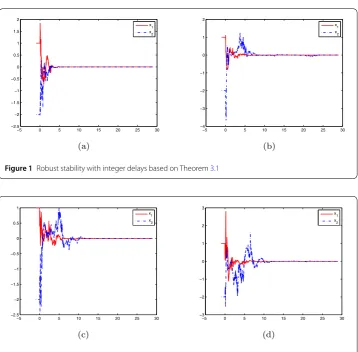
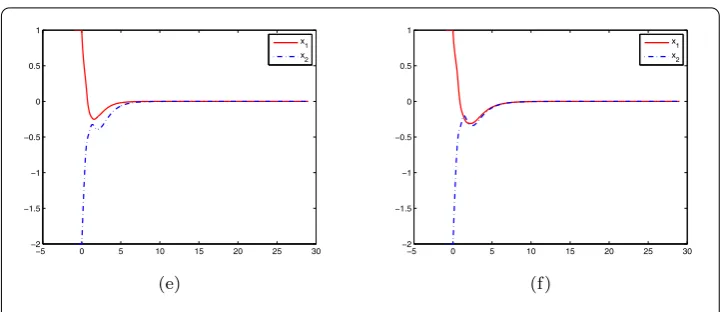
figures are presented in Fig.1, Fig.2, and Fig.3. The robust stability of system (1) with integer delays based on Theorem3.1is showed in Fig.1. The robust stability of system (1) with bounded time-varying delaysd(k) based on Theorem3.1is presented in Fig.2. And the robust stability of system (1) with integer delays based on Theorem3.2is provided in Fig.3. Therefore, system (1) with two states is robust stable.
Remark2 We know that the uncertainty parameters are difficult to express in this nu-merical simulation system. In order to address the uncertainty, these uncertainty param-eters are replaced with matrices randomly generated in Matlab. Therefore matricesA,
Figure 1Robust stability with integer delays based on Theorem3.1
Figure 3Robust stability with integer delays based on Theorem3.2
Ad,Bcan be objectively described with noise matrices by the stochastic quantitative method.
5 Conclusions
In this paper, we have investigated the robust stability for a class of uncertain parameter discrete systems with delays. The uncertainty parameter systems are more complex with time delays. By choosing a Lyapunov functional and utilizing some well-known inequal-ities, we provide two novel delay-dependent criteria which guarantee the robust stability of a class of uncertainty discrete-time systems. A method called the forward difference and an idea called the cost function have been developed to solve this problem of theo-rem proof. The sufficient conditions based on the feedback control for the robust stability have been obtained in terms of LMI. Meanwhile, the controller gain is designed for the cost control. The example has been given to demonstrate the effectiveness of the main results obtained. In addition, the adaptive synchronization analysis of this model with impulsive disturbance as well as fractional Brownian noise based on Markov switching parameters can be discussed in the near future.
Acknowledgements
We thank the referees for their time and comments.
Funding
Supported by the Natural Science Foundation of China (Grant No. 11871118).
Competing interests
The authors declare that they have no competing interests.
Authors’ contributions
XZ conceived the research idea and co-wrote the paper. ZY conducted the theorem analysis and numerical simulations. All authors read and approved the final manuscript.
Publisher’s Note
Springer Nature remains neutral with regard to jurisdictional claims in published maps and institutional affiliations.
Received: 11 September 2018 Accepted: 27 January 2019 References
1. Zhou, W., Zhou, X., Yang, J., Zhou, J., Tong, D.: Stability analysis and application for delayed neural networks driven by fractional Brownian noise. IEEE Trans. Neural Netw. Learn. Syst.29(5), 1491–1502 (2018)
3. Zhou, X., Zhou, W., Yang, J., Dai, A.: Asymptotical stability of stochastic neural networks with multiple time-varying delays. Int. J. Control88(3), 613–621 (2015)
4. Mahmoud, M.S., Almutairi, N.B.: Robust stability and stabilization methods for a class of nonlinear discrete-time delay systems. Appl. Math. Comput.215(12), 4280–4292 (2010)
5. Li, S.: Robust stability and stabilization of LTI fractional-order systems with poly-topic and two-norm bounded uncertainties. Adv. Differ. Equ.2018, 88 (2018)
6. Xu, X., Liu, L.: Robust stability analysis for linear systems subjected to time-varying uncertainties within the framework of nest algebra. Science Asia44(1), 46–53 (2018)
7. Zheng, S.: Robust stability of fractional order system with general interval uncertainties. Syst. Control Lett.99, 1–8 (2017)
8. Song, Q., Yu, Q., Zhao, Z.: Boundedness and global robust stability analysis of delayed complex-valued neural networks with interval parameter uncertainties. Neural Netw.103, 55–62 (2018)
9. Qiu, S., Liu, X., Wang, F.: Robust stability analysis for uncertain recurrent neural networks with leakage delay based on delay-partitioning approach. Neural Comput. Appl.30(1), 211–222 (2018)
10. Maharajan, C., Raja, R., Cao, J.: Novel global robust exponential stability criterion for uncertain inertial-type BAM neural networks with discrete and distributed time-varying delays via Lagrange sense. J. Franklin Inst. Eng. Appl. Math.355(11), 4727–4754 (2018)
11. Cheng, S., Zhang, Q.: Robust stability and stabilization for descriptor systems with uncertainties in all matrices. Int. J. Robust Nonlinear Control28(3), 753–766 (2018)
12. Svetoslav, S., Ivan, P.: Robust stability of discrete-time system with polytopic uncertainty. C. R. Acad. Bulgare Sci.70(6), 857–862 (2017)
13. Yang, H., Jiang, B., Tao, G.: Robust stability of switched nonlinear systems with switching uncertainties. IEEE Trans. Autom. Control61(9), 2531–2537 (2016)
14. Ramasamy, K., Balasubramaniam, P.: Robust stability results for nonlinear Markovian jump systems with mode-dependent time-varying delays and randomly occurring uncertainties. Complexity21(6), 50–60 (2016) 15. Guo, Y., Wang, Y., Xie, L.: Robust stability of reset control systems with uncertain output matrix. Automatica48(8),
1879–1884 (2012)
16. Li, X., Wu, J.: Stability of nonlinear differential systems with state-dependent delayed impulses. Automatica64, 63–69 (2016)
17. Li, X., Song, S.: Stabilization of delay systems: delay-dependent impulsive control. IEEE Trans. Autom. Control62(1), 406–411 (2017)
18. Li, X., Cao, J.: An impulsive delay inequality involving unbounded time-varying delay and applications. IEEE Trans. Autom. Control62(7), 3618–3625 (2017)
19. Dong, Y., Zhang, Y., Zhang, X.: Design of observer-based feedback control for a class of discrete-time nonlinear systems with time-delay. Appl. Comput. Math.13(1), 107–121 (2014)
20. Boukas, E.K.: State feedback stabilization of nonlinear discrete-time systems with time-varying time delay. Nonlinear Anal., Theory Methods Appl.66(6), 1341–1350 (2007)
21. Fernando, T.L., Phat, V.N., Trinh, H.M.: Output feedback guaranteed cost control of uncertain linear discrete systems with interval time-varying delays. Appl. Math. Model.37(3), 1580–1589 (2013)
22. Manivannan, R., Panda, S., Chong, K.T., Cao, J.: An Arcak-type state estimation design for time-delayed static neural networks with leakage term based on unified criteria. Neural Netw.106, 110–126 (2018)
23. Manivannan, R., Samidurai, R., Cao, J.: Stability analysis of interval time-varying delayed neural networks including neutral time-delay and leakage delay. Chaos Solitons Fractals114, 433–445 (2018)
24. Manivannan, R., Cao, Y.: Design of generalized dissipativity state estimator for static neural networks including state time delays and leakage delays. J. Franklin Inst.355(9), 3990–4014 (2018)
25. Manivannan, R., Samidurai, R., Cao, J., Alsaedi, A., Alsaadi, F.E.: Design of extended dissipativity state estimation for generalized neural networks with mixed time-varying delay signals. Inf. Sci.424, 175–203 (2018)
26. Boyd, S., El Ghaoui, L., Feron, E., Balakrishnan, V.: Linear Matrix Inequalities in System and Control Theory. SIAM, Philadelphia (1994)