R E V I E W
The effectiveness of Tai Chi for short-term
cognitive function improvement in the early stages
of dementia in the elderly: a systematic literature
review
This article was published in the following Dove Press journal: Clinical Interventions in Aging
Karine Huy-Leng Lim1
Alex Pysklywec2
Michelle Plante3
Louise Demers3,4
1Centre Intégré Universitaire de Sante at Service Sociaux du Nord de l‘île de Montréal, Montréal, QC, Canada; 2Department of Geography and Planning, Queen’s University, Kingston, ON, Canada;3Centre de Recherche de l’In Université de Montréalstitut
Universitaire de Gériatrie de Montréal, Montréal, QC, Canada;4École de Réadaptation, Université de Montréal, Montréal, QC, Canada
Purpose: This systematic review examines intervention studies using Tai Chi in the early
stages of dementia to determine the effectiveness of Tai Chi for the short-term improvement of cognitive functions for elderly persons with the disease.
Methods: A keyword search was done in PubMed/MEDLINE, Cumulative Index to
Nursing and Allied Health Literature (CINAHL), Excerpta Medica Database (EMBASE), and Cochrane Library databases using keywords such as Tai Chi, Dementia*, and cognition. A secondary search strategy consisting of a manual search in the reference lists of selected articles was also used.
Results:A total of nine studies were reviewed including six randomized controlled trials,
two non-randomized controlled trials, and one non-randomized prospective study. The studies suggest Tai Chi has impacts on global cognitive functions, visuospatial skills, semantic memory, verbal learning/memory, and self-perception of memory. The effects of Tai Chi on overall cognition for people with mild cognitive impairment are comparable to those in control groups which engaged in exercise.
Conclusion: The studies reviewed affirm the potential of Tai Chi to improve short-term
cognitive function in the elderly at the onset of dementia.
Keywords: behavioral intervention, cognition, dementia, older adult, Tai chi, systematic
review
Introduction
It is estimated that the proportion of those aged 60 and over will double from 11%
in 2000 to 22% by 2050.1As a result, health care systems will face new challenges
due to increased health-related problems such as neurodegenerative diseases.
Dementia is the most prevalent of these.2It is estimated that the number of people
in Canada living with dementia will increase from approximately 400,000 to nearly
700,000 by 2031.3The prevalence rate doubles approximately every 6 years from
the age of 65, from 7% of those affected between 75 and 79 years of age to 40% for
those aged 90 and over.4,5 In 2012, the World Health Organization declared
dementia a public health priority.6
Dementia is a term used to encompass many diseases that are usually chronic or
progressive in nature.4It is caused by neurodegeneration or a loss of cells in the
Correspondence: Louise Demers École de réadaptation, Faculté de médecine, Université de Montréal, C.P. 6128, succursale Centre-ville, Montréal, QC H3C 3J7, Canada
Tel +1 514 343 6417 Fax +1514 343 2105
Email [email protected]
Clinical Interventions in Aging
Dove
press
open access to scientific and medical research
Open Access Full Text Article
Clinical Interventions in Aging downloaded from https://www.dovepress.com/ by 118.70.13.36 on 20-Aug-2020
brain and the rupture of important nerve connections.7 There are several consequences associated with dementia, including behavioral changes, a deterioration of memory and reasoning, and the loss of the ability to perform daily activities that occur more rapidly comparatively to the
normal aging process.8The most common form of
demen-tia is Alzheimer’s disease, which accounts for 60–70% of
dementia cases.6
The social and economic impacts of dementia are numerous. In 2015, it was estimated that 48.7 million people globally were living with dementia resulting in approximately US$818 billion of care-related costs
(1.09% of the global gross domestic product).9It is
pro-jected that by 2030, 75 million people will have some
form of dementia, with care costing nearly US$2 trillion.9
Although population-level health interventions aimed at prevention are required, individual interventions are needed to ameliorate the quality of life of those already diagnosed with dementia and to possibly improve short-term cognitive function in the early stages of the disease. Evidence suggests that pharmacological interventions may
have only limited benefits for reducing the decline in daily
life habits and may also cause unwanted side effects.10
Additionally, clinical practice guidelines recommend beginning with more cost-effective behavioral or psycho-logical interventions before initiating pharmacopsycho-logical
interventions.1 Currently, the only evidence-based
beha-vioral intervention that has shown to provide short-term improvement of cognitive function is that of physical
activity.1,10–12
Tai Chi is a physical activity that also incorporates cognitive, social, and meditation components, and it is currently gaining popularity and generating much
interest.-11
It involves learning choreographed movement patterns, which require visuospatial skills, rapid information
proces-sing, and episodic memory.1 Tai Chi also leads to
increased heart rate and respiration, which helps create a larger network of connections between neurons thus
enhancing brain perfusion.1 Previous studies have
sug-gested that Tai Chi is a safe and effective activity that improves physical balance and emotional well-being in
older adults without disabilities.13,14 At the cognitive
level, several studies suggest that Tai Chi interventions
potentially provide beneficial effects, such as preserving
or improving cognitive functions and reducing the risk of developing dementia in the older adult population who are
without disabilities.5,11 A systematic review comparing
studies of Tai Chi against regular physical activities in
relation to the maintenance of cognitive ability among
healthy adults suggests that Tai Chi can be more effi
ca-cious than simply physical exercise for the maintenance of
global cognitive skills.1
Some emerging research demonstrates the potential effectiveness of Tai Chi in providing short-term improve-ment in cognitive function in the early stages of deimprove-mentia. Burgener et al conducted a 40-week intervention with people living with dementia (treatment group, n=24; con-trol, n=19) to evaluate the effectiveness of a multimodal
intervention.12 The authors concluded that interventions
combining Tai Chi, cognitive therapy and participation in a support group can be effective in improving or maintain-ing cognitive function for people with dementia. Wayne et al conducted a systematic review to explore the effective-ness of Tai Chi on cognitive performance in adults with and without cognitive impairment, concluding that Tai Chi may enhance executive function in older adults without
significant impairment; however, their sample included
participants with early stages to advanced stages of dementia, and this heterogeneous group may have masked
the effects for any subgroups of participants.11
Given the lack of consensus on the efficacy of
pharma-cological approaches and the emphasis on behavioral-focused treatments in the clinical setting, there has been growing interest in behavioral interventions, such as Tai Chi. The purpose of this systematic review is to examine intervention studies using Tai Chi in the early stages of dementia to determine the effectiveness of Tai Chi to improve short-term cognitive function.
Methods
A keyword search of electronic databases that followed the Preferred Reporting Items for Systematic Reviews and
Meta-Analyses (PRISMA) guidelines identified and
selected articles relevant for the purpose of the study.15
With the assistance of a biomedical librarian, an initial
search was conducted by the first author in September
2016, with an updated search conducted by the second author in December of 2018. The literature search was done in the following databases: PubMed/MEDLINE,
Cumulative Index to Nursing and Allied Health
Literature (CINAHL), Excerpta Medica Database
(EMBASE), and Cochrane Library using the following keywords: Tai Chi OR Tai Ji OR taichi OR taiji AND Dementia* OR Alzheimer* OR cognition OR cognitive OR neurocognitive disorder. A secondary search strategy was also used which involved a manual search in the
Clinical Interventions in Aging downloaded from https://www.dovepress.com/ by 118.70.13.36 on 20-Aug-2020
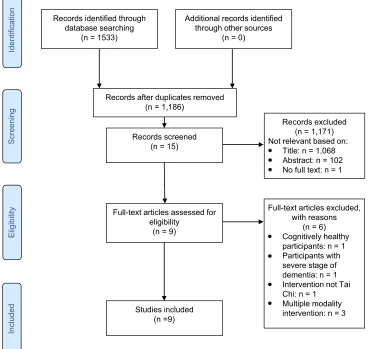
reference lists of selected articles. Figure 1 presents a PRISMA diagram summarizing the process of article
selection.15 The Supplementary material provides an
example of a search strategy.
Selected articles (1) included participants in the early stages of dementia (all forms of dementia were included),
beginning stages were defined by a Mini-Mental Status
Exam (MMSE) score between 18 and 24 and/or a Clinical Dementia Rating (CDR) score of 0.5 or 1 (valid for at least 80% of the sample); (2) employed Tai Chi exclusively as the intervention (all forms of Tai Chi were included); (3) examined the effects of Tai Chi on cognition; and (4) were written in French or English.
An extraction table was completed in order to facilitate the comparison of different elements found in the selected articles. The table format was based on other systematic
reviews of a similar topic.1,11 The information extracted
from the articles included the authors, the year of publica-tion, the country where the study took place, the study
design, the sample size, participant demographic informa-tion, the nature of the control group activity (eg, other form of exercise, education material, no activity), the length and frequency of the Tai Chi intervention, and the outcome measures.
Two evaluators (first and fourth authors) independently
assessed the quality of selected articles. The evaluation
tool used was a version of the “Checklist for Clinical
Trial Quality Assessment,” a 27-item tool with a total
possible score of 28 points.16,17The assessment is divided
into four sub-sections: reporting (ten items), external validity (three items), internal validity-bias (seven items),
and internal validity-confounding (six items). An“
excel-lent”score ranges from 24 to 28;“good”, 19 to 23;“fair”,
14 to 18; or“poor”, below 14.17,18
Results
A total of nine studies were selected including six randomized
controlled trials,5,21,22,24–26 two non-randomized control
Full-text articles assessed for eligibility
(n = 9)
Full-text articles excluded, with reasons
(n = 6) Cognitively healthy participants: n = 1 Participants with severe stage of dementia: n = 1 Intervention not Tai Chi: n = 1
Multiple modality intervention: n = 3 Studies included
(n =9)
Identification
Screening
Eligibility
Included
Records identified through database searching
(n = 1533)
Additional records identified through other sources
(n = 0)
Records after duplicates removed (n = 1,186)
Records screened (n = 15)
Records excluded (n = 1,171) Not relevant based on:
Title: n = 1,068 Abstract: n = 102 No full text: n = 1 ●
● ●
●
●
●
●
Figure 1PRISMA diagram.
Clinical Interventions in Aging downloaded from https://www.dovepress.com/ by 118.70.13.36 on 20-Aug-2020
trials,20,23and one non-randomized prospective study.19The average age across all 9 studies was 78 years old. The sample size for each of the studies ranged from 11 to 238 participants.
The studies were conducted infive countries: Brazil (n=1),20
China (n=3),5,21,26 the United States (n=3),19,23,24 France
(n=1),22and Thailand (n=1).25In seven of the studies,
partici-pants lived in the community,5,19,20,23–26 while two studies
focused on participants in an institutionalized
environment.-21,22
The duration of Tai Chi interventions varied greatly from 8 weeks to 1 year, in terms of frequency of practice (1 to 4 times a week), and style. Seven of the studies used control groups with various types of interventions, such as education, adaptive
physical activity, or crafts-based exercises.5,20,21,23–26Table 1
presents the characteristics of each of the selected studies. Methodological quality scores ranged from 14 to 25, with an average of 20.2 out of a possible 28 points. According to the interpretation scale, two articles scored
as being of “excellent”quality,25,26 five articles qualified
as “good,”5,21–24 and two articles qualified as “fair.”19,20
None of the studies were identified as being of “poor”
quality. The methodological quality of the selected studies is described in Table 2.
Effects of tai chi on cognitive functions
Similar to the reporting style for the studies reviewed, the results presented below are according to cognitive func-tions that were measured in the selected studies.
Global cognitive functions
Impacts on global cognitive function were estimated in
seven of the studies.5,19,21–24,26 All studies used the
MMSE tool,5,19,21–24,26however, Lam, et al also used the
Alzheimer’s Disease Assessment Scale (ADAS-Cog) and
the Clinical Dementia Rating (CDR).5The MMSE and the
CDR are tools used to screen for cognitive disorders, while the ADAS-COG is often used to evaluate the effectiveness
of interventions for Alzheimer’s disease.
By the end of their respective Tai Chi interventions, participants, on average, maintained or increased their scores on one or more of the cognitive functions. In four
studies,5,19,21,22MMSE performance remained stable with
no significant difference in scores within and between
groups. Among these studies, Chang et al was a
one-group pre-post design,19 while the studies authored by
Chan, et al21 Deschamps et al,22 and Lam et al were
randomized control trials.5 In the latter two, the MMSE
scores remained stable for the Tai Chi group and for the adapted-exercise control group. Three studies reported
improvements in overall cognitive function by the end of
the intervention.23,24,26 Of these studies, the studies by
Tsai et al and Cheng et al showed significant improvement
in performance in the intervention groups compared to that of the control groups (engaged in crafts and
education).-24,26
Lam et al5who used the ADAS-COG and CDR tools,
also showed an improvement in overall cognitive function after one year of intervention. This improvement, how-ever, was present in both the intervention group and the control group who did adapted exercise. While the overall cognitive function measured with the CDR was better preserved in the Tai Chi group than in the control group, only 4.3% (n=4) of participants in the Tai Chi group, progressed to dementia as diagnosed by the DSM-IV, compared to 16.6% (n=28) of the control group after one
year.5
Working memory and executive function
The impacts of Tai Chi on working memory and executive
function were reported in five studies using Digit Span
Backward (DSB),5,20,25,26 Digit Symbol Coding (DSC),19
Digit Span Forward (DSF),20,25,26 15-Word immediate
recall and/or Trail Making Test–Part B (TMT-B).25 The
DSF and DSB tests, derived from the Wechsler Adult Intelligence Scale (WAIS), consist of storing and repeating digit sequences in reverse order immediately after hearing
them.20The DSC, also from the WAIS, consists of
decod-ing symbols accorddecod-ing to their association with numbers.27
The TMT-B required participants to connect alternating letters and numbers in the correct order as quickly as
possible (eg, 1-A-2-B, etc.).25
Varying results were reported for the effect of Tai Chi on executive function or working memory from across the wide variety of measurements. Three studies used DSB to
measure this cognitive outcome.5,20,25 Two of these
stu-dies, those of Sungkarat et al and Cheng et al25,26 with
intervention durations of 12 and 15 weeks, did not demon-strate a difference between the intervention group and the control group at the end of the interventions. On the other
hand, the study conducted by Lam et al5 of a longer
duration demonstrated an improvement in working mem-ory after one year of intervention with the same tool. This improvement was found in both the intervention and the
control group but there was no significant difference
between the groups.5The studies conducted by Chang et
al and Cheng et al showed no significant difference
between pre- and post-intervention scores for working
memory,19,26 as assessed with the DSC and 15-Word
Clinical Interventions in Aging downloaded from https://www.dovepress.com/ by 118.70.13.36 on 20-Aug-2020
T able 1 Summar y of included studies
Author/ Year/ Countr
y Study Design P articipants T ype, fr equency , and duration of inter v ention Co gnitive outcomes/Measurements a Results related to co gnitiv e measur es Chan et al 2016 21 China RCT 52 participants with MCI (determined by an MMSE score betw een 13 – 26) Mean age =81 Community-dwelling I/C =27/25 Inter vention gr oup: TC Qiqong (gr oup class) 60 minutes, 2 times/w eek X 2 months Contr ol gr oup: health talk gr oup in community center 1 time/w eek X 2 months (1) Global cognitive function: MMSE; (2) A war eness of memor y de fi cits: MIC; Outcomes measur ed at baseline, after 2 months and after 6 months, No signi fi cant differe nce noted in MMSE scor e and MIC score betw een both gr oups (T1: p =0.394; T2: p =0.219). Chang et al 2011 19 United States PNCT 11 participants with MCI (determined by 15 ≤ MMSE scor e ≤ 27; DSC ≤ 6; DS ≤ 6; Str oop Color and W or d test or HVL T-R score ≤ 39) Mean age =85 Community-Dwelling Inter vention gr oup: TC sun style for arth ritis (gr oup class) 20 – 40 minutes, 2 times/w eek X 15 w eeks (1) Global cognitive function: MMSE; (2) W orking memor y: DSC & DS; (3) Attention: ST -color -w or d; (4) V erbal learning and memor y: HVL T-R; Outcomes measur ed at baseline and after 15 w eeks. At 15 w eeks, no signi fi cant pr e-post differe nces in MMSE score ( p =0.22), DSC ( p =0.32), DS ( p =1.08), Str oop Color and W or d Test ( p =0.4) and HVL T-R ( p =0.36). At 15 w eeks, signi fi cant differ ence in MMSE scor e in elders who participated in 24 – 29 ses-sions versus those who only w ent to 4 or less sessions ( p <0.05) and DSC ( p <0.05). Cheng et al 2014 26 China RCT 110 particip ants with MCI or early AD (determined by MMSE scor e betw een 10 – 24; CDR ≥ 0.5) Mean age =82 Institutionalized I/C =39/35 Inter vention gr oup: TC 12-form Y ang Style or Mahjong (gr oup class) 60 minutes, 3 times/w eek X 12 w eeks Contr ol gr oup: handicraft (fr e-quency and duration: idem) (1) Global cognitive function: MMSE; (2) W orking memor y: DSF , DSB & 15-w ord immediate re call; (3) Episodic memor y: 15-w or d 30 min. dela yed re call; (4) Semantic memor y: categorical fl uency; Outcomes measur ed at baseline, w eek 12, 24 and 36. At 24 w eeks, signi fi cant differ ence in MMSE scor e (3.7 pts.) betw een I gr oup (+1.5 pts.) and C gr oup ( − 2.7 pts.) (95%CI: 1.4 – 6.0; d=0.40). Signi fi cant differ ence in DSF scor e betwe en gr oups fa voring I gr oup ov er C gr oup (0.98; 95% CI: 0.12 – 1.84; d =0.25). At all time, no signi fi cant differe nce betw een gr oups in DSB, 15-w ord immediate & 30 min. dela ye d recall and categorical fl uency . Deschamps et al 2009 22 F rance RCT 52 participants with mild to moderate cognitiv e impairment Mean age =81
Institutionalized 2inter
ventions gr oups: TC: n=26 C A: n=26 TC inter ve ntion gr oup: Adapted TC Y ang Style (gr oup class) 30 minutes, 4 times/w eek X 24 w eeks C A inter ve ntion gr oup: Adapted ph ysical gr oup activity and education on health 30 – 40 minutes, 2 times/w eek X 24 w eeks (1) Global cognitive function: MMSE; Outcome measur ed at baseline and after 24 w eeks. At 24 w eeks, TC gr oup ’ s MMSE score remained stable (pr e-test: 19.4±7.4; post-test: 21.1±6.4; p =0.6). No signi fi cant differe nce in scor e betwe en both inter vention gr oups ( p =0.8). ( Continued )
Clinical Interventions in Aging downloaded from https://www.dovepress.com/ by 118.70.13.36 on 20-Aug-2020
T
able
1
(Continued).
Author/ Year/ Countr
y Study Design P articipants T ype, fr equency , and duration of inter v ention Co gnitive outcomes/Measurements a Results related to co gnitiv e measur es Kasai et al 2010 20 Brazil NRCT 26 participants (elderly w omen) with MCI Mean age =74 Community-Dwelling I/C =13/13 Inter vention gr oup: TC Chuan Y ang Style (gr oup class) and recommendation to also prac-tice at home 60 minutes, 2 times/w eek X 6 months Contr ol gr oup: no inter vention (1) Self-per ception of memor y: SMC; (2) Memor y: RBMT ; (3) W orking memor y: DSF; (4) Concentration capacity: DSB; Outcomes measur ed at baseline, after 3 months and after 6 months. At 6 months, signi fi cant dr op in memor y com-plaints in I gr oup compar ed to C gr oup ( p =0.023). At 6 months signi fi cant incr ease in RBMT scor e in I gr oup compar ed to C gr oup ( p =0.007). At 6 months, signi fi cant differe nce for DSF in I gr oup compar ed to C gr oup ( p =0.031). But no signi fi cant differ ence in DSB score betw een the 2 gr oups ( p =0.164). Lam et al 2014 5 China RCT 238 particip ants with amnestic MCI or CDR =0.5 Mean age =78 Community-dwelling I/C =96/169 Inter vention gr oup: TC (4 – 6 w eeks center -based and 46 – 48 w eeks home-based training with D VD of TC pr ogram + monthly refr esher). 30 minutes, 3 times/w eek X 1 year Contr ol gr oup: Str etching and relaxation ex er cises by PT &O T (1) Global se ve rity of cognitiv e impairment: CDR; (2) Global cognitive function: AD AS-COG & MMSE; (3) W orking memor y: DSB; (4) Episodic memor y: 10-min. dela yed recall; (5) Semantic memor y: Categor y ve rbal fl uency tests; Outcomes measur ed at baseline, after 2 months and after 12 months. At 1 year , I gr oup had better cognitive pr eser -vation than C gr oup: 4/92 (4.3%) [I] VS 28/169 (16.6%) [C] pr ogr essed to dementia (odds ratio [OR] =0.28; 95%CI=0.05 – 0.92; p =0.064). Signi fi cant differe nce in score fa vor ing I gr oup for CDR scor e ( p =0.038; 95%CI =0.63 – 0.99). At 1 year , both gr oups impr ov e in AD AS-COG, DSB, Dela yed re call test and categor y verbal fl uency but no signi fi cant differ ence betw een gr oups was noted ( p >0.05). No signi fi cant change in MMSE scor e in both gr oups (95%CI= − 0.62 – 1.42; p =0.44). Li et al 2014 23 United States NRCT 46 participants with MCI (determined by 20 ≤ MMSE scor e ≤ 25) Mean age =76 Community-dwelling I/C =22/24 Inter vention gr oup: Enhanced TC Chuan (gr oup class) 60 minutes, 2 times/w eek X 14 w eeks Contr ol gr oup: no inter vention Global cognitiv e function: MMSE; Outcome measur ed at baseline and after 14 w eeks. At 14 w eeks, I gr oup show ed signi fi cant impr ove ment on MMSE (mean =2.26, p <0.001) compared to C gr oup (mean =0.63, p =0.08). ( Continued )
Clinical Interventions in Aging downloaded from https://www.dovepress.com/ by 118.70.13.36 on 20-Aug-2020
T
able
1
(Continued).
Author/ Year/ Countr
y Study Design P articipants T ype, fr equency , and duration of inter v ention Co gnitive outcomes/Measurements a Results related to co gnitiv e measur es Sungkarat et al 2017 25 Thailand RCT 66 participants with MCI (meeting P eterson ’ s criteria for diagnosing amnestic multiple-domain MCI) Mean age =68 Community-dwelling I/C =33/33 Inter vention gr oup: TC 10-forms style (3 w eeks center -based & 12 w eeks home-based with D VD of TC pr ogram) 50 minutes, 3 times/w eek X 15 w eeks Contr ol gr oup: education gr oup on cognitiv e impairment (1) Episodic memor y: Logical Memor y – dela yed re call; (2) Visuospatial ability: Block Design; (3) Ex ecutive function: DSF , DSB & TMT -B; Outcomes measur ed at baseline and after 15 w eeks. At 15 w eeks, scor es w er e signi fi cantly better in I gr oup compar ed to C gr oup for the Logical Memor y – dela ye d recall ( p =0.006), Block Design ( p =0.01) and T rail Making Test – Part B-A ( p =0.005). No signi fi cant differ ence betw een gr oups for DSF and DSB ( p =0.43). Tsai et al 2013 24 United States RCT 55 participants with MCI (determined by 18 ≤ MMSE scor e ≤ 28) Mean age =79 Community-dwelling I/C =28/27 Inter vention gr oup: TC Sun Style (gr oup class) 20 – 40 minutes, 3 times/w eek X 20 w eeks Contr ol gr oup: health and cul-tural information class (fre -quency and duration: idem) Global cognitiv e function: MMSE; Outcome measur ed at baseline, w eek 5, 9, 13, 17 and 21. At 21 w eeks, signi fi cant impr ov ement in MMSE scor e only in I gr oup ( p =0.003 [I] vs p =0.082 [C]). No signi fi cant change in differ ence betw een the 2 gr oups ov er time ( p =0.223). Notes : aCognitiv e outcomes and measur ements used by the authors. Abbre viations : AD AS-COG, Alzheimer ’ s Disease Assessment Scale – Cognitiv e; AMD , Adjusted Mean Differen ce; C , Contr ol Gr oup; C A, Cognition-Action pr ogram; CDR, Clinical Dementia Rating; D AD , Disability Assessm ent for Dementia; DS, Digit Span; DSB, Digit Span Backwar d; DSC , Digit Symbol Coding; DSF: Digit Span Fo rwar d; HVL T-R, Hopkins V erbal Learning test – Revis ed; I, Inter vention Gr oup; MCI, Mild Cognitiv e Impairment; MIC , Memor y Inv entor y for Chinese Questionnair e; MMSE, Mini Mental Status Exam; NPI, Neur opsychiatric Inv entor y; NRCT , Non-Randomize Contr ol T rial; O T , Occu pational Therap y; PNCT , Pr ospective Non Contr olled T rial; PT , Ph ysical Therapist; RCT , Randomize Contr olled T rial; RBMT , Riv ermead Beha vioural Memor y T est; SMC , Subjectiv e Memor y Complaints Scale; ST -color -wor d, Str oop color and W or d test; TC , T ai Chi; TMT -B, T rail Making T est – Part B.
Clinical Interventions in Aging downloaded from https://www.dovepress.com/ by 118.70.13.36 on 20-Aug-2020
T
able
2
Summar
y
of
study
quality
and
risk
of
bias
Study
Reporting (scor
ed
out
of
11)
External
validity
(scor
ed
out
of
3)
Internal
validity
–
Bias
b
(scor
ed
out
of
7)
Inter
val
validity
–
confounding
(selection
bias,
scor
ed
out
of
6)
T
otal
scor
e
(out
of
28)
Chan
et
al
21
10
2
5
5
22
Chang
et
al
19,a
7/9
0
4/6
0/1
15.6
a
Cheng
et
al
26
10
3
5
5
24
Deschamps
et
al
22
92
5
5
21
Kasai
et
al
20
70
5
2
14
Lam
at
al
5
72
6
5
20
Li
et
al
23
11
1
4
3
19
Sungkarat
et
al
25
11
2
6
5
25
Tsai
et
al
24
10
2
5
5
22
Notes
:
aThis
article
was
a
pr
ospectiv
e
non-contr
olled
trial
for
which
the
scores
and
total
scor
e
w
er
e
adjusted.
bThe
main
outcomes
consider
ed
during
the
e
valuation
of
quality
are
only
those
related
to
cognition.
Abbre
viations
:
AD
AS-Cog,
Alzheimer
’
s
Disease
Assessment
Scale;
C
AMDEX,
Cambridge
Examination
for
Mental
Disor
ders
of
the
Elderly;
CDR,
Clinical
Dementia
Rating;
CINAHL,
Cumulativ
e
Index
to
Nursing
and
Allied
Health
Literatur
e;
DSB,
Digit
Span
Backward;
DSC
,
Digit
Symbol
Coding;
DSF
,
Digit
Span
Forwar
d;
EMBASE,
Excerpta
Medica
Database;
HVL
T-R,
Hopkins
V
erbal
L
earning
T
est
–
Re
vised;
MIC
,
Memor
y
In
ventory
for
Chinese
Questionnaire;
MCI,
Mild
cognitiv
e
disor
der
;
MMSE,
Mini-Mental
State
Examination;
PRISMA,
Preferr
ed
Reporting
Items
for
Systematic
Re
vie
ws
and
Meta-Analyses;
S
MC
,
Subjectiv
e
Memor
y
Complaints
Scale;
PRISMA,
Systematic
Revie
ws
and
Meta-Analyses;
TMT
-B,
T
rail
Making
Test
–
Part
B;
W
AIS,
W
echsler
Adult
Intelligence
Scale.
Clinical Interventions in Aging downloaded from https://www.dovepress.com/ by 118.70.13.36 on 20-Aug-2020
immediate recall. The results for working memory were positive for two out of the three studies that used the DSF
evaluation tool,20,26while Sungkarat et al did not report a
significant difference compared to their control group
(education).25 The studies that found positive results for
the DSF reported a significant difference with their control
group which, in one case, was a passive control group and the other was an active control group (crafts
activities).-20,26
Sungkarat et al25 also used the TMT-B to evaluate
executive function and achieved a significant improvement
against its control group.
The studies’ results were analyzed according to the
frequency and duration of the Tai Chi intervention. The three studies offering Tai Chi sessions three times/week showed an improvement in working memory and
execu-tive function in at least one of the tests used.5,25,26 For
these studies, the duration of Tai Chi sessions was 30, 50, and 60 mins, 3 times/week for 1 year, 15 weeks, and 12
weeks, respectively.5,25,26
Verbal learning and memory
Of the five studies that measured verbal learning and
memory,5,19,20,25,26results suggested that Tai Chi
interven-tions may improve performance. Three studies noted
improvement for these cognitive functions,5,20,25 while
two studies reported no effect.19,26 Verbal learning and
memory were evaluated by the following tests: the
Hopkins Verbal Learning Test – Revised (HVLT-R),19
based on the recall of12 words 20–25 mins after being
learned,28the 15-Word 30-Min Delayed Recall,26based on
the recall of 15 words learned after 30 mins, 10-Min
Delayed Recall,5based on the reminder of words learned
after 10 mins (number of words not mentioned in the
article), the Riverhead Behavioral Memory Test
(RBMT),20 which evaluates different tasks simulating
situations of everyday life, and the Logical Memory –
Delayed Recall, which asks the participant to recount two stories as precisely as possible 30 mins after hearing
them.25
Sungkarat et al25 demonstrated a significant
improve-ment in verbal learning and memory skills, as compared to the control group (education). This result was supported
by the findings of Kasai et al who reported a significant
improvement in the same cognitive functions after six months of intervention compared to a passive control
group.20 After one year, Lam et al observed an
improve-ment in memory in both the intervention group and control
group, who practiced adapted physical exercise, but no
significant difference between the two.5
Self-perception of memory
The effects of Tai Chi on self-perception of memory were
reported by Chan et al and Kasai et al.,20,21 with both
studies indicating improvements. During their eight-week intervention, Chan et al used the Memory Inventory for
Chinese Questionnaire (MIC),21 a 27-item evaluation
administered in a semi-structured interview, observing
improvements but no significant differences between the
intervention and control groups.29 The investigation
car-ried out by Kasai et al lasted 24 weeks and used the
Subjective Memory Complaints Scale (SMC),20an
assess-ment derived from the Cambridge Examination for Mental Disorders of the Elderly (CAMDEX) and composed of ten
questions.30 Their results suggested a significant decrease
in complaints of memory loss in the control group com-pared to the passive control group. The Kasai et al inter-vention duration was three times longer (twice per week for six months) than that of Chan et al (twice per week for
two months).20,21
Attention and concentration
Chang et al and Kasai et al assessed attention and
con-centration using different tools.19,20 Chang et al used the
Stroop Color and Word,19 a neuropsychological
assess-ment to determine cognitive-interference abilities,31while
Kasai et al employed the DSB.20The results of the studies,
both of fair methodological quality, showed no effect with
the practice of Tai Chi on attention and concentration.19,20
Semantic memory
Two studies evaluated the effect of Tai Chi on semantic
memory with the Categorical Verbal Fluency Test.5,26This
evaluation consists in saying as many words as possible in one minute according to given categories (animals, fruits,
vegetables).26Cheng et al,26whose study was of excellent
methodological quality, did not note any improvement in
semantic memory after 12 weeks. Lam et al,5a study of
good methodological quality, noted that there was a slight improvement in semantic memory in the Tai Chi group as compared to that of participants in the adapted exercise control group after one year.
Visuospatial skills
Sungkarat et al was the only study to have evaluated
visuospatial skills.25This study, deemed to be of excellent
Clinical Interventions in Aging downloaded from https://www.dovepress.com/ by 118.70.13.36 on 20-Aug-2020
methodological quality, used the Block Design tool, an evaluation consisting of placing blocks to reproduce a presented model and the quantity of blocks can increase from four to nine. They noted that after 15 weeks,
visuos-patial skills were significantly better for the intervention
group compared to the control group.25
Adverse effects
Of the nine studies, only four studies reported considering possible adverse effects; however, no adverse effects
related to Tai Chi practice were noted.21,23,25,26
Discussion
This systematic review was conducted to gain an apprecia-tion of the evidence surrounding non-pharmacological Tai Chi interventions. The studies included in this review suggest positive impacts on global cognitive functions, visuospatial skills, semantic memory, verbal learning/ memory, and self-perception of memory. The effects of Tai Chi on overall cognition for people with mild cogni-tive impairment are comparable to those control groups
which engaged in exercise.32,33The studies reviewed here
affirm the potential of Tai Chi to improve short-term
cognitive function in the early stages of dementia in the
elderly.26 These results are also consistent with the
sys-tematic review of Wayne et al11who concluded that there
was a slight clinically significant improvement in overall
cognitive function.
Contradictory results were noted across some of the studies. The differing conclusion for the positive impact of Tai Chi on semantic memory and self-perception of mem-ory may be explained by differences in the duration of
intervention.5,20,21,26 It is possible that improvement in
memory or perceived improvement is noted when inter-ventions are lengthier in duration (eg, six months or more). The mixed results regarding the effect of Tai Chi on executive function could be explained, among other things, by the multiple and complex nature of skills that
this cognitive domain represents.34 The effect of Tai Chi
appears to be most beneficial for the sub-functions of
mentalflexibility and immediate recall. This is consistent
with the praxis of Tai Chi, which involves the recalling and planning of movements.
Tai Chi may be an effective behavioral-focused treat-ment to consider for therapeutic intervention in clinical practice, such as in day hospitals, day centers, or commu-nity centers. Conceptually, this makes sense given that Tai Chi incorporates cognitive and physical abilities. Taken
together, the results of the studies reviewed suggest an intervention lasting at least three months with a frequency of three times per week between 30 and 60 mins per session could have a positive impact on some cognitive functions. After three months of a Tai Chi intervention,
even if interrupted, benefits may be maintained for up to
six to nine months post-intervention.26 An intervention
lasting six months to one year may lead to further improvements in other cognitive functions. Practitioners
may find it effective to compose intervention groups of
people with cognitive difficulties, exclusively, as opposed
to mixed groups. A relatively homogeneous group may allow for more tailored instruction aimed at the
partici-pants’ cognitive abilities. Consistently or partially
practi-cing Tai Chi in a group setting can further contribute to
slowing cognitive decline,5,19,25while potentially reducing
the risk of falling by improving overall physical condition
(eg, balance),23,25 promoting mental well-being, better
quality of sleep,21 and general improvements to quality
of life.22Consequently, locating a Tai Chi intervention in a
health or community center setting may ensure regular
practice by the client and provide the added benefit of
participating in a group activity. One further area of con-sideration when developing a Tai Chi intervention is the type of Tai Chi used. At present, to the best of our
knowl-edge, there is not a single study that attends to the efficacy
of one type of Tai Chi over another with respect to improving or maintaining cognitive functions. It is possi-ble, however, that certain types of Tai Chi may be easier for older adults with cognitive impairments to perform.
There are limitations to this systematic review. First, it is not a meta-analysis as there few studies reported on this topic. Another limitation is the wide variety of cognitive functions evaluated in the articles. In order to provide brief and clear results, this study regrouped certain cognitive functions despite there being differences between them. Finally, the studies reviewed were limited to cognition and to gain a more comprehensive view of the potential
benefits of Tai Chi it would be advantageous to include
measures that capture maintenance of ability to perform activities of daily living and mobility.
Conclusion
With an aging population that is increasing, maintaining functional autonomy of seniors will become a prominent issue. Therefore, it is important to introduce alternative activities such as Tai Chi to this population to stimulate physical, cognitive, and social skills while respecting
Clinical Interventions in Aging downloaded from https://www.dovepress.com/ by 118.70.13.36 on 20-Aug-2020
possible physical and cognitive limitations. Tai Chi is a safe activity for the elderly, free of adverse effects, and can be practiced alongside pharmacological interventions. The studies reviewed here support the potential of Tai Chi to improve short-term cognitive function in the elderly at the onset of dementia. The practice of Tai Chi promotes the preservation of cognitive abilities including global cogni-tive functions, semantic memory, verbal learning/memory, self-perception of memory, and visuospatial skills in the elderly.
Disclosure
The authors report no conflicts of interest in this work.
References
1. Zheng G, Liu F, Li S, Huang M, Tao J, Chen L. Tai Chi and the protection of cognitive ability: systematic review of prospective studies in healthy adults. Am J Prev Med. 2015;49(1):89–97. doi:10.1016/j.amepre.2015.01.002
2. Hirtz D, Thurman DJ, Gwinn-Hardy K, Mohamed M, Chaudhuri AR, Zalutsky R. How common are the“common” neurologic disorders?
Neurology. 2007;68(5):326–337. doi:10.1212/01.wnl.0000252807.38
124.a3
3. Wong SL, Gilmour H, Ramage-Morin PL Statistics Canada health reports, may 2016 - alzheimer’s disease and other dementias in Canada; 2016. Accessed from: https://www150.statcan.gc.ca/n1/pub/ 82-003-x/2016005/article/14613-eng.htm. Accessed January 5, 2018. 4. Cheng ST. Cognitive reserve and the prevention of dementia: the role of physical and cognitive activities.Curr Psychiatry Rep. 2016;18 (9):85. doi:10.1007/s11920-016-0721-2
5. Lam LC, Chan WM, Kwok TC, Chiu HF. Effectiveness of Tai Chi in maintenance of cognitive and functional abilities in mild cognitive impairment: a randomised controlled trial. Hong Kong Med J. 2014;20(3 Suppl 3):20–23.
6. World Health Organization. Dementia: a public health priority; 2012. Available from: http://apps.who.int/iris/bitstream/handle/10665/75263/ 9 7 8 9 2 4 1 5 6 4 4 5 8 _ e n g . p d f ; j s e s s i o n i d = 8 3 E 8 2 5 0 2 B 6 0 6 B 3 7 F 741FD0B353522069?sequence=1. Accessed December 14, 2017. 7. Psychological Association. Psychology works fact sheet: cognitive
disorders and dementia; 2015. Available from: https://cpa.ca/docs/ File/Publications/FactSheets/Psychology
WorksFactSheet_CognitiveDisordersAndDementia.pdf. Accessed January 17, 2019
8. World Health Organization. Dementia. 2016. Available from: https:// www.who.int/news-room/fact-sheets/detail/dementia/. Accessed January 5, 2018.
9. Prince M, Wimo A, Guerchet M, et al. World Alzheimer Report
2015: The Global Impact of Dementia. London, UK: Alzheimer’s
Disease International. Available from: https://www.alz.co.uk/ research/WorldAlzheimerReport2015.pdf/. Accessed January 23, 2019.
10. Forbes D, Thiessen EJ, Blake CM, Forbes SC, Forbes S. Exercise programs for people with dementia.Cochrane Database Syst Rev. 2015;12:CD006489.
11. Wayne PM, Walsh JN, Taylor-Piliae RE, et al. Effect of tai chi on cognitive performance in older adults: systematic review and meta-analysis.J Am Geriatr Soc. 2014;62(1):25–39.
12. Burgener SC, Yang Y, Gilbert R, Marsh-Yant S. The effects of a multimodal intervention on outcomes of persons with early-stage dementia.Am J Alzheimers Dis Other Demen. 2008;23(4):382–394. doi:10.1177/1533317508317527
13. Del-Pino-Casado R, Obrero-Gaitan E, Lomas-Vega R. The effect of Tai Chi on reducing the risk of falling: a systematic review and meta-analysis. Am J Chin Med. 2016;44(5):895–906. doi:10.1142/ S0192415X1650049X
14. Wang C, Bannuru R, Ramel J, Kupelnick B, Scott T, Schmid CH. Tai Chi on psychological well-being: systematic review and meta-analysis.BMC
Complement Altern Med. 2010;10:23. doi:10.1186/1472-6882-10-61
15. Moher D, Liberati A, Tetzlaff J, Altman DG, Group P. Preferred reporting items for systematic reviews and meta-analyses: the PRISMA statement.
PLoS Med. 2009;6(7):e1000097. doi:10.1371/journal.pmed.1000097
16. Downs SH, Black N. The feasibility of creating a checklist for the assessment of the methodological quality both of randomised and non-randomised studies of health care interventions. J Epidemiol
Community Health. 1998;52(6):377–384.
17. Trac MH, McArthur E, Jandoc R, et al. Macrolide antibiotics and the risk of ventricular arrhythmia in older adults.Cmaj. 2016;188(7): E120–E129. doi:10.1503/cmaj.150901
18. O‘Connor SR, Tully MA, Ryan B, Bradley JM, Baxter GD, McDonough SM. Failure of a numerical quality assessment scale to identify potential risk of bias in a systematic review: a comparison study.BMC Res Notes. 2015;8:224. doi:10.1186/s13104-015-1181-1 19. Chang JY, Tsai PF, Beck C, et al. The effect of tai chi on cognition in elders with cognitive impairment.Medsurg Nurs. 2011;20(2):63–69. quiz 70.
20. Kasai JY, Busse AL, Magaldi RM, et al. Effects of Tai Chi Chuan on cognition of elderly women with mild cognitive impairment.Einstein
(Sao Paulo). 2010;8(1):40–45. doi:10.1590/S1679-45082010AO1470
21. Chan AW, Yu DS, Choi KC, Lee DT, Sit JW, Chan HY. Tai chi qigong as a means to improve night-time sleep quality among older adults with cognitive impairment: a pilot randomized controlled trial.
Clin Interv Aging. 2016;11:1277–1286. doi:10.2147/CIA.S111927
22. Deschamps A, Onifade C, Decamps A, Bourdel-Marchasson I. Health-related quality of life in frail institutionalized elderly: effects of a cognition-action intervention and Tai Chi.J Aging Phys Act. 2009;17(2):236–248.
23. Li F, Harmer P, Liu Y, Chou LS, Tai J. Quan and global cognitive function in older adults with cognitive impairment: a pilot study.Arch Gerontol
Geriatr. 2014;58(3):434–439. doi:10.1016/j.archger.2013.12.003
24. Tsai PF, Chang JY, Beck C, Kuo YF, Keefe FJ. A pilot cluster-randomized trial of a 20-week Tai Chi program in elders with cog-nitive impairment and osteoarthritic knee: effects on pain and other health outcomes. J Pain Symptom Manage. 2013;45(4):660–669. doi:10.1016/j.jpainsymman.2012.04.009
25. Sungkarat S, Boripuntakul S, Chattipakorn N, Watcharasaksilp K, Lord SR. Effects of Tai Chi on cognition and fall risk in older adults with mild cognitive impairment: a randomized controlled trial.J Am
Geriatr Soc. 2017;65(4):721–727. doi:10.1111/jgs.2017.65.issue-4
26. Cheng ST, Chow PK, Song Y-Q, et al. Mental and physical activities delay cognitive decline in older persons with dementia.Am J Geriatr
Psychiatry. 2014;22(1):63–74. doi:10.1016/j.jagp.2013.01.060
27. Kreiner DS, Ryan JJ. Memory and motor skill components of the WAIS-III digit symbol-coding subtest.Clin Neuropsychol. 2001;15 (1):109–113. doi:10.1076/clin.15.1.109.1906
28. Shapiro AM, Benedict RH, Schretlen D, Brandt J. Construct and concurrent validity of the hopkins verbal learning test-revised.Clin
Neuropsychol. 1999;13(3):348–358. doi:10.1076/clin.13.3.348.1749
29. Lui VW, Lam LC, Chiu HF. Validation of a memory inventory for the assessment of awareness of memory deficits in Alzheimer‘s disease in Chinese elderly.Int J Geriatr Psychiatry. 2006;21(10):917–923. doi:10.1002/gps.1580
Clinical Interventions in Aging downloaded from https://www.dovepress.com/ by 118.70.13.36 on 20-Aug-2020
30. Schmand B, Jonker C, Hooijer C, Lindeboom J. Subjective memory complaints may announce dementia.Neurology. 1996;46(1):121–125. 31. Scarpina F, Tagini S. The stroop color and word test.Front Psychol.
2017;8:557. doi:10.3389/fpsyg.2017.00557
32. Erickson KI, Kramer AF. Aerobic exercise effects on cognitive and neural plasticity in older adults.Br J Sports Med. 2009;43(1):22–24. doi:10.1136/bjsm.2008.052498
33. Hahn EA, Andel R. Nonpharmacological therapies for behavioral and cognitive symptoms of mild cognitive impairment.J Aging Health. 2011;23(8):1223–1245. doi:10.1177/0898264311422745
34. Chan RC, Shum D, Toulopoulou T, Chen EY. Assessment of execu-tive functions: review of instruments and identification of critical issues.Arch Clin Neuropsychol. 2008;23(2):201–216. doi:10.1016/j. acn.2007.08.010
Clinical Interventions in Aging downloaded from https://www.dovepress.com/ by 118.70.13.36 on 20-Aug-2020
Supplementary material
Example search strategy
1. exp Tai Ji/.
2. (taiji or taichi or tai ji or tai chi).ab,kf,kw,ti. 3. or 2
4. exp Dementia/
5. exp Cognition Disorders/ 6. exp Cognitive Therapy/
7. exp Cognition/
8. Neurocognitive disorders/
9. (cognition or cognitive or neurocognition or neuro-cognitive or dementia* or alzheimer*).ab,kf,kw,ti. 10. or 5 or 6 or 7 or 8 or 9
11. and 10
Clinical Interventions in Aging
Dove
press
Publish your work in this journal
Clinical Interventions in Aging is an international, peer-reviewed journal focusing on evidence-based reports on the value or lack thereof of treatments intended to prevent or delay the onset of maladaptive correlates of aging in human beings. This journal is indexed on PubMed Central, MedLine, CAS, Scopus and the Elsevier
Bibliographic databases. The manuscript management system is completely online and includes a very quick and fair peer-review system, which is all easy to use. Visit http://www.dovepress.com/ testimonials.php to read real quotes from published authors.
Submit your manuscript here:https://www.dovepress.com/clinical-interventions-in-aging-journal
Clinical Interventions in Aging downloaded from https://www.dovepress.com/ by 118.70.13.36 on 20-Aug-2020