Combining Private Set-Intersection with
Secure Two-Party Computation
Michele Ciampi University of Edinburgh
UK
Claudio Orlandi Aarhus University
Denmark
Abstract
Private Set-Intersection (PSI) is one of the most popular and practically relevant secure two-party computation (2PC) tasks. Therefore, designing special-purpose PSI protocols (which are more efficient than generic 2PC solutions) is a very active line of research. In particular, a recent line of work has proposed PSI protocols based on oblivious transfer (OT) which, thanks to recent advances in OT-extension techniques, is nowadays a very cheap cryptographic building block.
Unfortunately, these protocols cannot be plugged into larger 2PC applications since in these protocols one party (by design) learns the output of the intersection. Therefore, it is not possible to perform securepost-processing of the output of the PSI protocol.
In this paper we propose a novel and efficient OT-based PSI protocol that produces an “encrypted” output that can therefore be later used as an input to other 2PC protocols. In particular, the protocol can be used in combination with all common approaches to 2PC includ-ing garbled circuits, secret sharinclud-ing and homomorphic encryption. Thus, our protocol can be combined with the right 2PC techniques to achieve more efficient protocols for computations of the formz=f(X∩Y)for arbitrary functionsf.
1
Introduction
Private Set-Intersection (PSI) is one of the most practically relevant secure two-party computation
(2PC) tasks. In PSI two parties hold two sets of strings X and Y, respectively. At the end of the protocol one (or both) party should learn the intersection of the two setsZ =X∩Y and nothing else about the input of the other party.
no control over this.1
Note that this is not just a theoretically interesting problem and that Sig-nal (one of the most popular end-to-end encrypted messaging app) has recently recognized this as being a real problem and offered partial solutions to it.2
PSI has many other applications, in-cluding computing intersections of suspect lists, private matchmaking (comparing interests),testing human genome [BBC+11], privacy-preserving ride-sharing [HOS17], botnet detection [NMH+10],
advertisment conversion rate [IKN+17] and many more.
From a feasibility point of view, PSI is just a special case of 2PC and therefore any generic 2PC protocol (such as [Yao82,GMW87]) could be used to securely evaluate PSI instances as well. However, since PSI is a natural functionality that can be applied in numerous real-world applications, many efficient protocols for this specific functionality have been proposed, with early results dating back to the 80s [Sha80, Mea86]. The problem was formally defined in [FNP04] and follow up work increased the efficiency of PSI protocols to have complexity only linear in the inputs of the parties [JL10, CT10]. A very recent work shows how to obtain a protocol where communication complexity is linear in the size of the smaller set and logarithmic in the larger set [CLR17].
However, these protocols still require performing expensive public-key operations (e.g., exponen-tiations) for every element in the input sets. As public-key operations are orders of magnitudes more expensive than symmetric key operations, these protocols are not practically efficient for large input sets. In the meanwhile, generic techniques for 2PC had improved by several orders of magnitude and the question of whether special purpose protocols or generic protocols were most efficient has been debated in [HEK12,CT12]. Due to its practical relevance, PSI protocols in theserver-aided model have been proposed as well [KMRS14]. Independent and concurrent works [PSWW18, FNO18] (which were not publicly available at time we first posted our paper on ePrint) consider the prob-lem of using a PSI protocol to construct more complex functionality in an efficient way. More specifically, [PSWW18] provides a way to securely compute many variants of the set intersection functionality using a clever combination of Cuckoo hashing and garbled circuit. The work of Falk et al. [FNO18] focuses on obtaining a PSI protocol that is efficient in terms of communication. In addition, the authors of [FNO18] propose a PSI protocol where the output can be secret shared that has communication complexity of O(mλlog logm), where λis the bit-length of the elements and mis the set-size.
The techniques used in our paper significantly differ from the techniques used in [PSWW18,
FNO18]. Our solution avoids the use of garbled circuits and rely on the security and the efficiency of OT and symmetric key encryption schemes.
1.1 OT-based PSI
The most efficient PSI protocols today are those following the approach of PSZ [PSSZ15, PSZ14]. These protocols make extensive use of a cryptographic primitive known asoblivious transfer (OT). While OT provably requires expensive public-key operation, OT can be “extended” as shown by [IKNP03, ALSZ13,KK13] i.e., the few necessary expensive public-key operations can be amor-tized over a very large number of OT instances, and the marginal cost of OT is only a few (faster)
1
Some apps do not transfer the contact list in cleartext, but a hashed version instead. However, since the domain space of phone numbers is small enough to allow for brute forcing of the hashes, this does not guarantee any real privacy guarantee.
2
Unfortunately, the Signal team has concluded that current PSI protocols are too inefficient for their application scenario and relied on trusted-hardware instead, in the style of [TLP+
17]. See
symmetric key operations instead. In particular, improvements in OT-extension techniques directly imply improvements to PSI protocols as shown by e.g., [KKRT16,OOS17].
In a nutshell, the PSZ protocol introduced two important novel ideas to the state of the art of PSI. First, they give an efficient instantiation of the private set membership protocol (PSM) introduced in [FIPR05] based on OT. Second, they show how to efficiently implement PSI from PSM using hashing techniques. (An overview of their techniques is given below).
1.2 Our contribution
The main contribution of this paper is to give an efficient instantiation of PSM that provides output in encrypted format and can therefore be combined with further 2PC protocols. Our PSM protocol can be naturally combined with the hashing approach of PSZ to give a PSI protocol with encrypted output achieving the same favourable complexity in the input sizes. This enables the combination the efficiency of modern PSI techniques with the potentials of general 2PC. Combining our protocols with the right 2PC post-processing allows more efficient evaluation of functionalities of the form
Z =f(X∩Y) for any function f. Like in PSZ we only focus on semi-honest security. Using the protocol together with an actively secure OT-extension protocol such as [ALSZ15, KOS15] would result in a protocol withprivacy but notcorrectness(i.e., the view of the protocolwithout the output can be efficiently simulated), which is a meaningful notion of security in some settings. PSI protocols with security against malicious adversaries have been proposed in e.g., [HL08,RR17a,RR17b]. It is an interesting open problem to design efficient protocols which are both secure against active (or covert) adversaries and that produce encrypted output. Also, like in PSZ, we only focus on the two-party setting. The recent result of [HV17] has shown that multiparty set-intersection can be computed efficiently. Extending our result to the multiparty case is an interesting future research direction.
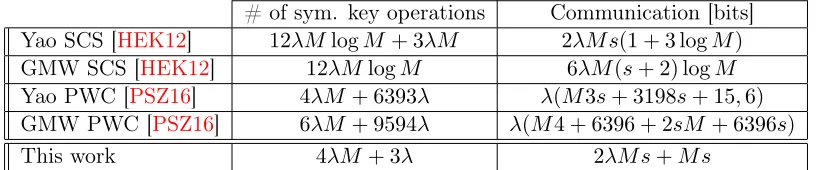
We also compare the computation complexity of our scheme for PSM with all the circuit-based PSI approaches (which can be combined with further postprocessing) proposed in [PSZ16]. More precisely, in Table 1 we compare our protocol with the protocols of [PSZ16] in terms of number of symmetric key operations, and bits exchanged between the parties. The result of this comparison is that our protocol has better performance, in terms of computational complexity, than all the circuit-based PSI approaches considered for our comparison3
. We refer the reader to App. A for more details about this comparison.
1.3 Improving the efficiency of smart contract protocols
Most of the cryptocurrency systems are built on top of blockchain technologies where miners run distributed consensus whose security is ensured as long as the adversary controls only a minority of the miners. Some cryptocurrency systems allow to run complex programs and decentralized applications on the blockchain. In Ethereum4
those programs are called smart contracts. Roughly speaking, the aim of a smart contract is to run a protocol and start a transaction to pay a user of the cryptocurrency systems according to the output of the protocol execution. Unfortunately, this
3
The complexity of the protocols proposed in [PSZ16] depends upon parameters that are also related to the used hash function. In order to make our comparison fair, we have set these parameters as showed in the first column in Table 10 of [PSZ16]. More precisely, the authors of [PSZ16] show in that table which parameters are adopted for their empirical efficiency comparison for the case where one set is much greater than the other set (which is exactly the case of PSM).
4
interesting feature of the smart contracts does not come for free. Indeed, in order to execute a smart contract, it is required to pay agas fee that depends on the number of instructions of the protocol to be executed. So, higher is the complexity of protocol, higher is the price to pay. In this context a cryptographic protocol that outputs intermediate values in a secret shared way is particularly useful. Suppose that two parties want to securely computef(X∩Y)for arbitrary functionsf, and reward another party depending on the output of this computation. Instead of writing on a smart contract the entire protocol to compute f(X∩Y), the two parties could run a sub-protocol Π to obtain a secret share of χ = X∩Y without using a smart contract, and then run another sub-protocol
Π′ to compute f(χ), this time using a smart contract to enforce the reward policy. Following this approach it is possible to move part of the computation off-chain, thus increasing the performance and, at the same time, decreasing the costs required to execute the smart contract. Moreover, we observe that χ can be reused to compute different functions f′. The scenario described above is particularly interesting if one of the party can be fully malicious, but in this work we will focus on semi-honest security leaving the above as an open question.
# of sym. key operations Communication [bits] Yao SCS [HEK12] 12λMlogM+ 3λM 2λM s(1 + 3 logM)
GMW SCS [HEK12] 12λMlogM 6λM(s+ 2) logM
Yao PWC [PSZ16] 4λM + 6393λ λ(M3s+ 3198s+ 15,6)
GMW PWC [PSZ16] 6λM + 9594λ λ(M4 + 6396 + 2sM+ 6396s)
This work 4λM+ 3λ 2λM s+M s
Table 1: Computation and communication complexity comparison for the PSM case. M represents the size of the set,sis the security parameter andλis the bit-length of each element.
2
Technical overview
2.1 Why PSZ and 2PC do not mix
We start with a quick overview of the PSM protocol in PSZ [PSSZ15,PSZ14], to explain why their protocol inherently reveals the intersection to one of the parties. From a high-level point of view, the protocol is conceptually similar to the PSM protocol from oblivious pseudorandom function (OPRF) of [FIPR05], except that the OPRF is replaced with a similar functionality efficiently implemented using OT. For simplicity, here we will use the OPRF abstraction.
The goal of a PSM protocol is the following: the receiver R has input x, and the sender S has input a setY; at the end of the protocol the receiver learns whetherx∈Y or not while the sender learns nothing. The protocol starts by using the OPRF subprotocol, so that R learns x∗ =F
k(x) (wherekis known to S), whereasS learns nothing aboutx. NowS evaluates the PRF on her own set and sends the set Y∗ = {y∗ = Fk(y)|y ∈Y} to R, who checks if x∗ ∈ Y∗ and concludes that
x∈Y if this is the case. In other words, we map all inputs into pseudorandom strings and then let one of the parties test for membership “in the clear”. Since the party performing the test doesn’t have access to the mapping (e.g., the PRF key), this party can only check for the membership of x
and no other points (i.e., all elements inY∗\ {x∗}are indistinguishable from random inR’s view).
the pseudorandom stringx∗ =F
k(x)corresponding tox, but nowSsends a valuefor every element
in the universe. Namely, for each i(in the domain of Y) S sends an encryption of whether i∈Y
“masked” usingFk(i) e.g.,S sendsci =Fk(i)⊕E(i∈Y)5. NowRcan computecx⊕x∗=E(x∈Y) i.e., an encrypted version of whetherx∈Y, which can be then used as input to the next protocol. While this protocol produces the correct result, its complexity is exponential in the bit-length of |x|, which is clearly not acceptable.
Intuitively, we know that only a polynomial number of ci’s will contain encryptions of 1, and therefore we need to find a way to “compress” all the ci corresponding toi 6∈Y into a single one, to bring the complexity of the protocol back toO(|Y|). In the following, after defining some useful notation, we give an intuitive explanation on how to do that.
2.2 Our protocol
We introduce some useful (and informal) notation in order to make easier to understand the ideas behind our construction. We let Y ={y1, . . . , yM}be the input set of the senderS, and we assume w.l.o.g., that |Y|=M = 2m.6
All strings have the same length e.g., |x|= |yi| =λ.7 We will use a special symbol ⊥ such that x 6= ⊥ ∀x. We use a function Prefix(x, i) that outputs the i most significant bits of x (Prefix(x, i) 6=Prefix(x, j) when i6=j independently of the value of x) and for simplicity we define Prefix(Y, i) to be the set constructed by taking the i most significant bits of every element inY.
The protocol uses a symmetric key encryption schemeSym= (Gen,Enc,Dec)with the additional property that given a key k← Gen(1s) it is possible to efficiently verify if a given ciphertext is in the range of k(see Sec.3 for a formal definition).
Finally, the output of the protocol will be one of two strings γ0, γ1 chosen by S, respectively
denoting x 6∈ Y and x ∈ Y. The exact format of the two strings depends on the protocol used for post-processing. For instance if the post-processing protocol is based on: 1) garbled circuits, then γ0, γ1 will be the labels corresponding to some input wire; 2) homomorphic encryption, then
γb =Enc(pk, b) for some homomorphic encryption schemeEnc; 3) secret-sharing, then γb =s2⊕b
where s2 is a uniformly random share chosen by S, so that if R defines its own share as s1 =γb then it holds thats1⊕s2=b.8
In order to “compress” the elements ofY we start by considering an undirected graph with a level structure ofλ+ 1 levels. The vertices in the last level of this graph will correspond to the elements of Y. More precisely, we associate the secret key kbλbλ−1...b1 of a symmetric key encryption scheme
Sym to each element y =bλbλ−1. . . b1 ∈ Y. The main idea is to allow the receiver to obliviously
navigate this graph in order to get the key kbλbλ−1...b1 if x=y, for somey=bλbλ−1. . . b1∈Y, or a special key k⋆ otherwise. Moreover we allow the receiver to navigate the graph efficiently, that is, every level of the graph is visited only once.
5
The exact format of the “encryption” E(·) would depend on the subsequent 2PC protocol and is irrelevant for this high-level description.
6
Sets can always be padded with dummy elements, but the complexity of the protocol can match M that in practice can beM ≈2m−1.
7
We can assumeλto be smaller than the (statistical) security parametersand we will denote the bit decomposition of xbyx =xλ. . . x1.. Otherwise before running the protocol the parties can hash their input down and run the
protocol with inputsh(x) andh(Y) ={h(y1), . . . , h(yM)}. Clearly ifx=yi thenh(x) =h(yi), and for correctness
we need thatP r[h(x)∈h(Y)∧x6∈Y]<2−s.
8
Once a key k is obtained by the receiver, the sender sendsO(|Y|) ciphertexts in a such a way that the key obtained by the receiver can decrypt only one ciphertext. Moreover the plaintext of this ciphertext will correspond toγ0 or γ1 depending on whether x∈Y or not.
2.2.1 First step: construct the graph G
Each graph level i ∈ {0, . . . , λ} has size at most |Prefix(Y, i)|+ 1. More precisely, for every t =
bλbλ−1. . . bλ−i ∈Prefix(Y, i) there is a node in the level iof Gthat contains a key kbλbλ−1...bλ−i. In
addition, in the level i there is a special node, called sink node that contains a key k⋆i (which we refer to assink key). The aim ofk⋆
i is to represent all the values that do not belong toPrefix(i, Y). Let us now describe how the graph G is constructed. First, for i = 1, . . . , λ the key (for a symmetric key encryption scheme) ki⋆ is generated using the generation algorithm Gen(·). As discussed earlier the aim of these keys is to represent the elements that do not belong to Y. More precisely, the sink key k⋆
i, with i ∈ {1, . . . , λ} represents all the values that do not belong to
Prefix(Y, i) and the key k⋆λ (the last sink key) will be used to encrypt the output γ0 corresponding
to non-membership in the last step of our protocol. Note that if Prefix(x, i) 6∈ Prefix(Y, i) then
Prefix(x, j)6∈Prefix(Y, j)for all j > i. Therefore, once entered in a sink node, thesink path is never abandoned and thus the final sink key k⋆
λ, will be retrieved (which allows recovery of γ0). Let us now give a more formal idea of howG is constructed.
- The root of G is empty, and in the second level there are two verticesk0 and k1 where9, for
b= 0,1
kb =
(
k←Gen(1s), if b∈Prefix(Y,1)
k⋆
1, otherwise
- For each vertex kt in the level i∈ {1, . . . , λ} and forb = 0,1 create the node kt||b as follows (if it does not exists) and connect kt to it.
kt||b =
k←Gen(1s), if t||b∈Prefix(Y, i+ 1)
k⋆
i+1, if t||b /∈Prefix(Y, i+ 1)
k⋆
i+1, if kt=ki⋆
We observe that a new nodekt||b is generated only whent||b∈Prefix(Y, i). In the other cases the sink nodek⋆
i+1 is used.
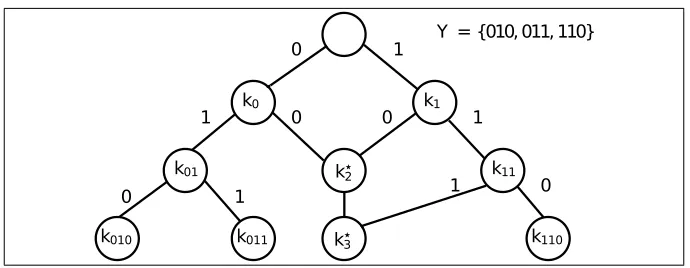
In Fig. 1 we show an example of what the graph G looks like for the set Y = {010,011,110}. In this example it is possible to see how, in the 2nd level, all the elements that do not belong to
Prefix(Y,2)are represented by the sink nodek⋆
2. Using this technique we have that in the last level
of Gone node (k⋆
3 in this example) is sufficient to represent all the elements that do not belong to
Y. Therefore, we have that the last level of G contains at most |Y|+ 1elements. We also observe that every level of Gcannot contain more than|Y|+ 1nodes.
9
k0 k1
k01 k2⋆ k11
k⋆
3 k110
k010 k011
0 1
0
1 0 1
1 0
0 1
Y = {010, 011, 110}
Figure 1: Example of how the graphGappears when the sender holds the setY.
2.2.2 Second step: oblivious navigation of G
Letx=xλxλ−1. . . x1be the receiver’s (R’s) private input andY be the sender’s (S’s) private input.
AfterSconstructs the graphGwe need a way to allowRto obtainkxλxλ−1...x1 ifx∈Y and the sink keyk⋆
λotherwise. All the computation has to be done in such a way that no other information about the setY is leaked to the receiver, and as well that no information aboutx is leaked to the sender. In order to do so we use λ executions of 1-out-of-2 OT. The main idea is to allow the receiver to select which branch to explore inGdepending on the bits ofx. More precisely, in the first execution of OT,Rwill receive the keykxλ iff there exists an element inY with the most significant bit equal
to xλ, the sink key k1⋆ otherwise. In the second execution of OT,Ruses xλ−1 as input and S uses
(c0,c1) wherec0 is computed as follows:
- For each key in the second level of G that has the form kt||0, the keykt||0 is encrypted using
the keykt.
- For every node v in the first level that is connected to a sink node k⋆
2 in the second level,
compute an encryption ofk⋆
2 using the key contained in v.
- Pad the input with random ciphertexts up to the upper bound for the size of this layer (more details about this step are provided later).
- Randomly permute these ciphertexts.
The procedure to compute the inputc1 is essentially the same (the only difference is that in this
case we consider every key with form kt||1 and encrypt it using kt).
Roughly speaking, in this step every key contained in a vertexuof the second level is encrypted using the keys contained in the vertexv of the previous level that is connected to u. For example, following the graph provided in Fig.1, c0 would be equal to {Enc(k0, k⋆2),Enc(k1, k2⋆)} and c1 to {Enc(k0, k01),Enc(k1, k11)}.
Thus, after the second execution of OTRreceivescxλ−1 that contains the ciphertexts described above where only one of these can be decrypted using the key k obtained in the first execution of OT. The obtained plaintext corresponds to the key kxλxλ−1 if Prefix(x,2) ∈ Prefix(Y,2), to the sink key k⋆
2 otherwise. The same process is iterated for all the levels of G. More generally, if
Prefix(x, j)∈Prefix(Y, j)then after the j−th execution of OTRcan compute the keykxλxλ−1...xλ−j
key k⋆
j is obtained by R. We observe that after every execution of OT R does not know which ciphertext can be decrypted using the key obtained in the previous phase, therefore he will try to decrypt all the ciphertext until the decryption procedure is successful. To avoid adding yet more indexes to the (already heavy) notation of our protocol we deal with this using a private-key encryption scheme with efficiently verifiable range. We note that this is not necessary and that when implementing the protocol one can instead use the point-and-permute technique [BMR90]. This, and other optimisations and extensions of our protocol, are described in Section5.
2.2.3 Third step: obtain the correct share
In this step S encrypts the output string γ0 using the key k⋆λ and uses all the other keys in the last level ofGto encrypt the output string γ1.10 At this point the receiver can only decrypt either
the ciphertext that contains γ0 if x /∈ Y or one (and only one) of the ciphertexts that contain γ1
if x ∈ Y. In the protocol that we have described so far Rdoes not know which ciphertext can be decrypted using the key that he has obtained. Also in this case we can use a point-and-permute technique to allowRto identify the only ciphertext that can be decrypted using his key.
On the need for padding As describe earlier, we might need to add some padding to the OT sender’s inputs. To see why we need this we make the following observation. We recall that in thei-th OT execution the sender computes an encryption of the keys in the leveliof the artificial graph Gusing the keys of the previous level (i−1).11
As a result of this computation the sender obtains the pair(ci
0, ci1), that will be used as input of thei-th OT execution, whereci0 (as well asci1)
contains a number of encryptions that depends upon the number of vertices on level (i−1) of G. We observe that this leaks information about the structure ofGto the receiver, and therefore leaks information about the elements that belong to Y. Considering the example in Fig. 1, if we allow the receiver to learn that the 2nd level only contains 3 nodes, then the receiver would learn that all the elements of Y have the two most significant bits equal to either t or t′ for some t, t′ ∈ {0,1}2
(in Fig.1 for example we have t= 01 and t′ = 11; note however that the receiver would not learn
the actual values of tand t′).
We note that the technique described in this section can be seen as a special (and simpler) example of securely evaluating a branching program. Secure evaluation of branching programs has previously been considered in [IP07,MN12]: unfortunately these protocols cannot be instantiated using OT-extension and therefore will not lead to practically efficient protocols (the security of these protocols is based on strong OT which, in a nutshell, requires the extra property that when executing several OTs in parallel, the receiver should not be able to correlate the answers with the queries beyond correlations which follow from the output).
Finally, we note that the work of Chor et al. [CGN98] uses a data structure similar to the one described here to achieve private information retrieval (PIR) based on keywords. The main difference between keyword based PIR and PSM is that in PSM the receiver should not learn any other information about the data stored by the sender, so their techniques cannot be directly applied to our setting.
10
The keykλ⋆could not exists; e.g. ifY contains all the strings ofλbits.
11
3
Definitions and tools
We denote the security parameter by s and use “||” as concatenation operator (i.e., if a and b are two strings then bya||bwe denote the concatenation ofaandb). For a finite setQ,x←Qdenotes a sampling of x from Q with uniform distribution. We use the abbreviation ppt that stands for
probabilistic polynomial time. We usepoly(·)to indicate a generic polynomial function. We assume the reader to be familiar with standard notions such as computational indistinguishability and the
real world/ideal world security definition for secure two-party computation (see AppendixCfor the actual definitions).
3.1 Special private-key encryption
In our construction we use a private-key encryption scheme with two additional properties. The first is that given the keyk, it is possible to efficiently verify if a given ciphertext is in the range of
k. With the second property we require that an encryption under one key will fall in the range of an encryption under another key with negligible probability
As discussed in [LP09], it is easy to obtain a private-key encryption scheme with the properties that we require. According to [LP09, Definition 2] we give the following definition.
Definition 1. Let Sym= (Gen,Enc,Dec) be a private-key encryption scheme and denote the range of a key in the scheme by Ranges(k) ={Enc(k, x)}x∈{0,1}s. Then
1. We say thatSymhas an efficiently verifiable rangeif there exists appt algorithmM such that M(1s, k, c) = 1 if and only if c∈Range
s(k). By convention, for everyc /∈Ranges(k), we have
that Dec(k, c) =⊥.
2. We say that Sym has an elusive range if for every probabilistic polynomial-time machine A, there exists a negligible functionν(·) such that Probk←Gen(1s)[A(1s)∈Ranges(k)]< ν(s).
Most of the the well known techniques used to construct a private-key encryption scheme (e.g. using a PRF) can be used to obtain a special private-key encryption scheme as well. The major difference is that a special encryption scheme has (in general) ciphertexts longer than a standard encryption scheme.
4
Our protocol
Π
∈In this section we provide the formal description of our protocolΠ∈= (S,R)for theset-membership
functionalityF∈ = (F∈
S,FR∈)where
FS∈: {{0,1}λ}M ×(γ0, γ1)
× {0,1}λ −→ ⊥ and
FR∈: {{0,1}λ}M ×(γ0, γ1)
× {0,1}λ −→ {γ0, γ1}
Y,(γ0, γ1), x
7−→
(
γ1 if x∈Y
γ0 otherwise
For the formal description of Π∈, we collapse the first and the second step showed in the
infor-mation description of Section2 into a single one. That is, instead of constructing the graphG, the sender only computes the keys at level i in order to feed the i-th OT execution with the correct inputs. The way in which the keys are computed is the same as the vertices for G are computed, we just do not need to physically construct G to allow S to efficiently compute the keys. In our construction we make use of the following tools.
1. A protocolΠOT = (SOT,ROT)that securely (according to Definition3) computes the following
functionality
FOT : ({0,1}⋆× {0,1}⋆)× {0,1} −→ {⊥} × {0,1}⋆
((c0, c1), b)7−→(⊥, cb).
2. A symmetric key encryption scheme Sym = (Gen,Enc,Dec) with efficiently verifiable and elusive range.
3. In our construction we make use of the following function:
δ:N−→N
i7−→min{2i,|Y|}.
This function computes the maximum number of vertices that can appear in the level i of the graph G. As discussed before, the structure of G leaks information about Y. In order to avoid this information leakage about Y, it is sufficient to add some padding to the OT sender’s input so that the input size become |Y|. Indeed, as observed above, every level contains at most |Y|
vertices. Actually, it is easy to see thatmin{|Y|,2i}represents a better upper bound on the number of vertices that the i-th level can contain. Therefore, in order to compute the size of the padding for the sender’s input we use the function δ.
4.1 Formal description
Common input: security parameter sand λ.
S’s input: a setY of sizeM,γ0 ∈ {0,1}s and γ1 ∈ {0,1}s.
R’s input: an elementx∈ {0,1}λ.
First stage
1. For i=1, . . . , λ,S computes the sink key k⋆
i ←Gen(1s).
2. S computes k0 ← Gen(1s), k1 ← Gen(1s). For b= 0,1, if b /∈Prefix(Y,1)then set kb =k1⋆
12 . Set(c10, c11) = (k0, k1).
3. S and R execute ΠOT, where S acts as the sender SOT using (c10, c11) as input and Racts as
the receiver ROT usingxλ as input. When the execution of ΠOT endsRobtainsκ1 :=c1xλ.
Second stage Fori= 2, . . . , λ:
1. Sexecutes the following steps.
12
1.1. Define the empty list ci
0 and for allt∈Prefix(Y, i−1)execute the following steps.
If t||0 ∈Prefix(Y, i) then compute kt||0 ← Gen(1s) and add Enc(k
t, kt||0) to the list
ci
0. Otherwise, ift||0∈/ Prefix(Y, i) then compute and addEnc(kt, k⋆i)to the listci0.
1.2. If |ci
0|< δ(i−1)then execute the following steps.
- Compute and addEnc(k⋆
i−1, k⋆i) to the listci0.
- For j= 1, . . . , δ(i−1)− |ci
0|compute and addEnc(Gen(1s),0)to ci0.
13
1.3. Permute the elements inside ci
0.
1.4. Define the empty14 list ci
1 and for allt∈Prefix(Y, i−1)execute the following step.
If t||1 ∈Prefix(Y, i) then compute kt||1 ← Gen(1s) and add Enc(kt, kt||1) to the list
ci
1. Otherwise, ift||1∈/ Prefix(Y, i) compute and addEnc(kt, k⋆i) to the listci1.
1.5. If |ci
1|< δ(i−1)then execute the following steps.
- Compute and addEnc(k⋆i−1, k⋆i) to the listci1. - For j= 1, . . . , δ(i−1)− |ci
1|compute and addEnc(Gen(1s),0)to ci1.
1.6. Permute the elements inside ci
1.
2. S and R execute ΠOT, where S acts as the sender SOT using (ci0, ci1) as input and Racts as
the receiverROT using xλ−i+1 as input. When the execution ofΠOT ends,Robtainscixλ−i+1.
Third stage
1. Sexecutes the following steps.
1.1. Define the empty list l.
1.2. For every t∈Prefix(Y, λ) compute and addEnc(kt, γ1)to l. 1.3. If |l|<2λ then compute and addEnc(k⋆
λ, γ0)to l. 1.4. Permute the elements inside l and sendl to R.
2. R, upon receiving lacts as follows.
2.1. For i= 2, . . . , λexecute the following steps. For every elementt in the list ci
xλ−i+1 computeκ ←Dec(κi−1, t). If κ6=⊥ then set
κi =κ.
2.2. For all e∈l computeout←Dec(κλ, e) and outputoutif and only ifout6=⊥.
Theorem 1. Suppose ΠOT securely computes the 1-out-of-2 OT functionality FOT and Sym is a symmetric key encryption scheme with efficiently verifiable range and elusive range, thenΠ∈ securely computes the functionality F∈.
We refer the reader to App. Bfor the formal proof of this theorem.
13
In this step, as well as in the step 1.e of this stage, the functionδ is used to compute the right amount of fake encryption to be added to the list that will we used as input ofROT. The fake encryptions encrypts the value0, but
of course any other value could be used.
14
The following three steps are equal to the previous three steps (1.a, 1,b and 1.c), the only difference is thatt||1
4.2 Round complexity: parallelizability of our scheme
In the description of our protocol in Sec4.1we have the sender and the receiver engagingλsequential OT executions. We now show that this is not necessary since the OT executions can be easily parallelized, given that each execution is independent from the other. That is, the output of a former OT execution is not used in a latter execution. For simplicity, we assume thatΠOT consists
of just two rounds, where the first round goes from the receiver to the sender, and the second goes in the opposite direction. We modify the description of the protocol of Sec 4.1as follows.
- Step3of thefirst stageand step2of thesecond stage are moved to the beginning of thethird stage.
- WhenSsends the last round ofΠOT, he also performs the step1of thethird stage. Therefore
the listl is sent together with the last rounds of theλΠOT executions.
Roughly speaking, in this new protocol S first computes all the inputs (k0, k1, c10, c11, . . . , cλ0, cλ1) for
the OTs. Then, upon receiving the λfirst rounds of ΠOT computed by R using as input the bits
of x,S sends λsecond round of ΠOT together with the list l. We observe that in this case the S’s
inputs to the λexecutions ofΠOT can be pre-computedbefore any interaction with Rbegins.
5
Optimisations and extensions
5.1 Point and permute
In our protocol the receiver must decrypt every ciphertext at every layer to identify the correct one. This is suboptimal both because of the number of decryptions and because encryptions that have efficiently verifiable range necessarily have longer ciphertexts. This overhead can be removed using the standardpoint-and-permute technique [BMR90] which was introduced in the context of garbled circuits. Using this technique we can add to each key in each layer a pointer to the ciphertext in the next layer which can be decrypted using this key. This has no impact on security.
5.2 One-time pad
It is possible to reduce the communication complexity of our protocol by usingone-time pad encryp-tion in the lastlogslayers of the graph, in the setting where the output values γ0, γ1 are such that
|γb|< s. For instance, if the output values are bits (in case we combine our PSM with a GMW-style protocol), then the keys (and therefore the ciphertexts) used in the last layer of the graph only need to be 1 bit long. Unfortunately, since the keys in the second to last layer are used to mask up to two keys in the last layer, the keys in the second to last layer must be of length2 and so on, which is why this optimisation only gives benefits in the lastlogslayer of the graph.
5.3 PSM with secret shared input
receiver, who now inputs the bits ofr=rλ, . . . , r1 to the λone-out-of-two OTs (instead of the bits
of x as in the original protocol). The sender, at each layer i, will follow the protocol as described above if si = 0 and instead swap the inputs to the OT if si = 1. It can be easily verified that the protocol still produces the correct result and does not leak any extra information.
5.4 Keyword search
Our PSM protocol outputs an encryption of a bit indicating whether x ∈Y or not. The protocol can be easily modified to output a value dependent on xitself and therefore implement “encrypted keyword search”. That is, instead of having only two output stringsγ1, γ0 representing membership
and non-membership respectively, we can have|Y|+ 1different output strings (one for each element
y ∈ Y and one for non-membership). This can be used for instance in the context where Y is a database containing id’s y and corresponding values v(y), and the output of the protocol should be an encryption of the value v(x) if x ∈Y or a standard value v(⊥) if x 6∈Y. The modification is straightforward: instead of using all the keys in the last layer of the graph to encrypt the same valueγ1, use each keyk
y to encrypt the corresponding value v(y) and the sink key (which is used to encryptγ0 in our protocol) to encrypt the valuev(⊥).
5.5 PSI from PSM
We can follow the same approach of PSZ [PSSZ15,PSZ14] to turn our PSM protocol into a protocol for PSI. Given a receiver with inputX and a sender with inputY the trivial way to construct PSI from PSM is to run |X| copies of PSM, where in each execution the receiver inputs a different x
from X and where the sender always inputs her entire set Y. As described above, the complexity of our protocol (as the complexity of the PSM protocol of PSZ) is proportional in the size of|Y|, so this naïve approach leads to quadratic complexityO(|X| · |Y|). PSZ deals with this using hashing
i.e., by letting the sender and the receiver locally preprocess their inputs X, Y before engaging in the PSM protocols. The different hashing techniques are explained and analysed in [PSZ16, Section 3]. We present the intuitive idea and refer to their paper for details: in PSZ the receiver usesCuckoo hashing to mapX into a vectorX′ of sizeℓ=O(|X|)such that all elements of X are present inX′
and such that everyx′i ∈X′ is either an element of X or a special ⊥ symbol. The sender instead maps her set Y into ℓ = |X′| small buckets Y1′, . . . , Yℓ′ such that every element y ∈ Y is mapped into the “right bucket” i.e., the hashing has the property that ify =x′
i for someitheny will end up in bucket Yi′ (and potentially in a few other buckets). Now PSZ uses the underlying PSM protocol to check whetherx′i is a member ofYi′ (for all i’s), thus producing the desired result. The overall protocol complexity is nowO(Pl
i=1|X′| · |Yi′|) which (by careful choice of the hashing parameters) can be made sub-quadratic. In particular, if one is willing to accept a small (but not negligible) failure probability, the overall complexity becomes only linear in the input size. Since this technique is agnostic of the underlying PSM protocol, we can apply the same technique to our PSM protocol to achieve a PSI protocol that produces encrypted output.
6
Applications
The major advantage provided by Π∈ is that the output of the receiver can be an arbitrary value
when x∈Y, or some random value otherwise. We now provide two examples of how our protocol can be used to implement more complex secure set operations. The examples show some guiding principles that can be used to design other applications based on our protocol.
Without loss of generality in the following applications only the receiver will learn the output of the computation. Moreover we assume that the size ofX andY is equal to the same valueM.15 Also for simplicity we will describe our application using the naïve PSI from PSM construction with quadratic complexity, but using the PSZ approach, as described in Sec. 5, it is possible to achieve linear complexity using hashing techniques. Finally, in both our applications we exploit the fact that additions can be performed locally (and for free) using secret-sharing based 2PC. In applications in which round complexity is critical, the protocols can be redesigned using garbled circuits computing the same functionality, since the garbled circuit can be sent from the sender to the other messages of the protocol. However in this case additions have to be performed inside the garbled circuit.
6.1 Computing statistics of the private intersection
Here we want to construct a protocol where sender and receiver have as input two sets, X and Y
respectively, and want to compute some statistics on the intersections of their sets. For instance the receiver has a list of id’s X and that the sender has a list of of id’s Y and some corresponding valuesv(Y) (thus we use the variant of our protocol forkeyword search described in Section5). At the end of the protocol the receiver should learn the average of v(X∩Y) (and not |X∩Y|).
The main idea is the following: the sender and the receiver run M executions of our protocol where the receiver inputs a differentxifromXin each execution. The sender always inputs the same setY, and chooses the|Y|+1outputsγiy for ally ∈Y∪{⊥}for alli= 1, . . . , M in the following way:
γiy is going to contain two parts, namely an arithmetic secret sharing of the bit indicating whether
xi ∈ Y and an arithmetic secret sharing of the value v(y). The arithmetic secret sharing will be performed using a moduloN large enough such thatN > M andN > M·V whereV is some upper bound on v(y)so to be sure that no modular reduction will happen when performing the addition of the resulting shares. Concretely the sender setsγiy = (−u2i + 1 modN,−vi2+v(y) modN) for ally ∈Y and γi⊥= (−u2i mod N,−vi2 modN). After the protocol the receiver defines her shares
u1
i, v1i to be the shares contained in her output of the PSM protocol, and then both parties add their shares locally to obtain secret sharing of the size of the intersection and of the sum of the values i.e., U1=P
iu1i,V1 =
P
ivi1,U2 =
P
iu2i, andV2 =
P
ivi2. Now the parties check if(U1, U2) is a sharing of0 and, if not, they compute and reveal the result of the computation VU11++VU22. Both these operations can be performed using efficient two-party protocols for comparison and division such as the one in [T+07,DNT12].
6.2 Threshold PSI
In this example we design a protocol Πt= (Pt
1, P2t) that securely computes the functionality Ft=
(Ft Pt
1
,Ft Pt
2
) where
Ft Pt
1:{{0,1}
λ}M × {{0,1}λ}M −→ ⊥
15
and
FPtt
2:{{0,1}
λ}M × {{0,1}λ}M −→ {{0,1}λ}⋆
(S1, S2)7−→
(
S1∩S2 if |S1∩S2| ≥t
⊥ otherwise
That is, the sender and the receiver have on input two sets, S1 and S2 respectively, and the
receiver should only learn the intersection between these two sets if the size of the intersection is greater or equal than a fixed (public) threshold valuet. In the case that the size of the intersection is smaller that t, then no information about S1 is leaked to P2t and no information about S2 is
leaked toPt
1. (This notion was recently considered in [HOS17] in the context of privacy-preserving
ride-sharing).
As in the previous example, the sender and the receiver runM executions of our protocol where the receiver inputs a different xi from S2 in each execution. The sender always inputs the same
set S1, and chooses the two outputs γi0, γi1 in the following way: γib is going to contain two parts, namely an arithmetic secret sharing of1if xi ∈Y or 0otherwise, as well as encryption of the same bit using a key k. The arithmetic secret sharing will be performed using a modulus larger than
M, so that the arithmetic secret sharings can be added to compute a secret-sharing of the value
|S1∩S2|with the guarantee that no overflow will occur. Then, the sender and the receiver engage
in a secure-two party computation of a function that outputs the key kto the receiver if and only if |S1 ∩S2| > t. Therefore, if the intersection is larger than the threshold now the receiver can
decrypt the ciphertext part of the γ values and learn which elements belong to the intersection. The required 2PC is a simple comparison with a known value (the threshold is public) which can be efficiently performed using protocols such as [GSV07,LT13].
7
Acknowledgments
A
Complexity analysis
We focus our analysis of the protocol described in Sec 4.1 without taking into account the many possible optimisations showed in Sec.5. In Π∈, sender and receiver runλexecutions of a 1-out-of-2 OT; in addition, they perform some symmetric key operations. More precisely, in order to compute the inputs for thei-th OT executions, withi∈ {2, . . . , λ},Scomputes2·min{2i−1,|Y|}encryptions
using the private-key encryption scheme Sym. We now observe that each encryption could contain a different key, and that this key needs to be generated by running Gen(·).16
This means that
4M represents an upper bound on the number of symmetric key operations performed by S to compute the input of one OT execution. Moreover, in the last interaction with R, S computes
M encryptions. Therefore, an upper bound on the number symmetric key operations performed by S is (λ−1)·4M +M + 2 ≈ λ·4M, where 2 represents the cost of running Gen(·) twice in order to compute the two keys required to feed the first OT execution17
. In every OT execution
i, with i ∈ {2, . . . , λ}, R receives min{2i−1,|Y|} encryptions, and tries to decrypt all of them.
Moreover, in the last interaction with S,RreceivesM encryptions and tries to decrypt all of them as well. This means that the upper bound on the number of symmetric key operations made byR
is (λ−1)·M +M = λ·M. Following [PSZ16] we assume that 3 symmetric key operations are required for one OT execution. Therefore the total amount of symmetric key operations isλM4+3λ
for the sender and λM + 3λ for the receiver. In order to compare the efficiency of our protocol with the PSI protocols provided in [PSZ16] and to be consistent with their complexity analysis, we consider only the computation complexity for the party with the majority of the workload in the comparison. In Table1 of Sec.1 we have compared the computation (and the communication) complexity of our protocol with the circuit-based PSI approaches (which can be combined with further postprocessing) considered in [PSZ16]. More precisely, we compare the sort-compare-shuffle (SCS) circuit of [HEK12] and the pairwise-comparison (PWC) circuit proposed in [PSZ16] with our approach for PSM.
As showed in Table 1, our protocol has better performance than all the circuit-based PSI ap-proaches (which can be combined with further postprocessing) considered in [PSZ16]. We note that, as described in Sec. 4.4 of [PSZ16], the approach based on evaluating the OPRF inside circuit is faster than any other PSI protocols if one set is much smaller than the other (like in the case of PSM), but in this case the output will necessarily leak to the receiver, which prevents composition with further 2PC protocol. We refer the reader to Table 7 of [PSZ16] for a detailed efficiency com-parison between different PSI protocols. Finally, we observe that the complexities analysis proposed in [PSZ16] is related to PSI protocols, while in this section we have only compared the efficiency of the PSM subprotocol.
A.1 Communication complexity
The communication complexity of our protocol is dominated by the communication complexity of the underlying OT protocol ΠOT = (SOT,ROT). Let sOT(D) be the amount of data exchanged
between SOT and ROT when SOT uses an input of size D, and let sSYM(A) be the size of a
ciphertext for the encryption schemeSymwhen a plaintex of sizeAis used. Then the communication
16
We recall that|Y|=M and thatλis the bit size of a set element.
17
complexity of our protocol is
λ·sOT(2·M·sSYM(λ)) +M·sSYM(λ)
where2·M is the number of ciphertexts used as input of OT and M is the amount of ciphertexts that are sent in the last interaction between S and R. If we assume that a chipertext for Sym is roughly of size s, and that ΠOT has a communication complexity that is approximately close to
the size of the input used18
, we obtain that the overall communication complexity of our protocol is well approximated byλM s2 +M s, that is comparable to the communication complexity of the approaches proposed in [PSZ16].
B
Security proof of Theorem
1
Proof. In order to prove the security of Π∈, according to Def. 3 we need show two probabilistic polynomial-time algorithms SS and SR called simulators, such that the following two conditions hold:
{(SS(1s, Y, γ0, γ1,FS∈(Y, γ0, γ1, x)),F∈(Y, γ0, γ1, x))}{Y,x,s} ≈
{viewΠS∈(1s, Y, γ0, γ1, x),outputΠ∈(1s, Y, γ0, γ1, x)}{Y,x,s}
(1)
{(SR(1s, x,FR∈(Y, γ0, γ1, x)),F∈(Y, γ0, γ1, x))}{Y,x,s}≈
{viewΠR∈(1s, Y, γ0, γ1, x),outputΠ∈(1s, Y, γ0, γ1, x)}{Y,x,s}
(2)
whereY ∈ {{0,1}⋆}⋆,x∈ {0,1}⋆, ands∈N.
Therefore we divide our proof in two parts. In the former we show a ppt algorithm SS that satisfies the property of the first point, and then a pptalgorithmSR that satisfies the requirement of the second point. Moreover, in order to make the security proof of our scheme easier, without loss of generality we assume Symto be secure in the setting where the challenge messages m0 and m1
are lists of λ values. That is m0 ={m1
0, . . . , mλ0} and m1 ={m11, . . . , mλ1}. The challenger, upon
receiving these lists picksb← {0,1}, defines an empty list cxand for i= 1, . . . λacts as follows:
1. computeski←Gen(1s);
2. computesEnc(ki, mib)and adds it to cx.
The aim of the adversary is to guess the bit b having on input just m0, m1,cx and an auxiliary
inputz.
B.1 SS description and proof of indistinguishability
SS runs S with some randomness r and the input Y. At this point SS needs a strategy to act as a receiver of OT in all the λOT executions (without the receiver’s input x). In order to do that,
SS runs the simulator of ΠOT, that we call SSOT (and that exists by assumption), in every OT
execution. We observe that in order to run SSOT in the i-th OT execution the inputs c
i
0 and ci1
18
need to be known. Clearly those values can be efficiently computed since the randomnessrand the inputY used to run Sare known.
We now show more formally howSS works. LetSSOT be such that
{SSOT(1
s,(c
0, c1),⊥),FOT((c0, c1), b)}{c0,c1,b,s} ≈
{viewΠOT
SOT (1
s,(c
0, c1), b),outputΠOT(1s,(c0, c1), b)}{c0,c1,b,s}
wherec0, c1 ∈ {0,1}⋆,b∈ {0,1}, ands∈N. SS, on inputY and1s executes the following steps.
1. pick a r← {0,1}s and run Son input1s, Y usingr as a randomness.
2. For every OT execution i, with i= 1, . . . , λ, run SSOT on input 1
s, ci
0 and ci1, where ci0 and
ci
1 are computed using the same procedure thatSuses.
3. Continue the execution againstS asRwould do.
In order to conclude this first part of the proof we just need to prove the following lemma.
Lemma 1.
{(SS(1s, Y,FS∈(Y, γ0, γ1, x)),F∈(Y, γ0, γ1, x))} ≈
{viewΠS∈(1s, Y, γ0, γ1, x),outputΠ∈(1s, Y, γ0, γ1, x)}
where Y ∈ {{0,1}⋆}⋆,x∈ {0,1}⋆, ands∈N.19
Proof. The proof goes through hybrid arguments starting from the real execution ofΠ∈. We
grad-ually modify the execution until the input of R is not needed anymore in such a way that the final hybrid represents the simulator SS. We denote with OUTHi
S (1s) the view of S in the hybrid experiment Hi withi∈ {0, . . . , λ}. The hybrid experiments that we consider are the following.
1. H0 is identical to the real execution ofΠ∈. More preciselyH0 runsSusing fresh randomness and interacts with him as Rwould do on inputx.
2. Hi proceeds according toH0 with the difference that in the firsti OT executions SSOT is
used.
Since F∈ is a deterministic function we have that
{viewΠS∈(1s, Y, γ0, γ1, x),F∈(Y, γ0, γ1, x))} ≡
{viewΠS∈(1s, Y, γ0, γ1, x),outputΠ∈(1s, Y, γ0, γ1, x)} .
Moreover we observe that
{OUTH0(1
s),F∈(Y, γ0, γ1, x)}=
{viewΠS∈(1s, Y, γ0, γ1, x),F∈(Y, γ0, γ1, x))}
and that
{OUTHλ(1
s),F∈(Y, γ0, γ1, x)}=
{(SS(1s, Y, γ0, γ1,FS∈(Y, γ0, γ1, x)),F∈(Y, γ0, γ1, x))}.
19
Therefore the only thing that remains to argue is that
{OUTHi−1(1
s),F∈(Y, γ0, γ1, x)} ≈ {OUT
Hi(1
s),F∈(Y, γ0, γ1, x)}
for i = 1, . . . , λ. We now show that if this statement does not hold then we can construct an adversary ASOT that breaks the security of Π
OT against malicious sender. Let CSOT be the
challenger for the security game w.r.t. the security ofΠOT against malicious sender; the reduction
works as follows.
1. ASOT runsS with randomnessr and interacts with him according toH
i−1 (Hi) until the i-th OT execution.
2. At this point ASOT computes (ci
0, ci1) and sends((ci0, c1i), xλ−i+1) toCSOT.
3. ASOT then acts as a proxy betweenCSOT andS.
4. When the interaction betweenCSOT andSis over,Acontinues the execution withSaccording
to Hi−1 (Hi).
The security proof ends with the observation that if CSOT has used the simulator S
SOT then the
joint distribution of the view ofSandF∈(Y, γ0, γ1, x)corresponds to{OUTRH i(1
s),F∈(Y, γ0, γ1, x)},
to {OUTRHi−1(1s),F∈(Y, γ0, γ1, x)}otherwise.
B.2 SR description and proof of indistinguishability
At a very high level,SR runsRwith some randomnessr and the inputx. SR then needs a strategy to acts as a sender of OT in all theλOT executions (without sender’s inputY). In order to do that,
SR runs the simulator of ΠOT, that we call SROT in every OT execution
20
. Moreover we need to feed the OT simulator with the correct input, depending on the valuex. More precisely in the first OT executionSROT is run by using as input a key k1. In the i-th OT execution (for i= 2, . . . , λ)
the simulator will run usingxλ−i+1 andci. The ciphertextci contains encryptions of a fixed value,
let us say0, computed using a fresh secret key (different for every ciphertext) and one encryption of the keyki using the keyki−1. After the λOT executions SR sends toRM encryptions of0 using a randomly generated secret key (also in this case a different secret key is used for each encryption of
0) and the encryption of the message out=FS∈(Y, γ0, γ1, x) using the key k
λ. We now show more formally howSR works. Let SROT be such that
{SROT(1
s, b, c
b),FOT((c0, c1), b)}{c0,c1,b,s} ≈
{viewΠOT
ROT (1
s,(c
0, c1), b),outputΠOT(1s,(c0, c1), b)}{c0,c1,b,s}
wherec0, c1 ∈ {0,1}⋆,b∈ {0,1}, and s∈N.
SR, on input x,outand 1s executes the following steps.
1. Computek1 ←Gen(1s) and runSROT on input(1
s, x λ,k1).
20
2. Fori= 2, . . . , λexecute the following steps.
2.1. Define the empty listci. Forj= 1, . . . ,min{2i,|Y|}−1compute and addEnc(Gen(1s),0)) to ci.
2.2. Computeki ←Gen(1s), and addEnc(ki−1,ki) to the listci. 2.3. Permute the elements inside ci.
2.4. RunSROT on input(1
s, x
λ−i+1,ci).
3. Define an empty list l.
4. Fori= 1, . . . M−1 compute and addEnc(Gen(1s),0)tol.
5. AddEnc(kλ,out) to l.
6. Permute the elements inside l and send it.
7. Continue the execution according toR’s description.
In order to conclude this latter part of the proof we need to prove the following lemma.
Lemma 2.
{(SR(1s, x,out,FR∈(Y, γ0, γ1, x)),F∈(Y, γ0, γ1, x))}{Y,x,s} ≈
{viewΠR∈(1s, Y, γ0, γ1, x),outputΠ∈(1s, Y, γ0, γ1, x)}{Y,x,s}
where Y ∈ {{0,1}⋆}⋆, x∈ {0,1}⋆, and s∈N.
Proof. The proof goes trough hybrid arguments starting from the real execution ofΠ∈. We gradually
modify the execution until the input ofS(Y) is not needed anymore such that the final hybrid would represent the simulator SR. We denote withOUTRHi(1s) the view of Rin the hybrid experimentH
i withi∈ {0, . . . , λ}.
1. H0 is identical to the real execution ofΠ∈. More preciselyH0 runsRusing fresh randomness and interacts with him as Swould do on inputY.
2. H1 proceeds according toH0 with the difference that in the first OT executionsSROT is used
on input(1s, x
λ,k1 ←Gen(1s)).
3. Hiproceeds according toH1with the difference that in thej-th OT executions, with2≤j ≤i,
SROT is run on input(1
s, x
λ−j+1,cj =cjxλ−j+1).
4. H⋆ proceeds according toH
λ with the difference that in each OT executioni, with2≤i≤λ, the inputci for the simulator SROT is computed as follows.
• Forj= 1, . . . ,min{2i,|Y|} −1compute and addEnc(Gen(1s),0)to ci.
• Computeki ←Gen(1s), and addEnc(ki−1,ki) to the listci.
• Permute the elements insideci.
• Define an empty list l.
• Fori= 1, . . . M−1 compute and addEnc(Gen(1s),0)tol.
• AddEnc(kλ,out) to l.
• Permute the element inside land send it to R.
Since F∈ is deterministic we have that
{viewΠR∈(1s, Y, γ0, γ1, x),F∈(Y, γ0, γ1, x))} ≡
{viewΠR∈(1s, Y, γ0, γ1, x),outputΠ∈(1s, Y, γ0, γ1, x)} .
Moreover we observe that
{OUTRH0(1s),F∈(Y, γ0, γ1, x)}={viewRΠ∈(1s, Y, γ0, γ1, x),F∈(Y, γ0, γ1, x))}
and that
{OUTRH⋆(1s),F∈(Y, γ0, γ1, x)}={(SR(1s, x,out,FR∈(Y, γ0, γ1, x)),F∈(Y, γ0, γ1, x))}.
Therefore there are two things that remain to argue:
1. {OUTRHi−1(1s),F∈(Y, γ0, γ1, x)} ≈ {OUTR
Hi(1
s),F∈(Y, γ0, γ1, x)} for i= 1, . . . , λ and
2. {OUTRHλ(1s),F∈(Y, γ0, γ1, x)} ≈ {OUTR
H⋆(1s),F∈(Y, γ0, γ1, x)}.
We now start by showing that if the first statement does not hold for i = 1, then we can construct a adversary ASOT that breaks the security of Π
OT against malicious receiver. Let CROT
be the challenger for the security game w.r.t. the security ofΠOT against malicious receiver. The
reduction works as follows.
1. AROT runsRwith randomnessr, computesk
0 ←Gen(1s),k1 ←Gen(1s)and sends((k0, k1), xλ) to CROT.
2. AROT then acts as a proxy between CROT and R.
3. When the interaction between CSOT and R is over, AROT continues the execution with R
according toH0 (H1).
This part of the security proof ends with the observation that ifCROT has used the simulatorS
ROT
then the joint distribution of the view ofRandF∈(Y, γ0, γ1, x)corresponds to{OUTHR0(1s),F∈(Y, γ0, γ1, x)}
, to {OUTRH1(1s),F∈(Y, γ0, γ1, x)} otherwise.
The proof that
{OUTRH i−1(1
s),F∈(Y, γ0, γ1, x)} ≈ {OUTR
Hi(1
s),F∈(Y, γ0, γ1, x)}
In order to prove that
{OUTRH λ(1
s),F∈(Y, γ0, γ1, x)} ≈ {OUTR
H⋆(1s),F∈(Y, γ0, γ1, x)},
thus concluding the lemma’s security proof, we need to consider the following intermediate hybrid experiment H⋆
y withy∈ {1, . . . , λ}. The description of the hybrid experiment follows.
1. Computek1 ←Gen(1s) and runSROT on input(1
s, x λ,k1).
2. Fori= 2, . . . , y execute the following steps.
2.1. Define the empty listci. Forj= 1, . . . ,min{2i,|Y|}−1compute and addEnc(Gen(1s),0)) to ci.
2.2. Computeki ←Gen(1s), and addEnc(ki−1,ki) to the listci. 2.3. Permute the elements inside ci.
2.4. RunSROT on input(1
s, x
λ−i+1,ci).
3. For each t∈Prefix(Y, y)− {xλ. . . xλ−y+1}computekt←Gen(1s). Ifxλ. . . xλ−y+1∈Prefix(Y, y) then setkxλ...xλ−y+1 =ky, otherwisek
⋆ y =ky. 4. Fori=y+ 1, . . . , λ execute the following steps.
4.1. Define the empty list ci and for eacht∈Prefix(Y, i−1)execute the following steps. Ift||xλ−i+1∈Prefix(Y, i)then computekt||xλ−i+1 ←Gen(1
s)and addEnc(k
t, kt||xλ−i+1) to the listci. Otherwise, ift||xλ−i+1∈/ Prefix(Y, i)then compute and addEnc(kt, ki⋆) to the listci.
4.2. If |ci|< δ(i−1)then execute the following steps.
• Compute and addEnc(k⋆
i−1, k⋆i) to the listci.
• Fori= 1, . . . , δ(i−1)− |ci|compute and addEnc(Gen(1s),0)toci. 4.3. Permute the elements inside ci.
4.4. RunSROT on input(1
s, x
λ−i+1,ci).
5. For everyt∈Prefix(Y, λ) compute and addEnc(kt, γ1)to l.
6. If|l|<2λ then compute and addEnc(k⋆
λ, γ0)to l. 7. Permute the elements inside l and sendl to R.
We now prove that
{OUTRH⋆ y−1(1
s),F∈(Y, γ0, γ1, x)} ≈ {OUTR
H⋆ y(1
s),F∈(Y, γ0, γ1, x)}
fory = 2, . . . , λ. The proof proceeds by contradiction. Suppose that there exists somey∈ {2, . . . , λ}
such that
{OUTRH⋆ y−1(1
s),F∈(Y, γ0, γ1, x)} ≈ {OUTR
H⋆ y(1
s),F∈(Y, γ0, γ1, x)}
then we can construct ad adversaryASymthat breaks the security of the encryption schemeSym. Let
CSym be the challenger for the security game w.r.t toSym. Our adversary runs Rwith randomness
1. Computek1 ←Gen(1s) and runSROT on input(1
s, x λ,k1).
2. Fori= 2, . . . , y−1execute the following steps.
2.1. Define the empty listci. Forj= 1, . . . ,min{2i,|Y|}−1compute and addEnc(Gen(1s),0)) to ci.
2.2. Computeki ←Gen(1s), and addEnc(ki−1,ki) to the listci.
2.3. Permute the elements inside ci. 2.4. RunSROT on input(1
s, x
λ−i+1,ci).
3. Define two empty lists m0 and m1 that will represent the challenge messages to be sent to CSym.
4. For each t∈Prefix(Y, y)− {xλ. . . xλ−y+1}computekt←Gen(1s)and add it to the list m0.
5. Forj= 1, . . . ,|Prefix(Y, y)− {xλ. . . xλ−y+1}|compute and add0 to m1.
6. Send the challenge messages to CSym.
7. Upon receiving the challenge ciphertext cx, setcy =cx
8. Forj= 1, . . . ,min{2i,|Y|} − |cx| −1 compute and addEnc(Gen(1s),0))to ci.
9. Computeky ←Gen(1s), and add Enc(ky−1,ky) to the listci.
10. Permute the elements insideci.
11. RunSROT on input(1
s, x
λ−i+1,ci).
12. Ifxλ. . . xλ−y+1∈Prefix(Y, y) then setkxλ...xλ−y+1 =ky, otherwise setk ⋆ y =ky. 13. Fori=y+ 1, . . . , λ execute the following steps.
13.1. Define the empty listci and for eacht∈Prefix(Y, i−1)execute the following steps. Ift||xλ−i+1∈Prefix(Y, i)then computekt||xλ−i+1 ←Gen(1
s)and addEnc(k
t, kt||xλ−i+1) to the listci. Otherwise, ift||x
λ−i+1∈/ Prefix(Y, i)then compute and addEnc(kt, ki⋆) to the listci.
13.2. If |ci|< δ(i−1)then execute the following steps.
• Compute and addEnc(k⋆
i−1, k⋆i) to the listci.
• Fori= 1, . . . , δ(i−1)− |ci|compute and addEnc(Gen(1s),0)toci. 13.3. Permute the elements inside ci.
13.4. RunSROT on input(1
s, x
λ−i+1,ci).
14. For everyt∈Prefix(Y, λ) compute and addEnc(kt, γ1)to l.
15. If|l|<2λ then compute and addEnc(k⋆