P
opulated virtual urban environments are important in many applications, from urban planning to entertainment. At the current stage of technology, users can interactively navigate through complex, polygon-based scenes rendered with sophis-ticated lighting effects and high-quality antialiasing techniques. As a result, animated characters (or agents) that users can interact with are also becoming increas-ingly common. However, rendering crowded scenes with thousands of different animated virtual people in real time is still challenging.To address this, we developed an image-based rendering approach for displaying multiple avatars. We take advantage of the properties of the urban environment and the way a viewer and the avatars move within it to produce fast rendering, based on positional and directional discretiza-tion. To display many different indi-vidual people at interactive frame rates, we combined texture com-pression with multipass rendering.
Our system allows real-time ren-dering of densely populated large-scale environments. The rendering speed is independent of the avatar model’s complexity, although rendering the same num-ber of humans would be impossible if using polygonal models. We improved already existing methods by three main contributions. (See the “Related Work” side-bar for more information on other approaches.) First, we adapted the choice of the impostor to the object to render, thus minimizing popping effects when chang-ing view. Second, we reduced the amount of texture memory, letting us load many different kinds of peo-ple. Finally, we used a multipass algorithm, taking advantage of the alpha channel to select and color dif-ferent regions of the body, which enabled the 10,000 people simulated in our experiment to all look differ-ent. With the continuous increase of the texture mem-ory available in common machines, we predict that using such image-based rendering approaches will pro-vide solutions to crowd visualization.
Approach in a nutshell
Rendering populated urban environments requires the synthesis of two separate problems: real-time visu-alization of large-scale static environments and visual-ization of animated crowds and traffic. Because both are expensive to render, it’s essential to reduce the amount of time required to display each frame. We believe that our effort on real-time animated crowd display, com-bined with accelerating techniques for walk-throughs in virtual environments, should allow high-quality visu-alization of big cities.
Large-scale environments contain millions of poly-gons. Although we can display and visualize thousands of polygons at a real-time frame rate, delays appear between frames for a larger number of polygons, decreasing the visualization’s quality and the user’s abil-ity to walk through. There has been a lot of published work on this subject. In general, we can use three dif-ferent classes of methods to accelerate rendering of large environments: visibility culling, imaged-based render-ing, and level-of-detail representation. In our case, we need to reduce the number of polygons to display and take care of the avatars’ real-time animation. Visibility culling can be an efficient acceleration in urban scenes, but we would still need to render many polygons. For example, think about a crowded square. A user might visualize thousands of virtual avatars and view the sur-rounding city details. Even the additional use of level-of-detail techniques results in too many polygons to display. Considering these limitations, an image-based approach seemed more suitable for both the animation and the rendering of the avatars. We focused on the low-est level, when the viewer is at a certain distance from the virtual humans and potentially has many of them in view. In applications where users need to have a closer look, we can render only the close avatars with polygons. To minimize geometrical complexity, we represent each human with a single adaptive impostor. (See the “Model Sampling and Collision Avoidance” sidebar on p. 38 for more details.) We selected appropriate impos-tor images depending on the viewpoint position and the animation frame. A previous approach1has already pro-posed such a solution. However in that approach, the required texture memory is excessive, resulting in a
sim-Image-Based Modeling, Rendering, and Lighting
We propose methods for
rendering real-time
animated crowds in virtual
cities. We developed an
image-based rendering
approach for displaying
multiple avatars.
Franco Tecchia and Céline Loscos University College London Yiorgos Chrysanthou University of Cyprus
Image-Based
We can either compute these images dynamically or a priori. Maciel and Shirley1used prerender images to replace polygonal parts of a static environment in a walk-through application. They do this individually for single objects or hierarchically for clusters of objects. These images are used in a load-balancing system to replace geometry, which is sufficiently far away. A year later Schaufler and Sturzlinger2 and Shade et al.3independently presented the concept of dynamically generated impostors. They generate object images at runtime and reused them for as long as the introduced error remained below a threshold.
We can find numerous algorithms in the literature that try to generate better approximations. For example Chen and Williams;4Debevec, Taylor, and Malike;5and McMillan and Bishop6warp the images to adapt them to different viewpoints while Mark, McMillan, and Bishop7and Darsa, Silva, and Varshney8apply the images on triangular meshes to better approximate the object’s shape. Schaufler9 proposes a hardware-assisted approach to image warping, and Dally et al.10use an algorithm that efficiently stores image data starting from a number of input images.
The literature on human modeling and rendering is also extensive. However, the largest part of it concerns achieving realistic approximations using complex and expensive geometric representations. Even with the help of level-of-detail techniques, it would be almost impossible to use a large number of such representations in a real-time system. An alternative, which Aubel and his colleagues11,12recently employed, is using impostors to render virtual humans. In one work,11they replace each human with a single impostor, while in another,12they replace each body part with an impostor, overall using 16 impostors for each human. In both methods, they compute the impostors dynamically and use them only for a few frames before discarding them.
Tecchia and Chrysanthou13propose a less accurate but more scalable method that uses fully precomputed images. They show results with only one individual replicated many times due to the excessive texture requirements. Part of our work is based on this approach, which mapped an
appropriate texture onto an impostor to display walking humans. To generate the impostors, Tecchia and
Chrysanthou created a set of textures, each corresponding to an animation frame. Each texture is composed of a set of images of the character taken from different positions. They used a sampled hemisphere to capture the images, from 32 positions around the character and eight elevations. At runtime, depending on the view position with respect to each individual, they chose the most appropriate image and displayed it on an impostor, which is a single polygon dynamically oriented toward the viewpoint. No
interpolation is used between views, as this would be too CPU-intensive. The appropriate texture to map depends on the viewpoint and animation frame. To improve the rendering speed, they draw the humans frame by frame of animation and load the textures only once per frame of rendering.
×
images need to be stored in one texture. We can also see popping between frames of animation due to the sampling of the view position—there are 11.25 degrees of difference in the orientation of the object between each image. Because of the texture memory’s cost, the authors showed animation only for a single type of character. We decided to use this method as a basis for his high efficiency, and we tried to reduce memory requirements to the minimum.
References
1. P.W.C. Maciel and P. Shirley, “Visual Navigation of Large Envi-ronments Using Textured Clusters,” P. Hanrahan and J. Winget, eds., ACM Computer Graphics(Symp. Interactive 3D Graphics), 1995, pp. 95-102.
2. G. Schaufler and W. Sturzlinger, “A Three-Dimensional Image Cache for Virtual Reality,” Computer Graphics Forum, vol. 15, no. 3, Sept. 1996, pp. C227-C235.
3. J. Shade et al., “Hierarchical Image Caching for Accelerated Walk-throughs of Complex Environments,” H. Rushmeier, ed., Proc.
Siggraph 96, Addison Wesley, Reading, Mass., 1996, pp. 75-82. 4. S.E. Chen and L. Williams, “View Interpolation for Image
Syn-thesis,” J.T. Kajiya, ed., Computer Graphics(Siggraph 93 Proc.), vol. 27, ACM Press, New York, 1993, pp. 279-288.
5. P.E. Debevec, C.J. Taylor, and J. Malik, “Modeling and Rendering Architecture from Photographs: A Hybrid Geometry- and Image-Based Approach,” Proc. Siggraph 96, Addison Wesley, Reading, Mass., 1996, pp. 11-20.
6. L. McMillan and G. Bishop, “Plenoptic Modeling: An Image-Based Rendering System,” Computer Graphics, vol. 29, 1995, pp. 39-46. 7. W.R. Mark, L. McMillan, and G. Bishop, “Post-Rendering 3D Warping,” M. Cohen and D. Zeltzer, eds., Proc. 1997 Symp. Inter-active 3D Graphics, ACM Press, New York, 1997, pp. 7-16. 8. L. Darsa, B.C. Silva, and A. Varshney, “Navigating Static
Environ-ments Using Image-Space Simplification and Morphing,” M. Cohen and D. Zeltzer, eds., Proc. 1997 Symp. Interactive 3D Graph-ics(ACM Siggraph), ACM Press, New York, 1997, pp. 25-34. 9. G. Schaufler, “Per-Object Image Warping With Layered
Impos-tors,” Proc. 9th Eurographics Workshop Rendering 98, Springer Computer Science, New York, 1998, pp. 145-156.
10. W.J. Dally et al., The Delta Tree: An Object-Centered Approach to Image-Based Rendering, tech. memo AIM-1604, Massachusetts Inst. of Tech., Artificial Intelligence Laboratory, May 1996. 11. A. Aubel, R. Boulic, and D. Thalmann, “Animated Impostors for
Real-Time Display of Numerous Virtual Humans,” J.-C. Heudin, ed., Proc. 1st Int’l Conf. Virtual Worlds(VW-98), vol. 1434, Springer, Berlin, 1998, pp. 14-28.
12. A. Aubel, R. Boulic, and D. Thalmann, “Lowering the Cost of Vir-tual Human Rendering with Structured Animated Impostors,”
Proc. 7th Int’l Conf. in Central Europe on Computer Graphics, Visu-alization, and Interactive Digital Media (WSCG 99), Univ. of West Bohemia Press, Czech Republic, Plzen, 1999.
ulation that includes only one type of avatar. Our work increases rendering quality using aggressive optimiza-tions and adds important environmental effects such as shadows.
We analyzed all the improvements needed to allow more variety with an increase of the visual quality, while keeping a real-time frame rate. This led us to the set of new techniques we present here, which together display
crowds with improved quality while keeping the ren-dering cost low. We minimize the popping effect when changing views by choosing the impostor representation that best fits walking humans. We can apply the tech-nique we used to select the best-fitting impostor, how-ever, to other kinds of objects. We also decided on a strategy to decrease the amount of texture memory required for one human, as well as find new displaying methods to make every avatar look different. To minimize the memory consumption, we dropped the images’ regular-grid organization, removing all the unused space in the impostor images set, which reduces the memory requirements by about three-quarters. This compression technique reduces the size of the required texture memory for each kind of human, letting us add sever-al kinds of humans. To enhance the crowd variety without increasing the memory usage, we used multipass rendering. Figure 1 shows an exam-ple of the final rendering system.
Choosing the impostor
representation
When we use image-based
repre-Image-Based Modeling, Rendering, and Lighting
Model Sampling and Collision
Avoidance
Tecchia and Chrysanthou1initially reported the idea of using prerendered animated impostors for real-time crowd rendering. As in that work, we took sample images of the detailed human model from around a discretized hemisphere, using a regular subdivision (32 views across and eight different elevations). We created and animated the original polygonal models using Curious Labs Poser (see Figure A).
To develop some simple behavior simulation, we implemented fast and efficient collision detection using a regular grid.1We call this grid a
height map, with each of its cells representing
about 30 ×30 cm of the environment and storing the elevation at that point. We constructed this information efficiently using rasterization hardware.
At start-up, we take an orthographic rendering of the static model with the camera looking down from above. Then the contents of the z-buffer are read making the height map (see Figure B). When the humans move around, they access this information to check the environment’s
properties. We interpret high discontinuities in the elevation of adjacent cells as obstacles. Agents moving around detect such discontinuities and adjust their direction accordingly. (Tecchia et al. also reported a more general use of a 2D grid to control crowd behavior.2)
A
Sampling themodels.
B
A simple collision test. Particles compare the elevation of the actual and destination cells.1
The crowdcan occur when we warp and/or blend the image sam-ples to obtain the final image. As we already mentioned, we try to maximize the rendering speed using a minimal geometric complexity for each impostor; this leads us to use a single polygon as the plane on which to project a sample. In this scenario, the main perceived artifact is the popping between different samples as the viewpoint changes. Unfortunately, the multipass algorithm our sys-tem uses to improve the crowd variety prevents us from blending different samples, a solution that could have mitigated the problem.
Another way to reduce the popping effect could be to augment the number of samples. However, because we still want to minimize the memory consumption, we pre-ferred to use some other methods. Because we have only a limited number of image samples
available, we decided to accept this popping effect up to a certain extent, while attempting to minimize it.
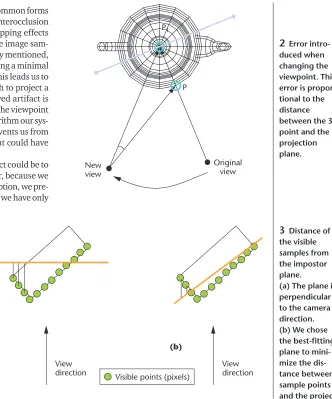
The popping artifact occurs because all the points on the surface of the sampled object are projected onto the same plane, from the direc-tion that the camera is facing when the sample is created. Obviously, as the camera position changes, the projection of such points on the impostor can’t change, and the cur-rent impostor is no longer an exact replica of the object appearance. The amount of error for a generic point on the object surface is pro-portional to the distance of the point from the projection plane. Figure 2 demonstrates this.
The plane researchers commonly use as the projec-tion plane for an impostor is usually the one perpendic-ular to the view direction from which the sample image was taken. This plane doesn’t take into account the object’s shape nor any kind of special occlusion that could be in the image. We then decided to try a different approach: Given an object and the camera position from where we created the sample image, we searched for the projection plane passing through the object that minimizes the sum of the distances of the sampled points and the projection plane.
To apply this idea, we had to project back in the 3D space the points visible in the impostor image to get 3D visible samples of the object. We applied a Principal Component Analysis (PCA) to the set of 3D points and identified the two principal eigenvectors as directions describing the projection plane. In the case of sample human polygonal models, such a plane results in a sig-nificantly better approximation of the position of the vis-ible pixels with respect to the actual point positions in 3D. Unfortunately, other visual artifacts arose when we used the best-fitting plane as the impostor plane. In fact, the special orientation of this new plane asymmetrical-ly warps the image depending on which direction the
camera moves away from the sampling position. In some extreme cases, for a particular plane orientation and a certain distance of the camera, perspective distortions can also become too evident (see Figure 3a). This is more visible when moving upward rather than around because our object (the avatar) is longer along that dimension.
Because we couldn’t use the best-fitting plane puted with PCA as is, we reduced the artifacts by com-bining the plane’s two candidate orientations. Starting from an impostor plane purely perpendicular to the camera, we “perturbed” its orientation using the result-ing plane obtained from a PCA of the sample image (see Figure 3b). This minimized the popping while limiting the introduction of other artifacts. In practice, we found that averaging the two directions worked well.
Image compression
Although the hardware texture memory available has increased, we should still make an effort to reduce the amount used to display virtual humans. First, because humans are walking, the movement is symmetric. Instead of 32 samples, we can then reduce it to 16 and get the other 16 by mirroring the texture. We can see such symmetry in other objects, such as cars or bicycles,
P
Original view New
view
2
Error intro-duced when changing the viewpoint. This error is propor-tional to the distance between the 3D point and the projection plane.Visible points (pixels) View
direction
View direction
3
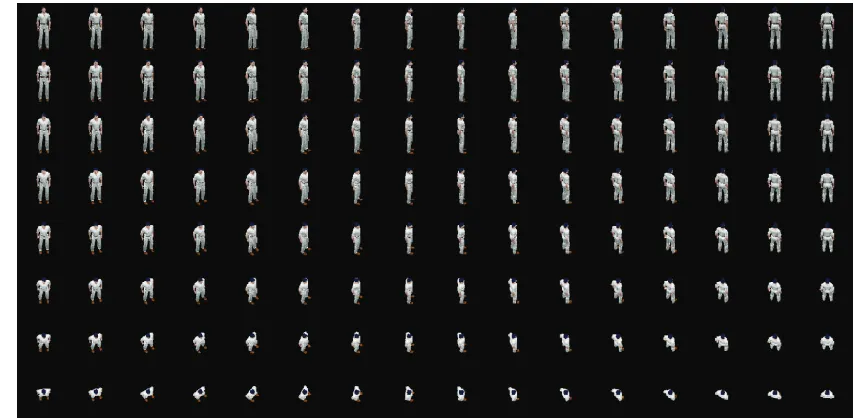
Distance of the visible samples from the impostor plane. (a) The plane is perpendicular to the camera direction. (b) We chose the best-fitting plane to mini-mize the dis-tance between sample points and the projec-tion plane.and this approximation may be useful for them as well. Second, all the images are the same size. This results in a considerable waste of space, because for some images, the human fits a restricted area. We started by placing the samples on a texture using a regular grid.1Each sample is a prerendered ray-traced image of 256 ×256 pixels of the character, using an orthographic projection. Figure 4 shows the resulting image. In this way, extracting a par-ticular sample is a trivial and fast operation, but there’s a lot of unused texture space around each sample that gets wasted. To minimize the amount of unused regions, dur-ing the preprocessdur-ing phase, we computed the smallest rectangle containing the character for each sample. Then, we combined all these samples in a single image, reorga-nizing them to minimize the unused space. Thanks to this process, the resulting new image is much smaller than the original without any loss of image quality.
With our current reorganization strategy, we can reduce the amount of texture memory necessary to store our human images to 25 percent of the original value. In our case, to have a good trade-off between the quality and
the memory required for the samples, we stored each animation frame using a single image of 512 ×512 pixel as a total size. Figure 5 shows an example of the result-ing texture. We then stored the texture usresult-ing the OpenGL compressed format (http://oss.sgi.com/projects/ ogl-sample/registry/EXT/texture compressions3tc.txt), which gives a further memory compression ratio of 1:4. This ratio is efficient, although the image loses part of its quality. The compression format lets us keep alpha val-ues and encodes them in 4 bits. Once loaded in texture memory, each animation frame for a single human model requires 256 Kbytes.
Because we no longer have a regular grid, we now must precompute appropriate texture coordinates and store them for each sample. Then, at rendering time, we need to compute on the fly the right size and orienta-tion for the impostor to avoid introducing distororienta-tions of the sample image. It’s important to notice that, because of our optimal samples placement strategy, these para-meters generally vary for different frames of animation even considering a fixed point of view. Figure 5 shows an example of the mapping and the choice of the impostor.
Increasing the variety of
avatars
With this texture compression we gain texture memory that we can use to simulate more humans than Tecchia and Chrysanthou.1To simulate 10 different types of human with 10 frames of anima-tion each, we need about 25 Mbytes of texture memory. Although we improved the possibility of variety, 10 different avatars aren’t enough to populate a city. Because we were limited by the texture memory, we decided to modify the texture on the fly using multipass rendering. We can't change the shape and the
Image-Based Modeling, Rendering, and Lighting
4
Impostortexture for an animation frame using the Tecchia and Chrysanthou method.1
5
Renderingkind of human, but we can assign a different color to significant parts of the body such as clothes, hair, and skin color.
To identify such areas, we precomputed an alpha-channel image with a different alpha value for each part to modify (see Figure 6). (We did this using 3D Studio Max. We had to turn off the antialiasing to avoid blurring the borders of two adjacent regions.) Tuning the alpha channel, we can define up to 256 different regions in the texture without using compression, or up to 16 using the s3tc compression (http://oss.sgi.com/projects/ogl-sam-ple/registry/EXT/texture compressions3tc.txt) because only 4 bits are available for the alpha channel. We per-formed multipass rendering using the alpha channel to select the parts to render. For each pass, we change the impostor polygon color to the desired color, and we apply the texture using the flag GL_MODULATE and set the alpha threshold of the alpha test to the one associated with the part of interest.
Computing a texture modulation preserves the shad-ing because it’s already included in the texture. In our experiments, we drew up to three passes, thus only changing each individual’s shirt and trousers color. More passes are possible because we can identify sev-eral regions. However, the multipass rendering might slow down the overall rendering rate, and there must be a trade-off between variety and rendering time.
Implementation details and results
We implemented and tested the methods we discuss here. For the simulation, we added some elements that allow better quality for the results. To control the virtu-al humans’ motion, we subdivided the floor of the envi-ronment into regular-sized tiles. While the humans move around, they check information corresponding to the tile they occupy. Several types of information can be stored,2but presently, we only use this information for collision detection and shadowing. We furthersubdi-vided the tiles so that an avatar can be at different posi-tions on the same tile.
If an avatar stays in the same tile in the next frame, it just continues to move in its current direction and no decision needs to be taken. In the case of the model we used for the test, the collision detection map is binary. When we encode the tile with black, it’s impassable and the avatar needs to change direction. In addition, we performed intercollision detection between humans by checking if a destination tile is already occupied.
Using the impostor approach, we can also compute and display the moving humans’ shadows.3To project the humans’ shadows on the ground, we exploit the fact that the shadow of a virtual human is the projection onto the ground of its silhouette as seen from the light source (see Figure 7). We can thus display the humans’ shadow on the ground using one of the images already stored in the database that we use for the impostor. In this way, with the cost of only one additional polygon corre-sponding to the projection of the impostor polygon on the ground, we create a shadow corresponding to the human posture.
avatar with alpha channels to identify parts to modify. On the right, an avatar rendered with multipasses regarding the alpha channel. Notice how these four avatars look different although they are built from the same 3D model.
We also cast the buildings’ shadows onto each virtu-al human extending the function of the regular grid used for collision detection. We compute and store in a 2D image the information about the height of a build-ing’s shadow volumes. For each virtual human travers-ing the grid, we compare its height with the height of
the shadow stored in the cell it occu-pies. The impostor polygon appro-priately darkens to reflect the shadow coverage.
We developed the system on an 800-MHz PC Pentium III with an Nvidia GeForce GTS2 video card. We populated our environment with six different avatars and performed three passes to draw different col-ors, chosen randomly. For the results in Figures 8 and 9, we dis-played 2,000 avatars for each of four types of humans and 1,000 for each of the two last type, thus displaying 10,000 different humans. One of these types is a jogger, thus having an animation different from the oth-ers. These humans move in a village modeled with 41,260 polygons. The display updates between 12 and 20 frames per second (frames/sec), depending on the displayed polygo-nal complexity. Although the ren-dering is in real time, there’s no trade-off made to decrease the qual-ity. The rendering quality is as good as if we hadn’t used optimization algorithms. Visit http://www.cs.ucl. ac.uk/research/vr/Projects/Crowds/ CGA/ for sample videos of this implementation.
To evaluate our simulation’s scal-ability, we simulated different sized crowds. The frame per second rate for 0 people was 26.20; for 1,000 people, it was 24.08; for 5,000 peo-ple, it was 18.26; and for 10,000 people, it was 13.35. We ran the sim-ulation on an identical camera path for each simulation.
Rendering the city model itself already uses a lot of the resources because the average display is only 26 frames/sec. In Figure 10, we plotted the same data but as time per frame versus the number of humans, and we can clearly see that the relation is almost linear. We believe that an occlusion culling algorithm performed on the static model could help speed up the rendering. The frame rate then decreases as the number of poly-gons (those for the avatars) displayed increases. These timings also include the collision detection performed for each of the virtual humans simulated. A visibility test and an occlusion culling algorithm applied to both the collision detection and the display of the humans could accelerate the frame rate.
Future work
Although we’ve already achieved good results, we believe that there’s room for further improvements and developments. In our implementation, we made a num-ber of assumptions that we can now reexamine. For example, we assumed that the viewer will be at a
cer-Image-Based Modeling, Rendering, and Lighting
8
The crowdvisualization. Notice the number of different peo-ple. Using the optimization techniques in this article, we visualized thou-sands of differ-ent humans in real time.
9
A closer view of the humans.80 70 60 50 40 30 20 10
Time per frame (ms)
5 10
Number of humans (thousands)
10
Number ofer, they will notice the artifacts. One way around this is to use a hybrid approach where polygonal human mod-els are used instead of impostors for the few avatars that come right up to the viewpoint.
Because we used the same textures to generate the avatar shadows, we also assumed that the light source at infinite. This wasn’t a limitation for our examples because the only light source was the sun. However, if we want to simulate the city at night with street lights, then we will have to warp the textures before applying them.
The impostors are currently shaded when we render them in 3D Studio Max. This effectively fixes the shad-ing to the particular light defined at that time, makshad-ing the sources static. However, we believe that we could shade the impostors on the fly using normal maps indi-cating each pixel’s orientation. This would let the shad-ing be consistent if we modified the light source.
An interesting extension to our system, that could greatly improve its impact, would be using real photo-graphic images of humans instead of synthetic models. Of course, the problem here would be acquiring all the sample images. Possibly, we could scan a person in color and then take the samples from the scan.
Methods to cull polygons could speed up rendering times, selecting for display both polygons from the sta-tic environments and the moving people.4
We could certainly use the current algorithms to ren-der different kinds of objects such as cars, pets, children, or groups of people (such as children holding an adult’s hands). Also, several animations could be possible, with an appropriate texture load. Particular care should be taken for transitions in between animations. Moreover, using the multipass rendering algorithm, we could sim-ulate simple animation such as turning a head to the left or right.
Finally, for each new type of object, we should do more work on developing appropriate behavior. Although researchers have done a lot of work on behavior in cities, there are still many problems to solve, especially for real-time simulation of thousands of agents. ■
Acknowledgments
This work was in part supported by the UK Engineer-ing and Physical Sciences Research Council (EPSRC) project GR/R01576/01 and the EPSRC Interdisciplinary Research Centre Equator, an interdisciplinary research project at University College London. (See http://www. cs.ucl.ac.uk/research/equator/ for more information.)
References
1. F. Tecchia and Y. Chrysanthou, “Real-Time Rendering of Densely Populated Urban Environments,” Proc. Rendering Techniques 2000, Springer Computer Science, New York, 2000, pp. 83-88.
3. C. Loscos, F. Tecchia, and Y. Chrysanthou, “Real-Time Shadows for Animated Crowds in Virtual Cities,” Proc. ACM Symp. Virtual Reality Software and Technology, ACM Press, New York, 2002, pp. 85-92.
4. F. Tecchia, C. Loscos, and Y. Chrysanthou, “Real Time Ren-dering of Populated Urban Environments,” ACM Siggraph Technical Sketch, ACM Press, New York, Aug. 2001.
Franco Tecchiais a research fel-low at the University College London, working on real-time rendering of populated complex environments. His research interests include real-time computer graphics, virtual and augmented reality, and software engineering. He received his DrEng degree in computer engineering from the University of Pisa.
Céline Loscosis a lecturer at the University College of London. Her research interests include inverse illu-mination and realistic illuillu-mination for complex environments. She par-ticipates in European Union and other funded projects for real-time rendering for mixed interfaces, such as real-world data or haptics. She received an MSc and a PhD in computer sci-ence from the Université Joseph Fourier in Grenoble, France. She is an ACM and Eurographics member.
Yiorgos Chrysanthou is an assistant professor at the University of Cyprus. His research interests are in computer graphics, virtual reali-ty, and computational geometry. He received a BSc in computer science and statistics and a PhD in comput-er graphics from Queen Mary and Westfield College. He is an IEEE, ACM, and Eurographics member. He also coau-thored the book Computer Graphics and Virtual Envi-ronments: From Realism to Real Time(Addison Wesley, 2001).
Readers may contact Franco Tecchia at the Dept. of Com-puter Science, Univ. College London, Gower St., WC1E 6BT, London, UK, email [email protected].