© 2014, IJCSMC All Rights Reserved 716 Available Online atwww.ijcsmc.com
International Journal of Computer Science and Mobile Computing
A Monthly Journal of Computer Science and Information Technology
ISSN 2320–088X
IJCSMC, Vol. 3, Issue. 7, July 2014, pg.716 – 730
RESEARCH ARTICLE
BANDWIDTH EFFICIENCY IN MAC
PROTOCOL FOR AD HOC NETWORK
Mayank Sharma
1, Mrs. Sunita Gupta
2¹Computer Science and Engineering M. Tech Scholar, JECRC University Jaipur, India
²Computer Science and Engineering Assistant Professor, JECRC University Jaipur, India
1
[email protected];
2[email protected]
Abstract: Bandwidth, power and collision are considered as three important resources in wireless networks. Therefore, how to manage these resources becomes a effect on wireless ad hoc network. These effects are not present in wire line networks, and evaluation of available bandwidth in wireless networks a difficult task. Furthermore, in wireless medium the available resources also vary with the protocol and its central network i.e. ad hoc network. In this thesis, a collision-aware spectrum assignment scheme has been proposed for Bandwidth Optical Networks allocates the available bandwidth and increases energy efficiency in multi hop collection networks compared to the traditionally used random back off.
We improve the MAC protocols with details about the bandwidth, power and collision used and their limitations. However, the MAC is utilizing in link layer, the channel is easy to access by the CSMA/CD scheme. All channels to establish the channels’ situation and avoid collision, in the process of the frame duration access the TDMA, i.e. time slots are required in frame duration, and FDMA (Scheduled protocol) access the bandwidth allocation which every node gets a permanent allocation of bandwidth. The aim of this thesis is to initiate multiple channels in medium for FDMA, which constrain the collision of number of channel (N) and utilized bandwidth (W). Therefore, how to increase a MAC protocol to improve the bandwidth efficiency and decrease the energy utilization is necessary.
Keywords— Wireless Local Area Network (WLAN), Medium Access control (MAC), Ad Hoc wireless Network (AHWN), Frequency Division Multiple Access (FDMA), Code Division Multiple Access (CDMA), Time Division Multiple Access (TDMA), Frequency Division Multiplexing (FDM), Frequency division duplex (FDD), Protocol control information (PCI), Cyclic Redundancy Check (CRC), Quality of Service (QOS), microseconds (µS)
1.
Introduction
© 2014, IJCSMC All Rights Reserved 717
Wireless networking offers latest prospect and challenges for wireless ad hoc network. In the absence of wireless network, allocated group of communication nodes set up and maintain a network among them, without maintaining a base station or a central control of ad hoc network. Further, when the number of stations and the traffic load enhance, the possibility of a successful communication will corrupt and transmission collisions will swell. Transmission collisions may outcome in the waste of bandwidth and the utilization of energy. Therefore, how to increase a MAC protocol to improve the bandwidth efficiency and decrease the energy utilization is necessary.
The Medium Access Control (MAC) protocol is use to provide the data link layer of the Ethernet LAN system. The MAC protocol added 14 byte header (Protocol control information) PCI from encapsulated SDU (payload data) before the data and checksum, the checksum is a 4-byte (32-bit) Cyclic Redundancy Check (CRC) after the data. The entire frame is preceded by a small idle period (the minimum inter-frame gap, 9.6 microseconds (µS)) and 8 byte preamble. MAC layer, sometimes also referred to as a sub layer of the Data Link layer, involves the functions and procedures necessary to transfer data between two or more nodes of the network. It is the responsibility of the MAC layer to perform error correction for anomalies occurring in the physical layer. The layer performs specific activities for framing, physical addressing, and flow and error controls. It is responsible for resolving conflicts among different nodes for channel access. Since the MAC layer has a direct bearing on how reliably and efficiently data can be transmitted between two nodes along the routing path in the network, it affects the Quality of Service (QOS) of the network. The design of a MAC protocol should also address issues caused by mobility of nodes and an unreliable time varying channel.
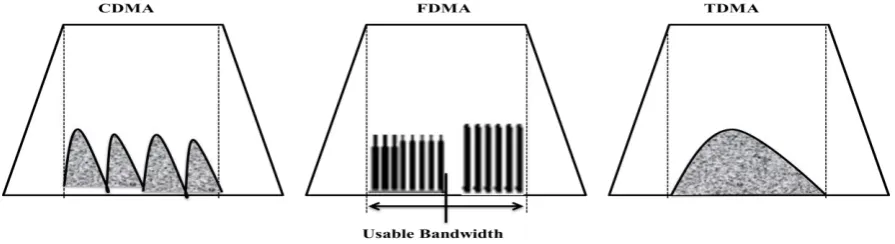
Figure 1: Bandwidth Efficiency in MAC protocol (CDMA, FDMA, and TDMA)
In medium access control (MAC) protocol developed for high bandwidth wireless networks, such as based on FDMA. In common, the invention provides MAC in a communication network. This includes number of channel over a shared communication medium. The network time separated in TDMA frames, every one containing a fixed number of time slots. Therefore, the cycle duration is fixed and entire network synchronized on frame and slot. Be MAC Protocol provides bandwidth provision for the delivery of network control messages and recognizes maintenance of network. Bandwidth is depending on many telephony applications. It is the frequency range taken by modulated carrier wave form in radio communication. The relaying process required to accomplish the multi hop network can be transparent or regenerative. In the former case, the signal stream is received on one frequency band and simply retransmitted on another band. In the latter case, the signal stream is decoded, re encoded, and retransmitted. For the regenerative case, the multiple access methodology can be frequency-division multiple-access (FDMA) or time-division multiple-access (TDMA).
© 2014, IJCSMC All Rights Reserved 718
FDMA-based regenerative relaying implies that the available bandwidth W is divided between the relaying nodes, while communication may occur continuously over the entire frame duration. On the other hand, TDMA-based regenerative relaying implies that the total frame duration T is partitioned into slots attributed to relaying nodes, in which case communication may occur over the entire bandwidth W.
1.1
Need for special MAC protocols:
The main issues need to be addressed while designing a MAC protocol for ad hoc wireless networks:
1. Bandwidth efficiency:
It is defined at the ratio of the bandwidth used for actual data transmission to the total available bandwidth. The MAC protocol for ad-hoc networks should maximize it.
2. Power conservation:
In an ad hoc network is the method of deciding the transmit power of every correspondence terminal such that a configuration objective (e.g. network lifetime, throughput, and so on.) could be fulfilled.
3. Quality of service:
It is support essential for time-critical applications. The MAC protocol for ad-hoc networks should consider the constraint of ad-hoc networks.
4. Synchronization:
It can be achieved by exchange of control packets. 5. Collision
6. Hidden and exposed terminal problems: Hidden nodes:
Hidden stations: Carrier sensing may fail to detect another station.
Fading: The strength of radio signals diminished rapidly with the distance from the transmitter.
Exposed nodes:
Exposed stations: B is sending to A. C can detect it. C might want to send to E but conclude it cannot transmit because C hears B.
Collision masking: The local signal might drown out the remote transmission.
7. Error-Prone Shared Broadcast Channel
8. Distributed Nature/Lack of Central Coordination 9. Mobility of Nodes: Nodes are mobile most of the time.
1.2
Goals of Mac protocol:
The available bandwidth must be utilized efficiently.
The protocol should ensure fair allocation of bandwidth to nodes.
The protocol should provide QOS support for real-time traffic.
The access delay, which refers to the average delay experienced by any packet to get transmitted, must be kept low.
The protocol should minimize the effects of hidden and exposed terminal problems.
The protocol must be scalable to large networks.
It should have power control mechanisms.
The protocol should provide synchronization among nodes.
2.
Literature Review
2.1
Introduction:
© 2014, IJCSMC All Rights Reserved 719
bandwidth is also consumed by the other medium of channel, and this can be significant. Another distinction to be made on this topic is that some papers are focused on increasing performance of bandwidth, power and collision usage few approaches and mechanisms in IEEE 802.16Networks.
2.2
Review process adopted & Issue wise Solution Approaches:
Bandwidth reservation in wireless networks is a very difficult task due to the volatility of collision between channels, radio channels, node mobility and need of synchronization between nodes. FDMA-based bandwidth efficiency better performance with MAC protocol that implies available bandwidth (w), divided between the relaying channels of access medium. Unlike several protocols for all nodes of frequency similarly with respect to bandwidth conservation, our protocol based over the period.
Applied to wireless ad hoc network over the existing wireless medium access protocols can improve bandwidth use, power consumption, effect on collision between numbers of channels and provide quality of service support to different medium access.
2.2.1 In 2013, Sheetal Sharma, Himanshu Sharma and Lucknesh Kumar works on “The Power Spectrum Encryption
and Decryption”, in which paper Encryption is a methodology of changing over some information from its unique structure to encrypted structure, essentially that can't reasonable by unapproved client. In this paper the power spectrum of a sound wav document is somewhat encrypted utilizing RSA encryption system. Here a change space sound sign (frequency area sound indicator) is taken for encryption and decoding. A period space sound sign is changed over to change area motion by utilizing Fast Fourier Transform.
This paper conclude in decoded wave structure is near the first wav structure that we had while recording our sound i.e. we are getting the same message as the sender send it to us. In this paper, we proposed a specific encryption approach. The proposed methodology recognizes and then encrypts imperative parts of the FFT coefficient (amplitude values). The endeavors that might be added to this proposed thought are creating a versatile channel to investigate the helpful sound specimen rapidly.
2.2.2 In 2012, Bhupendra Suman, Dr.SC Sharma, Dr. Millie Pant in their work for tactical MANET waveforms describes that the MAC protocol also plays an important role to meet the dynamics of tactical environment which is characterized by arbitrary and dynamic node topologies along with continuously changing traffic pattern. This makes mobile wireless communication complicated and difficult to maintain connectivity.
In this paper depict about the TDMA, utilization of USAP convention gives fundamental thought of element space task of information openings. The USAP-MA is an enlargement of USAP which presents ABC (Versatile Show Cycle) to change the edge length and the casing cycle alertly relying upon the amount of portable hosts and the system topology. USAP-MA enhances the channel use. On the other hand, USAP-MA does not offer none, of these when and how to change the edge length nor how to select an opening relegated to another hub. Additionally, in this convention no change in control openings number is conceivable inside an edge. In this way unassigned openings show up in the recent a piece of the edge which prompts underutilization of channel transmission capacity.
They conclude solution to avoid the collision by NES. On the off chance that two or more nodes attempt to join the network in the meantime, they will send their "NCF" in NES and impact will happen. All things considered the fighting hubs will come to think about the crash when they would accept the NCF (NCS_OI) of different hubs with unmodified "NCS space len". To purpose the dispute the battling hubs will run an irregular back off algorithm. In this paper, we have proposed a bandwidth efficient dynamic TDMA slot assignment protocol to improve the channel utilization. Our convention maintains a strategic distance from the build of unassigned spaces by minimizing the amount of control openings to the level of present neighborhood.
© 2014, IJCSMC All Rights Reserved 720
For the solution, in thesis, we first dissect two bandwidth request mechanisms in IEEE 802.16 networks. We give mathematical models to every component: unicast polling and contention resolution and perform execution dissection regarding throughput and delay. We further propose two execution objectives: 1) Minimizing delay with a fixed target throughput. 2) Maximizing throughput while achieving a target delay requirement. We design two algorithms to help BS settle on scheduling choice to attain every execution objective. The simulation results indicate that our algorithms can just help the BS settle on a superior decision.
Because of the way of bandwidth reservation, the bandwidth may not be used constantly. In bandwidth recycling, we first investigate the rate of unused bandwidth in a general network. We further propose a protocol named bandwidth recycling which permits the BS to schedule backup Sss to get the unused bandwidth. In light of the execution investigation of bandwidth recycling, we abridge the factors which affecting the execution and propose three extra algorithms to enhance the execution. According to our simulation results, bandwidth recycling can averagely enhance the framework execution by 40%.
2.2.4 In 2005, Shih K., Chang C., Chou C., in their work a “Power saving by increasing spatial reuse for IEEE 802.11 ad
hoc WLANs”. In this paper, heavy traffic load and high station density are most likely to incur collisions, and further consume bandwidth and energy. In this paper, a distributed power-saving protocol, Power Efficient MAC Protocol (PEM), to avoid collisions and to save energy is proposed.
We define the channel problem of the medium in their figure:
Figurer 2: The channel capture problem
In the paper, solution to perform both mechanisms is used to decrease unwanted energy, control overhead or increase network throughput.
Figure 3: The comparisons of network load and power throughput (1) and control overhead (2) in the random topology scenario.
© 2014, IJCSMC All Rights Reserved 721
errors and unique problems such as the hidden-terminal problem, the exposed-terminal problem, and signal fading property. Although a lot of research has been conducted on MAC protocols, the different issues concerned have mostly been accessible in separation of each other.
Various MAC schemes developed for wireless ad hoc networks can be classified. In contention-free schemes (e.g., TDMA, FDMA, CDMA), certain assignments are used to avoid contentions. Contention based schemes, on the other hand, are aware of the risk of collisions of transmitted data. Since contention-free MAC schemes are more applicable to static networks and/or networks with centralized control, we shall focus on contention-based MAC schemes in this survey.
This study has exhibited a wide diagram of the examination work led in the field of ad hoc wireless networks with respect to MAC protocols. We have discussed many schemes and identified their salient features.
2.2.6 In 2004, Mischa Dohler and Athanasios Gkelias,“Resource Allocation for FDMA” in their work on asset portion for multi jump interfaces so FDMA based regenerative handing-off intimates that the accessible bandwidth is partition between there laying nodes, while correspondence may happen constantly over the whole frame length of time T and its process allotment of the casing span or bandwidth. The points of this paper, present limit designation for FDMA which incorporates all out useable power S and bandwidth W.
For the solution, According to Shannon’s notion of entropy, capacity per unit time (or achievable rate) C, expressed in bits per second, for an additive Gaussian noise link is given as C = W. (1 + (S / N)), where W is the available bandwidth, S is the received signal power, and N = W is the received noise power. The receiver spectral noise density assumed constant over the herein considered frequency range. So finally it was proven that the capacity allocation of an FDMA and TDMA communication system coincides therefore the derived fractional bandwidth and transmission power allocations are equally applicable to a TDMA based system with fractional frame duration αi and transmission power αi • βi, continuously communicating over the entire bandwidth W .
There is many more research process to improve bandwidth performance, quality of service, energy efficiency and collision in ad hoc networks.
3.
Related Proposed Work
The energy-aware MAC protocols in a multi-hop self advertising mobile ad hoc network should all the while fulfill the following three destinations:
1. First, MAC protocols ought to encourage the formation of the network framework.
2. Second, MAC protocols are responsible for reasonably and productively imparting the wireless channels among various mobile terminals. In MAC layer channel scheduling, packet collision among diverse clients ought to be decreased or even totally stayed away from, and bandwidth should be fully-utilized. These two objectives are clashing with one another. In this way MAC protocol ought to be deliberately intended to adjust them focused around network requirement.
3. Third, MAC protocol ought to be energy-aware for amplifying battery lifetime. Supporting power administration to save energy is needed for battery-fueled portable hubs in MANETs.
3.1
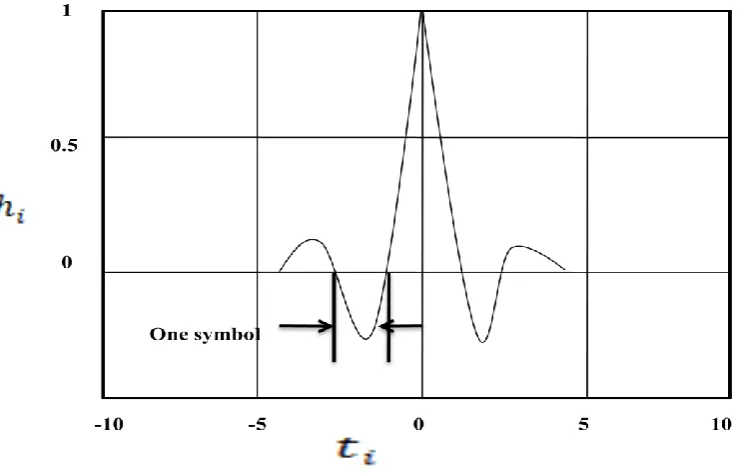
Shannon’s notion:
© 2014, IJCSMC All Rights Reserved 722
Figure 4: Shannon Channel Capacity
The methods secured incorporate channel reuse power controlled plan, power or mechanism, double channels, and reception apparatus based power efficient plans.
Energy efficiency or useful power spending of a framework is one of the essential requires for WLANs in light of constrained energy of batteries. The most suitable layer for converse energy and force issues is MAC Layer. The fundamental method for reduction power or upgrading energy capacity is to minimize the power wastage.
3.2
Nyquist theorem:
In this work another approached we will use to approaches of Nyquist Theorem for maximum bandwidth efficiency so we will discuss about in this part of this theorem and its factor noise channel, data transmission, spectral leakage etc.
© 2014, IJCSMC All Rights Reserved 723
4.
Problem Statement and Solution
As I reviewed that all above mention papers and their results so it gives again a new research about Bandwidth efficiency in MAC protocol gives a efficiency resources as used in the ad hoc network i.e. bandwidth resources which used in maximum efficient in FDMA, energy saving when we used many signal in sending or receiving and collision detection which is define in medium of channels. We use an algorithm and encryption techniques. If some change are made in the algorithm key size and the encryption techniques. I can implement in algorithm that may prevent the above maximum bandwidth, save energy and consume delay better than previous algorithm that give a secure and free medium. May be it cited as most prominent or proficient algorithm today.
So that why I am selecting my thesis title as “Bandwidth efficiency in MAC protocol for ad hoc network” that covers the bandwidth utilization, target delay, collision free medium, quality of service and power consumption.
“The main aim to implement in MAC protocol in which improves the bandwidth frequency from energy consumption techniques and collision detect procedure.
Energy efficiency or useful power spending of a framework is one of the essential requires for WLANs in light of constrained energy of batteries. The most suitable layer for converse energy and force issues is MAC Layer. The fundamental method for reduction power or upgrading energy capacity is to minimize the power wastage.
The collision theory is states that in the medium frame impact to break the channel of medium from all new channels i.e. in the medium successful changes are called successful collisions. Collisions have sufficient energy also known as activation energy.
4.1
Energy minimization techniques:
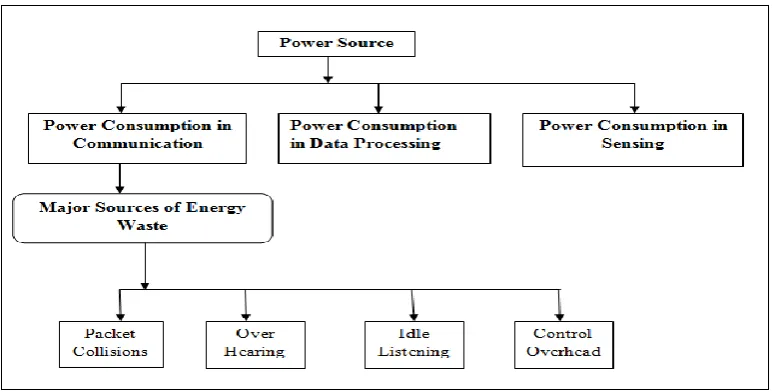
Energy efficiency or useful power spending of a framework is one of the essential requires for WLANs in light of constrained energy of batteries. The most suitable layer for converse energy and force issues is MAC Layer. The fundamental method for reduction power or upgrading energy capacity is to minimize the power wastage. There are a few resources of power wastage including packet collision, over hearing, unmoving tuning in, and control fault overhead and so on. Real source of energy wastefulness among the above recorded sources is packet impact for WLANs.
Power efficiency is most important issue in light of the fact that the force of nodes in WLANs is constrained and long span of operation is normal. The key idea for low power utilization is to minimize the power utilization in the accompanying sources:
sensing, information transforming and correspondence.
© 2014, IJCSMC All Rights Reserved 724
4.2
Importance of Bandwidth Efficiency:
The frequency range of a framework is the reach over which it is considered to give a valuable level of indicator with worthy mutilation attributes. A posting of the upper and lower points of confinement of frequency points of confinement for a framework is not helpful without a standard for what the range represents. Numerous frameworks are described by the scope of frequencies to which they react. Musical instruments produce diverse scopes of notes inside the listening to run. The electromagnetic range might be isolated into numerous diverse runs, for example, unmistakable light, infrared or ultraviolet radiation, radio waves, X-beams etc, and each of these reaches can thusly be separated into more diminutive extents. A radio interchanges indicator must possess a scope of frequencies convey a large portion of its vitality, called its bandwidth. Portion of radio frequency ranges to diverse utilization is a real capacity of radio spectrum designation.
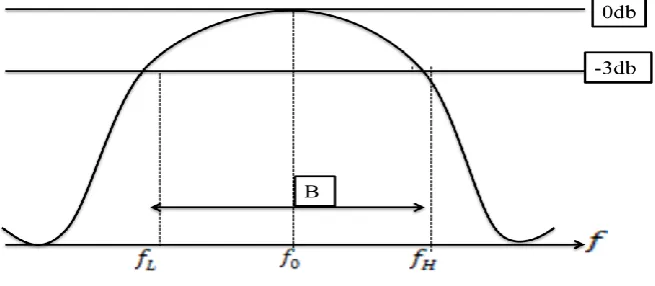
Bandwidth is characterized as a band including all frequencies between upper cut-off and lower cut-off frequencies. Upper and lower cut-off (or 3db) frequencies compares to the frequencies where the magnitude of indicator's Fourier Change is lessened to a large portion of (3db not exactly) its maximum quality.
Figure 7: Bandwidth Frequency
Importance of Bandwidth:
Bandwidth empowers calculation of the power needed to transmit an indicator. 1. signals that are band-constrained are not time-restricted
2. Energy of a signal is characterized as:
∫ (t) dt
3. Energy of a signal that is not time-constrained might be processed utilizing Parsevals Theorem:
∫ (t) dt = ∫ (w) dw
4.3
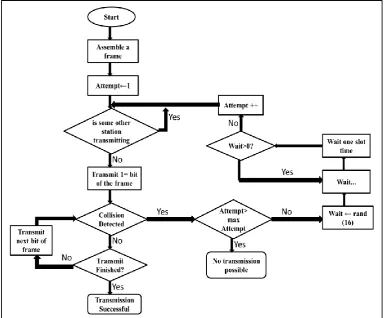
Algorithm Collision recognition procedure:
1) Continue transmission (with a jam signal instead of frame header/data/CRC) until minimum packet time is reached to ensure that all receivers detect the collision.
2) Increment retransmission counter.
3) Was the maximum number of transmission attempts reached? If so, abort transmission. 4) Calculate and wait random back off period based on number of collisions.
5) Re-enter main procedure at stage 1.
© 2014, IJCSMC All Rights Reserved 725
Figure 8: Collision recognition procedure
5.
Simulation Analysis
5.1
Software Requirement:
Software required for performing penetration testing is as follows:
5.1.1
Mat Lab 2009a:
© 2014, IJCSMC All Rights Reserved 726 Figure 9: Mat lab Flow Chart
5.2
Computation of Power of a Signal:
Computing the energy and power of signal was conferred here. We will confirm the technique by utilizing Discrete Fourier Transform (DFT) in Mat lab.
The total power of signal might be registered using the following comparison of equation:
P x = Lim N→∞ 1N ∑ n=0 n=N−1 |x (n)| 2 → (1)
Case Study:
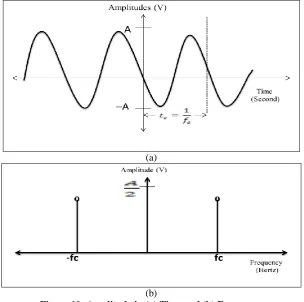
X (t) is a sine wave of amplitude A and frequency fc represented by the mathematical statement.
X (t) = A sin (2πf c t)
At the point when characterize in frequency area, it will resemble the one on the right side plot in the following figure. This is obvious from the way that the sine wave might be numerically illustrated to by applying Euler's equation.
A sin (2πf c t) = A e j2πf c t −e −j2πf c t 2j
Taking the Fourier transform of X (t) to represent to it in frequency space,
X (f) = F [A sin (2πf c t)]
= ∫ ∞ −∞ [e j2πf c t −e −j2πf c t 2j] e −j2πft dt = A2j [δ (f − f c) − δ (f + f c)]
© 2014, IJCSMC All Rights Reserved 727
(a)
(b)
Figure 10: Amplitude in (a) Time and (b) Frequency
Squaring the amplitudes provide the magnitude of energy of frequency parts. The energy range is plotted beneath.
Figure 10: Amplitude Provide in Square
Thus if the pure sine wave is of amplitude A=1V and frequency=100Hz, the power spectrum will have two spikes of value A 2 /4=0.25 at 100 Hz and -100 Hz frequencies. The total power will be A 2 /4+A 2 /4=0.25+0.25=0.5W.
5.2.1
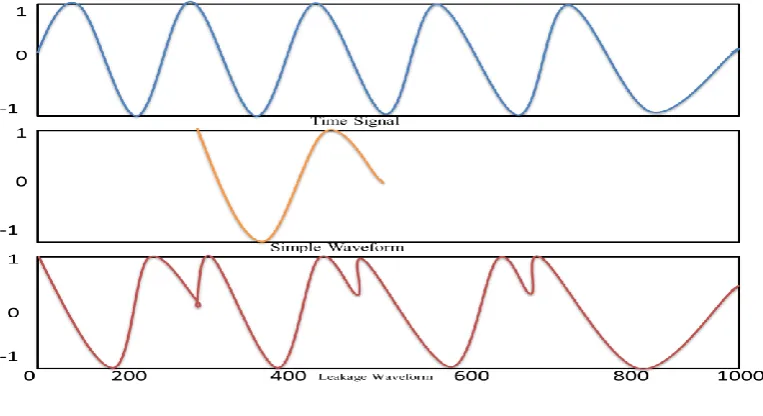
Spectral leakage in bandwidth:
Impact of restricted estimation time and it outcome Spectral Leakage were talked about in the post. How about we observe the application of window methods that has the capability of falling the spectral leakage.
© 2014, IJCSMC All Rights Reserved 728 Figure 11: Spectral Leakage Waveform
6.
Result
6.1
Calculating power and energy of a signalHere St=duration of the signal, and x[n] signifies discrete models of the indicator at normal periods (The inspected signal holds N focuses extending from 0 to N-1). "NORM" work in Mat lab might be used for computing the power and energy substance of an indicator.
NORM (V, P) = sum (abs (V).^P)^(1/P).
Inputs:
% calculate Power and to plot Power spectral density
St =10; %Total evaluation time of signal
Ts=0.005; %Sampling time => 5000 samples per second Fs=1/Ts; % Sampling period of signal
t=[0:Ts: St]; %define simulation time
%sample function to calculate power
x=cos(2*pi*200*t)+cos(2*pi*400*t)+sin(2*pi*600*t); power = (norm(x)^2)/length(x);
%Plot Power Spectral Density
psd1=spectrum(x,1024); specplot(psd1,Fs);
%For use psd function instead of specplot
psd1=spectrum(x,1024);
© 2014, IJCSMC All Rights Reserved 729
If chang the sample time then the spctrum density is modurate and consume pawer in medium and renovate frequency and come out felxibility in bandwidth.
It can be inferred from the above chart that the signal contains three peak power components at 200Hz, 400HZ, and 600Hz.
7.
Conclusion
© 2014, IJCSMC All Rights Reserved 730
References
[1] Schiller J., “Mobile Communications”, Pearson education limited, Edinburgh Gate, Harlow, Forth edition (2009).
[2] Manoj B., Murthy C., “Ad Hoc Wireless Networks Architectures and Protocols”, PrenticeHall, Upper Saddle River, New Jersey, Sixth edition (2008).
[3] Kannan R., Kalidindi R., Iyengar S., “Energy and Rate based MAC Protocol for Wireless Sensor Networks”, Department
of Computer Science Louisiana State University Baton Rouge, LA, 32 (4), 12-4, (2003).
[4] Shih K., Chang C., Chou C., “A Power Saving MAC Protocol by Increasing Spatial Reuse for IEEE 802.11 Ad Hoc
WLANs”, Department of Computer Science and Information Engineering Tamkang University, Tamshui 251, Taipei, Taiwan, 3-24, (2010).
[5] Dohler M., Gkelias A., “Resource Allocation for FDMA-Based Regenerative Multihop Links”, IEEE Transitions on wireless communications, 3(6) 11,(2004).
[6] Suman B., Sharma S., Pant M., “Bandwidth efficient medium access protocol for tactical MANET waveform”, International Journal of Engineering Research and Applications (IJERA), 2(3) 5-6,(2012).
[7] S. Hayat, N. Javaid, Z. A. Khan§, A. Shareef, A. Mahmood, S. H. Bouk, “Energy Efficient MAC Protocols”. a. Department of Electrical Engineering, COMSATS.
b. Institute of Information Technology, Islamabad, Pakistan. c. Faculty of Engineering, Dalhousie University, Halifax, Canada.
[8] Paul J.M. Havinga& Gerard J.M. Smit, “Energy-efficient TDMA Medium Access Controlprotocol scheduling” University
of Twente. Department of Computer ScienceEnschede, the Netherlands. {havinga, smit}@ cs.utwente.nl
[9] IlkerDemirkol, CemErsoy, and FatihAlagöz “MAC Protocols for Wireless Sensor. Networks: A Survey”, Bogazici
University. Sunil Kumar* a, Vineet S. Raghavan b, Jing Deng c “Medium Access Control protocols for ad hoc wireless
networks: A survey”.
a. Department of Electrical and Computer Engineering, Clarkson University, Potsdam, NY 13699, United States. b. Digital Television Group, ATI Technologies Inc., Marlborough, MA 01752, United States.
c. Department of Computer Science, University of New Orleans, New Orleans, LA 70148, United States Received 17 October 2003; received in revised form 13 September 2004; accepted 8 October 2004.
[10] Khaled H. Almotairi and Xuemin (Sherman) Shen*, “Multichannel medium access control for ad hoc wireless network”, Department of Electrical and Computer Engineering, University of Waterloo, waterloo, ON N2L 3G1, Canada.
[11] Raja Jurdak, Cristina Lopes, and Pierre Baldi, “A survey, Classification and Comparative Analysis of MAC Protocol for Ad hoc network”, University of California, Irvine.
[12] Paul C.Kocher, Joshua Jaffe, Benjamin Jun, PankajRohatgi, “Introduction to differential power analysis”, Journal of
Cryptographic Engineering.
[13] Chuck, David Haoen, "Bandwidth and Power Management in Broadband Wireless Networks" (2012), Iowa State University.
[14] Wei Yu , Student Member, IEEE, and John M. Cioffi, Fellow, IEEE “FDMA Capacity of Gaussian Multiple-Access
Channels With ISI”.
[15] Junsung Lim, Hyung G. Myung, Kyungjin Oh and David J. Goodman, Fellow IEEE “PROPORTIONAL FAIR
SCHEDULING OF UPLINK SINGLE-CARRIER FDMA SYSTEMS” (2006)Dept. of Electrical and Computer Engineering, Polytechnic University, USA.
[16] Maode Ma, Yongqing Zhu, Tee Hiang Cheng, Fellow IEEE “A Bandwidth Guaranteed Polling MAC Protocol for Ethernet
Passive Optical Networks” (2003) School of Electrical & Electronic Engineering Nanyang Technological University, Singapore.
[17] Dujdow Buranapanichkit and Yiannis Andreopoulos, Member, IEEE “stributed Time-Frequency Division Multiple Access
Protocol for Wireless Sensor Networks” (2012).
[18] Orlandos Grigoriadis, H. Srikanth Kamath, Member, IAENG “Ber Calculation Using Matlab Simulation For Ofdm Transmission” (2008) Hong Kong.
[19] Saleh Ali K.Al-Omari, Putra Sumari “An Overview of Mobile Ad Hoc Network” (2010) School of Computer Science,
Universiti Sains Malaysia, 11800 Penang, Malaysia.
[20] R.V. Nee, R. Prasad, “OFDM for Wireless Multimedia Communications” (Artech House, Boston, MA, 2000)
[21] J. Geier, “Wireless LANs, Implementing High Performance IEEE 802.11 Networks”, 2nd ed. (Sams Publishing,