Understanding Community
Wellness from a Multicultural Perspective
VICTORIA UNIVERSITY
Master in Applied (Community) Psychology
Research Thesis
2003
Victoria (Vicky) Totikidis
SUPERVISOR
Abstract
Acknowledgements
I would like to thank Professor Isaac Prilleltensky and Ms Heather Gridley (Victoria University) for initiating the Community Wellness Project and giving me the
Declaration
“I declare that this report does not incorporate any materials previously
written by another person except where due reference is made in the text”.
“I further declare that this study had adhered to the ethical principles as
established by the Psychology Ethics Committee of the Victoria
University”.
Signature:
Name:
Victoria (Vicky) Totikidis
Date:
21-10-2002
Contents
ABSTRACT 2
ACKNOWLEDGEMENTS 3
DECLARATION 4
CONTENTS 5
TABLES 7
FIGURES 8
CHAPTER ONE 9
INTRODUCTION 9
COMMUNITY WELLNESS 9
THE COMMUNITY WELLNESS PROJECT 10
THE COMMUNITY OF INTEREST 11
THE PRESENT STUDY 12
CHAPTER TWO 13
REVIEW OF WELLNESS 13
COMMUNITY PSYCHOLOGY ROOTS 13
OTHER HOLISTIC MODELS 17
WELLNESS IN A MULTICULTURAL CONTEXT 19
CHAPTER THREE 22
WELLNESS PRAXIS 22
COMMUNITY WELLNESS MODEL 22
PRAXIS 23
NEEDS THEORY 25
THEORETICAL INTEGRATION 25
WHOSE IDEALS OR VALUES? 27
CHAPTER FOUR 29
METHODOLOGY 29
OVERVIEW OF METHODS 29
PERSONAL BACKGROUND 29
RATIONALE FOR QUALITATIVE METHODS 30
INTERVIEW AND FOCUS GROUP PARTICIPANTS 31
MATERIALS 32
PROCEDURE 34
DATA ANALYSIS 35
CHAPTER FIVE 37
FINDINGS AND DISCUSSION 37
COMMUNITY WELLNESS IDEALS 37
COMMON IDEALS AMONG COMMUNITY MEMBERS 43
COMMUNITY PERCEPTIONS REGARDING ACTIONS 55
SIMILARITIES AND DIFFERENCES AMONG COMMUNITY MEMBERS 57
CHAPTER SIX 58
CONCLUSIONS 58
IDEALS,STRENGTHS,NEEDS AND ACTION 58
ACTION TO IMPROVE WELL-BEING 59
VALIDITY 61
IMPLICATIONS AND LIMITATIONS OF THE RESEARCH 63
REFERENCES 67
Tables
1. The Australian Bureau of Statistics Model of Well-being ... 19
2. Prilleltensky’s Community Wellness Model: A Synergy of Personal, Relational and Collective Well-being (2001a) ... 22
3. Parameters of Roth’s Need Theory and the Present Theory ... 27
4. Characteristics of the Interview and Focus Group Participants... 32
5. Questions Employed in the Interviews and Focus Groups, Parts of the Praxis Model and Research Questions ... 33
6. Conceptual Matrix Guiding the Analysis of Wellness Ideals ... 36
7. Summary of Community Wellness Ideals Among the Maltese-Australian Group ... 38
8. Summary of Community Wellness Ideals Among the Vietnamese-Australian Group ... 39
9. Summary of Community Wellness Ideals Among the Anglo-Australian Group . 40
10.Summary of Community Wellness Ideals Among the Italian-Australian Group 41
11.Summary of the Community Wellness Ideals of Individual Interviewees ... 42
12.Summary of Community Members’ Personal, Relational and Collective Wellness Ideals... 43
13.Community Perceptions on Actions or Changes that could Improve Well-being in St Albans ... 56
14.Community Strengths and Community Needs... 59
Figures
Figure 1. The Wellness Continuum and Reactive and Proactive Prevention Approaches
(after Cowen, 1996)………16
Figure 2. The Community Wellness Cycle of Praxis: A Synthesis of Theory and Method
Understanding Community Wellness from a
Multicultural Perspective
CHAPTER ONE
Introduction
Community Wellness
Wellness promotion strategies should be guided by a broad definition of wellness and by community members’ opinions on what wellness means and what they need to achieve it. Individuals, communities and cultural groups may ascribe different
meanings to concepts such as health, wellness, or well-being. Therefore, consultation with these stakeholders is vital. Definitions are important because they ultimately determine what actions health and community workers, researchers, policy makers and governments take to promote wellness. A narrow definition of wellness typically justifies a limited scope that takes into account only the physical or psychological aspects of health and well-being. In contrast, holistic, psycho-social, ecological or community approaches also consider the broader social, cultural, political and environmental factors that impinge on individual and community wellness.
Community development workers, social workers, and applied community psychologists require holistic models of wellness to inform and guide their work. Individualistic models may be suited to medical settings but can be ‘victim blaming’ (Ryan, 1971). Narrow models of wellness can also justify an ameliorative approach. However, broader transformations of pernicious social systems are required to promote human liberation (Prilleltensky & Nelson, 2002).
In the present context, the terms wellness and well-being are used more or less interchangeably to refer to a holistic state of health. This is consistent with the definition outlined in the constitution of the World Health Organization (WHO). According to the WHO: “Health is a state of complete physical, mental and social well-being and not merely the absence of disease or infirmity” (1946; in Commonwealth of Australia, 1997, p.1).
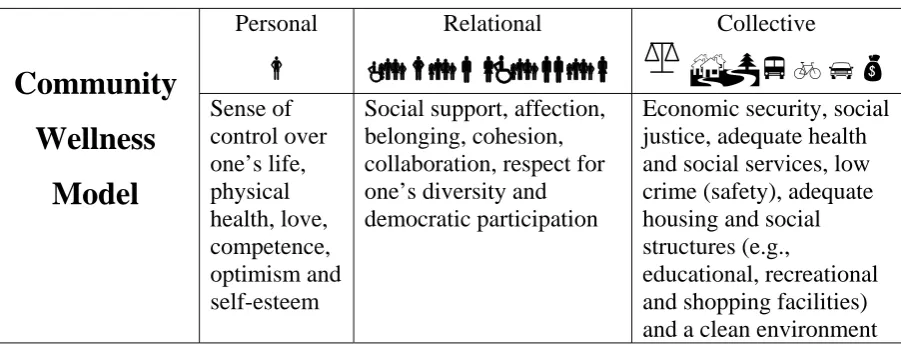
review for earlier versions of the model and contributing authors). The Community Wellness Model is an ecological model of well-being that encompasses the WHO definition. A major assumption associated with the model is that “wellness is a positive state of affairs brought about by the simultaneous satisfaction of personal, relational, and collective needs of individuals and communities” (2001a, p.2). According to the model, personal wellness needs include biological and psychological factors such as the need for a sense of control over one’s life, physical health, love, competence, optimism and self-esteem. Relational wellness needs include the need for social support,
affection, belonging, cohesion, collaboration, respect for one’s diversity and democratic participation in decisions and actions that affect one’s life. Collective wellness needs include the need for economic security, social justice, adequate health and social services, low crime (safety), adequate housing and social structures (e.g., educational, recreational, transportation and shopping facilities) and a clean environment
(Prilleltensky, 2001a).
The Community Wellness Project
In 2001, Isaac Prilleltensky and Heather Gridley from Victoria University (VU) initiated a participatory action research project known as the Community Wellness Project. The two complementary aims of their project were: a) to refine the Community Wellness Model by grounding it in an applied setting, and b) to facilitate community improvement in the multicultural western region of St Albans (Melbourne, Australia) (Prilleltensky & Gridley, 2001). The project consists of a research and community development partnership between Victoria University, Wellness Promotion Unit and a local community service agency known as Good Shepherd Youth and Family Service (GSYFS). Both institutions are situated in St Albans and have a common concern about disadvantage and social justice within this region.
Prilleltensky and Gridley (2001) have referred to the framework as a model for community assessment and change, while acknowledging that the model must be grounded in the lived experience of community members. This is consistent with an action research paradigm, which considers the role of the researched as vitally important to both the discovery of meaning and to future action arising from the research.
The role of the researcher in action research is to participate meaningfully and productively in the knowledge-generating processes of the group. The development of options for change and definitions of effective change are products of collaborative action, reflection and negotiation. In action researching approaches, the participants are themselves taken to be the experts in their own lived experiences (1999, pp. 202-203).
Grounding the model involves the recognition that while some of the needs represented in the model may be universal, the type and degree of need at each of these levels will differ from individual to individual and community to community -
depending on existing strengths, resources and personal and cultural values. Moreover, some individuals or communities may have specific needs that have not even been considered in the model. Needs and values must be explored anew in each community as implied in the following quote: “the particular configuration of values required for human welfare changes from society to society, group to group, and time to time” (Prilleltensky & Fox, 1997, p.9).
The Community Wellness Project is composed of various parts and phases over a three-year period. Phase-one included the present research with diverse community members (Vicky Totikidis) and another project of similar scope with community service workers (Donna Robertson). Phase-two (currently underway) involves social action strategies with young people in the community (Julie Morsillo). Phase-one was funded by an Australian Research Council (ARC) Small Grants Award and phase-two by an ARC Linkage Grant. A map of the broader project may be seen in Appendix A.
The Community of Interest
In the present context, the term community refers to St Albans and more broadly to the Brimbank region and its people. St Albans is a suburb in the local government area of Brimbank and is one of the most culturally and linguistically diverse
Australian born people make up the largest group in the Brimbank region (82,831 people or 50.84% of the Brimbank population), although figures regarding how many are Anglo-Australian (those born in Australia and associated with an English speaking background) and how many are children of non-English speaking background migrants are inconclusive. Most statistics are concerned with birth status and thus conceal the ‘cultural identity’ or ethnicity of the next generation. Even so, it is known that more than 46% (75,414) of the Brimbank population were born in a non-English speaking (NES) country and that about 57% (87,828) speak a language other than English at home (ABS, 2002). People born in Vietnam, Malta and Italy constitute the largest NESB cultural groups in the Brimbank region, with figures of 13,466; 7,056 and 4,423; respectively (ABS, 2002). St Albans is rich and unique in terms of its cultural diversity but is also generally known to be a disadvantaged region. This is a complex situation that requires an ecological understanding and analysis as implied in the Community Wellness Model.
The Present Study
The present research forms the thesis component of a Masters of Applied
(Community) Psychology at Victoria University. The overarching aim of the study was to explore the Community Wellness Model in research with diverse community
members from the St Albans region. The potential benefits of this study include an improved understanding of wellness from a multicultural perspective, while on the practical level it could guide actions to improve wellness in the community.
This research was an exploratory qualitative study that involved four focus groups with the major cultural groups who reside in the region (Anglo, Italian, Maltese and Vietnamese Australians) and two individual interviews with a Maltese and a Serbian woman (to pilot and further test the framework). Specific research questions appear just prior to the methodology section following a review of literature related to wellness in chapter two and the theoretical framework in chapter three. The methodology appears in chapter four and is followed by the findings and discussion in chapter five and conclusions in chapter six.
CHAPTER TWO
Review of Wellness
Our use of the term ‘wellness’ is closely connected to the discipline of community psychology; however, community health and well-being are interdisciplinary concerns. Community wellness is informed by literature dealing with community development, community building, social indicators, social capital, the ‘good community’, life
satisfaction, subjective well-being and quality of life research. Due to the limitations of a thesis of this scope, only a very small portion of the relevant literature can be
discussed. This chapter consists of a brief review of the community psychology roots of the present project; an outline of several other holistic models that could be used to promote well-being; and a section on wellness in a multicultural context.
Community Psychology Roots
The Community Wellness Model is essentially a Community Psychology endeavour. Community psychology emerged in North America during the socio-political activities of the 1960’s and out of a concern with mental health problems in society (Rappaport, 1977). Rappaport implies that community psychology was dissatisfied with totally intrapsychic explanations of mental health and adopted an ideology of prevention, believing that there was a “need to prevent problems in living by changing the social conditions that create them” (p.16).
Community psychology consists of a set of principles, values and concepts that guide community psychologists in their work. These include an ecological perspective, respect for diversity, collaboration with other disciplines (Duffy & Wong, 1996), the concept of psychological sense of community (Sarason, 1974), empowerment,
prevention, micro to macro levels of analysis, social support and a “proactive, seeking out approach to assessing needs and special risks in a community” (Orford, 1993, p.4). The field also accepts a broader range of research methods than just the traditional quantitative methods, including qualitative interviewing, focus groups, evaluation, needs assessment and action research. Variations on the theme of community
and Wandersman (2001), drawing on the work of Prilleltensky (1997) and other community psychologists, claimed that community psychology consists of seven core values. These were individual wellness, sense of community, social justice, citizen participation, collaboration and community strengths, respect for human diversity and empirical grounding.
The ideas of Kurt Lewin, Urie Bronfenbrenner and Emory Cowen are especially important to the field and the present research. Lewin (1890-1947) was one of the first people to acknowledge the wider physical environment in human behaviour and was the pioneer of ‘action research’, which may have been the “first major push in psychology toward linking scientific research with real world change" (Gifford, 1997, p.5). In 1935, he developed the famous equation: B=f (P,E) or behavior is the function of person and environment (cited in Levine & Perkins, 1997, p.114), to illustrate that the
individual should not be viewed in isolation from the broader environment. Lewin proposed the term psychological ecology to describe his field of inquiry (Gifford, 1997), suggesting that action research and an ecological perspective are intimately connected.
Urie Bronfenbrenner, a developmental psychologist, further developed the
ecological perspective. He used the metaphor of the Russian nested doll to illustrate the various levels of environment that surround and affect the development of an individual. According to the theory, the individual represents the inner system (central doll) and is surrounded by the outer microsystem (e.g., immediate settings such as home, school and work); mesosystem (linkages between settings); exosystem (non-immediate settings that affect the individual); and macrosystem (institutional level ideologies, organizations, culture) (Bronfenbrenner, 1979).
Emory Cowen (1926-2000) may have been the first person to use the term wellness within the field of community psychology and much of his work was explicitly or implicitly focussed around the development of a “psychology of wellness” (Cowen & Work, 1988). His writings reveal that his main interests were in primary prevention, mental health, child welfare, and wellness. Cowen’s publications are numerous and only a few of the theoretical papers most relevant to the present study are reviewed here.
divorced and low-income single mothers. The other was the competence-enhancement strategy for developing an inner-city action center to enhance people's ability to control their own lives. Cowen argued that while there were methodological differences between these approaches, both shared the underlying goal of strengthening the psychological wellness of the population at large and therefore complemented system-level primary prevention approaches aimed at social change (Cowen, 1985). This work demonstrates Cowen’s interest in community interventions as a means of bringing about social change and promoting wellness on a broad level.
The concept was further explored in Cowen’s paper: In pursuit of wellness (1991). In this article, Cowen stressed the need to move away from the emphases on diagnosis and repair of established disorders to an effort on building wellness. He recognised that advancing wellness was not a simple task and required “complex and divergent solutions” that give credence to the “age and life circumstances of diverse target groups”; and consider “person related, transactional-contextual, and
environmental-societal determinants” (Cowen, 1991, p.405). Cowen also identified four concepts as critical to the pursuit of wellness in the future, namely - competence, resilience, social system modification, and empowerment (1991).
Cowen viewed wellness as more than the absence of disease and was interested in wellness for all people (1994). In his 1994 paper regarding the enhancement of psychological wellness, Cowen argued that there were five essential pathways to wellness. These were: (1) positive attachments and (2) competence development in the early years; (3) positive settings that favour wellness and (4) promote empowering conditions and offer people justice, hope and opportunity; and (5) skills to effectively cope with stress (Cowen, 1994). He further argued that wellness depended on the “synergistic presence” of the five strands (1994, p.159). The paper shows that Cowen was concerned with the discovery of ideals, values or universals in wellness and the development of a model to promote it.
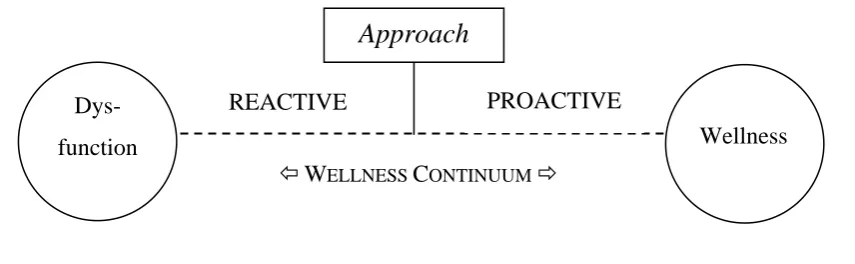
enhancement of psychological wellness in all people, from the start” (1996, p.1) was necessary rather than a reactive approach to dysfunction per se.
Figure 1 was developed by the present author as a visual representation of Cowen’s ideas on prevention approaches. The model takes into consideration his definition of wellness as “the positive end of a hypothetical adjustment continuum - an ideal we should strive continually to approach” (1996, p.246).
Dys-
function Wellness
REACTIVE
Approach
ÕWELLNESS CONTINUUM Ö
PROACTIVE
Figure 1. The Wellness Continuum and Reactive and Proactive Prevention Approaches
(after Cowen, 1996)
Cowen further clarified the concept of wellness in 2000, outlining in detail its meaning and the sources of impact on psychological wellness and discussing education as a potential force for psychological wellness. He stated that wellness was a broad concept that could encompass many ‘exemplars’ but believed that the three exemplars of competence, empowerment and heightened resilience in children were most
important to advancing wellness (Cowen, 2000).
designed to reduce oppression and promote emancipation and human welfare. The model explained the meaning of the values of self-determination, distributive justice and collaboration and democratic participation in relation to reciprocal empowerment, human diversity and oppression. The importance of engaging members of oppressed groups in theoretical and practical discourse was also stressed in the article
(Prilleltensky & Gonick, 1994).
Further theoretical development of the model is evident in Prilleltensky and Nelson (1997) and Prilleltensky (1997). In the first of these, the five values of caring and compassion, health, self-determination/participation, human diversity and social justice were presented in a matrix and discussed in relation to community psychology guiding concepts and the salience and social impact of the values. The values also appeared in a concentric circular model incorporating the three Bronfenbrennerian ecological levels of micro, meso and macro (Prilleltensky & Nelson, 1997). The second article consists of a set of questions to assess the moral implications of psychological discourses (Prilleltensky, 1997). More specifically, it questions whether the
psychological approach promotes the five values in addition to the good life and good society; and attends to issues of power, ethics, problem definition, role of client and helper, systemic issues and prevention.
In a recent book entitled: Promoting family wellness and preventing child maltreatment, a hierarchical wellness model consisting of the four ecological levels of child, parental and family, community and society was proposed (Prilleltensky, Nelson, & Peirson, 2001). The model was accompanied by a table showing the particular values, resources, programs and policies that are required at each of these levels. The values of caring and protection of health, opportunities for education and personal development, self-determination, collaboration and respect for the community, support for strong community structures, respect for human diversity and social justice in the provision of resources were advanced in the book (Prilleltensky et al., 2001a).
Other Holistic Models
Similar dimensions and values have been proposed in other holistic models. For example, researchers at Ohio State University (OHU) have put forward nine key
to needed goods and services, positive relationships that bind citizens together (or sense of inter-relatedness with others), shared values and goals, the whole person principle (being treated as a whole person), predictability (or familiarity) with one’s community, opportunities for growth and fulfilment, and a degree of homogeneity (OHU, 2001).
These elements have a parallel to the values expressed by Prilleltensky and colleagues, with the exception of the latter (homogeneity), which seems contrary to our ‘respect for diversity’ principle. The homogeneity principle can be criticised on the grounds that it implies a pro-segregationist philosophy. For example, the article cites literature from Gans (1967) that states that while heterogeneity (of cultural diversity) adds variety, promotes tolerance, provides a broadening of educational experiences for children and offers alternatives; heterogeneity on the suburban block level leads to conflict and insoluble chronic problems. Therefore the proposition is for selective homogeneity on the block level and heterogeneity on the community level (Gans, 1967; cited in Ohio State University). However, it can be argued that the real solution lies not in segregation but in strategies and policies designed to promote a respect for each others’ diversity.
Sweeney and Witmer (1991) and Witmer and Sweeney (1992) developed a holistic model of wellness and prevention over the life span. The model proposed five life tasks depicted in a wheel with spokes that are interrelated and interconnected (Myers, Sweeney & Witmer, 2000). The model was modified after factor analysis involving 3,000 people and use of the model in research and clinical practice (Myers et al., 2000). The modified wellness model consisted of sixty-one dimensions or sub tasks within the five major tasks of: Spirituality (seven subtasks); Self direction (thirty six subtasks); Work and leisure (ten subtasks); Friendship (four subtasks) and Love (four subtasks). The authors define wellness as a “way of life oriented toward optimal health and well-being in which body, mind, and spirit are integrated by the individual to live more fully within the human and natural community” (Myers et al., 2000). Interestingly though, while they acknowledge ‘community’ in their definition of wellness, the
An Australian nationwide research project on the topic of citizenship and
wellbeing conducted by the Victorian Council of Social Services (VCOSS, 1999) points to a potential model for promoting community well-being. The research involved ninety-eight people in fifteen focus group consultations across the country and one of the issues addressed was what makes a ‘good society’. The following eight key issues emerged: safety; economic security; freedom of action; tolerance of ethnic and cultural differences; equity; good, honest, accountable government; a reasonable standard of living; and adequate information.
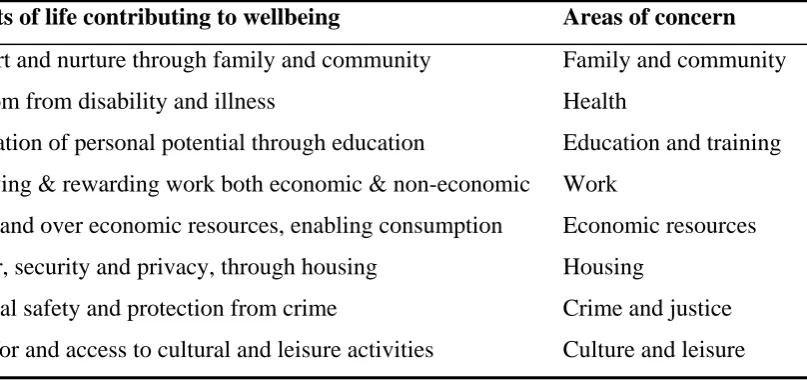
Another potential model for promoting community well-being comes from the Australian Bureau of Statistics. The ABS developed the framework in Table 1 as the basis for their social statistics, which according to Trewin acknowledges the OECD proposition that well-being can be measured by defining goal areas or areas of concern (ABS, 2001).
Table 1
The Australian Bureau of Statistics Model of Well-being
Aspects of life contributing to wellbeing Areas of concern
Support and nurture through family and community Freedom from disability and illness
Realisation of personal potential through education
Satisfying & rewarding work both economic & non-economic Command over economic resources, enabling consumption Shelter, security and privacy, through housing
Personal safety and protection from crime
Time for and access to cultural and leisure activities
Family and community Health
Education and training Work
Economic resources Housing
Crime and justice Culture and leisure Reproduced from ABS (2001).
Wellness in a Multicultural Context
Research on wellness in multicultural communities seems scarce. Although there is a rather large body of international literature on cross-cultural well-being, life
Moreover, the present thesis is concerned with wellness promotion and action rather than comparison per se. Still, these studies do throw some light on the holistic nature and conceptualisation of well-being and are for this reason reviewed here.
In one such study, Deiner, Deiner and Deiner, (1995) conducted a large
comparative study in order to investigate the association between subjective well-being and social, economic, and cultural characteristics of 55 nations. The aim was to identify factors that could predict the subjective well-being among these nations. Correlations between subjective well-being and characteristics of nations such as purchasing power, civil rights, GDP growth, income of neighbouring nations, income equality,
individualism and ethnic diversity (heterogeneity) were conducted. The results were that only income, individualism, and human rights yielded strong associations with subjective well-being. Individualism was also classified as a strong predictor of subjective well-being.
Subjective well-being was also the focus of a study conducted by Deiner, Suh, Smith and Shao (1995) that aimed to determine differences in well-being between students in South Korea, Japan, China and the U.S.A. The domains examined included four measures of happiness as well as satisfaction with education, employment, family, finances, friends, health, housing, partner, recreation, religion, self-esteem and
transportation. A general finding was that South Korea and Japan were below average in both happiness and life satisfaction and that U.S.A. was higher in both measures than the other countries.
In another study, Lee, Park, Uhlemann and Patsula (1999) conducted a study of cross-cultural happiness involving 198 Canadian students and 190 Korean students to address the question of whether people in individualistic and collectivist countries (Canada and Korea, respectively) differ in terms of their happiness. The results showed that Canadian students were significantly happier than Korean students and that
different criteria contributed to their happiness. Canadian students mentioned criteria such as family, financial/materialistic wealth, and stress-free life as important to their happiness whereas Korean students mentioned the criteria of relationships with
significant others, spiritual/religious life, goal/mission in life, and recognition by others (Lee et al., 1999).
‘life as a whole’ (Ryan & Dziurawiec, 2000). Materialistic persons were also less satisfied with a range of other life domains, including: standard of living, family life, amount of fun and enjoyment, place of residence, accomplishments in life and health and physical condition, compared to less materialistic individuals. Cultural differences were not explored in the study.
Schyns (1998) analysed the relationship between happiness (as measured in the 1990-1993 World Values Survey) and national economic (GDP) and cultural living conditions (political and civil rights, gender equality & individualism-collectivism) for forty countries. A general finding arising from the research was that the five happiest countries were wealthy and culturally free countries (Netherlands, Iceland, Denmark, Ireland, Sweden). The five least happiest countries (India, Hungary, Romania, Russia, Bulgaria) on the other hand, were poor and restricted countries. According to Schyns, the significant relationship between happiness and both economic prosperity and
cultural conditions agrees with Maslow’s (1970) ‘needs theory’ which holds that a good life is largely determined by the amount of need satisfaction; the more needs are
satisfied, the happier people will be (Schyns, 1998).
Conversely, unmet needs may lead to disadvantage and may be seen as the opposite end of the continuum to a good life, happiness and wellbeing. The Australian Department of Immigration and Ethnic Affairs (now Department of Immigration and Multicultural Affairs) lend support to this argument. According to this department disadvantage is not synonymous with characteristics such as ethnicity, low socio-economic status or Aboriginality but comes about when society and its institutions do not adequately respond to the diverse needs created by such characteristics (1986). Therefore, part of what we do to improve community well-being must be about identifying and addressing diverse community needs. However, another important aspect to any wellness enhancement or community improvement strategy is to search out and promote existing ‘strengths’ (Reardon & Welsh, 1993; Weil, 1996;
CHAPTER THREE
Wellness Praxis
Three main theories informed the present study. These were the community wellness model (Prilleltensky, 2001a), needs theory (Roth, 1990) and the cycle of praxis (Prilleltensky, 2001b & c). The three theories were integrated and together may be referred to as the Community Wellness Cycle of Praxis. This model provided both theoretical and methodological guidance to this study and is discussed further below.
Community Wellness Model
Prilleltensky’s (2001a) community wellness model is presented in Table 2. The symbols in the top row were added to assist the readers’ understanding of the theory. The essential features of the model are the three levels (personal, relational, collective); the various items or values contained within these levels; and the assumption that wellness is not just one or the other but a synergy of personal, relational and collective well-being. For example, good physical health does not equal wellness in the presence of discrimination at the relational level and lack of opportunity for economic security at the collective level.
Table 2
Prilleltensky’s Community Wellness Model: A Synergy of Personal, Relational and Collective Well-being (2001a)
Personal
d
Relational
Ë
v
d
vbcË
vb
b
vc
Collective
%3YEps
Community
Wellness
Model
Sense of control over one’s life, physical health, love, competence, optimism and self-esteemSocial support, affection, belonging, cohesion, collaboration, respect for one’s diversity and democratic participation
Economic security, social justice, adequate health and social services, low crime (safety), adequate housing and social structures (e.g.,
Indeed social injustices such as these can lead to apathy, feelings of
incompetence, pessimism, low self-esteem and other psychological and social problems. This example demonstrates the logic of the statement that: “there cannot be wellness but in the combined presence of personal, relational, and collective wellbeing”
(Prilleltensky, 2001a, p.8).
Praxis
There is often a gap between theory and practice that is difficult to bridge. This was certainly the feeling during the conceptualisation stage of this project when thinking about how to apply the community wellness model in research with diverse community members. The community wellness model may be important in terms of both theory and practice because it draws our attention to multiple needs that could be addressed; but it lacks a prescription for how this could be done. The action research method and concept of praxis are central to this dilemma.
The term praxis (πραξι) means action in Greek (Hionides, 1987). However, the term is most often used in reference to the combination of both theory and action following Aristotle’s reasoning that both praxis (action) and theoria (theory) are important (O’Brien, 1998). Seng (1998) offers a summary of the historical basis and usage of the term in the following quote:
O’Brien (1998) suggests that praxis and action research are not the same construct in his claim that action research is a method while praxis is a research paradigm. He also claims that action research belongs more rightly (epistemologically) to a praxis research paradigm than to either a positivist or an interpretive research paradigm
(O’Brien, 1998). The logic in this statement can be understood when one considers that while the positivist paradigm is mainly concerned with objective fact finding, and the interpretive paradigm is concerned with the discovery of subjective meanings, praxis is about vision and action.
Several other theorists have identified three types of action research, including McCutcheon and Jurg (1990) who distinguish between a positivist perspective, an interpretivist perspective and a critical science perspective (cited in Masters, 1995); and McKernan (1991) who distinguishes between the scientific-technical view of problem solving, practical-deliberative, and critical-emancipatory, action research.
Action research as a ‘method’ involves a cycle of various stages or steps, which begins with some kind of reflection and leads to some kind of action. One such model by Grundy and Kemmis (1981) consists of repeating cycles, with four steps (plan, act, observe and reflect) in each cycle. Another more complex model developed by Susman (1983) consists of five phases beginning with problem identification or (diagnosis); considering alternative courses of action (action planning); selecting a course of action (taking action); studying the consequences of an action (evaluating); and identifying general findings (specifying learning). This five stage cyclic process is repeated until the problem is resolved.
Needs Theory
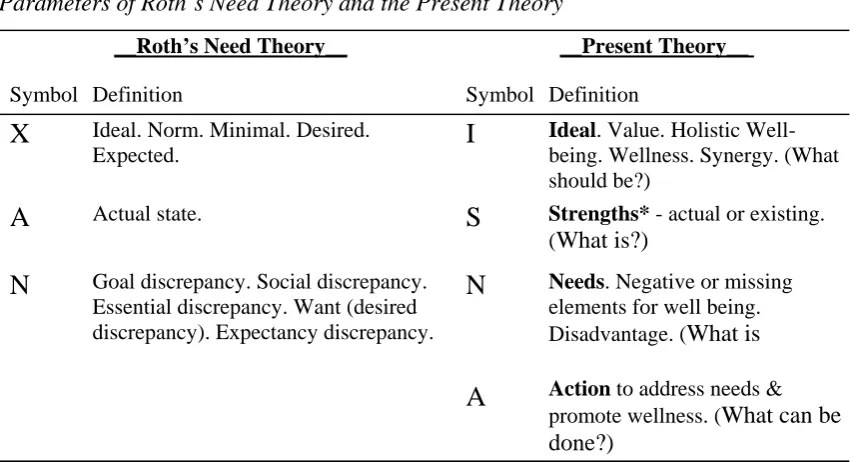
The model shares some methodological parallels with a needs assessment as defined by Roth (1990). Roth’s conceptualisation of need consists of a lineal equation that can be used in the design of a needs assessment. According to Roth, need (N) can be defined as the discrepancy between a target state (X) and an actual state (A) as expressed in the equation: X–A=N. The target state (X) in the above equation can represent an ideal state, a norm, minimal satisfactory state, desired state, or expected state (Roth, 1990). As may be compared, Prilleltensky’s (2001b) value-based cycle of praxis reflects three similar components with the additional component of ‘action’.
Theoretical Integration
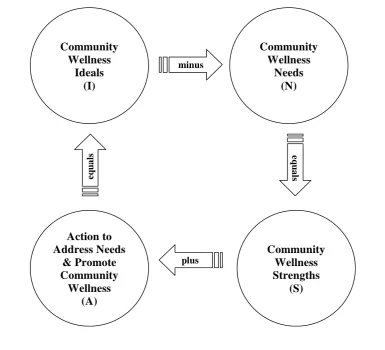
Figure 2 shows a synthesis of Prilleltensky’s Cycle of Praxis and concept of community wellness (2001a, b & c) in light of Roth’s (1990) needs equation. This model has been adapted from Prilleltensky’s previous praxis diagram (2001c), by adding mathematical signs and labels that are specific to the concept of community wellness. The result of this synthesis is a cyclical equation which can be expressed as I-N=S+A=I; where (I) are community wellness Ideals or values; (N) are Needs or needed elements of well-being; (S) are existing wellness Strengths or resources; and (A) is Action to address needs. The equation may be remembered by the acronym INSAI (pronounced in-sigh).
Community Wellness
Ideals (I)
Action to Address Needs
& Promote Community
Wellness (A)
Community Wellness Strengths
(S) Community
Wellness Needs
(N)
minus
plus
eq
u
a
ls
e
q
u
a
ls
Figure 2. The Community Wellness Cycle of Praxis: A Synthesis of Theory and Method
(Adapted from Prilleltensky, 2001a, b & c)
The praxis model forms a useful theoretical and methodological framework for the present study. While the emphasis of this study was on the community wellness Ideals, Needs and Strengths of community members, the study was designed with a view to what Actions could be undertaken to promote wellness. Roth’s symbols and definitions are summarised in Table 3 together with the corresponding parameters of the current theory.
Table 3
Parameters of Roth’s Need Theory and the Present Theory
__Roth’s Need Theory__ __Present Theory__
Symbol Definition Symbol Definition
X
Ideal. Norm. Minimal. Desired.Expected.
I
Ideal. Value. Holistic Well-being. Wellness. Synergy. (What should be?)
A
Actual state.S
Strengths* - actual or existing. (What is?)N
Goal discrepancy. Social discrepancy. Essential discrepancy. Want (desired discrepancy). Expectancy discrepancy.N
Needs. Negative or missing elements for well being. Disadvantage. (What isA
Action to address needs & promote wellness. (What can be done?)Note. Table adapted from Roth (1990); Prilleltensky, (2001b). *It makes more sense to use the term ‘strengths’ as opposed to ‘actual state’ because in reality an ‘actual state’ can consist of both positive (strengths) and negative (needs) aspects. However, in proposing an equation consisting of the ideal, actual and need, it is clear that Roth implied an existing positive by the term.
Whose Ideals or Values?
The top left circle in the praxis model entitled ‘Community Wellness Ideals’ (see Figure 2) begs the question: Whose ideals or values do we strive to achieve? Since questions about dogmatism and relativism are frequently raised in discussions about values (Bernstein, 1983; Bauman, 1993; Kane, 1994; Prilleltensky, 2001b), it is appropriate to discuss these concepts in relation to the community wellness model. Prilleltensky (2001b) and other authors acknowledge that imposing a dogmatic set of values onto people undermines human diversity (see also Taylor, 1992; Trickett, 1996). Extreme relativism on the other hand stifles action because its underlying message is that we can never have a common vision to strive for.
strengths and needs. It is also recognised that while ideals, strengths and needs may be personally or culturally relative; common ideals and values among people can also be expected. It can be argued that the stance taken in the present context is neither dogmatic nor relativistic. Researchers should not pretend that they are empty vessels without pre-existing values, knowledge and theories about what people might need in order to be well, but they must be aware of their own idiosyncrasies and be willing to test and refine their assumptions in light of emerging contradictions and viewpoints. Acknowledging that participants are the experts in their own lived experiences does not demand that that researchers ‘throw out the baby with the bath water’, that is, their own expertise. Curtis, Bryce and Treloar (1999) point to an answer to the question posed at the beginning of this section (Whose ideals or values should we strive to achieve?) in their statement that the development of options and definitions of effective change is a product of collaboration and negotiation between both researcher and participants (1999). Researchers, community service providers, policy makers and other professionals must therefore reflect on what they believe people need for well-being as well as on what community members say they need. This will ensure the appropriateness of the intervention.
Aims and Research Questions
The major aim of this study was to employ the Community Wellness Cycle of Praxis in qualitative research with diverse community members from the St Albans region in order to gain a theoretical and practical understanding of well-being from a multicultural perspective. Specific research questions were:
1. What are the community wellness ideals (a); needs (b); and strengths (c); of St Albans community members?
CHAPTER FOUR
Methodology
Overview of Methods
The research involved a total of 31 people (17 females & 14 males) and included a pilot interview with a Maltese woman, four focus groups with Maltese, Vietnamese, Anglo and Italian community members, and a further individual interview with a Serbian woman. Ideally, community research should include minorities as well as the major cultural groups who reside in a region. I had originally planned to conduct more individual interviews with culturally diverse persons but the research from the above sample generated a rich amount of data for a thesis of this scope and was sufficient to explore the framework.
Personal Background
It is important in qualitative research to discuss one’s personal interest and position as the research instrument (Maxwell, 1996). As a community psychology student, I was very pleased to be offered the opportunity to work within the Community Wellness Project. The project espouses many of the principles and methods of
community psychology while at the same time having interdisciplinary relevance. The community wellness model is a guide to ecological understanding and action. A practical example of an ecological approach can be drawn from my experience in a short term contract and student placement with an agency called ADEC (Action on Disability within Ethnic Communities). ADEC worked on multiple levels as suggested in the community wellness model. This included advocating for disabled and elderly individuals at the personal level; supporting their carers and providing community education and service provider training on disability and cross-cultural issues at the relational level; and affecting government policy at the systemic or collective level. I believe that working at multiple levels to solve community problems may be the service delivery model of the future.
Part of my work at this agency involved locating, examining and writing
their carers. An important lesson I learned about the needs assessment method was that it was an effective way of including the voices of disadvantaged persons and advocating for needed changes. Acting on peoples’ self-defined needs is also a much more
empowering process for the people concerned than implementing changes without their prior consultation. However, one of the limitations of needs assessments is that many of the arising recommendations are never implemented. This reflects the importance of building in the needs assessment and action/implementation phase into the one project.
The work with this agency also increased my understanding of the difficulties and barriers faced by diverse communities in accessing mainstream health and community services. These difficulties are increased when dominant members in society display negative attitudes towards cultural, linguistic and religious diversity. This background, together with my community and critical psychology orientation, interest in holistic/ecological models, values, multiculturalism, and familiarity with the St Albans region (both as a student and resident in this region) motivated me in this work.
Rationale for Qualitative Methods
Qualitative methods were considered more appropriate for this study than quantitative methods. Firstly, given that well-being has not been explored using this framework before, it was more logical to adopt a qualitative inquiry mode rather than a quantitative model. It could be argued that quantitative methods (e.g., surveys) are more suited to research where the parameters of a construct are already known and when the concern is with magnitudes and statistical differences rather than qualitatively different views on the meaning of well-being. Qualitative changes in well-being due to changed conditions, community events and government policies are also difficult to ascertain using quantitative methods. For example, a quantitative measure could tell us that person one was less satisfied in the ‘housing’ and ‘income’ domain than person two but not that person one was recently evicted because he could not pay the rent. Thus, qualitative methods were deemed more conducive to discovery in the present context.
criticised each other’s comments, it also allowed them to learn from and console each other. The research gave voice to participants in a way that could not be achieved with quantitative methods.
Quantitative (survey) methods using the community wellness framework and larger samples could yield valuable information regarding community well-being in the future. However, the model needs to be explored in depth and in a relatively
unstructured way before sufficient theoretical material for such a measure can be obtained.
Interview and Focus Group Participants
The pilot interview involved a 39-year-old Maltese-Australian woman from the Western region of Melbourne who migrated to Australia over 30 years ago. She was known to the researcher and recruited because she could offer feedback on the interview questions and the interviewers style. Following advertisement of the study to agencies in the St Albans region (see flyer in Appendix B), one of the local service providers introduced me to a 19-year old Serbian-Australian woman who was interested in participating in an interview. This participant had lived in St Albans for four years and migrated to Australia just six years ago.
Table 4
Characteristics of the Interview and Focus Group Participants
Method Number & Gender Age Range (& Mean)
Years Since Migration
Female Male Total (& Mean)
Interviews
Maltese 1 - 1 39 30
Serbian 1 - 1 19 6
Focus Groups
Maltese 5 2 7 46-55 (47.4) 22-38 (31)
Vietnamese 2 6 8 18-25 (21.5) 6-24 (18)
Anglo 4 3 7 20-47 (31.4) -
Italian 4 3 7 50-70 (60) 25-42 (36.7)
Totals 17 14 31 18-70 (40) 6-42 (27.95)
Participants’ religions included Catholic (58%), Buddhist (19%), other Christians (10%), and 13% undecided or not stated. Nearly 10% of participants had only a
primary school education, 29% attended 1-5 years of secondary education, 26% completed secondary school, six percent completed secondary and some form of other training, 26% had a university degree and one person (3%) was undertaking post-graduate studies.
Materials
A plain language statement, a consent form, a page consisting of 16
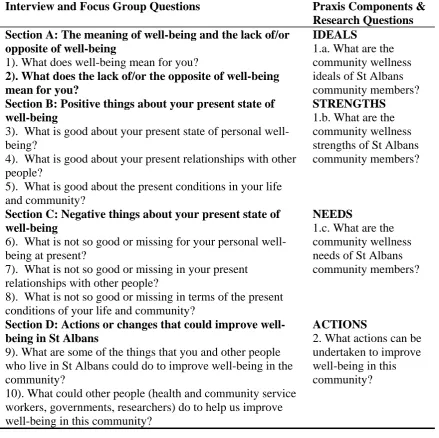
Table 5
Questions Employed in the Interviews and Focus Groups, Parts of the Praxis Model and Research Questions
Interview and Focus Group Questions Praxis Components & Research Questions Section A: The meaning of well-being and the lack of/or
opposite of well-being
1). What does well-being mean for you?
2). What does the lack of/or the opposite of well-being mean for you?
IDEALS
1.a. What are the community wellness ideals of St Albans community members? Section B: Positive things about your present state of
well-being
3). What is good about your present state of personal well-being?
4). What is good about your present relationships with other people?
5). What is good about the present conditions in your life and community?
STRENGTHS 1.b. What are the community wellness strengths of St Albans community members?
Section C: Negative things about your present state of well-being
6). What is not so good or missing for your personal well-being at present?
7). What is not so good or missing in your present relationships with other people?
8). What is not so good or missing in terms of the present conditions of your life and community?
NEEDS
1.c. What are the community wellness needs of St Albans community members?
Section D: Actions or changes that could improve well-being in St Albans
9). What are some of the things that you and other people who live in St Albans could do to improve well-being in the community?
10). What could other people (health and community service workers, governments, researchers) do to help us improve well-being in this community?
ACTIONS
2. What actions can be undertaken to improve well-being in this community?
The pilot individual interview revealed that the questions were understandable and could generate meaningful discussion about well-being. The general structure of the interview schedule was therefore not changed, although some questions were slightly reworded to improve clarity. Some further prompts were also developed.
Procedure
The research commenced following approval by the Department of Psychology Research Ethics Committee at Victoria University of Technology, St. Albans. The ethics approval note is attached as Appendix D. Approval was gained following the undertaking of slight modifications to the original research plan as recommended by the Ethics Committee Reviewers. The pilot interview was conducted in the participant’s home while the other individual and group meetings were conducted at GSYFS. Written approval to conduct the meetings at GSYFS was obtained from the manager of the agency and can be seen Appendix E. The procedure for individual interviews involved reading information about the study to the participant, obtaining signed consent and asking the two general questions about well-being. Following the first two questions, a simple colourful diagram illustrating the personal, relational and collective levels was shown to the interviewee (Appendix F). At this point, a copy of the schedule was also given to the interviewee to assist understanding and memory of the questions and framework. The value items of the model were not shown or discussed with the participant so as to avoid biasing the research.
(Appendix G). Once again the levels of the model were introduced to participants after the first two questions by means of a colourful diagram.
Five minutes was originally allocated for each of the ten questions. However, focus groups took considerably longer (up to 90 minutes) than the individual interviews (about 45 minutes). All the meetings were tape-recorded. Participants were asked to complete the demographic/background questions at the end of the discussions and a monetary gift of twenty dollars was given to each participant.
A social work student and a PhD (psychology) student were hired to produce verbatim type written transcripts from the audio tape recordings for the purpose of qualitative analysis. All the transcripts were checked for accuracy (by means of reading and listening to the audio tapes) by the author prior to analysis.
Data Analysis
The analysis of data was guided by the praxis model components and the research questions developed from these components. The data analysis therefore attempted to explicate participants’ ideals, strengths and needs as well as possible actions that could improve well-being in the community. Ideals are discussed in chapter six while strengths, needs and actions are discussed in the concluding chapter.
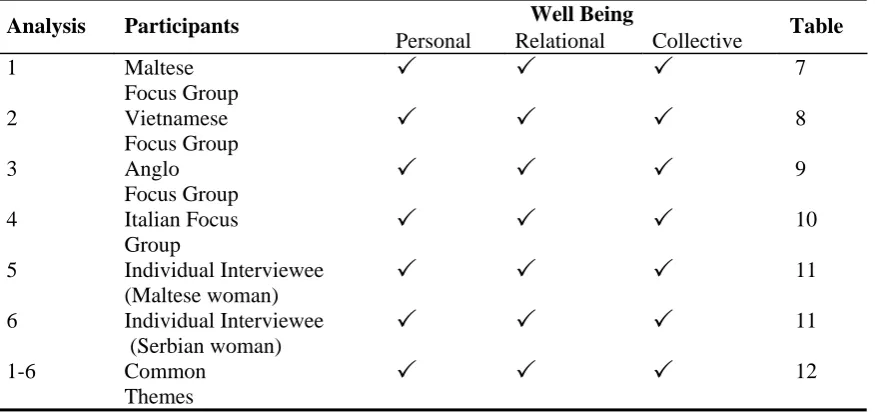
Although further information on the data analysis methods used to explicate each research question appear in the findings and discussion chapter, a conceptual matrix that guided the initial analysis of the first question on ideals is introduced in Table 6. As reflected in this table, the items of analysis were the responses from transcripts, audio recordings, overhead transparencies and interview notes for each focus group and interviewee (see columns 1&2) while the personal, relational and collective ideals of participants, were the foci.
Table 6
Conceptual Matrix Guiding the Analysis of Wellness Ideals
Well Being Analysis Participants
Personal Relational Collective Table 1 Maltese
Focus Group
3
3
3
72 Vietnamese Focus Group
3
3
3
83 Anglo Focus Group
3
3
3
94 Italian Focus Group
3
3
3
105 Individual Interviewee (Maltese woman)
3
3
3
116 Individual Interviewee (Serbian woman)
3
3
3
111-6 Common Themes
3
3
3
12
CHAPTER FIVE
Findings and Discussion
The presentation of findings in this section was guided by the research question (1a): What are the community wellness ideals of St Albans community members? This chapter therefore focuses on ideals while strengths, needs and actions are dealt with in the concluding chapter.
Community Wellness Ideals
Participants’ responses from all sections (A-D) and questions (1-10) of the interview schedule were examined in order to address the research question on community wellness ideals. This involved reflecting on the research, listening to the audio-taped responses and reading the transcripts, notes and transparencies (the latter were only used in focus groups). From this, concepts or factors that could be classified as ideals were entered into five tables, one for each focus group and one for the
individual interviewees.
Maltese-Australian Ideals. The wellness ideals of the Maltese-Australian group are shown in Table 7. Personal well-being for this group consisted of physical health, spirituality and a wide range of positive feelings and characteristics while extended family, cultural maintenance and friendly relations with other cultural groups in the community emerged as important values for relational well-being. Some of the collective issues of importance to this group included adequate infrastructure, services and policing of crime and safety, ethnic clubs and services for elders and responsive local government.
Table 7
Summary of Community Wellness Ideals Among the Maltese-Australian Group
Personal Well-being
Physical and mental health. Positive thinking. Self-esteem. Confidence. Control. Healthy mind, body & soul. Faith/spirituality. Inner peace (vs. inner conflict). Self-acceptance. Learning Opportunities. Happiness. Contentment. Authentic self. Coping ability. Resilience.
Relational Well-being
Caring for others. Feeling connected. Good relationships with partner, family & extended family. Community acceptance of cultural diversity. Relationship with God. Intercultural cohesion & mingling (vs. cultural segregation). Community participation and protest. Responsibility. Not blaming others. Cultural maintenance or connection to roots. Respect for elders needs.
Collective Well-being
Adequate infrastructure: education, hospitals, shops, higher education, employment, transportation, ethnic clubs & services for elders. Clean environment (no rubbish & beautification). Multicultural church. Responsive local government. Adequate parent, family & mental health support services. Adequate policing – crime & safety.
Vietnamese-Australian Ideals. The ideals of the Vietnamese-Australian participants may be seen in Table 8. The table shows many positive emotions and characteristics valued by this young group of Vietnamese people. Ideals related to the personal domain included holistic health, adjustment, happiness and satisfaction with life. Relational ideals included positive relationships with friends, family and others, safety, no racism and positive community relations. Ideals within the collective theme include adequate opportunities for education and employment, community information and a range of community and cultural resources.
Table 8
Summary of Community Wellness Ideals Among the Vietnamese-Australian Group
Personal Well-being
Health: physical, psychological, mental, spiritual and social. Secure (supportive) family. Not having fear. Positive sense of identity. Success. Self-esteem. Cultural integration (mental). Positive adjustment. True happiness. Satisfaction with life. Education. Hope, faith and motivation. Satisfaction of basic needs (food, rest, shelter, procreation).
Relational Well-being
Safety. Feeling accepted in the community. Supportive social group. Strong identification with friends. Tolerance. Good communications – family and others. Reciprocal relationships. Positive peer relationships. Trust. Understanding. No
racism/stereotyping. Intercultural interactions/integration (vs. cultural segregation). Part of community. Sense of belonging (community). Kindness to others.
Collective Well-being
Social well-being: being able to walk out on the street freely. Adequate meeting places. Community festivals and cultural events. Being informed about the community.
Anglo-Australian Ideals. Table 9 shows the wellness ideals of the Anglo-Australian group. People in this group value health and emotional well-being, and a range of positive feelings and characteristics such as self-esteem, happiness, feeling safe and self acceptance. Equality, no discrimination, kindness and respect were raised as important ideals within the relational domain. Many cultural and community issues were also discussed. The group were critical of the broader collective that they live in and identified many resources and responses of importance to their collective well-being.
Table 9
Summary of Community Wellness Ideals Among the Anglo-Australian Group
Personal Well-being
Health. Emotional well-being. Self-esteem. Free will. Empathy. Feeling good. Feeling safe. Happiness. Loving yourself [self-acceptance]. Not being greedy. Fun. Realistic expectations. Trust. Caring.
Relational Well-being
No discrimination. No racism or racial conflict among youth. Kindness to others. Respect for everyone. Golden rule. Not having fear of others. Trust with partners. Compromising. Joy from watching children grow. Political participation by community. Cross-cultural communication. Community spirit. Community cohesion (vs.
individualism). Connectedness. Cultural integration. Cultural reconciliation. Collective Well-being
Employment. Equality. Safety. Adequate income. Access to free legal services. Home ownership. Drug free kids. Staying alive in St Albans [no racial or turf wars].
Italian-Australian Ideals. The community wellness ideals of the Italian-Australian focus group participants are presented in Table 10. This older group of people mentioned many physical factors as important to their personal well-being (e.g., health, work, activities, absence of pain) as well as a few other values such as love, faith, religion and spirituality. Relational well-being for this group meant having an understanding
Table 10
Summary of Community Wellness Ideals Among the Italian-Australian Group
Personal Well-being
Good health. Good life. Love. Maintaining activity levels through physical work and recreation. Not having pain. Realistic expectations regarding pain/ageing. Pleasant distractions from boredom and pain. Balance between home/external activities. Not being isolated. Coping with death of loved ones. Faith, religion and spirituality.
Relational Well-being
Family health and well-being. Understanding partner. Strong (extended) family connections. Celebrations with family. Respectful relationships. Reciprocal
relationships with adult children (not being taken for granted). Caring/helping others. Friendship. Social activities. Cultural maintenance and contact with own culture. Good relationships with neighbours.
Collective Well-being
Adequate support for migrants. Safety in community. Safety on transport. Policing of drug risks to residents and crimes against elders. Adequate recreational facilities. Support/funding for ethnic elderly clubs, churches. Adequate response to vandalism. Adequate shopping facilities – variety and ‘quality’ shops. Education for responsible adolescence (re: respect, morals, graffiti, vandalism). Employment for this area. Availability of specialist services (e.g., optometrist).
Ideals of the Individual Interviewees. The ideals of the Maltese and Serbian interviewees are summarised in Table 11. As shown in the first row, some of the personal characteristics valued by the Maltese interviewee were good health, absence of pain, feelings of peacefulness, sense of control and spirituality. Issues of importance to her on the relational level included her son behaving well and maintaining contact with her close friends and family. She also had a concern about individualism and
materialism in the broader community. Collective ideals included basic financial security, safety, health care and good government.
Table 11
Summary of the Community Wellness Ideals of Individual Interviewees
Personal Well-being Relational Well-being Collective Well-Being Participant 1: Peaceful.
Not worried. Feeling relaxed, not nervous, not stressed, comfortable. Well organised. Control.
Physical health and absence of pain. Spirituality.
Transcendence.
Children behaving well. Good friendships. Many friends. Good relationships with immediate and
extended family.
Democratic participation. Loving partner. Sense of community (vs materialism, individualism and over competitiveness).
Financial security: (money, property, car). Good
government - responsible, effective, honest,
democratic. Free health care. No GST. Low crime rate - safety.
Participant 2: Physical and emotional health. Emotional strength (ability to cope with stresses and problems). Confidence. Feeling complete. Education. Self care. Happiness.
Loving parents and family. Communication with neighbours. Respect for diversity (of culture and personality). Tolerance and friendliness with others. Multiculturalism.
Collectivism (community).
Basic necessities (roof over head). Peace. Safety. Low crime. Adequate parks, gardens and public meeting places. Good government. Community information and education. Free youth facilities (recreation and places to go).
going through a war (Bosnia - 1996). The relational category shows that this participant had strong community values. Collective ideals consisted of a roof, peace, safety, adequate community structures and good government.
Common Ideals Among Community Members
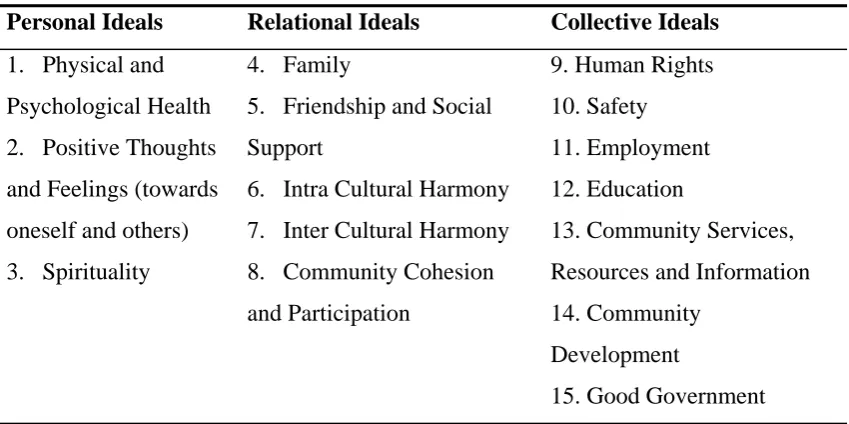
Further thematic analyses of the above tables, transcripts and other materials revealed fifteen common ideals in the participants’ responses. The ideals can also be referred to as common themes. These are shown in Table 12, with three classified as personal, five as relational and seven as collective. Following the table is a more detailed discussion of what community members said which includes summaries and excerpts from the transcripts to illustrate each theme.
Table 12
Summary of Community Members’ Personal, Relational and Collective Wellness Ideals
Personal Ideals Relational Ideals Collective Ideals
1. Physical and Psychological Health 2. Positive Thoughts and Feelings (towards oneself and others) 3. Spirituality
4. Family
5. Friendship and Social Support
6. Intra Cultural Harmony 7. Inter Cultural Harmony 8. Community Cohesion and Participation
9. Human Rights 10. Safety
11. Employment 12. Education
13. Community Services, Resources and Information 14. Community
Development
Physical and Psychological health. A general conclusion that may be drawn is that community members viewed well-being as a holistic phenomenon that extended beyond the physical. Both interviewees and at least one participant in each focus group expressed that well-being consisted of both physical and psychological health.
Participants valued both dimensions of health as exemplified in the following statement:
If you’re not [physically] healthy you can’t continue but you also need to be
emotionally strong to cope with all the stresses and all the problems (Serbian
woman, age 19).
Positive thoughts and feelings. The tables displayed in the previous section (Tables 7-11) showed that community members also named numerous positive thoughts and feelings associated with well-being. Some of the positive thoughts and feelings towards oneself were self-esteem, happiness, love, confidence, control and coping ability. Positive thoughts and feelings towards others included kindness, empathy, respect, love, caring, tolerance, trust and understanding. The following quote illustrates the importance of self esteem, confidence and coping in this man’s life:
To me well-being is related to my self-esteem – how I feel. My self esteem can be
high and good and because of that I feel confident to deal with my wife’s issues
and my son’s issues, you know, and my sister-in-laws problems and whatever. I
feel I can cope with all of that. That is what my well-being is (Maltese man).
To love one another, to help one another, is to be true to each other. That’s total
fulfilment I believe. I mean when you talk about religion or whatever, it’s
talking about being one with God, or Buddha, or who ever. It’s up there at that
level, above humanity, spiritual (Vietnamese man, age 22).
Still, not everyone in the Vietnamese group had spiritual beliefs. For example, one young Vietnamese man jokingly asked whether religion and spirituality were associated with mid-life crisis. Moreover, while general support for religion was evident among the older Italian group, one of the Anglo woman implied that our way of life was constrained by laws stemming from the bible. Only one man expressed spiritual values in the Anglo group. According to this man:
You need everything [the whole] to survive and to have an idealistic life, yeah. But … the
way this world is today, we can’t have that. But somehow we can strive [for well-being],
because we’ve got the God given gift of our own wills and minds to make our own decisions.
Family and Friendship and Social Support. Two relational themes that emerged during discussions with the community were family and friendship and social support. However, these themes appeared to be more important among the migrant groups and individual interviewees than the Anglo group. One migrant participant claimed that well-being for her was about the basic necessities in life. Basic necessities included physical and emotional health, a roof over her head and a loving supportive family. Her values with respect to family are clear in the statement below:
Even though you may not be living in a perfect society or perfect neighbourhood,
for example, if you have your family it does make you complete, and makes you
feel good and loved, and also love is part of being well (Serbian participant).
Another young migrant participant proposed a theory that stressed the