Scalable Lightning Factories for Bitcoin
Alejandro Ranchal-Pedrosaa,b,c,d, Maria Potop-Butucarub, Sara Tucci-Piergiovannia
aCEA LIST, PC 174, Gif-sur-Yvette, France
bSorbonne Universit´e, CNRS, Laboratoire dInformatique de Paris 6, LIP6, Paris, France cDepartment of Networks and Telecommunication Services (RST), T´el´ecom SudParis,
Paris-Saclay University, 91011 Evry, France
dDepartment of Information Engineering and Communications, Universitat Aut´onoma de Barcelona, Barcelona, Spain
Abstract
Bitcoin, the most popular blockchain system, does not scale even under very optimistic assumptions. The Lightning Network, a layer on top of Bitcoin, composed of one-to-one lightning channels make it scale to up to 105 Mil-lion users. Recently, Duplex Micropayment Channel factories have been proposed based on opening multiple one-to-one payment channels at once. Duplex Micropayment Channel factories rely on time-locks to update and close their channels. This mechanism yields to a situation where users’ funds time-locking for long periods increases with the lifetime of the factory and the number of users. This makes DMC factories not applicable in real-life scenarios.
In this paper, we propose the first channel factory construction, the Light-ning Factory, that offers a constant collateral cost, independent of the lifetime of the channel and members of the factory. We compare our proposed design with Duplex Micropayment Channel factories, obtaining better performance results by a factor of more than 3000 times in terms of the worst-case constant collateral cost incurred when malicious users use the factory. The message complexity of our factory isn while Duplex Micropayment Channel factories need n2 messages, where n is the number of users. Moreover, our factory copes with an infinite number of updates while in Duplex Micropayment
Email addresses: [email protected](Alejandro Ranchal-Pedrosa), [email protected](Maria Potop-Butucaru),
Channel factories the number of updates is bounded by the initial time-lock. Finally, we discuss the necessity for our Lightning Factories of BNN, a non-interactive aggregate signature cryptographic scheme, and compare it with Schnorr and ECDSA schemes used in Bitcoin and Duplex Micropayment Channels.
Keywords: Bitcoin, Blockchain, Scalability, Lightning Network.
1. Introduction
The Bitcoin blockchain aims at becoming the main system for e-commerce. However, it has a big problem: it does not scale. The way Bitcoin works at the time of writing, all (full) nodes need to know all bitcoin transactions ever made. Following this approach, the Bitcoin Network will need to generate more than 1TB of transactions per day to reach VISA’s peak transaction rate [14]. Even if the network achieved such numbers, becoming a Bitcoin node would be a very resource-consuming task. This hinders the use of stan-dard computational resources which, in turn, leads to a centralized network of a few powerful nodes, thus threatening its trustless nature.
into a new set of applications based on micropayments.
Recently the idea of payment channels has been further improved by the use of intermediate nodes that can also route payments, creating a network of payment channels, such as Lightning Network [14]. However, as pointed out by Poon et al. [14], the Lightning Network does not scale well enough. Even under the very generous assumption that each user only publishes 3 transactions per year (to open and/or close channels), the network scales to only 35 million users, far from covering the world’s population. For this rea-son, Burchert et al. [5] propose Channel Factories. Channel factories allow for various users to simultaneously open independent channels in one sin-gle transaction, reducing drastically the number of blockchain hits required. Their solution bases on Duplex Micropayment Channels (DMCs) [7], in which closing transactions rely on timelocks relative to the funding transaction en-tering the blockchain. The timelock makes the transaction invalid until an amount of time in the blockchain elapses (either actual time in seconds, or block-depth). This mechanism makes DMCs simple to setup and track, but it shows an important trade-off between the lifetime of the channel and the worst-case temporary lock-in of funds. On the one hand, a higher locktime will reduce the number of blockchain hits. On the other hand, if one party goes unresponsive, the counterparty will have to wait for the entire lock-time before retrieving their funds. In contrast to DMCs, Lightning Channels tackle this trade-off efficiently, leading to a constant worst-case locktime in-dependent of the lifetime of the channel – for this reason we propose in this paper a factory solution based on Lightning Channels instead of DMCs.
and ECDSA, used in Bitcoin and DMCs, and we compare them.
The remaining of this document is structured as follows: in Section 2 we discuss related work, while in Section 3 we introduce the necessary back-ground and basic notions on payment channels; Section 4 shows our Lightning Factory construction; in Section 5 we compare Lightning Factories with state of the art, and finally we conclude in Section 6.
2. Related Work
Decker et al. [7] firstly introduced Duplex Micropayment Channels (DMCs), with the usage of decreasing timelocks to update the channel. Poon and Dryja’s Lightning Network and channel construction [14] followed, gaining popularity as the most promising proposal for a payment channel network. Decker et al. [6] recently proposed eltoo, a proposal for removing incentives to updates for the updating phase of Lightning channels. Prihodko et al. [13] proposed FLARE, a routing algorithm for the Lightning Network.
An important aspect of the Lightning Network not yet extensively studied is its overall usage and impact, i.e. how the fees will be, how scalable the routing will really be, the impact it can generate on the blockchain, etc. Zohar et al. [4] studied this in two rather simple, static Lightning Network topologies.
Other proposals focused on more versatile blockchains. Poon and Vitalik released Plasma [12], a specification of off-chain childchains for Ethereum, as an intermediate layer between Lightning and the rootchain. Miller et al. [11] considered improvements in terms of collateral cost of HTLC-based routing for Ethereum, wile Khalil et al. [9] proposed a rebalancing protocol for exhausted channels.
layer in Bitcoin required a common notation of them, which has not been yet performed for Bitcoin, though it has for state channel networks [8].
3. Payment Channels and Factories
In this section, we sketch the functioning of payment channels and facto-ries.
3.1. Channels
A payment channel between n parties, also called n-party channel, con-sists of a funding transaction that locks up funds, and a sequence of update transactions that deterministically specify how the locked funds are split among participants/users. The structure of a generic transaction is intro-duced below.
Transaction. Each transactionTSis a data structure specifying an agreement among a set of subscribers S to move funds among accounts. TS has the following fields: TS.out: the set of outputs of the transaction, i.e., a set of elements of type oj, where oj indicates the fund o to transfer to the account
ai; TS.in: the set of inputs of the transaction. Each element of this set is an output of another transaction TS00.out, i.e. an amount spendable in
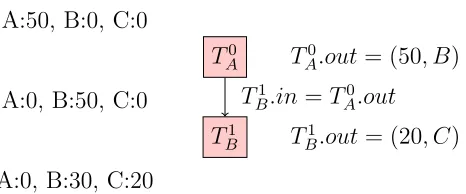
the transaction TS; TS.conds: the set of conditions for the transaction TS to be valid. A valid transaction makes the outputs of the transactions TS spendable (needed signatures, locktimes, etc.). Figure 1 shows the chaining of two transactions through their inputs and outputs. From the bottom to the top, the transaction T1
B moves an amount of 20 from the B’s account to theC’s one, i.e. TB1.out={(20, C)}. The relationship between theTB1’s input andT0
A’s output (represented by an arrow in the figure) creates a dependency between transactions, we say in this case that T1
B spends (fully or partially1) the output of the transaction TA0. Note that each transaction is executed when registered in the blockchain and that by construction T1
B cannot be registered before T0
A since TB1 refers toTA0 outputs.
Two-party Channels. Channels have two types of transactions: a fund-ing transaction, that opens the channel, and subsequentrefund transactions. Note that specific protocols can instantiate these transactions in a specific
1Usually if the total referred amount is not used, as in this case, an additional transfer
A:50, B:0, C:0
T0
A TA0.out= (50, B) A:0, B:50, C:0
T1
B
A:0, B:30, C:20
T1
B.in=TA0.out
T1
B.out= (20, C)
Figure 1: Example of a chain of transactions moving funds fromAtoB and fromBtoC. On the left-hand side of the picture, the state of balances before and after the execution of each transaction.
way and/or add other types of transactions. We give an intuition about gen-eral principles of channels before deepening into the details of the Lightning channels.
Funding Transaction. Any payment channel is initialized with a funding
transaction T0
i,j that creates a common account for the participants i and j. The the set of inputs refers to input transactions spendable separately by ui and uj; the output specifies instead an output moving funds to an account shared by ui and uj; conditions refers to the fact that to spend the common output the spending transaction must by signed by both ui and uj.
Refunding transaction. After locking up funds with the funding transaction
T0
i,j, each subsequent transaction will represent a two-party agreement on a new redistribution of funds, i.e. a refunding transaction. This means that any refunding transaction Tk
i,j with k ≥1 has Ti,jk.in=Ti,j0 .out, and outputs move funds back to i and j on independent accounts ai and aj. This means that spending transactions can spends Ti,jk outputs only be signed by ui or
uj, depending on the output referred, either oi oroj.
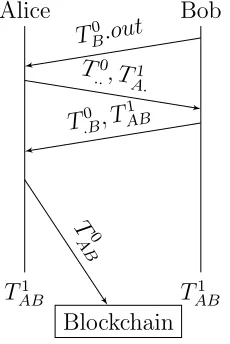
Let us note that transactions are created by participants by following a message-passing protocol to open a channel (creating the fund and the first refund transaction) and to update the channel (creating the subsequent refund transactions). Figure 2 shows a protocol to open a channel among Alice and Bob. Transactions are exchanged through messages that must be signed, i.e., T0
registered in the blockchain in a confirmed block. We then refer to an off-chain transaction as a transaction ready to be published on-chain, i.e. it is blockchain-enforceable, but not yet sent to the blockchain.
Bob Alice
T1
AB
T1
AB
Blockchain
T0B.out
T0
.., TA.1
T.B0 , T
1
AB
T 0
AB
Figure 2: Example of opening a channel by exchaning messages. The funding transaction and the first refund transactions are created and the funding transaction is sent to the blockchain.
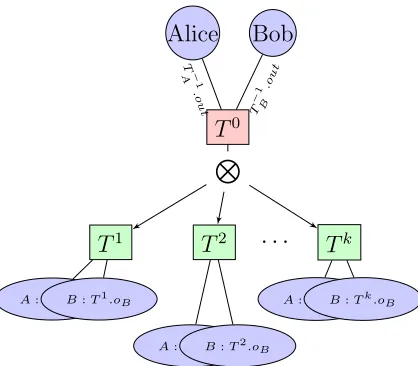
Figure 3 illustrates a sequence of k update transactions, being the last transaction Tk, where each transaction spends the outputs of the funding transactionT0, which is on chain. In green, transactionsT1, T2, · · ·, Tkthat spend from the same outputs ofT0 (conditition represented by the incoming arrow) and are off-chain. These transactions are mutually exclusive, only one of them can be included in the blockchain, condition represented by the N
. In purple, we show how much money each participant receives (that is, the balance of each participant at each state).
In the context ofn-party channels, a malicious party may want to publish on-chain an old balance, if this balance favors them. Consider an older prefix Ti,j such that the balancebi,k, k < n,is greater thanbi,n, thenuimay want the blockchain to confirmTk
i,j instead ofTi,jn. Note that, ifTi,jk hits the blockchain,
Ti,jn will be discarded (albeit perhaps after some locktime), because both transactions spend from the same outputs. From now on, we will refer to a party that successfully makes the blockchain confirm an old transaction as a party that commits a fraud. A party can go however unresponsive either maliciously or involuntarily.
Alice Bob
T0
N
T
−
1 A
.out
T
−1
B .out
T1
A:T1.oBA:T1.oB
T2
A:T2.oBA:T2.oB
· · · Tk
A:Tk.oBA:Tk.oB
Figure 3: Example of a channel between Alice and Bob. In red, the transactionT0
that is on-chain. In purple, The initial inputs and the final outputs, split between the participants Alice and Bob. In green, transactionsT1, T2,· · ·, Tk that spend from the same outputs of T0 and are off-chain. These transactions are mutually exclusive, only one of them can be included in the blockchain, represented by the
N
.
transaction, other refund transactions Tk can be created off-chain. In the reminder of the paper we will interchangeably use the term refund transaction
Tk and channel at state k, where at each state k the users of the channel have balances determined by the execution of the transaction Tk.
As already mentioned, a payment channel is implemented by a message-passing protocol among participants. Any protocol to correctly implement a payment channel must be fraud-resistant and cope with unresponsive be-havior. Honest parties should always own enough transactions to be able to get back at least an amount of funds equivalent to the last agreed-upon balance (no-steal). Moreover, if a new update cannot be fully singed due to an unresponsive behavior of one of the party, then the other party must get back the initial fund published with the f unding transaction (no-lock). For instance, in Figure 2 the first update transaction is signed before the fund transaction, to guarantee no-lock.
time-locks for each update, achieving the determinism of the updates. New up-dates are locked for less time, thus replacing the older ones. Note that in this protocol frauds cannot be commited under the assumption that the blockchain well-behaves. Eltoo Channels[6] update by creating a set of trans-actions that invalidate previous refund transtrans-actions when creating the new update. New updates invalidate old ones, but frauds can be committed. In this case the protocol can recover to the correct state under the assumption that the fraud is detected. Lightning Channels[14] follow eltoo channels ap-proach, but with the additional feature of penalizing parties that commits frauds.
3.2. Factories
A channel factory is ann-party channel which creates a funding transac-tion among n nodes, i.e. all of them sign the funding transaction. Further, instead of having an update consisting of a refunding transaction signed by all the parties, a special Allocation transaction create funding transactions for 2-party channels. The update of the factory consists in updating the allo-cation transaction. The channel factory concept has been introduced in [5] in which the funding transaction to open the factory is called Hook transaction and the first allocation transaction has an associated timelock. Updating the factory means opening/closing channels, by creating a new allocation trans-action with lower locktime. Finally, closing the factory means publishing the lastly signed allocation transaction (with the lowest locktime), or else cooperating to sign a last agreed-upon transaction with no locktime.
4. From Lightning Channels to Lightning Factories
In this section we present the Lightning Factory construction. We first detail Lightning and Duplex Micropayment Channels, then introduce the cryptographic scheme needed to cope with the challenges of extending light-ning channels tonparties. Furthermore, we explain the protocol for opening, updating and closing a Lightning Factory.
4.1. Lightning Channels
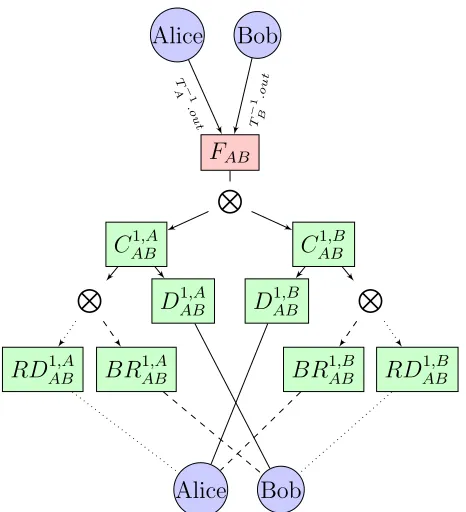
fraud, allow the honest one to remedy by publishing a specific transaction that gets back all the funds to the honest party –a proof of fraud. The set of created transactions and their dependency are shown in Figure 4. Let us note that all the transactions have now a subscript indicating the party that, once the transaction is created, stores the transaction locally. The figure shows two so-called Commitments transactions: CABk,A that only Alice can send to the blockchain, and CABk,B that only Bob can send to the blockchain. In case of unresponsive party or because one party wants to unilaterally close a channel, funds can be retrieved byAthanks to a so-called Revocable Delivery transactions RDABk,A after a timelock (by B through RDk,BAB, respectively), illustrated in the dotted paths in Figure 4. During the creation ofRDABk,A the protocol makes sure to create as well Dk,AAB which refunds B immediately (no time-locks). Proofs-of-frauds can be achieved through the Breach Remedy transactionsBRk,AAB,BRk,BAB, respectively. These transactions spend the same outputs as RDA,Bk,A and RDk,BA,B, but without a timelock and they give all the balance to the counterparty, illustrated in the dashed paths in Figure 4.
In the proposed scheme, ifB (the same applies to A) gets unresponsive, funds can be retrieved unilaterally by A thanks to RDk,AAB, but only after a timelock, this way no-lock is preserved. Moreover, if one of the two party sends to the blockchain a stale state, the timelock allows for B to react and send a breach remedy.
4.2. Duplex Micropayment Channel Factories[5].
Before defining our proposed Lightning Factory, and for the purpose of comparing performance, let us outline the state-of-the-art factory construc-tion: DMC Factories [5].
Suppose a set of users u0, ..., un−1 want to open an amount of channels
within them (e.g. {{u0, u1},{u0, u2},{u2, un}, ...}.). If they want to open m channels, n ≤m ≤ n2
, they would need to publish m transactions. With a DMC Factory, they can instead join together into a n-of-n multisig output, called the Hook transaction, H{u
j}nj=0−1 (i.e. T
0 in figure 3). The output
of this transaction is the input of another transaction, called the Allocation transactionA{u
j}nj=0−1 (i.e. T
1 in figure 3). The allocation transaction allocates
the funds of each channel, and has a timelock that is decreased in each update. That is, having the first allocation transactionA1{u
j}nj=0−1
(tlock :t1) then, when
updating, the new allocation is as follows: A2{u j}nj=0−1
(tlock : t2 ≤ t1 −δt),
Alice Bob
FAB
N
T
−
1 A
.out
T
−
1 B .out
CAB1,A CAB1,B
DAB1,A DAB1,B
N
Alice Bob
RD1AB,A BR1AB,A
N
RDAB1,B BR1AB,B
Figure 4: Example of a channel between Alice and Bob. Alice can only broadcast the left-hand side by publishing CAB1,A. If Bob has BR1AB,A then Alice loses all her funds (dashed path). Otherwise, she can publish RD1,A after waiting some locktime (dotted path), retrieving her funds. Bob receives his funds immediately in this case through D1,A. C1,A and C1,B are mutually exclusive, only one can be published.
in the blockchain, with a high probability. A more in-depth discussion about
δt, and ∆t, can be found in section 5.2. Therefore, the hook and allocation transactions extend the DMC concepts of funding and refund transactions to DMC Factories, respectively. Figure 5 shows an example of a DMC factory. The creation of each channel (i.e. each funding an refunding transaction), the first allocation transaction A1{u
j}nj=0−1
and the hook transaction H{u j}nj=0−1
represent the opening of the factory. Updating the factory means open-ing/closing channels, by creating a new allocation transaction A2{u
j}nj=0−1
Alice Bob Carol Dave
HA,B,C,D
50
50 50
50
A1
A,B,C,D tlock: t1
FAB no locktime
R1
AB tlock: t1
FCD no locktime
R1
CD tlock: t1 100
100
A: 50 B: 50 C: 50 D: 50
Figure 5: DMC factory between Alice, Bob, Carol and Dave with two payment channels inside: FAB and FCD. In red, the on-chain transaction. In green, trans-actions that do not ever hit the blockchain if A,B,C and D cooperate.
last agreed-upon transaction with no locktime. We deepen into the protocol specification of DMCs, analyzing their performance, in the appendix.
4.3. Cryptographic Scheme
This requires for a cryptographic scheme based on aggregate signatures. As detailed by Boneh et al. [2], an Aggregate Signature (AS) scheme is a digital signature scheme with the additional property that a sequence of signatures
σ1, ..., σn of some message mi under some public key pki can be condensed
into a single, compact aggregate signature σ that simultaneously validates the fact thatmihas been signed underpkifor alli= 1, ..., n. The verification process takes input (pk1, m1), . . . ,(pkn, mn), and accepts or rejects. Boneh et al. [2] propose an aggregate signature scheme based on BLS [3], called BGLS. Bellare et al. [1] improve this scheme by removing the per-signer distinct messages restriction to BGLS in a new scheme, BNN.
Using a non-interactive aggregated signature scheme, such as BNN, Alice, Bob and Carol sign a part of a transaction each, instead of the full transac-tion. A part of a transaction can be considered similar to a partially signed transaction with the sighash-single flag, or a partially signed n-of-n multisig. Typically, this is referred to as an aggregate signature. We will also refer to the signed message that needs to be aggregated with others to form a full transaction as a transaction fragment. As such, an n-of-n aggregate signa-ture needs n transaction fragments signed by n different users (each user signs one), in order to get a fully signed transaction.
4.4. Lightning Factory Protocol
Actions of users. In order to depict the Lightning Factory protocol, we define a set of actions that a user can perform. The protocol will decide the rules for the actions to be taken and the kind of transactions to build.
• createi(T): the transaction T is created by ui and stored locally atui; • signi(T): the transactionT is signed by the user ui;
• broadcasti(T): the transaction is sent to all n-channel participants;, • deliverij(T): the transactionT is delivered by ui from uj;
• publishi(T): the transactionT is published on-chain byui and stored in the blockchain, if and only if the transaction is valid (correct signatures and timelocks expired).
Note that the party ui can store the transaction T if and only if they have created it or another party uj shared it with i, i.e. ui delivered fromuj.
4.4.1. Opening a Lightning Factory
Lightning Factory sets up funds by locking them up into a n-of-n aggre-gated output, by means of a hook transaction. A Lightning Factory extends the concept of a Lightning Channel to Factories trough the equivalent of an Allocation transaction Ak
{ui}, i.e. a set of Allocation Commitment
trans-actions {C{k,jm i}}
n−1
j=0, one per user per state to ascribe blame, same way we
defined commitment transactions CABk,A, CABk,B as the equivalent of a refund transactions. The Allocation Commitment under the aggregate signature scheme is Ck,j
{mi}ni=0−1
= Pn−1
i=0 C
k,j
mi, where k is the state number, j is the user
that owns this commitment transaction, and{mi}indicates all required mes-sages are aggregated. The input of this transaction is the output of the hook. The output of this transaction points at a revocable allocation transaction
RAk,j{
mi}ni=0−1
=Pn−1
i=0 RAk,jmi, with a locktime relative to the inclusion ofC
k,j
{mi}ni=0−1
in the blockchain.
Specifically, a transaction fragment is a tuple<P,S,T,I,O,St >. Following, we explain each of the parts of the tuple, with an example of the fragment Bob signs for the Alice’s commitment transaction at the initial state, C1,A
mB: P is the issuer of the message (e.g. Alice in the case of C
1,A mB);S
is signer of the message (e.g. Bob in C1,A
mB); T is the type of the message:
either timelocked or not. In the case of Cm1,AB T has no locktime; I is the input for this fragment’s transaction. The H{u
i}ni=0−1 channel hook (funding)
output for the fragment the transaction belongs to; O is the output for this fragment’s transaction. For Cm1,AB this output is the input of the Revocable Allocation; St is state identifier for which this message is valid. In the case of C1,A
mB, state is 1.
Notice that only P and St are newly proposed fields for Bitcoin. P, the issuer, can be simply a one bit flag indicating that the signer of this fragment is not the issuer. St can be defined in some of the remaining bits still unspecified in the sequence no field2.
All users need to agree and sign for the state, so that they cannot reuse a fragment for a future state. Therefore, the aggregated Allocation Commit-ment transaction C{1,A
mi}ni=0−1
= Pn−1
i=0 C 1,A
mi would contain the following extra
fields: S is σi, ∀Cm1,Ai ; T is No locktime in the aggregated message in C
1,A
{mi};
O is one aggregate signature output,C{1m,A
i}.o. Throughout this paper, we use Tmi for the fragment of transaction T created and signed by user i, T{mi}ki=0
for an aggregation of fragments of transaction T created and signed by all users {ui}ki=0, and T{mi} as the same as T{mi}ni=0−1.
Let us note that, for this application, we require only one output for the commitment transaction (as detailed above). The output represents the balance that this message commits to. It can only be relative to the signer, i.e. Bob can only sign the amount Bob receives from the factory.
Analogously, one can also extend the concept of a revocable allocation transaction into a set of transaction fragments {RA1,A
mi} that, aggregated,
create a valid transaction RA1{,Am i} =
Pn−1
i=0 RA 1,A
mi spending the outputs of C{1m,A
i}. As such, provided that Alice already committed to this state by
broad-castingC{1m,A
i}, an aggregated revocable allocation message for her,RA
1,A
{mi} =
Pn−1
i=0 RA1m,Ai, would result in each part of the aggregated tuple RA
1,A
{mi} =<
P,S,T,I,O,St >: P is any,∀RA1A,m,A
i;Sisσi,∀RA
1,A
mi;T is relative locktime
for all,∀RA1A,m,A
i, dependent on when the corresponding commitment
transac-tion was published;IisC{1u,j
j}, regardless of thej(similar to SIGHASH NOINPUT);
O is one aggregate signature output,O=oRAi 1, ∀RAm1,Ai; St is 1, ∀RA1m,Ai. Notice that Pn
i=0o
RA1
i = B, being B the total amount locked at setup (the total balance). oRA1
i act as the output of a funding transaction, used as input for each refunding transaction of two-party channels. In order to allow each signer to specify with which output to aggregate, we use output indices. Also, each transaction fragment signs in its fragment the output indices with a list of signatures that can aggregate to this output, in order to prevent an outsider to lock funds of a channel by including their signature in the output.
3.
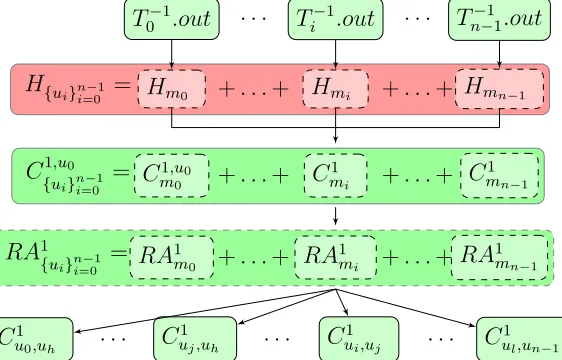
Figure 6 shows an example of a Lightning Factory foru0’s case (i.e. only
u0 can publish the commitment transaction shown). Transaction fragments
are shown within each transaction they form, vertically aligned with the user that signed for it. The lowest transactions represent each individual com-mitment transaction of each two-party lightning channel. Here we illustrate them as commitment transactions, considering them as lightning channels,
3This requirement is no different from how other works require different ways of
but they can be refunding transactions from DMCs. Also, another factory within the factory can be created at this level. Notice how, the same way
Ti−1.out . . .
T0−1.out . . . Tn−−11.out
Hm0 +. . .+ Hmi +. . .+ Hmn−1
C1,u0
m0 +. . .+ C
1
mi +. . .+ C
1
mn−1 C1,u0
{ui}ni=0−1
=
H{u
i}ni=0−1 =
RA1
m0 +. . .+ RA
1
mi +. . .+RA
1
mn−1 RA1{u
i}ni=0−1
=
C1
u0,uh . . . C
1
uj,uh . . . C
1
ui,uj . . . C
1
ul,un−1
Figure 6: Lightning Factory’s transactions and fragment for u0’s case (i.e. only u0 can
publish the commitment transaction shown). The transaction fragments are shown within each transaction they form, vertically aligned with the user that signed for it. Notice how the lowest Commitment transactions (e.g. C1
u0,uh) are those of each individual channel.
inputs are aggregated as needed (initially all need to aggregate their key), outputs are as well. Each user needs to sign also for which output indexes they want to sign, in order to add its key to the output (and, thus, require its signature in order to spend it). In the case of the hook, each transaction fragment Hmi signs only the input T
−1
i .o, which only requires user ui’s key, and the output n-of-n aggregated output H.o, which requires all other users. As for the revocable allocation fragmentsRAmi, the outputs userui signs are
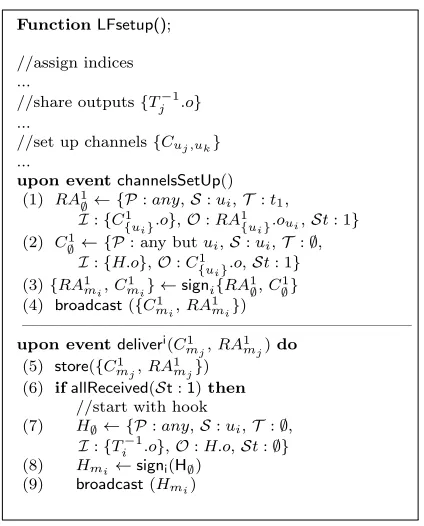
only those that are used as inputs in channels that involve ui. We provide the protocol to open the factory LFsetup() in Figure 7), and we prove its correctness in the Appendix.
4.4.2. Updating a Lightning Factory
Updating to statek+ 1 requires a two-step process:
1. sign and share transaction fragments for the new commitment and revocable allocation transactions for state k+1,C{km+1,A
i} =
Pn−1
i=0 Cmk+1i ,A
and RAk{m+1,A
i} =
Pn−1
i=0 RA
k+1,A mi
FunctionLFsetup();
//assign indices ...
//share outputs{Tj−1.o}
...
//set up channels{Cuj,uk}
...
upon eventchannelsSetUp() (1) RA1
∅← {P:any,S:ui,T :t1,
I:{C1
{ui}.o},O:RA 1
{ui}.oui,St: 1}
(2) C∅1← {P: any butui,S:ui,T :∅, I:{H.o},O:C1
{ui}.o,St: 1}
(3){RA1mi, C 1
mi} ←signi{RA 1
∅, C
1
∅}
(4) broadcast({C1 mi, RA
1 mi})
———————————————————————
upon eventdeliveri(C1 mj, RA
1 mj)do
(5) store({Cm1j, RA 1 mj})
(6) ifallReceived(St:1)then
//start with hook
(7) H∅← {P:any,S:ui,T :∅, I:{Ti−1.o},O:H.o,St:∅}
(8) Hmi←signi(H∅)
(9) broadcast(Hmi)
Figure 7: Opening a Lightning Factory. The initial comments refer selecting an ordering, sharing outputs to be spent, and setting up 2-party channels inside the factory.
Invalidation of Alice’s transaction for state k means for Alice to cre-ate and share a Breach Remedy transaction fragment, BRk,AmA, that spends fromC{k,Au
j} without a timelock, same as the fragment C
k,A
mi does with a
time-lock ∆t. More in detail, BR1m,AA’s transaction fragment fields are as follows: BR1,A
mA =<P=any, S=Alice, T=no locktime, I=C
1,A
{mi}, commitment
trans-action of Alice, St= 1, O= ∅>.
This way, if Alice publishes the previous state, Bob or Carol can prove fraud, and restore the channel without requiring Alice’s signature anymore. Notice this requires for the transaction fragments {Ck,A
mj}j6=A to be only valid
for the particular statek. This is whyStis required as part of the transaction fragment.
the factory.
BRRs: Proof-of-Fraud to expel fraudster. BRR is used to expel a fraudster upon committing to a fraud, but leave the rest of the factory in-tact. The output of a PoF in a BRR is simply a new (n-1)-(n-1) aggregated signature, that removes the fraudster. This way, since the fraudster’s frag-ments are not required anymore (nor are they accepted), then the Commit-ment and Revocable Allocation transactions will not take them into account. This means the key of the fraudster will not figure in the outputs that the fraudster signed for in its Revocable Allocation fragment. Hence, every 2-of-2 multisig output that funded a channel for this fraudster with someone else becomes a single-sig output for the counter-party, effectively giving all funds in the channel to the counter-party. In this sense, The BR acts as a new hook for a new Lightning Factory without the fraudster.
In order for BRRs to be reproducible, we also introduce idle transaction fragments (Is). That is, each participant signs one and gives it to all the rest, once for the entire lifetime of the factory. This fragment simply adds the key of the signer for the input and the output of the Proof-of-Fraud, making sure a non-fraudster is still part of the factory, whereas the BR only adds the key to the input. Therefore, when a fraudster tries to commit fraud by publishing an invalid Commitment Transaction, any participant must create a BRR transaction by aggregating the BR of the fraudster with the idle transaction fragments of the rest of the factory members.
We illustrate an example for a 4-party factory in figure 8, where Alice tried to commit fraud. In this channel factory, Alice aggregates CA,B,C,D1,A =Cm1,AA+
C1,A mB+C
1,A mC+C
1,A
mDand their public keys, i.e. pkA,B,C,D =pkA+pkB+pkC+pkD,
thus it is certainly possible that a BRR,BRR=BR1m,AA+ImB+ImC+ImD = BR1,A
mA +ImB,mC,mD, with BR
1,A
mA signed by Alice, could point its output to pkB,C,D, being CB,C,D2,B a valid transaction that spends this output. After A cheated, her messages are not necessary, and her buildable transactions not valid.
Imi serves as confirmation that user i agrees with unlocking the current
output o of the commitment transaction C{j,Au
i}, as long as the new output o 0
HA,B,C,D
CA,B,C,D1,A
BRR1{,Am
i} =BR
1,A
mA +ImB,mC,mD
“HB,C,D”
CA,B,C,D2,B
C2,B
ZA,B,C,D
XX
XXX
CA,B,C,D2,A
Figure 8: Expelling fraudster using a Breach Remedy Restoration transaction (BRR). After A cheated, her messages are not necessary, and her buildable trans-actions not valid.
the output of aBRRthat depends on Bob, Carol and Dave only, similar to a hookHB,C,D. Hence, a newBRRB,C can be created, should Bob try cheating with C{2m,B
i}, by aggregating BRR
2,B
B,C =BR
2,B
mB +ImC,mD, which would result
in the funds depending only on Carol and Dave’s keys. This reproducibility is necessary to guarantee correctness.
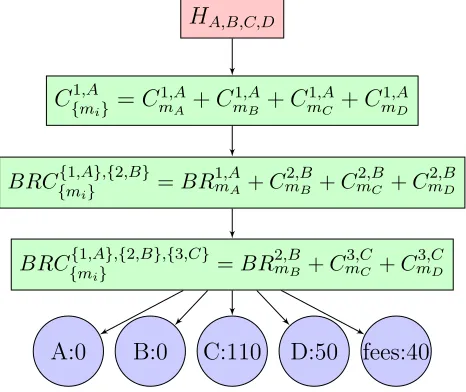
BRCs: Proof-of-Fraud to close factory. To close the factory while proving fraud, one can create a BRC transaction, made out of Breach Remedy and Revocable Allocation transaction fragments. The challenge here, as for BRRs, is to point at the proper outputs. Note that a BRC might be at the same time a fraud in itself by a second fraudster, and a third honest party must be able to proof two nested frauds (i.e. it must be reproducible). This is why this Proof-of-Fraud is revocable, as opposed to previous cases. BRRs already tackle this problem, since the factory is restored, not closed.
Figure 9 shows this scenario in a channel factory between Alice, Bob, Carol and Dave, for which the set of state updates are as follows:
User State 1 State 2 State 3
A 50BTC 20BTC 20BTC
B 50BTC 80BTC 20BTC
C 50BTC 50BTC 110BTC
D 50BTC 50BTC 50BTC
Therefore, Alice tries cheating by publishing C{1m,A i} =
Pn−1
i=0 C 1,A
mi . After
that, Bob, who is also dishonest, prepares a transaction BRC{{m1,A},{2,B}
i} =
BR1,A mA +C
2,B mB +C
2,B mC +C
2,B
mD, indicating that this transaction invalidates the
committed state 1 by Alice, and commits to state 2 by Bob. Finally, Carol, who is honest and whose best interest is also to publish the last state, prepares the last BRC{{m1,A},{2,B},{3,C}
i} =BR
2,B mB +C
3,C mC +C
3,C mD.
In this case, if there was a two-party channel between Alice and Bob in the factory, then A’s and B’s balances in the last valid state would go as fees. The remaining parties can, when cooperative, create new sets of Commitment transactions that split among them the balances of the malicious parties.
HA,B,C,D
C{1m,A i} =C
1,A mA +C
1,A mB +C
1,A mC +C
1,A mD
BRC{{m1,A},{2,B}
i} =BR
1,A mA+C
2,B mB +C
2,B mC +C
2,B mD
BRC{{m1,A},{2,B},{3,C}
i} =BR
2,B mB +C
3,C mC +C
3,C mD
A:0 B:0 C:110 D:50 fees:40
Figure 9: Nested BRCs. Valid state is state 3, not 2. Bob was trying to cheat with a BRC.
receiving one key. A protocol like this would require dn
2e users to collude in
order to successfully achieve a stale situation.
Nonetheless, a stale attack can be suspected any time an update is not fully finished, and, given the trustless-oriented nature of blockchains, one should always assume that the rest of users of the factory might be colluding to steal one’s funds. Furthermore, this protocol performs significantly faster than ordering and sharing the fragments one by one with one particular user at a time, since all fragments are delivered to all.
FunctionLFupdate(Ck
{uj}, RA k
{uj});
//set up, update channels{Fuj,uk}...
upon eventchannelsUpdated()
(1) C∅k+1,i← {P:i,S:ui,T :∅,I:{H{uj}.o}, O:C{ku+1
j}.o,St: 1}
(2) RAk∅+1← {P:any,S:ui,T :t1,I:{C{ku+1 j}.o}, O:RAk{+1u
j}.oui,St:k+ 1}
(3) C∅k+1← {P: any butui,S:ui,T :∅,I:{H{uj}.o},
O:C{ku+1
j}.o,St:k+ 1}
(4){Cmik+1,i, RAmik+1, Cmik+1} ←signi({C k+1,i
∅ , RA
k+1
∅ , C
k+1
∅ })
(5) broadcastk0+1({Cmk+1i , RA k+1 mi })
———————————————————————
upon eventdeliveri({Ck+1 mj , RA
k+1 mj })do
(6) store({Ckm+1j , RA k+1 mj })
(7) ifallReceived(St:k+1)then//start with breach remedy (8) BRk,i← {P:any,S:u
i,T :∅,I:{C1,i.o},O:∅,St:k}
(9) BRk,i∅ ←createi(BR)
(10) BRk,imi←signi(BR
k,i
∅)
(11) broadcasti(BRk,imi)
———————————————————————
upon eventtimeout protocoldo
(12)ifnotAllReceived(St:k+1)then
//publish lastly valid one (no breach remedy issued) (13) publishi(Pj−1
j=0C k,i mj)
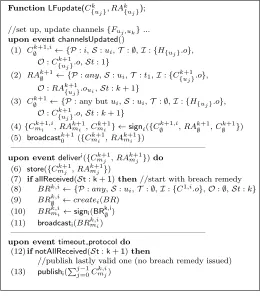
Figure 10: Updating a Lightning Factory.
4.4.3. Closing a Lightning Factory
In order for useruj to properly close a Lightning Factory, beinglf−1 the last state of the factory, they add the proper last Allocation Commitment fragments into an Allocation Commitment transactionC{k,j
mi}ni=0−1 =
Pn−1
i=0 C
k,j mi.
RAk,j{ 0
mi}ni=0−1
in order to close the factory. Notice that, should all users agree, they can create a last state lf, not revocable, that directly outputs into the accounts they agree upon, instead of setting up the channels of the factory when closing the factory.
5. Complexity, Resilience and Performance Analysis
In this section, we analyze the correctness and performance of our Light-ning Factory construction, and compare it with others. We show better performance by a factor of more than 3000 by decreasing the worst-case col-lateral cost of Lightning Factories, when compared to Duplex Micropayment Factories, among others. For this purpose, we first define here correctness, Bitcoin as a Clock, the adversarial model and components of payment chan-nels.
5.1. Correctness specification
Any protocol to correctly implement a payment channel must be fraud-resistant and cope with unresponsive behavior. Honest parties should always own enough signed transactions to be able to get back at least an amount of funds equivalent to the last agreed-upon balance (no-steal). If an update transaction is not fully signed and retrieved by all parties before the protocol times out, then the party must get back the initial fund published with the
f unding transaction (no-lock).
More formally, given a sequence of transactionsTi,j ={Ti−1, T
−1
j , Ti,j0 , . . . , Ti,jk, . . . Ti,jn}:
n >1, then we define the following properties:
No-steal. The two-party protocol guarantees no-steal if and only if all honest parties own enough off-chain and on-chain transactions to enforce their last balance unilaterally.
No-lock. the transaction T0
i,j is never on-chain, nor has it any partici-pant fully signed (off-chain), without having all participartici-pants at least one, fully-signed off-chain Tk
i,j that spends the outputs of such funding Ti,j0 . This guarantees no participant can publish T0
i,j and then not cooperate, not sign-ing, to lock funds.
We prove in the appendix the correctness of Lightning Factories.
5.2. Bitcoin as a Clock
of reliability to guarantee that after some timetany transaction that has met an average fee will hit the blockchain. If this can not be guaranteed, timelocks can be overdue and valid transactions can be invalidated. In general, one should take great care in deciding the timelock for transactions Ti. As a matter of fact, full correctness can not be guaranteed for certain, without assuming an ideal blockchain resilient to attacks that delay the inclusion of transactions in the blockchain, only with high-probability. A study of the proper time to select is a work in itself and is out of the scope of this paper. We will simply define two different times:
δt, considering it as the minimum time that two subsequent transactions that spend from the same output must differ in order to guarantee inclusion of the newest with a desired probability. Therefore, an update fromTABk (tlock:
tk) would require signing a new TABk+1(tlock : tk − δt). DMCs and DMC factories require new update transactions to have a timelock at leastδtsmaller relative to the previous update.
∆t, considering it as the minimum time a transaction must wait before spending an output to guarantee enough time for a counterparty to realize that the output is spendable (i.e. the transaction that generated the output hit the blockchain), prepare a transaction with no locktime, and publish it first. Lightning Channels and Lightning Factories require ∆t to give enough time to counterparties to prove fraud. Notice that ∆t> δt.
Additionally, other factors have a significant impact in the decision for ∆t and δt, or even in publishing the current state to prevent risk, such as forced expiration spam attacks, colluding miner attacks, or even signed fees becoming obsolete (i.e. too low to be included by miners) [14]. These attacks and their workarounds are out of the scope of this document.
Having such basic notation, it is possible to deepen into correctness prop-erties and performance measures of channels and factories.
5.3. Components of n-party Payment Channels.
We will assume that a group U of n users want to create an n-party channel. Any n-party payment channel has four components:
1. A cryptographic scheme, with specified algorithms and protocols for key generation, signing and verification. For a Lightning Factory, we require a non-interactive Aggregate Signature (AS) scheme, such as Bellare et al.’s [1] BNN.
3. A channel update protocol, in which members update the outputs of the channel, that precedes and/or invalidates all previous updates’ outputs, including the first one of the setup.
4. A channel close protocol, with which members enforce the last update. These components must be correct. That is, as long as the adversary does not get explicit access to honest parties’ keys, these components must guarantee the no-lock and no-steal properties of honest parties’ funds, described in section 5.
5.4. The Adversarial Model
We consider an adversaryF with the following capabilities:
• F can control the network to read, drop or redirect all messages. While this is all the correctness a channel requires, its performance improves if F is allowed to drop messages, but not to read or redirect them to a new recipient.
• F can take full control and corrupt any subset of players S U at any time, learning its entire state (stored messages, signatures, etc.). if S = U then there is no honest party (i.e. there is no victim of the adversary).
• For any uncorrupted user ui, F can decide to conduct and adaptive
chosen-message-and-subroup attack: at any time, it can request ui to execute the protocol on some specified message with some specified co-signers (who might be, in turn, corrupted by F).
5.5. Attacks in Factories
In this section, we present two attacks common to factories in general, before we compare the impact of these attacks in the different factories. To the best of our knowledge, we are the first to bring up these attacks.
5.5.1. Broken factory attack
Burchert et al. [5] propose a workaround in a channel factory F{u
i}ni=0−1
in which one of the members, uj, goes unresponsive, either during updating (Stale Factory attack) or not. When this happens, the factory cannot be updated, meaning that opened channels must remain open for the period of time that they lastly signed when uj was still responsive, A
lf {ui}ni=0−1
tmin < t1−(lf−1)δt), beingA lf
{ui}ni=0−1 the lastly signed allocation transaction
of a DMC factory. However, inner-channel states that do not depend on uj can still be updated within the factory. According to Burchert et al. [5], there is a workaround to create a new factory with these channels in which
Alice Bob Carol Dave
HA,B,C,D
50
50
50
50
A1
A,B,C,D
FAB
N
R1
AB R2AB RAB3
FBC
FAC FCD
N N
R1
BC
R2
BC
R1
AC RAC2 R1CD
A1
A,B,C A: 50 B: 50
Figure 11: Redirection of inner-channel outputs to a new factory, in the event Dave goes unresponsive, as claimed by Burchert et al. [5]. Notice how the new refund transaction
R3AB invalidates the Allocation A1A,B,C, both in purple. Alice and Bob are the only ones required for such update. Carol might think Alice and Bob’s last state isR2AB, and might accept payments from them in channels of the channel factory of AA,B,C. Afterwards,
Alice and Bob can publish R3
AB, which will hit the blockchain first and thus Alice and
Bob will steal from Carol.
The two signed offline transactions in purple, A1
conflict. If R3
AB, the third (and last) refunding transaction of the DMC between Alice and Bob, is published, then A1A,B,C, the allocation transaction of the new factory, is not valid. Also, Carol does not know that R3AB exists, thus Alice and Bob are stealing from Carol.
5.5.2. Stale factory attack
A stale factory attack does not affect the correctness of the factory (con-trary to a broken factory attack), but rather its performance. Before explain-ing a stale factory, let us consider a stale channel.
Stale Channel. Suppose a channel between Alice and Bob, with current valid state R1AB, in which they wish to update to a new stateR2AB. Alice prepares the transaction R2
A., signs it, and gives it to Bob. In such a case, if Bob is malicious, he can decide to stop responding, and Alice will not know if R1
AB will be valid, or if Bob will publish R2AB instead. We show a stale channel in figure 12.
Bob Alice
{Ri AB}
k−1
i=0,Rk.B,
{Ri AB}
k−1
i=0,RkAB R1.B
R1
AB
. . .
Rk.B
Figure 12: Stale channel. Alice becomes unresponsive after receiving Rk
.B. Bob cannot
know whether Rk−1AB is still valid, or if Alice will sign and publishRk
AB instead.
This situation creates an ambiguity that damages Bob as much as Alice, by timelocking his own funds. Also, it does not directly affect the no-steal and no-lock property, but creates ambiguity for an amount of time O(t1).
the moment of updating the factory. In a DMC Factory, or channel, there is no moment in which two states are equally valid, since one of them will always have a lower locktime. For this reason, an update can be a critical moment, if the last member to sign is malicious.
In a DMC Factory F{u
i}ni=0−1, regardless of the communication protocol
to update [5], there will always be a set of users {ui} j−1
i=0 that receive the
signatures of the rest {ui}ni=−j1 first. As such, not all users will get all signed transactions simultaneously, but some of them will have to sign and provide before ({ui}
j−1
i=0 in this case). Without loss of generality, we treat the set
of users who receive the signatures first as a single malicious user, uj, who receives the new state A2
{ui}i6=j(tlock:t2) signed by everybody else but them.
If uj is malicious, they can decide not to communicate the signed A2{u
i}ni=0−1,
and to go offline instead. Should this happen, any other channel that was modified by this update cannot be used anymore, since the members of the channel have no idea if they have to update the old channel or the new one, resulting in all these channels completely paralyzed for the amount of time
t2. The rest of channels can continue normal operation, and perform their
inner-channel updates.
Notice that, contrary as previously thought [5], updating both states for as long as there exists ambiguity is sometimes not possible. If previous state
A1{u i}ni=0−1
has two channels {FAB, FCD}, and the new state A2{u
i}ni=0−1
has two different channels{FAC, FBD}, then a payment Alice to Bob can not happen in the new state, whereas it can in the previous one. Routing within the factory in the second state is also not possible. Same happens for a payment Alice to Carol. As such, Alice’s funds are timelocked.
The stale factory attack is a significant drawback of DMC factories. Even if the communication protocol to update, in the best of cases, requires for a stale factory attack that n−1 of the members collude, only with one user going unresponsive is sufficient for the rest to suspect that the other n−1 might be colluding for a stale factory attack. That is, any update request that was initiated and not finished is potentially a stale factory attack.
5.6. Complexity Analysis
In this section we compare the complexity and security performances of our Lightning Factory versus DMC Factories.
Worst-case lock-in timeDMC Factories’ worst-case lock-in time is t1,
where t1 being A1{ui}(tlock : t1). Lightning Factories have a constant
Blockchain check timeDMC Factories only have to check the blockchain at t1−(lf −1)δt, where (lf −1) being A
lf−1
{ui} the lastly signed state.
Light-ning Factories have to periodically check the status of the blockchain at least every ∆t, in order to have enough time to prove fraud.
Memory footprintDMC Factories simply need to store the lastly signed
Alf−1
{ui}. Lightning Factories need to store, for Alice’s case, {C
lf−1,A {ui} , RA
lf−1,A {ui} }
along with all {Imi}i6=A and the last {BR
lf−1,i
mi }i6=A, since the last Breach
Remedy fragments can make use of
SIGHASH NOINPUT to match previous old states. However, if memory is a constraint, Breach Remedy fragments can also be aggregated, and Idle transaction fragments are not necessary for the correctness of the factory, requiring ultimately the size of 3 transactions, compared to that of 1 for DMC Factories. Recall that, at the moment of writing, DMC Factories have been proposed with Schnorr signatures, whose size is twice as much as our proposed BLS signatures, resulting in a final 3/2 ratio of size required for Lightning Factories compared to DMC Factories.
Number of updates DMC Factories are upper-bounded in the number of updates by bt1
δtc, wheret1 being A
1
{ui}(tlock :t1). Lightning Factories have
an unlimited amount of updates.
Message complexity The protocol proposed by Burchert et al. [5] re-quires exchanging n2 messages for each update. Lighting Factory requires 2n messages, being ordered in two sets. A first set of n allocation commit-ment and revocable allocation fragcommit-ments that are broadcast in an indistinct order, and a second set of n breach remedy fragments that are broadcast afterwards. Note that fragments and their signatures are smaller in size to the transactions and signatures reported in DMC Factories. That is, BLS signatures are half as big as Schnorr.
5.7. Resilience Analysis
Previous work [5] suggested a mechanism for splicing out unresponsive/malicious parties which attempts against the correctness of the factory. The authors suggest the redirection of inner-chanel outputs to a new factory. We have the evidence that this splicing out mechanism is vulnerable to broken factory attack, which cracks the no-steal correctness property.
the lifetime of the factoryt1, wheret1 the timelock for the first state, as with
DMC. This means that the trade-off between locktime and lifetime of the factory is addressed, being possible to have unlimited lifetime with constant locktime. Also, malicious parties are disincentivized to try fraud, since any other member of the factory can publish a Proof-of-Fraud, and make them lose all funds.
Furthermore, the attacks possible in a channel factory make it difficult for DMC factories to tackle their trade-off, since the properties of long-lasting channels/factories (high number of updates) and low worst-case lock-in time of funds are in direct conflict. However, in a Lightning Factory, given the smaller locktime, not dependent on the number of updates, and the fact that invalidation of states are only signed once everybody has a validation of the new state, the stale factory attack is significantly less bothersome. We compare the impact of such an attack in section 5.8.
Broken factory attack in Lightning Factories. The broken factory attack is common to all factories constructions, including Lightning Factories. The purpose of the broken factory attack is to illustrate that splicing out an un-responsive member from the factory will require waiting the entire timelock, which means that splicing out a member takes as much time and transactions as closing and reopening the factory. For a DMC FactoryF{u
i}ni=0−1 with initial
Allocation transaction A1
{ui}(tlock : t1), the number of updates possible in
the factory isbt1
δtc. Considering the factory breaks (i.e. one member becomes
unresponsive) at state At1
{ui}, then the amount of time that it takes to wait
before being able of ’splicing out’ this member is t1 >> δt. We can see how, in order to make the factory useful, t1 should be high enough. However, the
greater i, the greater the worst-case lock-in time t1.
For a Lightning Factory, this issue is much less relevant. Since all states are invalidated and have a constant locktime ∆t, not only is the number of updates not upper-bounded, but also the worst-case lock-in time is constant ∆t, regardless of the number of possible updates.
Stale factory attack in Lightning Factories. The stale factory attack is not damaging in Lightning Factories. In a DMC Factory, a stale factory attack uses the fact that all states are actually valid, but with a different locktime. New states have a lower locktime, which means that the existence and the publication of a new state invalidates previous ones, since these have a higher locktime. As such, if a set of users with current state defined byAk,uj
tk = t1−(k−1)δt) initiate but do not finalize sharing with each other the fully signed new Allocation transaction Ak+1,uj
{ui} (tlock : tk+1 = t1 −k∗δt),
users cannot be sure of which of the two transactions will be published, since they do not know if any other user actually obtained a fully signedAk+1,uj
{ui} , or
if all users have only a partially signed version (i.e. Ak,uj
{ui} would be the lastly
enforceable state). As such, the factory cannot be further used, at least for a subset of the channels (see section Appendix B.4). In this case, again, users will have to waittk >> δttime, unless a newAk{+2ui}(tlock :tk+2 =t1−(k+1)δt)
becomes fully signed.
A Lightning Factory, however, can have two equally valid states, at the same time. Since users do not invalidate the previous state until they receive a new, fully signed one, they are sure that they always have an enforceable state of the factory. As such, if a state update does not complete, and they suspect there is ambiguity as to which state is the valid one in the factory, they can simply publish their owned state, wait for ∆t, and close the factory with their enforceable version of the state.
5.8. Performance Analysis
In this section, we compare the impact of different timelocks, that of a Lightning Factory and of a DMC Factory. If the factory faces a stale factory situation, some funds from some channels or, in the worst case, all funds from all channels may be locked for the locktime that was set by the timelock. If the factory simply can not be updated because of one or several users being offline, the funds can be moved within the already opened channels, but not outside, for as long as the timelock has not finished.
In both cases, we consider the cost of holding unusable liquidity during each locktime. We call this the interest rate. Similar to the value chosen by Zohar et al’s [4], we choose an interest rate of r = 0.0001096 per iteration step, when fixed. For our simulation, we consider the factory wishes to update at each iteration step, and each iteration steps reduces the timelock by one. The two above-mentioned cases will change the impact of the locktime, that is, the value of r, but the locktime is not dependent on it. Hence, we use a generic model that works for both cases.
Let p be the probability of a user going unresponsive and/or malicious during an update (or in between updates) in a binomial distribution, and let
remaining updates are lf −E(n) otherwise. Finally, to consider the cost, we consider the remaining updates and multiply them by the interest rate r, being the cost (lf −E(n))r if E(n)< lf.
Figure 13 shows the simulation results4 of the remaining percentage of
updates as a function on the total lifetime of the factorylf and on the number of usersn, expected number of updatesj as a function on the probability of a malicious/offline party p, and simulation results showing resulting cost when increasing the lifetime, from left to right. Both in Figure 13 and Figure 14, when fixed, the chosen values of each parameter are: p = 10−7 (1 user in 10 million goes unresponsive, either during update or not), lf = 10000 (after 10000 updates the DMC Factory closes), n = 1000 (1000 users in the factory). One can see how increasing the number of users immediately affects the lifetime of the channel, due to the increasing chance of a stale attack. Increasing the lifetime of the channel also increases such chance, given the more tries. This is strongly dependent on the value on p chosen, as shown in Figure 13, which we consider to be generous for the DMC construction in our results.
Figure 14 shows the cost as a function on the number of users n, the probability of a malicious/offline party pand the interest rate r, from left to right. The right-most plot of Figure 13, along with the tables in Figure 14, illustrate how the cost, dependent on the interest φ, is much lower in our construction compared to a DMC factory, by a factor of more than 3000 in almost all results, and increasing for DMC while remaining constant for our construction LF. These results were obtained by a simulation on 1000 factories per result.
It is, therefore, clear that Lightning Factories scale well better when con-sidering the locktime of fund than DMC factories, regardless of the actual values for n,lf,pand r. Additionally, we prevent selfish users from continu-ously publishing outdated states that maximize their rewards, by penalizing them.
5.9. BNN vs Schnorr
Schnorr-based signatures schemes have recently been suggested for Bit-coin [10]. Here, we compare our proposal of a non-interactive AS scheme
Figure 13: Remaining percentage of updates as a function on the total lifetime of the factory.
n LF DMF
10 φ 3437φ
100 φ 3576φ
3000 φ 6839φ
104 φ 8977φ
Interest LF DMF
φ φ 3785φ
5φ 5φ 3729φ
9φ 9φ 3551φ
10φ 10φ 3686φ
p LF DMF
10−7 φ 3645φ
2·10−7 φ 5661φ
5·10−7 φ 7963φ
10−6 φ 8957φ
Figure 14: Cost as a function on the number of users n, the probability of a mali-cious/offline party and the interest rate.
based on BLS [3], such as BNN, with Schnorr-based interactive AS schemes proposed by Maxwell et al. [10].
Signatures size is an important matter in the blockchain, since every bit that is stored in it has a cost, and it will be replicated by all nodes. BLS signatures consist of one group element (i.e. 256 bits), whereas Schnorr signatures are longer, with one group element plus one integer of the size of the group order, (i.e. 512 bits). Therefore, the improvements in terms of size, derived by Maxwell et al. [10], from switching from ECDSA to Schnorr are not only preserved with our proposed BLS-based system, but improved by a factor of 2.
While this design is not exclusive to Bitcoin, adapting it to Bitcoin would require additional modifications from the perspective of validation semantics. Again, this is not a new requirement, and in fact Maxwell et al. [10] already require a new Opcode for cross-input multi-signatures.The reason is that it is necessary to enforce all and only the required transaction fragments at each step. This can be implemented with a new Opcode, in a backward compatible way, such that miners that do not want to upgrade will simply believe transactions involving this Opcode in other miners’ blocks.
non-interactive AS. Flags such as sighash-single5, which allows modification
of other outputs in the same transaction, make it impossible to aggregate this other outputs non-interactively with Schnorr-based schemes. Moreover, cross-input multi-signatures, i.e. aggregating all transactions and inputs in a block into one signature, would not be possible with Schnorr-based schemes, since they require the interaction of each input signer. Therefore, there are at least two of Bitcoin’s state-of-the-art proposals that are not possible without a non-interactive AS.
6. Conclusions and Discussion
In this paper, we proposed the first extension of Lightning Channels to Lightning Factories, solving the trade-off between the lifetime of the factory and the risk of temporary funds lock-in existing in DMC Factories. Our design scales well better than DMC Factories, offering a constant collateral cost, independent of the lifetime of the channel and the members of the fac-tory. Moreover, our Lightning Factories are resilient to attacks. Driven by the necessity to implement non-interactive aggregate signatures, we proposed BNN as signature scheme. Note that advantages of BNNs lie in a reduced signature size with respect to the Schnorr-based interactive AS schemes pro-posed by Maxwell et al. [10] by a factor of 2. Moreover, it would be possible to implement it in Bitcoin, requiring additional modifications from the per-spective of validation semantics. The reason is that it is necessary to enforce all and only the required transaction fragments at each step. This can be implemented with a new Opcode, in a backward compatible way, such that miners that do not want to upgrade will simply believe transactions involving this Opcode in other miners’ blocks. Other than Bitcoin, we believe that this design would be beneficial to other existing and upcoming blockchains.
Appendix A. Payment Channels
Poon et al. [14] proposed initially Lightning Channels for the Lightning Network. Yet, there are currently several on-going projects to implement the concept, most of which are open to other types of payment channels, not only Lightning Channels. In this section, we take a look not only at Lightning Channels, but rather at a variety of possible constructions that can
empower an off-chain payment network. As such, Payment Channels are the cornerstone of the Lightning Network. In this section, we show how to open, update and close a payment channel. We explain Duplex Micropayment Channels in section Appendix A.1, while we mention Lightning Channels in section Appendix A.2.
Appendix A.1. Duplex Micropayment Channels
As already mentioned, all channels have three main phases: open, update and close (sometimes referred to as setup, negotiation and settlement [6]. Duplex micropayment channels rely on timelocks to update and close their channels. Potentially, every update of the channel is a new close of the channel, with smaller timelock. We deepen into the details here below.
Appendix A.1.1. Opening a DMC
Figure A.15 shows the negotiation to create a payment channel in a Bitcoin-like blockchain, with a particular example in figure A.16. To this end, Alice and Bob create a funding and a first refund transaction. First, Bob tells Alice which outputs o he wants to include in this channel (i.e. how much money). Then, Alice creates a funding transaction F.. with hers and Bob’s outputs as inputs (2-of-2 multisig), which she does not sign. Notice the two dots in F.. indicate that none of them signed. Following the generic example of figure 3, here is both transactions involving DMC channels:
F.. =T..0
T0
AB.kind =funding,
TAB0 .in ={TA−1.out, TB−1.out},
T0
AB.out=oAB,
T0
AB.conds = (skA, TA−1.out),(skB, TB−1.out) where skA and skB are the secret keys owned by A and B to digitally sign transactions.
R1
AB =TAB1
T1
AB.in =FAB.oAB,
TAB1 .out= (o1A, o1B) :o1A =oA∧o1B =oB,
T1
AB.conds= (skA∧skB, FAB.oAB) whereskAwithskBallow for spending
FAB.oAB as long as blockheight > block(FAB) +tlock, where tlock is the timelock (e.g. 14400 blocks ' 100 days).
The outputs of F.. are the inputs of R1A.. Bob then sings both of them,
R1
AB, F.B, and shares them with Alice. At this point, since RAB has been signed by both of them, R1AB is ready to be published. However, the inputs of R1
is not fully signed and published yet. Now Alice signs and publishes FAB. Note that at this point Alice and Bob both stored locallyR1AB, ensuring they both can redeem the funds if they want to.
FunctionDMCsetup();
Init:
(1) F, F.., R1, R1..← ⊥
(2) deliverji (Ti−1.out)
———————————————————————
upon eventdeliverjj(Tj−1.out)do
(3) F← {in: {Ti−1.out, Tj−1.out}, out:{oij},
conds: {(ski, Ti−1.out),
(skj, Tj−1.out)}}
(4) F..←createi(F) (5) R1← {in: {F
ij.oij},out:{o1i, o1j},conds:{(ski∧skj, Fij.oij),
tlock:t1}}
(6) R1..←createi(R1)
(7) R1
i.←signi(R1..)
(8) deliverji(F.., R1i.)
———————————————————————
upon eventdeliveri
j(F.., R1.j)do
(9) R1
ij←signi(R1.j)
(10)Fi.←signi(F..)
(11)deliverji(R1 ij, Fi.)
———————————————————————
upon eventdeliveri
j(F.j, Rij1)do
(12)Fij←signi(F.j)
(13)publishi(Fij)
Figure A.15: Opening a DMC. the dots in F.. represent two missing signatures, while in
R1i.only j’s signature is missing.
Appendix A.1.2. Updating a DMC
Updating a channel balance is equivalent to replacing Rk
AB byR k+1
AB and so on, that is, being RkAB = TABk , then RkAB+1 = TABk+1. A payment channel protocol must do this in a way that RABk+1 invalidates Rk
AB, to prevent any party from stealing funds by publishing a former state.
For DMCs, update transactions are actually timelocked for an amount of time i, e.g. R1
AB(tlock : t1) where t1 is the locktime. This locktime can be
subse-Bob Alice
RAB
RAB
Blockchain
T−B1.out
F.., R1
A.
F.B, R
1
AB
F
AB
Figure A.16: Example of opening a DMC following protocol described in figure A.15 [7].
quent kick-off transaction [7, 5]6. Therefore, if the current state corresponds
to the refund transaction R1
AB(tlock :t1), then updating the state is simply
signing a new refund transaction with lower locktime R2AB(tlock : t1 −δt).
This way, assuming no forced expiration spam nor colluding miner attacks, the transaction R2
AB would enter the blockchain before RAB1 , since it has a lower locktime, i.e. if δt= 1day then it has one more day as advantage.
FunctionDMCupdate(Rk ij);
Init:
(1) Rk+1, Rk+1
.. ← ⊥
(2) Rk+1← {in: {F
ij.oij},out:{oki+1, o k+1
j },conds:{(ski∧skj, Fij.oij),
tlock:tk+1=t1−kδt}}
(3) Rk+1
.. ←createi(Rk+1)
(4) Rki.+1←signi(Rk+1 .. )
(5) deliverji(Rki.+1)
———————————————————————
upon eventdeliverji(Rk.j+1)do
(6) Rkij+1←signi(Rk.j+1) (7) deliverji(Rkij+1)
Figure A.17: Updating a DMC.
6