
Rig:
A simple, secure and flexible design for
Password Hashing
Donghoon Chang, Arpan Jati, Sweta Mishra, Somitra Kumar Sanadhya
Indraprastha Institute of Information Technology, Delhi (IIIT-D), India {donghoon,arpanj,swetam,somitra}@iiitd.ac.in
Abstract. Password Hashing, a technique commonly implemented by a server to protect passwords of clients, by performing a one-way transformation on the password, turning it into another string called the hashed password. In this paper, we introduce a secure password hashing framework Rig which is based on secure cryptographic hash functions. It provides the flexibility to choose different functions for different phases of the construction. The design of the scheme is very simple to implement in software and is flexible as the memory parameter is independent of time parameter (no actual time and memory trade-off) and is strictly sequential (difficult to parallelize) with comparatively huge memory consumption that provides strong resistance against attackers using multiple processing units. It supports client-independent updates, i.e., the server can increase the security parameters by updating the existing password hashes without knowing the password. Rigcan also support the server relief protocol where the client bears the maximum effort to compute the password hash, while there is minimal effort at the server side. We analyze Rig and show that our proposal provides an exponential time complexity against the low-memory attack. Keywords: Password, Password hashing, GPU attack, Cache-timing attack, Client-independent update, Server-relief technique
1
Introduction
Password hashing is an active topic of interest in cryptography community and a competition on password hashing is going on [1]. Currently, the significant constructions for password hashing are PBKDF2 [12], Bcrypt [14] and Scrypt [13]. All of these do not satisfy most of the necessary requirements mentioned at the competition page [1]. PBKDF2 (NIST standard) consumes very less memory as it was mainly designed to derive keys from a seed (password). Bcrypt uses fixed memory (4KB) for its implementation. Scrypt is not simple (different internal modules) and not flexible (time and memory parameters are dependent) and susceptible to cache timing attack ( discussed in section 5 ).
Specifically, the rate at which an attacker can guess passwords is a key factor in determining the strength of the password hashing scheme. Current requirements [1] for a secure password hashing scheme are the following:
– The construction should be slow to resist password guessing attack but should have a fast response time to prove the authenticity of the user.
– It should have a simple design and should be easy to implement (coding, testing, debugging, integration), i.e., the algorithm should be simple in the sense of clarity and concise with less number of internal components and primitives.
– It should be flexible and scalable, i.e., if memory and time are not dependent then one would be able to scale any of the parameters to get required performance.
– Cryptographic security [1]: The construction should behave as a random function (random-looking output, one-way, collision resistant, immune to length extension, etc.).
– Resistant to GPU attack: A typical GPU has lots of processing cores but has limited amount of memory for each single core. It is quite efficient for an attacker to utilize all the available processing cores with limited memory to run brute-force attack over the password choices. Use of comparatively huge memory per password hash by the password hashing construction can restrict the use of GPU. Therefore, the design should have large memory consumption to force comparatively slow and costly hardware implementation that can resist the GPU attack.
– Leakage Resilience: The construction should protect against information extraction from physical implementation, i.e., the scheme should not leak information about the password due to cache timing or memory leakage, while supporting any length of password.
– The construction should have the ability to transform an existing hash to a different cost setting (client independent update, explained in section 5) without knowledge of the password.
The most challenging threat faced by any password hashing scheme is the existence of cheap, massively parallel hardware such as Graphics Processing Units (GPUs), Application-Specific Integrated Circuits (ASICs) and Field-Programmable Gate Arrays (FPGAs). Using such efficient hardware, an adversary with multiple computing units can easily try multiple different passwords in parallel. To prevent such attempts we need to slow down password hash computation and ensure that there is little parallelism in the design. One way to achieve this is to use a ‘Sequential memory-hard’ algorithm, a term first introduced with the design of ‘Scrypt’ [13], a password hashing scheme. The main design principle of Scrypt is that it asymptotically uses almost as many memory locations as it uses operations to slow down the password-hash computation. Memory is relatively expensive, so, a typical GPU or other cheap massively-parallel hardware with lots of cores can only have a limited amount of memory for each single core. Hence an attacker with access to such hardware will still not be able to utilize all the available processing cores due to the lack of sufficient memory and will be forced to have an (almost) sequential implementation of the password hashing scheme.
In this document we propose Rig, a password hashing scheme which aims to address the above mentioned requirements. Rig is based on cryptographic (secure) hash functions and is very simple to implement in software. It is flexible as the memory parameter is independent of time parameter (no actual time and memory trade-off) and is strictly sequential (difficult to parallelize) with comparatively huge memory consumption that provides strong resistance against attackers using multiple processing units. It supports client-independent password hash up-gradation without the need of the actual password. This feature helps the server to increase the security parameters to calculate the password hash to reduce the constant threats of technological improvements, specifically in the field of hardware. Rig provides protection against the extraction of information from cache-timing attack and prevents denial-of-service attack if implemented to provide server-relief technique. We analyzeRig and show that our proposal provides an exponential time complexity against memory-free attack. It gives the flexibility to choose different functions for different phases of the construction and we denote the general construction of Rig as Rig [H1,H2,H3]. In this work we provide two variants of Rig [H1, H2,
H3]. A strictly sequential variant, Rig [Blake2b, BlakeCompress, Blake2b] and
the other variant, Rig [BlakeExpand, BlakePerm, Blake2b] which improves the performance by performing memory operations in larger chunks.
2
Preliminaries
The techniques used in our construction are discussed below.
– Binary 64-bit mapping:It is a 64-bit binary representation of the decimal value. The binary number
an−12n−1+an−22n−2+· · ·+a0
is denoted asan−1an−2· · ·a0whereai∈ {0,1}andnis the number of digits
to the left of the binary (radix) point. In our construction we usen = 64 and we denote binary64(x) for 64-bit binary representation of the valuex. – Bit reversal permutation [9, 11] (br):It is implemented to permute the
indices of an array ofn= 2k elements wherek
∈N. We explain the steps of the permutation through Algoritm 1 below.
The example of a bit reversal permutation applied on an array of m= 23
elements wherek= 3 and indices are 0,1,· · ·,7 is given below.
br[000,001,010,011,100,101,110,111] = [000,100,010,110,001,101,011,111] =br[0], br[1], br[2], br[3],· · · , br[7].
Algorithm 1:Bit reversal permutation (br) Input:Indices of an arrayAofn= 2k elements wherek
∈Nand indices are: 0,1,2,· · ·, n−1.
Output:Permuted indices of arrayAas:br[0], br[1], br[2],· · ·, br[n−1] 1. fori= 0 ton−1
2. (i)bink=ik−1ik−2· · ·i1i0= Pk−1
j=02jij
3. .(i)bink=k-bit binary representation of valuei
4. br[i] =Pk−1 j=02
ji k−1−j
5. returnbr[0], br[1], br[2],· · ·, br[n−1]
3
Attack platforms: Significant hardwares
According to Moore’s Law [15], the number of transistors on integrated circuits doubles approximately every two years. This has indeed been the case over the history of computing hardware. Following this law, hardware is becoming more and more powerful with time. This happens to be the most prominent threat for existing password hashing schemes. Consequently, there is a need to raise the cost of brute force attack by controlling the performance of the massively parallel hardware available.
Field Programmable Gate Arrays(FPGAs) are programmable integrated circuits and consist of an array of logic elements together with an interconnected network and memory chips, providing high-performance. A designer can test her design on an FPGA before implementing it on an ASIC.
Both ASIC and FPGAs can be configured to perform password hashing with highly optimized performance. The cost of implementation on FPGA is cheaper than ASICs if the number of units of the hardware required is small. Therefore, one can easily use parallel FPGAs to increase the rate of password guessing. RIVYERA FPGA cluster is an example of a very powerful and cost optimized hardware. It can hash 3,56,352 passwords per second by using PBKDF2 (NIST standard, Password Based Key Derivation Function 2) with SHA-512 and 512-bit derived key length [8]. This high performance is possible on the FPGA because PBKDF2 does not consume high memory for password hashing. Comparing FPGAs with GPUs (Graphics processing units), the authors of [8] provide results of the same implementation on 4 Tesla C2070 GPUs as 1,05,351 passwords per second. ASIC is better than FPGA purely on performance in terms of number of hashes per second. However, FPGA is preferable when cost is considered with the speed of hashing. Following Moore’s law, the speed of hardware is likely to increase by almost a factor of two in less than two years. However, as processor speeds continue to outpace memory speeds [10], the gap between processor and memory performance increases by about 50 % per year [5]. Thus, there is a need to minimize the effects of such high performance hardware. Hence, we need a password hashing algorithm which consumes comparatively large memory to prevent parallel implementation.
4
Specification
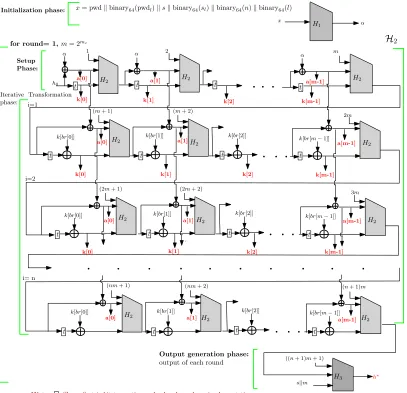
Our construction is described in Fig. 1. Following is the step-by-step description of Algorithm 2 which explains our constructionRig.
1. First we need to fix the following parameters:
– pwd = The user password of any length.
– s= The salt value of any length.
– n= The number of iterations required to perform iterative transformation phase.
– mc= The memory count from which the memory-cost is defined as:m=
2mc, i.e., m denotes the number of items to be stored in the memory.
The value ofmis updated as:mi+1= 2×mi at each round.
– r= The number of rounds for the setup phase followed by iterative transformation phase and output generation phase.
– l= The output length of the password hash.
– t= The number of bits retained from hash output after truncation. Used with a function trunct(x) =x(|x| −t), wherexis the hash output.
2. Initialization phase:We map the parameters, namely the values: password lengthpwdl, salt lengthsl,nand the output length,lto a 64-bit binary value
using binary64 mapping. We create the value xas the concatenation (||) of
the above mentioned parameters as
H2 H2
H2 H2
H3 h∗
1 2
(m+ 1) (m+ 2)
k[1]
H2 H2
(2m+ 1) (2m+ 2)
H2
H2 H2
(nm+ 1) (nm+ 2) (n+ 1)m
k[0] k[m-1]
((n+ 1)m+ 1)
∗Note: :Shows firstt−bit truncation and value depends on implementation.
k[br[i]] : is theith index of arraykobtained from bit reversal permutation k[2]
α
t t t t
h0
t t t t
t
t t t
t t t t
t i=1
i=2
i= n
s||m
a[0] a[1] a[m-1] a[0] a[1] a[0] a[0] a[1] a[1] a[m-1] H2 H2 a[m-1] H2 a[m-1] m 2m 3m
H2 H2
H2 H2 H2 Initialization phase: Iterative Transformation phase: Setup Phase:
Output generation phase: output of each round
α α
k[br[0]] k[br[1]] k[br[2]] k[br[m−1]]
k[br[m−1]]
k[br[m−1]]
k[br[2]]
k[br[2]]
k[br[0]]
k[br[0]]
k[br[1]]
k[br[1]]
H2 H1
x α
H1
for round= 1,m= 2mc
k[0] k[1] k[1] k[0] k[2] k[2] k[m-1] k[m-1] x= pwdkbinary64(pwdl)kskbinary64(sl)kbinary64(n)kbinary64(l)
Rig: A password hashing scheme
Algorithm 2:Rig [H1,H2,H3] Construction
Input:Password (pwd), Password length (pwdl), Salt (s), Salt length (sl), No. of iterations (n),
Memory count (mc), No. of bits to be retained from hash output of the setup phase (t),
Output length (l), No. of rounds (r). Output:l-bit hash valuehr∗obtained afterr rounds
1. .Initialization phase: generatesαfrom password
2. Initialize: a random salt (s) of atleast 16-bytes, number of iterations (n), value of memory countmcwherem= 2mc, valuet
3. x= pwdkbinary64(pwdl)kskbinary64(sl)kbinary64(n)kbinary64(l) .concatenation:k
4. α=H1(x) . H1: underlying hash function
5.forround 1 tor
6. .Initialization of Setup phase: Creates two arrayskanda
where|k|=|a|=mwherem= 2(round−1)
×2mc
7. h0= initialized with the value ofπafter decimal, and|h0|=|α|.
8. a[0] =α⊕h0,k[0] =trunct(h0)
9. fori= 1 tom
10. hi=H2(ika[i−1]kk[i−1]) . H2: underlying hash function
11. ifi6=m
12. a[i] =α⊕hi
13. k[i] =trunct(hi) .retains the firstt−bits of the hash output
14. .Initialization of Iterative Transformation phase 15. fori= 1 ton
16. forj= 1 tom
17. a[j−1] =a[j−1]⊕h{im+j−1}
18. br[j−1] = index value of arraykobtained using bit reversal permutation
19. .initialize a temporary array|ktemp|=|k|
20. ktemp[j−1] =k[br[j−1]]⊕trunct(him+j−1)
21. him+j=H2((im+j)ka[j−1]kktemp[j−1])
22. k=ktemp
23. .Output generation phase
24. hround∗= (H3((n+ 1)m+ 1)kh(n+1)mkskbinary64(m))
25. if round< r
26. α=hround∗
and computeH1(x) =αwhere H1 is the underlying hash function. We use
αfor further calculations in the setup phase.
3. Setup phaseWe initializeh0 with the value of πafter the decimal point.
We take as many digits ofπas desired to ensure that|h0|=|α|. The values
h0 andαare used to initialize two arrayskandaand furtherm−1 values
of the arrays are iteratively calculated as shown in the fig. 1. Firstt-bits of each hash output are stored in the arrayk.
The large number of calls to the underlying hash function are guaranteed to have different inputs by the use of different counter values.H2 denotes the
underlying hash function.
element of the arraysaandk,n-times wherenis the number of iterations. Arrayais accessed sequentially where values of array k are accessed using bit reversal permutation explained in Algorithm 1. We denote the index of arraykobtained applying bit-reversal permutation as:br[j], 0≤j≤m−1. 5. Output generation phaseAfter execution of the setup phase and iterative transformation phase sequentially, we calculate one more hash, denoted by H3 to get the output of each round. If round=1, this output is considered
as the password hash.
Note:The output is anl-bit value. The algorithm stores the output as the hashed password. Our construction allows for storing a truncated portion of the hash output as well. If this is desired we can take one of the following two approaches.
(a) The user may run the complete algorithm as described above and truncate the final output after r rounds to the desired length. This approach does not support client-independent update.
(b) To support client-independent updates the user can choose a length for truncation which is sufficient to claim brute-force security. Then append some constant value, we suggest the hexadecimal value of π after first 64-bytes of decimal point. Take as many digits as desired to make the output length of each round equal to the length ofαof the setup phase. So this way one can reduce the storage requirement for password hashes at the server.
5
Design rationale
Existing password hashing schemes are not simple and do not fulfill the necessary requirements as discussed in section 1. We have tried to design a solution which overcomes the known disadvantages of existing schemes (PBKDF2 [12], Bcrypt [14] and Scrypt [13]). The primary concerns against existing proposals are their complex design and their inefficiency to prevent hardware threats. We have tried to strengthen our design by considering the necessary requirements as mentioned in section 1.
1. Initialization phaseWe have used concatenation of password, salt, 64-bit value ofpwdl, sl,n andl as input to increase the size of input. This resists
brute force dictionary attack.
2. Setup phase In this phase we initialize h0 with π, as we want to have a
For arraykthere is a flexibility to vary the bit storage by taking firstt-bits of the hash output where t is taken to be close to the hash-length but not equal to the hash-length. This fulfills the demand of huge memory while at the same time ensures sequential hash calculation and forces an attacker to compute the hash at run-time thus slowing him down. Further, it also allows to extend the scope of implementation in that a low memory device may keep very few bits of the hash values stored but may increase the number of iterations. This ensures thatRigcan be implemented in resource constrained devices.
3. Iterative transformation phase To make the storage requirement compulsary, this phase progresses sequentially, accessing and updating all stored values at each iteration. Here again, we use different counters for hash input for the same reason as mentioned above. In this phase the memory access pattern is made password independent to reduce the chance of cache timing attack which we have explained later in this section.
4. Output generation phaseThis is the last phase of each round. We reuse the salt value as input to make the collision attack difficult.
Apart from that the output of each round can be truncated to a desired length. This is optionally mentioned to handle the situations when it is required to reduce the server storage per password.
The other important criteria taken into account in the design of the scheme are the following:
5. Simplicity and flexibility Symmetry (as setup phase and iterative transformation phase follows similar structure) in the design ofRig enhances the overall clarity of the scheme. An earlier password hashing scheme Scrypt [13] uses PBKDF2 (internally calls HMAC-SHA256) and ROMix (internally calls BlockMix and uses Salsa20/8). Unlike Scrypt,Rig uses only a single primitive (a cryptographically secure hash function). This makes our scheme easier to understand and easy to implement (coding, testing, debugging and integration).
In our scheme the memory parameter is independent of the time parameter. This flexibility in design choice allows a user to scale any of these parameters to get the required performance. On the other hand we have the flexibility for the choice of the functionsH1,H2 andH3(see Fig. 1), but proper selection
of the primitives are required to maintain the overall design properties and security. Therefore there can be multiple variants ofRig aimed at different implementations or scenarios.
With the property of different input, different output and same input, same output, our scheme mimics the Random Oracle Model. This provides theoretical justification of the security ofRig.
7. Client-independent update [9]Our design supports client independent update, i.e., server can increase the security parameter without knowing the password. This is possible if we fix the value ofn(number of iterations) and increase the number of roundsr. Each round of the algorithm doubles the memory consumption m from the previous round and hence increases the security parameter. This is possible because the output of each round can be treated as the valueαat the next round and then can easily follow the Algorithm 2 to produce the output of the next round. The idea of client independent update of the security parametermis fulfilled by the following way. The value of m is updated at each next round i+ 1 (say) from its previous roundias:mi+1= 2×mi.
The overall procedure is: output of each round is the input to the next. Each round gives full hash maintaining all requirements of a good password hashing technique. By increasing the number of rounds, the scheme increases the required memory and time hence increases the security parameter without the interference of the client.
8. Resistance against cache-timing attackIn our construction, to access the memory which is stored in an arrayk, we use bit-reversal permutation, which is independent of the password used. If a password dependent permutation is used and if the array can be stored in the cache while accessing the values, an attacker can trace the access pattern observing the time difference in each access of the array index. This helps the adversary to filter the passwords that follows similar memory access pattern and to make a list of feasible passwords. Therefore, a password hashing scheme should have password-independent memory access patterns and to follow this requirement we use bit reversal permutation as in [9].
9. Server-relief hashing Current requirement of a password hashing technique is that it should be slow and should demand comparatively large memory to implement. But this requirement may put extra load on server. Therefore we need a protocol to divide the load between the client and the server. The idea is provided in [9] and our construction supports this property following the protocol as mentioned below:
First the authentication server provides the salt to the client. The client performs the initialization phase, setup phase and iterative transformation phase (see Algorithm 2), and sends the end result to the server. The server computes the output generation phase and produces the final hash. This way we can easily reduce the load of the server.
Note:In this case, an attacker acting as a client, can repeatedly send some random data without following the computations of the proposed algorithm to the server. Here, the attacker can easily get the access with a correct guess. But, the complexity of the random guess will be equivalent to the brute-force complexity i.e. 2n, wherenis the output length of the underlying
6
Implementation aspects
This proposed construction for password hashing can be implemented efficiently on a wide range of processors. However, the same implementation will require huge number of computations if dedicated hardware such as ASIC or FPGA is used with limited memory.
Our design allows the flexibility to utilize less storage with increased number of calculations if we retain few bits of the intermediate hash computation after truncation and increase the number of iterationsn. This way,Rigcan be efficient on low memory devices.
We designed Rig to have a highly flexible structure. By changing the functions H1, H2 and H3 (see Figure 1) we can completely change the overall design
properties. From side channel resistance to GPU or ASIC/FPGA resistance, any property can be achieved by the proper selection of the above primitives. Therefore there can be multiple variants aimed at different implementations or scenarios. As mentioned before, we describe the general construction of Rig as Rig [H1,H2,H3], where we can design/choose the functions H1, H2, H3 for
implementing different variants ofRig.
We have designed and implemented two versions ofRig as follows:
1. Rig [Blake2b, BlakeCompress, Blake2b] This variant is strictly sequential. Full Blake2b is used for H1 and H3 while the first round
of the compression function of Blake2b is used for H2 (and we call it
BlakeCompress). We have removed the constants in the ‘G’ function of Blake2b as suggested by the Blake authors in [3] to improve the overall performance. This version does a large number of random reads and writes and as a result it is strictly bounded by memory latency.
2. Rig [BlakeExpand, BlakePerm, Blake2b] This variant is designed to improve the performance by performing memory operations in larger chunks. The functionsH1andH2are parallelized internally and the idea of handling
larger chunk size improves the performance significantly without changing the overall sequential nature and memory-hardness of Rig. It also makes this variant ofRig much more difficult to execute efficiently in GPUs and FPGA/ASIC (explained in sections 6.4 and 6.5). We implemented the functionsH1 as ‘BlakeExpand’ andH2 as ‘BlakePerm’. These functions are
explained later. The functionH3 uses full Blake2b.
6.1 Design of Rig [Blake2b, BlakeCompress, Blake2b]
This strictly sequential variant follows the general construction of Rig as explained in section 4. The functions H1 and H3 implements Blake2b (full
hash). The functionH2is implemented using first round of Blake2b compression
function.
initializes the initial state of Blake2b with this input. Then the eightG-functions as defined in Blake2b are applied with an all zero input message of length 1024 bits. RFidenotes theith call to these eightG-functions. As we use the first round
only, we show the round as RF1 in Figure 2. The modified state after RF1 is
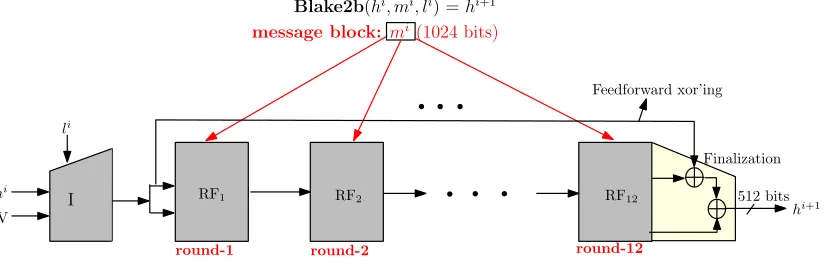
then split in two equal halves and xor’ed together to produce 512-bits of output. This choice of implementation is different from the actual Blake2b in many ways. The actual Blake2b construction, shown in Figure 3, has an initialization phase which initializes the starting state. A permutation of the messagemiis supplied
as the input to each RFi for roundi= 1 to 12. After 12 rounds, the finalization
phase performs feedforward xor’ing with output of RF12. This preserves the
onewayness of the Blake2b function. This feedforward xor’ing is omitted in our BlakeCompress implementation. This choice of implementation reduces the time of hash computation and improves the performance. The overall security is not compromised by this implementation (see section 8.2.1).
RF
1512 bits
512 bits message (0)
BlakeCompress
x
1024 bits 512 bitsy
Fig. 2: FunctionH2implemented as function BlakeCompress[x] =y, where input
length ofx= 1024 bits and output length ofy = 512 bits. RF1is the first round
of Blake2b compression function. Input size of RF1 = 1024 bits.
6.2 Design of Rig [BlakeExpand, BlakePerm, Blake2b]
RF1
round-1 round-2 round-12
Finalization Feedforward xor’ing
li
IV
RF2 RF12
hi
message block: mi(1024 bits) Blake2b(hi, mi, li) =hi+1
512 bits hi+1 I
Blake2b compression funtion defined asBlake2b(hi, mi, li)=hi+1where
•hi is the 512 bits chaining value,
•mi is theith message block and eachmiis of length1024 bits •lidenotes the number of data bytes inm0, m1,· · ·, mi •Idenotes the initialization phase of Blake2b
•RFidenotes theith call to the eightG-functions
Fig. 3: Blake2b compression function
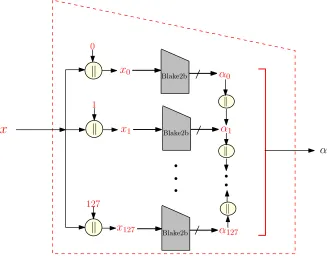
6.2.1 Design of the BlakeExpand expansion function The BlakeExpand function is a very simple function which expands the input xto a fixed size of 8KiB. The function BlakeExpand is an instantiation ofH1. The inputxpasses
through 128 individual instances of Blake2b (full hash) each appended by a counter as xi =xki, for 0≤i≤127 and produces the output α=α0 kα1k
· · · k α127 where eachαi is of length 512 bits, i.e., 64 bytes. This construction
ensures that the output of the function is random and the randomness depends solely on the cryptographic strength of Blake2b. Since this function needs to be executed only once, it has negligible impact on the performance of the overall Rig construction.
6.2.2 Design of BlakePerm function We provide the design considerations for the function BlakePerm before the description of the design.
α
0α
1x
0 Blake2bBlake2b
Blake2b
k
k
k
x
1x
0
1
127
k
k
k
α
α
127x
127BlakeExpand [x] =α whereα=α0kα1k · · · kα127,xi= (xki) for 0≤i≤127
andx= pwdkbinary64(pwdl)kskbinary64(sl)kbinary64(n)kbinary64(l)
Fig. 4: Function BlakeExpand
– L1 cache sizeThis is one of the major factors because the L1 cache has the lowest latency of around 1-1.5ns (as few as 3 clocks). Therefore it is important that the work piece (chunk) fits within this size for high performance in case of a compute intensive task.
– L1/L2/L3 cache line size A typical modern processor has cache line size of 64 bytes. Therefore working in multiple of 64 bytes with preferably aligned memory access is the best strategy. The problem with working with other non-multiple sizes is that there would be a lot of extra accesses and split loads and stores, which will dramatically reduce performance in computation intensive tasks. The Blake2b compression function nicely fits this requirement as it compresses 128 bytes to 64 bytes. The only other requirement is an implementation detail for setting the proper aligned memory access while memory allocation. As a result, in our implementation we have zero split load/stores.
be to perform reads and writes in larger chunks. If the chunk size is large enough, the performance hit due to latency can become significantly small. We tested against various sizes from 2 KiB to 64 KiB and observed that 16 KiB is a good size; and it also fits the L1 cache. We have, as a result chosen chunk size of 16 KiB for theH2function.
Design of the BlakePerm function The BlakePerm function is a compression function which compresses 16 KiB of data to 8 KiB. It is a two step function as described below.
i
g0
1
g0
127 g0
0
i. Compression ii. Permutation
g1
g127 g
Permutation
BlakePerm[S] =g, where inputS=s0ks1k · · · ks127and outputg=g0kg1k · · · kg127
16 KiB input is equally divided in each 128 bytesi. RF1denotes the first round of Blake2b compression function
g0
0
g0
1
0 1
15
512
I J
7 8 Index-i
g0
127
g0
1023 1016
0 1
15
512 7 8
8Bytes
Index-j
j= (i×109+512)%1024 0≤i,j≤1023
8Bytes
g0 512 bits
s0 1024 bits 0
512 bits s1 1024 bits
0
512 bits 1024 bits
0
s127
RF1 RF1
RF1
BlakePerm[S] =g
Fig. 5: FunctionH2 implemented as function BlakePerm.
bytes to 64 bytes, as a result we need 128 such functions to compress 16 KiB to 8 KiB.
2. PermutationA permutation layer is needed to mix the compressed data so that the bit-relations are spread evenly among the output bits over several rounds. Even though, any random permutation can be chosen in such a scenario, a permutation of the form: output Oi = (Ii ×A+B) mod C
was chosen, where 0 ≤ Ii ≤ 1023. The values A = 109, B = 512 and
C = 1024 were chosen carefully after a series of experiments and diffusion tests. The permutation works on words of 8 bytes at a time, as a result the total addresses would be 8192/8 = 1024. The value B = 512 is the number by which the overall permutation is cyclically rotated, it is half of the total size. The value of A is the most critical, even though the only requirement for a permutation is that A should be co-prime with C. The value of A strongly affects the overall characteristics and it needs to be carefully selected. It takes around 5 rounds for all the output bits to be fully affected by a single change in the input data. Since H2 function is
sequentially applied hundreds of times, the function BlakePerm produces complete avalanche and is cryptographically strong.
6.3 Parallelization
The design of Rig is sequential and therefore it is impossible to parallelize the overall implementation. As a result we chose to parallelize the H1 and
H2 functions. The most critical function which affects the performance of the
overall design is the H2 function. The optimized variant Rig [BlakeExpand,
BlakePerm, Blake2b] takes an input of 16 KiB and compresses it using 128 Blake2b compression functions. These 128 operations can be done in parallel to improve the performance without affecting the overall sequential nature of Rig. H1 can similarly be parallelized but it has negligible effect on the overall
performance.
6.4 GPU resistance
We designed Rig to have side-channel resistance, in pursuit of which we had to choose password-independent memory access patterns. Such memory-access patterns are harder to protect against GPU attacks. Modern GPUs have very strict requirements for memory accesses and very small cache sizes per core, as a result small random reads and writes dramatically reduce performance.
While designingH2 of Rig [BlakeExpand, BlakePerm, Blake2b], we chose a
permutation which causes reads and writes at significantly varying distances. Combined with the bit-reversal permutation used in Rig at the iterative transformation phase, the overall design is hard to parallelize efficiently.
As theH2 function is pluggable, a new function can be easily added which
6.5 ASIC/FPGA resistance
The Rig construction is strictly sequential and is therefore non-parallelizable. The compression function H2 (BlakePerm) as explained above, can be
parallelized. But, the size of the inputs and outputs (16 KiB to 8 KiB) which needs 128 parallel instances of Blake2b compression function is too large for implementations with a large number of simultaneousRig instances.
Even though there can be a lot of possibilities of implementations with varying numbers of compression functions, the overall space requirement still remains high.
The biggest problem in case of ASIC resistance would however come from the memory latency and bandwidth of the DRAM needed for storage of the extremely large state (several hundred megabytes to a few gigabytes). Even though the compression functions consume less power because of their simplicity, the latency and very high memory bandwidth requirements would make parallel implementations on ASIC prohibitively expensive. For example, for a single instance of Rig [BlakeExpand, BlakePerm, Blake2b] having n = 4 (5 memory passes), and 1 GiB of state, the bandwidth on a standard PC exceeds 7.37 GiB/s as shown in Table 2.
7
Performance analysis
The reference implementation of Rig has been done in C language on an Intel Core i7-4770 CPU with 16GB RAM at 2400 MHz. For the implementation of the first round of the compression function of Blake2b1 for the functionH
2, we use
AVX2 instructions. Specifically these AVX2 instructions are used to parallelize the implementation of first round G-function of Blake2b. The following tables (Table 1 and Table 2) show the performance figure in terms of ‘memory hashing speed’ and ‘DRAM bandwidth’ for different values of parameter n (number of iterations).
The reference implementation is available at: https://github.com/arpanj/Rig.
7.1 Suggested parameters
The performance figures provided in Table 1 and Table 2 show that, as expected, the memory hashing speed for Rig [BlakeExpand, BlakePerm, Blake2b] is significantly higher than that of the strictly sequential variant.
Due to the wide spectrum of possible uses it is very difficult to suggest optimal values for parameters which suits every possible implementation scenario. However, we can suggest values for common applications. For the parameter ‘n’ (number of iterations) we suggest values higher than 3. This means that one should have at least four passes over memory (including setup phase). For some scenarios this may be increased to make low memory attacks prohibitively expensive.
0 2 4 6 8 10 12
0 200 400 600 800 1000 1200
Time in seconds
Memory usage in MB Scrypt
Rig(n=2) Rig(n=4) Rig(n=6)
Fig. 6: Performance of Rig (at different value ofn) and Scrypt.
The memory count value (mc) would depend strongly on the requirement and
the actual use-case. For a server client architecture where the clients are expected to have enough free RAM, the value can be set to use few tens of megabytes to a few hundred megabytes. In a mobile environment, this can be further reduced to allow for clients with smaller memories. In the case the algorithm is to be used as a proof-of-work test, large memory requirements of a few gigabytes combined with a large ‘n’ value can be set. It is important to keep ‘n’ high (as high as 6-10) in case the overall memory cost is very small.
The performance of Scrypt (with suggested parameters [13]) and the results from Table 2 are depicted in Figure 6. The graph shows the memory processing rate when consumable memory to compute the password hash is fixed. The comparison shows that the memory consumption of Scrypt is comparatively small with time. Scrypt takes approximately 6 seconds for 512 MB memory while Rig at n = 2 and n = 4 takes approximately 0.389 seconds and 0.613 seconds respectively.
8
Security analysis
Table 1: Performance of RIG [Blake2b, BlakeCompress, Blake2b]
---|1)RIG[Blake2b, BlakeCompress, Blake2b]:Memory Hashing Speed(MiB/s)|
---| M => | 15 M | 30 M | 60 M | 120 M | 240 M | 480 M | 960 M |
---| n = 2 | 681 | 684 | 663 | 675 | 681 | 674 | 659 |
| n = 4 | 383 | 383 | 381 | 388 | 388 | 391 | 392 |
| n = 6 | 268 | 270 | 267 | 275 | 272 | 258 | 270 |
| n = 8 | 211 | 210 | 210 | 212 | 210 | 201 | 209 |
| n = 10 | 174 | 173 | 170 | 173 | 170 | 174 | 170 |
---| Memory Bandwidth (GiB/s) |
---| n = 2 | 3.552 | 3.566 | 3.458 | 3.517 | 3.551 | 3.515 | 3.436 |
| n = 4 | 3.596 | 3.595 | 3.575 | 3.642 | 3.640 | 3.666 | 3.677 |
| n = 6 | 3.638 | 3.665 | 3.624 | 3.737 | 3.693 | 3.500 | 3.666 |
| n = 8 | 3.740 | 3.731 | 3.736 | 3.758 | 3.728 | 3.562 | 3.707 |
| n = 10 | 3.826 | 3.789 | 3.721 | 3.796 | 3.737 | 3.811 | 3.736 |
---Table 2: Performance of RIG [BlakeExpand, BlakePerm, Blake2b]
---|2)RIG[BlakeExpand, BlakePerm, Blake2b]:Memory Hashing Speed(MiB/s)|
---| M => | 64 M | 128 M | 256 M | 512 M | 1 GiB | 2 GiB | 4 GiB |
---| n = 2 | 1377 | 1345 | 1307 | 1326 | 1315 | 1312 | 1318 |
| n = 4 | 858 | 846 | 829 | 845 | 835 | 838 | 833 |
| n = 6 | 621 | 621 | 617 | 618 | 606 | 610 | 619 |
| n = 8 | 500 | 485 | 481 | 490 | 485 | 489 | 489 |
| n = 10 | 403 | 398 | 399 | 402 | 404 | 404 | 402 |
---| DRAM Memory Bandwidth (GiB/s) |
---| n = 2 | 6.728 | 6.575 | 6.389 | 6.478 | 6.429 | 6.412 | 6.439 |
| n = 4 | 7.547 | 7.441 | 7.295 | 7.431 | 7.347 | 7.374 | 7.329 |
| n = 6 | 7.888 | 7.898 | 7.847 | 7.858 | 7.709 | 7.750 | 7.873 |
| n = 8 | 8.309 | 8.070 | 8.003 | 8.152 | 8.072 | 8.123 | 8.126 |
| n = 10 | 8.282 | 8.179 | 8.205 | 8.251 | 8.291 | 8.293 | 8.265 |
---n = ---no. of iteratio---ns, performa---nce figures averaged over 20-iteratio---ns.
makes the parallel implementation hard and prevents significant speed up by the use of multiple processing units.
Flexibility of the design and the independence of the selection of memory parameter from time parameter makes it unique from existing constructions.
8.1 Resistance against low memory attack
Attacker’s approach An attacker running multiple instances of Rig may try to do the calculations using smaller part of the memory (low memory) or almost no-memory (memory-free) to reduce the memory cost per password guess. This approach may allow parallel implementations of independent password guesses, utilizing almost all the available processing cores. This may not give advantage over single password hash computation but may increase the overall throughput of password guessing as compared to the legitimate implementation of the algorithm. Next we explain how feasible the low-memory or memory-free attack approach is, from the attacker’s point of view.
Attack scenario Varying the required storage values We emphasize that the goal of analyzing the complexity of low memory attack is to show the approximate impact on the overall processing cost to implement the algorithm Rig. Our construction needs to store two arraysa andk as shown in Figure 1. Therefore we try to compute the time complexity when most of these array values are not stored. The cost of calculation for the values of array a are dominated by the cost of arrayk. Therefore, for the simplicity of the evaluation we consider the calculation cost for arrayk.
To vary the required storage at each iteration, we assume that we store
t consecutive values, 0 ≤ t ≤ m −1, of both the arrays at iterative transformation phase. This assumption is without loss of generality as we can easily calculate the index value of array k from the bit reversal permutation explained in section 2. We also store the hash chaining values after each iteration.
Effect of bit-reversal permutation on low memory scenario We use the bit-reversal permutation to shuffle the access of the array k. The effect of this yields exponential complexity for the low memory scenario. This is because at every step we update the values of array kand each updated value depends on all previous values. Let at iterationi, 1≤i≤n,k[j], 0≤j ≤m−1, is the required value that is not stored. Then we need to compute the value k[j] at all previous i−1 iterations and as the access was not sequential, it is difficult to calculate the exact complexity. Hence, we compute the expected time complexity of a password hashing for memory constrained scenario.
password computation.
Analysis of low memory attack complexity For the legitimate implementation of the algorithm,Rig, we need to storem= 2mc values of arrays
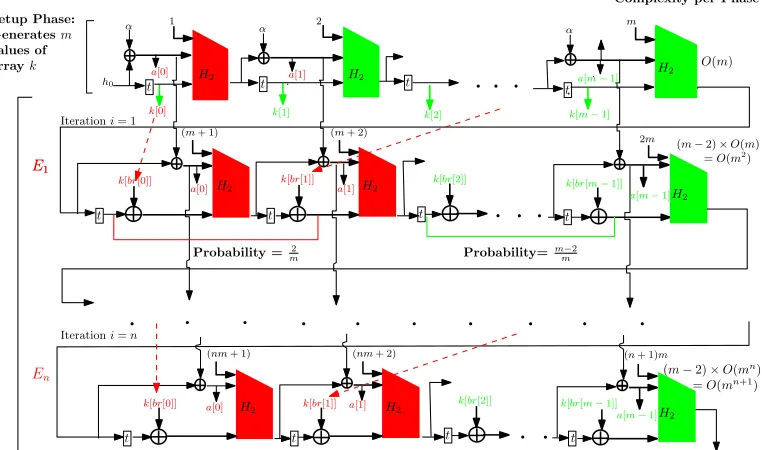
a and k which are created at the setup phase and repeatedly accessed and updated at each iterationiof the iterative transformation phase (see Figure 1). Our goal is to analyse the extra cost incurred when we do not store the array values, and calculate them on the fly at each iteration i where 1 ≤ i ≤ n. Specifically, we analyze the time complexity by varying the possible storage (0 to m) of the array values. At each iteration i of the iterative transformation phase, we apply bit reversal permutation (Algorithm 1) on m indices of the array k which we denote by (1,2,· · ·, m) → (br[0], br[1],· · · , br[m−1]) and access the output of the permutation sequentially. It is easy to calculate this permutation for all n-iterations in advance. We calculate the overall cost of password hashing depending on whether a value of array k, let, k[br[j]], 0≤j≤m−1 is stored or not. As mentioned before, to compute the complexity we store first t consecutive values of array k (where 0≤ t ≤m−1) that are required for corresponding hash calculations at iterative transformation phase. We also store the hash chaining values after each iteration except the last one, i.e., if the implementation uses n-iterations then we store n−1 such values. Figure 7 shows the graphical view of the low memory scenario with an example where we store two consecutive values of the arrays required for corresponding hash calculations, shown in red. Other m−2 values that are calculated on the fly and the corresponding hash calculations are shown in green. The general approach is explained below.
We apply the law of total expectation to estimate the expected running time for a password hashing, conditioning on the indices of the array k. This is because the calculation cost is very high when we do not store the values of required indices ofkand is the most influential parameter in the overall attack complexity. Therefore, we calculate the probability of a value at a particular index of arraykof being stored when we assumetconsecutive values are stored. We also calculate the probability of a value at an index not being stored when (m−t) values are not stored. Further, in case a specific index of array k is not stored, then we estimate the expected cost to evaluate this element at each iterationi.
We know that the total required indices are m for the array k. Out of these m values, we store t values while the remaining m−t values are not stored. Therefore, the probability of a stored and not-stored index is given by
Pr[a value of an index is stored ] = t m
Fort= 2 we store only 2 values andm−2 values are remained un-stored. Then, the above probabilities are 2
m and
m−2
m respectively as shown in Figure 7.
H2 H2
H2
H2
1 2
(m+ 1) (m+ 2)
α α
k[br[0]] α
h0
t t t t
k[br[1]] k[br[2]] k[br[m−1]]
Iterationi= 1
H2
H2
(nm+ 1) (nm+ 2)
k[br[0]]
t t
k[br[1]]
t
k[br[2]]
H2
H2
H2 H2
Iterationi=n
E1
E1
En
H2
t
(m−2)×O(m) =O(m2)
Complexity per Phase
k[1]
k[0] k[2] k[m−1]
t t t t
Setup Phase:
Generatesm
values of
arrayk
(m−2)×O(mn)
=O(mn+1) (n+ 1)m
a[0] a[1]
a[0] a[1] k[br[m−1]]
a[m−1]
a[0] a[1] a[m−1]
H2 2m
H2 O(m) m
a[m−1]
Probability=m−2
m
Probability = 2
m
∗Note:k[br[i]] : is theith index of arraykobtained from bit reversal permutation
Here in this example figure we storet= 2 consecutive memory for corresponding hash calculation shown in red (m−2) not stored values are shown in green
Fig. 7: Graphical representation of the calculation for the low memory complexity ofRig.
To apply the law of total expectation we apply the following concept. At the setup phase we performmhash calculations to storemvalues of arrayk. Therefore, for thesem calculations the complexity of the setup phase isO(m). In our construction, at each iteration i, 1 ≤ i ≤ n, we access the values that are calculated at the previous iterationi−1, i.e., every next value is dependent on its previous value. Therefore at the first iteration of iterative transformation phase, if we need to access an element of array k that is not stored, we need to perform maximum m calculations of setup phase for that value. Therefore, at iterationi = 1 the total cost of calculation is (m−t)×O(m) =O(m2) (as
maximummcalculations are required for allm−tnot stored values). Similarly, at iteration i = 2, for all m−t not stored values of array k it is required to calculate maximummhashes of setup phase to generate the initial values. Then it is required to check when those values were updated at i= 1. Ati= 1, the maximum calculations are: (m−t)×O(m) = O(m2), and similarly at i = 2
the total calculations are: (m−t)×O(m2) = O(m3) and so on. This way we
phase shown in Figure 7 as ‘Complexity per phase’. Now at each iteration we estimate the expected cost of calculation for each valuek[br[j]] of arraykwhere 0 ≤ j ≤ m−1. We denote the expected cost at iteration i as Ei. If a value
is already stored then the expected cost of calculation, i.e., E(cost when value is stored)=1 but if the value is not stored then the expected cost will be the complexity till the previous iteration as the required value is dependent on all its previous values. So the expectation at each iteration is as follows:
E1= m−1
X
j=0
P r[ value atk[br[j]] is stored ]×[ cost of calculation whenk[br[j]] is stored ]
+P r[ value atk[br[j]] is not stored ]×E[ cost of calculationk[br[j]] is not stored ]
=
m−1 X
j=0 t
m +
m−t m
×O(m)
E2= m−1
X
j=0
P r[ value atk[br[j]] is stored ]×[ cost of calculation whenk[br[j]] is stored ]
+P r[ value atk[br[j]] is not stored ]×E[ cost of calculationk[br[j]] is not stored ]
=
m−1 X
j=0 t
m +
m−t m
×O(m2)
· · · ·
En= m−1
X
j=0
P r[ value atk[br[j]] is stored ]×[ cost of calculation whenk[br[j]] is stored ]
+P r[ value atk[br[j]] is not stored ]×E[ cost of calculationk[br[j]] is not stored ]
=
m−1 X
j=0 t
m +
m−t
m
×O(mn)
The total costE aftern−iterations:
E=m+E1+E2+· · ·+En
=m+
m−1 X
j=0 t
m+
m−t
m
×O(m)+
m−1 X
j=0 t
m+
m−t
m
×O(m2)+
· · ·
· · ·+
m−1 X
j=0 t
m+
m−t
m
×O(mk)+
· · ·+
m−1 X
j=0 t
m+
m−t
m
×O(mn)
=m+nt+m−t m
mX−1
t=0
[O(m) +O(m2) +
· · ·+O(mn)]
=m+nt+m−t m
O(mn+1)
Case (i): t= 0 implies the case of memory-free attack where the attacker does not use any memory.
The expected cost is =m+O(mn+1)≡O(mn+1)
Repeating forr-rounds, the complexity of the attack isO(r×mn+1). Case (ii): When 1≤t≤m−1, i.e. the case when the attacker stores some of the memories.
The expected cost is =m−t m
O(mn+1)≡O(mn+1)
Repeating forr-rounds, the complexity of the attack isO(r×mn+1) Case (iii): t=mimplies the legitimate implementation of the algorithm.
The complexity is =m+nm≡O(n+ 1)m
Repeating forr-rounds, the complexity isO(n+ 1)mr.
Therefore, the memory-free attack complexity ofRig isO(r×mn+1) whereris
the number of rounds.
8.2 Resistance against collision attack
In the design ofRig(see Figure 8) we define three different functions,H1,H2and
H3. The input ofH1isxwherexis the concatenation of password, 64-bit value
of password length, salt, 64-bit value of salt length, 64-bit value ofn(number of iterations) and 64-bit value of the output length of password hash. The output ofH1isα. The functionH2 signifies the repetitive computation of functionH2
at setup phase and iterative transformation phase (see Figure 1) and generates the output c which is the output of iterative transformation phase. Therefore the inputs ofH2areα,mcandn, wheremc is the number of memory count and
n, the number of iterations used. FinallyH3takes the concatenation of a 64-bit
value which is the function ofmc andn, output ofH2, the value salt and 64-bit
value of 2mc and produces the output of password hash. Here we are considering
round r = 1 (w.l.o.g). This is because, different values of round, say r and r0 implies collision ofH3.
Theorem 1. Collision for Rigmeans
i. collision forH1, or
ii. collision for H2 when α 6= α0 and (mc, n) = (m0c, n0) for two different
password hash computations, where mc = m0c = the memory count and
n=n0 =number of iterations, or
iii. collision forH3.
Proof. We analyse the collision of Rig with five possible cases as shown in Figure 9. Specifically, we include all possible conditions that results in collision of H1 or collision ofH2 or collision ofH3 which implies the overall collision of
Inputx= pwd||binary64(pwdl)||s||binary64(sl)||binary64(n)||binary64|l|
s= Salt,mc=memory count n= no. of iterations
H1
x H
1 α
H1 c
H
2 (mc, n)H1
H3 h∗
(mc, n)
s||2mc
Fig. 8: Rig[H1,H2,H3](x, mc, n, s), whereH2 signifies repetitive use ofH2.
CaseI. Collision Rig [H1, H2, H3] if (s, mc, n) = (s0, m0c, n0) =⇒ CollisionH1: The
construction ofRig is such that if we get collision at H1 for two different
inputs say,x andx0 and if (s, mc, n) = (s0, m0c, n0) then it implies collision
ofH2 which implies collision atH3, i.e., collision of Rig [H1, H2, H3].
CaseII. Collision Rig [H1, H2, H3] if (s, mc, n) = (s0, m0c, n0) and α 6= α0 =⇒
CollisionH2: For two different inputsx,x0ifα6=α0then collision ofH2 =⇒
collision ofH3 when (s, mc, n) = (s0, m0c, n0) for respective inputs.
CaseIII. Collision Rig [H1, H2, H3] if (s, mc, n) = (s0, mc0, n0),α6=α0 andc6=c0 =⇒
Collision H3: For two different inputs x, x0 if α 6= α0 and c 6= c0 and if
(s, mc, n) = (s0, m0c, n0) then collision Rig [H1, H2, H3] =⇒ collisionH3, i.e.,
collision is due toH3.
CaseIV. Collision Rig [H1, H2, H3] if (s, mc, n)= (6 s0, m0c, n0) =⇒ CollisionH3: For
two different inputsx,x0 ifα6=α0 andc6=c0 and if (s, mc, n)6= (s0, m0c, n0)
then collision Rig [H1, H2, H3] =⇒ collisionH3.
CaseV. Collision Rig [H1, H2, H3] if x= x0 and mc 6= m0c =⇒ Collision H3: For
two different password hash calculations ifmc 6=m0c for the same inputx
then collision of Rig [H1, H2, H3] is for collision atH3.
Therefore these five cases describe how collisions ofRig implies collision of H1
or H2 or H3. Hence Rig is collision resistant if H1 or H2 or H3 are collision
resistant.
no significant attack on Blake. A recent paper cryptanalyzing Blake2b is [7] shows that no collision or preimage attacks exist against Blake2b. In fact, the best differential against Blake2b covers 3.5 rounds and has a complexity of 2480. Therefore Blake2b is quite secure against collision and preimage attacks,
properties which we need in our design. For further details on attacks on compression function and permutation of Blake2b, we refer the reader to [7]. Hence, the use of full round Blake2b is enough to claim security of our construction against attacks utilizing collisions or preimages of the underlying hash function. H1 H1 H2 H2 c c0 H3 H3 h∗
h∗0
h∗
h∗0
x0 x
h∗
h∗0
CaseIII:Collision Rig[H1,H2,H3] if (s, m, n) = (s0, m0, n0),
α6=α0andc6=c0⇒collision ofH
3
h∗
h∗0
h∗
h∗0
CaseV:Collision Rig[H1,H2,H3] ifx=x0
andmc6=m0c⇒collision ofH3 (m0
c, n)
α0
α H1
H1 H2 H2 c c0 H3 H3 x0 x
(m0
c, n)
α0 α H1 H1 H2 H2 c c0 H3 H3 x0 x α0
α H1
H1 H2 H2 c c0 H3 H3 x0 x
(m0
c, n)
α0 α H1 H1 H2 H2 c c0 H3 H3 x0 x
(m0c, n)
α
(s, m, n) = (s0, m0, n0)
s||2mc
s||2mc
s||2m0 c
CaseIV:Collision Rig[H1,H2,H3] if (s, m, n)6= (s0, m0, n0),
α6=α0andc6=c0⇒collision ofH
3
(mc, n)
(m0
c, n)
(mc, n)
(m0c, n)
(mc, n)
(mc, n)
(mc, n)
α0
s||2m0 c
s||2mc
s||2mc
s||2m0 c
s||2mc
s||2m0 c
s||2m0 c
(mc, n)
(mc, n) (mc, n)
(mc, n) (mc, n)
(m0
c, n)
CaseII:Collision Rig[H1,H2,H3] if (s, mc, n) = (s0, m0c, n0) andα6=α0⇒collision ofH2
CaseI:Collision Rig[H1,H2,H3] if (s, mc, n) = (s0, m0c, n0) ⇒collision ofH1,
(m0
c, n)
(m0
c, n)
(m0c, n)
Note:Symbol is used to show that values above and below the image in each box are different and symbol to show that the values are same. Symbol denotes the implication relation.
Fig. 9: Five cases showing collisions for Rig [H1, H2, H3]. – Rig [Blake2b, BlakeCompress, Blake2b]
Instantiation of H1 and H3 with Blake2b: We use full round Blake2b
for the functions H1 and H3. We need collision resistance of both the
functions for the security ofRig. Use of Blake2b allows us to claim collision resistance ofH1 andH3 [7].
Instantiation ofH2 with BlakeCompress: The functionH2as shown in
Figure 8 signifies the repetitive computations of the functionH2and inputs
ofH2areα, mc, n. Theorem 1 shows that collision ofH2implies collision of
Rig only if H1 gives two distinct outputs say, α, α0 for two different inputs
x 6= x0 while corresponding values (m
of Blake2b compression function for the implementation ofH2 as shown in
Figure 2.
For finalization phase we omit the feed-forward xor’ing as explained in Blake2b (see Figure 3). This choice of implementation is to improve the performance, but it does not preserve the onewayness as there is no feed-forward xor’ing. In this case it would appear that backward calculation is easy asH2 computation is then reversible. But due to the design ofRig it
is very difficult to perform these backward computations as input values of H2are arraysaandkand depends on their values at previous iteration (see
Figure 1). Therefore, we only have the freedom to guess the values of array a and k to move backward with reverse calculation for the last iteration, sayi=n. Last iteration nwill fix the values of iteration (n−1) as values are dependent. So we lose the freedom of guessing the values from iteration (n−1) and onwards and the backward computations become hard. Hence omitting the feed forwardness can compromise the onewayness but the design of the scheme provides no security loss. Now consider two distinct inputs of H2 asα=H1(x) andα0=H1(x0) forx6=x0.
H2 H2
1 2
(m+ 1) (m+ 2)
k[1]
k[0] k[2] k[m-1]
α
t t t t
h0
a[0] a[1] a[m-1] H2
m
H2 H2
Setup Phase:
α α
Fig. 10: Setup phase usesminputs generated fromα.
Figure 10 shows thatm= 2mc number of computations ofH
2 of the setup
phase are generated from these differentαorα0and it will be difficult to find collision everywhere as values generated from two different inputs are usually expected to be different. The values of arrayaandk are generated fromα orα0 and influence further calculations. Now, consider the last iteration of
iterative transformation phase, i.e., the last layer of 2mc computations ofH 2
as shown in Figure 11. All theseH2 calls use single round Blake2b and are
generated from the same valueαor α0. The input values influenced byαor
α0 are shown in red color and most of them will have nonzero difference. We
can visualize this scenario as similar to the Blake2b construction, instead of 12 rounds using 2mc rounds. Use of comparatively large number of rounds
provides enough security. Since we expect the parametermc ≥10, we will
have 1024 rounds of Blake2b compression function. Therefore, we can expect H2 to be collision resistant.
– Rig [BlakeExpand, BlakePerm, Blake2b]
Instantiation of H1 with BlakeExpand and H3 with Blake2b: As
explained in section 6.2 we are using 128 individual instances of Blake2b (full hash) appended by a counter for the functionH1. Therefore a collision
for H1 means collisions for each of the 128 calls to Blake2b. Therefore,
collision resistance ofH1is obtained from the collision resistance of Blake2b.
For the function H3 we implement Blake2b (full round), therefore H3 is
collision resistant if Blake2b is so.
Iterationi=nofH2
Input: α (512 bits)
t t t
k[br[2]]
t
round-1 round-2 round-2mc
i= n
(nm+ 2) (n+ 1)m
0 0 0
RF1 RF1 RF1
(nm+ 1)
H2implemented with the first round of Blake2b compression function denoted as RF1
and input of RF1=1024 bits
H2 H2 H2
k[br[0]] k[br[1]] k[br[m−1]]
Fig. 11: H2 implemented with RF1 at iterationi=n.
Instantiation ofH2 with BlakePerm: We implement eachH2with two
step functions. The first function, ‘Compression’ executes 128 instances of first round Blake2b compression function and compresses total 16 KiB input to 8 KiB. The second function, ‘Permutation’ is a permutation that mixes the compressed 8 KiB output to spread the bit-relations evenly among the output bits (see Figure 5).
We can provide similar arguments for the security ofH2as explained for the
sequential variant, Rig [Blake2b, BlakeCompress, Blake2b] above.
Hence, the above choice of implementation is expected to be secure against collision attack.
8.3 Resistance against length extension attack
The length extension attack on hash function works as follows. Hash functions work on blocks of data iteratively. Let the initial value of a hash be IV=h0. A
is computed and then the recursionhi+1=H(hi, mi) is used for 1≤i≤l. The
final output is hl+1. An attacker, without knowing the intermediate message
blocks, may simply append a new block m∗ and compute the hash value of
the message m0 = m
0km1k. . .kmlkm∗, by using one call to the hash function
as H(hl+1, m∗). In our construction the password is not the only input to the
hash function. If an attacker attempts to append the password by any text, the value of αwill change and it will affect all subsequent blocks. Thus the length extension attack is not feasible in our design.
8.4 Resistance against cache-timing attack
As discussed in section 5, our construction accesses arrayk(see section 4) using a bit reversal permutation which is password independent. Hence cache timing attack is not possible on our costruction. Further, since the only primitive used in our scheme is a secure hash function, the security of our scheme can be formulated in terms of the security of the underlying hash function. With the current state-of-the-art we have the possibility of using SHA-3 implementation, or even any of the other finalists of SHA-3 competition, which are resilient to side-channel attacks. Thus our scheme resists cache timing attacks.
8.5 Resistance against denial-of-service attack
In computing, a denial-of-service (DoS) attack is an attempt to make a machine or network resource unavailable to its intended users. This is possible by making the server busy injecting lots of request for some resource consuming calculation. It is quite easy if the server uses some slow password hashing technique for authentication. To handle such situations, the server-relief technique can provide some relief to the server from heavy calculations as the client will do the heavy part of the algorithm. This way we can reduce the chances of DoS attacks with slow password hashing schemes.
9
Conclusions
In this work, we have proposed a secure password hashing schemeRig based on cryptographic hash functions. Besides supporting necessary and commonly used features of a password hashing scheme, Rig also supports client-independent updates and server relief technique. The flexibility in the choice of the two important parameters (memory count and number of iterations) enhances the scope of its implementation. Rig can be implemented in various software and hardware platforms including resource constraint devices.
10
Acknowledgments
References
1. Password Hashing Competition (PHC), 2014. https://password-hashing.net/ index.html.
2. Leonardo C. Almeida, Ewerton R. Andrade, Paulo S. L. M. Barreto, and Marcos A. Simpl´ıcio Jr. Lyra: Password-Based Key Derivation with Tunable Memory and Processing Costs. IACR Cryptology ePrint Archive, 2014:30, 2014.
3. Jean-Philippe Aumasson, Samuel Neves, Zooko Wilcox-O’Hearn, and Christian Winnerlein. BLAKE2: Simpler, Smaller, Fast as MD5. In Michael J. Jacobson Jr., Michael E. Locasto, Payman Mohassel, and Reihaneh Safavi-Naini, editors,ACNS, volume 7954 ofLecture Notes in Computer Science, pages 119–135. Springer, 2013. 4. Jean-Philippe Aumasson, Samuel Neves, Zooko Wilcox-O’Hearn, and Christian Winnerlein. BLAKE2: simpler, smaller, fast as MD5. IACR Cryptology ePrint Archive, 2013:322, 2013.
5. Carlos Carvalho. The gap between processor and memory speeds. In Proc. of IEEE International Conference on Control and Automation, 2002.
6. Joan Daemen and Vincent Rijmen. A new MAC construction ALRED and a specific instance ALPHA-MAC. In Fast Software Encryption: 12th International Workshop, FSE 2005, Paris, France, February 21-23, 2005, Revised Selected Papers, pages 1–17, 2005.
7. Jian Guo, Pierre Karpman, Ivica Nikolic, Lei Wang, and Shuang Wu. Analysis of BLAKE2. In Josh Benaloh, editor,Topics in Cryptology - CT-RSA 2014 - The Cryptographer’s Track at the RSA Conference 2014, San Francisco, CA, USA, February 25-28, 2014. Proceedings, volume 8366 of Lecture Notes in Computer Science, pages 402–423. Springer, 2014.
8. Markus D¨urmuth, Tim G¨uneysu, Markus Kasper, Christof Paar, Tolga Yal¸cin, and Ralf Zimmermann. Evaluation of Standardized Password-Based Key Derivation against Parallel Processing Platforms. In Sara Foresti, Moti Yung, and Fabio Martinelli, editors,ESORICS, volume 7459 ofLecture Notes in Computer Science, pages 716–733. Springer, 2012.
9. Christian Forler, Stefan Lucks, and Jakob Wenzel. The Catena Password Scrambler. Submission to Password Hashing Competition (PHC), 2014.
10. Jim Gray and Prashant Shenoy. Rules of Thumb in Data Engineering. Technical Report, MS-TR-99-100, Microsoft Research, Advanced Technology Division. December 1999, Revised March 2000.
11. Thomas Lengauer and Robert Endre Tarjan. Upper and lower bounds on time-space tradeoffs. InProceedings of the 11h Annual ACM Symposium on Theory of Computing, April 30 - May 2, 1979, Atlanta, Georgia, USA, pages 262–277, 1979. 12. William Burr Meltem Snmez Turan, Elaine Barker and Lily Chen. NIST: Special Publication 800-132, Recommendation for Password-Based Key Derivation. Computer Security Division Information Technology Laboratory. http://csrc. nist.gov/publications/nistpubs/800-132/nist-sp800-132.pdf.
13. Colin Percival. Stronger key derivation via sequential memory-hard functions. In BSDCon, 2009. http://www.bsdcan.org/2009/schedule/attachments/87_ scrypt.pdf.
14. Niels Provos and David Mazi`eres. A Future-Adaptable Password Scheme. In USENIX Annual Technical Conference, FREENIX Track, pages 81–91. USENIX, 1999.
![Fig. 2: Function H2 implemented as function BlakeCompress[x] = y, where inputlength of x= 1024 bits and output length of y = 512 bits](https://thumb-us.123doks.com/thumbv2/123dok_us/7949514.1319311/12.612.176.427.305.498/fig-function-implemented-function-blakecompress-inputlength-output-length.webp)


![Table 1: Performance of RIG [Blake2b, BlakeCompress, Blake2b]](https://thumb-us.123doks.com/thumbv2/123dok_us/7949514.1319311/19.612.135.495.397.629/table-performance-of-rig-blake-b-blakecompress-blake.webp)
, where H2 signifies repetitive use of H2.](https://thumb-us.123doks.com/thumbv2/123dok_us/7949514.1319311/25.612.158.443.115.225/fig-rig-h-h-h-signies-repetitive-use.webp)
![Fig. 9: Five cases showing collisions for Rig [H1, H2, H3].](https://thumb-us.123doks.com/thumbv2/123dok_us/7949514.1319311/26.612.137.490.230.504/fig-cases-showing-collisions-rig-h-h-h.webp)
