PARTICLE SWARM OPTIMIZATION FOR SOLVING DNA SEQUENCE DESIGN PROBLEM
NOOR KHAFIFAH BINTI KHALID
A thesis submitted in fulfilment of the requirements for the award of the degree of
Master of Engineering (Electrical)
Faculty of Electrical Engineering Universiti Teknologi Malaysia
A BSTRA CT
A BSTRA K
C H A PT E R T IT L E PA G E
D EC LA R A TIO N ii
D ED IC A TIO N iii
A C K N O W LE D G E M E N TS iv
A BSTRA CT v
A BSTRA K vi
TA B LE O F C O N TEN TS vii
L IST O F TABLES xi
L IST O F FIG U R ES xiii
L IST O F A BBREV IA TIO N S xvii
L IST O F SYM BOLS xviii
L IST O F A PPEN D IC ES xix
1 IN T R O D U C TIO N 1
1.1 Particle Swarm Optimization in Brief 1
1.2 Deoxyribonucleic Acid 2
1.3 The Importance of DNA Sequence Design 5
1.3.1 DNA Nanotechnology 6
1.3.2 DNA Computing 8
1.3.3 DNA Biotechnology 9
1.4 Problem Statement and Objective 10
1.7 Scope of W ork 11
1.8 Thesis Contributions 11
L IT E R A T U R E R E V IE W 14
2.1 Introduction 14
2.2 DNA Sequence Design Approaches 14
2.2.1 Simple Method 14
2.2.2 Evolutionary Method 16
2.2.3 Heuristic Method 16
2.2.4 Theoretical Method 18
2.2.5 In vitro Method 18
2.2.6 Population-based search Method 19
2.2.7 Hybrid Method 20
2.3 Particle Swarm Optimization 20
2.4 Chapter Summary 26
O B JE C T IV E FU N C TIO N S AND CO N STRA IN TS
IN DNA SEQ U EN C E D ESIG N 27
3.1 Introduction 27
3.2 Design Criteria for DNA Sequence 28
3.3 Formulation and Fitness Functions for
DNA Sequence Design 29
3.4 Objective Functions for DNA Sequence Design 33
3.4.1 Hmeasure 33
3.4.2 Similarity 34
3.4.3 Hairpin 36
3.4.4 Continuity 37
3.5 Constraints in DNA Sequence Design 38
3.5.1 GCcontent 38
3.5.2 Melting Temperature 38
3.6 Example Calculations for Objective Functions 40
3.6.1 Hmeasure Calculation 41
3.6.2 Similarity Calculation 44
3.6.3 Hairpin Calculation 45
3.6.4 Continuity Calculation 47
3.7 Chapter Summary 48
4 P A R T IC L E SW A RM O P T IM IZ A T IO N 49
4.1 Introduction 49
4.2 Background 50
4.3 Particle Swarm Optimization 52
4.3.1 PSO Algorithm 54
4.3.2 PSO Control Parameters 57
4.3.4.1 Swarm Size, Number of Iterations 58
4.3.4.1 Velocity Clamping 58
4.3.4.1 Inertia W eight 59
4.3.4.1 Acceleration Coefficients and
Random Values 61
4.3.3 Values Selection 64
4.4 Binary PSO 65
4.4.1 Formulation and Parameters in Binary PSO 66
4.4.2 Binary PSO Applications 66
4.5 Multi-objective Particle Swarm Optimization 68
4.5.1 Basic Concept 68
4.5.2 Classification of MOPSO 71
4.5.3 Aggregation-based Method 71
4.5.4 Criterion-based Method 72
4.5.5 Dominance-based Method 73
4.6 Discussions 75
4.7 Chapter Summary 77
5 A G G REG A TIO N -B A SED DNA SEQ U EN CE D ESIG N 78
5.1 Introduction 78
5.2 Aggregation-based Optimization 79
5.2.2 DNA Sequence Design Based on Binary PSO 80 5.2.3 DNA Sequence Design Based on
Continuous PSO 82
5.3 Implementation 83
5.3.1 Experimental Parameters 83
5.3.2 PSOligo: A Program 85
5.5 Chapter Summary 99
6 V E C T O R EVA LUA TED P A R T IC L E SW ARM
O P T IM IZ A T IO N F O R DNA SEQ U EN C E D ESIG N 100
6.2 Introduction 100
6.2 Vector Evaluated Particle Swarm Optimization 101 6.3 DNA Sequence Design Based on
Binary VEPSO Algorithm 103
6.3.1 Experimental Parameters 106
6.3.2 Binary VEPSOligo: A Program 106 6.4 Implementation and Experimental Results 108
6.5 Chapter Summary 115
7 SUM M ARY AND C O N C LU SIO N S 116
7.1 Summary 116
7.2 Conclusion 118
7.3 Limitations 119
7.3 Suggestions for Future Research 120
R E FE R EN C ES Appendices A-B
TA B LE NO. T IT L E PA G E
2.1 Summary of the previous DNA sequence design approaches 14 3.1 Summary of the objective functions and constraints
employed in previous works 29
3.2 Basic notations 30
3.3 AH and AS values of nearest-neighbour model 39
3.4 An example of a set of DNA sequences 39
3.5 The first and second sequences 40
3.6 The first sequence and the reverse of the second sequence 40 3.7 The values of Ebp, Ecbp, hdis, hcon functions, and the thdis_hcon
value for all positions during Hmeasure calculation. The bold
bases are the hybridized bases 41
3.8 Hmeasure for the first sequence. This sequence is compared
with other sequences 43
3.9 Hmeasure for a set of DNA sequences 43
3.10 similarity for a set of DNA sequences 44
3.11 The values of from Ebp, pinlen(r, s), and T(Ebp, pinlen(r, s)) functions during hairpin calculation. The bold bases
are the hybridized bases 45
3.13 An example of a set of DNA sequences for
continuity calculation 46
3.14 Sample set of DNA sequences for continuity calculation 46
4.1 Standard fitness functions 55
4.2 Values selection for PSO parameters 64
4.3 The summary of differences between PSO and EA 76
5.1 The values of PSO control parameters 83
5.2 DNA Sequence Parameters 84
5.3 Comparison of the sequences from Continuous PSO and
the sequences generated by Binary PSO 87
5.4 Comparison of the sequences in (Deaton et al., 1996) and
the sequences generated by Binary PSO 91
5.5 Comparison results of the sequences in (Tanaka et al., 2002)
and the sequences by Binary PSO method 93
5.6 Comparison of the sequences in (Guangzhao et al., 2007)
and the sequences generated by Binary PSO 95
5.7 Comparison results of the sequences in (Zhao et al., 2007)
and the sequences by Binary PSO method 97
6.1 The values of control parameters for Binary VEPSO 105 6.3 The DNA sequences extracted from the first non-dominated
solution 108
6.4 The DNA sequences extracted from the second non-dominated
Solution 109
6.5 The DNA sequences extracted from the third non-dominated
FIG U R E NO. T IT L E PA G I
1.1 Chemical structure of each base and phosphate in
single-stranded DNA 3
1.2 A double-stranded DNA structure 3
1.3 Example of hybridization and denaturation of two
single-stranded DNA 5
1.4 Example of hairpin formation 5
1.5 An example of four-armed junctions, assembled to create
2-D lattice (Seeman et al., 1998) 7
1.6 Examples of DNA nanostructures (Seeman et al., 1998) 8 1.7 Polymerase chain reaction (Vierstraete, 1999) 10 3.1 Schematic representation of the classic secondary structure
of DNA 28
3.2 Example of Hmeasure calculation (Kurniawan et al., 2008) 32 3.3 Example of similarity measure (Kurniawan et al., 2008) 34 3.4 A possible formation of a hairpin. In this example, p = r = 6 35 4.1 Flow chart representing a general PSO algorithm 53
4.2 The illustration to update pbest 56
4.4 The movement of a particle with ci=0 4.5 The movement of a particle with c2 = 0 4.6 The movement of a particle with ci = c2 > 0
4.7 The dominance concept for two objective functions and concept of Pareto Front
5.1 An example showing the proposed Continuous PSO model with two particles search for a set two DNA sequences
5.2 The example showing the proposed model, where the position of particle 1 represents one base DNA sequence in
2 dimensions binary search space
5.3 User interface program of Continuous PSOligo for DNA sequence design problem
5.4 Average fitness comparison results between Continuous PSO and Binary PSO algorithms, for the case of 7 sequences with
20-mer length
5.5 Convergence pattern of /dna for the Continuous PSO algorithm for the case of 7 sequences with 20-mer length
5.6 Convergence pattern of /dna for the Binary PSO algorithm for the case of 7 sequences with 20-mer length
5.7 The position update for two iterations using Continuous PSO algorithm for a 20-mer DNA sequences
5.8 The position update for two iterations using Binary PSO algorithm for a 20-mer DNA sequences
61 62 63 69 80 81 85 87 88 88 89 90
5.9 Average fitness comparison results between
(Deaton et al., 1996) and the proposed approaches, for the
5.10 5.11 5.12 6.1 6.2 6.3 6.4 6.5 6.6 6.7 6.8 6.9 6.10 6.11 6.12
Average fitness comparison results between
(Tanaka et al., 2002) and Binary PSO method, for the
case of 14 sequences with 20-mer length 93
Average fitness comparison results between
(Guangzhao et al., 2007) and the proposed approach, for the
case of 20 sequences with 20-mer length. 96
Average fitness comparison results between
(Zhao et al., 2007) and Binary PSO method, for the
case of 14 sequences with 20-mer length 97
The basic concept of VEPSO 101
The ring migration scheme 102
The implementation of DNA sequence design based on VEPSO
algorithm, with 4 objective functions 104
User interface program of Binary VEPSO for DNA sequence
design problem 106
The control parameters setting for Binary VEPSOligo 107 A list of non-dominated solutions obtained based on
Binary VEPSO. The 1st, 2nd, and 3rd non-dominated solutions
are in the marked circle 108
The objective functions space graph of H measure - similarity pair 110 The objective functions space graph of H measure - continuity pair 111 The objective functions space graph of H measure - hairpin pair 111 The objective functions space graph of sim ilarity- hairpin pair 112 The objective functions space graph of hairpin- continuity par 112 The objective functions space graph of similarity- continuity
7.1 Difference between well distributed non-dominated solutions
A - Adenine
ACO - Ant Colony Optimization
AFSA - Artificial Fish Swarm Algorith m s
ANN - Artificial Neural Network
BSGA - Bee Swarm Genetic Algorith m s
C - Cytosine
DNA - Deoxyribonucleic Acid
G - Guanine
GA - Genetic Algorithms
MOO - Multi-objective Optimization
MOEA - Multi-Objective Evolutionary Algorithms MOPSO - Multi-Objective Particle Swarm Optimization
PSO - Particle Swarm Optimization
SA - Simulated Annealing
SI - Swarm Intelligence
T - Thymine
L IS T O F SYM BOLS
A - bases of DNA {A, C, G, T}
x, y - a DNA sequence
Ixl - length of x (DNA sequences)
xi (1 < i < Ixl) - i-th nucleotide from 5 ’-end of sequence x E - a set of n sequences with the same length l
Si - i-th member of E
a - complementary base of a
l - length of sequence
n - number of sequences
A PPEN D IX
A
B
L IST O F A PPEN D IC ES
PA G E
139
145 T IT L E
List of Non-dominated Solutions
IN T R O D U C TIO N
1.1 P article Sw arm O ptim ization in B rief
Swarm intelligence is a discipline that deals with natural and artificial systems composed of many individuals that coordinate using decentralized control and self-organization (Bonabeau, Dorigo and Theraulaz, 1999). In particular, this discipline focuses on the collective behaviours that result from the local interactions of the individuals with each other and also with their environment. Examples of systems studied by swarm intelligence are colonies of ants and termites, schools of fish, flocks of birds, and herds of land animals. Some human artifacts also fall into the domain of swarm intelligence, notably some multi-robot systems, and also certain computer programs that are written to tackle optimization and data analysis problems.
1.2 D eoxyribonucleic Acid
Deoxyribonucleic acid (DNA) is a nucleic acid that contains the genetic instructions used in the development and functioning of all known living organisms and some viruses. The main role of DNA molecules in living organism is the long term storage of information.
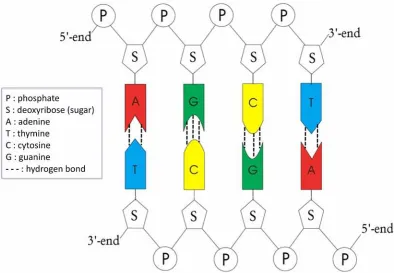
Chemically, DNA is a polymer, which is linked together from a series of monomers. Monomers, which form the structure of nucleic acids, are called nucleotides. Each nucleotide contains a sugar (deoxyribose), a phosphate group, and one of four bases: Adenine (A), Thymine (T), Guanine (G), or Cytosine (C). These bases are grouped into two. Adenine and Guanine are called purine bases because their structure consists of two rings of atoms. On the other hand, cytosine and Thymine are known as pyrimidine bases, since they have a single ring of atoms. Each base has a slightly different composition, or combination of oxygen, carbon, nitrogen, and hydrogen.
A single-stranded DNA consists of a series of nucleotides, which has a sense of direction, in which one end is chemically different than the other. The 5’ end terminates in a 5 ’ phosphate group (-PO4); the 3 ’ end terminates in a 3’ hydroxyl group (-OH), as shown in Figure 1.1. This is important because DNA strands are always synthesized in the 5 ’ to 3’ direction. Thus, single-stranded DNA is normally written according to the sequence of nucleobases, from 5 ’ to 3’. As such, a single stranded DNA, 5 ’-ATCG-3’ is normally written as ATCG.
Figure 1.1: Chemical structure of each base and phosphate in single-stranded DNA
Hybridization is a technique or process that has been found by biochemist Roy Britten in the 1960s as a way to analyse the composition of genome. By understanding hybridization, the process which single DNA strands combine to form a double helix is fundamental to biology and central to DNA-based technologies such as DNA computing, DNA biotechnology, and DNA nanotechnology.
Denaturation is a process where double-stranded DNA strands uncoils and separate into single-stranded DNAs, while hybridization occurs when complementary DNA strands bind, or hybridize based on Watson-Crick base pairing. In denaturation, double-stranded DNAs can be separated by heating up the solution to about 85-95°C, while hybridization can be done by cooling down the test tube reaction solution (Ausubel and Struhl, 1995). There are three types of hybridization, namely bi-molecular hybridization, multi-molecular hybridization, and uni-molecular hybridization. Bi-molecular hybridization occurs when two kinds of single-stranded DNAs form a double helix structure of DNA as shown in Figure 1.3. Meanwhile, three or more strands are involved in the multi-molecular hybridization, which is the essence of Adleman DNA computing (Adleman, 1994). Uni-molecular hybridization or self-hybridization could develop a hairpin formation as shown in Figure 1.4. This would happen if a complementary subsequence exists in the same single-stranded DNA.
6 A C T
Figure 1.3: Example of hybridization and denaturation of two single-stranded DNA
Figure 1.4: Example of hairpin formation
1.3 T he Im p o rtan ce of DNA Sequence Design
media and three dimensional structural materials for nanotechnology (Seiffert and Huhle, 2008).
In DNA computing field, one of the major concerns is reliability. The reliability of the computation is determined by whether the oligonucleotides can be hybridized in a predetermined way. In DNA computing, information is encoded as DNA strands. Each DNA strand is composed of short sequences. DNA computing depends on the hybridization, which allows short single-stranded DNA sequences to self-assemble to form long DNA molecules. The key to success in DNA computing is the availability of a large collection of DNA sequences pairs that are unique from one another.
However, the necessity of DNA sequence design appears not only in DNA computing, but also in other fields, such as DNA nanotechnology and biotechnology (Reece, 2004). Due to the differences in experimental requirements, it seems impossible to establish an all-purpose library of sequences that effectively caters all requirements of laboratory experiments. Since the design of DNA sequences depends on the protocol of biological experiments, a method for the systematically design of DNA sequences is highly required (Kashiwamura et al., 2003).
Designing good DNA sequences to control DNA reaction is a fundamental issue in the fields of DNA nanotechnology, DNA computing, and DNA biotechnology. It is important to ensure that DNA molecules react as desired because unexpected secondary structures of DNA sequences may cause unwanted results.
1.3.1 DNA N anotechnology
building of nanomechanical devices, and even the possibility to force single molecules and atoms into well defined arrangements (Seiffert and Huhle, 2008).
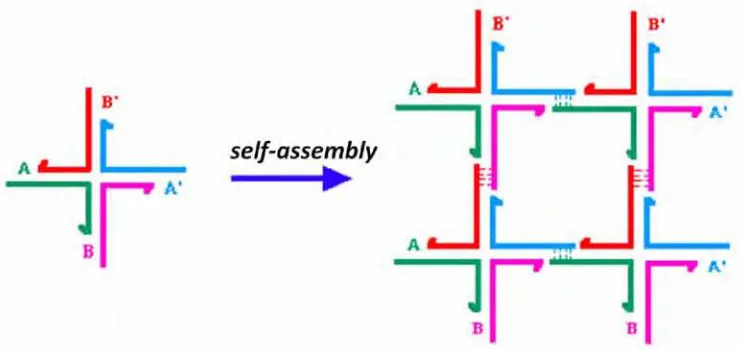
DNA nanotechnology makes use of branched DNA structures to create DNA complexes with useful properties. For example, an assembly of DNA branched four armed junctions can be made into 2-D lattice, which are complementary to each other in the correct pattern. Based on Watson-Crick base pairing, only portions of the strands which are complementary to each other will hybridize to each other to form duplex DNA. Figure 1.5 shows an example of the lattice made by DNA sequences.
Many different DNA nanostructures have already been built in the laboratory. There are simple junctions, more complex tiles like double-crossover, two dimensional lattices assembled from building blocks cubes, tubes, and even nano mechanical devices have also been created (Seiffert and Huhle, 2008). As an example, Figure 1.6 shows the DNA nanostructure of cubes, tetrahedra, tile, and truncated octahedron. All these DNA structures were produced by three major steps: (i) structure design (ii) sequence design, and (iii) building the structure by self assembly in the laboratory. Among these three, sequence design is a very crucial step. The base sequences of the single strands determine the resulting DNA structure. Taking the wrong sequences would produce undesired structures. Therefore, many works have concentrated on producing good DNA sequences to avoid wrong results or structures (Seiffert and Huhle, 2008).
f e * ' '
t e n
&
< * ■
*
<-*• . ? -T 5 C * - v ^ ’*
? LUi
^ 4 *• w j . ” 1 ^V c
F
1
V ’ * 1
* ■
J U
■'W1
'3»<w
* A ' \ .7;
*'%
*1
I f
JF**
in,
S3
F igure 1.6: Examples of DNA nanostructures (Seeman et al., 1998)
1.3.2 DNA C om puting
Boolean circuit development (Owenson et al., 2001), computational model (Mills, 2002), medical problem (Benenson et al., 2004), and associative memory construction (Baum, 1995).
In DNA computing, single-stranded DNAs must hybridize correctly to produce a good solution. Otherwise, DNA computing fails to generate identical results for the same problem and algorithm. Also, DNAs could be wasted if the DNAs perform undesirable reaction. Usually, in DNA computing, the calculation process consists of several chemical reactions, where the successful lab experiment depends on the DNA sequences that have been used. Thus, DNA sequence design turns out to be one of the approaches to achieve high computation accuracy and becomes one of the most practical and important research topics in DNA computing.
1.3.3 DNA Biotechnology
Biotechnology is a technology based on biology, agriculture, food science, and medicine. Biotechnology draws on pure biological sciences such as genetics, microbiology, molecular or DNA biology, biochemistry, and may also depends on knowledge and methods from outside the sphere of biology such as in chemical engineering, information technology, and biorobotics.
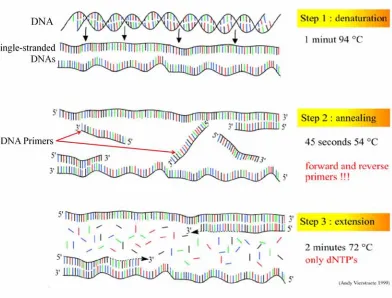
process of PCR for a cycle, where the primers are needed to be designed to start the annealing process in step 2 (Vierstraete, 1999).
30 - 40 cycles of 3 steps :
D N A
Single-stranded mTmTTiiniiniiiHitiiiiiiiiti iffiiTmrmniniiiin iTniTuiii m u n i
Step 1 : denaturation 1 minut 94 °C
D N A s
5 '
... mi fnTnrnniTnnTririinTTTnTn^i mm
ystep 2: annealing
D N A Primers
S'
f 45 secon d s 54 °C''TTTnTnmrrTi1013‘ .
5
nuMiwimi i^mni n.- in nrTfrrnniTTTTinTnnTTnTTnTrwnT^ 3* StCD
3
. cxtcnsion
s , r x 1 ^ - . j^iiiyiyjuMuiiiiMiiMiJ-5’ p ' extension ■, ^
1
1
" N " v '1
'1
1
1
\ \ ^ /^ ^ ^ I . x . \ \ 1 / / 2 m inutes 72 °C
Figure 1.7: Polymerase chain reaction (Vierstraete, 1999).
on ly dNTP's
( A n d y V icTslr*c1c I W9)
1.4 Problem S tatem ent a n d O bjective
DNA sequence design problem is a multi-objective optimization (MOO) problem, where more than one objective needs to be optimized subjected to several constraints.
hairpin, and continuity. These objectives are subjected to GCcontent and melting temperature constraints.
Generally, given a number of objective functions and constraints in DNA sequence design, the objective of the problem is to design and produce sets of good DNA sequences with minimized values of the objective functions. If this condition is achieved, it can be said that the sequences in the set are unique and cannot hybridize to each other.
1.5 Scope of W ork
For the design and development of PSO algorithm for DNA sequence design problem, the scope of this research has been defined as follows:
(i) The proposed approach is developed by considering four objective functions namely: Hmeasure, similarity, continuity, and hairpin and two constraints, which are GCcontent and melting temperature (Tm).
(ii) The research considers Continuous PSO and Binary PSO algorithms for optimizing of DNA sequences.
(iii) The multi-objective optimization problem of DNA sequence design is solved using aggregation-based method and criterion-based method, particularly vector evaluated PSO (VEPSO).
1.6 Thesis C ontrib u tio ns
than one sequence, which is a set of DNA sequences. Other researches have implemented PSO algorithm with different representation of model and search space.
The second contribution of this work is the development of Binary PSO algorithm for DNA sequence design. This work is believed to be novel since there is no research work has been carried out to implement Binary PSO to solve the DNA sequence design problem.
The third contribution in this work is the employment of VEPSO method to solve MOO problem of DNA sequence design. In this method, four objectives are represented using four swarms. Each swarm minimizes only one objective function, and by the end of each iteration, these swarms share their information with each other. It is also found that so far no research has employed VEPSO method for DNA sequence design.
1.7 Thesis O rganization
The thesis is organized as follows. Chapter 2 provides a review on the existing DNA sequence design approaches as well as the objective functions and constraints used. PSO algorithm is introduced briefly and the applications of PSO are also discussed in this chapter. In Chapter 3, four specific objective functions and constraints are decided and explained in detail.
R E FE R EN C ES
Abido, M. A. (2002). Optimal Power Flow Using Particle Swarm Optimization. International Journal Electrical Power Energy System. 24(7), 563-571.
Adleman, L. (1994). Molecular computation of solutions to combinatorial problems, Science, 266 (11), 1021-1024.
Adriansyah, A. (2007). Particle Swarm Fuzzy Controller fo r Behavior-Based Mobile Robot. Doctor Philosophy. University Teknologi Malaysia, Skudai.
Anderson, C., and Franks, N.R. (2001). Teams in animal societies. Behavioral Ecology. 12(5), 534-540.
Arita, M., and Kobayashi, S. (2002). DNA sequence design using templates. New Generation Computing, 20 (3), 263-278.
Arita, M., Nishikawa, A., Hagiya, M., Komiya, K., Gouzu, H., and Sakamoto, K. (2000). Improving sequence design for DNA computing. In Proceedings o f Genetic and Evolutionary Computation Conference (GECCO 2000). 8-12 July. Las Vegas, Nevada, USA, 875-882.
Ausubel, F. M., and Struhl, K. (1995). Short Protocols in Molecular Biology: A
rd
Compendium o f Methods fro m Current Protocols in Molecular Biology. (3 ed.). New York: John Wiley & Sons.
Axelrod, R. (1984). The Evolution o f Cooperation. New York: Basic Books.
Baum, E. B. (1995). Building an associative memory vastly larger than the brain. Science. 268 (5210), 583-585.
Baum, E. B. (1996). DNA Sequences Useful fo r Computation, unpublished, available under http://www.neci.nj.nec.com/homepages/eric/seq.ps.
Baumgartner, U., Magele, C., and Reinhart, W. (2004). Pareto Optimality and Particle swarm Optimization. IEEE Transactions on Magnetics. 40 (2), 1172 1175.
Benenson, Y., Gil, B., Ben-Dor, U., Adar, R., and Shapiro, E. (2004). An autonomous molecular computer for logical control of gene expression. Nature. 249 (6990), 423-429.
Brabazon, A., Silva, A., de Sousa, T. F., O ’Neill, M., Matthews, R., Costa, E. (2005). Investigating strategic inertia using OrgSwarm. Informatica. 29 (2), 125-141. Braendler, D., and Hendtlass, T. (2002). The Suitability of Particle Swarm
Optimisation for Training Neural Hardware. In Proceedings o f the 15th International Conference on Industrial and Engineering, Applications o f Artificial Intelligence and Expert Systems (IEA/AIE). 17-20 June. Cairns, Australia, 190-199.
Brenneman, A., and Condon, A., (2002). Strand design for biomolecular computation. Theoretical Computer Science. 287(1), 39-58.
Breslauer, K. J., Frank, R., Blocker, H., and Marky, L. A. (1986). Predicting DNA duplex stability from the base sequence. Proc. Natl Acad. Sci. USA. 83 (11), 3746-3750.
Brits, R., Engelbrecht, A.P., and van den Bergh, F. (2002). A Niching Particle Swarm Optimizer. In the Proceedings o f Fourth Asia-Pacific Conference on Simulated Evolution and Learning. November 18-22. Singapore, 692-696.
Carlisle, A., and Dozier, G. (2001). An off-the-shelf PSO. In Proceedings o f the Workshop on Particle Swarm Optimization. April 6-7. Purdue School of Engineering and Technology, Indianapolis, Indiana, USA, 1-6.
Chang, B.C.H., Ratnaweera, A., Halgamuge, S.K., and Watson, H.C. (2004). Particle swarm optimization for protein motif discovery. Genetic Programming and. Evolvable Machines. 5(2), 203-214.
Chatterjee, A., and Siarry, P. (2006). Nonlinear inertia weight variation for dynamic adaptation in particle swarm optimization. Computers and Operations Research. 33 (3), 859-871.
Chen, Y., Dong, J., Yang, B., and Zhang, Y. (2004). A local linear wavelet neural network. In Proceedings o f the fifth world congress on intelligent control and automation. 15-19 June. Hangzhou, China, 1954-1957.
Chunxia, X., Zhang, Q., Li, J., and Zhao, X. (2008). A Bee Swarm Genetic Algorithm for the Optimization of DNA Encoding. 3rd International Conference on Innovative Computing Information and Control (ICICIC’08).
18-20 June. Dalian, China, 35-38.
Clerc, M. (1999). The Swarm and the Queen: Towards a Deterministic and Adaptive Particle Swarm Optimization. Proceeding o f the IEEE Congress on Evolutionary Computation. July 6-9. Washington D.C, USA, 1951-1957.
Clerc, M. (2000). Discrete Particle Swarm Optimization Illustrated by Traveling Salesman Problem, Technical Report, http://clerc.maurice.free.fr/pso/.
Clerc, M., and Kennedy, J. (2002). The particle swarm - explosion, stability, and convergence in multi dimensional complex space. IEEE Trans. Evolutionary Computation. 6(1), 58-73.
Coello, C.A., Luna, H., Erika, H., and Aguirre, H. (2003). Use of Particle Swarm Optimization to Design Combinational Logic Circuits. Lecture Notes in Computer Science, Springer. 2606, 398-409.
Coello, C.A., and Lechunga, M.S. (2002). MOPSO: A Proposal for Multiple Objectives PSO. In Proceedings o f the IEEE Congress on Evolutionary Computation. May 12-17. Honolulu, Hawaii, USA, 1051-1056.
Conradie, A., Miikkulainen, R., and Aldrich, C. (2002). Adaptive control utilising neural swarming. In: Proceedings o f the genetic and evolutionary computation conference. 9-13 July. New York, USA, 60-67.
Cui, G., Cao, X., Zhou, J., and Wang, Y. (2007). The Optimization of DNA Encoding Sequence Based on Improved AFS Algorithms. In Proceedings o f the IEEE International Conference on Automation and Logistics. 18-21 August. Jinan, Shandong , China, 1141- 1144.
Das, S., Konar, A., Chakraborty, U.K. (2005a). An efficient evolutionary algorithm applied to the design of twodimensional IIR filters. In Proceedings o f the Conference on Genetic and Evolutionary Computation (G E C C 0 ’05). June 25 - 29. Washington DC, USA, 2157-2163.
Das, S., Konar, A., Chakraborty, U.K. (2005b). Improving particle swarm optimization with differentially perturbed velocity. In Proceedings o f the Conference on Genetic and Evolutionary Computation (G E C C 0 ’05). June 25 - 29. Washington DC, USA, 177-184.
Deaton, R., Chen, J., Bi, H., and Rose, J. A. (2002a). A Software tool for generating non-crosshybridization libraries of DNA oligonucleotides. In Proceedings o f 8th International Workshop on DNA Based Computers. June 10-13. Sapporo, Japan, 253-261.
Deaton, R., Garzon, M., Murphy, R. C., Rose, J. A., Franceschetti, D. R., and Steven, S. E. J. (1998). Reliablibity and efficiency of a DNA-based computation. Physical Review Letters. 80(2), 412-420.
Deaton, R., Murphy, R. C., Garzon, M., Franceschetti, D. R., and Steven, S. E. J. (1996). Good Encodings for D N A -based Solutions to Combinatorial Problems. Proceedings o f the Second Annual Meeting on DNA Based Computers. 10-12 June. Princeton University, 159-171.
Deb, K. (2001). Multi-objective Optimization Using Evolutionary Algorithms. West Sussex, England: John W iley & Sons, Ltd.
Eberhart, R.C., and Shi, Y. (2000). Comparing inertia weights and constriction factors in particle swarm optimization. In Proceedings o f the Congress on Evolutionary Computing. July 16-19. LA Jolla, California, USA, 84-89.
Engelbrecht, A.P. (2005). Fundamentals o f Computational Swarm Intelligence. West Sussex, England: John W iley & Sons, Ltd.
Faulhammer, D., Cukras, A. R., Lipton, R. J., and Landweber, L. F. (2000). Molecular computation: RNA solutions to chess problems. Proc. Natl. Acad. Sci. USA. 97(4),1385-1389.
Feldkamp, U., Saghafi, S., Banzhaf, W., and Rauhe, H. (2001). DNA sequence generator-A program for the construction of DNA sequences. In Proceedings o f 7th International Workshop DNA Based Computer. June 10-13. Tampa, Florida, USA, 179-188.
Fieldsend, J.E., and Singh, S. (2003). A Multi-Objective Algorithm Based upon Particle Swarm Optimisation. In Proceedings o f the UK Workshop on Computational Intelligence. September 1-3. University of Bristol, UK, 37 44.
Franken, N., and Engelbrecht, A.P. (2004). Evolving intelligent game-playing agents. South African Computer Journal. 32, 44-52.
Frutos, A. G., Liu, Q., Thiel, A. J., Sanner, A. M. W., Condon, A. E., Simith,L. M., and Corn, R. M. (1997a). Demonstration of a word design strategy for DNA computing on surfaces. Nucleic Acids Research. 25(23), 4748-4757.
Frutos, A. G., Thiel, A. J., Condon, A. E., Smith, L. M., and Corn, R. M. (1997b). DNA computing at surfaces: Four base mismatch word design. In Proceedings o f 3rd DIMACS Workshop DNA Based Computer. June 23-25. University of Pennsylvania, Philadelphia, USA, 238.
Garzon, M., Neathery, P., Deaton, R., Murphy, R. C., Franceschetti, D. R., and Stevens Jr., S. E. (1997). A new metric for DNA computing. In Proceedings o f Genetic Programming (GP97). 13-16 July. Stanford University, Stanford, California, 472-478.
Garzon, M. H., and Deaton, R. J. (2004). Codeword design and information encoding in DNA ensembles. Natural Computing. 3 (3), 253-292.
Gies, D., Rahmat-Samii, Y. (2004). Vector evaluated particle swarm optimization (VEPSO): optimization of a radiometer array antenna. In Proceedings o f antennas and propagation society - IEEE international symposium. 3, 2297 3000.
Guangzhao, C., Yunyun, N., Yangfeng, W., Xuncai, Z., and Linqiang, P. (2007). A New approach Based on PSO algorithm to Find Good Computational Encoding Sequences. Progress in Natural Science. 17 (6), 712-716.
Guangzhao, C., Cao, X., Zhou, J., Wang, Y. (2007). The Optimization of DNA Encoding Sequences Based on Improved AFS Algorithms. IEEE International Conference on Automation and Logistics (ICAL 2007). August
18-21. Jinan, Shandong, China, 1141-1144.
Head, T. (2000). Relativised code concept and multi-tube DNA dictionaries. In Calude, C. S. and Paun, G. (Eds.) Finite versus Infnite: Contributions to anEternal Dilemma, Discrete Matematics and Theoretical Computer Science.
157-168.
Heitsch, C.E., Condon, A. E., and Hoos, H. H. (2002). From RNA secondary structure to coding theory: A combinatorial approach. In Proceedings o f 8th International Workshop on DNA Based Computers. June 10-13. Sapporo, Japan, 215-228.
Heppner, F., and Grenander, U. (1990). A Stochastic Non-linear Model fo r Coordinated Bird Flocks. S. Krasner, editor, The Ubiquity of Chaos. AAAS Publications.
Hendtlass, T. (2001). A Combined Swarm Differential Evolution Algorithm for Optimization Problems. Proceedings o f the 14th International Conference on Industrial and Engineering Applications o f Artificial Intelligence and Expert Systems (IEA/AIE 2001). June 4-7. Budapest, Hungary, 11-18
Hsiao, Y.T., Chuang, C.L., Jiang, J.A. (2005). Particle swarm optimization approach for multiple biosequence alignment. In Proceedings o f the IEEE international workshop on genomic signal processing and statistics. 22-24 May. Rhode Island, USA.
Hu, X., and Eberhart, R.C. (2002). Solving constrained nonlinear optimization problems with particle swarm optimization. 6th World Multiconference on Systemics, Cybernetics and Informatics (SCI 2002). July 14 - 18. Orlando , Florida, USA.
Hu, X., and Eberhart, R.C. (2002). Multiobjective optimization using dynamic neighborhood particle swarm optimization. In Proceedings o f the IEEE Congress on Evolutionary Computation. May 12-17. Honolulu, Hawaii, USA, 1677-1681.
Hussini, S., Kari, L., and Konstantinidis, S. (2003). Coding properties of DNA languages. Theoretical Computer Science. 290 (3), 1557-1579.
Ismail, A., and Engelbrecht, A.P. (1999). Training product units in feedforward neural networks using particle swarm optimization. In Proceedings o f the international conference on artificial intelligence. 24-26 September. Durban, South Africa, 36-40.
Jime'nez, J.J., and Ceden~o, J.R. (2003). Application o f particle swarm optimization fo r electric pow er system restoration. The IASTED International Conference
on PowerCon. December 10 - 12. New York, USA.
Jin, Y., Olhofer, M., and Sendhoff, B. (2001). Evolutionary dynamic weighted aggregation for multiobjective optimization: Why does it work and how?. In Proceedings o f the Genetic and Evolutionary Computation Conference (GECCO 2001). July 7-11. San Francisco, California, 1042-1049.
Kashiwamura, S., Kameda, A., Yamamoto, M., and Ohuchi, A. (2003). Two-step Search for DNA Sequence Design. In Proceedings o f the 2003 International Technical Conference on Circuits/Systems, Computers and Communications (ITC-CSCC 03). July 7-9, Phoenix Park, Kang-win Do, Korea, 1815-1818.
Kannan, S., Slochanal, S.M.R., Subbaraj, P., Padhy, N.P. (2004). Application of particle swarm optimization technique and its variants to generation expansion planning problem. Electric Power Systems Research.70(3), 203 210.
Karpat, Y., O ’zel, T. (2006). Swarm-intelligent neural network system (SINNS) based multi-objective optimization of hard turning. Transactions of North American Manufacturing Research Institute. 34, 9-16.
Kassabalidis, I.N., El-Sharkawi, M.A., Marks, R.J.I., Moulin, L.S., Alves da Silva, A.P. (2002). Dynamic security border identification using enhanced particle swarm optimization. IEEE Trans Power Syst. 17(3), 723-729.
Kendall, G., Su, Y. (2005). A particle swarm optimization approach in the construction of optimal risky portfolios. In Proceedings o f the 23rd IASTED international multi-conference artificial intelligence and application. 14-16 Feb. Innsbruck, Austria, 140-145.
Kennedy, J. (1998). The Behavior of Particles. Evolutionary Programming. 581-589. Kennedy, J., Eberhart, R.C., and Shi, Y. (2001). Swarm Intelligence. San Francisco:
Morgan Kaufmann Publishers.
Kennedy, J. and Eberhart, R. C. (1997). A discrete binary version of the particle swarm algorithm. In Proceedings o f the IEEE 1997 International Conference on Systems, Man and Cybernetics. October 12-15. Orlando, Florida, USA, 4104-4109.
Kennedy, J., and Mendes, R., (2003). Neighourhood Topology in Fully-Informed and Best-of Neighbourhood Particle Swarm. In Poceedings o f the IEEE International Workshop on Soft Computing in Industrial Applications. June 23-25. New York, USA, 45-50.
Kennedy, J., and Eberhart, R.C., (1995). Particle Swarm Optimization. Proceeding o f IEEE International Conference on Neural Networks. IV. Nov. 27 - Dec. 1. Perth, Australia, 1942-1948.
Khemka, N., Jacob, C., Cole, G. (2005). Making soccer kicks better: a study in particle swarm optimization. In Proceedings o f the Conference on Genetic and Evolutionary Computation (G ECCO ’05). June 25 - 29. Washington DC, USA, 382-385.
Knowles, J.D., and Corne, D.W. (2000). Approximating the Non-dominated Front using the Archive Evolution Strategy. Evolutionary Computation. 8(2), 149
172.
Ko, P.C., Lin, P.C. (2004). A hybrid swarm intelligence based mechanism for earning forecast. Asian Journal o f Information Technology. 3(3), 197-201. Kurniawan, T. B., Khalid, N. K., Ibrahim, Z., Khalid, M., and Middendorf, M.
Thermodynamics. Proceedings o f the Fourth IASTED International Conference Advances in Computer Science and Technology (ACST 2008). April 2-4. Langkawi, Malaysia, 144-149.
Laskari, E.C., Parsopoulos, K.E., and Vrahatis, M.N. (2002). Particle Swarm Optimization for Integer Programming. In Proceedings o f the IEEE Congress on Evolutionary Computation. May 12-17. Honolulu, Hawaii, USA, 1582 1587.
Li, Y., Yao, D., Yao, J., Chen, W. (2005). A particle swarm optimization algorithm for beam angle selection in intensity-modulated radiotherapy planning. Phys M ed Biol. 50, 3491-3514.
Lin, C.J., Hong, S.J., and Lee, C.Y. (2006). The design of neuro-fuzzy networks using particle swarm optimization and recursive singular value decomposition. Neurocomputing. 71, 271-310.
Liu, Q., Wang, L., Frutos, A. G., Condon, A. E., Corn, R. M., and Smith, L. M. (2000). DNA computing on surface. Nature. 403, 175-179.
Maley, C.C. (1998). DNA computation: Theory, practice, and prospects. Evolutionary Computer. 6 (3), 201-229.
Marathe, A., Condon, A. E., and Corn, R. M. (1999). On Combinatorial DNA Word Design. In Proceedings o f the 5th International Meeting on DNA Based Computers. June 14 - 15. Cambridge, Massachusetts, 75-89.
Mauri, G., and Ferretti, C. (2004). Word design for molecular computing: A survey. In Proceeding o f 9th DIMACS Workshop on DNA Based Computers. June 1-3. Madison, WI, USA, 37-46.
Mehran, R., Fatehi, A., Lucas, C., Araabi, B.N. (2006). Particle swarm extension to LOLIMOT. In Proceedings o f the Sixth International Conference On Intelligent Systems Design and Applications (ISDA’06). October 16-18. Jinan, Shandong, China, 969-974.
Conference On Neural Networks (IJCNN 2002). 27-30 August. Madrid, Spain, 1895-1899.
Mills, A.P. (2002). Gene Expression Profiling Diagnosis through DNA Molecular Computation. Trends in Biotechnology. 20(4), 137-140.
Moore, J., and Chapman, R. (1999). Application o f Particle Swarm To Multiobjective Optimisation. Technical Report, Department of Computer Science and Software Engineering, Auburn University.
Mostaghim, S., and Teich, J. (2003). The Role of e-dominance in Multi-objective Particle Swarm Optimization Methods. In Proceedings o f the IEEE Congress on Evolutionary Computation. December 9-12. Canberra, Australia, 1764 1771.
Mostaghim, S., and Teich, J. (2003). Strategies for Finding Local Guides in M ulti Objective Particle Swarm Optimization (MOPSO). In Proceedings o f the IEEE Swarm Intelligence Symposium. April 24-26. Indianapolis, Indiana, 26 33.
Naka, S., Genji, T., Yura, T., Fukuyama, Y. (2003). A hybrid particle swarm optimization for distribution state estimation. IEEE Trans Power Syst. 18(1), 60-68.
Nenortaite, J. (2005). Computation improvement of stockmarket decision making model through the application of grid. Information Technology and Control. 34(3), 269-275.
Nenortaite, J., and Simutis, R. (2004). Stocks’ trading system based on the particle swarm optimization algorithm. In Workshop on computational methods in finance and insurance (ICCS 2004). 7 -9 June. Krako'w, Poland.
Omkar, S.N., Mudigere, D., Naik, G.N., and Gopalakrishnan, S. (2007). Vector evaluated particle swarm optimization (VEPSO) for multi-objective design optimization of composite structures. Computers and Structures. 86 (1-2), 1
Omran, M.G., Engelbrecht, A.P., Salman, A. (2005). A color image quantization algorithm based on particle swarm optimization. Informatica. 29, 261-269. Owenson, G.G., Amos, M., Hodgson, D.A., and Gibbson, A. (2001). A DNA-based
logic. Soft Computing. 5, 102-105.
Pareto, V. (1927). Economie Politique. (2nd edition). Paris: Marcel Giard.
Parsopoulos, K.E., Vrahatis, M.N. (2002). Particle Swarm Optimization for Imprecise Problems, D. Fotiadis and C. Massalas (eds.), Scattering and Biomedical Engineering, Modeling and Applications. 254-264.World Scientific.
Parsopoulos, K.E., Vrahatis, M.N. (2002). Particle Swarm Optimization Method in Multiobjective Problems, Proceedings o f the Symposium on Applied Computing (SAC 2002). March 11-14. Madrid, Spain, 603-607.
Parsopoulos, K.E., Vrahatis, M.N. (2002). Computing Periodic Orbits of Nonlinear Mappings Through Particle Swarm Optimization. Proceedings o f the 4th GRACM Congress on Computational Mechanics. June 27-29. Patras, Greece, 2002.
Parsopoulos, K.E., and Vrahatis, M.N. (2002). Recent Approaches to Global Optimization Problem through Particle Swarm Optimization. Natural Computing. 1 (2-3), 235-306.
Parsopoulos, K.E., Vrahatis, M.N. (2004). UPSO: A Unified Particle Swarm Optimization Scheme. Lecture Series on Computer and Computational Sciences, Proceedings o f the International Conference o f "Computational Methods in Sciences and Engineering" (ICCMSE 2004). 1, 868-873.
Parsopoulos, K.E., Vrahatis, M.N. (2004). On the Computation of All Global Minimisers through Particle Swarm Optimization. IEEE Transactions on Evolutionary Computation. 8 (3), 211-224.
Penchovsky, R., and Ackermann, J. (2003). DNA library design for molecular computation. Journal Computer Biology. 10(2), 215-229.
Plagianakos, V.P., and Vrahatis, M.N. (2002). Parallel evolutionary training algorithms for “hardware-friendly” neural networks. Natural Computing. 1(2-3), 30 7 - 322.
Rahmat-Samii, Y., Gies, D., and Robinson, J. (2002). Particle Swarm Optimization (PSO): A Novel Paradigm For Antenna Designs. The Radio Science Bulletin. 305, 14-22.
Reece, R. J. (2004). Analysis o f Genes and Genomes. England: Wiley.
Reyes-Sierra, M., and Coello, C.A. (2006). Multi-Objective Particle Swarm Optimizers: A Survey of the State-of-the-Art. International Journal o f Computational Intelligence Research. 2 (3), 287-308.
Reyes-Sierra, M., and Coello, C.A. (2007). A Study of Techniques to Improve the Efficiency of a Multi-Objective Particle Swarm Optimizer. Evolutionary Computation in Dynamic and Uncertain Environments. 269-296.
Reynolds, C.W. (1987). Flocks, Herds, and Schools: A Distributed Behavioral Model. Computer Graphics. 21(4), 25-34.
Saaid, M.F.M. (2008). Clustering Techniques fo r DNA Computing Readout Method Based On Real-Time Polymerase Chain Reaction. Master Degree. Universiti Teknologi Malaysia, Johor.
SantaLucia Jr., J. (1998). A unified view of polymer, dumbbell, and oligonucleotide DNA nearest-neighbour thermodynamics. Proc. Natl Acad. Sci. USA. 95, 1460-1465.
SantaLucia Jr., J., Allawi, H. T., and Seneviratne, P. A. (1996). Improved Nearest- Neighbor Parameters for Pedicting DNA Duplex Stability. Biochemistry. 35(11), 3555-3562.
Seeman N.C., Wang H., Yang X., Liu F., Mao C., Sun W., W enzler L., Shen Z., Sha R., Yan H., Wong M.H., Sa-Ardyen P., Liu B., Qiu H., Li X., Qi J., Du S.M., Zhang Y., Mueller J.E., Fu T.-J., Wang Y., and Chen, J. 1998). New Motifs in DNA Nanotechnology. Nanotechnology. 9, 257-273.
Seeman, N. C. (1990). De Novo Design of Sequences for Nucleic Acid Structural Engineering. Journal o f Biomolecular Structure & Dynamics. 8(3), 573-581. Seiffert, J., Huhle. A., (2008). A Full-automatic Sequence Design Algorithm for
Branched DNA Structures. Journal o f Biomolecular Structure & Dynamics. 25(5).
Sharpe, F.A. (2000). Social Foraging o f Southeast Alaskan Humpback Whales. Doctor Philosophy. Simon Fraser University, Burnaby, British Columbia. Shi, Y., and Eberhart, R.C. (1998a). A Modified Particle Swarm Optimizer. IEEE
International Conference on Evolutionary Computation. May 4-9. Anchorage, Alaska, USA, 69-73.
Shi, Y., and Eberhart, R.C. (1998b). Parameter Selection in Particle Swarm Optimization, The 7th Annual Conference on Evolutionary Programming. March 25-27. San Diego, C.A, 591-601.
Shi, Y. and Eberhart, R.C. (1999). Empirical Study of Particle Swarm Optimization. Proceeding o f the IEEE Congress on Evolutionary Computation. July 6-9. Washington D.C, USA, 1945-1950.
Shi, Y. and Eberhart, R.C. (2001a). Fuzzy Adaptive Particle Swarm Optimization. Proceeding o f Congress on Evolutionary Computation. May 27-30. Seoul, Korea, 101-106.
Shi, Y. and Eberhart, R.C. (2001b). Particle Swarm Optimization with Fuzzy Adaptive Inertia Weight. Proceeding o f the Workshop on Particle Swarm Optimization. April 6-7. Indianapolis, USA.
Shihua, Z., Zhang, Q., Zhao, J., and Li, J. (2007). DNA Encoding Based on M ulti objective Particle Swarm. Journal o f Computational and Theoretical Nanoscience. 4, 1249-1252.
Shin, S.Y., Lee, I.H., Kim, D., and Zhang, B.T. (2005). Multiobjective Evolutionary Optimization of DNA Sequences For Reliable DNA Computing. IEEE Transaction on Evolutionary Computation. 9 (2), 143-158.
Spector, I.L., Goodman, E.D., Wu, A., Langdon, W.B., Voigt, H., Gen, M., Sen, S., Dorigo, M., Pezeshk, S., Garzon, M.H., and Burke, E. (2001). Dynamic Weighted Aggregation for Evolutionary Multi-Objective Optimization: Why Does It W ork and How? In Proceedings o f the Genetic and Evolutionary Computation Conference (GECCO 2001). July 7-11. San Francisco, California, 1042-1049.
Sugimoto, N., Nakano, S., Yoneyama, M., and Honda, K. (1996). Improved thermodynamic parameters and helix initiation factor to predict stability of DNA duplexes. Nucleic Acids Res. 24, 4501-4505.
Sugisaka, M., Fan, X. (2005). An effective search method for neural network based face detection using particle swarm optimization. IEICE Trans In f Syst. E88- D(2), 214.
Tanaka, F., Nakatsugawa, M., Yamanoto, M., Shiba, T., and Ohuchi, A. (2002). Towards a general-purpose sequence design system in DNA computing. In Proceedings o f the IEEE Congress on Evolutionary Computation. May 12
17. Honolulu, Hawaii, USA, 73-78.
Tanaka, F., Nakatsugawa, M., Yamamoto, M., Shiba, T., and Ohuchi, A. (2001). Developing support system for sequence design in DNA computing. In Proceedings o f 7th International Workshop DNA Based Computer. June 10
13. Tampa, Florida, USA, 340-349.
Trelea, I.C. (2003). The Particle Swarm Optimization Algorith m : Convergence Analysis and Parameter Selection. Information Process. Letter. 85(6), 317 325.
Tulpan, D. C., Hoose, H., and Condon, A. (2002). Stochastic local search algorithms for DNA word design. In Proceedings o f 8th International Workshop on DNA Based Computers. June 10-13. Sapporo, Japan, 229-241.
Ujjin, S., Bentley, P.J. (2003). Particle swarm optimization recommender system. In Proceedings o f the IEEE Swarm Intelligence Symposium. April 24-26. Indianapolis, Indiana, USA, 124-131.
van den Bergh, F. (1999). Particle swarm weight initialization in multi-layer perceptron artificial neural networks. Development and practice of artificial intelligence techniques. IAAMSAD, Durban, South Africa, 41-45.
van den Bergh, F., Engelbrecht, A.P. (2000). Cooperative learning in neural networks using particle swarm optimizers. South Africa Computer Journal. (26), 84-90.
van den Bergh, F., and Engelbrecht, A.P. (2002). A New Locally Convergent Particle Swarm Optimizer. In Proceedings o f the IEEE International Conference on system, Man and Cybernetics. October 6-9. Yasmine Hammamet, Tunisia, 96-101.
van den Bergh, F., and Engelbrecht, A.P. (2001). Effects of Swarm Size on Cooperative Particle Swarm Optimizers. In Proceedings o f the Genetic and Evolutionary Computation Conference (GECCO 2001). July 7-11. San Francisco, California, 892-899.
Veldhuizen, D., and Lamont, G. (2000). Multiobjective Evolutionary Algorithms: Analyzing the State-of-the-Art. Evolutionary Computation. 8(2), 121-147. Vierstraete, A., (1999). Insertional RNA editing in metazoan mitochondria: The
Vlachogiannis, J.G., and Lee, K.Y. (2005a). Determining generator contributions to transmission system using parallel vector evaluated particle swarm optimization Power Systems. IEEE Transactions. 20 (4), 1765 - 1774.
Vlachogiannis, J.G., and Lee, K.Y. (2005b). Reactive Power Control Based on Particle Swarm Multi-Objective Optimization. In Proc. o f 13th International Conference on Intelligent Systems Application to Power Systems. November 6-10. Arlington, VA.
Voss, M.S. (2003). Social programming using functional swarm optimization. In Proceedings o f the IEEE Swarm Intelligence Symposium. April 24-26. Indianapolis, Indiana, USA.
Voss, M.S., Feng, X. (2001). Emergent system identification using particle swarm optimization. Complex adaptive structures conference, Hutchinson Island, FL.
Voss, M.S., Feng, X. (2002). A new methodology for emergent system identification using particle swarm optimization (PSO) and the group method of data handling (GMDH). In Proceedings o f genetic and evolutionary computation conference. July 9-13. New York, NY.
Wachowiak, M.P., Smolikova, R., Zheng. Y., Zurada, J.M., Elmaghraby, A.S. (2004). An approach to medical biomedical image registration utilizing particle swarm optimization. IEEE Transaction o f Evolutionary Computing. 8(3), 289-301.
Wallace, R. B., Shaffer, J., Murphy, R. F., Bonner, J., Hirose, T., and Itakura, K. (1979). Hybridization of synthetic oligodeoxyribonucleotides to phi chi 174 DNA: the effect of single base pair mismatch. Nucleic Acids Research. 6(11), 3543-3557.
Wetmur, J. G. (1991). DNA probes: applications of the principles of nucleic acid hybridization. Critical Reviews in Biochemistry and Molecular Biology. 26, 227-259.
o f second IEEE international workshop on high performance computational biology. April 22. Nice, France.
Xiao, J., Xu, J., Chen, Z., Zhang, K., and Pan, L., (2009). A hybrid quantum chaotic swarm evolutionary algorithm for DNA encoding. Computer and Mathematic with Application. 57, 1949-1958.
Yen, G.G., and Lu, H. (2003). Dynamic Population Strategy Assisted Particle Swarm Optimization. In Proceedings o f the IEEE International Symposium on Intelligent Control. October 5-8. Texas, USA, 697-702.
Yoshida, H., Kawata, K., Fukuyama, Y., Takayama, S., Nakanishi, Y. (2001). A Particle Swarm Optimization For Reactive Power And Voltage Control Considering Voltage Security Assessment. In Proceedings o f Power Engineering Society Winter Meeting. Jan 28- Feb 1st. Columbus, Ohio, USA, 498.
Zhang, Y., and Huang, S. (2003). Multi-objective Optimization using Distance-based Particle Swarm Optimization. In Proceedings o f the International Conference on Computational Intelligence, Robotics and Autonomous System. December 15-18. Singapore.
Zhang, K., Xu, J., Geng, X., Xiao, J., and Pan, L. (2008). Improved taboo search algorithm for designing DNA sequences. Science Direct Progress in Natural Science. 18, 623-627.
Zhang, L., Liu, C., Ma, Z., Ma, M., Liang, Y. (2003). Solving Multi-objective Optimization Problems Using Particle Swarm Optimization. In Proceedings o f the IEEE Congress on Evolutionary Computation. 4, 2400-2405.
Zhang, B.T., and Shin, S.Y. (1998). Molecular algorithms for efficient and reliable DNA computing. In Proceeding o f Genetic Programming (GP98). July 22 25. Madison, Wisconsin, USA, 735-742.