Obfuscating Circuits via Composite-Order Graded Encoding
∗Benny Applebaum† Zvika Brakerski‡
Abstract
We present a candidate obfuscator based on composite-order Graded Encoding Schemes (GES), which are a generalization of multilinear maps. Our obfuscator operates on circuits directly without converting them into formulas or branching programs as was done in previous solutions. As a result, the time and size complexity of the obfuscated program, measured by the number of GES elements, is directly proportional to the circuit complexity of the program being obfuscated. This improves upon previous constructions whose complexity was related to the formula or branching program size. Known instantiations of Graded Encoding Schemes allow us to obfuscate circuit classes of polynomial degree, which include for example families of circuits of logarithmic depth.
We prove that our obfuscator is secure against a class of generic algebraic attacks, formulated by a generic graded encoding model. We further consider a more robust model which provides more power to the adversary and extend our results to this setting as well.
As a secondary contribution, we define a new simple notion ofalgebraic security (which was implicit in previous works) and show that it captures standard security relative to an ideal GES oracle.
1
Introduction
General-purpose program obfuscation allows us to transform an arbitrary computer program into an “unintelligible” form while preserving its functionality. Syntactically, an obfuscator for a func-tion family C = {CK} is a randomized algorithm that maps a function CK ∈ C (represented by an identifier K) into a “program” ˆC ∈ {0,1}∗. The obfuscated program should preserve the func-tionality of CK while hiding all other information about CK. The first property is formalized via the existence of an efficient evaluation algorithm Eval which, given an input x and an obfuscated program ˆC, outputs CK(x). The second property has several different formulations, most notably
Virtual Black-Box (VBB) andIndistinguishability Obfuscation (iO) [BGI+12].
The first candidate general-purpose obfuscator has been introduced by Garg et al. [GGH+13b]. Their work and follow-ups such as [BR14b, BGK+14] relied on Graded Encoding Schemes (GES)
[GGH13a, CLT13] which generalize the more traditional notion of multilinear maps. All these works share a similar two-step outline. First it is shown how to use the GES to obfuscate func-tion families from a weak complexity class such as N C1 (the class of polynomial-size circuits with
∗
A preliminary version of this paper appears in the proceedings of TCC 2015.
†
Tel-Aviv University, [email protected]. Supported by the European Unions Horizon 2020 Programme (ERC-StG-2014-2020) under grant agreement no. 639813 ERC-CLC, ISF grant 1155/11, Israel Ministry of Science and Technology (grant 3-9094), GIF grant 1152/2011, and the Check Point Institute for Information Security.
‡
logarithmic depth and bounded fan-in gates), and then the weak obfuscator is bootstrapped into a general-purpose obfuscator for arbitrary polynomial-size circuits based on low-complexity fully homomorphic encryption [GGH+13b, BR14b, BGK+14] or on low-complexity pseudorandom func-tions [GIS+10, App14]. Following [AGIS14], we refer to the first step as the “core obfuscator”.
So far, all known core obfuscators are applied to the branching program representation of the function. Hence, in order to obfuscate some family of circuits (say in N C1) one has to first convert the given circuit into a branching program, and only then use the core obfuscator. This is both unnatural and inefficient. Indeed, the complexity of existing core obfuscators (in terms of computation, program size, and number of multilinear levels) grows with the formula size or
branching program size of the obfuscated program, which are polynomially larger than the circuit size. (See Section 1.3 for quantitative comparison.) From a more principal point of view, one may wonder whether the use of branching programs is inherent or is just a limitation of our current techniques. In this paper, we study the existence of “direct circuit obfuscators”. Specifically, we ask:
Is it possible to construct a function family Cby a core obfuscator whose complexity is linear in the circuit complexity of C?
Following [AGIS14], we assume that the familyC={CK}is represented by some universal evalua-torU which given an index K of a functionCK ∈ C and an inputx outputs the valueCK(x). The (circuit) complexity ofCis measured by the (circuit) complexity ofU and the size ofC is measured by the bit-length of the identifiersK. (These are natural complexity measures which lower-bound the time/size complexity of any obfuscator for C. See Remark 1.2.)
1.1 Our Results
We take a step towards answering the above question in the affirmative: We construct new core obfuscators for any circuit family C, where the size of an obfuscated program, measured by the number of GES elements, is proportional to the size ofC, and its time-complexity, measured by the number of GES operations, is proportional to the circuit complexity of C.
When instantiating with current GES candidates, this falls short of a full answer to the above question since in these instnatiations the element size depends on the total evaluated degree, a property which is inherited by our constructions. Our constructions are based on composite order Graded Encoding Scheme [GLW14], and are proved to achieve indistinguishability against adver-saries which are limited to algebraic attacks allowed in a generic GES model. In fact, we study two different variants of the generic model (one is weaker than the other) and provide corresponding constructions in each of these models. Before stating our results, a few words about generic models are in order.
Generic Graded Encoding Schemes. AGraded Encoding Scheme is parameterized by a ring
R and a top level multiset vzt over the universe [τ]. Intuitively, the GES defines (exponentially)
many encodings of the ring where each encoding is indexed by a multiset v⊆vzt. (A multiset is
represented by an integer vectorNτ.) In our first (and weaker) generic modelMRG (for
Multiple-encoding Random GES), the encoding of a ring elementg∈ Runder an indexv, denoted by [g]v, is distributed uniformly over an exponentially large set of random strings.1 As a result, the adversary
1An alternative way to model a generic attack is to assume that the adversaries is given abstract handles to the
can manipulate encodings only via the use of a GES oracle that supports some restricted set of “legal” operations. In particular, the adversary is allowed to: (1) compute addition/subtraction for encodings that share the same index [g]v±[g0]v= [g±g0]v; (2) multiply elements with possibly distinct indices as long as the union of their indices is still a subset of vzt, i.e., [g]v ×[g0]v0 = [g·g0]vS
v0; and (3) zero-test a top-level encoding, i.e., isZero([g]vzt) = 1 ⇔ g = 0. The L1 norm ofvzt (denotedkvztk1) upper bounds the total degree of polynomials that can be evaluated on the
GES elements. In this model we prove the following theorem:
Theorem 1.1. There exists an indistinguishability obfuscatorSimpleObf with respect toMRG for any circuit family as follows. For a function family C ={CK}K∈{0,1}m which is indexed by m-bit
strings, operates on n-bit inputs, and can be universally computed by at-size circuit of depthd, the obfuscation has the following properties:
• (Size) The description of the obfuscated program contains only 4n+ 2m+ 2 encoded ring elements.
• (Evaluation complexity) The complexity of the evaluation algorithm is O(t). In particular, the obfuscated program can be evaluated by anO(t)-size arithmetic circuit over the underlying GES ring with oracle gates to the GES oracle.
• (GES parameters) The underlying ring is a composite order ring Zp1 ×Zp2 where p1 and p2
are co-primes and kvztk1≤2d.
Remark 1.2. The above parameters are essentially optimal (up to the dependency in the security parameter and in the encoding-size of a ring element under the GES oracle). Indeed, by the cor-rectness property, any obfuscation scheme for C with sizeM and evaluation complexityT naturally defines anM-bit length indexing forC and a corresponding T-time universal evaluation algorithm. Hence, the size/time-complexity of the obfuscated program cannot beat the size/complexity of C.
Remark 1.3. Our security proof requires certain properties on the underlying ring which in par-ticular imply that the bit-lengths of the primes p1, p2 have to grow linearly with the depth d (and
also with the security parameter), see formal statement in Theorem 5.3. As a result, assuming ideal
MRG oracle, the bit length of an encoded ring element grows with d as well. Such ideal MRG
oracle would still allow to instantiate our obfuscator for any class of polynomial size circuit with a-priori bounded polynomial depth.
In known instantiations of GES, the bit length of encoded elements in fact grows withkvztk1≈2d
(due to nature of noise growth) which implies that we can only obfuscate circuits of logarithmic depth.
While the above scheme has a fairly low overhead, it relies on a strong generic model. Specifi-cally, the scheme becomes insecure if the adversary manages to zero-test element whose encoding [g]v lies in a low-level v vzt. This vulnerability puts a strong restriction on the class of
poten-tial implementations. For example, GES in which each ring element has a unique encoding (in each level) cannot be used as it trivially permits low-level zero-testing.2 Note that known
candi-dates for bilinear maps have exactly this property. Currently, only few candidates for GES are
futrher note that security in the current (random string) model immediately implies security in the “handle model”. Since our model only gives more power to the adversary and not to the honest user (since correctness should hold even for non random GES instantiations).
2
known [GGH13a, CLT13], and based on our current understanding, it is possible to tweak these candidates into forbidding low-level zero-testing.3 Still, it is desirable to obtain results in a more
robust model which allows the adversary to zero-test low-level encodings. Formally, we define a dif-ferent ideal GES oracleU RG (forUnique-encoding Random GES) which, for every level v, assigns for every ring element g ∈ Ra unique (randomly chosen) encoding. Some works in the literature such as [BR14b] use models that are essentiallyU RG, while others such as [AGIS14] only provide proof in a weaker model that is similar to our MRG. Our result in theU RG model is as follows.4
Theorem 1.4. There exists an indistinguishability obfuscator RobustObf with respect toU RG for any circuit family C. The parameters are similar to those of Theorem 1.1, except that the oracle
U RG needs to be defined over an(n+ 2)-composite order ring R=Zp1× · · · ×Zpn+2 wheren is the
length of the input of the obfuscated program.
The use of O(n)-composite order rings introduces an indirect efficiency overhead. Indeed, the description length of ring elements and the computational cost of oracle operations now grow with the input length n (and the security parameter). It is important to note that this overhead is independent of the size/complexity ofC, and so, for sufficiently large/complicated circuit families, we may still get an asymptotic advantage over alternative branching-program based approaches. We further note that Remark 1.3 applies to this case as well.
Definitional contribution. As already mentioned, we prove security relative to an ideal GES oracle (either U RG or MRG). Towards this goal, we propose a new algebraic abstraction of
canonical GES-based obfuscators and define a corresponding notion of algebraic security (which was implicit in [BR14b, BGK+14, AGIS14, PST14]). Roughly speaking, a GES-based obfuscator is in canonical form, if given a program identifier K, it samples a tuple a= (a1, . . . , a`) from the underlying ringR, and then outputs a GES-encoding of these elements under the labels (v1, . . . ,v`)
which depend only on the length parameters but otherwise are independent of the program identifer. Hence, an obfuscator is essentially a mapping from a program identifierK to distribution DK over
R`.
For algebraic security, an adversary A is a polynomial over ` variables (described by an arith-metic circuit) which is evaluated over the tuple a= (a1, . . . , a`) sampled from DK. The outcome of the attack is the bitisZero(A(a)). Security requires the existence of a simulator S that given an oracle access to CK can predict isZero(A(DK)) with all but negligible probability.
Abstracting previous works, we show that algebraic security implies (standard) security relative to an ideal GES oracles.5 Note that algebraic security considers only a static attack (a single query
3It may be surprising that such tweaking could exist, since one can always increase the level fromv tov zt by
multiplying with a non-zero element of level (vzt−v). However, in known instantiations, it is possible to generate
public parameters that cannot be used for generating new encodings, thus restricting the adversary to only have access to those levels provided in the obfuscated program. Those, in turn, are designed so there is no way to obtain an encoding at level (vzt−v) for “dangerous” values ofv. (This is somewhat similar to the “straddling sets” technique
[BGK+14].) 4
It is important to emphasize that the honest parties (the obfuscator and evaluator) do not exploit the fact that elements have unique encodings, as they are required to work with respect to any GES implementation. (See Section 3). Therefore, theU RGmodel is strictly better than theMRGmodel in the sense that an obfuscation which is secure relatively to U RG is also secure relatively to MRG. The reverse direction does not necessarily hold as demonstrated bySimpleObf from Theorem 1.1.
5
to DK) whereas standard security (VBB or iO) corresponds to an adaptive game with possibly many GES queries for arithmetic/zero-testing operations. Roughly speaking, the proof maps each GES-query to a formal polynomial over some set of atomic variables; In order to simulate the answer of this query, it suffices to check whether the corresponding polynomial equals to one of the former polynomials. This can be done by using the algebraic-security simulator to zero-test the difference-polynomial. (See Lemma 3.7.)
Naturally, algebraic security is much easier to work with. (Indeed, a notable part of the proofs of [BR14b, BGK+14] is devoted to essentially reducing standard security to algebraic security.) More importantly, algebraic securitydoes not depend on the GES oracle at all. As such, it crystal-izes the information-theoretic properties that are required in order to achieve security in an ideal GES model. We hope that this abstraction will be valuable for future constructions, and that our general lemma (algebraic security ⇒ standard security) will allow to work directly with algebraic security.
1.2 Our Techniques
Obfuscation over locked boxes. To illustrate our techniques let us consider the following
simplified physical model. The obfuscator is allowed to put ring elements in locked boxes that are labeled by multisets, such that everyone can add/multiply boxes at mostT times (while respecting the aforementioned graded encoding multiset rules). After performing T operations, the box is opened only if its content is equal to zero.
A naive way to obfuscate a functionCK in this model is to put the identifier bitsK1, . . . , Kmin
m separate boxes (labeled byv1, . . . ,vm and referred to as “identifer” encodings), and prepare for
each inputxi a pair of boxes (labeled byvi,0,vi,1 and referred to as input encoders) with the values
0 and 1. Given these boxes and an inputx, the evaluator can choose the boxesvi,xi, and propagate
the values according to the circuit ˆU(·,·) which is the arithmetized version of the universal evaluator
U. As a result, we obtain a box that holds the value ˆU(x, K). Assuming that the circuit’s size is
T, the resulting box will be opened if and only if CK(x) = 0.
This construction is insecure for several reasons. First and foremost, one can ignore the structure of the universal circuit ˆU and compute any otherT-size circuitF(x, K). As a result one can easily extract the identifierK and completely learn the function. We resolve this problem via a novel use of authenticators.
Using authenticators. Assume that each box has two slots, such that addition and
multipli-cation are performed separately for each slot, and a final box can be opened (zero-tested) if the contents of both slots equal to zero. We keep the second slot as in the previous suggestion. As for the first slot, we generate n+m random authenticators y1, . . . , yn+m and assign them to the boxes such that the zero-box and the one-box that correspond to the same input variable xi share the same authenticator yi. In addition, let us add another box (labeled by v0 and referred to as a
“nullifier”) that contains the pair (y0,0) wherey0 = ˆU(y1, . . . , yn+m), and let us increase the bound
on the number of operations toT+ 1. Given an inputx, we can apply ˆU to the boxesvi,xi, obtain
a box with the pair ( ˆU(y),Uˆ(x, K)), subtract the result from the lastv0 box and check for zero.
(n+m+ 1)-variate polynomial
F(V0,(V1, . . . , Vm),(V10, . . . , Vn0))6=
ˆ
U((V10, . . . , Vn0),(V1, . . . , Vm))−V0
to the boxesv0,(v1, . . . ,vm),(v1,x1, . . . ,vn,xn) for somex∈ {0,1}
n, then the result is almost surely
non-zero. To see this, let us focus on the first slot of F(v0,(v1, . . . ,vm),(v1,x1, . . . ,vn,xn)) and
substitute y0 = ˆU(y1, . . . , yn+m). Since the adversary is compatible with the GES rules, it follows that the polynomial F simplifies to a non-trivial polynomial over the random values y1, . . . , yn+m of degree at most T. Therefore (by Schwartz-Zippel) it vanishes with negligible probability.6
From boxes to GES. We adopt the above outline to the GES setting where the two-slot boxes
are emulated via the use of a composite-order ring R=Zp1×Zp2 wherep1, p2 are two (large)
co-prime integers. The labels of the boxes correspond to GES levels. For now, assume that all levels are multisets over the universe {1, . . . , n+m+ 1}, and thus can be represented by integer-valued vectors in Nn+m+1. Further, assume that for i ∈ [n] we set vi,0 = vi,1 = ei, for i∈ [m] we take
vi =en+i and setv0=en+m where ej is the j-th unit vector.
Ensuring level compatibility via El-Gamal encoding. Note that there are still several tech-nicalities. First, unlike the simplified boxes model, in the GES setting, addition can be applied only to encodings from the same level. We solve this problem by representing each valuew∈ R by a pair ([r]v,[r·w]v) wherer← RR is a (unique) randomizer. This “El-Gamal” encoding (which was also used in prior works, e.g. [BR13]) naturally supports addition and multiplication. Namely, if two ring elementsw, w0are in El-Gamal form ([r]v,[rw]v) and ([r0]v0,[r0w0]v0) then their sum can be computed by “cross-multiplication” and their product can be computed by computing component-wise product. As a result, we can evaluate the universal evaluator ˆU on the encoded inputs and subtract at the end, the nullifier which is labeled byv0. The outcome of such an “honest execution”
always reaches the same level, which is defined to be the zero-testing levelvzt.
Coping with input-mixing attacks. The resulting construction is vulnerable to “input-mixing” attacks in which the adversary does not respect any input x, i.e. uses two boxes vi,0,vi,1 which
correspond to the same input variable. We solve this issue via the use ofstraddling sets, following the approach of [BGK+14]. Roughly speaking, straddling sets force consistency by making sure that input-mixing attacks cannot reach the top (zero-testing) level. Details follow.
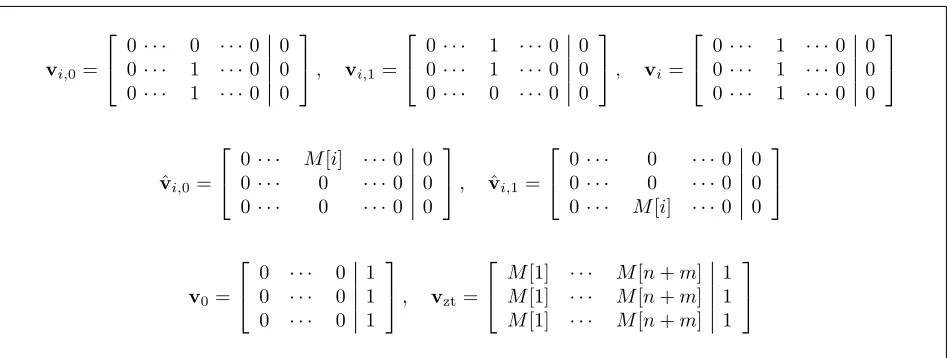
We “lift” the space of levels from integer-valued vectors of length (n+m+ 1) to longer vectors whose length is three times larger. In fact, it will be convenient to view the new levels as integer-valued matrices of dimension 3×(n+m+ 1). (We provide a high level outline below, see also Figure 1 for more complete details.) The levels of the program identifiers, the level of the nullifier and the zero-testing level, are all lifted from vectors to matrices by duplicating the vector three times and placing a copy in each row of the matrix. The “lifting” of the input encodings is a bit more subtle. The level vi,0 of the i-th zero-input is “lifted” from ei to a matrix whose first row is the all-zero vector and itssecond and third rows contain copies of ei. The level vi,1 of thei-th
one-input is modified similarly except that the copies of ei are placed in the first and second rows
6
and thethird row is taken to be the zero vector. More explicitly:
vi,0=
0· · · 0 · · · 0 0· · · 1 · · · 0 0· · · 1 · · · 0
, vi,1=
0 · · · 1 · · · 0 0 · · · 1 · · · 0 0 · · · 0 · · · 0
.
As a result, any input-mixing attack that combinesvi,1 withvi,0 reaches a level whosei-th column
consists of at least two distinct elements, and so such a computation cannot reach the zero-testing level.
Unfortunately, an “honest execution” does not reach the zero level as well. Indeed, an honest execution that corresponds to an input x= (x1, . . . , xn) ends up in a level v∈N3×(n+m+1) whose i-th column has a zero either at the first entry (if xi = 0) or at the third entry (if xi = 1). The other two entries of the column agree with the corresponding entries of the zero-testing level vzt.
We fix this problem by providing additional “dummy” encodings that will be used to push the levelvof an honest execution up tovzt. For this, we need dummy encodings at levels ˆvi,0 and ˆvi,1
where the matrix ˆvi,0 (resp., ˆvi,1) agrees withvztin the first position (resp., third position) of the
i-th column and is filled with zeroes in all other locations.
ˆ vi,0 =
0· · · M[i] · · · 0 0· · · 0 · · · 0 0· · · 0 · · · 0
, vˆi,1=
0 · · · 0 · · ·0 0 · · · 0 · · ·0 0 · · · M[i] · · ·0
.
The content of the dummy encodings will be random and, for compatibility, it should be given in El-Gamal encoding. Specifically, for each inputi∈[n] we choose a random value ˆwi, encode it twice using (fresh) El-Gamal encoding and place one copy at the level ˆvi,0 (“thei-th zero dummy input”)
and another copy at level ˆvi,1 (“the i-th one dummy input”). In addition, we update the value of
the nullifier by multiplying it with the product Q
iwˆi of all dummy values. Now we can run an honest execution over an input x= (x1, . . . , xn), multiply it with the product of all the ndummy
inputs that correspond to the selected inputs (x1, . . . , xn), and subtract the nullifier. The result
reaches the zero-testing level and so correctness holds. Further, one can show that input-mixing attacks do not lead to vzt even at the presence of the additional dummy inputs. This essentially
completes the description of our basic obfuscator SimpleObf. (A detailed and formal description appears in Section 4.)
Low-level zero-testing attacks. Interestingly,SimpleObf is completely broken if low-level zero-testing is allowed. Recall that the authenticatoryi is shared among the zero and the one encodings of thei-th input. Therefore, by subtracting the El-Gamal encodings of these elements, we zero-out the authenticatoryi and get a low-level El-Gamal encoding of an element that has zero in the first (authentication) slot and has one in the second slot. We can now multiply the El-Gamal encoding of this element with, say, the El-Gamal encoding ofK1, the first bit of the identifier. This will
zero-out the authenticator of K1, and we will get an encoding of zero if and only ifK1 = 0. Therefore,
we can recoverK1 (or, more generally, fully recover the identifierK) using low-level zero-testing.
Solving this issue is the main technical challenge addressed by our more robust obfuscator
RobustObf. As a first step, we add more slots to the encoding (using (n+ 2) subrings R =
Zp1×. . .· · ·Zpn+2) and make sure that the pair of encodings which share the same yi, hold distinct
evaluator to zero-out the additional slots (while preventing the adversary from doing so in a low-level). To this end, we publish some auxiliary elements (more “dummy” values) ˆwi whosei-th slot is zero. We publish two copies of each ˆwi, each in a different level ˆvi,0,vi,ˆ 1, and an appropriate
straddling set structure that guarantees that the ˆvi,0 copy can only interact with vi,0 and vice
versa. Now, if the previous attack is sought, the attacker will attempt to subtract vi,0 from vi,1,
but then it will need to multiply by one of ˆvi,0 or ˆvi,1. Since both operations are forbidden by the
straddling sets, the attack seems to be prevented.
Preventing early nullification via shifted El-Gamal encoding. We notice that in order for
the previous fix not to interfere with functionality, the new nullifierw0 (which combines the original
nullifiery0 with the productQiwˆi) must take the value 0 in all of the new slots. The reason is that
after the honest evaluator finishes multiplying with the ˆw values, it needs to compare against w0.
This leaves us vulnerable to an attacker that will use w0 instead of the ˆw to zero out coordinates
ahead of time. To solve this last problem, we present our final trick, theshifted El-Gamal encoding. Instead of encoding ([r]v,[rw]v), we will now use ([r]v,[rw]v+v∗), wherev∗ is a special vector used by all of the encodings. The result of this change is that now, if addition/subtraction is performed, thev∗ part of the result is the same as of the operands, but if multiplication is performed, the v∗ part is the sum of thev∗’s of the operands. Therefore the v∗ part keeps track of the multiplicative degree of the evaluation process. Finally, the element w0 will be encoded as ([r]v0,[rw0]v0+Dv∗),
whereDis the total multiplicative degree of our evaluation process. This means that one can only add/subtract with w0, and never multiply (otherwise the v∗ multiple goes beyond D and we set
the zero-test level to not allow this). This prevents misuse ofw0 and completes the description of
RobustObf.
See Section 4 for a detailed description of the construction and Section 5 for the proof of security.
1.3 Related Works
Ananth et al. [AGIS14] explored the efficiency of obfuscating formulae. They considered two set-tings. One where the formula is represented as a sequence of variables and gates, and another more similar to our formulation where there is a universal evaluator (in the form of a formula in their case), and the specific function is specified as a key to this evaluator. In the latter case, which is more relevant for the sake of comparison, they show how to obfuscate classes with formula size
s with obfuscated program size and complexity almost as low as O(s). This is in comparison to previous methods that used Barrington’s theorem and achieved O(s2) for balanced formulae or
O(s3.64) for unbalanced. Still, their complexity measure remained theformula size of the function family, whereas in this work we show that one can obfuscate relative to thecircuit size of the family which may be smaller.7 On the flip side, we use composite order graded encoding schemes that are even newer and less substantiated (and possibly less efficient) than standard prime-order graded encoding schemes.
Composite order graded encoding schemes have been used by Gentry, Lewko and Waters [GLW14] and by Gentry, Lewko, Sahai and Waters [GLSW14] to introduce improvedsecurity reductions for witness encryption and for obfuscation (respectively). In particular they showed that in this setting
7
one can construct a witness encryption scheme or an obfuscator, and prove security in the standard model based on exponential hardness assumptions.
Concurrent and Independent Work. In a very recent concurrent and independent work,
Zimmerman [Zim14] presented an obfuscator which is almost identical to our simpler obfuscator
SimpleObf. Zimmerman also presents applications for this new obfuscation method for circuits, e.g. for functional encryption or multi-bit-output obfuscation. Security is proven in a generic model where zero testing below the last level is impossible, similar to our MRG oracle. Both the obfuscator from [Zim14] and our SimpleObf are completely broken in a more challenging model where it is possible to test for zero at low levels. Our second obfuscator RobustObf addresses this issue and provides security in the more challenging setting represented by the GES oracleU RG, at the expense of being less efficient. On the other hand, we only prove that our obfuscators are secure indistinguishability obfuscator in the generic model,8 whereas [Zim14] proves the more stringent notion of virtual black box security.
Road map. Section 2 defines Graded Encoding over Composite Order Groups and ideal GES
oracles. Section 3 defines GES-based obfuscation, suggests two alternative security definitions (standard oracle-based definition and algebraic security) and shows that one implies the other. Section 4 describes our new constructions and Section 5 is devoted to the proof of their security.
Acknowledgments. We thank the reviewers of TCC 2015 and Journal of Cryptology for their
insightful and detailed comments. We also thank Mark Zhandry for highlighting a point in our analysis that required further clarification.
2
Graded Encoding over Composite Order Groups
2.1 General Notation
Partial Order of Natural Valued Vectors. For an integer τ ∈N, we view vectors in Nτ as
multisets over the universe [τ]. Correspondingly, we define a partial ordering “≤” on vectors Nτ,
which has the same semantics as inclusion “⊆” for the respective multisets. In particular, we say that v ≤ w if for all i ∈ [τ] it holds that v[i] ≤ w[i]. If there exists a coordinate i for which the above does not hold, we say thatv 6≤w. We note that since our vectors are defined over the naturals, this relation is monotonous: Ifv≤wthen for allw0∈Nτ it also holds thatv≤(w+w0), and dually ifv6≤w then for allv0 ∈Nτ it holds that (v+v0)6≤w.
CRT representation. Let σ ∈ N, let p1, . . . , pσ be pairwise coprime numbers and let P =
Qσ
i=1pi. Considering the ring ZP, the Chinese Remainder Theorem (CRT) asserts that there is an isomorphism ZP ∼= Zp1 × · · · × Zpσ such that if a ∼= (a1, . . . , aσ) and b ∼= (b1, . . . , bσ), then
a+b ∼= (a1+b1, . . . , aσ+bσ) and a·b ∼= (a1·b1, . . . , aσ ·bσ). For a given isomorphism, we will
denote byaJiKthe component ai=a (modpi).
8
2.2 Syntax
We begin with the definition of a graded encoding scheme in composite order groups. As explained in the introduction, such a scheme maps a pair that consists of a ring element and a multiset, into a collection of strings where each string is viewed as an encoding of the pair. We begin by formalizing the arithmetic operations induced on pair of encoded elements (Definition 2.1), and continue (Definition 2.2) by describing the type of interface provided by such a scheme (encoding an element, performing arithmetic operations on encoding, applying some limited zero-testing, and so on).
The following definitions are adapted from [GGH13a] and follow-up works, but our notation deviates somewhat from that of some previous work.
Definition 2.1 (Graded Encoding Scheme). Let Rbe a ring, and letvzt∈Nτ be an integer vector
of dimension τ ∈N. A graded encoding scheme for R,vzt is a collection of sets {[α]v ⊂ {0,1}∗ :
v∈Nτ,v≤v
zt, α∈ R}with the following properties:
1. For every index v ≤ vzt, the sets {[α]v : α ∈ R} are disjoint, and so they are a partition
of the indexed set [R]v =Sα∈R[α]v. We slightly abuse notation and often denote a= [α]v
instead of a∈[α]v.
2. There are binary operations “+” and “−” such that for all v∈ {0,1}τ, α
1, α2 ∈ R and for
allu1= [α1]v, u2 = [α2]v:
u1+u2= [α1+α2]v and u1−u2= [α1−α2]v ,
where α1+α2 and α1−α2 are addition and subtraction in R.
3. There is an associative binary operation “×” such that for allv1,v2∈Nτ such thatv1+v2≤
vzt, for all α1, α2∈ R and for all u1 = [α1]v1, u2 = [α2]v2, it holds that
u1×u2 = [α1·α2]v1+v2,
where α1·α2 is multiplication in R.
The above definition does not touch upon the computational aspects of graded encoding schemes, which are described below. We note that there is a difference between the definition below and the ones that are used in the prime-order setting.
Definition 2.2 (Efficient Procedures for Graded Encoding Scheme). An efficiently computable collection of graded encoding schemes (GES) is characterized by the following efficient algorithms.
• Composite-Order Instance Generation: InstGen(1λ,1σ,vzt,1kvztk1) outputs the set of
parame-ters params, a description of a Graded Encoding Scheme relative tovztand relative to a ring R such that R ∼= Zp1 × · · · ×Zpσ, where all pi are pairwise coprime numbers, i.e. R ∼= ZN
for N =Q
pi.9 We typically refer to elements inR as tuples over Zp1 × · · · ×Zpσ.
In addition, the procedure outputs a subset evparams⊂paramsthat is sufficient for comput-ing addition, multiplication and zero testcomput-ing, but may be insufficient for samplcomput-ing, encodcomput-ing or for randomization.
9 In our security model, we will require that each prime factor ofN is chosen from a distribution with roughly
• Ring Sampler: samp(params) outputs a “level zero encoding” A∈[a]0 for a nearly uniform
a← RR .
• Sub-Ring Sampler: subsamp(params, i∗), where i∗ ∈ [σ] outputs a “level zero encoding” in a CRT sub-ring of R. Namely, it outputs A ∈ [a]0 for an element a ∼= (a1, . . . , aσ), such
thatai∗ is statistically indistinguishable from uniform in Zp
i∗, and for all i6=i
∗ it holds that ai= 0.10
• Encode and Re-Randomize: encRand(params,v, A) takes as input an index v ≤ vzt and A= [a]0, and outputs an encodingB = [a]v, where the distribution of B is (statistically close to being) only dependent on aand not otherwise dependent on A.
• Addition and Negation: add(evparams, A1, A2) takes A1 = [a1]v, A2 = [a2]v, and outputs
B = [a1+a2]v. (If the two operands are not in the same indexed set, then add returns ⊥).
We often use the notation u1+u2 to denote this operation when evparamsis clear from the
context. Similarly, negate(evparams, A1) = [−a1]v.
• Multiplication: mult(evparams, A1, A2) takes A1 = [a1]v1, A2 = [a2]v2. If v1 +v2 ≤ vzt,
thenmult outputs B = [a1·a2]v1+v2. Otherwise, mult outputs ⊥. We often use the notation A1×A2 to denote this operation when evparams is clear from the context.
• Zero Test: isZero(evparams, A) outputs 1 if A= [0]vzt, and 0 otherwise.
Remark 2.3. Note that the instance generation procedure takes as input not only vzt but also a
unary representation ofkvztk1. While one could hope for a definition that does not require the latter,
for known GES candidates, the running time of instance generation (and all other procedures) in fact scales with kvztk1. Therefore in order to maintain the convention of polynomial run-time in
the input length, we provide kvztk1 in unary as input.
Noisy encodings. In known candidate constructions, encodings are noisy and the noise level
increases with addition and multiplication operations, so one has to be careful not to go over a specified noise bound. However, the parameters can be set so as to supportO(kvztk1) operations, so
long asInstGenis allowed to run in poly(kvztk1) time, as our function interface compels. This will be
sufficient for our purposes and we therefore ignore noise management throughout this manuscript.
Remark 2.4. Given params, we can use subsamp together with add,negate,mult to efficiently generate level-0 encodings of related elements, so long as each of their CRT components can be expressed as a polynomial size arithmetic circuit (with addition, multiplication, negation and con-stants 0,1) applied to a set of uniformly distributed variables. More formally, subsamp allows to generate any set of encodings A1, . . . , A` (where Aj = [aj]0) with the following structure. For each
CRT slot i, the values a1JiK, . . . , a`JiK can all be computed by a multi-output arithmetic circuit as
above, whose input is a set of uniform random variables. The sets of input variables for each sloti
are distinct. (Note that performing arithmetic operations on level-zero encodings does not increase their level.)
For example, in a 2-composite GES, one can generate [((x1+x2)·x3, y1)]0, [(x3+x4, y2)]0, [(x1·x2, y1+y2)]0, for uniform and independent x, y variables. However, we cannot generate
10Let us emphasize that this procedure requiresparamsand notevparams. This distinction will be important in
[(y1, x1)]0 in addition to the above, since the variables of the first and second slot will not be
distinct in this case.
Combining the above with access toencRandallows, given params, to encode the aforementioned elements to arbitrary indices v≤vzt.
Remark 2.5. For our application we require that it is intractable to execute subsamp using only
evparamsand without access to params. Our application involves an adversary that is given a set
of encodings and evparams. If the adversary is able to perform sub-ring sampling or to modify the level of an encoded element, then our obfuscator will be insecure.
Further, in our first construction, the adversary should not be able to apply zero-testing to encodings in level v<vzt, and should not have a way to distinguish low-level zero encodings from
nonzero. This in turn means that we must forbid the adversary to runsamp,encRand as well, since these will allow to “lift” an encoding from level v to level vztand run isZero. While this may seem
like a severe limitation, known candidates appear to have this property.
Concrete instantiations. The candidate constructions of [GGH13a, CLT13] do not support the
above functionality out of the box. Specifically, [GGH13a] only allows R of prime order, whereas [CLT13] does natively support composite order groups, but its security features are unclear if sub-ring sampling is allowed. This issue has been extensively addressed in [GLW14, Appendix B of full version]. In particular the authors there present a variant of [CLT13] that appears to overcome the aforementioned security issues. This variant supports a σ-product ring R ∼= (Zp1 × · · · ×Zpσ)
where thepi’s are composite numbers with large prime divisors. Note that this is compatible with our requirements which allow the pi’s to be non-primes. Furthermore, this variant adheres to the constraints we need to impose as per Remark 2.5. Overall, even though we prove security in the generic model, we do not know of attacks when our obfuscator is instantiated with this candidate.
2.3 Ideal GES oracles
We would like to prove the security of our construction againstgeneric adversaries. To this end, we will use thegeneric graded encoding schememodel, adapted from [BR13, BR14a, BR14b, BGK+14], which is analogous to thegeneric group model(see Shoup [Sho97] and Maurer [Mau05]). Intuitively, we would like to guarantee that the encoding of a ring element reveals no information on the element itself (similarly to random oracle evaluation), and so the adversary can manipulate elements only via the GES procedures. One way to formulate this restriction is to prove security relative to an oracle that implements a truly random GES. We focus on two particular (inefficient) GES oracles: the unique random generic encoding scheme oracle U RG and the multiple-encoding random GES oracleMRG. Both variants will be defined with respect to some probability distribution ensemble
{Rλ,σ,vzt}over rings (with certain entropic properties as mentioned in Footnote 9). The adversary is not allowed to know the identity of the specific ring that was sampled, except through interaction with the GES oracle interface.
The U RG Oracle. Upon initialization of InstGen(1λ,1σ,vzt,1kvztk1), the oracle U RG samples a
ring R ← RR λ,σ,vzt and encodes each element a ∈ R in level v ≤ vzt by a pair (v, ρ), where ρ is
the oracle supports all the GES-operations with respect to the above encoding. It is not hard to see that the only way thatAcan obtain valid encodings is by calls to the oracleU RG (except with negligible probability).
The oracle U RG is practically identical to the random GES oracle of [BR14b], and similarly to that work we will also consider an online variant of U RG, or rather a variant that approximates
U RG to within negligible statistical distance. This is done by anonline (stateful) polynomial time process, which samples the representations on-the-fly. Specifically, the oracle will maintain a table of entries of the form (v, a,labelv,a), where labelv,a ∈ {0,1}t is the representation of [a]v inU RG. The table is initially empty. Every time U RG is called for some functionality, it checks that its operands indeed correspond to an entry in the table, in which case it can retrieve the appropriate (v, a) to perform the operation. If the operands are not in the table, U RG returns ⊥. Whenever
U RG needs to return a value [a]v, it checks whether (v, a) is already in the table, and if so returns the appropriate labelv,a. Otherwise it samples a new uniform label, and inserts a new entry into the table.
When interacting with an adversary that only makes a polynomial number of calls, the online version ofU RG is within negligible statistical distance of the offline version (in fact, the statistical distance is exponentially small in λ). This is because the only case when the online oracle imple-mentation differs from the offline one is when when the adversary guesses a valid label that it has not seen (in the offline setting). This can only occur with exponentially small probability due to the sparsity of the labels. The running time of the online oracle is polynomial in the number of oracle calls.
Defining Multiple-encoding random GES. We would like to define a similar random oracle
which assigns exponentially many possible encodings for each element in each level. The interface to this oracle has to be defined carefully. Consider, for example, the case where we have three labels
A, B, C where A = [a]v,B = [b]v, C = [c]v and we compute the term (A+B)×C and the term
A×C+B×C. We have to specify whether the resulting label will be identical or not. We choose the more conservative approach and assume that in such a case the label will be indeed identical. In contrast, the labels ofA+B andA0+Bshould disagree whenA, A0 are twoindependent labels of
a(e.g., bothAandA0 were generated using two different calls toencRandon some labelA0 = [a]0). To formalize these requirements we define an online version of the Multiple-encoding Random GES (MRG) oracle.
The (online)MRG Oracle. The oracleMRG is initialized similarly to theU RG oracle, except that each ring elementa∈ Rin levelv≤vztis encoded by multiple strings of the form (v, ρi) where
ρi is random string of lengtht= (log|R| ·λ2). Whenever a sampling query is made,MRG samples an elementafromR(or from the appropriate sub-ring), a uniform length-tlabel, and also generates a new formal variable Xi. It then stores the tuple (0, a, Xi,label0,a,Xi) in its table. Whenever an
encRand query is made, again a random label and a new formal variable Xi0 are chosen, and the tuple (v, a, Xi0,labelv,a,X
i0) is stored. Whenever an “arithmetic” query is made, MRG looks up
respective polynomials (PC1 ≡ PC2, note that this is an efficiently testable condition11), and distinct otherwise. Finally, for zero-test queries,MRG will test whether the actual value is the zero value inRand respond accordingly.
Both oracles support the standard GES operations with respect to the resulting encodings. We note that U RG (which essentially corresponds to the traditional notion of multilinear maps over generic groups) is more robust thanMRG as it gives more power to the adversary (for example it can easily detect if it has two encodings of the same element). Specifically, it is not hard to show that if a construction is secure with respect to U RG then it is also secure with respect toMRG. (Formally, the MRG oracle can be efficiently emulated using aU RG oracle.)
3
GES-based Obfuscators
In this section we define the notion of GES-based obfuscators. Our definitions somewhat deviate from the more traditional definitions formulated in [BGI+12]. Specifically, to allow a more fine-grained notions of efficiency, we distinguish between the description-length and the time complexity of the obfuscated program. Furthermore, we adopt the definition to the GES setting and distinguish between correctness, which should hold for any syntactically valid (possibly trivial) GES, and security, which should hold with respect to some “ideal” GES oracle. Finally, we show (Section 3.2) that for natural GES-based obfuscators, security with respect to ideal oracles boils down to certain algebraic properties of the obfuscator’s output (referred to asalgebraic security). This abstraction (which was implicit in previous works) allows us to reduce the security of the obfuscator to an algebraic statement that does not directly relate to the interface of the GES.
3.1 Main Definitions
We begin by recalling the notion of efficient function families.
Function family. LetC={CK}K∈{0,1}∗ be a family of efficiently computable functions. We will assume that C is represented by a uniform family of polynomial-size universal evaluation circuits
U = {Un}n∈
N, where Un maps an identifier K ∈ {0,1}
m(n) and input x ∈ {0,1}n to the output
CK(x) (the efficiency of Un imposes a polynomial bound on m(·)). Thecomputational complexity of C (with respect to the representationU) is the circuit size ofU and therepresentation size ofC
ism(n). We say that Cis inN C1 ifU is a family of polynomial size circuits of logarithmic depth.12
GES-based Obfuscators: Syntax. A GES-based obfuscation scheme for a family of efficiently
computable functions C consists of a pair of PPT algorithms: an obfuscatorObf and an evaluator
Eval, which have oracle access to a GES. The input to the obfuscator is an identifierK∈ {0,1}m(n)of
a functionCK ∈ C, a unary representation of the security parameter 1λ, and an unary representation 1n of the input length of CK. The obfuscator outputs an obfuscated program ˆC ∈ {0,1}∗. The evaluation algorithm Eval maps an obfuscated program ˆC, an input x ∈ {0,1}n, and an unary representations of the security parameter 1λ to a stringy. We note that the efficiency requirement
11
Polynomial Identity Testing of arithmetic circuit can be done in randomized polynomial time (RP) using Schwartz-Zippel over a sufficiently large field.
12
on the obfuscatorObfimplicitly puts a polynomial restriction on the size of the obfuscated program ˆ
C.
Correctness should hold with respect to an arbitrary concrete GES instantiation.
Definition 3.1 (Preserving Functionality). A GES-based obfuscation scheme (Obf,Eval) for C is
functionality preserving if for every instantiation of GES G, every n ∈ N, every CK ∈ C where
K ∈ {0,1}m(n), and every x ∈ {0,1}n, with all but negl(λ) probability over the coins of Obf,Eval
and the GES oracle G it holds that:
EvalG(1λ,C, xˆ ) =CK(x), where Cˆ R
←ObfG(1n,1λ, K).
We define Indistinguishability Obfuscator with respect to some (possibly inefficient) GES in-stantiation. Our definition is formulated in terms of unbounded simulation which is equivalent to the more standard indistinguishability-based definition (cf. [BR14b]).
Definition 3.2(Indistinguishability Security [BGI+12]). A GES-based obfuscation scheme(Obf,Eval)
for C is called an Indistinguishability Obfuscator (iO) with respect to some GES instantiation G
if for every (non-uniform) polynomial size adversary A and polynomial p, there exists a (compu-tationally unbounded) simulator S, such that for every n ≤ p(λ) and for every CK ∈ C where
K ∈ {0,1}m(n):
Pr[AG(1λ,Cˆ) = 1]−Pr[SCK(1|K|,1n,1λ) = 1]
= negl(λ),
where Cˆ ←R ObfG(1n,1λ, K). If the simulator can be implemented by (non-uniform) polynomial size circuits than the obfuscator is Virtually Black-Box (VBB) secure.
We will instantiate the above definition with the ideal oracles U RG and MRG defined in Section 2.3.
3.2 Algebraic Security
In this section we present a notion of security that will be easier to work with, and prove its equivalence to security in the random GES model above. This model and the equivalence are implicit in previous works.
Definition 3.3 (Obfuscator in Canonical form). A GES-based obfuscator is in canonical form if it can be presented as follows. (Recall that the obfuscator is given a security parameter 1λ, an input length 1n, and a program identifier K∈ {0,1}m(n).)
1. Based onn, the obfuscator deterministically generates`=`(n)integer-valued vectorsv1, . . . ,v`,
a zero-testing vector vzt s.t. vi≤vzt for alli, and a ring arity σ∈N.
2. Based on λ, K, n, the obfuscator defines, for any ringR ∼=R1× · · · × Rσ, a joint distribution
DR
λ(n, K) over ` ring elements (a1, . . . , a`) ∈ R`. This distribution is defined by a circuit
Dλ(n, K) (which is not ring-specific) which uses the following gates: addition, subtraction, multiplication, the constant 1, and special sampling gates {Si}i∈[σ]. Given a ring R, the
distributionDλR(n, K) is defined by runningDλ(n, K)and replacingSi with random elements
3. Then, the obfuscator initializes the GES by running(params,evparams) =InstGen(1λ,1σ,vzt,1kvztk1),
letR be the underlying ring. The obfuscator computes([a1]0, . . . ,[a`]0) where(a1, . . . , a`) are
distributed according toDλR(n, K), as specified in Remark 2.4. It then usesencRand(params,vi,[ai]0)
to compute and output the vector of encodings([a1]v1, . . . ,[a`]v`), together with the evaluation
parameters evparams.
Overall, such a canonical obfuscator can be defined by the length function `=`(n), the ring arity
σ(n), the vectors Vn= (v1, . . . ,v`,vzt) and the circuit Dλ(n, K).
Our notion of security will be defined w.r.t an obfuscator in canonical form (`, σ, V,Dλ(n, K)) and a distribution ensembleRλ,σ,vzt over rings (supposedly induced by a GES construction).
Intu-itively, an adversary who gets an obfuscated program ([a1]v1, . . . ,[a`]v`) can choose some polynomial
and check if it is evaluated to zero on the ring elements (a1, . . . , a`). Security should guarantee that such an attack gives no information on the program K beyond what follows from an oracle access toCK. That is, we would like to have a simulator that given an oracle access to CK can tell whether a given adversaryA evaluates to zero on DRλ(n, K), where R← RR λ,σ,vzt.
We will formalize this notion of security in Definition 3.6, but before that we define a family of ring-independent adversaries. We will focus on the class of purely arithmetic circuits with arbitrary fan-out. These circuits will not have any constants and will contain only input, addition and multiplication gates. Since it contains no constants, it is not ring-specific and one can consider the evaluation of the same circuit over various rings. Formally, each such circuit naturally defines a polynomial with integer coefficients.
Definition 3.4. A purely arithmetic circuitA is a circuit which contains input gates (no fan-in, fan out >0), an output gate (fan-in1, fan out0) and operator gates for addition (+), subtraction (−) and multiplication (×) with fan-in 2 and fanout >0. The size of A is the number of gates in
A. Given a purely arithmetic circuitA with`input gates and a ringR, we letPR
A ∈ R[X1, . . . , X`]
denote the `-variate polynomial defined by the circuit A by associating a formal variable Xi with
each input gate. When the subscript R is omitted we view PA as a polynomial over the integers.
We will consider adversaries A that respect the GES-indexing, namely, addition and multipli-cation can be applied only according to the algebra induced by the GES indexing.
Definition 3.5(V-compatible circuits). A purely arithmetic circuitAis evaluated over the integer-valued vectors (v1, . . . ,v`) via the following recursive process. The i-th input gate takes the value vi, a multiplication gate with inputs v,v0 takes the value v+v0, and an addition (or subtraction)
gate with identical inputs v = v0 takes the value v. If there exists an addition (subtraction) gate with non-identical inputs v6=v0 then the circuit is defined to be syntactically-illegal. We say that
A is compatible with V = ((v1, . . . ,v`),vzt) if the computation A(v1, . . . ,v`) is syntactically legal
and the level v of the output gate is lower or equal to the zero-test level vzt, i.e., v ≤vzt. When
v=vzt we say that A is strictly compatible withV.
We can now define a simulation-based definition of security which is parameterized by some family of purely arithmetic circuits Aλ.
randomized algorithm S (simulator) such that for every input length n, function identifier K ∈ {0,1}m(n), and adversary A∈ A
λ,n we have
Pr R←RR λ,σ,vzt
[PAR(DRλ(n, K)) = 0]−Pr[SCK(1λ,1n, A) = 0]
≤negl(λ),
where the probability in the minuend is taken over a random choice of a ring R ← RR λ,σ,vzt and over a random sample from the distribution DRλ(n, K). By default, we consider security against all classes of poly(λ)-size purely arithmetic circuits A={Aλ,n} (this implicitly imposes a polynomial bound on n as a function of λ) which are strictly compatible with Vn and refer to this notion as strict algebraic security. If the above further holds for circuits which are compatible with Vn in a
non-strict sense, we say that the obfuscator achieves algebraic security.
We note that the case of efficient simulator S corresponds to VBB security and the inefficient case to the notion of iO. Also, different choices of adversaries A may be considered in order to capture the operations accessible for the adversary in other generic models. A larger class may provide stronger security. Note that the class of Vn-compatible adversaries is larger than the class ofstrictly Vn-compatible, and so security against the former (“algebraic security”) implies security against the latter (“strict algebraic security”).
The following lemma, which is implicit in previous works (cf. [BR14b]), shows that security in the algebraic model implies security in the generic model.
Lemma 3.7. Let O = (`, σ, V,D) be a canonical GES-based obfuscator, and let Rλ,σ,vzt be a
dis-tribution supported over rings R ∼=R1 × · · · × Rσ s.t. for all i∈ [σ] and for every fixed nonzero multivariate polynomial p of degree at most kvztk1 ·deg(Dλ(n, K)) it holds that when sampling
a ring R ← RR λ,σ,vzt and then a random set of variables from the ith subring ~r ← RR i, then
PrR,~r[p(~r) = 0] = negl(λ).
If O is algebraically secure with respect to Rλ,σ,vzt (resp., strict algebraically secure) then it is
a secure indistinguishably obfuscator relative to the GES oracle U RG (resp., MRG) over the ring distribution Rλ,σ,vzt. Furthermore, if the above holds with efficient simulation then the conclusion is strengthened to VBB security in the corresponding model.
Proof. We first show that algebraic security implies security relative to the U RG oracle, and then proceed to the case of strict algebraic security. Our goal is to simulate the view of an adversary
BU RG(1λ,Cˆ), where ˆC is produced by running ObfU RG(1n,1λ, K), using only oracle access to the function CK. Recall that ˆC consists of the public parameters evparams together with the labels ([a1]v1, . . . ,[a`]v`) where ~a = (a1, . . . , a`)
R
← Dλ(n, K). Since the simulator does not have an access to K, it cannot sample a state~a from Dλ(n, K) by himself. Instead, we pretend that such a hidden state ~a was already sampled and show how to “program” the (online-version of the) U RG oracle consistently with ~a, without knowing ~a itself. This emulation (which follows the methodologies of [BR13, BR14a, BR14b, BGK+14]) will employ the algebraic simulator SCK alg
promised by Definition 3.6. Details follow.
` = `(n) formal variables (α1, . . . , α`), v ∈ Nτ is an integer vector and ρ is a string of length t= (log|Rλ,σ,vzt| ·λ). Throughout the simulation we will view (v, ρ) as the level v encoding that
U RG assigns to the ring element obtained by applying A to the hidden state~a.
At the beginning we initialize the list with`triples (Ai,vi, ρi) whereAi is the formal polynomial which outputs αi, vi is the i-th entry of Vn (the index set used by the obfuscator) and ρi is a random string. We generate evparams uniformly and initialize the adversary B with the values
ˆ
C = ((vi, ρi)i∈[`],evparams). From now on, we assume that all U RG calls of B contain the
identifier evparams. Next, if B issues an addition query of the form “(v, ρ) + (v0, ρ0)”, we first verify that the labels (v, ρ) and (v0, ρ0) both appear in the list and that the operation respects
V (i.e., v = v0 ≤ vzt). If the verification fails we return ⊥. Otherwise, we traverse the list and
find the circuits A and A0 which correspond to (v, ρ) and (v0, ρ0). For every tuple in the list of the form (A0,v, ρ0), we check if the polynomials (PA+PA0) and PA
0 agree on the hidden state
(a1, . . . , a`(n)). This check is implemented by calling the algebraic simulator SalgCK on the circuit
A∗ = (A+A0)−A0. If the answer is zero we return the value (v, ρ0); otherwise, if the answer is
non-zero for all tuples on the list, we return (v, ρ) where ρis a new random string, and add to the list a new triple (A+A0,v, ρ).
Multiplication and negation queries are performed similarly with the natural modifications (e.g., in the case of multiplication one has to verify that (v+v0)≤vzt, compare against all (v+v0)-level
triples, and output/store an encoding at level v+v0). The case of a zero-test query (vzt, ρ) is
handled directly by querying the algebraic simulator SCK
alg on the circuit A which appears in the
tuple (vzt, ρ, A) (again, if such a tuple does not appear in the list we answer ⊥).
Analysis. Notice that if the algebraic simulator is efficient then so is the simulatorS. We claim that, in each call of the adversary, the statistical distance between the simulator and the real view of B grows by a negligible amount, and so if the number of queries is polynomially bounded the overall statistical distance is negligible.
To see this, first consider the following equivalent description of the actual execution ofBU RG(1λ,Cˆ). At the beginning, the obfuscated circuit ˆC is sampled just like as in the real execution. At this point, the ringR is sampled, and the secret vector~ais sampled fromDλR(n, K). The oracle U RG
is modified as follows: Given a query to U RG, the oracle acts as the simulator described above (including the same book keeping) except that instead of checking whether an arithmetic circuit
A∗ evaluates to zero, the oracle checks whether PA∗(~a) = 0 over the ring R, we refer to this as a
check.
Next, consider the following hybrid which is identical to the previous experiment except that each checkPA∗(~a) = 0 is performed with respect to a freshly chosen vector~a← DR R
λ(n, K) (but the ring remains the same).
We claim that, except with negligible probability, each such check returns the same outcome as in the previous experiment. Consider the distribution PA∗(DR
λ(n, K)) and, for i ∈ [σ], let
PA∗(DR
λ(n, K))JiK denote its restriction to the i-th sub-ring. The key observation is that this
distribution can be written as the output of a polynomialQi applied to a uniform vector of elements in the subring Ri, where the degree ofQi is at most deg(A∗)·deg(Dλ(n, K))≤ kvztk1·d. (Indeed,
Qi is simply the composition of A∗ with the polynomial obtained by taking the circuit Dλ(n, K) and replacing each Si sampling gate with an input gate and any other sampling gate Sj with the constant 0.) Observe that if, for every sub-ring, the corresponding polynomial Qi is identically zero over Ri, then the check PA∗(~a) = 0 passes for any~ain the support ofDR
consider some Qi which is not identically zero overRi. Then
Pr ~a←DR R
λ(n,K)
[PAR∗(~a) = 0] = negl(λ),
since in the i-th sub-ring we get an evaluation of Qi on a random input, which, by the conditions of the lemma, zeros out only with negligible probability.
At this point, each check is computed using a uniform and independent~abut all with the same ring R. We now further consider a sequence of hybrids where in the j-th hybrid, the firstj checks are replaced with calls to SCK
alg on the respective A
∗. The zeroth hybrid is identical to the above
and the final hybrid where all checks are replaced with algebraic simulator calls, is exactly the view generated by our simulator S. We claim that each two adjacent hybrids are indistinguishable by the algebraic security property. To see this, we note that in the j-th hybrid, the (j+ 1)-th check specifies a circuitA∗ which is independent of the underlying ring, since the adversary’s view up to this point is indeed independent of R. This allows us to plug in this A∗ as the algebraic security simulator challenge.
Strict Algebraic Security. Let us move to the case of algebraic security with respect tostrictly
Vn-compatible adversaries. Recall that in this case the algebraic simulator cannot be applied to adversaries whose output is strictly lower thanvzt. This seems problematic as in the course of the
simulation we had to check the equivalence of a pair of purely arithmetic circuits A and B whose output level is below vzt. More precisely, to emulate theU RG oracle we had to check whether A
andB are likely to agree on the hidden state (a1, . . . , a`). This problem vanishes if we only attempt to emulate theMRG oracle (and so achieve weaker form of security), since this oracle associates a fresh encoding with every formally different polynomials (see Section 2.3).
Recall that the course of execution of BMRG(1λ,Cˆ) is as follows. First, a ring R is sampled and the vector (a1, . . . , a`) is generated using DRλ(n, K). Then, the execution of the adversary
is determined by a sequence of tests of two types. Comparison tests that determine whether arithmetic circuits A, A0 compute the same polynomial over R, and zero tests that determine whether an arithmetic circuit A evaluates to zero over the entries (a1, . . . , a`). Let us gradually
modify this experiment so as to finally derive a simulator.
Consider a hybrid where the firstitests are handled differently from above. Specifically, instead of using the sameRall along, we sample a new ringR← RR λ,σ,vzt for every test and apply the test relative to this fresh ring. In zero tests this also involves generating new values for ~a. We claim that two adjacent hybrids are indistinguishable. Observe that after the firstitests, the adversary’s view is independent of the ringRand therefore the input to the i+ 1 test (circuitsA, A0 or circuit
A) is independent of R. We distinguish between two cases.
• If the i-th test is a zero test we first apply the same reasoning, but now over the composed circuitA(Dλ(n, K)). Again, with all but negligible probability, this polynomial is equivalent to zero on R if and only if it is equivalent to zero on a fresh ring, except with negligible probability. Furthermore, if it is not equivalent to zero, evaluating it on a random input (which is equivalent to evaluating A on a properly distributed~a) will be nonzero with all but negligible probability. This again means that evaluating on the prescribed ~a over R is equivalent, up to negligible probability, to sampling fresh R, ~a. The indistinguishability of the hybrids follows.
At this point we see that the adversary’s view is indistinguishable from a hybrid where each test is answered relative to an independent ring and input vector. However, the answers to zero tests still depend on the polynomial Dλ(n, K) which in turn depends on the obfuscated circuit. Our next hybrid is to answer zero tests using the algebraic simulator. Indistinguishability follows by definition of algebraic security.
Our last hybrid is thus completely independent of the obfuscated circuit. However, it still requires zero testing of arithmetic circuits relative to a random ring inRλ,σ,vzt. Such a test can be implemented efficiently (up to negligible error probability) by sampling a random~rand evaluating the function on it. This results in an efficient and circuit independent process that produces a distribution indistinguishable from the adversary’s. We define our simulator to be the process generating this distribution.
4
Description of the Obfuscator and Correctness
In this section we provide a formal description of our obfuscators and establish their correctness. The reader is referred to Section 1.2 for an informal overview of the construction.
4.1 Setting and Definitions
Let C = {CK}K∈{0,1}∗ be a family of efficiently computable functions with n-bit inputs, repre-sentation size m = m(n) and universal evaluator U. Let ˆU be the arithmetized version of U. Namely an arithmetic circuit with {+,−,×} gates and the constant 1, such that for any ring R, if (x, K) ∈ {0,1}n+m ⊆ Rn+m, then ˆU(x, K) = C
K(x). We let deg( ˆU) denote the degree of the polynomial computed by ˆU.
Consider an enumeration of the wires of ˆU in topological order, such that the firstn+m wires refer to the wires of the inputs (x, K) . For each wirei, we define a vectorsi ∈Zn+m+1 as follows.
Ifi≤n+m, then si =ei (theith indicator vector). For a wireiwhich is the output wire of a gate whose input wires are j1, j2, we define si =sj1+sj2. We define themultiplicity of input wireito
be M[i] = sout[i], where “out” is the output wire of ˆU. (Note that we only used the first (n+m)
coordinates of the vectors. The last coordinate will be utilized in the actual construction for the purpose of checking the consistency of the computation.)
4.2 The Obfuscator SimpleObf
We first define a sequence of level vectors (v’s) in Z(n+m+1)×3. These vectors will be defined as
vi,0=
0· · · 0 · · ·0 0 0· · · 1 · · ·0 0 0· · · 1 · · ·0 0
, vi,1=
0 · · · 1 · · · 0 0 0 · · · 1 · · · 0 0 0 · · · 0 · · · 0 0
, vi=
0 · · · 1 · · · 0 0 0 · · · 1 · · · 0 0 0 · · · 1 · · · 0 0
ˆ
vi,0=
0 · · · M[i] · · · 0 0 0 · · · 0 · · · 0 0 0 · · · 0 · · · 0 0
, vˆi,1=
0· · · 0 · · ·0 0 0· · · 0 · · ·0 0 0· · · M[i] · · ·0 0
v0=
0 · · · 0 1 0 · · · 0 1 0 · · · 0 1
, vzt=
M[1] · · · M[n+m] 1
M[1] · · · M[n+m] 1
M[1] · · · M[n+m] 1
Figure 1: The level vectors for obfuscatorSimpleObf. All vectors are in Z(n+m+1)×3.
For all i ∈ [n], b ∈ {0,1}, we define vi,b as vi,b = ei⊗[b,1,1−b], where ei denotes the i-th indicator vector of dimension n+m+ 1. We further define ˆvi,b =ei⊗[(1−b)·M[i],0, b·M[i]]. For all i ∈ {n+ 1, . . . , n+m} we define vi = ei ⊗[1,1,1] and similarly v0 =en+m+1⊗[1,1,1].
Lastly, we define vzt = (sout+en+m+1)⊗[1,1,1]. We note that for all x ∈ {0,1}n it holds that
vzt=v0+
Pn
i=1(M[i]·vi,xi+ ˆvi,xi) +
Pn+m
i=n+1M[i]·vi.
ObfuscatorSimpleObf:
• Input: Circuit identifierK ∈ {0,1}m whereC K ∈ C.
• Output: Obfuscated program with the same functionality asCK.
• Algorithm:
1. Instantiate a 2-composite graded encoding scheme
(params,evparams) =InstGen(1λ,12,vzt,1kvztk1) .
2. For all i∈[n], b∈ {0,1}, compute random encodings Ri,b = [ri,b]vi,b as well as encodings of
Zi,b = [ri,b·wi,b]vi,b, where wi,b = (yi, b) and yi is uniform. More explicitly, (ri,b·wi,b)J1K= ri,bJ1K·yi, namely a product of two random elements in the appropriate subring, and (ri,b· wi,b)J2Kis either 0 ifb= 0, orri,bJ2Kifb= 1.
13
3. For all i∈[n], b∈ {0,1}, compute random encodings ˆRi,b = [ˆri,b]vˆi,b as well as encodings of
ˆ
Zi,b = [ˆri,b·wˆi,b]vˆi,b, where ˆwi,0 = ˆwi,1 = ˆwi = (ˆyi,βˆi), i.e. ˆwi is uniform but is used in both
ˆ
Zi,b.
4. For all i∈ {n+ 1, . . . , n+m}, compute random encodings Ri = [ri]vi as well as encodings of
Zi = [ri·wi]vi, where wi = (yi, Ki−n), where Ki is theith bit of the circuit description and
yi is uniform.
13
5. Compute random encoding R0 = [r0]v0 and Z0 = [r0w0]v0, where w0 =
Q
i∈[n]wˆi
·(y0,1)
and y0= ˆU(y1, . . . , yn+m).
6. The obfuscated program will contain the following:
• The evaluation parametersevparams.
• For alli∈[n], b∈ {0,1} the elementsRi,b, Zi,b,Rˆi,b,Zˆi,b.
• For alli∈ {n+ 1, . . . , n+m} the elementsRi, Zi.
• The elementsR0, Z0.
We note that all of the required encodings can be efficiently generated using params. This follows from Remark 2.4 by noting that each CRT component can be expressed as a polynomial over uniform elements. In addition, since elements are represented as pairs using El-Gamal encoding, the constant 1 can be generated by taking two encodings of the same random element.
An important feature of our obfuscator (that will be used in the proof) is that all of the information that depends on the circuitCKresides in the second element of the CRT representation, and the distribution of the first element is completely independent ofCK.
4.3 The Obfuscator RobustObf
For simplicity of presentation, we assume w.l.o.g that ˆU is such that the inputs to every binary gate (addition or multiplication) have the same total degree (as polynomials in the input variables and program description). This is straightforward to achieve by adding the constant 1 as one of the elements of the program description, and multiplying by this variable (raised to the proper degree) to balance the input degrees.14
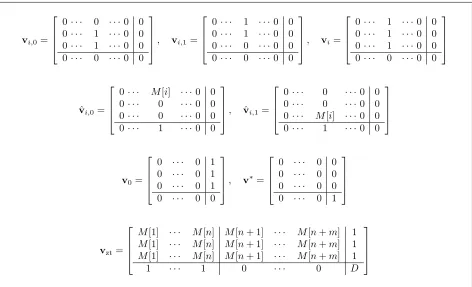
We define a sequence of level vectors (v’s) in Z(n+m+1)×4. These vectors will be defined as
tensors of vectors from Zn+m+1 and vectors fromZ4. We illustrate the level vectors in Figure 2.
For all i ∈ [n], b ∈ {0,1}, we define vi,b as vi,b = ei ⊗[b,1,1−b,0]. We further define ˆ
vi,b =ei⊗[(1−b)·M[i],0, b·M[i],1]. For alli∈ {n+ 1, . . . , n+m}we definevi =ei⊗[1,1,1,0]. We define v0 =en+m+1⊗[1,1,1,0] andv∗ =en+m+1⊗[0,0,0,1]. Lastly, we define vzt = (sout+
en+m+1)⊗[1,1,1,0] + (Pni=1ei)⊗[0,0,0,1] +D·v∗, whereD= deg( ˆU) +n. We note that for all
x∈ {0,1}n it holds that v
zt=v0+Pni=1(M[i]·vi,xi+ ˆvi,xi) +
Pn+m
i=n+1M[i]·vi+D·v∗.
ObfuscatorRobustObf:
• Input: Circuit identifierK ∈ {0,1}m whereC K ∈ C.
• Output: Obfuscated program with the same functionality asCK.
• Algorithm:
1. Instantiate a (n+ 2)-composite graded encoding scheme
(params,evparams) =InstGen(1λ,1n+2,vzt,1kvztk1) .
14While this transformation may incur a significant increase in the degree, the depth remains unchanged up to a