Journal of
May, 1960RANGE
MANAGEMENT
A Lysimeter Study of Sulfur Fertilization
of an Annual-Range Soil1
Deficiency of the plant nu- trient sulfur is widespread on California soils. The majority of 242 responding sites recorded in a recent sulfur deficiency survey are on range or dry-farmed land (Martin, 1958). The Leguminosae are the group of plants that re- spond to sulfur fertilization most frequently. Several authors have pointed out the benefits from supplying additional sulfur where deficiencies occur (Con- rad, 1950; Bentley and Green, 1954; Arkley, et al., 1955 and Walker, 1957). The economics of the practice appear promising, because carriers of the sulfur are relatively inexpensive. How- ever, choosing a rate and fre- quency of sulfur fertilization and source of sulfur that will maxi- mize returns is a problem. The solution depends on detailed knowledge of such factors as the availability of sulfur in the soil, sulfur supplied by precipitation and air contact, leaching losses, erosion losses, and the differ- ential uptake by various plant
CYRUS M. McKELL AND WILLIAM A. WILLIAMS Plant Physiologist, Crops Research Division, Agricul- tural Research Service, U. S. Department of Agriculture, and Associate Professor of Agronomy, Department of Agronomy, University of California, Davis.
1 Cooperative investigations of the Crops Research Division, Agricul- tural Research Service, U. S. De- partment of Agriculture, and the Department o j Agronomy, Univer- sity of California, Davis.
species. The first of a series of lysimeter investigations to study these factors in relation to the nutrition and production of a range legume was initiated at the San Joaquin Experimental Range’. Lysimetery was the technique chosen for studying these problems because sulfur leaches readily as the sulfate ion (Stauffer and Rust, 1954) and, therefore, study of the percolate was of prime interest. Several workers (Kohnke, et al., 1940; Harrold and Dreibelbis, 1951; Stauffer and Rust, 1954, and Dreibelbis and McGuinness,
1957) reviewed the literature on lysimeter construction and dis- cussed the advantages and prob- lems of lysimetery. The radio- isotope S”” was incorporated in the gypsum fertilizer so that the fate of applied sulfur could be distinguished from that of sulfur from natural sources.
Methods
The lysimeters used for this study are 74 inches in diameter with side walls 25.5 inches deep. Each contains an 8-inch deep conical bottom drained by a polyethylene pipe leading to a 5-gallon glass carboy (Fig. 1). Lysimeter interiors were painted with asphalturn paint. During February 1957 the lysi-
113
meters were installed on a hill- side terrace with rims extend- ing 2 inches above the ground surf ace.
A soil profile was reconsti- tuted in the tanks by stockpiling soil from 0 to 1 inch, 1 to 6 inches, 6 to 12, and 12 to 24 inches, and then placing this soil in the proper sequence in the lysimeters. The soil settled approximately 2 inches during the first spring and summer with essentially no later subsidence. The soil used in this study is Vista sandy loam, an upland soil derived from granitic parent material. The soil contains 75 percent sand, 17 percent silt and
FIGURE 1. Diagram of lysimeter construc-
8 percent clay and has a mean
bulk density of 1.43 gms/cc in the lysimeters. It was character- ized by analysis of the 6-12 inch depth in the lysimeters: pH 6.2; organic matter 0.61 percent; P 12.1 ppm; K 0.20 ppm; Ca 2.8 ppm; Na 0.50 ppm; Mg 0.35 ppm; total N 0.029 percent; conduc- tivity 0.40 mmhos/cm, and cation exchange capacity 4.16 me/100 g. The Vista series is a permeable soil with depth of 21 to 36 inches and occurs extensively in the lo- to 20-inch rainfall zone of the Sierra Nevada foothills.In October 28, 1957 the follow- ing treatments were randomized among the lysimeters: Check, 100, 200, and 300 pounds gypsum per acre. There were three check lysimeters, and two of each gypsum rate. The gypsum used at the lOO- and 30Oqoound rates was labeled with approx- imately 2.5 mc. S”” activity per lysimeter and was broadcast as fine powder. All the lysimeters and the adjacent area were seeded with inoculated rose clover (Trifolium hirtum All.) at a rate of 50 pounds per acre and covered with l/4 inch of soil previously removed from the surface. A high rate of seeding was used to insure a complete stand of plants. As a precaution- ary measure against rodent and bird damage and contamination of the surrounding area with the radioisotope, each lysimeter was provided with a wire en- closure.
Percolate and rain water were collected during each storm pe- riod, and sulfur was precipitated as barium sulfate and deter- mined gravimetrically (A.O.A.C., 1955). Rain was caught in glazed pots which were covered with aluminum foil during dry pe- riods. The clover was harvested on May 9, 1958, at the full-bloom stage for yield determination. Clover samples were oxidized by the magnesium nitrate method (A.O.A.C., 1955) and sulfur de- termined (Johnson and Nishita,
1952). Radio-sulfur activity was determined on infinitely thick samples of barium sulfate (Hendricks, et al.) in a window- less gas flow counter. Smaller samples were corrected to infi- nite thickness from an appropri- ately determined calibration curve. Lead peroxide candles were exposed at the location to determine the sulfur dioxide content of the atmosphere (Alway, et al., 1937).
Soil samples were obtained from four depths (0 - 1, l-6, 6 - 12 and 12 - 24 inches) at the end of the growing season. These samples were extracted with Morgan’s reagent (sodium ace- tate in acetic acid, pH 4.8) and analyzed by the method de- scribed by Johnson and Nishita
(1952) for the microestimation of sulfur3.
Resulfs and Discussion
As might be anticipated from knowledge of the solubility of calcium sulfate in the soil solu- tion (Vanoni and Conrad, 1942), the sulfur in gypsum is very susceptible to leaching loss when applied to a coarse-textured soil. In this experiment sulfate sul- fur4 was lost from all treated tanks at a rapid rate in the ini- tial percolates from early-winter rains (Fig. 2). The magnitude of
the loss was proportional to the amount of gypsum applied. As the rainy season progressed the rate of sulfur loss per unit of percolate gradually declined and towards the end of the season approached asymptotic values for all treatments. The curves in Figure 2 also show that roughly comparable amounts of sulfur between adjacent treatment levels were leached by the end of the 1957-58 season: 15.0 pounds per acre for the first 100 pound increment of gypsum ap- plied per acre, 18.5 pounds for the second increment, and 11.1 pounds for the third increment.
In view of this observation and because of the similarity in shape of the cumulative leached sulfur curves, Figure 3 was drawn. The cumulative amount
3 The authors wish to express sin- cere appreciation to J. E. Ruckman, S. S. Winans, and D. P. Ormrod, who helped in the collection of samples and the performance of chemical and radiological analyses. Preparation of radioactive jertil- izer by Fertilizer Investigations Research, ARS, USDA is also ap- preciated.
4 For simpZicit,a subsequent rejer-
ences to sulfate sulfur in percolate will be designated as sulfur.
FIGUR’E 2. Cumulative amount of sulfur leached as a function of the amount of percolate
of sulfur lost by leaching was
plotted as a percent of the total
against the cumulative percolate
expressed as a percent of the
total percolate. The near equi-
valence of the curves for the
three rates of gypsum and also
the check treatment is striking.
Each treatment, including the
check, lost essentially the same
percentage of the total leached
sulfur with each increment of
percolate. The curves of Figure
3 indicate that the amount of
water passing through the soil
was sufficient to maintain maxi-
mum solubility. Figure 3 also
illustrates that the first 50 per-
cent of the percolate carried
down an average of 89.4 percent
of the total leachable sulfur for
all treatments. In 1957-58, a year
of exceedingly heavy rainfall
(31.8 inches), the first 50 percent
of the percolate resulted from
an amount of precipitation very
nearly equal to the annual mean
for the site (19.4 inches).
A large proportion of the sul-
fur applied in the gypsum was
lost in the percolate as indicated
by recovery of the radioisotope
S”“. 77.0 and 77.9 percent of the
sulfur applied, in the lOO- and
300-pound rates, respective‘ly,
were accounted for in the perco-
late collections (Fig. 4). The
gypsum applied in the 200-pound
treatment was not labeled, but
there is no reason to expect that
its fate would differ appreciably
from the lOO- and 300-pound
treatments.
Recovered
Sulfur:
60
1
I” plllnts in percolate50 m percolate
from C&O4
The sulfur brought down in
rainfall was 21.4 pounds per acre
during the 1957-58 season, a
rather appreciable amount for
an agricultural area (Jordan, et
al., 1959). There was consider-
able variation in the sulfur con-
tent of rain from the season’s
storms (Table 1). Concentration
of sulfur in rain water ranged
from a low of 0.50 ppm to a
high of 4.70 pp. It was expected
that the sulfur concentration
would be high in the first fall
rains and then would decline as
sulfur in the air was washed
out by additional storms (Seay,
1957). However, the data indi-
cate that sulfur content of rain
was as high in the last storms
of the season as it was in the
first storms, and no particular
trend was evident.
jreotmenl: Check 100 gyp. 200 gyp. 300 qyp. Rain SULFUR SOURCE
FIGURE 4. Sulfur added in gypsum and
rainwater and recovered in clover plants
and percolate.
Lead peroxide candles at the
site did not show any appreciable
amounts of sulfur in the local
atmosphere; 100 sq. cm. of the
exposed surface of the candles
absorbed 0.50 + 0.11 mg. sulfur.
Using a conversion value of 22
percent (average of data from
Alway, et al., 1937) to relate the
surface absorption of the candles
to soil absorption, the amount of
sulfur absorbed from the atmos-
phere by the soil surface was al-
most negligible, 0.1 pound per
acre. Apparently
the sulfur
brought down in the rain was
Table 1. Sulfur contenf of rain- wafer collected af fhe San Joaquin Experimental Range Iysimefer site July 1, 1957 fo June 30, 1958.
FIGURE 3. Relative rate of loss of sulfur by leaching as influenced by the rate of gypsum application,
Collection interval
Rain (in.)
Sulfur content (ppm)
9/17 - 12/3 2.99 2.75
12/4 - 5 .54 .50
12/6 - 16 1.73 3.61
12/17 - 18 .54 3.25
12/19 - 22 .18 4.70
12/23 - l/9 .27 2.32
l/10 - 24 2.10 3.88
l/25 - 27 1.66 2.35
l/27 - 2/5 2.73 3.45
2/6 - 13 .68 1.32
2/14 - 19 1.30 .85
2/20 - 25 2.57 2.50
2/26 - 3/17 6.14 2.73
3/18 - 24 3.20 3.47
3/25 - 4/7 5.14 3.61
picked up in air masses some Table 3. Additions, losses, and apparent adsorption of sulfur by Vista sandy distance from the site. loam treated with gypsum.
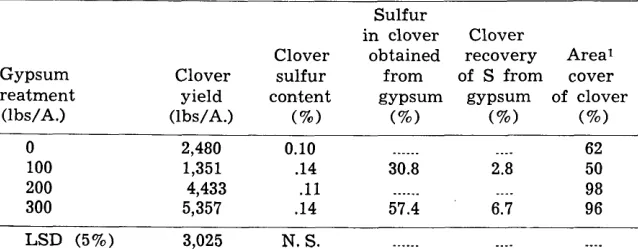
Clover growth was stimulated by the gypsum applications. Yields of clover were significant- ly greater on the 200- and 300- pound treatments than on the check and lOO-pound treatments (Table 2). The increases in sul- fur content of the plant tissues were not significant. Often an increase in sulfur occurs when gypsum is applied to legumes growing on sulfur-deficient soils (Arkley, et al., 1955; Bentley, et
al.,
1955, and Walker, 1957). However, most of the leachable sulfur had been lost by the first week of March in this experi- ment. Rapid spring growth was initiated by the clover at ap- proximately this time, and as a result, high concentrations of sulfur were not available for luxury consumption during the period of rapid plant growth.Sulfur per acre (lbs.) from lysimeters treated with indicated gypsum per acre
Item 0
100 (lbs)
200 (lbs)
300 (lbs) Sulfur added from:
Gypsum Rain Air Seed
0.0 21.3 42.7 74.3
21.4 21.4 21.4 21.4
0.1 0.1 0.1 0.1
0.1 0.1 0.1 0.1
Total 21.6 42.9 64.3 85.9
_ - d
Sulfur lost in:
Percolate (gypsum) -16.4 -50.1
-47.7* Percolate (rain, air
and seed) -14.2 -12.8 - 8.7
Radioassay indicated that clover grown on the 100- and 300-pound treated lysimeters ob-
Crop removal
(gypsum) - 0.6 - 4.3
Crop removal (rain, - 6.0”
air and seed) - 2.5 - 1.3 - 3.2
Total -16.7 -31.1 -53.7 -66.3
Calculated sulfur absorption from:
Gypsum 4.3 9.9
10.6*
Rain, air and seed 4.9 7.5 9.7
Total 4.9 11.8 10.6 19.6
__ - * Non-labeled gvnsum used; thus source of sulfur not distinguishable.
tained an average of 30.8 and _” _
57.4 Percent of the sulfur, re- from gypsum, rain water, air
spectively, from gypsum, the
proportion increasing at the contact, and seed. The losses re- higher level of application. Re- sulted from leaching removal, the former being the and crop coverY of sulfur from applied greater in magnitude, by far. gYPsum bY
the ‘clover
amounted Calculation of the net change to a 2.8 and 6.7 percent, respec- shows that the soil adsorbedtively. more sulfur than it released in
A sulfur-balance sheet was all treatments. The net adsorp- constructed for each treatment tion varied from 4.9 pounds per using the data for additions to acre for the check up to 19.6 and losses from the soil (Table pounds per acre for the lysi- 3). Additions to the soil were meters receiving the 300-pound
Table 2. Yield and sulfur conienf of rose clover grown in lysimefers treated with various amounts of gypsum.
rate of gypsum. Ensminger (1954) demonstrated sulfur ad- sorption capacity up to as high as 411 ppm in a sandy loam under laboratory conditions. The sulfur adsorbed by the soil from the label gypsum amounted to 20.2 and 15.4 percent of the sul- fur applied in the lOO- and 300- pound rates, respectively. These data lend support to the con- clusion of Kramprath, et al. (1956) that the amount of sulfate adsorbed by soil is directly re- lated to the concentration of sul- fate in the applied solution. Be- cause of the overriding adsorp- tion effect there is no way to determine whether any sulfur was released from the native soil sulfur content.
Gypsum Clover
treatment yield
(lbs/A.) (lbs/A.)
0 2,480
100 1,351
200 4,433
300 5,357
LSD (5%) 3,025
Sulfur
in clover Clover
Clover obtained recovery Area’
sulfur from of S from cover
content gypsum gypsum of clover
(%) (%) (%) (%)
0.10 ---___ ___- 62
.14 30.8 2.8 50
.ll ______ .___ 98
.14 57.4 6.7 96
N. S. __..__ ____ ____
Table 4. Effect of raie of gypsum a balance sheei check.
application on soil adsorption of sulfur-
Sulfur per acre (lbs.) from lysimeters treated with indicated gypsum per acre
Sulfur source
0 100 200 300 Gypsum
(Check) Ibs. Ibs. lbs. mean
Total S adsorbed 1958-59 (Table 3) Gypsum S adsorbed
1958-59*
Total S extracted by Morgan’s reagent Gypsum S extracted by
Morgan’s reagent *
4.9 11.8 10.6 19.6
._.. 6.9 5.7 14.7 9.1
37.5 49.7 41.9 48.8
__._ 12.2 4.4 11.3 9.3
* Values obtained by subtracting sulphur absorbed in amounts of sulphur absorbed in treated lysimeters.
check lysimeters from
petted that the contribution of sulfur from rainfall might be less in normal or subnormal rainfall years.
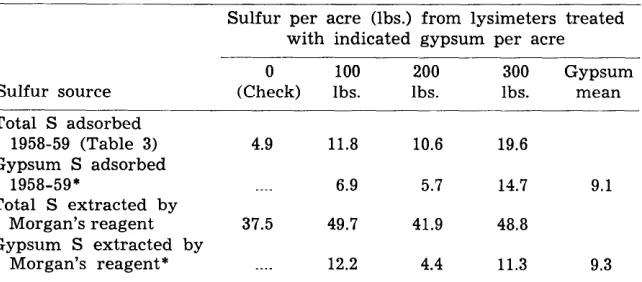
Chemical analysis of the soil at the end of the season showed an average increase of 9.3 pounds per acre of extractable sulfur in the treated lysimeters relative to the checks (Table 4). The increase can be attributed to the adsorption of added gypsum. The above value does not differ significantly from the average increase of 9.1 pounds per acre of sulfur adsorbed from the ap- plied gypsum, as calculated from the balance-sheet data by com- paring the amount of sulfur ad- sorbed in the treated lysimeters with that in the checks. The lack of close agreement among rates of applied gypsum is not surpris- ing since the differences in ex- tractable sulfur represent con- centration differences in the neighborhood of 1 ppm extract- able sulfur, which stretches the sensitive chemical method used to the lower limit of accuracy. However, these data serve as a worthwhile check on the bal- ance sheet results given in Table 3.
It may be concluded from the preceding discussion that in a wet year gypsum applied to cor- rect a sulfur deficiency may be subject to considerable leaching loss. A high rate of sulfur appli-
cation intended to last for sev- eral years could be lost as easily as a lower sulfur application rate intended for one year. Further study under less intense rainfall conditions is desirable.
Summary
A lysimeter study was initi- ated in the annual-range type to study the fate of sulfur applied in gypsum to an annual-legume, rose clover, on Vista sandy loam. The gypsum leached rapidly in a season of heavy rainfall. Sul- fur contributed by rainfall amounted to 21.4 pounds per acre, and sulfur adsorbed from the atmosphere contributed ap- proximately 0.1 pound per acre. Use of the radioisotope S”” per- mitted identification of fertilizer sulfur in the percolate. In the growing season following f ertil- ization 77.0 percent of the sulfur applied in the lOO-pound gypsum rate and 77.9 percent of the sul- fur applied in the 300-pound gypsum rate were accounted for in percolate collections.
Rose clover yield responded significantly to the higher levels of gypsum. The clover took up 30.8 and 57.4 percent of its tissue sulfur content from 100 and 300 pound applications, respectively.
LITERATURE CITED
ALWAY, F. J., A. W. MARSH, AND W. J. METHLEY. 1937. Sufficiency of atmospheric sulfur for maxi- mum crop needs. Soil Sci. Sot. Amer. Proc. 2: 229-238.
ARKLEY, R. J., W. N. HELPHENSTINE, AND W. A. WILLIAMS. 1955. Range- land forage almost trebled by seeding rose clover and use of sulfur-bearing fertilizers. Calif. Agric. 9 (8) : 15-16.
ASSOCIATION OF OFFICIAL AGRICUL- TURAL CHEMISTS. 1955. Official and tentative methods of analysis. Ed. 8, 1,008 pp. Washington.
BENTLEY, C. F., D. J. HOFF, AND D. B. SCOTT. 1955. Studies with radio- active sulphur II. Can. Jour. Agr. Sci. 35: 264-281.
BENTLEY, J. R. AND L. R. GREEN. 1954. Stimulation of native annual clovers through application of sul- fur on California foothill range. Jour. Range Mngt. 7:25-30. CONRAD, J. P. 1950. Sulfur fertiliza-
tion in California and some re- lated factors. Soil Sci. 70 (1) :43-54. DREIBELBIS, F. R. AND J. L. MCGUIN- NESS. 1957. Plant nutrient losses in lysimeter percolates. Agron. Jour. 49: 523-527.
ENSMINGER, L. E. 1954. Some factors affecting the adsorption of sul- fate by Alabama soils. Proc. Amer. Sot. Soil Sci. 18:259-264.
HARROLD, L. L., AND DREIBELBIS, F. R. 1951. Agricultural hydrology as evaluated by monolith lysimeters. U.S.D.A. Tech. Bul. 1050.
HENDRICKS, R. H., L. C. BRYNER, M. D. THOMAS, AND J. 0. IVIE. 1943. Measurement of the activity of radiosulfur in barium sulfate. Jour. Phys. Chem. 47: 469-473. JOHNSON, C. M., AND H. NISHITA. 1952.
Microestimation of sulfur in plant materials, soils, and irrigation water. Anal. Chem. 24: 736-742. JORDAN, H. V., C. E. BARDSLEY, JR.,
L. E. ENSMINGER, AND J. A. LUTZ, JR. 1959. Sulfur content of rain- water and atmosphere in southern states as related to crop needs. U.S.D.A. Tech. Bul. 1196.
KOHNKE, HELMUT, F. R. DREIBELBIS, AND J. M. DAVIDSON. 1940. A sur- vey and discussion of lysimeters and bibliography on their con- struction and performance. U.S.D.A. Misc. publ. 372:1-67. KRAMPRATH, E. J., W. L. NELSON, AND
J. W. FITTS. 1956. The effect of pH, sulfate and phosphate con- centrations on the adsorption of sulfate by soils. Soil Sci. Sot. Amer. Proc. 20: 463-466.
MARTIN, W. E. 1958. Sulfur defi- ciency widespread. Calif. Agric. 12(11):10-12.
SEAY, WILLIAM A. 1957. Sulfur con- tained in precipitation in Ken- tucky. Agron. Jour. 49: 453-454. STAUFFER, R. S. AND R. H. RUST. 1954.