Short Solutions to Nonlinear Systems of
Equations
Alan Szepieniec and Bart Preneel imec-COSIC KU Leuven, Belgium [email protected]
Abstract. This paper presents a new hard problem for use in cryptogra-phy, called Short Solutions to Nonlinear Equations (SSNE). This problem generalizes the Multivariate Quadratic (MQ) problem by requiring the solution be short; as well as the Short Integer Solutions (SIS) problem by requiring the underlying system of equations be nonlinear. The joint requirement causes common solving strategies such as lattice reduction or Gr¨obner basis algorithms to fail, and as a result SSNE admits shorter representations of equally hard problems. We show that SSNE can be used as the basis for a provably secure hash function. Despite failing to find public key cryptosystems relying on SSNE, we remain hopeful about that possibility.
Keywords: signature scheme, hard problem, post-quantum, MQ, SIS, SSNE, hash function
1
Introduction
The widely deployed RSA and elliptic curve cryptosystems rely on the hard-ness of the integer factorization and discrete logarithm problems respectively, which are in fact easy to solve on quantum computers by means of Shor’s al-gorithm [31]. These encryption and signature schemes will therefore become insecure once large enough quantum computers are built; and as a result we need to design, develop and deploy cryptography capable of resisting attacks by quantum computers, despite running on classical computers.
A number of hard problems have been proposed to replace integer factoriza-tion and discrete logarithms for precisely this purpose of offering post-quantum
hash function inversion have been used to generate stateless digital signature schemes [5]. However, in nearly all post-quantum cryptosystems to date, either the public key or else the ciphertext or signature is huge — measurable in tens of kilobytes if not megabytes1. In the interest of easing the transition away from the quantum-insecure but very low-bandwidth ECDSA, designing a post-quantum signature scheme with short signatures or ciphertextsand short public keys is a major open problem.
In this paper, we propose a new cryptographic problem called Short Solutions to Nonlinear Equations (SSNE) and argue that it is likely hard, even for quantum computers. Informally, our new hard problem asks to find a short solution to a system ofnon-linear multivariate polynomial equations, and thus generalizes both the Short Integer Solution (SIS) problem where the system is linear, and the Multivariate Quadratic (MQ) problem where the solution need not be short. Adopting both requirements renders standard attack strategies inapplicable or wildly inefficient.
Nevertheless, we show in Section 4 that it is possible to attack SSNE with limited success, in a way that improves over brute force search. We take this attack and its limitations into account and delineate a niche of parameter space in which brute force is the most efficient attack strategy. As a result, SSNE offers a denser encoding of computational hardness than either SIS or MQ, and if it is possible to design public key cryptosystems that rely on this hard problem, it holds promise of generating a smaller public keys, ciphertexts and signatures than their MQ and SIS counterparts without incurring a security cost.
While designing a public key cryptosystem on top of SSNE remains an open problem, designing a hash function whose security relies on SSNE does not, as this problem is solved in Section 5. This result does not merely serve to demon-strate design of cryptographic primitives in lieu of the comparably more difficult end-goal of designing public key functionalities; it has standalone value as well. From the point of view of provable security, very few hash functions come with a security proof showing that finding a solution implies solving a hard problem that is defined independently of the hash function itself. Therefore these not-provably-secure hash functions offer less assurance of security than provably se-cure hash functions whose underlying hard problems are studied independently. Moreover, it is prudent to diversify the hard problems upon which cryptographic primitives rely, in order to isolate the effects of cryptanalytic breakthroughs.
2
Preliminaries
Notation. We denote by Fq the finite field of q elements. The integer range
{a, a+ 1, . . . , b−1, b}is denoted by [a:b]. Vectors are denoted in boldface,e.g., xand matrices by capital letters,e.g.,A, with indexation starting at zero. The 1 The curious exception to this rule is the supersingular isogeny Diffie-Hellman key
slice ofA consisting of rowsi—j and columnsk—l is denoted by A[i:j,k:l], and we drop the, k:l when slicing from a vector instead of a matrix.
Lattices. A lattice of dimension n and embedding degree m is a discrete n -dimensional subspace of Rm; without loss of generality, we consider subspaces of Zm. Any such lattice L can be described as the set of integer combinations of a set of vectorsb0, . . . ,bn−1∈Zm, which is called abasis for the lattice and is not unique for a given lattice. A latticeLisq-ary whenever membership of a pointp∈Zmis decided bypmodq,i.e., with each component reduced modulo
q.
The LLL algorithm [24] takes a matrix of integers A ∈ Zh×w whose rows span a lattice, and outputs another matrixB∈Zh×wwhose rows span the same lattice but are much shorter in length. Without loss of generality we assume the LLL algorithm also outputs a unitary matrixU such thatU A=B. The shortest basis vector produced by LLL when applied to a lattice spanned byhvectors of
welements, is bounded in length by
kb0k2≤
4 4δ−1
(w−1)/4
det(L)1/w , (1)
where 14 < δ≤1 is the LLL parameter and where thedeterminant of the lattice
is given by det(L) = det(AAT)1/2 = det(BBT)1/2 if A and B have linearly independent rows.
In the case ofq-ary matrices, a basis matrix can be obtained by adjoining the original basis matrix withqI. LLL will return a (w+h)×wmatrix whose first
w rows consist of all zeros. The determinant ofq-ary lattices of this dimension isqw−h with high probability [27], which means that the length of the shortest nonzero vector in the output of LLL is bounded by
kb0k2≤
4 4δ−1
(w−1)/4
q(w−h)/w . (2)
The ith successive minimum λi(L) of a lattice L is the smallest ρ ∈ R such that the hypersphere with radiusρcentered at the origin contains at least
i independent lattice points. According to the m-dimensional ball argument of Micciancio and Regev [27], the first successive minimum of a randomq-ary lattice of dimensionhand embedding dimension wcan be approximated by
λ0(L)≈
r
w
2πeq
(w−h)/w . (3)
3
Short Solutions to Nonlinear Equations
consider some straightforward attacks. In the next section we consider a more sophisticated one.
MQ Problem.Given a quadratic mapP :Fn
q →Fmq consisting ofm poly-nomials in n variables of degree at most 2, find a vector x ∈ Fn
q such that
P(x) =0.
The MQ problem isNP-hard in general as well as empirically hard on average wheneverm≈n. The best known attack is the hybrid attack [6], which consists of guessing some variables so as to overdetermine the system of equations and then solving it using a Gr¨obner basis type solver such as F4 [16] or XL [13]. The reduced cost of solving the overdetermined system compensates for the increased cost of retrying a new guess whenever it leads to no solutions. The complexity of the optimal-trade-off hybrid attack approaches 2Cqn asnq→ ∞withC
q =
ω(1.38−0.44ωlog2q) and whereω≥2 is the exponent of matrix multiplication complexity [7]. However, whenqn, the cost of even one random guess beyond the number of variable-fixes that makes the system a determined one, dominates the attack complexity. In this case the complexity of a purely algebraic attack can be estimated using thedegree of regularity Dregof the system. For semi-regular quadratic systems [4,3] (which we assume random quadratic systems are), the degree of regularity is equal to the degree of the first term with a non-positive coefficient of the power series expansion of
HS(z) = (1−z 2)m
(1−z)n . (4)
At this point, the Gr¨obner basis computation using F4 or XL boils down to performing sparse linear algebra in the Macaulay matrix whose polynomials have degree Dreg. The complexity of this task is O
n+D
reg+1 Dreg
2
in terms of the number of finite field operations, which in turn are polynomial in logq. In summary, the complexity of solving the MQ problem isexponential in n≈m, but barely affected byq.
SIS Problem.Given a matrixA∈Fnq×mwithm > n, find a nonzero vector x∈Zm\{0} such thatAx=0modqandkxk
2≤β.
While notNP-hard, SIS does offer an average-case to worst-case reduction: solving random SIS instances is at least as hard as solving the lattice-based Shortest Independent Vectors Problem (SIVP) up to an approximation factor of ˜O(β√n) in the worst case [26]. The most performant attack on SIS is indeed running a lattice-reduction algorithm such as BKZ 2.0 [8] to find short vectors in the associated lattice which is spanned by the kernel vectors ofA. The complexity of this task is captured by the root Hermite factor δ > 1, which approaches 1 for more infeasible computations. For a givenδ the optimal number of columns of A to take into account (i.e., by setting the coefficients of x associated to the other columns to zero) is given by m=pnlog2q/log2δ. At this point the average length of the lattice points found is 22
√
security requiresβ to be smaller than this number. Albrechtet al.estimate the complexity of obtaining lattice points of this quality as 0.009/log22δ+4.1 in terms of the base-2 logarithm of the number of time steps [2]. The key takeaway is that the complexity of SIS growsexponentiallyinmandn, butpolynomiallyinqand
β.
SSNE Problem (Short Solutions to Nonlinear Equations) Given a map
P : Fnq → Fmq consisting of m polynomials in n variables over a prime field Fq and with deg(P) ≥2, find a vector x ∈ Zn such that P(x) = 0modq and
kxk2≤β.
It is clear that the attack strategies that work for MQ and SIS do not apply out of the box to the SSNE problem. The random guess of the hybrid attack on MQ might fix the first few variables to small values, but offers no guarantee that an algebraic solution to the other variables is small. Alternatively, one can drop the random guess and compute a Gr¨obner basis for the under-determined system. Even if the resulting Gr¨obner basis consists of a reasonable number of polynomials of reasonable degrees, obtaining a short vector in the variety associated with the Gr¨obner basis seems like a hard problem in and of itself. Alternatively, one can linearize the system by introducing a new variable for every quadratic term and treat the resulting matrix of coefficients as the matrix of a SIS instance. However, in this case it is unclear how to find the correct length boundβ as it now applies to a vector of quadratic monomials. Nevertheless, we now show under which conditions or adaptations an algebraic attack and attack based on lattice reduction are possible.
3.1 Algebraic Attack
The constraint kxk2 ≤ β can be formulated algebraically. Assume β < q/2, and let b = bβc. Then any solution x to the SSNE problem must consist of coefficients in [−b:b]. For any such coefficientxi, the polynomialQ
b
j=−b(xi−j) must evaluate to zero. Therefore, by appending these polynomials to P, one obtains a less under-determined system and perhaps even a determined one. If that is the case, XL and F4 will find a short solution; however, the Gr¨obner basis computation must reach degree 2b for the added polynomials to make a difference, and for sufficiently largeβeven this task is infeasible. It is possible to generalize this strategy so as to require that the sums-of-squares of all subsets of the coefficients ofxare smaller thanβ. This method cannot work when β > q, but can be effective whenβ is small — say, a handful of bits.
Alternatively, it is possible to run down the unsigned bit expansion of every component of x and introduce a new variable xi,j for each bit and one for each component’s sign si. This transformation adds n equations of the form
xi =siP
dlog2qe
In both cases, the system of equations becomes infeasibly large wheneverβ
grows, which is exactly the intended effect from a design perspective. Phrased in terms of the security parameterκ, we have
Design Principle 1:β must be large: log2β > κ.
Note thatβ cannot be larger than√n(q−1)/2 because in that caseany so-lution vectorxsatisfies the shortness criterion, which can therefore be forgotten at no cost in favor of a very fast algebraic solution. In fact, we want a random solution to the system of equations to satisfykxk2≤β with at most a negligible probability. Design principle 2 requires this probability to be at most 2−κ, where
κis the targeted security level.
Design Principle 2:β must not be too large: nlog2q≥κ+nlog2β.
3.2 Lattice Attack
In the relatively small dimensions considered for SSNE, basic lattice reduction algorithms such as LLL [23] manage to find the shortest vector in polynomial time with all but absolute certainty. Moreover, the nonlinear systemP(x) =0 can always2be represented as a linear systemPx¯=0, whereP is the Macaulay matrix of P and¯x is the vector of all monomials inx that appear in P. If the solutionxtoP(x) =0is short enough, then its expansion into¯xwill also be a solution toP¯x=0— and might be found quickly by lattice-reducing any basis for the kernel ofP and weighting the columns as necessary.
In fact, the vector¯xassociated with a solutionxtoP(x) =0willalways lie in the kernel of P, although not every kernel vector corresponds to a solution. Since¯xis necessarily in the lattice spanned by the kernel vectors ofP, the only way to hide it from lattice-reduction is to make it long — as long as random lattice vectors taken moduloq. The rationale behind the next design principle is to require that some of the quadratic monomials¯xare of the order of magnitude ofq(possibly after modular reduction).
Design Principle 3: xmust not be too small: log2kxk2
2≥log2q.
A straightforward attack strategy to cope with this design principle is to focus only on those columns ofP that correspond to the monomials of degree 1 in¯x. Lattice reduction will then find short kernel vectors for this reduced matrix
˜
P. The attack runs through linear combinations of these small reduced kernel vectors until it finds a small linear combinationcsuch thatP(c) =0. A rigorous argument counts the number of points in this lattice that have the correct length and then computes the proportion of them that solveP(x) =0, and infers from this a success probability and hence a running time for the attack. A far simpler but heuristic argument pretends that the nonlinear monomials of ¯x multiply with their matching columns from P and thus generate a uniformly random
2
offset vector p. The attacker succeeds only when p+ ˜Px = 0, which can be engineered to occur with at most a negligible probability.
Design Principle 4:The output space must be large enough:mlog2q≥κ.
Lattice-reduction has been used in the past to find small solutions to uni-variate and multiuni-variate polynomial equations, for instance in the context of factoring RSA modulin=pq where some of the bits ofporqare known. These applications of LLL were first discovered by Coppersmith [10,9], and were then expanded on by Howgrave-Graham [19], Jutla [21], Coron [11,12], and most re-cently by Ritzenhofen [30]. The common strategy behind all these attacks is to generate clever algebraic combinations of the polynomials but which must be lin-early independent. LLL is run either on the resulting system’s Macaulay matrix or on its kernel matrix to find either polynomial factors with small coefficients or else short roots. However, this family of methods is only effective when the targeted solution is short enough. In particular, ifXi ∈Zis a bound onxi,i.e.,
|xi| ≤Xi, then success is only guaranteed whenever for every termt∈Fq[x] of every polynomial ofP (interpreted ast∈Z[x])
|t(X1, . . . , Xn)|< q . (5) This success criterion is inconsistent with design principle 3.
3.3 Additional Considerations
Note that the shortness constraint kxk2 ≤ β does not have to apply to all variables. Even requiring onlyqP
i∈Sx 2
i ≤β where the sum is taken only over a non-empty subset S of the variables suffices to capture the hardness of the problem. More generally, the problem can be defined with respect to any weight matrixW ∈Zn×n, namely by requiring thatxTWx≤β2. Diagonalization ofW leads to a partitioning of the variables into one set which should be short and one set whose length does not matter. Nevertheless, one should be careful to ensure that the number of short variables must be larger than the dimension of the variety. Otherwise the shortness constraint is no constraint at all because it is possible to guess the short variables and subsequently solve for the remaining variables using a Gr¨obner basis algorithm.
Design Principle 5.There should be more small variables than the dimen-sion of the variety:rank(W +WT)>dimV(P) =n−m.
indicate the variables whose size is unconstrained. Moreover, the rank ofW+WT cannot change under left or right multiplication by invertible matrices such as
STor S.
3.4 Estimating Hardness
The main selling point of the SSNE problem is that neither the algebraic solvers nor lattice-reduction algorithms seem to apply, and as a result of this immunity it admits a much conciser encapsulation of cryptographic hardness. In MQ prob-lems, the hardness derives from the large number of variables and equations n
andm, and is largely independent of the field sizeq. In SIS problems, the hard-ness derives mostly from the large lattice dimensionn, although the field sizeq
and length constraintβ are not entirely independent. Since both Gr¨obner basis and lattice-reduction algorithms do not apply, the hardness of SSNE problems must be much more sensitive to the size of the search space than their MQ and SIS counterparts. In particular, this sensitivity allows designers to achieve the same best attack complexity while shrinkingm and nin exchange for a larger
q— a trade-off that makes perfect sense because in all cases the representation of a single problem instance is linear inlog2q andpolynomial inm andn.
All five design principles, including design principle 6 which will be derived in Section 4, have a limited range of applicability. No known algorithm solves SSNE problems for which all six criteria are met, faster than the following brute force search does. In the most optimistic scenario, no such algorithm exists. We invite the academic community to find attacks on SSNE that outperform this brute force search. In Section 5 we propose a hash function whose security relies on the assumption that either such an algorithm does not exist or that if it does, it does not beat brute force by any significant margin.
A brute force strategy must only search acrossFnq−m. Each guess of the first
n−m variables is followed by an algebraic solution to the remaining system of m equations in m variables. If m is not too large then the task of finding this solution algebraically is rather fast, and the complexity of this joint task is dominated by O(qn−m). In quantum complexity, Grover’s algorithm [18] offers the usual square root speed-up ofO(q(n−m)/2).
4
An Algebraic-Lattice Hybrid Attack
4.1 UOV
Unbalanced Oil and Vinegar [22] is an MQ signature scheme with parameters
n = o+v, v ≈ 2o and m = o. The public key is a homogeneous quadratic map P : Fnq →F
m
q . The secret key is a decomposition of this public map into
F : Fnq →Fmq and S ∈GLn(Fq) such that P =F ◦S. WhileS is a randomly chosen invertible matrix, F must have a special structure. All m components
fi(x) partition the variables into two sets: vinegar variablesx0, . . . , xv−1, which are quadratically mixed with all other variables; and oil variablesxv, . . . , xn−1. Visually, the matrix representations of these quadratic forms have an all-zero3
o×oblock:
fi(x) =xT
x . (6)
In order to compute a signature for a document d ∈ {0,1}∗, the signer
computes its hash y = H(d). He then chooses a random assignment to the vinegar variables and substitutes these into the system of equations P(x) =y, or more explicitly
.. .
Pv−1 j=0
Pj k=0f
(i) j,kxjxk+
Pv−1 j=0
Pn−1 k=vf
(i)
j,kxjxk=yi ..
.
, (7)
wherefj,k(i)represents the coefficient of the monomialxjxk of theith component ofF. The underlining indicates vinegar variables, which are substituted for their assignments. It is clear from this indication that the system of equations has become linear in the remaining oil variables, and since m=o, it has one easily computed solution in the generic case. The signer chooses a different assignment to the vinegar variables until there is one solution. At this point, the signature s∈Fnq is found by computing s=S−
1x. It is verified through evaluation ofP,
i.e.,P(s)=? H(d).
4.2 Reconciliation Attack
The reconciliation attack [15] is essentially an algebraic key recovery attack: the variables are the coefficients ofS−1and the equations are obtained by requiring that all the polynomials be of the same form as Eqn. 6. Na¨ıvely, this requires solving a quadratic system of mo(o+ 1) equations in n2 variables. However, the attack relies on the observation that there is almost always a viable S0−1
3
compatible with (6) but of the form
S0−1=
v
o
. (8)
This observation is justified by the fact that only the coefficients ofS−1that are located in the rightmostocolumns appear as indeterminates in the coefficients that are equated to zero. Moreover, any linear recombination of these columns also maps the oil-times-oil coefficients to zero and therefore we might as well consider only the representative of this equivalence class (equivalence under lin-ear recombination of the rightmost o columns) whose bottom righto×oblock is the identity matrix.
The use of this observation reduces the number of variables tov×o. Moreover, the key observation behind the reconciliation attack is that theocolumns ofS0−1
can be found iteratively, solving a new quadratic system at each step. Moreover, the authors of this attack argue that the complexity of this strategy is dominated by the first step, which requires solving onlymequations in v variables [15].
These optimizations are no issue in our attack on SSNE. The parametersm
and n are generally small enough to make na¨ıvely solving a quadratic system ofmo(o+ 1)/2 equations inn2variables feasible. However, for generic systems, whenevermo(o+ 1)/2> n2 there might not exist aS−1∈GLn(
Fq) that brings
P into the form of Eqn. 6. But choosingoto be different frommmight bring a suitableS−1 back into existence. This motivates the following definition. Definition 1 (o-reconcilable). A systemP ofmmultivariate quadratic poly-nomials in nvariables overFq is o-reconcilable iff there exists anS ∈GLn(Fq)
such thatP ◦S partitions thenvariables into v=n−ovinegar variables and o
oil variables distinguished by P ◦S being linear in the oil variables.
Remark.Clearly, constant and linear terms are linear in all variables under any change of basis. Reconcilability considers only the quadratic part of the polynomials and without loss of generality we may restrict attention to their homogeneous quadratic part.
Theorem 1 (m-reconcilability of UOV).LetP :Fn
q →Fmq be the public key
of a UOV cryptosystem. ThenP ism-reconcilable.
Proof. Trivial: follows from construction ofP =F ◦S. F induces the required
partition into oil and vinegar variables. ut
Theorem 2 (bn/2c-reconcilability when m= 1). Assume q is odd. LetP : Fnq →Fq be a single quadratic polynomial. ThenP isbn/2c-reconcilable.
Proof. LetQp∈Fqn×nbe a symmetric matrix representation ofP(x) viaP(x) = xTQ
All non-zero elements on the diagonal must be one except for the last which might be the smallest quadratic non-residue in Fq. Now choose a random sym-metric matrixQf ∈Fnq×n such that the lower rightbn/2c × bn/2cblock consists of all zeros and such thatrank(Qf) =rank(Qp). It is also diagonalizable: there is an invertible matrixB∈Fnq×n such thatBTQfBis a diagonal matrix consisting of all ones except for the last element which might be the smallest quadratic non-residue. IfBTQ
fB=ATQpAwe are done becauseF =P ◦B−1◦Ainduces the required partition. IfBTQ
fB6=ATQpAthey must differ in the last diagonal element. So then multiply any one nonzero row ofQf by any quadratic residue and obtain another diagonalization. NowBTQfB =ATQpA must hold and we
are done. ut
Theorem 3. In the generic case, a system of m quadratic polynomials in n
variables overFq iso-reconcilable whenm(o+ 1)/2≤n.
Proof. The number of coefficients of S−1 that are involved in the mo(o+ 1)/2 equations that set the oil-times-oil coefficients to zero is no, corresponding the rightmost n×o block of S−1. The other elements of S−1 do not affect these coefficients. This leads to a system of mo(o+ 1)/2 quadratic equations in no
variables which generically has solutions whenmo(o+ 1)/2≤no, or equivalently
whenm(o+ 1)/2≤n. ut
4.3 Generating Small Solutions
After obtaining an o-reconciliation (F, S), the task is to obtain a solution x such thatF(x) =0and such thatS−1xis small. The partitioning ofxinto the vinegar variables x0, . . . , xv−1 and the oil variables xv, . . . , xn−1 separates the shortness objective into two parts. On the one hand, thevinegar contribution
S−1[:,0:(v−1)]x[0:(v−1)] (9) must be small; on the other hand, the oil contribution
S−1
[:,v:(n−1)]x[v:(n−1)] (10) must be small as well. The reason for this separation is not just that the vinegar variables and oil variables are determined in separate steps; in fact, determining vinegar variables that lead to a small vinegar contribution is easy. The form of Eqn. 8 guarantees that small vinegar variables will map onto a small vinegar contribution. Therefore, the only requirement for selecting vinegar variables is that they be small enough, say roughlyq1/2. By contrast, the process of finding suitable oil variables is far more involved.
The task is thus to find an assignment to the oil variables such that a)
F(x) =0is satisfied; and b) S−1
[:,v:(n−1)]xv:(n−1)is small as well. Constraint (a) is satisfiable whenever m ≤ o (in the generic case, i.e., assuming certain square matrices over Fq are invertible). Constraint (b) requireso > m and the resulting vector can be made shorter with growingo−m.
The matrix representation of a quadratic form is equivalent under addition of skew-symmetric matrices, which in particular means that it is always possible to choose an upper-triangular representation even of UOV maps such as Eqn. 6. Theith equation ofF(x) =0can therefore be described as
fi(x) =xT
Qi Li
x+`
(i)Tx+c
i= 0 (11)
xT
[0:(v−1)]Li+` (i)T [v:(n−1)]
x[v:(n−1)]=−xT[0:(v−1)]Qix[0:(v−1)]−` (i)T
[0:(v−1)]x[0:(v−1)]−ci.
(12) All m equations can jointly be described as Ax[v:(n−1)] = b for some matrix
A ∈Fmq ×o and vectorb ∈F m
q , because the vinegar variables x[0:(v−1)] assume constant values. Letx(p)be any particular solution to this linear system, and let x0(k), . . . ,x(ok−)m−1 be a basis for the right kernel ofA. Any weighted combination of the kernel vectors plus the particular solution, is still a solution to the linear system:
∀(w0, . . . , wo−m−1)∈Foq−m. A x (p)+
o−m−1
X
i=0
wix (k) i
!
=b . (13)
This means we haveo−mdegrees of freedom with which to satisfy constraint (b). In fact, we can use LLL for this purpose in a manner similar to the clever selection of the vinegar variables. The only difference is that the weight associ-ated with the vectorx(p) must remain 1 because otherwise constraint (a) is not satisfied. This leads to the following application of the embedding method.
Identifyx(p)and allx(k)
i by their image after multiplication by S
−1
[:,v:(n−1)], thus obtainingz(p)= S−1
[:,v:(n−1)]x
(p) and z(k)
i = S−1
[:,v:(n−1)]x (k) i . Then appendq2 to z(p) and 0 to all z(ik), and stack all these vectors in column form over a diagonal ofq’s to obtain the matrixC:
C=
— z(p)T — q2 — z(0k)T — 0
..
. ...
—z(ok−)mT−1— 0
Run LLL on this matrix to obtain a reduced basis matrixB∈Z(o−m+1+n)×(n+1) of which the firstnrows are zero, and a unimodular matrixUsatisfyingB=U C. The appendedq2element guarantees that the row associated with the particular solution will never be added to another row because that would increase the size of the basis vectors. As a result, there will be one row in the matrixBthat ends in
q2. Moreover, this row will be short because it was reduced by all other rows. We now proceed to derive an upper bound for the size of this vector considering only the first n elements,i.e., without theq2. Unfortunately, the best upper bound we can prove rigorously is dq2e√n, but we can rely on the following heuristic argument for a meaningful result.
Letsbe the index of this targeted row. Without rowsand omitting the last column, the nonzero rows ofB form an LLL-reduced basis for aq-ary lattice of dimensiono−mand embedding dimensionn. We approximate the sizes of these vectors usingλi(L)≈λ0(L). Coupled with them-dimensional ball argument of Micciancio and Regev for estimating the first successive minimum [27], this gives
kb`k2.2(o−m)/2
r
n
2πeq
(n−o+m)/n . (15)
Moreover, row s (considered without the q2) cannot be much larger than this quantity because it is LLL-reduced with respect to vectors of this size. So
kbsk2 ≈ kb`k2. Our experiments show that this heuristic bound is followed quite closely in practice for smallm, nand largeq.
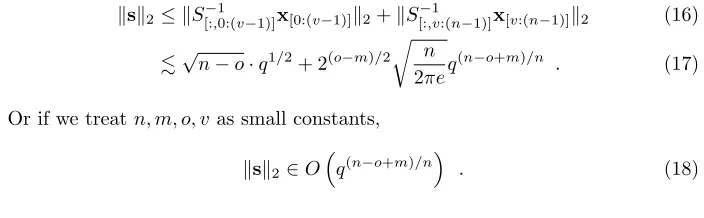
The solution s=S−1x consists of two parts: the vinegar contribution and the oil contribution. Therefore, we can bound the size of the whole thing.
ksk2≤ kS[:−,10:(v−1)]x[0:(v−1)]k2+kS[:−,v1:(n−1)]x[v:(n−1)]k2 (16)
.√n−o·q1/2+ 2(o−m)/2
r
n
2πeq
(n−o+m)/n . (17)
Or if we treatn, m, o, vas small constants,
ksk2∈O
q(n−o+m)/n . (18)
4.4 Summary
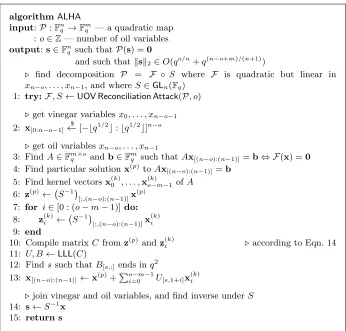
algorithmALHA
input:P:Fnq →Fmq — a quadratic map :o∈Z— number of oil variables output:s∈Fnq such thatP(s) =0
and such thatksk2∈O(qo/n+q(n−o+m)/(n+1))
. find decomposition P = F ◦ S where F is quadratic but linear in
xn−o, . . . , xn−1, and whereS∈GLn(Fq) 1: try:F, S←UOV Reconciliation Attack(P, o)
.get vinegar variablesx0, . . . , xn−o−1 2: x[0:n−o−1]
$
←−[−bq1/2c:bq1/2c]n−o
.get oil variablesxn−o, . . . , xn−1
3: FindA∈Fm×oq andb∈Fqmsuch thatAx[(n−o):(n−1)]=b⇔ F(x) =0 4: Find particular solutionx(p) toAx
[(n−o):(n−1)]=b 5: Find kernel vectorsx(k)0 , . . . ,x
(k)
o−m−1 ofA 6: z(p)← S−1
[:,(n−o):(n−1)]x (p)
7: for i∈[0 : (o−m−1)]do: 8: z(k)i ← S−1
[:,(n−o):(n−1)]x (k) i 9: end
10: Compile matrixC fromz(p)andz(k)i .according to Eqn. 14 11: U, B←LLL(C)
12: Findssuch thatB[s,:] ends inq2 13: x[(n−o):(n−1)]←x(p)+P
o−m−1
i=0 U[s,1+i]x(k)i
.join vinegar and oil variables, and find inverse underS
14: s←S−1x 15: return s
Fig. 1.Algebraic-lattice hybrid attack.
the returned solution is not fixed beforehand but depends on the largest o for which step 1 succeeds.
With this algebraic-lattice hybrid attack in mind, we formulate the last design principle for SSNE instances. The rationale is that the targeted solution should be significantly smaller (i.e., κ bits, spread over n variables) than what the algebraic-lattice hybrid attack can produce.
Design Principle 6: Let o be the largest integer such that the system is
o-reconcilable. If o > mthen guarantee that
κ
n+log2β≤
n−o+m
4.5 Discussion
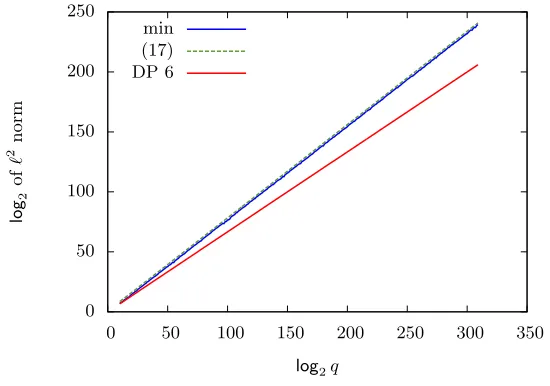
Equation 15 is an upper bound whereas we actually need a lower bound in order to delineate a portion of the parameter space where the attack does not apply. In practice, the short solutions found by the algebraic lattice hybrid attack are indeed shorter than the heuristic upper bound of Eqn. 17. Nevertheless, the solutions found by the attack have length very close to this bound, to the point where it is a suitable estimate. Fig. 2 plots in full blue the minimum length of solutions found by the algebraic lattice hybrid attack across one hundred trials for various modulus sizes. This graph follows the dashed green line, which represents the estimate or heuristic upper bound of Eqn. 17, quite closely. Both are far apart from the recommendation of design principle 6, which is drawn in full red. This graph represents many random SSNE instances with m = 2 and n= 9. The same behavior was observed across a wide range of parameter choices.
0 50 100 150 200 250
0 50 100 150 200 250 300 350
log
2
of
`
2
norm
log2q
min (17) DP 6
Fig. 2. Comparison of prediced length against experimental length of solutions ob-tained by the algebraic-lattice hybrid attack.
It is worth stressing that the algebraic-lattice hybrid attack applies only when o > m. Wheno=m it does not produce solutions that are shorter than random vectors in Fn
q, and when o < m there is no guarantee it will find even one solution. Obviously, instead of requiring β to be significantly smaller than the expected length of this attack’s solutions, the designer might also choose n
5
Hash Function
At this time we do not know how to use SSNE to generate short-message public key functionalities. The next best option is to generate a hash function, which is what this section is about.
The resulting design does not merely exemplify using the SSNE problem constructively; it has concrete advantages over other hash functions as well. For instance, not only is the SSNE hash function provable secure (in contrast to all widely deployed hash functions), but it also relies on a different hard problem, which is likely to be unaffected by potential future breakthroughs in cryptanalysis of other hard problems. Also, our hash function has essentially optimal output length in terms of security: forκbits of security against collision finders the output is 2κbits long. This stands in contrast to many other provably secure hash functions which either have larger outputs or else require purpose-defeating post-processing functions to shrink them.
Additionally, because the hash function is built on top of SSNE instances, it requires comparably few finite field multiplications to compute. This property of having low multiplication complexity is interesting from the point of view of multiparty computation, zero-knowledge proofs, and fully homomorphic encryp-tion, where multiplication operations are typically so expensive as to compel minimization at all costs. However, this argument ignores the cost of the bit shuffling, which are nonlinear operations over the finite field.
We note that it is possible to generate digital signature schemes from just hash functions [17,5], although the size and generation time of the signatures scales poorly. Nevertheless, anyone wanting to implement this signature scheme’s key generation or signature generation procedures in a distributed manner — for instance, in order to require majority participation — must develop applied multiparty computation protocols and must consequently look to minimize mul-tiplication complexity. Therefore, the SSNE hash function might be a good can-didate for instantiating hash-based digital signature schemes with if they must enable distributed key and signature generation.
5.1 Description
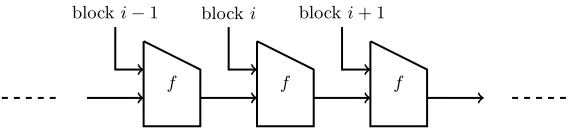
We use the Merkle-Damg˚ard construction, which requires dividing the data stream into a sequence of size b blocks. At every iteration, one data block is consumed and it is compressed with the state in order to produce a new state. The hash value is the output of the compression function after the last block has been consumed. The concept is described visually in Fig. 3.
Before applying the sequence of compression functions, the data streamx∈ {0,1}∗must first be expanded into a multiple ofbbits. Let`=|x|be the number
of bits before padding, and let x`y be its expansion and |`| the number of bits in this expansion. The expansion function is given by
expand:{0,1}`→ {0,1}d(`+|`|)/beb=x7→xk0−`modbk0−|`|modbk
f f f
blocki−1 blocki blocki+ 1
Fig. 3.Merkle-Damg˚ard construction for hash functions.
Letqbe the largest prime smaller than 22κ, whereκis the targeted security level. For the purpose of defining this hash function, the elements of Fq are
{0, . . . , q−1}. The compression function itself decomposes intof =P ◦r. The purpose ofr:{0,1}b×
Fq →F2q is to permute the bits and output two integers inside [0 : dq3/4e −1], which are then interpreted as small elements of
Fq. In particular, on input (s, e)∈ {0,1}b×
Fq, this reshuffling function takes the most significant 14dlog2qebits ofe, appends them tos, and reinterprets this bitstring as an integer. Formally,rmaps
r: sb−1k · · · ks0,
dlog2qe−1 P
i=0
2ie i
!
7→
b−1 P
i=0
2is i
+ d3
4log2qe−1
P
i=b
2ie i+b/2
!
, d3
4log2qe−1
P
i=0
2ie i
!
.
(21) In particular, this implies thatb=12dlog2qe.
The mapP :F2
q →Fq is a single homogeneous cubic polynomial in two vari-ables. There are 52
= 10 coefficients which are assigned indices lexicographically from 0 to 9. Then the ith coefficient has a bit expansion equal to the first 2κ
bits in the expansion ofπi+1, without the leading 1.
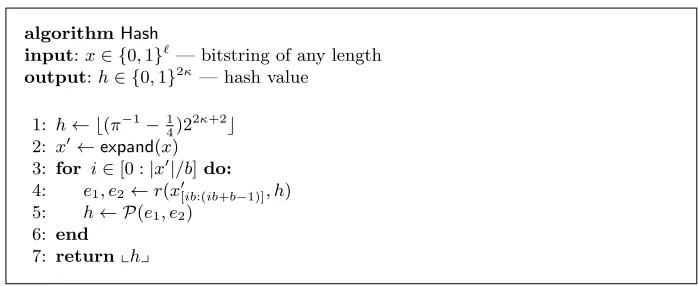
The description of the hash function is complete except for one remaining item. The initial state element, i.e., the field element that is fed into the very first compression function must still be specified. For this value we choose the first 2κbits ofπ−1, again without the leading 1. The formal description of the algorithm is given in Fig. 4.
5.2 Security
The key property a hash function should possess is collision-resistance, which in-formally states that it should be difficult to find two different inputsx, y∈ {0,1}
such that Hash(x) = Hash(y). Collision-resistance implies weaker properties such as second preimage resistance and first preimage resistance (also known as one-wayness). Therefore, it suffices to show that collisions are hard to find. We demonstrate this fact by showing that any pair of colliding values implies a collision for P, which should be difficult to find because that task requires solving a hard SSNE instance.
First, consider that expand is injective. To see this, assume there are two different stringsxandythat have the same output underexpand. Then|x| 6=|y|
algorithmHash
input:x∈ {0,1}`— bitstring of any length output:h∈ {0,1}2κ
— hash value
1: h← b(π−1−1 4)2
2κ+2c 2: x0←expand(x) 3: for i∈[0 :|x0|/b]do: 4: e1, e2←r(x0[ib:(ib+b−1)], h) 5: h← P(e1, e2)
6: end 7: returnxhy
Fig. 4.Hash function relying on SSNE.
be present in their images underexpand as well. However, the lastb bits of the images under expanduniquely determine the length of the original strings and this quantity must be the same, which contradicts |x| 6= |y|. This argument assumes the length of the inputs is less than 2b = 2κ, which is reasonable from a practical point of view. Sinceexpandis injective, it cannot be the source of a collision.
Next, the permutation of bits r is a bijection. It cannot be the source of a collision either.
Therefore, the only source of collisions contained in the description of the hash function isP. Finding a collision means finding a pair of vectorsa,b∈F2 q whose elements have at most 64κbits, such thatP(a) =P(b). One can re-write this equation in terms of the difference d from the mean c = (a+b)/2. The equation then becomes
P(c+d)− P(c−d) =0 . (22)
This expression is useful because its degree incis one less,i.e., 2 instead of 3. Therefore, by choosing a random value for dthe attacker finds c by solving a
quadratic, instead ofcubic, SSNE instance. (In fact, this argument was precisely the motivation for a degree-3 polynomial mapP to begin with; to kill an attack strategy that involves only finding short solutions to linear equations.) The parameters of the hash function were chosen to ensure that the SSNE instance of Eqn. 22 (with randomly chosend) satisfies all design principles.
6
Conclusion
scaling of the SIS and MQ problems; and therefore, if it is possible to generate post-quantum public key cryptosystems from SSNE as it is from SIS and MQ, then these cryptosystems are very likely to require dramatically less bandwidth for having smaller public keys, ciphertexts, or signatures.
Indeed, the goal of the research that lead to the writing of this paper was to generatepublic keycryptosystems with exactly those properties. Needless to say, we have failed in that endeavor. Some of the design principles came about as a result of a process of design and attack. At least from a superficial point of view, this failure suggests that the design principles are incompatible with strategies for generating public key cryptosystems. Nevertheless, we remain hopeful about the possibility of finding strategies that are compatible with the design principles and leave their discovery as an open problem.
Acknowledgments. The authors would like to thank Fr´e Vercauteren and Wouter Castryck for useful discussions and references, as well as the anony-mous reviewers for helpful comments. Alan Szepieniec is being supported by a Ph.D. grant from the Institute for the Promotion of Innovation through Science and Technology in Flanders (IWT-Vlaanderen). This work was supported in part by the Research Council KU Leuven: C16/15/058. In addition, this work was supported by the European Commission through the Horizon 2020 research and innovation programme under grant agreement No H2020-ICT-2014-644371 WITDOM and H2020-ICT-2014-645622 PQCRYPTO.
References
1. Ajtai, M.: Generating hard instances of lattice problems (extended abstract). In: Miller [28], pp. 99–108,http://doi.acm.org/10.1145/237814.237838
2. Albrecht, M.R., Cid, C., Faug`ere, J., Fitzpatrick, R., Perret, L.: On the complexity of the BKW algorithm on LWE. Des. Codes Cryptography 74(2), 325–354 (2015), http://dx.doi.org/10.1007/s10623-013-9864-x
3. Bardet, M.: ´Etude des syst`emes alg´ebriques surd´etermin´es. Applications aux codes correcteurs et `a la cryptographie. Ph.D. thesis, Pierre and Marie Curie University, Paris, France (2004),https://tel.archives-ouvertes.fr/tel-00449609 4. Bardet, M., Faugere, J.C., Salvy, B.: On the complexity of gr¨obner basis
compu-tation of semi-regular overdetermined algebraic equations. In: Proceedings of the International Conference on Polynomial System Solving. pp. 71–74 (2004) 5. Bernstein, D.J., Hopwood, D., H¨ulsing, A., Lange, T., Niederhagen, R.,
Pa-pachristodoulou, L., Schneider, M., Schwabe, P., Wilcox-O’Hearn, Z.: SPHINCS: practical stateless hash-based signatures. In: Oswald, E., Fischlin, M. (eds.) Ad-vances in Cryptology - EUROCRYPT 2015 - 34th Annual International Con-ference on the Theory and Applications of Cryptographic Techniques, Sofia, Bulgaria, April 26-30, 2015, Proceedings, Part I. Lecture Notes in Computer Science, vol. 9056, pp. 368–397. Springer (2015), http://dx.doi.org/10.1007/ 978-3-662-46800-5_15
7. Bettale, L., Faug`ere, J., Perret, L.: Solving polynomial systems over finite fields: improved analysis of the hybrid approach. In: van der Hoeven, J., van Hoeij, M. (eds.) International Symposium on Symbolic and Algebraic Computation, IS-SAC’12, Grenoble, France - July 22 - 25, 2012. pp. 67–74. ACM (2012), http: //doi.acm.org/10.1145/2442829.2442843
8. Chen, Y., Nguyen, P.Q.: BKZ 2.0: Better lattice security estimates. In: Lee, D.H., Wang, X. (eds.) Advances in Cryptology - ASIACRYPT 2011 - 17th ternational Conference on the Theory and Application of Cryptology and In-formation Security, Seoul, South Korea, December 4-8, 2011. Proceedings. Lec-ture Notes in Computer Science, vol. 7073, pp. 1–20. Springer (2011), http: //dx.doi.org/10.1007/978-3-642-25385-0_1
9. Coppersmith, D.: Finding a small root of a bivariate integer equation; factoring with high bits known. In: Maurer [25], pp. 178–189,https://doi.org/10.1007/ 3-540-68339-9_16
10. Coppersmith, D.: Finding a small root of a univariate modular equation. In: Maurer [25], pp. 155–165,https://doi.org/10.1007/3-540-68339-9_14
11. Coron, J.: Finding small roots of bivariate integer polynomial equations revis-ited. In: Cachin, C., Camenisch, J. (eds.) Advances in Cryptology - EURO-CRYPT 2004, International Conference on the Theory and Applications of Cryp-tographic Techniques, Interlaken, Switzerland, May 2-6, 2004, Proceedings. Lec-ture Notes in Computer Science, vol. 3027, pp. 492–505. Springer (2004), https: //doi.org/10.1007/978-3-540-24676-3_29
12. Coron, J.: Finding small roots of bivariate integer polynomial equations: A direct approach. In: Menezes, A. (ed.) Advances in Cryptology - CRYPTO 2007, 27th Annual International Cryptology Conference, Santa Barbara, CA, USA, August 19-23, 2007, Proceedings. Lecture Notes in Computer Science, vol. 4622, pp. 379– 394. Springer (2007),https://doi.org/10.1007/978-3-540-74143-5_21 13. Courtois, N., Klimov, A., Patarin, J., Shamir, A.: Efficient algorithms for solving
overdefined systems of multivariate polynomial equations. In: Preneel, B. (ed.) Advances in Cryptology - EUROCRYPT 2000, International Conference on the Theory and Application of Cryptographic Techniques, Bruges, Belgium, May 14-18, 2000, Proceeding. Lecture Notes in Computer Science, vol. 1807, pp. 392–407. Springer (2000),http://dx.doi.org/10.1007/3-540-45539-6_27
14. Ding, J., Yang, B.Y.: Multivariate public key cryptography. In: Post-quantum cryp-tography, pp. 193–241. Springer (2009)
15. Ding, J., Yang, B., Chen, C.O., Chen, M., Cheng, C.: New differential-algebraic attacks and reparametrization of rainbow. In: Bellovin, S.M., Gennaro, R., Keromytis, A.D., Yung, M. (eds.) Applied Cryptography and Network Security, 6th International Conference, ACNS 2008, New York, NY, USA, June 3-6, 2008. Proceedings. Lecture Notes in Computer Science, vol. 5037, pp. 242–257 (2008), https://doi.org/10.1007/978-3-540-68914-0_15
16. Faugere, J.C.: A new efficient algorithm for computing gr¨obner bases (F 4). Journal of pure and applied algebra 139(1), 61–88 (1999)
17. Goldreich, O.: The Foundations of Cryptography - Volume 2, Basic Applications. Cambridge University Press (2004)
18. Grover, L.K.: A fast quantum mechanical algorithm for database search. In: Miller [28], pp. 212–219,http://doi.acm.org/10.1145/237814.237866
in Computer Science, vol. 1355, pp. 131–142. Springer (1997),https://doi.org/ 10.1007/BFb0024458
20. Jao, D., Feo, L.D.: Towards quantum-resistant cryptosystems from supersingular elliptic curve isogenies. In: Yang, B. (ed.) Post-Quantum Cryptography - 4th In-ternational Workshop, PQCrypto 2011, Taipei, Taiwan, November 29 - December 2, 2011. Proceedings. Lecture Notes in Computer Science, vol. 7071, pp. 19–34. Springer (2011),http://dx.doi.org/10.1007/978-3-642-25405-5_2
21. Jutla, C.S.: On finding small solutions of modular multivariate polynomial equa-tions. In: Nyberg, K. (ed.) Advances in Cryptology - EUROCRYPT ’98, Interna-tional Conference on the Theory and Application of Cryptographic Techniques, Espoo, Finland, May 31 - June 4, 1998, Proceeding. Lecture Notes in Com-puter Science, vol. 1403, pp. 158–170. Springer (1998),https://doi.org/10.1007/ BFb0054124
22. Kipnis, A., Patarin, J., Goubin, L.: Unbalanced oil and vinegar signature schemes. In: Stern, J. (ed.) Advances in Cryptology - EUROCRYPT ’99, International Con-ference on the Theory and Application of Cryptographic Techniques, Prague, Czech Republic, May 2-6, 1999, Proceeding. Lecture Notes in Computer Sci-ence, vol. 1592, pp. 206–222. Springer (1999), http://dx.doi.org/10.1007/ 3-540-48910-X_15
23. Lenstra, A.K., Lenstra, H.W., Lov´asz, L.: Factoring polynomials with rational coefficients. Mathematische Annalen 261(4), 515–534 (Dec 1982), https://doi. org/10.1007/BF01457454
24. Lenstra, A.K., Lenstra, H.W., Lov´asz, L.: Factoring polynomials with rational coefficients. Mathematische Annalen 261(4), 515–534 (Dec 1982), https://doi. org/10.1007/BF01457454
25. Maurer, U.M. (ed.): Advances in Cryptology - EUROCRYPT ’96, Interna-tional Conference on the Theory and Application of Cryptographic Techniques, Saragossa, Spain, May 12-16, 1996, Proceeding, Lecture Notes in Computer Sci-ence, vol. 1070. Springer (1996),https://doi.org/10.1007/3-540-68339-9 26. Micciancio, D., Regev, O.: Worst-case to average-case reductions based on gaussian
measures. SIAM J. Comput. 37(1), 267–302 (2007),http://dx.doi.org/10.1137/ S0097539705447360
27. Micciancio, D., Regev, O.: Lattice-based cryptography. In: Bernstein, D.J., Buchmann, J., Dahmen, E. (eds.) Post-Quantum Cryptography, pp. 147–191. Springer Berlin Heidelberg, Berlin, Heidelberg (2009),https://doi.org/10.1007/ 978-3-540-88702-7_5
28. Miller, G.L. (ed.): Proceedings of the Twenty-Eighth Annual ACM Symposium on the Theory of Computing, Philadelphia, Pennsylvania, USA, May 22-24, 1996. ACM (1996)
29. Regev, O.: On lattices, learning with errors, random linear codes, and cryptog-raphy. In: Gabow, H.N., Fagin, R. (eds.) Proceedings of the 37th Annual ACM Symposium on Theory of Computing, Baltimore, MD, USA, May 22-24, 2005. pp. 84–93. ACM (2005),http://doi.acm.org/10.1145/1060590.1060603
30. Ritzenhofen, M.: On efficiently calculating small solutions of systems of polyno-mial equations: lattice-based methods and applications to cryptography. Ph.D. thesis, Ruhr University Bochum (2010), http://www-brs.ub.ruhr-uni-bochum. de/netahtml/HSS/Diss/RitzenhofenMaike/