A preliminary version of this paper appears in the proceedings of Asiacrypt 2016. This is the full version.
From Identification to Signatures, Tightly:
A Framework and Generic Transforms
Mihir Bellare1 Bertram Poettering2 Douglas Stebila3
August 2016
Abstract
This paper provides a framework to treat the problem of building signature schemes from identification schemes in a unified and systematic way. The outcomes are (1) Alternatives to the Fiat-Shamir transform that, applied to trapdoor identification schemes, yield signature schemes with tight security reductions to standard assumptions (2) An understanding and characteriza-tion of existing transforms in the literature. One of our transforms has the added advantage of producing signatures shorter than produced by the Fiat-Shamir transform. Reduction tightness is important because it allows the implemented scheme to use small parameters (thereby being as efficient as possible) while retaining provable security.
1Department of Computer Science & Engineering, University of California San Diego, 9500 Gilman Drive, La
Jolla, California 92093, USA. Email: [email protected]. URL:http://cseweb.ucsd.edu/~mihir/. Supported in part by NSF grant CNS-1526801, a gift from Microsoft corporation and ERC Project ERCC (FP7/615074).
2Ruhr University Bochum, Universit¨atsstr. 150, 44801 Bochum, Germany. Email:
[email protected]. URL:http://www.crypto.rub.de/. Supported by ERC Project ERCC (FP7/615074).
Contents
1 Introduction 3
2 Notation and basic definitions 9
3 Constrained impersonation framework 10
4 Achieving CIMP-XY security 15
5 From UUF to UF 17
5.1 From UUF to UF by removing randomness . . . 17
5.2 From UUF to UF by adding randomness . . . 20
6 Signatures from identification 21 6.1 From CIMP-UC identification to UUF signatures: MdCmt . . . 22
6.2 From CIMP-UU identification to UUF signatures: MdCmtCh . . . 23
6.3 From CIMP-CC identification to UF signatures: MdCh . . . 25
6.4 From CIMP-CU identification to UF signatures: FS . . . 27
6.5 From CIMP-UC identification to UF signatures: Swap. . . 29
6.6 From identification to UF signatures: Summary . . . 31
7 Signatures from GQ 32
References 34
1
Introduction
This paper provides a framework to treat the problem of building signature schemes from identifi-cation schemes in a unified and systematic way. We are able to explain and characterize existing transforms as well as give new ones whose security proofs give tight reductions to standard as-sumptions. This is important so that the implemented scheme can use small parameters, thereby being efficient while retaining provable security. Let us begin by identifying the different elements involved.
id-to-sig transforms. Recall that in a three-move identification scheme ID the prover sends a
commitment Y computed using private randomnessy, the verifier sends a randomchallenge c, the prover returns a response z computed using y and its secret key isk, and the verifier computes a boolean decision from the conversation transcript Ykckz and public key ivk (see Fig. 3). We are interested in transforms Id2Sig that take ID and return a signature scheme DS. The transform must be generic, meaningDSis proven to meet some signature security goal Psig assuming only that ID meets some identification security goal Pid. This proof is supported by a reduction Psig→Pid that may be tight or loose. Boxing an item here highlights elements of interest and choice in the id-to-sig process.
Canonical example. In the most canonical example we have, Id2Sig =FS is the Fiat-Shamir transform [16] ; Pid = IMP-PA is security against impersonation under passive attack [14, 1] ; Psig = UF is unforgeability under chosen-message attack [20] ; and the reduction Psig→Pid is that of AABN [1], which is loose.
We are going to revisit this to give other choices of the different elements, but first let us recall some more details of the above. In the Fiat-Shamir transformFS [16], a signature of a messagem is a pair (Y, z) such that the transcript Ykckz is accepting for c=H(Ykm), where H is a random oracle. IMP-PA requires that an adversary given transcripts of honest protocol executions still fails to make the honest verifier accept in an interaction where it plays the role of the prover, itself pickingY any way it likes, receiving a random c, and then producingz. The loss in the Psig→Pid reduction of AABN [1] is a factor of the number q of adversary queries to the random oracle H: If id, sig denote, respectively, the advantages in breaking the IMP-PA security of ID and the UF security of DS, thensig≈q id.
Algebraic assumption to id. Suppose a cryptographer wants to build a signature scheme meeting the definition Psig. The cryptographer would like to base security on some algebraic (or other computational) assumption Palg. This could be factoring, RSA inversion, bilinear Diffie-Hellman, some lattice assumption, or many others. Given an id-to-sig transform as above, the task amounts to designing an identification schemeIDachieving Pidunder Palg. (Then one can just apply the transform toID.) This proof is supported by another reduction Pid→Palg that again may be tight or loose. The tightness of the overall reduction Psig→Palg thus depends on the tightness of both Psig→Pid and Pid→Palg.
Canonical example. Continuing with the FS+AABN-based example from above, we would need to build an identification scheme meeting Pid= IMP-PA under Palg. The good news is that a wide swathe of such identification schemes are available, for many choices of Palg (GQ [23] under RSA, FS [16] under Factoring, Schnorr [36] under Discrete Log, ...). However the reduction Pid→Palg is (very) loose.
latter meaning that from two accepting conversation transcripts with the same commitment but different challenges, one can extract the secret key) and Palg= KR (“key recovery”) is the problem of computing the secret key given only the public key. To solve this problem, we have to run a given IMP-PA adversary twice and hope for two successes. The analysis exploits the Reset Lemma of [6]. If alg, id denote, respectively, the advantages in breaking the algebraic problem and the IMP-PA security ofID, then it results inid≈
√
alg. Ifsig is the advantage in breaking UF security of DS, combined with the above, we havesig≈q
√
alg.
Approach. We see from the above that a tight overall reduction Psig→Palg requires that the Psig→Pid and Pid→Palg reductions both be tight. What we observe is that we have a degree of freedom in achieving this, namelythe choice of the security goal Pid for the identification scheme. Our hope is to pick Pid such that (1) We can give (new) transformsId2Sig for which Psig→Pid is tight, and simultaneously (2) We can give identification schemes such that Pid→Palg is tight. We view these as two pillars of an edifice and are able to provide both via our definitions of security of identification under constrained impersonation coupled with some new id-to-sig transforms. We first pause to discuss some prior work, but a peek at Fig. 1 gives an outline of the results we will expand on later. Following FS, we work in the random oracle model.
Prior work. The first proofs of security forFS-based signatures [35] reduced UF security of the FS-derived signature scheme directly to the hardness of the algebraic problem Palg, assuming His a random oracle [7]. These proofs exploit forking lemmas [35, 5, 4]. Modular proofs of the form discussed above, that use identification as an intermediate step, begin with [33, 1]. The modular approach has many advantages. One is that since the id-to-sig transforms are generic, we have only to design and analyze identification schemes. Another is the better understanding and isolation of the role of random oracles: they are used by Id2Sig but not in the identification scheme. We have accordingly adopted this approach. Note that both the direct (forking lemma based) and the AABN-based indirect (modular) approach result in reductions of the same looseness we discussed above. Our (alternative but still modular) approaches will remove this loss.
Consideration of reduction tightness for signatures begins with BR [8], whose PSS scheme has a tight reduction to the RSA problem. KW [24] give another signature scheme with a tight reduction to RSA, and they and GJ [18] give signature schemes with tight reductions to the Diffie-Hellman problem. GPV [17] give a signature scheme with a tight reduction to the problem of finding short vectors in random lattices.
The lack of tightness of the overall reduction for FS-based signatures is well recognized as an important problem and drawback. Micali and Reyzin [30] give a signature scheme, with a tight reduction to factoring, that is obtained from a particular identification scheme via a method they call “swap”. ABP [2] say that the method generalizes to other factoring-based schemes. However, “swap” has never been stated as a general transform of an identification scheme into a signature scheme. This lack of abstraction is perhaps due in part to a lack of definitions, and the ones we provide allow us to fill the gap. In Section 6.5 we elevate the swap method to a general Swap transform, characterize the identification schemes to which it applies, and prove that, when it applies, it gives a tight Psig→Pid reduction.
CIMP-CC
CIMP-UC CIMP-CU
CIMP-UU
Pid
Id2Sig
Trapdoor? Psig-secureSignature
Reductions
Transform Psig→Pid/Pid→Palg
CIMP-CU FS No (Y, z) : c=H(Ykm) Tight/Loose
CIMP-UC MdCmt Yes (c, z) : Y =H(m) ;c←${0,1}ID.cl Tight/Tight
CIMP-UU MdCmtCh Yes (s, z) : s←${0,1};Y =H1(m) Tight/Tight
c=H2(mks)
CIMP-CC MdCh No (Y, s, z) : s←${0,1} sl
Tight/Unknown
c=H(mks)
CIMP-UC Swap Yes (c, z) : c←${0,1} ID.cl
Tight/Tight
Y =H(mkc)
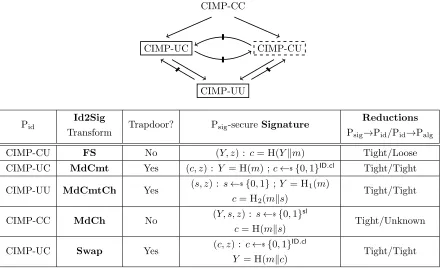
Figure 1: Top: Relations between notions Pid of security for an identification scheme ID under constrained impersonation. Solid arrows denote implications, barred arrows denote separations. A solid box around a notion means a tight Pid→Palg reduction for Sigma protocols; dotted means a loose one; no box means no known reduction. Bottom: Transforms of identification schemes into UUF (row 2,3) or UF (rows 1,4,5) signature schemes. The first column is the assumption Pid on the identification scheme. The third column indicates whether or not the identification scheme is assumed to be trapdoor. ID.cl is the challenge length and sl is a seed length. In rows 1,4 the commitmentY is chosen at random. The third transform has the shortest signatures, consisting of a response plus a single bit.
Constrained impersonation. Recall our goal is to define a notion of identification security Pid such that (1) We can give transforms Id2Sig for which Psig→Pid is tight, and (2) We can give identification schemes such that Pid→Palg is tight. In fact our definitional goal is broader, namely to give a framework that allows us to understand and encompass both old and new transforms, the former including FS and Swap. We do all this with a definitional framework that we refer to as constrained impersonation. It yields four particular definitions denoted CIMP-XY for XY∈ {CU,UC,UU,CC}. Each, in the role of Pid, will be the basis for an id-to-sig transform such that Psig→Pid is tight, and two will allow Pid→Palg to be tight.
are novel.
What do any of these notions have to do with identification if one understands the latter as the practical goal of proving one’s identity to a verifier? Beyond CIMP-CU, very little. In practice it is unclear how one can constrain a prover to only use, in impersonation, a commitment from a prior transcript. It is even more bizarre to allow a prover to pick the challenge. Our definitions however are not trying to capture any practical usage of identification. They view the latter as an analytic tool, an intermediate land allowing a smooth transition from an algebraic problem to signatures. The constrained impersonation notions work well in this regard, as we will see, both to explain and understand existing work and to obtain new signature schemes with tight reductions.
Relations between the four notions of constrained impersonation are depicted in Fig. 1. An arrow A → B is an implication: Every identification scheme that is A-secure is also B-secure. A barred arrow A 6→ B is a separation: There exists an identification scheme that is A-secure but
not B-secure. (For now ignore the boxes around notions.) In particular we see that CIMP-UU is weaker than, and CIMP-UC incomparable to, the more standard CIMP-CU. See Proposition1for more precise renditions of the implications.
Auxiliary definitions and tools. Before we see how to leverage the constrained impersonation framework, we need a few auxiliary definitions and results that, although simple, are, we believe, of independent interest and utility.
We define a signature scheme to be UUF (Unique Unforgeable) if it is UF with the restriction that a message can be signed at most once. (The adversary is not allowed to twice ask the signing oracle to sign a particular m.) It turns out that some of our id-to-sig transforms naturally achieve UUF, not UF. However there are simple, generic transforms of UUF signature schemes into UF ones —succinctly, UF→UUF— that do not introduce much overhead and have tight reductions. One is to remove randomness, and the other is to add it. In more detail, a well-known method to derandomize a signature scheme is to specify the coins by hashing the secret key along with the message. This has been proved to work in some instances [32, 26] but not in general. We observe that this method has the additional benefit of turning a UUF scheme into a UF one. We call the transformDR. Theorem 4 shows that it works. (In particular it shows UF-security of the derandomized scheme in a more general setting than was known before.) The second transform, AR, appends a random salt to the message before signing and includes the salt in the signature. Theorem 5 shows that it works. The first transform is attractive because it does not increase signature size. The second does, but is standard-model. We stress that the reductions are tight in both cases, so this step does not impact overall tightness. Now we can take (the somewhat easier to achieve) UUF as our goal.
Recall that in an identification scheme, the prover uses private randomness y to generate its commitment Y. We call the scheme trapdoor if the prover can pick the commitment Y directly at random from the space of commitments and then compute the associated private randomnessy using its secret key via a prescribed algorithm. The concept is implicit in [30] but does not seem to have been formalized before, so we give a formal definition in Section3. Many existing identi-fication schemes will meet our definition of being trapdoor modulo possibly some changes to the key structure. Thus the GQ scheme of [23] is trapdoor if we add the decryption exponent dto the secret key. With similar changes to the keys, the Fiat-Shamir [16] and Ong-Schnorr [34] identi-fication schemes are trapdoor. The factoring-based identiidenti-fication scheme of [30] is also trapdoor. But not all identification schemes are trapdoor. One that is not is Schnorr’s (discrete-log based) scheme [36].
UUF signature scheme DS; the transform from CIMP-CC security achieves even a UF signature scheme. The reduction Psig→Pid is tight in all four cases. (To further make the signature schemes UF secure, we can apply the above-mentioned UF→UUF transforms while preserving tightness.) The table in Fig. 1 summarizes the results and the transforms. They are discussed in more detail below and then fully in Section6.
This is one pillar of the edifice, and not useful by itself. The other pillar is the Pid→Palg reduction. In the picture at the top of Fig.1, a solid-line box around Pidmeans that the reduction Pid→Palg is tight, a dotted-line box indicates a reduction is possible but is not tight, and no box means no known reduction. These results assume the identification scheme is a Sigma protocol, as most are, and are discussed in Section 4. We see that two points of our framework can be tightly
obtained from the algebraic problem, so that in these cases the overall Psig→Palg reduction is tight, which was the ultimate goal.
More details on results. The id-to-sig transform from CIMP-CU is the classicalFS one. The reduction is now tight, even though it was not from IMP-PA [1], simply because CCU is IMP-PA extended to allow multiple impersonation attempts. The result, which we state as Theorem9, is implicit in [1], but we give a proof to illustrate how simple the proof now is. In this case our framework serves to better understand, articulate and simplify something implicit in the literature, rather than deliver anything particularly new.
For CIMP-UC, we give a transform called MdCmt, for “Message-Derived Commitment”, where, to sign m, the signer computes the commitment Y as a hash of the message, picks a challenge at random, uses the identification trapdoor to compute the coins y corresponding to Y, uses y and the secret key to compute a response z, and returns the challenge and response as the signature. See Section 6.1.
For CIMP-UU, the weakest of the four notions, our transform MdCmtCh, for “Message-Derived Commitment and Challenge”, has the signer compute the commitment Y as a hash of the message. It then picks a single random bit sand computes the challenge as a hash of the message and seed s, returning as signature the seed and response, the latter computed as before. Beyond a tight reduction, this transform has the added feature of short signatures, the signature being a response plus a single bit. (In all other transforms, whether prior or ours, the signature is at least a response plus a challenge, often more.) See Section6.2.
Since CIMP-CC implies CIMP-UC and CIMP-UU (Fig. 1, top), for the former the MdCmt and MdCmtChtransforms would both work. However, these require the identification scheme to be trapdoor and achieve UUF rather than UF. (The above-mentioned UF→UUF transforms would have to be applied on top to get UF.) We give an alternative transform calledMdCh (“Message-Derived Challenge”) from CIMP-CC that directly achieves UF and works (gives a tight reduction) even if the identification scheme is not trapdoor. It has the signer pick a random commitment, produce the challenge as in MdCmtCh, namely as a randomized hash of the message, compute the response, and return the conversation transcript as signature. See Section 6.3.
Swap. As indicated above, our framework allows us to generalize the swap method of [30] into an id-to-sig transformSwapand understand and characterize what it does. In Section6.5we present Swap as a generic transform of a trapdoor identification scheme ID to a signature scheme that is just like MdCmt (cf. row 2 of the table of Fig. 1) except that the challenge c is included in the input to the hash function (cf. row 5 of the table of Fig. 1). Recall that MdCmt turns a CIMP-UC identification scheme into a UUF signature scheme. We can thence get a UF signature scheme by applying theAR transform of Section5.2. Swapis a shortcut, or optimization, of this two step process: it directly turns a CIMP-UC identification scheme into a UF signature scheme by effectively re-using the randomness of MdCmt in AR. We note that the composition of our DRwith ourMdCmtCh yields a UF signature scheme with shorter signatures thanSwap while also having a tight reduction to the weaker CIMP-UU assumption, and would thus be superior. However we think Swap is of historical interest and accordingly present it. See Section 6.5 for details.
Instantiation. As a simple and canonical example, in Section 7 we apply our framework and transforms to theGQidentification scheme to get signature schemes with tight reductions to RSA. It is also possible to give instantiations based on claw-free permutations [20] and factoring. An intriguing application area to explore for our transforms is in lattice-based cryptography. Here signatures have been obtained via theFS transform [28, 29]. The underlying lattice-based identi-fication schemes do not appear to be trapdoor, so our transforms would not apply. However, via the techniques of MP [31], one can build lattice-based trapdoor identification schemes to which our transforms apply. Whether there is a performance benefit will depend on the trade-off between the added cost from having the trapdoor and the smaller parameters permitted by the improved security reduction.
Discussion. We measure reduction tightness stringently, in a model where running time, queries and success probability are separate parameters. The picture changes if one considers the expected success ratio, namely the ratio of running time to success probability. Reduction tightness under this metric is considered in PS [35] and the concurrent and independent work of KMP [25].
We establish the classical notion of standard unforgeability (UF) [20]. Our transforms also es-tablish strong unforgeability if the identification scheme has the extra property of unique responses. (For any public key, commitment, and challenge, there exists at most one response that the verifier accepts.)
A reviewer commented that “The signature scheme with the tightest security in this paper is derived from the Swap transform, which makes the result less surprising since the Swap method, first used in [30], has already been found to be generic to some extent by ABP [2].” In response, first, the tightness of the reductions is about the same for Swap, DR◦ MdCmt and DR◦
GameGufDS(A) / GuufDS(A)
M ← ∅; (vk,sk)←$DS.KgH
(m, σ)←$ASign,H(vk)
Ifm∈M: Returnfalse
ReturnDS.VfH(vk, m, σ)
H(x,Rng)
If not HT[x,Rng]: HT[x,Rng]←$Rng
Return HT[x,Rng]
Sign(m)
Ifm∈M: Return⊥
σ←$DS.SigH(vk,sk, m)
M ←M ∪ {m} Returnσ
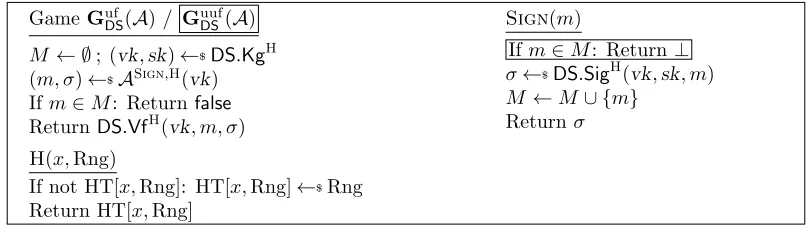
Figure 2: Games defining unforgeability and unique unforgeability of signature schemeDS. Game GuufDS(A) includes the boxed code and game GufDS(A) does not.
GK [22] give an example of a 3-move ID protocol where FS yields a secure signature scheme in the ROM, but the RO is not instantiable. Their protocol however is not a Sigma protocol, as is assumed for the ones we start with and is true for practical identification schemes. Currently, secure instantiation of the RO, both for FS and our transforms, is not ruled out for such identification schemes.
2
Notation and basic definitions
Notation. We let ε denote the empty string. If X is a finite set, we let x←$X denote picking an element of X uniformly at random and assigning it to x. We use a1ka2k · · · kan as shorthand
for (a1, a2, . . . , an). By a1ka2k · · · kan ← x we mean that x is parsed into its constituents. We
use bracket notation for associative arrays, e.g.,T[x] =y means that key x is mapped to value y. Algorithms may be randomized unless otherwise indicated. Running time is worst case. If Ais an algorithm, we let y ← A(x1, . . .;r) denote running A with random coins r on inputs x1, . . . and assigning the output to y. We let y←$A(x1, . . .) be the result of picking r at random and letting y←A(x1, . . .;r). We let [A(x1, . . .)] denote the set of all possible outputs of (randomized)Awhen invoked with inputs x1, . . .. We use the code based game playing framework of [9]. (See Fig. 2 for an example.) By Pr[G] we denote the event that the execution of game G results in the game returning true. Boolean flags (like bad) in games are assumed initialized to false, and associative arrays empty. We adopt the convention that the running time of an adversary refers to the worst case execution time of the game with the adversary. This means that the time taken for oracles to compute replies to queries is included.
Our treatment of random oracles is more general than usual. In our constructions, we will need random oracles with different ranges. For example we may want one random oracle returning points in a group Z∗N and another returning strings of some length l. To provide a single unified
definition, we have the procedureHin the games take not just the inputxbut a description Rng of the set from which outputs are to be drawn at random. Thus y←$H(x,Z∗
N) will return a random
element of Z∗N, whilec←$H(x,{0,1}l) will return a random l-bit string, and so on. Sometimes if
the range set is understood, it is dropped as an argument.
Signatures. In a signature scheme DS, the signer generates signing key sk and verifying key vk via (vk,sk)←$DS.KgH where H is the random oracle, the latter with syntax as discussed above. Now it can compute a signatureσ←$DS.SigH(vk,sk, m) on any messagem∈ {0,1}∗. A verifier can deterministically compute a boolean v ←DS.VfH(vk, m, σ) indicating whether or not σ is a valid
Prover Input: ivk,isk (Y, y)←$ID.Ct(ivk)
z←ID.Rp(ivk,isk, c, y)
Y
-c
z
-Verifier Input: ivk
c←${0,1}ID.cl
v←ID.Vf(ivk, Ykckz)
Figure 3: Functioning of an identification scheme ID.
m)) = true with probability one. Game Guf
DS(A) associated to DS and adversary A as per Fig. 2
captures the classical unforgeability notion of [20] lifted to the ROM as per [7], and we letAdvufDS(A) = Pr[GufDS(A)] be the UF-advantage of A. The same figure also defines game GuufDS(A) to capture
unique unforgeability. The difference is the inclusion of the boxed code, which disallows A from getting more than one signature on the same message. We let AdvuufDS(A) = Pr[GuufDS(A)] be the UUF-advantage of A.
Of course, UF implies UUF, meaning any signature scheme that is UF secure is also UUF secure. The converse is not true, meaning there exist UUF signature schemes that are not UF secure (we will see natural examples in this paper). In Section 5 we give simple, generic and tight ways to turn any given UUF signature scheme into a UF one.
We note that unique unforgeability (UUF) should not be confused with unique signatures as defined in [21,27]. In a unique signature scheme, there is, for any message, at most one signature the verifier will accept. If a unique signature scheme is UUF then it is also UF. But there are UUF (and UF) schemes that are not unique.
3
Constrained impersonation framework
We introduce a framework of definitions of identification schemes secure against constrained im-personation.
Identification. An identification (ID) scheme ID operates as depicted in Fig. 3. First, via (ivk,isk,itk)←$ID.Kg, the prover generates a publicverification key ivk, privateidentification key
isk, andtrapdoor itk. Via (Y, y)←$ID.Ct(ivk) it generates commitment Y ∈ID.CS(ivk) and corre-sponding private statey. We refer to ID.CS(ivk) as the commitment space associated to ivk. The verifier sends a random challenge of lengthID.cl. The prover’sresponse zand the verifier’s boolean
decision v are deterministically computed perz←ID.Rp(ivk,isk, c, y) and v←ID.Vf(ivk, Ykckz), respectively. We assume throughout that identification schemes have perfect correctness. We also assume uniformly-distributed commitments. More precisely, the outputs of the following two pro-cesses must be identically distributed: the first propro-cesses generates (ivk,isk,itk)←$ID.Kg, then lets (Y, y)←$ID.Ct(ivk) and returns (ivk, Y); the second processes generates (ivk,isk,itk)←$ID.Kg, then lets Y ←$ID.CS(ivk) and returns (ivk, Y). An example ID scheme is GQ [23]; see Section7. For basic ID schemes, the trapdoor plays no role; its use arises in trapdoor identification, as dis-cussed next.
GameGcimpID -xy(P)
S← ∅; i←0 ;j ←0 (ivk,isk,itk)←$ID.Kg
(k, z)←$PTr,Ch(ivk)
If not (1≤k≤j): Returnfalse T ←CT[k]kz
ReturnID.Vf(ivk, T)
Tr()
i←i+ 1
(Yi, yi)←$ID.Ct(ivk)
ci←${0,1}ID.cl
zi←ID.Rp(ivk,isk, ci, yi)
S←S∪ {(Yi, ci)}
ReturnYikcikzi
Ch(l) // xy=uu
If not (1≤l≤i): Return⊥
j←j+ 1 ; c←${0,1}ID.cl
CT[j]←Ylkc; Return c
Ch(l, c) // xy=uc
If not (1≤l≤i): Return⊥ If (c=cl): Return⊥
j←j+ 1
CT[j]←Ylkc; Return c
Ch(Y) // xy=cu
j←j+ 1 ; c←${0,1}ID.cl
CT[j]←Ykc; Returnc
Ch(Y, c) // xy=cc
If (Y, c)∈S: Return⊥
j←j+ 1
CT[j]←Ykc; Returnc
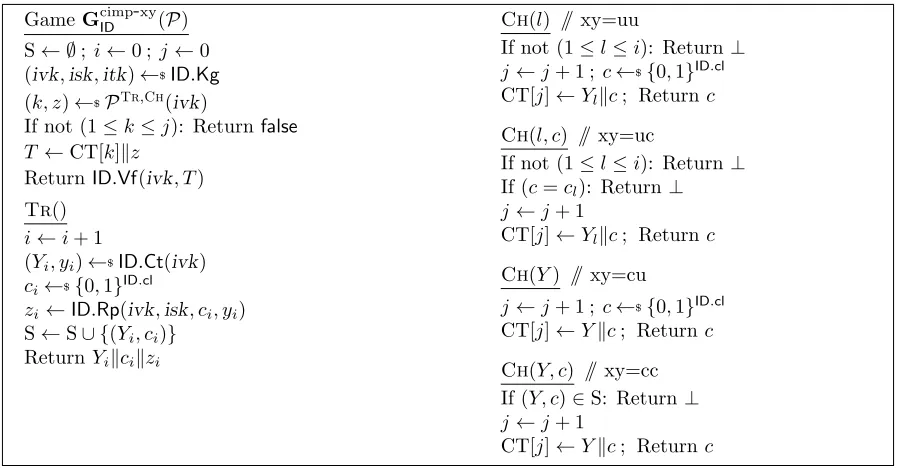
Figure 4: Games defining security of identification scheme ID against constrained impersonation under passive attack.
Security against impersonation. Classically, the security goal for an identification scheme ID has been impersonation [15,1]. The framework has two stages. First, the adversary, givenivk but notisk, attacks the honest, isk-using prover. Second, using the information it gathers in the first stage, it engages in an interaction with the verifier, attempting to impersonate the real prover by successfully identifying itself. In the second stage, the adversary, in the role of malicious prover, submits a commitmentY of its choice, receives an honest verifier challengec, submits a responsez of its choice, and wins if ID.Vf(ivk, Ykckz) = true. A hierarchy of possible first-phase attacks is defined in [6]. In the context of conversion to signatures, the relevant one is the weakest, namely passive attacks, where the adversary is just an eavesdropper and gets honestly-generated protocol transcripts. This is the IMP-PA notion. (Active and even concurrent attacks are relevant in other contexts [6].) We note that in the second stage, the adversary is allowed only one interaction with the honest verifier.
must finally supply a correct response. And, also regardless of these choices, the adversary can mount multiple attempts to convince the verifier, contrasting with the strict two-phase adversary in classical definitions of impersonation security.
For choices xy ∈ {uu,uc,cu,cc} of parameters, the formalization considers game GcimpID -xy(P) of Fig.4 associated to identification scheme IDand adversaryP. We let
AdvcimpID -xy(P) = Pr[GcimpID -xy(P)].
The transcript oracle Trreturns upon each invocation a transcript of an interaction between the honest prover and verifier, allowing P to mount its passive attack, and is the same for all four games. The impersonation attempts are mounted through calls to the challenge oracleCh, which creates a partial transcript CT[j] consisting of a commitment and a challenge, wherej is a session id, and it returns the challenge. Multiple impersonation attempts are captured by the adversary being allowed to call Ch as often as it wants. Eventually the adversary outputs a session id k and a response z for session k, and wins if the corresponding transcript is accepting. In the UU case, P would give Ch only an index l of an existing transcript already returned by Tr, and CT[j] consists of the commitment from thel-th transcript together with a fresh random challenge. In the UC case, Ch takes in addition a challenge c chosen by the adversary. The game requires that it be different from cl (the challenge in the l-th transcript), and CT[j] then consists of the
commitment from thel-th transcript together with this challenge. In CU, the adversary can specify the commitment but the challenge is honestly chosen. In CC, it can specify both, as long as the pair did not occur in a transcript. The adversary can call the oracles as often as it wants and in whatever order it wants.
CIMP-CU is a multi-impersonation extension of the classical IMP-PA notion. The other notions are new, and all will be the basis of transforms of identification to signatures admittingtightsecurity reductions. CIMP-CU captures a practical identification security goal. As discussed in Section 1, the other notions have no such practical interpretation. However we are not aiming to capture some practical form of identification. We wish to use identification only as an analytic tool in the design of signature schemes. For this purpose, as we will see, our framework and notions are indeed useful, allowing us to characterize past transforms and build new ones.
Implications. Fig. 1 shows the relations between the four CIMP-XY notions. The implications are captured by Proposition 1. (The separations will be discussed below.) The bounds in these claims imply some conditions or assumptions for the implications which we did not emphasize before because they hold for typical identification schemes. Namely, CIMP-UC→CIMP-UU assumes the identification scheme has large challenge length. CIMP-CC → CIMP-UC assumes it has a large commitment space. CIMP-CC → CIMP-CU again assumes it has a large challenge length. We remark that in all but one case, the adversary constructed in the proof makes only oneCh query, regardless of how many the starting adversary made.
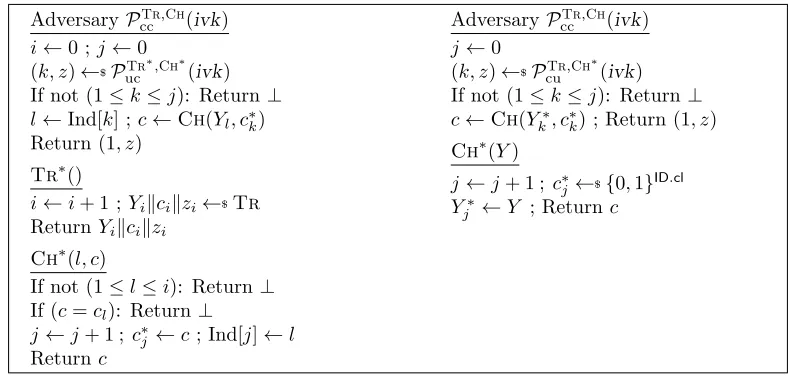
Proposition 1 Let IDbe an identification scheme. Let
ID.CSS= min{ |ID.CS(ivk)| : (ivk,isk,itk)∈[ID.Kg]}. Then:
1. [CIMP-UC→ CIMP-UU] Given Puu making qc queries to Ch, we construct Puc, making one
Chquery, such thatAdvcimpID -uu(Puu)≤AdvIDcimp-uc(Puc) +qc·2−ID.cl.
2. [CIMP-CU → CIMP-UU] Given Puu, we construct Pcu making as many Ch queries as Puu, such thatAdvcimpID -uu(Puu)≤AdvcimpID -cu(Pcu).
Game G0, G1 i←0 ; j←0
(ivk,isk,itk)←$ID.Kg
(k, z)←$PuuTr,Ch(ivk)
If not (1≤k≤j): Returnfalse T ←CT[k]kz
ReturnID.Vf(ivk, T)
Tr() i←i+ 1
(Yi, yi)←$ID.Ct(ivk)
ci←${0,1}ID.cl
zi←ID.Rp(ivk,isk, ci, yi)
ReturnYikcikzi
Ch(l)
If not (1≤l≤i): Return⊥
j←j+ 1 ;c←${0,1}ID.cl
If (c=cl):
bad←true; c←${0,1}ID.cl\ {cl}
CT[j]←Ylkc; Returnc
AdversaryPTr,Ch
uc (ivk) i←0 ;j ←0
(k, z)←$PTr
∗,
Ch∗
uu (ivk)
If not (1≤k≤j): Return⊥
l←Ind[k] ;c←Ch(l, c∗k) Return (1, z)
Tr∗()
i←i+ 1 ;Yikcikzi←$Tr
ReturnYikcikzi
Ch∗(l)
If not (1≤l≤i): Return⊥
j ←j+ 1 ; Ind[j]←l
c∗j←${0,1}ID.cl\ {cl} ; Returnc∗j
AdversaryPTr,Ch
cu (ivk) i←0 ;j ←0
(k, z)←$PTr
∗,
Ch∗
uu (ivk)
If not (1≤k≤j): Return⊥ Return (k, z)
Tr∗()
i←i+ 1 ;Yikcikzi←$Tr
ReturnYikcikzi
Ch∗(l)
If not (1≤l≤i): Return⊥
j ←j+ 1 ;c∗j←$Ch(Yl)
Returnc∗j
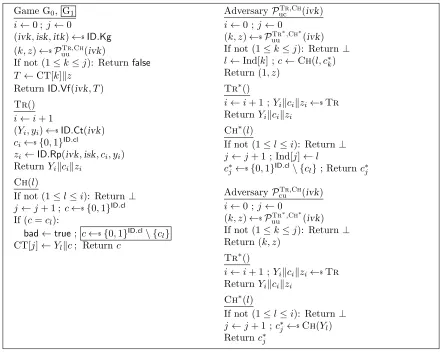
Figure 5: Games and adversaries for proof of Proposition 1 parts1.and 2.
Chquery, such thatAdvcimpID -uc(Puc)≤AdvIDcimp-cc(Pcc) +qt(qt−1)/2ID.CSS.
4. [CIMP-CC→CIMP-CU] GivenPcumakingqtqueries toTrandqcqueries toCh, we construct
Pcc, making one Chquery, such thatAdvcimpID -cu(Pcu)≤Adv
cimp-cc
ID (Pcc) +qtqc·2
−ID.cl.
In all cases, the constructed adversary makes the same number of Tr queries as the starting adversary and has about the same running time.
Proof of Proposition 1: We writeTr∗ and Ch∗ for subroutines in the code of the constructed adversaries that provide answers to the Tr and Ch queries, respectively, of the given adversary. We now proceed item by item.
For part1.consider the games of Fig. 5. Game G0 omits the boxed code while game G1 includes it. Game G0 is game GcimpID -uu(Puu) of Fig. 4. Games G0 and G1 are identical until bad. By the Fundamental Lemma of Game Playing [9] we have
AdvcimpID -uu(Puu) = Pr[G0] = Pr[G1] + (Pr[G0]−Pr[G1])≤Pr[G1] + Pr[G0setsbad]
≤Pr[G1] + qc
2ID.cl .
AdversaryPTr,Ch
cc (ivk) i←0 ;j←0
(k, z)←$PTr
∗,
Ch∗
uc (ivk)
If not (1≤k≤j): Return⊥
l←Ind[k] ;c←Ch(Yl, c∗k)
Return (1, z)
Tr∗()
i←i+ 1 ;Yikcikzi←$Tr
ReturnYikcikzi
Ch∗(l, c)
If not (1≤l≤i): Return⊥ If (c=cl): Return⊥
j←j+ 1 ;c∗j ←c; Ind[j]←l
Returnc
AdversaryPTr,Ch
cc (ivk) j←0
(k, z)←$PTr,Ch
∗
cu (ivk)
If not (1≤k≤j): Return⊥
c←Ch(Yk∗, c∗k) ; Return (1, z)
Ch∗(Y)
j←j+ 1 ; c∗
j ←${0,1}ID.cl
Y∗
j ←Y ; Returnc
Figure 6: Adversaries for proof of Proposition1 parts3.and 4.
It simulates for Puu the environment of game G1. This guarantees that the challenge c∗k in itsCh
query is different fromcl. Thus Pr[G1]≤AdvcimpID -uc(Puc), completing the proof.
For part 2.the adversary Pcu is on the bottom right in Fig. 5. It answers a Ch(l) query of Puu by the challenge returned by its ownCh oracle on the transcript commitmentYl. The analysis is
straightforward because there are no restrictions on winning in either case.
The remaining two implications are not of importance for our results and given for completeness. We omit the game-based analysis required to make the proofs rigorous. For part 3.the adversary
Pcc is on the left in Fig. 6. When Puc returns (k, z), adversary Pcc calls its Ch oracle on the corresponding commitment and challenge. It will win its game unless the pair is not new, meaning is in the set S, which can happen with at most the probability that some commitment is returned more than once byTr. The probability of the latter is at mostqt(qt−1)/2ID.CSS.
For part4.the adversaryPcc is on the right in Fig.6. Trqueries are relayed to the own challenger. As in part3.,Pcc will win its game unless the forged transcript is not new, meaning is in the set S. This can happen with at most the probability that a challenge chosen by Ch∗ is the same as one in a transcript returned by Tr. The probability of this is at mostqtqc·2−ID.cl.
Separations. We now discuss the separations, beginning with CIMP-CU=6⇒CIMP-UC. Start with any CIMP-CU scheme. We will modify it so that it remains CIMP-CU-secure but is not CIMP-UC-secure. Distinguish a single challenge c∗ ∈ {0,1}ID.cl, e.g., c∗ = 0ID.cl. Revise the
verifier’s algorithm so that it will accept any transcript with challengec∗. This is still CIMP-CU-secure (as long as ID.cl is large) since, in the CIMP-CU game, challenges are picked uniformly at random for the adversary, so existence of the magic challenge is unlikely to be useful. This is manifestly not CIMP-UC-secure since there the adversary can use any challenge of its choice. CIMP-UU=6⇒CIMP-UC for the same reason.
GameGex
ID(A)
(ivk,isk,itk)←$ID.Kg
(Y, c1, z1, c2, z2)←$A(ivk,isk,itk)
v1←ID.Vf(ivk, Ykc1kz1)
v2←ID.Vf(ivk, Ykc2kz2)
isk∗←$ID.Ex(ivk, Ykc1kz1, Ykc2kz2)
Return (isk∗6=isk)∧(c16=c2)∧v1∧v2
GameGzk
ID(A)
(ivk,isk,itk)←$ID.Kg;b←${0,1}
(Y1, y)←$ID.Ct(ivk) ; c1←${0,1}ID.cl
z1←ID.Rp(ivk,isk, c1, y)
Y0kc0kz0←$ID.Sim(ivk)
b0←$A(ivk, Ybkcbkzb)
Return (b=b0)
GameGkr
ID(I)
(ivk,isk,itk)←$ID.Kg
isk∗←$I(ivk)
Return (isk∗=isk)
Figure 7: Games defining the extractability, HVZK and key-recovery security of an identification schemeID.
since, in the CIMP-UC game, commitments are generated randomly for the adversary, so existence of a magic commitment is unlikely to be useful. This is manifestly not CIMP-CU-secure since there the adversary can use any commitment of its choice. CIMP-UU=6⇒CIMP-CU for the same reason. Finally, CIMP-UC=6⇒CIMP-CC and CIMP-CU=6⇒CIMP-CC since otherwise, by transitivity in Fig. 1, we would contradict the separation between CIMP-UC and CIMP-CU.
4
Achieving CIMP-XY security
Here we show how to obtain identification schemes satisfying our CIMP-XY notions of security. We base CIMP-XY security on the problem of recovering the secret key of the identification scheme given nothing but the public key, which plays the role of the algebraic problem Palg in typical identification schemes and corresponds to a standard assumption. (For example for GQ it is one-wayness of RSA.) For CIMP-UC and CIMP-UU, the reductions are tight. For CIMP-CU, the reduction is not tight. CIMP-CC cannot be obtained via these paths, and instead we establish it from signatures. First we need to recall a few standard definitions.
HVZK and extractability. We say that an identification scheme ID is honest verifier
zero-knowledge (HVZK) if there exists an algorithm ID.Sim (called the simulator) that given the ver-ification key, generates transcripts which have the same distribution as honest ones, even given the verification key. Formally, if A is an adversary, let AdvzkID(A) = 2 Pr[GzkID(A)]−1 where the game is shown in Fig. 7. Then ID is HVZK if AdvzkID(A) = 0 for all adversaries A (regardless of the running time of A). We say that an identification scheme ID is extractable if there exists an algorithm ID.Ex (called the extractor) which from any two verifying transcripts that have the same commitment but different challenges can recover the secret key. Formally, if A is an ad-versary, let AdvexID(A) = Pr[GexID(A)] where the game is shown in Fig. 7. Then ID is extractable if AdvexID(A) = 0 for all adversaries A (regardless of the running time of A). We say that an identification scheme is a Sigma protocol [13] if it is both HVZK and extractable.
AdversaryI(ivk)
i←0 ;j←0
(k, z)←$PTr,Ch(ivk)
If not (1≤k≤j): Return⊥
T ←CT[k]kz; l←Ind[k] isk∗←ID.Ex(ivk, Ylkclkzl, T)
Returnisk∗
Tr() i←i+ 1
Yikcikzi←$ID.Sim(ivk)
ReturnYikcikzi
Ch(l, c)
If not (1≤l≤i): Return⊥ If (c=cl): Return⊥
j←j+ 1 ; CT[j]←Ylkc; Ind[j]←l
Returnc
Figure 8: Adversary for proof of Theorem 2.
most identification schemes (e.g., the one-wayness of RSA for the GQ identification scheme, and the factoring assumption for factoring-based schemes).
Obtaining CIMP-UU and CIMP-UC. Here we show that for Sigma protocols, CIMP-UU and CIMP-UC security reduce tightly to security under key recovery.
Theorem 2 Let ID be an identification scheme that is honest verifier zero-knowledge and ex-tractable. Then for any adversary P against CIMP-UC we construct a key recovery adversary I such that
AdvcimpID -uc(P)≤AdvkrID(I) . (1)
Also for any adversary P againstCIMP-UUthat makesqc queries to its Choracle we construct a
key recovery adversary I such that
AdvcimpID -uu(P)≤AdvkrID(I) +qc·2−ID.cl . (2) In both cases, the running time of I is about that of P plus the time for one execution ofID.Ex and the time for a number of executions of ID.Sim equal to the number of Trqueries of P.
Proof of Theorem 2: Adversary I for the first claim is shown in Fig. 8. It responds to Tr queries of P via the simulator. In a Ch(l, c) query, the game ensures that c 6= cl, so P’s output
immediately allows the extractor to obtain the secret key. The second claim follows from the first and Part 1.of Proposition 1.
Obtaining CIMP-CU. CIMP-CU security of Sigma protocols can also be established under their key recovery security, but the reduction is not tight.
Theorem 3 Let ID be an identification scheme that is honest verifier zero-knowledge and ex-tractable. For any adversary P against CIMP-CU making q queries to its Ch oracle, we construct a key recovery adversary I such that
AdvcimpID -cu(P)≤q q
AdvkrID(I) + 1 2ID.cl
The running time of I is about twice that of P.
To establish Theorem 3, our route will be via standard techniques and known results, and the proof can be found for completeness in Appendix A. Lemma 11 relates CIMP-CU security of ID to IMP-PA, the standard security against impersonation under passive attack as formalized in [1]. (IMP-PA is exactly CIMP-CU restricted to adversaries that make only oneCh query.) Lemma12 relates IMP-PA security to key recovery using the reset lemma of [6] and the extractability property of ID. Together these yield CIMP-CU security.
ObtainingCIMP-CC. This is our strongest notion, and is quite different from the rest. Sigma pro-tocols will fail to achieve CIMP-CC because an HVZK identification scheme cannot be CIMP-CC-secure. The attack (adversary)Pshowing this is as follows. AssumingIDis HVZK, our adversaryP, given the verification keyivk, runs the simulator to get a transcriptYkckz←$ID.Sim(ivk). It makes no Trqueries, so the set S in the game is empty. It then makes queryCh(Y, c) and returns (1, z) to achieve AdvcimpID -cc(P) = 1.
This doesn’t mean CIMP-CC is unachievable. We now show how to achieve it. Our construction is from a UF digital signature schemeDS. Associate toDSand a challenge lengthlthe identification scheme ID defined as follows. It has challenge length ID.cl = l. Key generation algorithm ID.Kg lets (vk,sk)←$DS.Kg and returns (vk,sk, ε). The commitment is empty, meaning ID.Ct(ivk) returns (ε, ε). The response is a signature of the challenge, meaning ID.Rp(vk,sk, c, ε) returns z←$DS.Sig(vk,sk, c). This identification scheme is trivially trapdoor,ID.Ct−1(vk, ε, ε) returningε. It is CIMP-CC assumingDSis UF and the challenge lengthlis large enough, with a tight reduction. More precisely, given adversaryP makingqtqueries to itsTroracle andqcqueries to itsChoracle,
we can build adversary A such thatAdvcimpID -cc(P)≤AdvDSuf (A) +qtqc·2−l. Adversary Amakes
qt queries to itsSign oracle and has about the same running time as P.
While this shows CIMP-CC is achievable, and even under standard assumptions, it is not of help for us, since we want to obtain signature schemes from identification schemes and if the latter are themselves built from a signature scheme then nothing has been gained. We consider CIMP-CC nonetheless because our framework naturally gives rise to it and we wish to see the full picture, and also because there may be other ways to achieve CIMP-CC.
5
From
UUF
to
UF
Some of our transforms of identification schemes into signature schemes naturally achieve UUF security rather than UF security. To achieve the latter, one can take our UUF schemes and apply the transforms in this section. The reductions are tight and the costs are low. First we observe that standard derandomization (removing randomness) has the additional benefit (apparently not noted before) of turning UUF into UF. Second, we show that message randomization (adding randomness) is also a natural solution.
5.1 From UUF to UF by removing randomness
DS∗.Kg
ReturnDS.Kg
DS∗.SigH(vk,sk, m)
r←H(skkm)
ReturnDS.Sig(vk,sk, m;r)
DS∗.Vf(vk, m, σ) ReturnDS.Vf(vk, m, σ)
DS∗.Kg
ReturnDS.Kg
DS∗.Sig(vk,sk, m)
s←${0,1}sl
σ←$DS.Sig(vk,sk, mks)
σ∗←σks; Returnσ∗
DS∗.Vf(vk, m, σ∗)
σks←σ∗
ReturnDS.Vf(vk, mks, σ)
Figure 9: Left: Our construction of deterministic signature scheme DS∗ = DR[DS] from a sig-nature scheme DS. By H(·) we denote H(·,{0,1}DS.rl), which has range {0,1}DS.rl. Right: Our construction of added-randomness signature schemeDS∗=AR[DS,sl] from a signature schemeDS and a seed lengthsl∈N.
when this scheme is ECDSA [26]. Such de-randomization is also used in the Ed25519 signature scheme [10]. However, it has not been proven in the general case. This will follow from our results. The purpose of the method, above, was exactly to derandomize, namely to ensure that the signing process is deterministic, and the starting signature scheme was assumed UF secure. We observe here that the method has an additional benefit which does not seem to have been noted before, namely that it works even if the starting scheme is only UUF secure, meaning it upgrades UUF security to UF security. It is an attractive way to do this because it preserves signature size and verification time, while adding to the signing time only the cost of one hash. We specify a derandomization transform and prove that it turns UUF schemes into UF ones in general, mean-ing assummean-ing nothmean-ing more than UUF security of the startmean-ing scheme. In particular, we justify derandomization in a broader context than previous work.
The construction. For a signature scheme DS, let DS.rldenote the length of the randomness (number of coins) used by the signing algorithm DS.Sig. We write σ ← DS.Sig(vk,sk, m;r) for the execution of DS.Sig on inputsvk,sk, mand coinsr ∈ {0,1}DS.rl. Let signature scheme DS∗ = DR[DS] be obtained fromDSas in Fig.9. Here, the functionH(·) used to computer in algorithm DS∗.Sigis H(·,{0,1}DS.rl), meaning the range is set to {0,1}DS.rl.
While algorithms of the starting schemeDSmay invoke the random oracle (and, in the schemes we construct in Section 6, they do), it is assumed they do not invoke H(·,{0,1}DS.rl). This can be ensured in a particular case by domain separation. Given this, other calls of the algorithms of the starting scheme to the random oracle can be simulated directly in the proof via the random oracle available to the constructed adversaries. Accordingly in the scheme description of Fig.9, and proof below, for simplicity, we do not give the algorithms of the starting signature scheme access to the random oracle. That is, think of the starting scheme as being a standard-model one.
Game G0, G1
M ← ∅; HT← ∅; ST← ∅ (vk,sk)←$DS.Kg
(m, σ)←$ASign
,H
(vk) ReturnDS.Vf(vk, m, σ)
Sign(m)
Ifm∈M: Return ST[m]
r←${0,1}DS.rl
If HT[sk, m]:
bad←true; r←HT[sk, m] HT[sk, m]←r
σ←DS.Sig(vk,sk, m;r) ST[m]←σ; M ←M∪ {m} Returnσ
H(x)
sk∗km←x; r←${0,1}DS.rl
If HT[sk∗, m]:
bad←true; r←HT[sk∗, m] HT[sk∗, m]←r
Return HT[sk∗, m]
AdversaryASign
0 (vk)
M ← ∅; HT← ∅; ST← ∅;S← ∅
(m, σ)←$ASign
∗,
H∗
(vk) Pick somem∗∈/ M
Forsk∗∈S do
σ∗←$DS.Sig(vk,sk∗, m∗)
IfDS.Vf(vk, m∗, σ∗): Return (m∗, σ∗)
Return⊥
AdversaryASign
1 (vk)
M ← ∅; HT← ∅; ST← ∅;S← ∅
(m, σ)←$ASign
∗,
H∗
(vk) Return (m, σ)
Sign∗(m)
Ifm /∈M: ST[m]←$Sign(m)
M ←M∪ {m} ; Return ST[m]
H∗(x)
sk∗km←x; S←S∪ {sk∗} HT[sk∗, m]←${0,1}DS.rl
Return HT[sk∗, m]
Figure 10: Games and adversaries for proof of Theorem4.
exposure of the key. The proof says that it might a little, but the advantage does not go up by more than a factor of two.
Theorem 4 Let signature scheme DS∗ = DR[DS] be obtained from signature scheme DS as in Fig. 9. Let A be a UF-adversary against DS∗ that makes qh queries to H and qs queries to Sign. Then from A we can construct UUF-adversary A such that
AdvufDS∗(A)≤2·AdvuufDS(A). (4) Adversary A makes qs queries to Sign. It has running time about that of A plus the time for qh invocations of DS.Sig and DS.Vf.
Proof of Theorem 4: Game G0 of Fig.10includes the boxed code, while game G1 does not. We assume (wlog) thatAdoes not repeat a query to itsHoracle. We assume further the messagemin the forgery (m, σ) returned byAwas not queried toSign. Game G0 is equivalent to the UF game of Fig. 2 with the algorithms of DS∗ plugged in and Sign exploiting the deterministic behavior ofDS∗. Observe that in game G1 all evaluations of the formH(sk∗, m) are replaced by assignments with fresh randomness. Games G0,G1 are identical until bad. By the Fundamental Lemma of Game Playing [9] we have
AdvufDS∗(A) = Pr[G0] = Pr[G1] + (Pr[G0]−Pr[G1])≤Pr[G1] + Pr[G1setsbad].
We construct adversariesA0,A1 such that
The adversaries are shown in Fig. 10. They have access to a Sign oracle for the DS scheme. They do not have access to Hbecause of our simplifying assumption that DSis a standard-model scheme. They executeA, responding toHand Signqueries of the latter via the shown procedures H∗ andSign∗, respectively. These procedures are subroutines in the code ofA0 andA1, and both incorporate and use them. Procedure Sign∗ ensures that the adversaries are uuf, meaning do not submit a particular message twice to their ownSignoracle that is invoked bySign∗. AdversaryA1 simulates forAthe environment of game G1 and returns the forgery thatAreturns. AdversaryA0 also simulates forAthe environment of game G1. The code ofH∗ records all candidate secret keys. At the end,A0 attempts a forgery under each of them, returning one that is successful. In G1, we claim that if bad is set, either by Sign or by H, it must be that there was a H query of the form
skkm for some m. To justify this, consider two cases. First, if bad is set by Sign, it could only be because of a prior H query of the form skkm. Second, consider bad being set by H. We have assumed that A does not repeat a query toH. Thus, if a query sk∗km toH setsbad, it must be that HT[sk∗, m] was defined by Sign, in which case it must be thatsk∗ =sk. Thus if G1 setsbad thensk ∈S, soA0 is successful. Finally we defineASign(vk) to pick a random bitc←${0,1} and returnASign
c (vk). This means
AdvuufDS(A0) +AdvuufDS(A1) = 2·AdvuufDS(A), which completes the proof.
We remark that adversary A0 actually violates key recovery security of DS, not just its UUF security.
5.2 From UUF to UF by adding randomness
A complementary and natural method for constructing UF signatures from UUF ones is by adding randomness: before being signed, the message is concatenated with a random seed s of some length sl, so even for the same message, the inputs to the UUF signing algorithm are (with high probability) distinct. Compared to derandomization, the drawback of this method is that the signature size increases because the seed must be included in the signature. The potential advantage is that the transform is standard model, not using a random oracle, while preserving the secret key. (Derandomization can be done in the standard model via a PRF, but this requires augmenting the signing key with the PRF key.)
The construction. Let signature scheme DS∗ =AR[DS,sl] be obtained from DS as in Fig. 9. As above, DS is for simplicity assumed to be a standard-model scheme, so that its algorithms do not have access toH. The transform itself does not useH.
Unforgeability. The following says that the constructed schemeDS∗ is UF secure assuming the starting scheme DS was UUF secure, with a tight reduction. The reason is quite simple, namely that unless seeds collide, the messages being signed are distinct.
Theorem 5 Let signature scheme DS∗ = AR[DS,sl] be obtained from signature scheme DS and seed lengthsl∈N as in Fig.9. Let Abe aUF-adversary against DS∗ makingqs queries to itsSign
oracle. Then from A we construct a UUF adversary A such that
AdvufDS∗(A)≤AdvuufDS(A) + q
2 s
2sl+1 .
Game G0, G1
S← ∅; (vk,sk)←$DS.Kg
(m, σ∗)←$ASign(vk)
σks←σ∗
ReturnDS.Vf(vk, mks, σ)
Sign(m)
s←${0,1}sl
σ←$DS.Sig(vk,sk, mks)
σ∗←σks
Ifmks∈S then:
bad←true; σ∗← ⊥
S←S∪ {mks} Returnσ∗
AdversaryASign(vk)
(m, σ∗)←$ASign
∗
(vk)
σks←σ∗
ReturnDS.Vf(vk, mks, σ)
Sign∗(m) s←${0,1}sl
σ←$Sign(mks)
σ∗←σks
Returnσ∗
Figure 11: Games and adversaries for proof of Theorem5.
Proof of Theorem 5: Game G1 of Fig. 11 includes the boxed code, while game G0 does not. Game G0 is equivalent to the UF game of Fig.2with the algorithms ofDS∗plugged in. We assume the message m in the forgery (m, σ) returned by A was not queried to Sign. Games G0,G1 are identical until bad. By the Fundamental Lemma of Game Playing [9] we have
AdvufDS∗(A) = Pr[G0] = Pr[G1] + (Pr[G0]−Pr[G1])≤Pr[G1] + Pr[G0setsbad] ≤Pr[G1] +
qs2 2sl+1 . We construct adversaryA such that
Pr[G1]≤AdvuufDS(A).
Adversary A is shown in Fig. 11. It has access to a Sign oracle for the DS scheme. It executes
A, responding to Sign queries of the latter via the shown procedure Sign∗. This procedure is a subroutine in the code of A. In the execution of gameGuufDS(A), if Arepeats a query to Sign, the reply will be ⊥. This means that A is providingAthe environment of G1.
6
Signatures from identification
DS.KgH
(ivk,isk,itk)←$ID.Kg
vk←ivk; sk←(isk,itk) Return (vk,sk)
DS.VfH(vk, m, σ)
ivk←vk; (c, z)←σ Y ←H(m)
ReturnID.Vf(ivk, Ykckz)
DS.SigH(vk,sk, m)
ivk←vk; (isk,itk)←sk
Y ←H(m)
y←$ID.Ct−1(ivk,itk, Y)
c←${0,1}ID.cl
z←ID.Rp(ivk,isk, c, y)
σ←(c, z) Returnσ
Figure 12: The construction of signature scheme DS =MdCmt[ID] from trapdoor identification schemeID. By H(·) we denote H(·,ID.CS(ivk)).
AdversaryPTr,Ch(ivk)
HT← ∅; ST← ∅;M ← ∅
i←0 ; (m, σ)←$ASign,H(ivk)
Y ←H(m)
(c, z)←σ; l←ST[m]
c0←Ch(l, c) //c0=c
Return (1, z)
Sign(m)
Ifm∈M: Return⊥
Y ←H(m)
l←ST[m] ; σ←(cl, zl)
M ←M ∪ {m}; Returnσ
H(m)
If HT[m]: Return HT[m]
i←i+ 1 ; ST[m]←i Yikcikzi←$Tr()
HT[m]←Yi
Return HT[m]
Figure 13: CIMP-UC adversary for proof of Theorem 6.
6.1 From CIMP-UC identification to UUF signatures: MdCmt
MdCmt transforms a CIMP-UC trapdoor identification scheme to a UUF signature scheme using message-dependent commitments.
The construction. LetIDbe a trapdoor identification scheme andID.clits challenge length. Our MdCmt (message-dependent commitment) transform associates toID the signature schemeDS= MdCmt[ID]. The algorithms of DS are defined in Fig. 12. By H(·) we denote H(·,ID.CS(ivk)), meaning the range is set to commitment space ID.CS(ivk). Signatures are effectively identification transcripts, but the commitments are chosen in a particular way. Recall that with trapdoor ID schemes it is the same whether one executes (Y, y)←$ID.Ctdirectly, or samplesY ←$ID.CSfollowed by computing y←$ID.Ct−1(Y). Our construction exploits this: To each message m it assigns an individual commitment Y ← H(m). The signing algorithm, using the trapdoor, completes this commitment to a transcript (Y, c, z) and outputs the pair c, z as the signature. Verification then consists of recomputing Y from m and invoking the verification algorithm of the ID scheme. Unforgeability. The following theorem establishes that the (unique) unforgeability of a signature scheme constructed with MdCmt tightly reduces to the CIMP-UC security of the underlying ID scheme, in the random oracle model.
CIMP-UC adversaryP such that
AdvuufDS(A)≤ Adv
cimp-uc
ID (P)
1−2−ID.cl . (5)
AdversaryP makes qh+qs+ 1 queries to Tr and one query to Ch. Its running time is about that
of A.
The bound of Equation (5) may be a bit hard to estimate. The following simpler bound is also true and may be easier to use:
AdvuufDS(A)≤AdvcimpID -uc(P) + 1
2ID.cl . (6)
We now explain why Equation (5) implies Equation (6) and also compare the bounds. For nota-tional ease letp=AdvcimpID -uc(P) and= 2−ID.cl. Then consider two cases. First, ifp≥1−then the right side of Equation (6) is at least 1 so the equation is trivially true. Now suppose p≤1−. This meansp/(1−)≤1. Then from Equation (5) we have
AdvuufDS(A)≤ p
1− =
p(1−) +p
1− =p+· p
1− ≤p+ ,
which establishes Equation (6). Now, to compare, although both bounds hold, Equation (5) will be better whenpis small, specifically, p <1−. But this is usually the case since otherwise we are not indicating much security.
Proof of Theorem 6: Adversary P is shown in Fig. 13. It executes A, responding to H and Sign queries of the latter via the shown procedures, which are subroutines in the code of P. For each H query, it uses its Tr oracle to generate a transcript, assigning the commitment from this transcript as the answer to the query. The reason for the “Y ←H(m)” statements in the code of Sign and following the execution ofAis to ensure that the value ofH(m) is assigned. We assume the message m in the forgery (m, σ) returned by A was not queried to Sign and is not in the set M, since otherwise A would automatically lose. Adversary P identifies the transcript index l corresponding to the forgery message, and calls itsChoracle with thisl and the challengec in the forged signature. TheChoracle will assign this session identifierj= 1 and nowP can provide the response as per the forged signature. Adversary Awins if the forgery is successful andc6=cl. The
events being independent we have
AdvcimpID -uc(P)≥(1−2−ID.cl)·AdvuufDS(A). Transposing terms yields Equation (5).
6.2 From CIMP-UU identification to UUF signatures: MdCmtCh
MdCmtCh transforms a CIMP-UU trapdoor identification scheme to a UUF signature scheme using message-dependent commitments and challenges.
DS.KgH
(ivk,isk,itk)←$ID.Kg
vk←ivk; sk←(isk,itk) Return (vk,sk)
DS.VfH(vk, m, σ)
ivk←vk; (z, s)←σ Y ←H1(m)
c←H2(mks)
ReturnID.Vf(ivk, Ykckz)
DS.SigH(vk,sk, m)
s←${0,1}
ivk←vk; (isk,itk)←sk
Y ←H1(m)
y←$ID.Ct−1(ivk,itk, Y)
c←H2(mks)
z←ID.Rp(ivk,isk, c, y)
σ←(z, s) ; Returnσ
Figure 14: Our construction of signature schemeDS=MdCmtCh[ID] from a trapdoor identifica-tion scheme ID. ByH1(·) we denote random oracleH(·,ID.CS(ivk)) with rangeID.CS(ivk) and by H2(·) we denote random oracleH(·,{0,1}ID.cl) with range {0,1}ID.cl.
is not hashed along with the message.) The randomization is captured by a one-bit seed s. The construction, and proof below, both use the technique of KW [24].
By H1(·) we denote random oracle H(·,ID.CS(ivk)) with range ID.CS(ivk) and by H2(·) we denote random oracle H(·,{0,1}ID.cl) with range {0,1}ID.cl. We assume ID.CS(ivk)6={0,1}ID.cl so that these random oracles are independent. In caseID.CS(ivk) ={0,1}ID.cl, the scheme should be
modified to use domain separation, for example prefix a 1 to any query toH1 and a 0 to any query toH2.
Notice that the signature consists of a response plus a bit. It is thus shorter than for MdCmt (where it is a response plus a challenge) or forFS (where it is a response plus a commitment or, in the more compact form, a response plus a challenge). These shorter signatures are a nice feature of MdCmtCh.
Unforgeability of our construction. The following shows that unique unforgeability of our signature tightly reduces to the CIMP-UU security of the underlying ID scheme. Standard unforgeability follows immediately (and tightly) by applying one of the UUF-to-UF transforms in Section5.
Theorem 7 Let signature scheme DS=MdCmtCh[ID] be obtained from trapdoor identification scheme ID as in Fig. 14. Let A be a UUF adversary against DS. Suppose the number of queries thatAmakes to itsH1 andH2 oracles isqh, and the number to its Signoracle is qs. Then from A we construct CIMP-UUadversary P such that
AdvuufDS(A) ≤ 2·AdvcimpID -uu(P). (7)
AdversaryP makes qh+qs+ 1queries to Trandqh+qs queries to Ch. It has running time about
that of A.
AdversaryPTr,Ch(ivk)
HT1← ∅; HT2← ∅ M ← ∅;i←0
(m, σ)←$ASign,H1,H2(ivk)
(z, s)←σ Y ←H1(m)
j←Ind[m] Return (j, z)
Sign(m)
Ifm∈M: Return⊥
M ←M∪ {m}
Y ←H1(m) ; l←Ind[m]
σ←(zl, sl) ; Returnσ
H1(m)
If HT1[m]: Return HT1[m] i←i+ 1 ; Yikcikzi←$Tr()
HT1[m]←Yi; Ind[m]←i
si←${0,1}; HT2[mksi]←ci
HT2[mksi]←$Ch(i)
Return HT1[m]
H2(x)
If HT2[x]: Return HT2[x] mks←x; Y ←H1(m)
Return HT2[x]
Figure 15: Adversary for proof of Theorem 7.
are taken to ensure that, if, later, aSign(m) query is made, then a signature to return is available. This is done by picking a random one-bit seedsi and assigningH2(mksi) the valueci. At the time
of a signing query, one can usesi as the seed and use the response of the corresponding transcript
to create the signature. To be able to win via the forgery, H2(mksi) is assigned a challenge via
Ch, where si denotes the complement of the bit si. Now, when the forgery (m,(z, s)) is obtained
from A, the associated indexj is computed, and thenz is returned as a response for that session. AdversaryP will be successful as long asAis successful ands=sj. The events being independent
we have
AdvcimpID -uu(P)≥ 1
2 ·Adv uuf
DS(A).
Transposing terms yields Equation (7).
6.3 From CIMP-CC identification to UF signatures: MdCh
The MdCmt and MdCmtCh transforms described above rely on the trapdoor property of the underlying identification scheme and achieve UUF rather than UF. The MdCh transform we describe here does not have these limitations. (It does not require the identification scheme to be trapdoor, and it directly achieves UF.) However, among the security notions for ID schemes that we defined,MdCh assumes the strongest one: CIMP-CC.
The construction. Our MdCh (message-dependent challenge) transform associates to iden-tification scheme ID and a seed length sl ∈ N the signature scheme DS = MdCh[ID,sl] whose algorithms are defined in Fig. 16. Signing picks the commitment directly rather than (as in our prior transforms) specifying it as the hash of the message. The challenge is derived as a randomized hash of the message, the randomization being captured by a seedsof lengthsl. ByH(·) we denote random oracleH(·,{0,1}ID.cl) with range{0,1}ID.cl.
DS.KgH
(ivk,isk,itk)←$ID.Kg
vk←ivk; sk←isk Return (vk,sk)
DS.VfH(vk, m, σ)
ivk←vk; (Y, s, z)←σ c←H(mks)
ReturnID.Vf(ivk, Ykckz)
DS.SigH(vk,sk, m)
ivk←vk; isk←sk
s←${0,1}sl
(Y, y)←$ID.Ct(ivk)
c←H(mks)
z←ID.Rp(ivk,isk, c, y)
σ←(Y, s, z) Returnσ
Figure 16: The construction of signature schemeDS=MdCh[ID,sl] from identification schemeID and seed lengthsl. ByH(·) we denote random oracleH(·,{0,1}ID.cl) with range {0,1}ID.cl.
Game G0, G1
(ivk,isk,itk)←$ID.Kg
(m, σ)←$ASign,H(ivk)
(Y, s, z)←σ c←H(mks)
ReturnID.Vf(ivk, Ykckz)
Sign(m) s←${0,1}sl
(Y, y)←$ID.Ct(ivk)
c←${0,1}ID.cl
If HT[m, s]:
bad←true; c←HT[m, s] HT[m, s]←c
z←ID.Rp(ivk,isk, c, y)
σ←(Y, s, z) Returnσ
H(x) mks←x
If not HT[m, s]: HT[m, s]←${0,1}ID.cl
Return HT[m, s]
AdversaryPTr,Ch(ivk)
(m, σ)←$ASign,H(ivk)
(Y, s, z)←σ c←H(mks)
c0←Ch(Y, c) //c0 =c
Return (1, z)
Sign(m)
s←${0,1}sl
Ykckz←$Tr()
HT[m, s]←c σ←(Y, s, z) Returnσ
H(x) mks←x
If not HT[m, s]: HT[m, s]←${0,1}ID.cl
Return HT[m, s]
Figure 17: Games and adversary for proof of Theorem 8.
Theorem 8 Let signature scheme DS = MdCh[ID,sl] be obtained from identification scheme ID
and seed length sl∈Nas in Fig. 16. LetA be a UF adversary againstDS making qh queries to its
H oracle and qs queries to its Sign oracle. Then from A we construct a CIMP-CC adversary P
such that
AdvDSuf (A)≤AdvIDcimp-cc(P) + qhqs 2ID.cl+
(qh+qs)qs
2sl . (8)
AdversaryP makes qs queries to Trand one query to Ch and has running time about that of A.
identical until bad. By the Fundamental Lemma of Game Playing [9] we have
AdvufDS(A) = Pr[G0] = Pr[G1] + (Pr[G0]−Pr[G1])≤Pr[G1] + Pr[G1setsbad]
≤Pr[G1] +
(qh+qs)qs
2sl .
AdversaryP of Fig.17 executesA, responding to Sign and H queries of the latter via the shown procedures, which are subroutines in the code ofP. AdversaryP simulates forAthe environment of game G1. In the execution of game GcimpID -cc(P) of Fig.4, letBdenote the event that (Y, c)∈S, whereY, c is the argument to the singleChquery made by ourP. Then
Pr[G1]≤AdvcimpID -cc(P) + Pr[B].
To complete the proof, it suffices to show that
Pr[B]≤ qhqs 2ID.cl .
We bound Pr[B] by the probability thatc is a challenge in one of the transcripts. The message m in the forgery is assumed not one of those signed, so HT[m, s] was not set by Sign and is thus independent of the transcript challenges. There are at most qs transcript challenges and at most
qh queries toH, so Pr[B]≤qhqs/2ID.cl.
6.4 From CIMP-CU identification to UF signatures: FS
The first proofs of UF security of FS-based signatures used a Forking Lemma and were quite complex [35]. More modular approaches were given in OO [33] and AABN [1]. AABN reduce UF security of the signature scheme to IMP-PA security of the identification scheme. (The latter is established separately via the Reset Lemma of [6].) The reduction of AABN is not tight.
Our framework allows a tight reduction of the UF security of FS-based signatures to the CIMP-CU security of the underlying identification scheme. The reason for this is simple, namely that CIMP-CU is the multi-impersonation version of IMP-PA. The proof is implicit in AABN [1]. We give a proof however for completeness and to illustrate how much simpler this proof is to prior ones.
We note that this tighter reduction does not change overall tightness. That is, in AABN, Psig→Pid was not tight, while for us, it is, but the tightness of the overall Psig→Palg reduction remains the same in both cases.
The construction. The FS transform [16] associates to identification scheme ID the signature scheme DS = FS[ID] whose algorithms are defined in Fig. 18. Signing picks the commitment directly. The challenge is derived as a hash of the commitment and message. By H(·) we denote random oracleH(·,{0,1}ID.cl) with range{0,1}ID.cl.
DS.KgH
(ivk,isk,itk)←$ID.Kg
vk←ivk; sk←isk Return (vk,sk)
DS.VfH(vk, m, σ)
ivk←vk; (Y, z)←σ c←H(Ykm)
ReturnID.Vf(ivk, Ykckz)
DS.SigH(vk,sk, m)
ivk←vk; isk←sk (Y, y)←$ID.Ct(ivk)
c←H(Ykm)
z←ID.Rp(ivk,isk, c, y)
σ←(Y, z) Returnσ
Figure 18: The construction of signature scheme DS= FS[ID] from identification scheme ID. By H(·) we denote random oracleH(·,{0,1}ID.cl) with range {0,1}ID.cl.
Game G0, G1
(ivk,isk,itk)←$ID.Kg
(m, σ)←$ASign,H(ivk)
(Y, z)←σ c←H(Ykm)
ReturnID.Vf(ivk, Ykckz)
Sign(m)
(Y, y)←$ID.Ct(ivk)
c←${0,1}ID.cl
If HT[Y, m]:
bad←true; c←HT[Y, m] HT[Y, m]←c
z←ID.Rp(ivk,isk, c, y)
σ←(Y, z) Returnσ
H(x) Ykm←x
If not HT[Y, m]: HT[Y, m]←${0,1}ID.cl
Return HT[Y, m]
AdversaryPTr,Ch(ivk)
j ←0
(m, σ)←$ASign,H(ivk)
(Y, z)←σ c←H(Ykm)
k←Ind[Y, m] Return (k, z)
Sign(m) Ykckz←$Tr()
HT[Y, m]←c σ←(Y, z) Returnσ
H(x) Ykm←x
If HT[Y, m]: Return HT[Y, m]
j ←j+ 1 ; Ind[Y, m]←j
HT[Y, m]←$Ch(Y)
Return HT[Y, m]
Figure 19: Games and adversary for proof of Theorem 9.
Theorem 9 Let signature scheme DS = FS[ID] be obtained from identification scheme ID as in Fig. 18. Let ID.CSS = min{ |ID.CS(ivk)| : (ivk,isk,itk) ∈ [ID.Kg]}. Let A be a UF adversary against DS making qh queries to its H oracle and qs queries to its Sign oracle. Then from A we
construct a CIMP-CU adversaryP such that
AdvufDS(A)≤AdvcimpID -cu(P) +qs(2qh+qs−1)
2·ID.CSS . (9)
Adversary P makes qs queries to Tr and qh + 1 queries to Ch and has running time about that of A.



![Figure 9: Left: Our construction of deterministic signature scheme DS∗ = DR[DS] from a sig-nature scheme DS](https://thumb-us.123doks.com/thumbv2/123dok_us/7919375.1314985/18.612.120.491.69.219/figure-left-construction-deterministic-signature-scheme-nature-scheme.webp)