Improving Video Segmentation by Fusing Depth
Cues and the ViBe Algorithm
Xiaoqin Zhou 1,2,3,4, Xiaofeng Liu 2,3,4*, Aimin Jiang 2,3,4, Bin Yan 5 and Chenguang Yang 6 1 College of Computer and Information Engineering, Hohai University, Nanjing, China; e-mail:
2 College of Internet of Things Engineering, Hohai University, Changzhou, China 3 Changzhou Key Laboratory of Robotics and Intelligent Technology, Changzhou, China 4 JiangsuKeyLaboratoryofSpecialRobots(HohaiUniversity),Changzhou213022,China;
5 CollegeofElectronics,CommunicationandPhysics,ShandongUniversityofScienceandTechnology,
Qingdao, China; e-mail: [email protected].
6 Zienkiewicz Centre for Computational Engineering, Swansea University, Swansea SA1 8EN, UK; e-mail:
* Correspondence: [email protected]
Abstract: Depth-sensing technology has led to broad applications of inexpensive depth cameras that can capture human motion and scenes in 3D space. Background subtraction algorithms can be improved by fusing color and depth cues, thereby allowing many issues encountered in classical color segmentation to be solved. In this paper, we propose a new fusion method that combines depth and color information for foreground segmentation based on an advanced color-based algorithm. First, a background model and a depth model are developed. Then, based on these models, we propose a new updating strategy that can eliminate ghosting and black shadows almost completely. Extensive experiments have been performed to compare the proposed algorithm with other, conventional RGB-D algorithms. The experimental results suggest that our method extracts foregrounds with higher effectiveness and efficiency.
Keywords:object detection; background subtraction; video surveillance; Kinect sensor fusion
1. Introduction
In recent years, enormous amounts of data on human behavior have been collected using 2D and 3D cameras, and automated methods for detecting and tracking individuals have begun to play an important role in studies of experimental biology, behavioral science, and related disciplines. The extraction of moving objects from a video sequence is the first step in such video analysis systems. At present, a variety of motion detection methods have been proposed, such as the frame
difference method [1], the background subtraction method [2], the optical flow method [3] and the
block matching method [4]. The core of a background subtraction algorithm is the modeling of the
background. Zones that show notable differences between the current frame and the background model are deemed to correspond to moving objects. Generally, background subtraction algorithms
include the average background model (AVG) algorithm, the GMM algorithm [5], the Codebook
algorithm [6] and the ViBe algorithm [7–9]. The ViBe algorithm is a fast motion detection algorithm
proposed by Olivier Barnich et al. [7]. It is characterized by a high processing efficiency and a good
detection effect.
Most of the conventional methods mentioned above were designed for application to color images. However, depth is another interesting cue for segmentation that is less strongly affected by the adverse effects encountered in classical color segmentation, such as shadow and highlight regions. Depth cameras, such as the Microsoft Kinect and the ASUS Xtion Pro, are able to record real-time depth video together with color video. Because of their beneficial depth imaging features and moderate price, such depth cameras are broadly applied in intelligent surveillance, medical
diagnostics, and human-computer interaction applications [10–12]. The Kinect sensor is not sensitive to light conditions; it works well either in a bright room or in a pitch black one. This makes depth images more reliable and easier for a computer program to understand.
Most studies using the Kinect sensor have focused on human body detection and tracking
[13–15]. The Histogram of Oriented Depths (HOD) detection algorithm, proposed in [13], can be
used to match human body contour information in an image. In [14], a model was presented for
detecting humans using a 2-D head contour model and a 3-D head surface model. In these studies, the computational complexity of the feature generation and matching process was relatively high.
Crabb et al. [16] and Schiller et al. [17] focused on combining the depth and color information
obtained by low-resolution TOF cameras, but their methods are not well suited for video surveillance.
For example, the method of Crabb et al. [16] requires the definition of a distance plane where no
foreground object is located behind any part of the background. Fernandez-Sanchez et al. [18]
proposed an adaptation of the Codebook background subtraction algorithm that focuses on different sensor channels. In these methods, no emphasis is placed on eliminating ghosting. A ghost is a set of interconnected points that is detected as a moving object but does not correspond to any real object
(see Figure1(c)). Ghosting greatly reduces the effectiveness of motion detection.
Figure 1.Ghosting in a foreground segmentation map generated by the ViBe algorithm [7]: (a) color frame, (b) ground truth, (c) foreground extraction result.
In this paper, we propose an adaptive ViBe background subtraction algorithm that fuses the depth and color information obtained by the Kinect sensor to segment foreground regions. First, a background model and a depth model are established. Then, based on these models, we develop a new updating strategy that can efficiently eliminate ghosting and black shadows. The improved
algorithm is evaluated using an RGB-D benchmark dataset [19] and achieves good results that
provide a perfect basis for subsequent feature extraction and behavior recognition.
The remainder of the paper is organized as follows. In Section 2, we briefly describe the original ViBe algorithm. Then, the improved algorithm is developed in Section 3. In Section 4, experimental results and discussions are presented. Finally, we conclude the paper in Section 5.
2. ViBe background subtraction algorithm
In this section, we first review the basic ViBe algorithm. Then, we identify its disadvantages. This technique involves modeling the background based on a set of samples for each pixel. New frames are compared with the background model, pixel by pixel, to determine whether each pixel belongs to the background or the foreground.
2.1. Pixel model
Background model construction begins from the first frame. Formally, letv(x)denote the value
in a given Euclidean color space associated with the pixel located atxin the image, and letvibe the
background sample value with indexi. Each background pixelxis modeled based on a collection of
2.2. Classification process
If the Euclidean distance from a samplevi in M(x) tov(x)is below a threshold R, thenvi is
regarded as a neighbor ofv(x). We define the number of neighbors of the pixel located atxasNR(x) =
{kv(x)−vik<R,∀vi∈ M(x)}. When NR(x)is greater than a thresholdλ,xis a background pixel.
Otherwise, it is a foreground pixel.
2.3. Updating the background model over time
It is necessary to continuously update the background model with each new frame. This is a
crucial step for achieving accurate results over time. When a pixelxis classified as background, the
background model updating strategy is triggered. A sample is chosen randomly. Mathematically,
the probability that a sample present in the model at timetwill be preserved is given by(N−1)/N.
Under the assumption of time continuity, for any later timet+dt, this probability is equal to
P(t,t+dt) = (N−1 N )
(t+dt)−t (1)
which can be rewritten as
P(t,t+dt) =e−ln(NN−1)dt (2)
This expression shows that the expected remaining lifespan of any sample value in the model decays
exponentially according to a random subsampling strategy. As in [7], we adopt a time subsampling
factor ofφ, meaning that a background pixel value has one chance inφof being selected to update its
pixel model.
Reduced pseudo-code for the ViBe construction phase is given in Algorithm1.
Algorithm 1Algorithm for ViBe construction
1: procedureVIBE(image,N,R,λ,φ)
2: foreach pixeldo
3: whilematches<λandindex<Ndo
4: Calculate Euclidean distance betweenvxandvi
5: ifdist<Rthen
6: matches←matches+1
7: end if
8: index←index+1
9: end while
10: ifmatches>λthen
11: Store that pixel∈background
12: Update current pixel background model with probability 1/φ
13: Update neighboring pixel background model with probability 1/φ
14: else
15: Store that pixel∈foreground
16: end if
17: end for 18: end procedure
3. Fusion: depth-extended ViBe (DEVB)
3.1. Depth model
To eliminate ghosting, the ViBe algorithm is improved by enhancing the matching conditions
when a pixel is classified as foreground. A depth modelMD(x)is added. Initially, the pixel values of
the first depth frame are saved toMD(x). This depth model also has an updating strategy similar to
that for the background model. When the updating strategy is triggered, the depth value MD(x)is
replaced with that corresponding to the current pixel. If the following condition is satisfied, this pixel will be considered a ghost pixel:
v(x,t0)−v(x,t)>τ (3)
wherev(x,t0)is the value of the pixel located atxin the depth modelMD(x)at timet0,v(x,t)is the
value of the pixel located atx in the current image at timet, andτis the threshold on the distance
betweenv(x,t0)andv(x,t). The parameterτcan be tuned to obtain the best result. The value ofτis
recommended to lie within the range of[1, 3].
3.2. Fusion algorithm for color and depth images
A color image conforms to an individual’s visual habits and provides detailed information such as color and texture. The most intuitive fusion strategy is to add the depth information as a fourth channel to the ViBe algorithm for color images. The channel combination f = (fr,fg,fb,d)is formed
from the three color channels in RGB space and the depth valued. In this way, we intend to utilize
depth information as a measure of reliability during segmentation. A depth image quantifies the distance from an object to the camera. The higher the value of a pixel is, the more reliable its measurement is in the depth image. Thus, we use the inverse of the depth image to allow it to be used in the same way as a variance image.
The inverted depth values are normalized between zero and one, and the normalized uncertainty
is denoted by σ(x). In a region where the depth uncertainty is high, the depth measurement is
considered unreliable. For example, where there are holes in the depth image, the fusion result
will depend on the color image. We weight the normalized depthd(ˆx)with the uncertainty σ(x),
resulting inwd values that range between zero and one depending onσ(x). Meanwhile, the color
value ˆc(x)is multiplied byσ(x)and added to itself to obtain the weighted color value, defined aswc.
The combined normalized image is denoted byI(ˆx), as shown in Equation (4).
wd= (1−σ(x))d(ˆx)
wc= (1+σ(x))c(ˆx)
ˆ I(x) = 1
2(wd+wc)
(4)
The original algorithm can eliminate ghosts and black shadows in subsequent frames, but the process is relatively slow. We propose a fusion strategy that incorporates an additional depth model to effectively remove ghosting and black shadows. Reduced pseudo-code for the DEVB construction
phase is given in Algorithm2.
Section 4 presents experiments performed without post-processing and the results obtained
using three RGB-D algorithms (MOG4D [17], DECB [18] and DEVB) as well as the color-based ViBe
algorithm.
4. Experiments and results
Algorithm 2Algorithm for DEVB construction
1: procedureDEVB(imagef usion,imagedepth,N,R,λ,φ)
2: foreach imagef usion pixeldo
3: whilematches<λandindex<Ndo
4: Calculate Euclidean distance betweenvxandvi
5: ifdist<Rthen
6: matches←matches+1
7: end if
8: index←index+1
9: end while
10: ifmatches>λthen
11: Store current pixel∈background
12: Update current pixel background model inimagef usionwith probability 1/φ
13: Update neighboring pixel background model inimagef usionwith probability 1/φ
14: Update current pixelmodeldepthusingimagedepth
15: else
16: Store current pixel∈foreground
17: Find ghosts, calculate Euclidean distances between pixels at the same position in
imagedepthandmodeldepth
18: ifdist>τthen
19: Store that pixel∈background
20: Update current pixel background model inimagef usionwith probability 1/φ
21: Update neighboring pixel background model inimagef usionwith probability 1/φ
22: end if
23: end if
24: end for 25: end procedure
frame rate was 30 fps, and the size of both the color and depth images was 640×480. We compared the
results of our method with those obtained using two state-of-the-art RGB-D fusion-based background
subtraction algorithms, namely, MOG4D [17] and DECB [18], as well as the ViBe algorithm on the
color images [7] (ViBe) and the ViBe algorithm on the depth images (ViBe1D). To evaluate these
algorithms objectively through a quantitative analysis, we required a benchmark that would provide information on both color and depth images. The chosen benchmark sequences are publicly available
at [19]. However, the depth image sequences provided by this source could not be utilized directly.
The depth images are in the 16-bit png format, with the first 3 bits swapped with the last. We needed to swap them back after reading each image to obtain values for each pixel corresponding
to the distance from the Kinect sensor to the object in mm. The sequenceschild_no1, new_ex_occ4,
walking_occ1 andnew_ex_no_occfrom [19] were chosen for testing. Each sequence presents important problems that are typically challenging for background subtraction algorithms, such as background clutter and flickering lights.
Many metrics can be used to assess the output of a background subtraction algorithm given a series of ground truths for several frames in each sequence. Various relative metrics can be calculated
based on the numbers of true and false positives and negatives (TP,FP,TN, andFN). These metrics
are most widely used in computer vision to assess the performance of a binary classifier, as in [20].
PWC is the percentage of incorrect classifications in the entire image. This measure represents a
PWC= FN+FP
TP+TN+FP+FN × 100 (5)
The proposed approach relies on several parameters originating from the ViBe algorithm: N,
R, λ, andφ[7]. Considering our aim of evaluating the overall performance of the algorithms, we
chose a unique set of parameters that yielded sufficiently good results on the complete dataset. The
parameters were set toN=20,R=20,λ=2, andφ=16, respectively. To ensure a fair comparison
of the performances of the various algorithms, all algorithms were applied without morphological filtering.
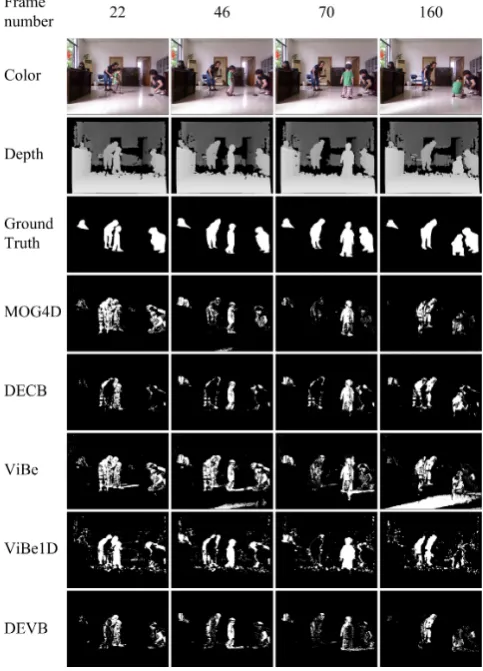
The first sequence,child_no1, shows a child and two adults playing in a living room. The main
difficulties in this sequence are light reflections and subjects that sometimes remain still or move
only slowly. Figure2shows the segmentations produced by the four methods as well as the original
color and depth frames and the hand-generated segmentations (ground truths). Ghosts appear in some frames for MOG4D, DECB, ViBe and ViBe1D, greatly reducing the effectiveness of foreground detection. The ViBe algorithm yields worse results than the other algorithms in frame 160 because of the reflection in the color image. In general, the DEVB algorithm achieves improvement over ViBe by virtue of the additional depth model, which allows the ghosts and black shadows to be effectively removed.
Table1shows the quantitativePWCresults obtained by the four approaches on the evaluation
frames from thechild_no1 sequence. All RGB-D approaches achieve improvements with respect to
ViBe, obtaining lowerPWCvalues. A lowerPWCvalue indicates better performance. The proposed
DEVB algorithm achieves the lowest average error rate of 7.023% in Table1, which indicates that our
method performs better than the other algorithms.
Table 1. Segmentation evaluation for thechild_no1 sequence. The table shows thePWCresults for the various approaches on four different evaluation frames and the mean values for this sequence.
child_no1 Evaluation Frame Global
Approach 22 46 70 160 Mean
DEVB 6.114 6.035 8.826 7.118 7.023
ViBe 7.808 8.932 7.879 16.455 10.269
ViBe1D 11.183 10.686 9.458 10.848 10.544
MOG4D 7.519 6.559 8.003 8.13 7.553
DECB 8.271 8.072 8.672 8.334 8.337
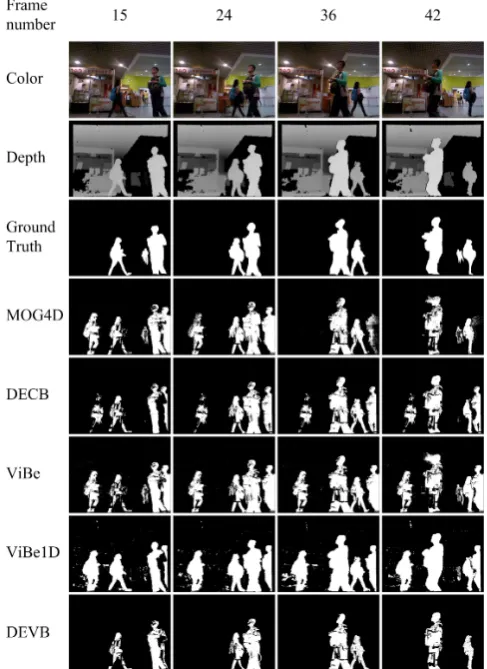
The second sequence,new_ex_occ4, shows two individuals walking in front of a coffee shop. The
main difficulties presented by this sequence are flickering lights and areas where depth information
cannot be obtained by the active infrared sensor. Figure3shows the segmentations produced by the
four approaches. Our DEVB algorithm achieves good results, whereas ghosting greatly reducing the effectiveness of the other algorithms in foreground extraction.
Table2shows the quantitativePWCresults obtained by the four approaches on the evaluation
frames from thenew_ex_occ4 sequence. The proposed DEVB algorithm achieves the lowestPWCof
3.968, which indicates that our method performs better than the other algorithms. ViBe yields the
worst result ofPWC=12.872 on this sequence.
Table 2. Segmentation evaluation for thenew_ex_occ4 sequence. The table shows thePWCresults for the various approaches on four different evaluation frames as well as the mean values for this sequence.
new_ex_occ4 Evaluation Frame Global
Approach 15 24 36 42 Mean
DEVB 5.129 2.997 3.261 4.485 3.968
ViBe 12.294 12.394 12.684 14.116 12.872
ViBe1D 12.096 12.554 12.461 11.999 12.278
MOG4D 11.685 11.157 4.845 5.189 8.219
DECB 9.753 8.522 8.706 9.909 9.223
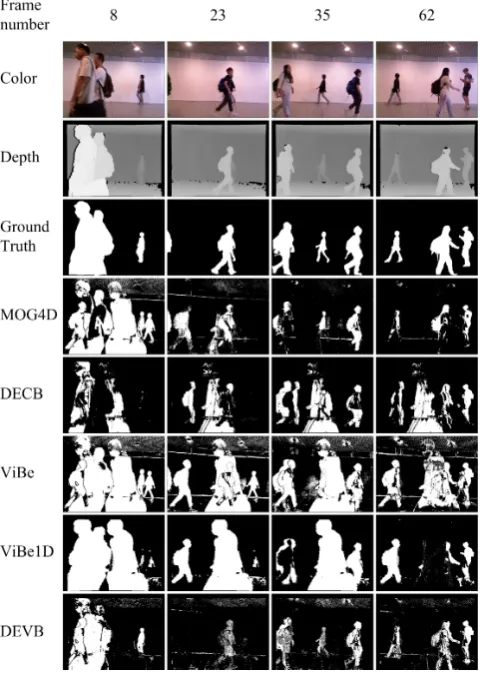
The third sequence,walking_occ1, shows a few people walking in and out of the camera field. In
addition, there are flickering lights on the ceiling and sudden illumination changes. Figure4shows
the segmentations produced by the four approaches. DECB and ViBe1D are less affected by the sudden illumination changes. In addition to ghosting, ViBe1D results in black shadows in frames 35 and 62. The reason for the generation of black shadows is that a new moving object reaches the previous position of an old target. Because the pixel values are similar, the foreground is misclassified as background.
Table3shows the quantitativePWCresults obtained by the four approaches on the evaluation
frames from the walking_occ1 sequence. The DEVB algorithm achieves PWC = 8.847 in frame
8, whereas the PWC values obtained by the other algorithms are higher by more than a factor of
three. Moreover, despite being affected by illumination changes in the RGB space, DEVB achieves an
averagePWCof 8.721 (Table3), indicating that our method is fairly robust to difficult situations.
Table 3. Segmentation evaluation for thewalking_occ1 sequence. The table shows thePWCresults for the various approaches on four different evaluation frames and the mean values for this sequence.
walking_occ1 Evaluation Frame Global
Approach 8 23 35 62 Mean
DEVB 8.847 7.728 10.17 8.137 8.721
ViBe 33.287 30.628 30.221 24.078 29.554
ViBe1D 29.944 26.806 31.726 14.332 25.702
MOG4D 38.186 11.195 10.798 9.185 17.341
DECB 30.262 18.616 22.371 21.162 23.103
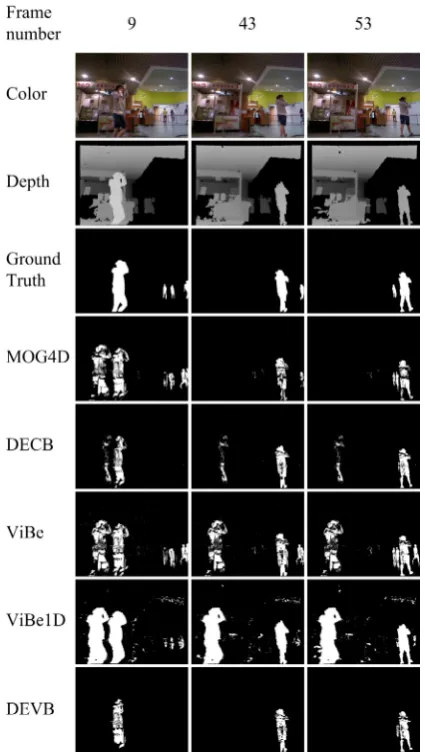
The fourth sequence,new_ex_no_occ, shows a lady walking in front of a coffee shop. The scenario
is similar to thenew_ex_occ4 sequence discussed above. A large amount of noise is generated by the
ViBe1D algorithm because of the holes in the original depth image.
Table4shows the quantitativePWCresults obtained by the four approaches on the evaluation
frames from thenew_ex_no_occsequence. The proposed DEVB algorithm achievesPWC = 2.437.
This value is the lowest in Table4, which indicates that our method performs better than the other
algorithms. ViBe1D obtains the worst result on this sequence, withPWC=12.389.
Table 4.Segmentation evaluation for thenew_ex_no_occsequence. The table shows thePWCresults for the various approaches on three different evaluation frames as well as the mean values for this sequence.
new_ex_no_occ Evaluation Frame Global
Approach 9 43 53 Mean
DEVB 4.102 1.549 1.66 2.437
ViBe 8.188 5.832 6.097 6.706
ViBe1D 14.009 11.249 11.91 12.389
MOG4D 7.977 1.719 1.842 3.846
DECB 5.264 2.222 2.225 3.237
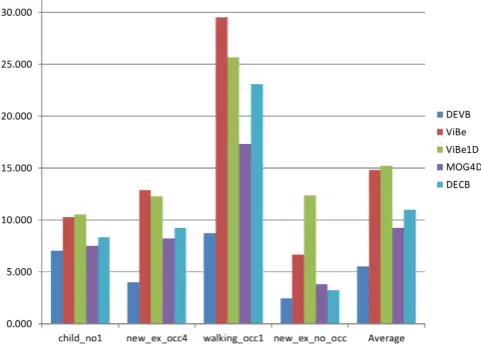
Finally, Figure6shows the averagePWCvalue obtained by each approach on each benchmark
sequence. According to this figure, DEVB yields the best results on every sequence. Thewalking_occ1
sequence is particularly complicated because of the high pedestrian flow; consequently, for each algorithm, the error rate is considerably increased.
Figure 6.AveragePWCvalues for each of the four sequences and for the entire dataset.
5. Conclusion
In this paper, we present an efficient moving object detection algorithm that fuses depth and color information. To incorporate the features of depth images, a depth model is designed in addition to a background model. The inspection mechanism for the classification of foreground pixels is further considered. Finally, we propose a new updating strategy based on the developed background and depth models, which can eliminate ghosting and black shadows almost completely. Experimental results indicate that our method is able to extract foregrounds efficiently, providing an excellent basis for the subsequent motion analysis of a scene. Our proposed method could serve as a convenient research tool for the detection of moving objects captured by the Kinect sensor.
Acknowledgments: This work was supported by the National Natural Science Foundation of China (61471157); the Fundamental Research Funds for the Central Universities of China (2011B11114, 2012B07314, 2015B38214); the Natural Science Foundation of Jiangsu Province, China (BK20141157, BK20141159); and the Open Foundation Programs of Changzhou Key Laboratory of Robotics and Intelligent Technology (CZSR2014003).
References
1. Migliore, D.A.; Matteucci, M.; Naccari, M. A Revaluation of Frame Difference in Fast and Robust Motion Detection. Proceedings of the 4th ACM International Workshop on Video Surveillance and Sensor Networks; ACM: New York, NY, USA, 2006; VSSN ’06, pp. 215–218.
2. Elhabian, S.Y.; Elsayed, K.M.; Ahmed, S.H. Moving Object Detection in Spatial Domain using Background Removal Techniques - State-of-Art.Recent Patents on Computer Science2008,1, 32–54.
3. Barron, J.L.; Fleet, D.J.; Beauchemin, S.S. Performance of optical flow techniques. International journal of computer vision1994,12, 43–77.
4. Barjatya, A. Block matching algorithms for motion estimation. IEEE Transactions Evolution Computation 2004,8, 225–239.
5. Amamra, A.; Mouats, T.; Aouf, N. GPU based GMM segmentation of kinect data. International Symposium Elmar, 2014, pp. 1 – 4.
6. Murgia, J.; Meurie, C.; Ruichek, Y., An Improved Colorimetric Invariants and RGB-Depth-Based Codebook Model for Background Subtraction Using Kinect. In Human-Inspired Computing and Its Applications; Springer, 2014; pp. 380–392.
7. Barnich, O.; Van Droogenbroeck, M. ViBe: A universal background subtraction algorithm for video sequences.Image Processing, IEEE Transactions on2011,20, 1709–1724.
8. Yin, C.; Luo, Y.; Zhang, D. A novel background subtraction for intelligent surveillance in wireless network. Wireless Communications and NETWORKING Conference, 2014, pp. 3017–3021.
9. Kryjak, T.; Gorgon, M. Real-time implementation of the ViBe foreground object segmentation algorithm. Computer Science and Information Systems, 2013, pp. 591–596.
10. Han, J.; Shao, L.; Xu, D.; Shotton, J. Enhanced computer vision with microsoft kinect sensor: A review. Cybernetics, IEEE Transactions on2013,43, 1318–1334.
11. Moeslund, T.B.; Hilton, A.; Krüger, V. A survey of advances in vision-based human motion capture and analysis. Computer vision and image understanding2006,104, 90–126.
12. Ji, X.; Liu, H. Advances in view-invariant human motion analysis: a review. Systems, Man, and Cybernetics, Part C: Applications and Reviews, IEEE Transactions on2010,40, 13–24.
13. Spinello, L.; Kai, O.A. People detection in RGB-D data. IEEE/RSJ International Conference on Intelligent Robots & Systems IEEE/RSJ International Conference on Intelligent Robots & Systems, 2011, pp. 3838–3843.
14. Xia, L.; Chen, C.C.; Aggarwal, J.K. Human detection using depth information by Kinect. Applied Physics Letters2011,85, 5418–5420.
15. Ming, M.; Fangbo, Y.; Qingshan, S.; Yao, S.; Zhizeng, L. Human motion detection based on the depth image of Kinect. Chinese Journal of Scientific Instrument2015,2, 017.
16. Crabb, R.; Tracey, C.; Puranik, A.; Davis, J. Real-time foreground segmentation via range and color imaging. Computer Vision and Pattern Recognition Workshops, 2008. CVPRW ’08. IEEE Computer Society Conference on, 2008, pp. 1–5.
17. Schiller, I.; Koch, R., Improved Video Segmentation by Adaptive Combination of Depth Keying and Mixture-of-Gaussians. InImage Analysis: 17th Scandinavian Conference, SCIA 2011, Ystad, Sweden, May 2011. Proceedings; Springer Berlin Heidelberg: Berlin, Heidelberg, 2011; pp. 59–68.
18. Fernandez-Sanchez, E.J.; Javier, D.; Eduardo, R. Background Subtraction Based on Color and Depth Using Active Sensors. Sensors2013,13, 8895–915.
19. Song, S.; Xiao, J. Tracking Revisited Using RGBD Camera: Unified Benchmark and Baselines. IEEE International Conference on Computer Vision, 2013, pp. 233–240.
20. Goyette, N.; Jodoin, P.M.; Porikli, F.; Konrad, J.; Ishwar, P. changedetection.net: A New Change Detection Benchmark Dataset. Computer Vision and Pattern Recognition Workshops (CVPRW), 2012 IEEE Computer Society Conference on, 2012, pp. 1–8.
c
![Figure 1. Ghosting in a foreground segmentation map generated by the ViBe algorithm [7]: (a) colorframe, (b) ground truth, (c) foreground extraction result.](https://thumb-us.123doks.com/thumbv2/123dok_us/8004463.1329910/2.595.165.431.315.395/ghosting-foreground-segmentation-generated-algorithm-colorframe-foreground-extraction.webp)