2006
A STUDY ON E-TRAINING ADOPTION FOR HIGHER LEARNING
INSTITUTIONS
Mueen Mohsin
College of Information Technology, UniversitiTenaga National, Kajang, Selangor, Malaysia
Rosnafisah Sulaiman
College of Information Technology, UniversitiTenaga National, Kajang, Selangor, Malaysia
ABSTRACT
Conducting or attending training sessions have become essential for developing the required competencies to fulfil organizations’ needs and for individual personal growth. This is also becoming part of developing knowledge society or workers. Most of the organizations are still
applying the traditional training approach for human resource training (e.g. employees need to be
in a certain place, duration, and with an appointed trainer). However, the traditional training
practices consume high cost, less flexibility, and difficult to meet the needs and expectations of
participants and the organizations. This research aims to explore the possibility of adopting
electronic-training (e-training) concept at the higher learning institutions. The e-training in this
research context covers the training provider (the institution) and the trainee (employees) for
in-house training or for external participants. UNITEN was used as a case study to identify the
requirements and the possibilities to adopt the e-training concept. This research applied the
quantitative and qualitative approach that involved survey and interview techniques. The outcome
from this research is an e-training adoption framework that could assist an institution to step
forward into another level of delivering and engaging knowledge to build knowledgeable and
skilful staffs.
Keywords
: E-learning, E-training, E-training Awareness, ICT.1.
INTRODUCTION
Continuous training in an organization has become essential to individual personal growth and
well-being in developing the required professional capabilities (Frank and Rijkema, 2012).
Training was considered as non-productive exercise, but at present, the level of knowledge inside
the organizations can hardly keep up with the rapid changes in business needs and technology. In
order to face with business change and challenges, such as new technology and high economic
competition, it is essential for the organizations to provide education or training to their workforce
to upgrade and equip them with the right knowledge and skills (Srinivasan, 2005). Most of the
International Journal of Asian Social Science
Special Issue: International Conference on Teaching and Learning in Education, 2013
2007 organizations are still applying the traditional training approach for their employee training
programs where the training holds at a certain place, in certain duration and with a trainer presence.
The traditional training practices are contributed to several problems such as high cost, lack of
flexibility, and difficult to meet needs and expectations of participants. According to(Khademi et
al., 2011) traditional training is costly because of time and money spends for traveling and
accommodation. It is less flexible because of the training courses can only be held at a specific time
and place. In addition, traditional training may have some limitations in terms of designing learning materials that meet the employees’ level of knowledge, interest and the needed skills for the job assigned. In University Tenaga National (UNITEN), the training is also conducted in the same
manner (traditional approach). The training is conducted either in house (at the university) or at the third party place. The types of training are various and based on the applicants’ needs such as soft skills, technical skills, or knowledge-based training that may fall under different areas such as IT,
engineering, business as well as for support processes. Based on the description above, it can be
seen that having an intermediate technology for training such as e-training could solve some of the
issues above. Therefore, this study aims to look for the possibility of adopting e-training in an
organization, in particular a higher learning institution where teaching and learning mostly takes
place.
2.
LITERATURE REVIEW
A few topics were reviewed in this study such as the e-learning and e-training concepts, the
differences between these two concepts, the issues and challenges in current practices and existing
frameworks.
2.1. Definitions of E-Learning, Training and E-Training
E-learning
E-Learning was defined in many ways and in different context. E-learning is defined as “encompasses any type of learning content that is delivered electronically” (Bowles, 2004). This concurs with the definition of the American Society for Trainers and Development (ASTD) that
defines e-learning as “instructional content or learning experiences delivered or enabled by
electronic technology” (Hambrecht, 2001). Fallon and Brown, (2002), defined the e-learning as “any learning, training or education that is facilitated by the use of well-known and proven computer technologies, specifically networks based on Internet technology”. In order to align with
the current demand and availability of technology, e-learning provides further enhancements by
incorporating a multitude of assets, such as images and videos to produce media-rich, flexible, and
interactive courses (Yu and Fan, 2009). Naidu (2006)stated that virtual learning environments
motivate learners with multimedia components to capture and visualize real-world scenarios. This
allow the learners with some flexibility such as 24 hours and 7 days a week of learning session and
accessibility to learning materials in the training system (Bowles, 2004). The description of the
E-learning by Fallon and Brown (2002)is adopted as a guide throughout this study. This is because
the definition includes the key ingredients for the growing success of E-learning that are the
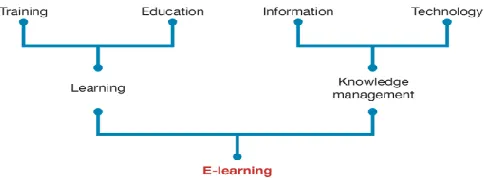
2008 Figure 1 shows that E-learning can be divided in two main categories which are knowledge
management and learning. The knowledge management component focuses on the technical
aspects, while, learning covers the pedagogical background that comes from the combination of
training and education. Training which the focus of this study is considered under the learning
category.
Figure- 1. Overview of Fields of Thought and Practice Involved in E-learning (Bowles, 2004)
Training
Training is described as “an activity that changes people’s behaviors in an organization. Increased productivity is meant to be the most important reason for training”(McClelland, 2002).
However, training is also essential not only to increase productivity but to motivate and inspire
workers about the importance of their jobs and how to perform the jobs as expected as well as part
of their career growth (McClelland, 2002). The term ‘training’ is also defined as “a planned and
systematic sequence of activities usually under the guidance of qualified supervisors”(Jarvis, 1999;
Hickman and Geller, 2003). The aims are to develop knowledge, skills and good behavior pattern
required by an individual in order to perform their work adequately and effectively. In addition, ‘‘training,’’ according to Sloman (2001), ‘‘is the process of acquiring the knowledge and skills related to work requirements using formal structured or guided means, but excluding general
supervision, job specific innovations, and learning by experience.’’. This definition means the
training lies within the domain of the organization: it’s an intervention designed to produce behaviors from individuals that have positive organizational results (Masie and M.J., 2001).
E-training
Echard and Berge (2008)defined the e-training concept as: “A separation of trainer from
trainee and part of teaching and training through instruction, observations, or processes focused
on providing needed skills and knowledge to meet immediate business goals.”. Based on the
definitions and descriptions given above, the e-training concept in this research context is defined “as using technology to deliver knowledge and skills from a trainer (instructor or teacher) to trainees (employee), through a mediator such as the internet, or intranet environment”. These includes special skills such as problem solving, analytical; specialized knowledge, and characters
required in order to build successful and knowledgeable employee that in return will benefit the
2009
2.2.
The Difference Between E-Training and E-Learning
The Table 1 below describes the difference between e-training and e-learning based on
definitions, outcomes, time, target user, paradigm, and measurement (Bernárdez (2002), Bowles
(2004), Masie and M.J. (2001), Horton (2000), Suraya, Azizan, et al. (2008), Ramayah, Ahmed et
al. (2012).
Table- 1.The Difference between e-training and e-learning
No. Criteria
E-training
E-learning
1
Definition
Training lies within the domain
of the organization: it is an
intervention designed to produce
behaviours from individuals that
have
positive
organizational
results.
Encompasses any type of
learning
content
that
is
delivered electronically.
2
Outcome
Based on organization needs,
typically
is
used
on
the
professional or corporate.
Learner
activities
in
a
structured learning process
3
Time
Short duration
Long duration based on the
study
program
example,
degree, diploma etc.
4
Target user
Employees
or
professional
workers
Adult learners
5
Paradigm
Instructional,
programmed-instruction paradigm.
Web
browsing,
self-development paradigm.
6
Measurement Measurement criteria: usage /
cost reduction.
Measurement criteria: learning
outcomes.
From the comparison, it can be seen that the e-training concept is more suitable as it
emphasizes for training the trainees such as employee and potential participants who seek for short
training courses to improve or to acquire new knowledge and skills specifically for job
improvement. Whereas, e-learning is more suitable for learners that engage for a long study
duration, such as students take a diploma, foundation, degree, or master level.
2.3.
Issues and Challenges of E-Training and E-Learning Implementation
There are many challenges and issues that have been highlighted with regards to e-training.
(Ali, 2004; Pagram and Pagram, 2006; Ramayah et al., 2012), claimed that there are several issues
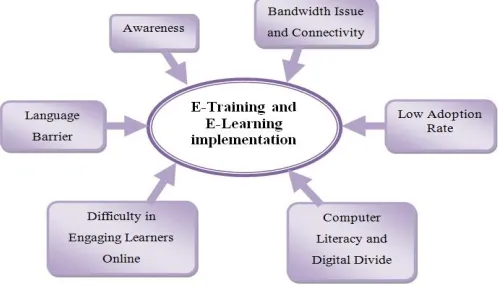
and challenges of e-training and e-learning implementation that need to be considered as illustrated
2010 Figure- 2. Issues and Challenges of e-training and e-learning Implementation
Figure 2 shows that there are six main issues and challenges of e-training and e-learning
implementation which are lack of awareness,low adoption rate, bandwidth issue and connectivity,
language barrier, difficult in engaging learners online, and lastly computer literacy and digital
divide. In order to enhance the effectiveness of understanding e-training concept, the challenges and the issues need to be overcomed. One of the challenges is to identify the organization’s training needs through the use of Information and Communication Technology (ICT) and to ensure the
workforce are ICT literate. Training and re-qualification are essential to face the obsolescence of
skills, and to modify or adapting production and services to the market in a flexible way.
Organizations need to move towards a continuous training system so that it can be well integrated
into the working environment and be part of the organization culture. Competence and knowledge
management should be closely linked to one another to monitor any corporate needs that require a
training to take place (Bagnasco et al., 2003). Due to the circumstances, ICT can broadly be
defined as tools, facilities, processes, and equipment that provide the required environment with the
physical infrastructure and the services for the generation, transmission, processing, storing and
disseminating of information in all forms such as voice, text, data, graphics and video that could
assist the delivery of future job assignment or job improvement (Asabere and Enguah, 2012).
3.
THE EXISTING FRAMEWORKS AND COMPARISON ANALYSIS
In this section, three existing frameworks from previous studies were reviewed and discussed,
as follow:
The first framework was “UM In-House E-training Program Framework” (Azizan, et al.,
2008). This framework was developed and customized to cater for the employee of
Small-Medium Enterprises (SMEs). The focus of this framework is the relationship between the
e-training system and with other components involved in the training process. Currently,
the e-training system was used to offer two coursewares namely the BSC
coursewareandthe Technopreneurship courseware. In this framework, Knowledge
Management (KM) components such as knowledge transfer, knowledge sharing,
knowledge archiving and knowledge creation are incorporated to manage users’ learning
process. The learning organization is also introduced and expected to evolve over time
2011
The second framework was “E-learning (EL) framework” by Ion (2007). This framework
focuses on the use of ICT in order to deliver knowledge and to improve learners’ abilities. The core of E-learning is represented by digital content. Students or employee will be part
of the system through the Internet and Intranet (Ion, 2007).
The third framework is Employees’ Acceptance of Web-Based Training Framework by
Chatzoglou, Sarigiannidis et al. (2009). This framework is used to examine employees’
intention in accepting a web-based training program. The Table 2 below shows the
advantages and disadvantages of the three existing frameworks.
Table- 2. Advantages and Disadvantages of the Three Existing Frameworks Frameworks Advantages Disadvantages
UM In-House E-training Program Framework
reduce training cost
customized for SMES
can be assessed anywhere
The courses in the system are limited
and are not based on trainee’s needs
No relationship with system
developers showed in the framework
Focus on implementation only
E-learning framework (Ion)
Accessibility for both
Intranet and Internet
Provide flexibility in
learning time
management.
Focus more on trainees.
No standard used for developing the digital content
Limitation in terms of
interoperability and content
repository.
Employees’ acceptance of web-based training framework
Provides support for
individual assessment
before designing a
training program.
Customize based on
individuals goal
orientation to suit with different training designs.
This study does not include any
dynamic changes that may appear after trainees test a web-training program and detail the changes that may occur in trainees’ self-efficacy after testing a specific web-training platform.
Only tested with computers only
From the literature review, several criteria were highlighted such as learners or training–
center, general components, specific components, combination of general and specific components,
behavioral components, and awareness or readiness components, as shown in Table 3 below.
These criteria were used to compare the existing frameworks and were also used as a basis for the
proposed framework. Table 3 shows that the first framework and the second one have similarity in
term of the trainees/ learners are in the center or focus of the system. Further, the first framework
highlighted the needs to have a virtual library, e-discussion group, and digital content. In contrast,
the third framework was focused on the intention of using e-training system. Based on the previous
description of the three frameworks, it can be seen that the most obvious differences are that the
first two frameworks (UM In-House E-training Program Framework and E-learning (EL)
framework) were not contained any form of awareness about e-training or e-learning approach. On the other hand, although the third framework was gauged the level of trainees’ intention towards e-training approach but also the awareness of e-e-training approach was not part of the framework.
Therefore, this research is focused on providing a step of e-training awareness in an organization in
2012 Table- 3. The Comparison of the Three Existing Frameworks
No Criteria UM In-House
E-training Program Framework
E-learning framewor k (Ion)
Employees’ acceptance of web-based training framework
1 Learners –centred/ trainees- centred -
2 General components such as Students, IT infrastructure,
hardware, software, and communications networks. -
3 Specific components such as key performance index
(KPI), Several Access Medium, the BSC courseware, the Technopreneurship courseware, and Knowledge Management (KM) components.
- -
4 Combination of general and specific components -
5 Behavioral components such as Intention, Perceived
Ease of Use, Perceived Usefulness, Computer Anxiety, Self-Efficacy, Enjoyment, Learning Goal Orientation, and Management Support.
- -
6 Awareness or readiness components - - -
4.
METHODOLOGY
This research employed qualitative and quantitative research approaches by using
questionnaire and interview methods. The quantitative approach, using questionnaire was used to
elicit information from the respective respondents. The respondents of the survey were academic
staff, employees of UNITEN, and potential participants of e-training courses. The outcomes of the
survey are to determine the level of acceptance and readiness of organization towards the e-training
approach. Qualitative research approach using an interview technique was used to support and
complement the findings gathered from the survey. In this research, the questionnaire was
developed based on a study that was conducted in Greece byChatzoglou, Sarigiannidis et al.
(2009).However, it was customized to suit with this research context. The interview was then
conducted as semi-structured interview with the officer in-charge at Institute of Professional
Advancement (INSPA), UNITEN. Data from questionnaire was analyzed quantitatively and results
were used as a basis to develop the proposed framework.
5.
RESULT, FINDINGS, AND DISCUSSION
In UNITEN, training is divided into two categories, the in-house training either conducted by
the employee to other employee or having invite trainers to conduct training for the UNITEN
employee. The second category, short courses are offered to external participants. These short
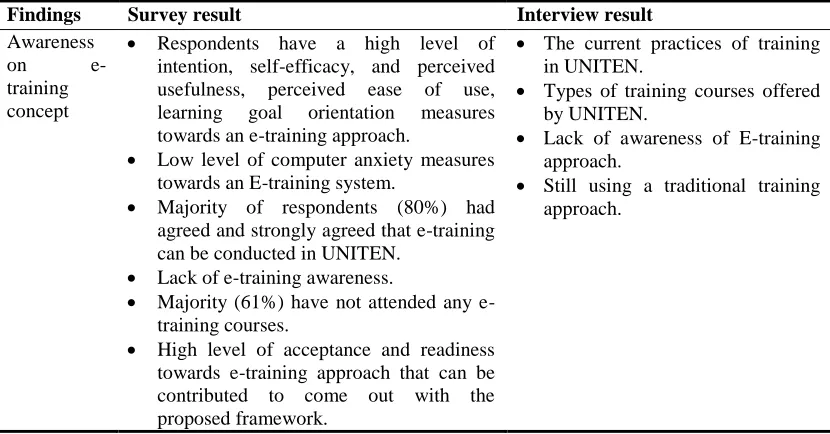
training courses provide the industries with workforce training in a wide range of area normally based on the immediate requirements and tailored to the industries’ needs. From the comparison analysis of existing frameworks, a gap can be seen that none of the frameworks are focusing at the
early stage of e-training adoption which to create awareness. Thus, this section as shown in Table
4, will discuss in brief the findings that supporting the awareness issues with regards to e-training
2013 Table- 4. Survey and Interview Results and Findings
Findings Survey result Interview result Awareness
on
e-training concept
Respondents have a high level of
intention, self-efficacy, and perceived usefulness, perceived ease of use,
learning goal orientation measures
towards an e-training approach.
Low level of computer anxiety measures towards an E-training system.
Majority of respondents (80%) had
agreed and strongly agreed that e-training can be conducted in UNITEN.
Lack of e-training awareness.
Majority (61%) have not attended any e-training courses.
High level of acceptance and readiness towards e-training approach that can be contributed to come out with the proposed framework.
The current practices of training in UNITEN.
Types of training courses offered by UNITEN.
Lack of awareness of E-training approach.
Still using a traditional training approach.
Table- 5. Results on level of Acceptance
Based on the discretion of the results and findings, it can be seen that each criteria of the
acceptance level has a high of percentage which indicates that trainees are accepted and ready to
use e-training. Further, the results and findings were contributed to come out with the proposed
framework. Due to the positive despondences of the survey, it can be concluded that e-training
approach is highly possible to be conducted at a higher learning institution such as UNITEN.
However, most of respondents have not attended any e-training courses before. Thus, the
awareness issues will be taken into consideration throughout this study.
6.
E-TRAINING ADOPTION FRAMEWORK (ETA)
Figure 3 shows the proposed framework which is known as E-training Adoption (ETA)
Framework. This framework provides a step by step approach of developing awareness and
readiness towards the e-training concept at a higher learning institution. The proposed framework
contains six main phases which are Creating Awareness, Identify Learner Needs, Identify System
Requirements, Designing E-training Lessons roles, Development and Delivery of E-training, and
finally E-training Program Assessment. Furthermore, each phase includes some sub-steps as shown
in Figure 3.
Task Moderate Agree and Strongly Agree
Intention 21 % 70 %
Self-Efficacy 21 % 73 %
Perceived Usefulness 28 % 65 %
Perceived Ease Of Use 23 % 71 %
Computer Anxiety 14% 17%
2014 Figure- 3: E-training Adoption (ETA) Framework
Creating Awareness
The first phase shows an early step of the proposed framework which is creating awareness
about E-training. In this research, the awareness means to let the management team, academic
employee, non-academic employee, students, and people know and understand the e-training
approach. A set of questions are prepared in this phase; i) What is training? ii) Why do we need
e-training? iii) What are the benefits of e-e-training? iv) What adequate computer skills should
learners have? v) How to create e-training awareness?
Table- 6. Questions for Awareness No Questions Description and expected benefit
1 What is e-training system? This question is to guide the user to find out the meaning of e-training. The information can be accessed from various resources such as from the Internet, academic publications, vendors etc. This can help the user to understand and exposed to what e-training is all about.
2 Why do we need e-training
system?
This question is to show the importance of e-training. Through this question, the e-training significance can be explained by assessing the organization needs. This includes by incorporating a multitude of assets, such as images and videos, to produce media-rich, flexible, interactive courses.
3 What are the benefits of
e-training system?
This question is to let the users know what they can gain by implementing the e-training approach. For example: cost saving, flexibility, and meeting needs and expectations of trainees.
4 What adequate computer
skills should learners have?
This question is to guide the user to determine what basic skills trainees/trainers should have to be able to use e-training approach. For example: trainees/trainers should have intermediates (e.g. computer or laptop), brewers or e-training software and internet skills.
5 How to create e-training
awareness?
This question is to show the user how to create awareness about e-training approach. For example: the e-e-training awareness can be conducted by two methods which are Advertisements and Seminars.
Identify Learner Needs
This phase contains two steps which are identifying training goals and stakeholders. The
training goals should describe how the gap in skill and knowledge are determined. The training
2015 same goals’ statements can be reused during e-training program assessment to measure the success
of the training session. Stakeholders mean the people who will be involved in the entire e-training
program. They are trainees who need to be trained; an instructor, who provides a training session
to the trainees; and a developer who is the responsible person for the e-training system.
Identify System Requirements
The primary goal of this phase is to create detailed system requirements and architecture to
define the full set needed of e-training approach capabilities to be implemented. These system
requirements include hardware, software, and services. Two options that user or organization
should have: i) to build in-house e-training system or ii) to buy or renting the off-shelves software
provided by established vendor such as ORACLE.
Designing E-training Lessons Roles
The fourth phase of the proposed framework is designing e-training lessons roles. Two aspects
should be defined at this phase; the role of the instructor and the role of trainees. For example: the
instructor’s roles are responsible to provide training lessons, facilitate and conduct training
sessions, conduct training assessment and communicating with trainees. For the trainees, their roles
are to attend the training lessons and getting the materials as well as communicating with the
instructor.
Development and Delivery of E-training
The fifth phase of the proposed framework is Development and Delivery of E-training. The
development makes e-training presentation an ease understanding and usable structure. To perform
this phase, it should be matched and straightforward with the previous phases, because this phase is
a result of the previous phases. Building or developing e-training system depends on identifying
learning lessons, identifying system requirements, and designing e-training lessons. The delivery
here means using the Internet and an intranet to deliver e-training, because of e-training is built in
Web environment. This phase includes two main stages which are implementation and
maintenance. In the implementation stage, an e-training system is installed, initial users training are completed, and users’ documentations are delivered to trainees. When this phase is completed, an e-training system is in steady-state of the training procedure, it is reviewed to ensure that the
training procedure met all the goals for a satisfactory result.
E-training Program Assessment
The assessment focuses on continuous improvement. After the e-training program is completed, an
assessment of this program will be conducted for accuracy, effectiveness, and clarity to meet the
training goals. To assess an e-training program, two perspectives will be considered, trainees’
perspective and training result. In the trainees’ perspective step, trainees will be asked to evaluate a
training program after it is completed. The evaluation will be on measuring how well trainees liked
the training program. The next one is the training results. The training results will be measured
2016
Revision Cycle
To illustrate the revise instruction arrow in the Figure 3, once the e-training program has successfully conducted, it can be positioned at any components based on the trainers or trainees’ needs.
6.1.
Framework Validation
The validation process is performed as follow: the proposed framework was presented in front
of two experts who are in charged and experienced in managing training programs. Five questions were used through this interview session to ask about the framework’s structure, practicality and suitability for its implementation at a higher learning institution. Based on the interview the results
were summarized as follow:
The framework overall structure is sensible and suitable to be implemented at a higher learning institution.
The framework is feasible, easy to understand and possible to be implemented.
The framework gives a clear and effective way of presenting the general benchmarking concept.
The framework provides comprehensive steps and covers most of the major aspects in e-training approach.
However, some improvements can also be done on the step’s sequence and the activities involved in each of the phases.
7.
CONCLUSION
In facilitating the training processes, there are some issues that can be overcome such as high
cost (travel expenses), lack of flexibility, and others. However, having intermediate technology
training such as e-training system can solve some of these issues. Therefore, in this research, an
E-Training Adoption (ETA) framework was developed based on the understanding and analyzing of
reviews and feedbacks gathered through literature review, survey, and interview. The ETA
framework provides a step by step on how to develop awareness and readiness on for e-training
adoption at a higher learning institution. UNITEN was chosen as a case study in this study for
collecting requirements and to gauge the possibilities for e-training adoption. For future works,
more data is still required to validate and improve the framework further that may include detail
infrastructure design, policy and implementation plan.
REFERENCES
Ali, A. 2004. Issues & challenges in implementing e-learning in Malaysia. UNITEM Sdn.
Bhd: ( Cited on pages 4, 5, and 6.).
2017
Bagnasco, A., M. Chirico, G. Parodi, and A. Scapolla, 2003. A model for an open and
flexible etraining platform to encourage companies’ learning culture and meet
employees’ learning needs. Educational Technology & Society, 6(1): 55-63.
Bernárdez, M. 2002. From e-training to e-performance: Using online learning to work.
Bowles, M. 2004. Relearning to e-learn: Strategies for electronic learning and knowledge.
Melbourne University Publishing.
Chatzoglou, P.D., L. Sarigiannidis, E. Vraimaki, and A. Diamantidis, 2009. Investigating
Greek employees’ intention to use web-based training. Computers & Education,
53(3): 877-889.
Echard, R.D. and Z.L. Berge, 2008. Quality management builds solid e-training.
Administering examinations for quality control in distance education: The
National Open University of Nigeria Perspective EC IBARA, National Open
University of Nigeria, NIGERIA . 7-11: 12.
Echard, R.D. and Z.L. Berge, 2008. Quality management builds solid e-training.
Administering examinations for quality control ın distance education: The
National Open University of Nigeria Perspective EC IBARA, National Open
University of Nigeria, Nigeria. 7-11: 12.
Fallon, Carol, D.M. Jeanne , M.D. Jeanne, and B. Sharon, 2002. E-learning standards: A
guide to purchasing, developing, and deploying standards-conformant e-learning:
A primer for using the standards as decision support tools. . St Lucie Press.:
(Cited on pages 3, 4, 5, 6, 7, 8, 9, 10, 15, 16, 17, 18, 20, 21, 22 and 25.).
Frank, d. and B. Rijkema, 2012. Positioning the oer business model for open education.
Hambrecht, W. 2001. E-learning: 2001 outlook for the learning management system
market. IsoDynamic.
Hickman, J.S. and E.S. Geller, 2003. A safety self-management intervention for mining
operations. Journal of Safety Research, 34(3): 299-308.
Horton, W.K. 2000. Designing web-based training: How to teach anyone anything
anywhere anytime. Wiley.
Ion, R. 2007. E-education versus e-training life long learning perspective. ICVL.
Jarvis, P. 1999. International dictionary of adult and continuing education., London:
Kogan Page.
Kamarudin, S.M. 2012. E-courses system. Universiti Tenaga National. pp: 28.
Khademi, M., H. Kabir, and M. Haghshenas, 2011. E-learning as a powerful tool for
knowledge management. International Proceedings of Computer Science and
Information Technology, 12: 35-39.
Khademi, M., H. Kabir, and M. Haghshenas, 2011. E-learning as a powerful tool for
knowledge management. In: International Conference on Distance Learning and
Education (ICDLE 2011). pp: 16-18.
Masie, E. and M.J. 2001. The e-learning revolution. McGraw-Hill. pp: 35-38.
2018