1420
CONTRIBUTION OF ADVANCED TECHNOLOGY AND FOREIGN CAPITAL TO GROWTH OF DIFFERENT STAGE OF DEVELOPMENT COUNTRIES
Paitoon Kraipornsak
Faculty of Economics, Chulalongkorn University Bangkok, Thailand
ABSTRACT
This study determines influence of advanced technology and foreign capital on economic growth apart from contribution of the other major domestic inputs. The countries were classified into four groups; i.e., lower and lower middle income countries, upper middle income countries, non-OECD high income countries, and OECD countries. Five major factors as sources of growth in this study are domestic factors; i.e., domestic capital, labour, and human capital and supporting factors; i.e., foreign capital, and advanced technology. The long run cointegrating relation of the five major factors and its output was estimated for each group of countries. By using panel dynamic production function, most factors in the model were found significantly determining growth in all income groups. Human resources, in form of labour and human capital, were the most contributors to growth. Although all factors were found significantly contributing to growth in the OECD, at least one of the factors has not played significant role in the other three lower stages of development countries. Noticeably, both advanced technology and foreign capital were found significantly contributing to growth in all countries except for the high income Non-OECD where the advanced technology being insignificant source of growth. All five engines of growth must be put attention to play role in development of economy so that the development can be sustainable such as found all being significant factors in the case of the OECD.
© 2014 AESS Publications. All Rights Reserved.
Keywords: Domestic capital, Foreign capital, Human capital, Advanced technology, Country specific, Sources of growth, Cointegrating relation, Panel dynamic model.
JEL Classification: O33, O40, O50.
Contribution/ Originality
This study has used panel dynamic model that can help demonstrate the role of country
specific factor and the crucial factors determining growth in the various level of development
countries. Furthermore the study incorporated into the model human capital, foreign capital and
role of technology of which data are often unavailable and inconsistent across countries and over
periods of time.
Asian Economic and Financial Review
1421
1. INTRODUCTION
The well-known classical economic growth theory identified sources of growth into two major
factors: input growth and residual growth. The input growth consists of capital growth and labour
growth. The residual growth, or Total Factor Productivity growth, is the growth of output caused by factor other than the inputs’ growth so is named as the residual and is determined exogenously outside the system of the model.
The new endogenous growth approach has believed in roles of human capital and
accumulation of knowledge process such as research and development and technological progress
or advanced technology including externality and scale economies. The econometric method states
clearly that the omission of relevant variables in the regression equation can cause biased estimate.
In addition, possible endogenous explanatory variables included in the model can also cause the
endogenous biasedness and inconsistency of the estimation.
This study constructed the model of sources of growth by incorporating major factors
contributing to growth and estimating the model using panel data. Owing to problem of
non-stationarity of time series data of variables in the model, the dynamic model in line with the error
correction model is therefore constructed and estimated. Moreover, unobservable specific cross
country effect possibly due to differences in institutions, socioeconomic factors, culture, and
production was also incorporated into the study.
Next section will review the related literatures. It is expected to provide background on some
related studies on sources of growth. The third section described the model construction and the
data being used in the estimation. Estimation of domestic capital stock and foreign capital stock are
described. The proxies of human capital, advanced technology as well as incorporated country
specific factor being used in the study are presented in this section. Section four discussed the
estimation result and its detailed analysis in comparison across the groups of the countries. Section
five presented the conclusion.
2. LITERATURE REVIEW
The traditional Solow’s growth model put role of capital accumulation and population growth as two important conventional inputs that contribute to output growth apart from the exogenously
given residual growth being explained by technical progress (Solow, 1956; 1957). The Solow’s
growth model however requires the equilibrium condition of input elasticity equals input share and
hence constant returns to scale is a necessary condition.
To add few more important factor inputs into the sources of growth, Nelson and Phelps (1966)
explain the role of human capital and also showed that Solow residual depends on the gap of the
level of knowledge. They put emphasis on the role of education as human capital factor that can
invent and adopt new advanced technology earlier or faster so can speed up diffusion of
technology. The adoption and implementation of technology is being invented gradually at a rate
exogenously given. Therefore increase in educational attainment of labour can raise technological
1422
Mankiw et al. (1992) examined roles of physical and human capital stocks on the determinants of economic growth as factors included in the Cobb-Douglas production function. They augmented human capital as the other capital input apart from the physical capital in the Solow’s growth model. They argued that the omission of human capital input in the model can lead to biased
estimate and can explain why the roles of population growth and physical capital inputs were found
too large. Data set of selected 98 countries from Summers and Heston, the Penn World Table, was
used in the estimation. The study could indicate why some countries were rich and some countries
were poor and showed existence of conditional convergence using the traditional two input growth
model. Moreover the study found existence of non-constant returns to scale production function
and supported for the augmented human capital input into the Solow’s production function. It is
interesting to note that the Adjusted R2 or the goodness of fit of the estimated augmented production function of the OECD countries was found obviously the highest value than those of the
other 98 non-oil countries and 75 intermediate income level countries.
Human capital is also considered an important factor in the growth in Benhabib and Spiegel
(1994). When the model in which human capital associated with the growth of Total Factor
Productivity was constructed and estimated, the result showed that the human capital was
confirmed to be a significant factor determining growth. According to this paper, the human capital
can affect growth through two mechanisms: affecting the speed of technology adoption and
influencing domestically produced technology and innovation. The first mechanism was postulated
in line with Romer (1990a) that the human capital can directly influence productivity by way of
increasing capacity of the nation to innovate new appropriate technology. The second mechanism
was the one in which adapted from the model of Nelson and Phelps (1966) to allow human capital
to catch up the speed of technological innovation and diffusion. The relationship between human
capital and economic development was also tested by using long run cointegrating relation.
Enrolment rates in primary, secondary and tertiary education were found to be correlated with the
per capita GDP while the causality was tested and found that education causes GDP for primary
school and secondary school. However, for the tertiary education, it was found the reversal relation.
Human capital was considered to be an important factor of growth. The author constructed the
human capital that based on Mincerian wage equation in the previous study for Thailand
(Kraipornsak, 2009). Data of individual samples from the Labour Force Survey of the National
Statistical Office in year 1993 and 2006 was used in the estimation of the sectoral wage equations.
The human capital index was then augmented into the production function for the analysis of
growth in Thailand. The finding of the study indicated the existence of the positively long run
contribution of human capital and the Total Factor Productivity to growth in agriculture while the
physical capital input positively contribute to all sectors. The long run growth of industry can be
traded off with those of agriculture and services when allowing all sectors to interact in the growth
of the economy wide. Advanced technology has been placed a crucial role in sources of growth.
Lucas (1988) and Romer (1990b) have modeled the growth of advanced technology, or
technological progress, to depend directly on the educational level of labour, saying as human
1423 human capital is determined by incentives in the market that allocates between production and
invention that enhances the growth of technology. Therefore the role of human capital is facilitating
adoption of technology from other advance countries and creation of appropriate technology
locally.
Research and development can be considered as an investment flow that cumulates stock of the
capital investment and finally affects output as a consequence. The stock of research and
development capital was therefore accounted for another source of growth that is not easily
measurable (Griliches, 1980). He found a substantial decline in the effectiveness or the rate of
research and development capital on productivity growth during the period of the productivity
slowdown in the US during 1969 – 1977. Research and development is a process of knowledge
creation that cumulates stock of knowledge to achieve advancement in technology. Advanced
technology as a consequence of research and development investment can then be accounted for a
source of growth. It was believed that foreign direct investment can affect positively or negatively
to any economy. The positive effect of foreign direct investment has been obtained by various
possible ways such as enhancing capital formation, promoting exports, learning by doing and
technological transfer and spillover effects. The negative effect of foreign direct investment has
been mainly based on the Marxist and the dependency theories over the exploitation of and gaining
control over the host countries. In addition, there are various effects of the foreign direct investment
such as employment, growth, balance of payment, transfer of technology, and income inequality. In
overall, whether or not the foreign direct investment affects the economy positively or negatively
depends very much on how it affects the national welfare in the long run.
There have been many studies on the effects of foreign direct investment using panel data.
Recently various empirical studies on growth used panel data on the estimation of the model. The
advantage of using panel data is on its correcting for country specific differences in various factors
including institutions, culture, and socio-economic factors. Moreover, the frequent problem of
autocorrelation in the time series and the problem of heteroscedasticity in the cross sectional data
estimation can also be minimized or avoided (Hsiao, 1986). Although, to ovoid biasedness of
omitted variables in the model so country specific factor is included and fixed effect estimation is
adopted in the panel data analysis; it relies on homogeneity assumption of the different panel
country groups for a common slope. In dynamic panel data with a large time dimension, Pesaran
and Smith (1995) showed that ignorance of heterogeneity of groups of countries can create
autocorrelation of disturbances and inconsistent estimates of parameters. Average effects with
changing slopes across individual groups in dynamic panel model can be used to give consistent
estimation of mean group procedure.
De Mello (1999) studied impact of foreign direct investment on capital accumulation, Total
Factor Productivity growth and output growth and compared the results of estimation from time
series and panel data. It was found that foreign direct investment can be growth enhancing
depending on its degree of complementarity and substitution with domestic investment. If foreign
direct investment can positively affect growth, complementarity between foreign direct investment
1424 create spillovers in the production of the economy significantly so it can lead to growth of output.
By using panel data set of Summers and Heston, The Penn World Table, and divided countries into
two income level groups; i.e., OECD and non-OECD countries, the impact of foreign direct
investment should be smaller in the OECD countries group. The impact of foreign direct
investment should be smaller for the more advance countries or net exporters of foreign direct
investment. There is however evidences that many foreign direct investments occurred across
advanced economies where they are higher level of technology countries (Lucas, 1990).
The study of De Mello found mixed (positive and negative) results of foreign direct investment
impact on output growth in time series analysis in both short run and long run. Foreign direct
investment showed positively affect output growth suggesting the dominant complementary effect
between foreign direct investment and domestic investment in the fixed effect panel data estimation
after introduction of the country specific factor into the model. Under the dynamic model of foreign
direct investment, foreign capital is complementary to the domestic capital when it involves
transfer of new technology and new process and management style. Borensztein et al. (1998) also found that in sixty nine developing countries during 1970 – 1989 they needed foreign direct
investment to be as domestic absorptive capacity to enhance growth. The study revealed marginally
significant impact of foreign direct investment on growth. The foreign direct investment is
considered to be complementary to the domestic investment in the developing countries. The
magnitude of this positive effect of foreign direct investment on the economic growth however
depended on stock of human capital available in the host country.
3. MODEL AND ESTIMATION
The aggregate production function in this study consists of five major factors; i.e., domestic
capital input (KD), foreign capital input (KF), labour (L), human capital (HC), and advanced
technology (). By using panel data estimation, there is an important advantage over the time series
estimation in that the time series estimation of the standard two factor input production function
leads to possible simultaneity or endogeneity bias. The bias is caused by the relationship between
the regressors in the model and the error term since the model omits some other important variables
such as human capital and advance knowledge especially country specific difference. The high
estimates of capital elasticity coefficient well above the capital share in output found in many
studies can also be the evidence of this endogeneity bias (Young, 1995). The panel data estimation
can help correct for the endogeneity bias caused by the omission of unobservable cross-country
effects or country specific differences in institutions, socioeconomic factors, culture, and
production (Hsiao, 1986).
Recall the aggregate production function, assuming that the production function exhibits
Cobb-Douglas functional form and the technological progress is in exponential form, the aggregate
production equation is therefore written as in Equation (1) below.
(1)
1425 Taking natural logarithmic form into Equation (1), it becomes log-linear equation as in
Equation (2) below.
(2)
Panel data of 108 countries during 1992 – 2011 was collected and used in the estimation of the
model basically depending on availability of completeness of data on all variables in the model.
List of the countries included in the study is shown in the Appendix. Since data of some variables
used in the model estimation are not available and those available data are not consistently defined
among these countries, the study generated series to be the proxies of those variables to be used in
the model estimation. Details of each variable used in the study can be described as follows.
Y is Gross Domestic Product (GDP) measured in purchasing power parity in billion US dollars
from IMF-World Economic Outlook.
, or HTECX named in this study, is to represent the advanced technology or the stage of knowledge in each country over time. The study used the proportion of hi-tech exports on the total
exports to be the proxy of the advanced technology in the model.
KD is domestic capital stock which was estimated in the study as in Equation (3) by using the
conventional Perpetual Inventory Method (PIM) (Christensen and Jorgenson, 1969). Total
investment was divided into domestic investment and foreign investment. Capital stock was then
calculated by using the PIM equation below. Both domestic capital stock and foreign capital stock
were measured in million US dollar.
(3)
Where, Kt is capital stock, It is investment, and is depreciation rate.
KF is foreign capital stock which was calculated in the same manner as in the domestic
physical capital stock (KD) described below whereas foreign direct investment was used in place of
domestic investment in the calculation. This paper estimated the capital stock as suggested by
Berlemann and Wesselhöft (2012). Their study provides comprehensive estimations of aggregate
capital stocks for 103 countries in 2010 using the Perpetual Inventory Method in hoping for
suggestion of constructing internationally comparable datasets of capital stock. It is one of few
studies on the estimation of capital stock worldwide while it is easily extended for more countries
and for more recent years. Most available studies estimated the capital stock for the US such as
Nadiri and Prucha (1996) for the US manufacturing sector, Griliches (1980) for the US 3-digit
manufacturing industry, and Kamps (2006) for the estimated capital stock for 22 OECD countries
using investment data from the OECD Database. Kamps (2006) assumed 4.25 percent of the
depreciation rate for nonresidential assets and 1.5 percent for residential assets and 2.5 percent for
government assets. The study of Berlemann and Wesselhöft applied various approaches of the
estimation of capital stock including the unified approach. The initial capital stock (Kt0) was estimated by the following Equation (4).
1426 Where, gI is the long term growth rate of investment that is obtained by the estimation of the
equation of semi log function as in Equation (5) below. Here bj is the long term growth rate of investment. The initial period of the investment (I0) can also be obtained by this estimated equation.
(5)
The estimation results of the depreciation rate obtained by the study of Berlemann and
Wesselhöft were 3.7 percent, 0.03 percent and -1.02 percent for private non-residential fixed assets,
private residential fixed assets, and government fixed assets, respectively. Therefore, the average
rate of 1.6 percent of these three assets was assumed to be the depreciation rate in the estimation in
this study.
L is Employed labour in thousand persons from UNCTAD.
The UNDP Human Development Index combines various dimensions of human indicators
covering health, education and living standard. A minimum and a maximum for each dimension (or
goalpost) is set and each country stands in relation to these goalposts is then expressed in values
between 0 and 1 (The United Nations Development Programme). It is noted that instead of using
education enrolment rate to be the proxy of human capital as many studies did, this study
constructed the human capital index by using the international human development index of the
United Nations to make adjustment for the human capital index. In details, Human capital (HC, or
HDIAVG named in this study) was constructed by taking the human development index of the
United Nations to adjust into the number of labour to have this index reflecting its quality of human
of each country. Human development index or HDI (ranged between 0, the lowest, and 1, the
highest) that having been constructed and ranked by the United Nations was used as the parameter
to adjust the number of employed labour to be the proxy of human capital index (HDIAVG) in the
model. While higher HDI implies better human development status relatively, many more people
also means higher human capital stock. Nevertheless, the HDI was available only for the year 1990,
2000 and in each year from 2005 on. To deal with the unavailable annual data of the HDI during
1991 - 2004, the human capital index (HDIAVG) was therefore calculated by using the HDI in
1990 and 2000 for the construction of HDIAVG during 1991 – 1999 and 2000 – 2004, respectively.
The study classified the countries into four income groups mainly based on the World Bank
classifications by Gross National Income per capita as of 1st July 2013; i.e., lower and lower
middle income countries, upper middle income countries, non-OECD high income countries, and
OECD countries. Heterogeneous character across groups of countries such as natural resources,
political system, geography, weather, and religion can be considered as specific factor of countries
significantly determining different growth. In order to avoid the problem of autocorrelation of
disturbances and to gain consistent estimate, responding to Pesaran and Smith findings as
mentioned earlier, this study separately estimates the model into four income groups of countries. The study denotes this country specific factor by variable’s name of C1, C2, C3, and C4 being for the lower and lower middle income countries, the upper middle income countries, the non-OECD
1427
4. RESULTS AND DISCUSSION
In general, there are advantages of using panel data in the estimation over cross sectional units
or time series data. The case of a particular country in which too short period of time series data
available can create the problem of too small degree of freedom causing large variances of
estimated parameters and loss of power of hypothesis tests. The panel data model can be used to
avoid this small degree of freedom if under assumption of homogeneous parameter across
countries. In case of too small number of cross section or countries, the panel data can be used by
assuming country specific effect or fixed effect model. Most of all, comparing with cases of cross
sectional data, the panel data model can help avoid the possible problem of misspecification of
dynamic model biases in the estimation in case that the static model ignores the possible dynamic
adjustment of the model over time. Specifically, by inclusion of lagged dependent variable in the
dynamic model, it can control the problem of ignorance some possible omitted variables.
As almost being the case, non-stationary process is found in time series. To test for the unit
root in panel data, assuming the autoregressive process of degree 1 as written in Equation (6)
below.
it it it it
y
z
y
/1 (6)
T
t
N
i
1
,
2
,
...,
;
2
,
3
,
4
,...,
Where
; it is a stationary process;z
it/ is the deterministiccomponent and can be 0, 1, fixed effects ( i) and time trend (t).
The null hypothesis of unit root (
i
1
) for all i is set against the alternative hypothesis ofstationary (
i
1
). The standard unit root tests include Levin et al. (2002), Im et al. (2003) andFisher-type proposed by Maddala and Wu (1999) and Choi (2001).
Levin, Lin and Chu allowed heterogeneity of individual deterministic effects and
heterogeneous autocorrelation structure of the residuals and assuming homogeneous parameters in
the autoregressive process or generally so called common unit root process across cross sectional
units. It is sometimes referred to common unit root process null hypothesis. The structure of the
analysis can be written as in Equation (7) below. This panel unit root tests is more relevant for the
moderate size of the panel data.
it i i it
it
y
t
y
1 0 1 (7)Where it is an invertible ARMA stationary process and is assumed to be independently distributed across individuals. The equation for this test is estimated by pooled OLS regression.
Im, Pesaran and Shin test introduces a more flexible and simple procedure of the unit root test
and allows for simultaneous stationary and non-stationary series of parameter (i) that can be different between individuals. The test also allows for autocorrelation and heterogeneity of the
dynamic error variances across groups. It is sometimes referred to individual unit root process null
1428 autocorrelated and dimensions of time and cross section are sufficiently large. The equation for this
test is estimated by balance panel data procedure. In case of autocorrelation of the residuals the test
uses Augmented Dickey Fuller t test for individual series. The rejection of the null hypothesis does
not necessary means that the unit root is rejected for all cross sectional units.
Maddala and Wu and Choi offered an alternative test following the non-parametric Fisher’s
Type test. This test is based on a combination of the probability values of the test statistics for a
unit root in each unit of cross section. While Im, Pesaran and Shin test and Fisher’s test combine
information on individual unit root tests, this test also relax the assumption of the Levin, Lin and
Chu of the same parameter (i) under alternative hypothesis. In addition, the Fisher test is based on general assumption compared to both Im, Pesaran and Shin test and Levin, Lin and Chu test. The Fisher’s test has some advantages especially that it does not require the balance panel data and is possible to use different lag lengths in the Augmented Dickey Fuller regression.
Although the data used in this study is a moderate size sample that is more relevant for the
Levin, Lin and Chu test, the other two tests were also considered and see whether there is any test
rejects the null hypothesis of the unit root. The results of the unit root tests of each variable in the
study showed that all variables are non-stationary process (Table A2 and Figure A1 in Appendix).
All series appear to be random walk processes. This suggests that there is a short-run
disequilibrium and the long-run equilibrium of the model equation. The cointegrating relation is
therefore estimated based on the approach of dynamic model. The study began by estimating the
static panel data model as in Equation (2) preliminarily using panel Least Square for all countries in
the panel data. The estimation result clearly showed that although all the estimated coefficients of
the equation were statistically significant but some of them were found to be the questionable sign
(negative sign); i.e., those of labour (ln(L)) and advanced technology (ln(HTECX)) (Equation (8)
below). In addition, the residuals of the regression line appeared to have autocorrelation problem
(Figures A2 and A3 in Appendix). This indicates possible omission of some relevant variables (i.e.,
country specific factor) in the model.
0.1317 Stat
DW 0.0000], [p
4880 . 8328
, 0738 . 224 Re
, 9567 . 0 R Adj
(-12.4874)
ln 0677 . 0
(20.5124)
(-13.7644)
(18.5365)
(41.1868)
(-77.4074)
(t)
ln 2644 . 1 ln 7632 . 0 ln
1176 . 0 ln
3545 . 0 3400 . 6 ln
2
F
sid SumSquare HTECX
HDIAVG L
KF KD
y
it
it it
it it
it
(8)
The fixed effect panel data model was next estimated. The advantage of fixed effect inclusion
into the model is to help eliminate any unobservable factor assuming constant over time while
varying across countries. This implies the existence of country specific effect in the model. The
fixed effect model is written as Equation (9) below. Here, the fixed effect is denoted by i.
it i it it
it it
it
it
KD
KF
L
HDIAVG
HTECX
y
ln
ln
ln
ln
ln
ln
1 2 3 4 (9)The study estimated the model by introducing panel fixed effect to take account of the country
specific factor. The result is shown in Equation (10) below and country fixed effect in Table A3 in
1429 they became insignificant. The residual plot and its correlogramme were examined and found that
the residual still had some autoregressive moving average problem (Figures A4 and A5 in
Appendix), though it was little better than that of Equation (8) (as showed earlier in Figures A2 and
A3 in Appendix).
3460 . 0 ] 0000 . 0 [ 2760 . 3515 , 2555 . 23 Re , 9952 . 0 (-1.7898) ln 0059 . 0 (13.9940) (-1.4595) (27.1164) (14.7331) (-21.7745) (t) ln 8740 . 0 ln 1166 . 0 ln 1530 . 0 ln 1585 . 0 9236 . 5 ln 2 Stat DW p F sid Squared Sum AdjR HTECX HDIAVG L KF KD y it it it it it it (10)
The random effect was estimated based on Generalized Least Square. The result was shown in
Equation (11) below. Whether the fixed effects specification of cross sectional units is appropriate
or not, the test for random effect can be carried out. The essential assumption in the random effects
model is that the random effects must be uncorrelated with the explanatory variables. The study
performed the Hausman Test for random effect that is Chi-Square distribution. It was 113.9754,
which was significant, so the statistic rejected null hypothesis of independence between the residual
and the explanatory variables. The fixed effect is therefore preferable. However, the estimat ion
result similarly gave the unsatisfied residual property owing to the existence of autocorrelation.
(Figures A6 – A7 in Appendix).
3418 . 0 ], 0000 . 0 [ 8430 . 3328 1159 . 26 Re , 8982 . 0 : Statistic Weighted (-2.2493) ln 0073 . 0 (18.9696) (-6.8679) (26.2443) (19.5442) (-31.4973) (t) ln 0219 . 1 ln 3951 . 0 ln 1417 . 0 ln 1957 . 0 2378 . 5 ln 2 Stat DW p F sid Squared Sum AdjR HTECX HDIAVG L KF KD y it it it it it it (11)
The study conducted the unit root test as mentioned earlier. Since the variables used in the
model estimation were non-stationary processes; therefore, the estimate of static model as written
in Equation (2) was mis-specified dynamic biased. The unit root test of all variables could not
reject the null hypothesis of non-stationarity. The second difference series were also tested to see
whether they are non-stationary. The results of second difference series test for unit root showed to
be stationary processes therefore it indicates that all variables are integrated of order one. By being
non-stationary process of the time series variables, the appropriate equation must be constructed by
using dynamic model. The error correction mechanism type of model can be used to specify short
run disequilibrium and long run cointegrating relation between variables in the model described as
follows.
The general linear dynamic panel model specification can be written as in Equation (12)
below. The first differenced equation of the general linear dynamic model can help eliminate the
1430
it it k it P
k k i
it
Y
X
Y
/1
(12)
it it
k it P
k k i
it
Y
X
Y
/1
(13)
The panel dynamic structure for the n+1 dimensional time series vector
/
, itit X
Y and if
cointegration exists, it can be written as in Equation (14) below. The cointegrating relation between
Y and X above is assumed to be homogeneous across cross sectional units and the specification
allows for cross section specific deterministic effects.
it i it it
it
X
Z
Y
1/
/
(14)
Where
Z
it
Z
1/it,
Z
2/it
/ are deterministic trend regressors.it it i it i
it
Z
Z
X
/ 2 222 1 /
21
(15)And
2it
2it (16)There are two basic estimation methods for a single cointegrating relation in general; i.e., Fully
Modified Ordinary Least Square (FMOLS) and Dynamic Ordinary Least Square (DOLS). The
study adopted DOLS method in the cointegrating relation and assumed homogeneity in the
equation1. Given cointegration is found, the panel DOLS estimator pools the data along within dimension of the panel. Kao and Chiang (2000) argued that under cointegration, DOLS is
promising in small samples and performs well so that it is consistent with the sample used in this
study. However Pedroni (2001) proposed the group mean FMOLS estimator to allow endogeneity
and autocorrelation problems to obtain consistent and asymptotically unbiased estimates.
When a panel contains large numbers of time series and cross sectional unit, the model can be
practically estimated by either separately cross sectional regressions or mean group estimator,
assuming the slope coefficients and error variances are identical. In case of pooled mean group
estimation, the long run coefficients must be constrained to be identical and the short run
coefficients and error variances can be different across groups. Pesaran et al. (1997) empirically estimated various cases including the case where it followed unit root processes and derived the
asymptotic distribution of the estimators with varying length of time period. In case of short time
period panel data, all estimators (group specific, mean group, pooled mean group, and fixed effect)
were subject to downward biased on the coefficient of lagged dependent variables.
The panel DOLS augments the panel cointegrating regression with the cross section specific
lags and leads of the difference of explanatory variable to eliminate th9 asymptotic endogeneity
1 The study also complemented the DOLS estimation of the long run cointegrating relation by the group mean FMOLS as
1431 and autocorrelation. The method estimates an augmented cointegrating equation as in Equation (17)
below by OLS. The equation indicates that the short run dynamic coefficients ( i) are cross section
specific.
_ 1 /
_ _
/ _
it i r
q k
k it it
it
i
i X X
Y
(17)
Let
/ _
k it
X
interact with cross section dummy variables to be formed as regressors (Zit_ ) and
let
/ / _ / _ / _
,
it it
it X Z
W , the pooled DOLS estimator can be written as Equation (18).
Moreover, Kao and Chiang showed that asymptotic distribution of the estimation is the same
as for the pooled FMOLS.
N
i
it T
t it N
i
it T
t
it
W
W
Y
W
1
/ _
1 _ 1
1
/ _
1 _
^ ^
(18)
To test for cointegration, panel Pedroni’s cointegration test was performed for each of the four groups of countries as showed in Table 1 below. The test performed by lag length selection based
on SIC with lags from 0 to 2 and using Newey-West automatic bandwidth selection and Bartlett
kernel. The test can reject the null hypothesis of no unit root or, in the other word, variables are
cointegrated, especially the tests of those ADF statistics in which it allows the use of different lag
lengths in the regression equation.
To estimate for the cointegrating relation, the panel Dynamic Least Square (DOLS) estimation
method is used. It however does not allow the importance of country specific difference or cross
country heterogeneity. The study therefore took into account the country specific difference by
separately estimating the model for each of the four income groups of countries.
Table-1. Panel Cointegration Test
C1 C2 C3 C4(OECD)
Ha: common AR coefficients. (within-dimension)
Statistic [prob] Statistic [prob] Statistic [prob] Statistic [prob] Panel v-Stat. -2.0875[0.9816] -0.8909[0.8135] -0.9876[0.8383] -1.2748[0.8988] Panel -Stat. 4.7562[1.0000] 4.1675[1.0000] 3.1131[0.9991] 5.0749[1.0000] Panel PP-Stat. -1.4979[0.0671] 0.5120[0.6957] 0.5520[0.7095] 2.9231[0.9983] Panel ADF-Stat. -4.5282[0.0000] -1.8914[0.0293] -1.3986[0.0810] -1.1466[0.1258] Ha: individual AR coefficients. (between-dimension)
1432 The long run cointegrating relations for four groups of countries; i.e., one, the lower and lower
middle income countries; two, the upper middle income countries; three, the non-OECD high
income countries; and four, the OECD countries were estimated and showed in Equations (19) –
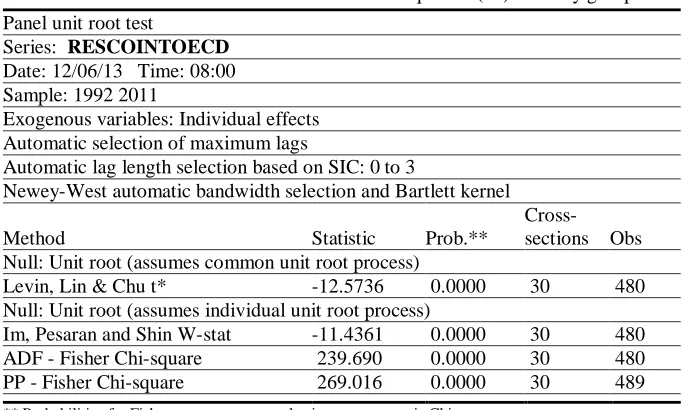
(22). The unit root tests of the residuals was also done and found that the tests reject the null
hypothesis (Table 2 – 5).
0006 . 0 , 2744 . 0 Re , 999929 . 0 AdjR (3.8081) ln 0333 . 0 (1.6332) (2.4615) (8.0343) (9.9791) (t) ln 2180 . 0 ln 4793 . 0 ln 1379 . 0 ln 3355 . 0 ln
2
Variance Run Long sid Squared Sum HTECX HDIAVG L KF KD Y it it it it it it (19)
Table-2. Test for unit root of the residuals of Equation (19): country group 1 Panel unit root test
Series: RESCOINTC1
Exogenous variables: Individual effects Automatic selection of maximum lags
Automatic lag length selection based on SIC: 0 to 2
Newey-West automatic bandwidth selection and Bartlett kernel
Method Statistic Prob.**
Cross- sections Obs Null: Unit root (assumes common unit root process)
Levin, Lin & Chu t* -16.7370 0.0000 25 337
Null: Unit root (assumes individual unit root process)
Im, Pesaran and Shin W-stat -13.1846 0.0000 25 337
ADF - Fisher Chi-square 245.102 0.0000 25 337
PP - Fisher Chi-square 295.989 0.0000 25 348
** Probabilities for Fisher tests are computed using an asymptotic Chi -square distribution. All other tests assume asymptotic normality.
05 61 . 2 , 0186 . 0 Re , 999992 . 0 AdjR (8.5265) ln 1668 . 0 (7.0234) (3.6742) (7.0027) (-1.6942) (t) ln 7203 . 0 ln 8621 . 0 ln 1421 . 0 ln 2738 . 0 ln
2
E Variance Run Long sid Squared Sum HTECX HDIAVG L KF KD Y it it it it it it (20)
Table-3. Test for unit root of the residuals of Equation (20): country group 2 Panel unit root test
Series: RESCOINTC2
Exogenous variables: Individual effects Automatic selection of maximum lags
Automatic lag length selection based on SIC: 0 to 3
Newey-West automatic bandwidth selection and Bartlett kernel
Method Statistic Prob.**
Cross-
sections Obs Null: Unit root (assumes common unit root process)
1433
Levin, Lin & Chu t* -22.2529 0.0000 17 260
Null: Unit root (assumes individual unit root process)
Im, Pesaran and Shin W-stat -19.0890 0.0000 17 260
ADF - Fisher Chi-square 477.386 0.0000 17 260
PP - Fisher Chi-square 1672.56 0.0000 17 271
** Probabilities for Fisher tests are computed using an asymptotic Chi -square distribution. All other tests assume asymptotic normality.
0017 . 0 , 3466 . 0 Re , 999859 . 0 AdjR (-0.4825) ln 0101 . 0 (3.9122) (-0.4001) (3.5644) (4.4961) (t) ln 2750 . 1 ln 1459 . 0 ln 0970 . 0 ln 1681 . 0 ln
2
Variance Run Long sid Squared Sum HTECX HDIAVG L KF KD Y it it it it it it (21)
Table-4. Test for unit root of the residuals of Equation (21): country group 3 Panel unit root test
Series: RESCOINTC3 Date: 12/06/13 Time: 07:58 Sample: 1992 2011
Exogenous variables: Individual effects Automatic selection of maximum lags
Automatic lag length selection based on SIC: 0 to 1
Newey-West automatic bandwidth selection and Bartlett kernel
Method Statistic Prob.**
Cross-
sections Obs Null: Unit root (assumes common unit root process)
Levin, Lin & Chu t* -9.90936 0.0000 13 180
Null: Unit root (assumes individual unit root process)
Im, Pesaran and Shin W-stat -7.90001 0.0000 13 180
ADF - Fisher Chi-square 106.865 0.0000 13 180
PP - Fisher Chi-square 137.927 0.0000 13 185
** Probabilities for Fisher tests are computed using an asymptotic Chi -square distribution. All other tests assume asymptotic normality.
0007 . 0 , 3109 . 0 Re , 999962 . 0 AdjR (2.0494) ln 0.0315 (4.5748) (4.2649) (14.0390) (7.1101) (t) ln 5693 . 0 ln 6670 . 0 ln 1370 . 0 ln 1565 . 0 ln
2
Variance Run Long sid Squared Sum HTECX HDIAVG L KF KD Y it it it it it
it (22)
The equation estimation is the part of the long run equilibrium in addition to the short run
disequilibrium dynamic part following the error correction mechanism approach. Furthermore, the
Pedroni cointegrating relation estimation extends the grouped estimator concept to DOLS
estimation by averaging over the individual cross section estimates. Therefore the goodness of fit
(R2) of this theoretical long run relation can be noticeably recorded very high as it left only very small regression error component in the calculation of R2. The study further imposed the constant returns to scale restriction into the production function equation. The Wald test for constant returns
to scale restriction was rejected in all the production function estimations (Table 6) and so it
confirmed the non-constant returns to scale production function (increasing returns as found in
1434 Table-5. Test for unit root of the residuals of Equation (22): country group 4
Panel unit root test
Series: RESCOINTOECD Date: 12/06/13 Time: 08:00 Sample: 1992 2011
Exogenous variables: Individual effects Automatic selection of maximum lags
Automatic lag length selection based on SIC: 0 to 3
Newey-West automatic bandwidth selection and Bartlett kernel
Method Statistic Prob.**
Cross- sections Obs Null: Unit root (assumes common unit root process)
Levin, Lin & Chu t* -12.5736 0.0000 30 480
Null: Unit root (assumes individual unit root process)
Im, Pesaran and Shin W-stat -11.4361 0.0000 30 480
ADF - Fisher Chi-square 239.690 0.0000 30 480
PP - Fisher Chi-square 269.016 0.0000 30 489
** Probabilities for Fisher tests are computed using an asymptotic Chi -square distribution. All other tests assume asymptotic normality.
Table-6. The Wald test for constant returns to scale production function
Wald Test F-Statistic [Prob]
Lower and lower middle income countries 82.3702 [0.0000]
Upper middle income countries 25.4295 [0.0000]
Non-OECD high income countries 6.7012 [0.0098]
OECD countries 77.6517 [0.0000]
The study further examined sizes of the estimated coefficients in details in order to compare
the differences of the impacts among factors of growth. However, the sizes of coefficients of
regressors in any regression equation are not directly comparable due to their differences in their
units and their variances. The standardization adjusts the different units and different standard
errors of the variables just like the Z-score statistic so that these standardized coefficients unit-less
scores can be comparable across variables as written in Equation (23) below.
(23)
Where = standardized coefficient of the jth explanatory variable = coefficient of the jth explanatory variable
SEj = standard error of the jth explanatory variable
SEy = standard error of y variable
Table 7 below shows the sizes of the standardized coefficients of variables in each group of
country. Since the production function was a log-linear equation, the coefficient of variable means
its elasticity of output or its factor share in the equilibrium condition. The result in Table 7 thus
clearly indicated that either labour or human capital or both forms of human factor are the factors
contributing most to the output growth in the four income level groups of countries. Note also that
labour was found to be the least (and insignificant) contributor to growth for the non-OECD high
1435 domestic capital was found to be the least (and insignificant) contributor to growth for the upper
middle income countries (group 2) where many of them are new emerging or rapidly growing
countries. This insignificant negative impact of domestic capital on growth can imply that there
was substitution or displacement of stronger effect of foreign capital and its weaker effect of
domestic capital on growth in such countries. Although all factors were found significantly
contributing to growth in the OECD, at least one of the factors has not played significant role in the
other three lower stages of development countries. Both advanced technology and foreign capital
significantly contribute to growth in all countries except the high income Non-OECD where the
advanced technology being insignificant source of growth.
Table-7. The standardized coefficients of the production function
Coefficient of C1 C2 C3 C4
L 0.0490 0.0872 -0.0352 0.0377
HDIAVG 0.0153 0.0319 0.2750 0.0256
KD 0.0059 -0.0191 0.0042 0.0012
KF 0.0012 0.0012 0.0017 0.0005
HTECX 0.0002 0.0014 -0.0001 0.0002
Source: Author’s calculation
The finding of significant long run contribution of human capital to economic growth in most
income countries, except in the lower and lower middle income countries, is consistently found as
in many previous studies. In addition, the advanced technology was found to be a crucial factor to
growth except for the high income non-OECD. These two findings confirm the essential role of
human capital and advanced technology in promoting sustainable economic growth especially in
the upper middle income countries and the advanced high income OECD. Likewise, foreign capital
was found to play significant contribution to growth in all countries from the rich to the poor. This
confirms the conventional hypothesis of the role of capital accumulation in economic growth
particularly that of foreign capital. A policy implication on these findings indicates importance of
advanced technology and foreign capital which are crucial supporting factors apart from investment
in human capital to sustain economic growth in the long run. Most of all, all the mentioned five
engines of growth must be placed attention to play role in development of economy so that the
development can become of great success such as found all being significant factors in the case of
the OECD. Certainly, the country specific factor cannot simply be changed though it is also found
important.
5. CONCLUSION
Apart from the conventional role of capital accumulation and population growth in economic
growth; human capital, foreign capital, and advanced technology are also the other important
1436 Panel data of 108 countries during 1992 – 2011 was collected and used in the estimation of the
aggregate production function. For the disaggregate model, the study classified the countries into
four groups; i.e., lower and lower middle income countries, upper middle income countries,
non-OECD high income countries, and non-OECD countries based on the World Bank income
classifications by GNI per capita. The study generated indices as proxies for some variables used
in the model estimation. Since data for physical capital in many countries in the study is incomplete, Perpetual Inventory Method (PIM) was used to estimate the countries’ domestic and foreign physical capital stocks. Human capital was estimated and used as the proxy by taking the
Human Development Index of the United Nations to make adjustment to number of workers for
each country. The ratio of hi-tech export to the total export of goods was used to be the proxy of
advanced level of technology.
Since all variables in the model are found to be non-stationary processes and be integrated of
order one, the dynamic model is appropriate and the cointegrating relation of the production
function was estimated. By using panel dynamic least square method, the long run cointegrating
relations of the production function were estimated for the four groups of countries separately. This
separated equation estimation can also help avoid the biased problem due to the possible omission
of country specific factor as the separately estimated equations can be considered as each
individual or independent function. This study showed that the pooled mean group panel dynamic
model estimation for each group of countries provided better result than the panel fixed effect
model. As a part of the superiority of the panel dynamic model estimated separately by each
income group to be accounted for each country specific factor, the pooled mean group dynamic
model allows short run dynamic to differ across countries while the aggregate panel fixed effect
model does not have this dynamic effect.All the estimated production functions were found
exhibiting non-constant returns to scale and were consistent with most findings of the new
endogenous growth theory. Interestingly, all coefficients of factors were found significant for the OECD’s long run production function. At least one of those factors of growth was found insignificant for the other three lower income groups. The advanced technology and foreign capital
can be the supporting factors and thus the OECD growth is better sustainable than the other
countries. The finding indicates importance of advanced technology and foreign capital which are
crucial factors apart from investment in human capital to sustain economic growth in the long run.
All the five engines of growth were found being significant factors in the case of the successful
OECD therefore a policy must be placed attention to these five factors to fully play their roles on
growth.
Besides, these estimation results are in line with the endogenous growth approach. The human
capital and the advancement of knowledge, or named in this study the advanced technology, are the
two important endogenous factors of growth and must be included in explanation of the
conventional Total Factor Productivity growth, previously considered as the exogenously given
residual growth. As the result, the residual growth is found insignificant or it is approaching zero
1437
REFERENCES
Benhabib, J. and M.M. Spiegel, 1994. The role of human capital in economic development: Evidence from
aggregate cross country data. Journal of Monetary Economics, 34(2): 143-173.
Berlemann, M. and J.E. Wesselhöft, 2012. Estimating aggregate capital stocks using the perpetual inventory
method: New empirical evidence for 103 countries. Diskussionspapierreihe Working Paper Series
No. 125. Hamburg, Germany: Helmut Schmidt University, Department of Economics.
Borensztein, E., J.D. Gregorio and J.W. Lee, 1998. How does foreign direct investment affect growth?. NBER
Working Paper No. 5057, Cambridge.
Choi, I., 2001. Unit root tests for panel data. Journal of International Money and Finance, 20(2): 249-272.
Christensen, L.R. and D.W. Jorgenson, 1969. The measurement of U.S. real capital input, 1929-67. Review of
Income and Wealth, 15(4): 293 - 320.
De Mello, J.L.R., 1999. Foreign direct investment-led growth: Evidence from time series and panel data.
Oxford Economic Papers, 51(1): 133-151.
Griliches, Z., 1980. R&D and the productivity slowdown. NBER Working Paper Series No. 434. Cambridge.
Hsiao, C., 1986. Analysis of panel data. Cambridge: Cambridge University Press.
Im, K.S., M.H. Pesaran and Y. Shin, 2003. Testing for unit roots in heterogeneous panels. Journal of
Econometrics, 115(1): 53-74.
Kamps, C., 2006. New estimates of government net capital stocks for 22 OECD countries 1960 – 2001. IMF
Staff Paper, 53(1): 120 – 150.
Kao, C. and M.H. Chiang, 2000. On the estimation and inference of a cointegrated regression in panel data. In
Baltagi, B.H. et al. eds. Nonstationary panels, panel cointegration and dynamic panels, 15.
Amsterdam: Elsevier. pp: 179-222.
Kraipornsak, P., 2009. Roles of human capital and total factor productivity growth as sources of growth:
Empirical investigation in Thailand. International Business & Economics Research Journal, 8(12):
37-52. Available from http://journals.cluteonline.com/index.php/IBER/article/view/3196/3244. Levin, A., C.F. Lin and C.S.J. Chu, 2002. Unit root tests in panel data: Asymptotic and finite sample
properties. Journal of Econometrics, 108(1): 1-24.
Lucas, R., 1988. On the mechanics of economic development. Journal of Monetary Economics, 22(1): 3-42. Lucas, R., 1990. Why doesn’t capital flow from rich to poor countries? American Economic Review, 80(2):
92 – 96.
Maddala, G. and S. Wu, 1999. A comparative study of unit root tests and a new simple test. Oxford Bulletin of
Economics and Statistics, 61(S1): 631-652.
Mankiw, M.G., D. Romer and D.N. Weil, 1992. A contribution to the empiric of economic growth. Quarterly
Journal of Economics, 107(2): 407 – 437.
Nadiri, M.I. and L.R. Prucha, 1996. Estimation of the depreciation rate of physical and R&D capital in the
U.S. total manufacturing sector. Economic Inquiry, 34(1): 43 – 56.
Nelson, R. and E. Phelps, 1966. Investment in humans, technological diffusion, and economic growth.
American Economic Review, 56(1/2): 69-75.
Pedroni, P., 2001. Purchasing power parity tests in cointegrated panels. Review of Economics and Statistics,
1438
Pesaran, M.H., Y. Shin and R.P. Smith, 1997. Pooled estimation of long-run relationships in dynamic
heterogenous panels. DAE working papers amalgamated Series No. 9721, University of Cambridge.
Pesaran, M.H. and R. Smith, 1995. Estimating long-run relationships from dynamic heterogeneous panels.
Journal of Econometrics, 68(1): 79-113.
Romer, P., 1990a. Endogenous technological change. Journal of Political Economy, 98(5): S71-S102.
Romer, P., 1990b. Human capital and growth: Theory and evidence. Carnegie Rochester Conference Series on
Public Policy, 32(1): 251-286.
Solow, R., 1956. A contribution to the theory of economic growth. Quarterly Journal of Economics, 70(1): 65 – 94.
Solow, R., 1957. Technical change and the aggregate production function. Review of Economics and
Statistics, 39(3): 312 – 320.
The United Nations Development Programme. Human development report, various issues. Available from:
http://hdr.undp.org/en/statistics/hdi.
Young, A., 1995. The tyranny of numbers: Confronting the statistical realities of the East Asian growth
experience. Quarterly Journal of Economics, 110(3): 640 – 680.
APPENDIX
As of 1 July 2013, the World Bank income classifications by GNI per capita are as follows: • Low income: $1,035 or less
• Lower middle income: $1,036 to $4,085 • Upper middle income: $4,086 to $12,615 • High income: $12,616 or more
Appendix-1.
Table-A1. List of the countries included in the study
1439 Table-A2. Test for panel unit root
Panel unit root test Series: lnY Sample: 1992 2011
Exogenous variables: Individual effects Automatic selection of maximum lags
Automatic lag length selection based on SIC: 0 to 4
Newey-West automatic bandwidth selection and Bartlett kernel
Method Statistic Prob.**
Cross-
sections Obs Null: Unit root (assumes common unit root process)
Levin, Lin & Chu t* -1.34632 0.0891 109 1969
Null: Unit root (assumes individual unit root process)
Im, Pesaran and Shin W-stat 10.5067 1.0000 109 1969
ADF - Fisher Chi-square 124.740 1.0000 109 1969
PP - Fisher Chi-square 81.7986 1.0000 109 2060
** Probabilities for Fisher tests are computed using an asymptotic Chi -square distribution. All other tests assume asymptotic normality.
Panel unit root test Series: lnKD
Exogenous variables: Individual effects Automatic selection of maximum lags
Automatic lag length selection based on SIC: 0 to 4
Newey-West automatic bandwidth selection and Bartlett kernel
Method Statistic Prob.**
Cross-
sections Obs Null: Unit root (assumes common unit root process)
Levin, Lin & Chu t* 6.61186 1.0000 108 1838
Null: Unit root (assumes individual unit root process)
Im, Pesaran and Shin W-stat 20.8896 1.0000 108 1838
ADF - Fisher Chi-square 35.7602 1.0000 108 1838
PP - Fisher Chi-square 38.1107 1.0000 108 2025
** Probabilities for Fisher tests are computed using an asymptotic Chi-square distribution. All other tests assume asymptotic normality.
Panel unit root test Series: lnKF
Exogenous variables: Individual effects Automatic selection of maximum lags
Automatic lag length selection based on SIC: 0 to 4
Newey-West automatic bandwidth selection and Bartlett kernel
Method Statistic Prob.**
Cross-
sections Obs Null: Unit root (assumes common unit root process)
Levin, Lin & Chu t* 2.26494 0.9882 108 1875 Null: Unit root (assumes individual unit root process)
Im, Pesaran and Shin W-stat 15.4172 1.0000 108 1875 ADF - Fisher Chi-square 137.395 1.0000 108 1875 PP - Fisher Chi-square 31.0000 1.0000 108 2025
1440 Panel unit root test
Series: lnL
Exogenous variables: None
Automatic selection of maximum lags
Automatic lag length selection based on SIC: 0 to 4
Newey-West automatic bandwidth selection and Bartlett kernel
Method Statistic Prob.**
Cross-
sections Obs Null: Unit root (assumes common unit root process)
Levin, Lin & Chu t* 27.1507 1.0000 109 1985
Null: Unit root (assumes individual unit root process)
ADF - Fisher Chi-square 56.1011 1.0000 109 1985
PP - Fisher Chi-square 82.4210 1.0000 109 2069
** Probabilities for Fisher tests are computed using an asymptotic Chi -square distribution. All other tests assume asymptotic normality.
Panel unit root test: Summary Series: lnHDIAVG
Exogenous variables: Individual effects Automatic selection of maximum lags
Automatic lag length selection based on SIC: 0 to 3
Method Statistic Prob.**
Cross- sections Obs Null: Unit root (assumes common unit root process)
Levin, Lin & Chu t* -0.49219 0.3113 109 2055
Null: Unit root (assumes individual unit root process)
Im, Pesaran and Shin W-stat 12.1373 1.0000 109 2055
ADF - Fisher Chi-square 81.3718 1.0000 109 2055
PP - Fisher Chi-square 129.203 1.0000 109 2069
** Probabilities for Fisher tests are computed using an asymptotic Chi -square distribution. All other tests assume asymptotic normality.
Panel unit root test Series: lnHTECX
Exogenous variables: Individual effects, individual linear trends Automatic selection of maximum lags
Automatic lag length selection based on SIC: 0 to 3
Newey-West automatic bandwidth selection and Bartlett kernel
Method Statistic Prob.**
Cross-
sections Obs Null: Unit root (assumes common unit root process)
Levin, Lin & Chu t* -6.58995 0.0000 107 1715
Breitung t-stat 4.74294 1.0000 107 1608
Null: Unit root (assumes individual unit root process)
Im, Pesaran and Shin W-stat -1.52661 0.0634 107 1715
ADF - Fisher Chi-square 261.311 0.0150 107 1715
PP - Fisher Chi-square 273.833 0.0036 107 1759
1441 Table-A3. Country fixed effect
Country Effect Country Effect Country Effect Country Effect
ALB -0.051723 EGY -0.118681 LAT 0.219227 SAU 0.864067
ALG 0.189144 ELS 0.138111 LEB 0.269898 SIN 0.383350
ARG -0.234324 EST 0.226432 LIT 0.315831 SLK 0.288783
AME -0.336875 FIN 0.446690 MAL -1.098180 SLN 0.430264
AUS 0.171635 FRA 0.253092 MAY -0.122445 SAF 0.213056
AUT 0.509618 GEO -0.666923 MAU 0.275740 SPA 0.251122
AZE -0.411226 GER 0.113099 MEX 0.029313 SLA -0.545041
BAH 0.558381 GRE 0.419888 MOL -0.860204 SUD -0.279379
BAN -0.979745 GUA -0.120938 MON -0.282612 SWE 0.291848
BEL 0.079830 HON -0.185630 MOR -0.396387 SWI 0.190712
BEG 0.223984 HOK -0.106272 NEP -0.719319 SYR 0.169853
BOL -0.430102 HUN 0.239419 NET 0.197941 TAJ -0.934786
BOT 0.146613 ICE 0.673376 NEW 0.040867 TAN -0.988154
BRA -0.215584 IND -0.469333 NIC -0.169729 THA -0.646395
BRU 0.998680 INN -0.732903 NIR -0.652862 TRI 0.086940
BUL 0.247494 IRA 0.650182 NOR 0.609617 TUN -0.167959
CAM -0.910534 IRE 0.342754 OMA 0.751708 TUR 0.317470
CAN 0.249379 ISR 0.475244 PAK -0.305521 UGA -0.683005
CHI -0.101160 ITA 0.430061 PAN -0.213310 UK 0.202770
CHN -1.022496 JAM -0.152117 PAR -0.308637 UKR -0.433052
COL 0.005928 JAP -0.066856 PER -0.200575 UAE 0.992904
COS -0.013239 JOR -0.203652 PHI -0.742052 URU -0.029914
CRO 0.631168 KAZ -0.195778 POL 0.239432 USA 0.212959
CYP 0.344226 KEN -0.654190 POR 0.118393 VEN 0.142447
CZE 0.258095 KOR 0.234784 QAT 1.486632 VIE -1.069250
DEN 0.275603 KUW 1.725792 ROM 0.149837 YEM -0.036514
ECU -0.071428 KYR -0.752796 RUS 0.083042 ZAM -1.124330
Figure-A1. Correlogramme of Series
Series lnY
Sample: 1992 2011
Included observations: 2169
Autocorrelation Partial Correlation AC PAC Q-Sta... Pro...
1442 Series lnKD
Series lnKF
Series lnL Sample: 1992 2011
Included observations: 2133
Autocorrelation Partial Correlation AC PAC Q-Sta... Pro...
1 0.942 0.942 1893.8 0.000
2 0.886 -0.007 3570.7 0.000
3 0.830 -0.034 5041.8 0.000
4 0.774 -0.021 6324.4 0.000
5 0.720 -0.023 7433.9 0.000
6 0.666 -0.026 8384.8 0.000
7 0.613 -0.026 9190.8 0.000
8 0.561 -0.027 9865.3 0.000
9 0.509 -0.030 10421. 0.000
10 0.457 -0.031 10870. 0.000
11 0.406 -0.031 11224. 0.000
12 0.356 -0.031 11496. 0.000
Sample: 1992 2011
Included observations: 2133
Autocorrelation Partial Correlation AC PAC Q-Sta... Pro...
1 0.932 0.932 1854.3 0.000
2 0.862 -0.048 3441.2 0.000
3 0.791 -0.042 4779.3 0.000
4 0.721 -0.036 5891.0 0.000
5 0.652 -0.028 6802.0 0.000
6 0.586 -0.024 7538.0 0.000
7 0.523 -0.018 8124.9 0.000
8 0.464 -0.015 8586.3 0.000
9 0.408 -0.019 8942.3 0.000
10 0.354 -0.020 9210.8 0.000
11 0.303 -0.020 9407.4 0.000
12 0.255 -0.017 9546.6 0.000
Sample: 1992 2011 Included observations: 2178
Autocorrelation Partial Correlation AC PAC Q-Sta... Prob