Simulation for thick-target yields of transmutation reactions on
radioactive targets, based on inverse kinematics
Shuichiro Ebata1,a, Masayuki Aikawa1, and Shotaro Imai2
1Nuclear Reaction Data Centre, Faculty of Science, Hokkaido University, Sapporo 060-0810, Japan 2Institute for the Advancement of Higher Education, Hokkaido University, Sapporo 060-0817, Japan
Abstract.To dispose of long-lived fission products (LLFP) ejected from nuclear reactor plants is one of the most important tasks on nuclear physics and engineering. The ex-periments with the radiative target are limited, due to the high radioactivity and chemical property of the target. In consequence, the nuclear reaction data for LLFP are insufficient. In this work, we propose a feasible method to obtain the data for radiative targets using inverse kinematics and simulate specific systems to evaluate the thick-target yields of the nuclear transmutation reactions for LLFP.
1 Introduction
To reduce radioactive waste ejected from nuclear power plants is a significant topic in globe. Nuclear transmutation is a promising technology to dispose of the waste with high radioactivity. The problem-atic high-level radioactive waste is composed mainly of the minor actinide (MA) and long lived fission products (LLFP). For the reduction of MA, the accelerator-driven system (ADS) has been studied in global, e.g. J-PARC plans to establish the ADS test facility [1]. However, an effective procedure to reduce the LLFP has not been found yet. An essential problem for the development of LLFP transmu-tation is the insufficiency of the reaction data with a charged particle. Although to accumulate the data is strongly demanded, the experiments with the LLFP target are very few due to the several difficulties which are the high radioactivity and the chemical instability.
Due to the recent progress of the radioactive isotope beam technique, we can utilize LLFP nuclei as the beam. The experiments to access the data of LLFP reactions by the inverse kinematics can be namely performed, while avoiding the radioactive target [2]. When the lump of radioactive waste is assumed, it needs huge effort to obtain many data in a wide energy region. Hence we consider the integration quantity composed by microscopic values and a target matter property: a thick-target yield (TTY). The TTY is a macroscopic value which is defined with corresponding to the reaction, and is composed of the target properties such as the atomic weightA(g mol−1), the densityρ(g cm−3) and also the cross sectionσ(cm2). If the TTY is obtained microscopically, the excitation function of the reaction cross section is needed. Therefore, we suggest the method to estimate the TTY of the transmutation reaction from the inverse kinematics, without measurements of microscopic values.
In this paper, we introduce briefly our method and its applications to show the availability of the method. Finally, we summarize the contents and mention the feasibility for the LLFP reaction data.
2 Method
Most fundamental definition of reaction probabilityY can be written as a ratio between the numbers of reacted and un-reacted particle. The TTY is equivalent to thisY in the case of a thick target. The differential TTYdYwithin an infinitesimal thicknessdx(cm) can be described as
dY =σNAρ
AT dx,
(1)
whereNA(mol−1) is the Avogadro constant,AT (g mol−1) andρ(g cm−3) are the atomic weight and
density of the target. Here we introduce the stopping powerS(ε)=−APd
d(ρx) (MeV g−1cm
2) whereA
P
is the projectile atomic weight and energyε = E/AP is represented in the energy per nucleon. The
TTY at the incident energyεin(MeV/nucleon), can be obtained by integratingdY for the projectile energyεin the target:
Y(εin)= NAAP
AT εin
0 σ(ε)
S(ε)dε. (2)
The lower limit of energy integration of Eq. (2) corresponds to zero, i.e., the projectile is stopped inside the target. The form of the TTY does not change in the inverse kinematics althoughAPandAT
are exchanged, and theS(ε) is changed to that of the inverse kinematics system.
Here we consider the conversion between the TTYs of the original reaction and of its inverse kinematics. The variable defined in the original reaction (“forward”) is denoted asYfor, and for its
“inverse” kinematics asYinv. The notationsPandT for the projectile and target are defined as those
of the original reaction. In these notations, a ratioR(ε) between the differential yieldsdYforanddYinv
can be expressed as
R(ε)= dYfor
dYinv =
A2
P
A2
T
Sinv(ε)
Sfor(ε),
(3)
because the cross section is common among the “forward” and “inverse” reactions. If we can obtain theYinvand calculate the stopping powers at each projectile energyε, theYforcan be estimated without
measuring the cross sections [3]. Indeed the stopping power can be calculated accurately by the present simulation code e.g. SRIM2008 (The Stopping power and Range of Ions in Matter) [4].
3 Result
In this section, we show two applications for the availability of the method with the SRIM code, and for a more specific system to access the LLFP data.
3.1 natCu +12C reaction system
The reactionnatCu (12C, X)24Na is considered here because there are some cumulative cross section
data with respect to the energy [5]. More detail data in the low energy region is necessary, thus we prepare the excitation function of the cross section,σ(ε), from the spline interpolation of the data, shown as Fig.1 (i). The lowest energy corresponds to the roughly estimated Coulomb barrierUC of
this system:UC=e2ZTZP/1.2(A1T/3+A
1/3
P ).
We estimate the TTYs using theσ(ε) and the stopping powersSfor(ε),Sinv(ε) which are calculated
by SRIM 2008. The ratioR(ε) is shown in Fig.1 (ii). TheYforandYinvatεin=40 and 100 MeV/nucleon
on the proton numbers of the reaction system, because the behaviour of a stopping power is governed by the Coulomb force. The rise ofR(ε) has a strong dependence on the difference betweenZTandZP
[3]. Therefore we propose a more convenient conversion relation:
Yfor(εin)RY˜ inv(εin), (4)
where ˜Ris constant value. In this example ˜R=1.1 is chosen and the TTYYR estimated by Eq. (4)
is shown also in Table 1. The convenient linear relation Eq. (4) well works at both 40 and 100 MeV/nucleon. If we can obtain the energy dependence of TTY in the inverse kinematics system, we can completely calculate the TTY of the original reaction theoretically. Even when we could get the dataYinvat only one energy point, we will estimate an approximateYforif we use the Eq. (4).
Table 1.The TTYs ofnatCu+12C reaction withε
in=40 and 100 (MeV/nucleon) are listed.YDandYR=1.1denote
the values calculated by Eq. (2) and evaluated by Eq. (4) with ˜R=1.1, respectively.
εin(MeV/nucleon) YD
for(εin) YinvD(εin) YforR=1.1(εin)
40 0.91×10⁻⁵ 0.86×10⁻⁵ 0.94×10⁻⁵ 100 0.114×10⁻³ 0.103×10⁻³ 0.113×10⁻³
0 2 4 6 8
σ
[mb]
(i)
Exp.
0.6 0.8 1 1.2
0 50 100 150 200
R
(
ε
)
ε [MeV/nucleon]
(ii)
Cu/C
Figure 1. (i) Cross section with respect toεof thenatCu(12C,X)24Na with experimental data [5], and (ii) the
3.2 Application to the LLFP135Cs
135Cs is one of the most problematic LLFP, which has the half-life over two million years. We simulate
the transmutation reaction of 135Cs bombarded by 12C, through their inverse kinematics. For the
simulation, we utilize the PHITS (Particle and Heavy Ion Transport code System) which is a general purpose Monte Carlo particle transport simulator developed under the collaboration among JAEA, RIST, KEK and several other institutes [6]. These simulations for TTYs of12C(135Cs, X)ACs at
several energies as the inverse kinematics of135Cs(12C, X)ACs reaction, are performed by the PHITS
which includes an empirical formula to generate reaction cross sections.
Production yield as chart for 135Cs on 12C 100 MeV/A
plotted by ANGEL 4.35 Ground state calculated by PHITS 2.75
0 20 40 60 80
0 20 40 60
N Neutron Number
Z Proton Number
20 28
50
20 28
50
82
10−5 10−4 10−3 10−2 10−1
Number [1/source]
yield distribution in region mesh
Figure 2.The distribution of fragments for135Cs+12C reaction simulated by PHITS 2.75.
Table 2.The PHITS condition for12C(135Cs, X)ACs
Beam intensity 1000 pps Irradiation time 1000 s
12C target thickness 2.0 cm
Beam energy region 20−100 MeV/nucleon
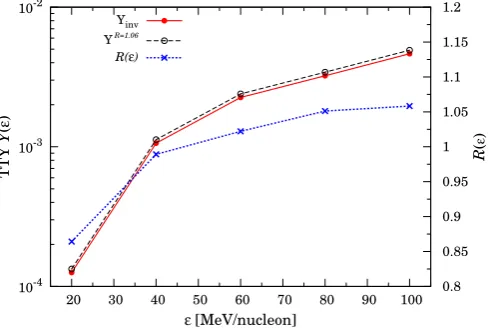
The reaction induced135Cs is equivalent to the objective transmutation reaction. Figure 2 shows
symbols. The stopping power ratio of the system is calculated by SRIM 2008, which is displayed in Fig.3 with star symbols. Furthermore the TTY of the original reaction is evaluated using Eq. (4) with the constant stopping power ratio ˜R=1.06, which is plotted as open circle.
10-4
10-3
10-2
20 30 40 50 60 70 80 90 100 0.8
0.85 0.9 0.95 1 1.05 1.1 1.15 1.2
TTY
Y
(
ε
)
R
(
ε
)
ε [MeV/nucleon]
Yinv Y R=1.06
R(ε)
Figure 3. The TTY of12C(135Cs, X)ACs (solid circles), the evaluated TTYYRby Eq. (4) with ˜R=1.06 (open
circles), and theR(ε) (stars), are shown.
4 Conclusion
To accumulate the data for the transmutation of LLFP, the recent progress of radioactive isotope beam facility is essential. We reported the conversion method assuming the inverse kinematics using a radioactive beam, to obtain the TTY of the reaction with a radioactive target.
When we apply the method to natCu +12C, the more convenient conversion relation is found,
which is to replace the energy dependent ratio with the constant value. The ratio between differential TTYs (dYfor,dYinv) which is governed by the stopping powers decided with the combination of target
and projectile, has the saturated behaviour in a high energy region. The linear relation betweenYfor
andYinvis justified when the reaction cross section in the low energy has only minor contribution to
the TTY. We simulate also the135Cs bombarding on12C reaction with helps of PHITS and SRIM to
estimate the TTY of the LLFP transmutation reaction. The TTYs of breaking up135Cs toACs by12C
are estimated. Although the stopping power ratio converge to about 1.06 in this system, the tendency of the ratio is gentler up to the convergence than the previous example.
In future work, we will apply our method to more specific LLFP subjects and analyse the second particle effects for yields in the Monte Carlo simulation. Although for some LLFP data our method is effective, it has not been finished for other LLFP, yet. We should develop the extended procedure to gather the more accurate data for the transmutation technology.
Acknowledge
References
[1] http://j-parc.jp/Transmutation/en/index.html
[2] H. Wang et al., http://dx.doi.org/10.1016/j.physletb.2015.12.078 [3] M. Aikawa, S. Ebata and S. Imai, Nucl. Instr. Meth. B353, 1 (2015)
[4] J. F. Ziegler, J. P. Biersack, M. D. Ziegler, SRIM: the Stopping and Range of Ions in Matter, http://www.srim.org, Nucl. Instr. Meth. B268, 1818 (2010)
[5] H. Yashima et al., Phys. Rev. C66, 044607 (2002)