Department of ECE, Adhiyamaan College of Engineering, Hosur, Tamilnadu, India.
Voice Identification Based Home
Automation Using Speech Recognition.
Ananthapriya.M.S1, Anisha.R2, Gayathri.S3, Gayathri.V4, J.Madhavan5
U.G Student, Department of ECE, Adhiyamaan College of Engineering, Hosur, Tamilnadu, India1,2,3,4
Assistant Professor, Department of ECE, Adhiyamaan College of Engineering, Hosur, Tamilnadu, India5
ABSTRACT: In this paper a voice identification based home automation using speech recognition has been presented for elderly and disabled people. Old aged and disabled persons must be served in a systematic, quick, sophisticated, and efficient manner by very little effort. This project presents an effective method to overcome these problems. We have designed and implemented a reliable, efficient and secure speech operated system for home appliances, especially for persons with disabilities to do their work at home. This system is divided into three main parts namely, Voice train process, Voice recognition process and integration of hardware. The main goal of this system is to control home appliances by using voice commands. The proposed system can recognize the voice commands, convert them into the required data format, and send the data through the wireless transmitter. Based on the received data at the wireless receiver associated with the appliances desired switching operations are performed. Additionally the proposed system needs to be trained of voice command only once.
KEYWORDS: Home automation, Microcontroller , Voice Recognition, XBee, Power Supply.
I. INTRODUCTION
The Wireless Home Automation System is an integrated system to facilitate elderly and disabled people with an easy-to-use home automation system that can be fully operated based on speech commands. The system is portable and constructed in a way that is easy to install, configure, run, and maintain. A typical wireless home automation system allows one to control house hold appliances from a centralized control unit which is wireless. The project demonstrates a system that can be integrated as a single portable unit and allows one to wirelessly control lights, fans, air conditioners, television sets, security cameras. The overall system is controlled from a microphone which is connected with HM 2007 speech recognition chip. This chip sends the voice commands in binary sequence to microcontroller. The base station unit takes decision and sends the commands to XBee by transmitter. The XBee which is present in receiver side receives the commands and performs the request function. According to the commands that has been received in the receiver, the appliances will act.
II. PROPOSED SYSTEM
Department of ECE, Adhiyamaan College of Engineering, Hosur, Tamilnadu, India.
conditions (a) the output from the interface program is forwarded to a wireless transmitter and sent to a receiver through wireless channel, and (b) the receiver at the appliances accept the receive signal to turn ON or OFF the device.The system operation can be described based on this front panel in the following steps:
• The voice command is captured by using a microphone and sent to the computer. • Upon recognition of the voice command control characters are generated and sent through XBee wireless communication protocol to specified application address.
At receiver side, application can turn ON or OFF a relay controlling circuit depending on the received controlled characters.
• A hardware switching toggle circuit is added to simplify the switching process and to allow for ON/ OFF switching with a single word voice command.
• As an additional feature the system can be controlled using smart devices
The proposed method is aimed at designing a voice controlled smart home control system for the following reasons. One of the major problems in our present day society is wastage of energy, whereby energy consumption is continuously increasing year by year. Nowadays, some people may be too lazy or too busy to get up and turn off a particular appliance. Hence, the smart home control system will be useful as one will only have to speak to turn off a device, thereby saving energy as well as one's time. Moreover, old or disabled persons may experience difficulties in going around the house to turn on/off their appliances, especially if they live alone. It will be much easier for them to use the voice control system. It will also help blind people as they will be able to turn on a fan or a radio without relying on others. The system can be divided into 3 main parts:
1. Audio processing part microphone
2. Transmission part XBee transceivers
3. Control part microcontroller and relays
The voice commands will first be captured and processed in the voice recognition system according to the voice recognition method used. After successful identification of the commands, control characters will be wirelessly sent through the XBee transceivers to the microcontroller, which will in turn activate the corresponding relay. As a result, home appliances could be turned on or off depending on the voice command given.
A. TRANSMITTER
The transmitter station will operate with a voltage of +5 volts. This voltage will be used as the reference operating voltage for all of the circuit components in the transmitter station. The microphone in the transmitter station will be given commands by speaker. The audio signal from the microphone will be fed as input into the HM 2007 speech recognition processor. The HM 2007 processor will process the audio and determines if the commands are speech commands and valid then it will pass the commands in terms of signals through microcontroller and XBee to receiver station where the matched command operation will be implemented. A 16 x 2 LCD display module is interfaced with the microcontroller to display the current status of the system and the appliances will act according to the commands or relay is used as controlling element to per form swi tching operat ion as ON/OFF. The HM 2007 processor does voice analysis and identifies on the microphone audio signals. The HM 2007 interfaces directly with a microphone and the microcontroller in turn interfaced with XBee transceiver. The word length to be recognized will be selected which can have the highest amount of time duration up to1.92 seconds.
Department of ECE, Adhiyamaan College of Engineering, Hosur, Tamilnadu, India.
Figure 1. Handheld microphone with voice recognition unit in the Transmitter
B. RECIEVER
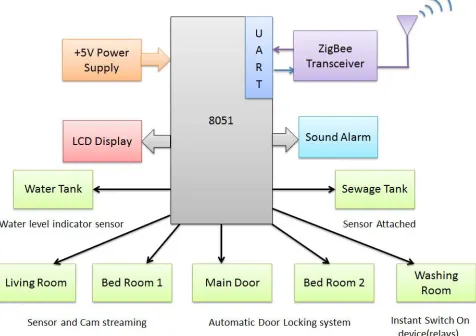
The receiver station will also operate with same +5 V. The receiver station micro controller receives the digital signal commands from the transmitter station by using the Xbee wireless serial communication protocol and performs the request operation. On the basis of command signals received it will update the status of controlling relay switches board. It also takes the command values to update the LCD status on the receiver station.
Figure 2. Functional Block Diagram of Remote station Unit
C. SYSTEM MODEL
The system model of this work is shown in Figure
Department of ECE, Adhiyamaan College of Engineering, Hosur, Tamilnadu, India.
Automatic speech recognition (ASR) system can be defined as an independent and computer driven transcription of spoken language that allows a computer to identify the spoken words captured from a microphone or telephone and convert it into written texts. The main components of an ASR are(i) a microphone,
(ii) speech recognition software,
(iii)a computer, and
(iv)a sound card.
The ultimate goal of ASR is to allow a computer to recognize in real time, with 100% accuracy, all words that are spoken by any person, independent of vocabulary size, noise, speaker characteristics or accent. Through a speech recognition program/application, the computer is able to process words one says and turn them into text that is displayed on the screen. There have been many research activities on the speech recognition system. The fundamental reasons of these research activities are
(i) accessibility for the deaf and hard of hearing,
(ii) cost reduction through automation, and
(iii) searchable text capability.
The control unit (CU) coordinates the components of a computer system. It fetches the code of the instructions in a program. It directs the operation of the other units by providing timing and control signals. All computer resources are managed by the CU. It directs the flow of data between the Central Processing Unit (CPU) and the other devices. There are different types of control program available including MatLab, C++, and LabView. In this work we choose
LabView because of the following reasons: (a) it is easier to build a large program piecewise using small amounts of code,
(b) it is easy to control the interfaces between hardware,
(c) it is easy to find compatible hardware in the market, (d) it is simple to integrate with other hardware and software, and
(e) it is easy to create the user-interface.
Wireless networks and sensors are playing important roles in emerging pervasive computing technologies that are required for the realization of smart homes. Effectively all wireless technologies that can support some form of remote data transfer, sensing, and control are candidates for inclusion in the smart home portfolio. In this work we used XBee wireless system. Compared to other wireless systems like Bluetooth and Wi-Fi, XBee has some advantages as follows: (a) XBee aims at automation whereas other two technologies aim at the connectivity of mobile devices in close proximity, (b) XBee uses low data rates, and consumes low power, (c) XBee networks support devices with longer range, and (d) XBee network is a robust network and that is easily scalable.
Applications and home appliances are the last step of the proposed system. Each device connected with the network must have a switching circuit to turn it On\ OFF. The status of each device is monitored by using toggle circuit. In addition to the switching devices a Data Acquisition Card (DAQ) has been used in this work. A typical commercial DAQ card contains
ADC and DAC that allow input and output of analog and digital signals in addition to digital.
III. PROJECT DESIGN METHODOLOGY
This section will discuss the methodology involved in the design of the Voice Recognition Wireless Home Automation System Based On XBee. The project is divided into parts to make the design process modular. In the prototype board fabricated by the authors, these parts replaced with their specifications are:
A. SPEECH RECOGNITION UNIT
Department of ECE, Adhiyamaan College of Engineering, Hosur, Tamilnadu, India.
want the circuit to recognize. This circuit board allows us to experiment with many facets of speech recognition technology. It has 8 bit data out which can be interfaced with any microcontroller for further development3.1.1 Features • User programmable
• Up to 20 word vocabulary of duration two second each • Multi-lingual
• Non-volatile memory back up with 3V battery backup which will keep the speech recognition data in memory even after power off.
• Easily interfaced to any microcontroller like 8051, PIC or AVR can be interfaced to data port.
3.1.2 HM2007
It is a single chip CMOS voice recognition LSI circuit with the on-chip analog front-end, voice
analysis, recognition process and system control function.
A 20 isolated word voice recognition system can be composed of external microphone, keyboard, 8K SRAM and other components, combined with a microcontroller, an intelligent recognition system can be built. It support two control mode: Manual mode and CPU mode. It is also available in 48-pin PDIP. The pin description of HM2007 is shown above. The keypad and digital display are used to communicate with and program the HM2007 chip. The keypad is made up of 12 normally open momentary contact switches. The 74LS373 8-bit registers feature 3-state outputs designed specifically for driving highly capacitive or relatively low-impedance loads. The high-impedance 3-state and increased high-logic-level drive provide these registers with the capability of being connected directly to and driving the bus lines in a bus-organized system without need for interface or pull-up components. The IC 7448 is BCD to 7–segment common cathode IC. To display the data, we have to convert it from BCD to 7-segment code. The IC makes this process. It has four inputs called BCD inputs and seven outputs to drive the display. The voice recognition system schematic diagram is shown below in fig.4. A microphone is connected directly with pin 15(MICIN) of HM2007which is shown below. On this system, voice is trained first and then recognized whenever a command is given through microphone.
B. XBee
It is a low-cost, low-power, wireless networking standard. The low cost allows the technology to be widely deployed in wireless control and monitoring applications, the low power-usage allows longer life with smaller batteries, and different networking topologies provides high reliability and larger range.
Department of ECE, Adhiyamaan College of Engineering, Hosur, Tamilnadu, India.
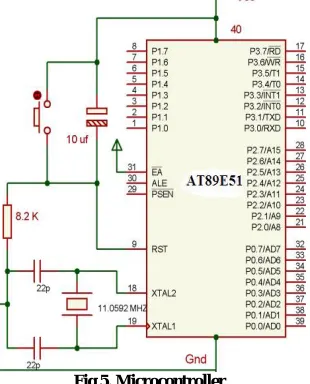
device also has four 8-bit I/O ports, three 16-bit timer/event counters, a multi-source, four-priority-level, nested interrupt structure, an enhanced UART and on-chip oscillator and timing circuits. The added features of the P89E51RB2/RC2/RD2 makes it apowerful microcontroller for applications that require pulse width modulation, high-speed I/O and up/down
counting capabilities such as motor control.
Fig 5. Microcontroller
Features
89E51 Central Processing Unit
Can be programmed by the end-user application (IAP)
6 clocks per machine cycle operation (standard)
12 clocks per machine cycle operation (optional)
Speed up to 20 MHz with 6 clock cycles per machine cycle
(40 MHz equivalent performance); up to 33 MHz with 12 clocks
per machine cycle
Fully static operation
RAM expandable externally to 64 kB
4 level priority interrupt
7 interrupt sources
Four 8-bit I/O ports
Full-duplex enhanced UART
Programmable clock out
Second DPTR register
Asynchronous port reset
Low EMI (inhibit ALE)
VI. CONCLUSION
Department of ECE, Adhiyamaan College of Engineering, Hosur, Tamilnadu, India.
Automation circuit considerable amount of power saving is possible and it is flexible and compatible with future technologies so it can be easily customized for individual requirements. On the other hand with voice recognition system, it provides secure access to home. So when we are living in a fast world where everything is changing with in no time such security is essential.REFERENCES
[1]. Y.Usha Devi 1, II M.Tech, Wireless Home Automation System Using ZigBee, International Journal of Scientific & Engineering Research Volume 3, Issue 8, August-2012 ISSN 2229-5518. [2].www.imagesco.com/articles/hm2007/SpeechRecognitionTutorial01.html
[3]. Jieming Zhu, Xuecai, Yucang Yang, and Hang Li (2010) “ Developing a voice control system for ZigBee based home automation”, Proceedings of IEEE International Conference on network Infrastructure and Digital Content, September 24-26, Beijing, 2010, pp. 7737-741
[4]. ZigBee Alliance Official Site, [online].Available: www.zigbee.org
[5]. Prof. Jitendra R. Rana, Prof. S.N.Pawar, ZigBee Based Home Automation, http://ssrn.com/abstract=1587245
[6]. “XBee-2.5-Manual,” ZigBee RF communication protocol. (2008). Minnetonka: Digi International Inc. [7]. XBee OEM RF Modules‐ ZigBee ‐ v1.x1x [2007.06.01] © 2007 Digi International, Inc.www.digi.com [8]. http://www.pyroelectro.com/tutorials/xbee_wireless_interface
[9]. Lakhya1, Inder2, Emanual3, Abhijit4, Lalan5, Debraj6, Er. M. Sujitha7, Home Automation System Based On Arm And Zigbee,
Undergraduate Academic Research Journal (UARJ), ISSN: 2278 – 1129, Volume-1, Issue-3,4, 2012.
[10]. Muhammad A Mazidi , Janice Mazidi , The 8051 Microcontroller And Embedded systems, person Education second Edition ,printed in India by Gopson papers Ltd.
[11]. Dhawan S. Thakur and Aditi Sharma, Wireless Solar Irradiance Meter, International Conference On Re-Newable Energy,5th-6thMay., 2012, Eternal University, H.P., INDIA