Scholarship at UWindsor
Scholarship at UWindsor
Electronic Theses and Dissertations Theses, Dissertations, and Major Papers
1-1-2006
Localizing damage in the functional architecture: The distinction
Localizing damage in the functional architecture: The distinction
between implicit and explicit processing in deep dyslexia.
between implicit and explicit processing in deep dyslexia.
Annette Colangelo University of Windsor
Follow this and additional works at: https://scholar.uwindsor.ca/etd
Recommended Citation Recommended Citation
Colangelo, Annette, "Localizing damage in the functional architecture: The distinction between implicit and explicit processing in deep dyslexia." (2006). Electronic Theses and Dissertations. 7218.
https://scholar.uwindsor.ca/etd/7218
Explicit Processing in Deep Dyslexia
by
Annette Colangelo
A Dissertation
Submitted to the Faculty of Graduate Studies and Research through Clinical Psychology
in Partial Fulfillment of the Requirements for the degree of Doctor o f Philosophy at the
University of Windsor
Windsor, Ontario, Canada
2006
Published Heritage Branch
Direction du
Patrimoine de I'edition
395 W ellington Street Ottawa ON K1A 0N4 Canada
395, rue W ellington Ottawa ON K1A 0N4 Canada
Your file Votre reference ISBN: 978-0-494-35981-5 Our file Notre reference ISBN: 978-0-494-35981-5
NOTICE:
The author has granted a non exclusive license allowing Library and Archives Canada to reproduce, publish, archive, preserve, conserve, communicate to the public by
telecommunication or on the Internet, loan, distribute and sell theses
worldwide, for commercial or non commercial purposes, in microform, paper, electronic and/or any other formats.
AVIS:
L'auteur a accorde une licence non exclusive permettant a la Bibliotheque et Archives Canada de reproduire, publier, archiver,
sauvegarder, conserver, transmettre au public par telecommunication ou par I'lnternet, preter, distribuer et vendre des theses partout dans le monde, a des fins commerciales ou autres, sur support microforme, papier, electronique et/ou autres formats.
The author retains copyright ownership and moral rights in this thesis. Neither the thesis
nor substantial extracts from it may be printed or otherwise reproduced without the author's permission.
L'auteur conserve la propriete du droit d'auteur et des droits moraux qui protege cette these. Ni la these ni des extraits substantiels de celle-ci ne doivent etre imprimes ou autrement reproduits sans son autorisation.
In compliance with the Canadian Privacy Act some supporting forms may have been removed from this thesis.
While these forms may be included in the document page count,
their removal does not represent any loss of content from the
Conformement a la loi canadienne sur la protection de la vie privee, quelques formulaires secondaires ont ete enleves de cette these.
Deep dyslexia is an acquired reading disorder in which a previously literate adult
produces semantic errors during reading and demonstrates impaired nonword reading.
Most models of the syndrome account for the reading errors observed in deep dyslexia in
terms of multiple loci of damage. In contrast, Buchanan, McEwen, Westbury, and Libben
(2003) proposed that reading errors result from damage in the phonological output
lexicon alone. According to this formulation, semantic errors result from impaired
explicit access and production due to failure of inhibition. In contrast, implicit processing
is assumed to be intact in deep dyslexia. In the current manuscript, I tested several
predictions that develop from the Failure of Inhibition Theory in order to localize damage
As always, I would like to thank JO for her participation and continued interest in our research program over the years. She is utterly relentless in her commitment to furthering knowledge about language difficulties after brain injury. Her unparalleled perseverance and enthusiasm for life has been simply inspiring. Through my work with her, I have learned much about the world of possibility and the importance of continued hope.
I am grateful to the numerous people who helped make this research project possible. I extend a warm thank you to JO’s family for helping to arrange testing and coordinating some of our sessions. I have appreciated your flexibility and humour. Thank you also to Lois Harwood. Your logistical management has always ensured that my research program ran smoothly, not to mention the fact that your smile and kindness has made coming to the lab a welcoming experience. To Arpita Bose and Chris Domen: I cannot express enough how much I enjoyed our theoretical discussions. I have truly appreciated and benefited greatly from your contributions in developing novel research approaches. You have taught me much about the joy of collaboration.
I am indebted to my advisor, Lori Buchanan. Working with you has been more than a delight. From you, I learned a love for new discovery and the elegance o f complexity simply stated. I cannot thank you enough for your mentorship, support, and enthusiasm. It was because of my early work with you in Edmonton that I found my academic home, both with neuropsychology and with the training opportunities available at University of Windsor (I followed you here, after all). To you, I owe the development o f my
professional identity as a researcher and the establishment of my research career. What an amazing gift! I look forward to continued collaborations. No doubt they will continue to be fruitful!
Thank you to my committee members, Morris Moscovitch, Keith Taylor, Douglas Shore, and Anne Baird. How enjoyable you made this process! I appreciated your thoroughness and thoughtful questions. Your comments helped make this manuscript more accessible. Thank you for your willingness to explore new domains of research and your
commitment to improving the quality of my work. Our discussions taught me much about the peer review process. Put simply, I just could not have asked for more in a dissertation committee.
And, to my family: How lucky I am to have you! Your support and love have been unwavering. You have always been just exactly what I needed: Thank you for firm hands while nervous heels skid. Thank you for celebrating palms as each end neared and future
journeys unfolded. Thank you for open lines w hen days were too long and, w h ile tw ilight
ABSTRACT iii
DEDICATION iv
ACKNOWLEDGEMENTS v
LIST OF TABLES ix
LIST OF FIGURES x
CHAPTER
I. INTRODUCTION 1
Language Representation and Information Processing in Normal Reading 1
Models of Skilled Reading 2
PEIR: A Model to Study Deficits in Neurolinguistic Patients 3
Reading Disorders 6
II. DEEP DYSLEXIA 8
The Symptom-Complex of Deep Dyslexia 8
Accounts for Deep Dyslexia 9
III. HEMISPHERIC CONTRIBUTIONS TO LANGUAGE 16
IV. LEFT HEMISPHERE INHIBITION: CONTROLLED LEXICAL SEMANTIC
PROCESSING 20
V. THE DISTINCTION BETWEEN IMPLICIT AND EXPLICT ACCESS IN
DEEP DYSLEXIA 25
Intact Implicit Access in Deep Dyslexia 25
Impaired Explicit Access in Deep Dyslexia 27
Representation 31
VII. METHODS 33
Experiment la and lb: Distinction between Explicit and Implicit Access at the
Word Level 33
Experiment 2a and 2b: Explicit Decision Tasks without Production 37
VIII. DEEP DSYLEXIA AND THE PHONOLOGICAL OUTPUT LEXICON 42
Implicit and Explicit Access: Phonology 42
Experiment 3: Pseudohomophone Reading 44
Experiment 4: Forced Choice Pseudohomophone Lists 48
Experiment 5: Pseudohomophone Naming and Forced Choice
Pseudohomophone Lists 50
Experiment 6: Recognition Memory for Semantic Distinctions 53
IX. GENERAL DISCUSSION 56
X. EXPLICIT ACCESS TO PHONOLOGY AND BEYOND: A PEEK INTO
FUTURE RESEARCH... 61
Explicit Phonological Processing 61
What About Articulation, Anyway? 62
XI. THE RIGHT HEMISHPERE HYPOTHSIS FOR DEEP DYSLEXIA
REVISITED 65
APPENDIX 1: Summary of Results for Divided Visual Field Studies 69
APPENDIX 2: Stimulus Sets 72
REFERENCES 95
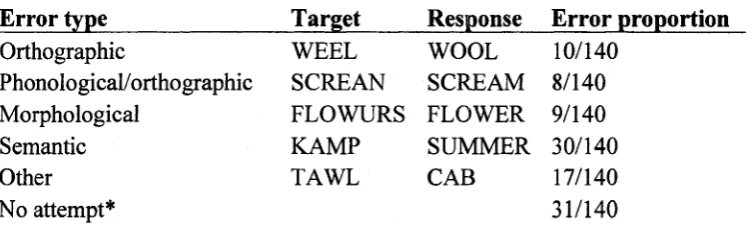
TABLE 2. Example of Errors JO Made During Screening...31
TABLE 3. Proportion of Errors for Ambiguous and Unambiguous Words... 35
TABLE 4. Proportion of Errors for Semantic Decision Reading Lists... 41
TABLE 5. Comparison of Error Rate for Words Read in Colangelo et al. and the Current Experiment... 41
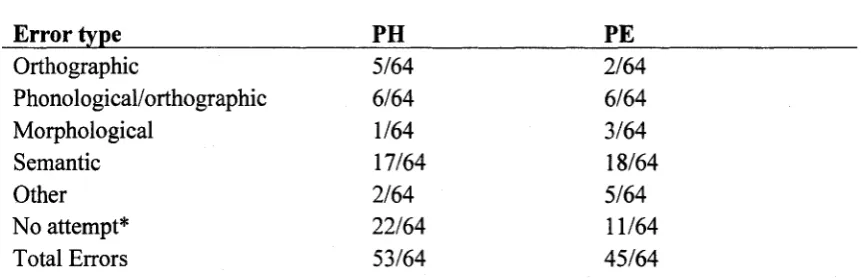
TABLE 6. Proportion of Errors for Matched PH and PE...46
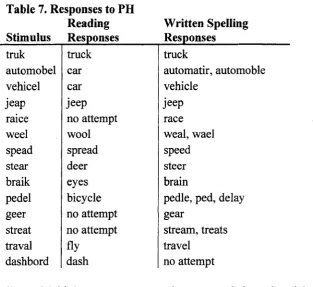
TABLE 7. Responses to PH... 47
TABLE 8. Proportion of Errors of Read PH Lists...51
TABLE 9. Proportion of Errors for Semantic Lists... 55
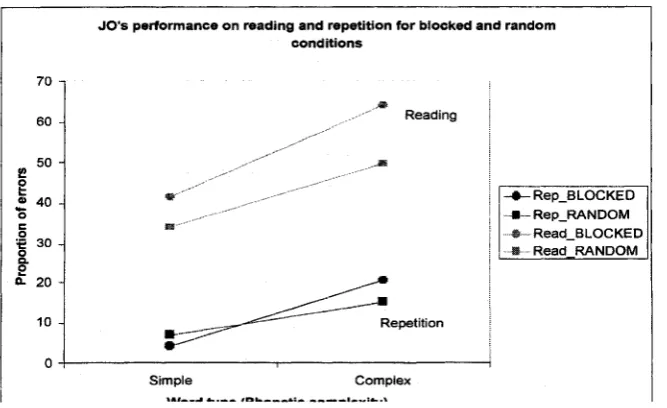
FIGURE 2. The Relationship between Semantic and Phonetic Complexity for
INTRODUCTION
The adequacy of explanations for neuropsychological phenomena hinges upon the
theoretical sufficiency of the models from which they are derived. In order to refine
accounts of various disorders, the assumptions upon which these models are predicated
must be rigorously tested and revised to accommodate novel research findings. With
respect to language disorders, the basic assumption underlying cognitive models of
different acquired dyslexias is that impairments reflect the operation of remaining
linguistic components after damage to the functional architecture. How this breakdown is
conceptualized depends on the manner by which lexical information is assumed to be
represented in the language system.
Language Representation and Information Processing in Normal Reading
Although conceptualized differently depending on the model, most accounts
assume normal reading is a multi-step process that is mediated by the spread of neuronal
activation from one level of word (lexical) representation to the next: The processing of
words involves visual analysis of the printed form, which results in access to entries in
the orthographic lexicon (i.e., the ‘mental dictionary’ that contains the spelling
descriptions for words in the reading vocabulary, known as orthography). Subsequently,
orthographic information feeds into the semantic system (i.e., the ‘mental dictionary’ that
contains word definitions) to access the meaning of words. Semantic entries then access
the phonological lexicon (i.e., the ‘mental dictionary’ that contains sound specifications
for words, known as phonology) where activation supports an oral response. Within this
framework for lexical processing, access at each level of representation (i.e., orthography,
presented information are activated (e.g., for the semantic system, at the point that the
definition for a printed word is activated).
Models of Skilled Reading
Theories of normal reading are similar insofar as they posit different storage
systems for linguistic information (e.g., orthographic, semantic, and phonological
information). However, they differ in the manner in which this information is represented
and accessed. Although hybrid models exist, current theories o f skilled reading can
generally be divided into two broad categories: dual and single route models. In dual
route accounts (e.g., Coltheart, Curtis, Atkins, & Haller, 1993; Patterson & Morton,
1985), the conversion from orthography to phonology can occur by either of two possible
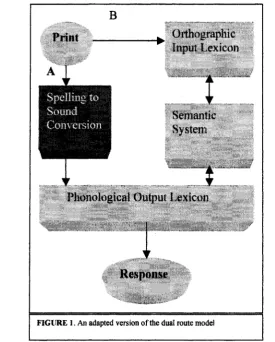
routes: the assembled and addressed routes (see Figure 1). The assembled route (pathway
A) uses rules regarding the relationship between letters and sounds to sequence sound
segments (i.e., phonemes) in order to develop a pronunciation. Because regular words
(e.g., save and wave) reflect these rules, the assembled route can produce their correct
pronunciations. However, exception words (e.g., pint) have atypical spelling-to-sound
correspondences and therefore violate these rules. Consequently, processing o f exception
words via the assembled route does not yield correct pronunciations. Thus, this route
cannot process words by directly accessing its meaning in the semantic system. However,
it can read nonwords that reflect typical spelling-to-sound correspondences.
The addressed route (pathway B) relies on previous experience with letter strings,
which results in the formation of whole-word representations in the orthographic lexicon.
Providing that the system has encountered the printed word before, its orthographic
the corresponding meaning in the semantic system. The semantic representation then
proceeds to the phonological output lexicon, which supports the production of an oral
response (i.e., the aloud reading response). Because exception words are represented in
the orthographic lexicon (i.e., the system has previously encountered them), they can be
processed via the addressed reading route. Thus, although the addressed reading route
cannot process nonwords, it can process words associated with semantic information.
B
1 Print ^ Orthographic
^ Input Lexicon
N
■
t
I Semantic
I System
1r
t
Phonological Output Lexicon
1
< Response
FIG U RE 1. An adapted version o f the dual route model
It is important to note that dual-route theories of reading are explicitly localized in
their representations: Each unit in the architecture codes for distinct pieces of
information. For example, one processing unit in the semantic system may contain all the
uses either a rule-based (rules express general grapheme-phoneme correspondences) or a
memory-based strategy (whole entries are stored in memory based on previous
experiences with the unit).
Seidenberg and McClelland (1989) presented an alternative to the dual-route
theories by proposing that normal reading is accomplished via a single route involving
interactions between orthography, semantics, and phonology. Each unit in the system
contributes activation to many different representations that are accessed simultaneously
via a network of interconnections and back propagation. Thus, according to parallel-
distributed progressing (PDP) models or “connectionist” networks, word knowledge is
not represented in discrete entries that are serially accessed. Instead, information is
distributed throughout the network, accessed in parallel, and is stored as a pattern of
activation across units resulting from “experience with the spelling-sound
correspondences implicit in the set o f words from which it learns" (p. 525). For oral
reading to proceed, the orthographic pattern o f activation representing a word produces
the pattern of activation that corresponds to that word across nodes at the semantic level.
In networks that include a layer for phonology, the pattern of semantic information
activated by orthographic input activates the pattern of nodes representing the phonology
of the word.
PEIR: A Model to Study Deficits in Neurolinguistic Patients
Given that word production is generally acknowledged to be a multi-step process,
lexical processing can potentially be compromised at different theoretical levels.
Buchanan, McEwen, Westbury, and Libben (2003) introduced a framework for studying
acknowledges the distinction between word entries and access to those entries. According
to the PEIR formulation, word production depends on explicit access, which depends on
/mplicit access, which in turn depends on intact representations (e.g., the specific entries
representing word meanings in the semantic system). Within this framework, Buchanan et
al. (2003) proposed that production errors (e.g., making semantic errors during aloud
reading of a single word) reflect compromised explicit access. Explicit access refers to
overt knowledge regarding relevant orthographic, semantic, or phonological
characteristics of words. For example, with respect to explicit access in the semantic
system, the ability to correctly judge that horse is more related in meaning to saddle than
house depends on the ability to overtly compare word meanings. Because damage is only
posited at the level of explicit access, implicit access to intact representations is assumed
to be preserved. Implicit access is conceptualized in terms of sensitivity to orthographic,
phonological, or semantic manipulations without requiring explicit access or production.
For example, sensitivity to semantic manipulations can be indexed in terms of faster
responses to name a word like table or to decide whether it is a word when it is preceded
by chair rather than by an unrelated word, even in the context of not being able to overtly
decide whether table and chair are semantically related.
A fundamental goal of word recognition research is to specify the functional
architecture of the mental lexicon and to adjudicate between various theories of lexical
representation and processing. A powerful test of word recognition models hinges upon
the performance profile that emerges when putative components within the language
system are damaged and factors presumed to impact linguistic mechanisms are varied.
subcomponents of linguistic processing (e.g., orthographic lexicon, semantic system,
phonological output lexicon). Thus, functional analysis of lexical performance associated
with acquired reading disorders offers a privileged opportunity to elucidate the
organization and structure of normal reading.
Reading Disorders
Most reading disorders that result from brain damage are broadly classified into
three categories (Buchanan, Hildebrandt, & MacKinnon, 1999): surface dyslexia,
phonological dyslexia, and deep dyslexia. Patients with surface dyslexia are able to sound
out letter strings based on rules for spelling-to-sound correspondences but are unable to
access whole word representations from print (Marshall & Newcombe, 1973).
Consequently, aloud reading for regular words (i.e., words with common spelling-to-
sound correspondences, such as gave, save, and cave) and nonwords (i.e., nonsense letter
strings that can be decoded based on rules for spelling-to-sound correspondences, such as
frip) is intact. However, surface dyslexics read exception words incorrectly because these
words have irregular spelling-to-sound correspondences (e.g., have). Instead, they
regularize exception words by applying the rules for typical pronunciations. For example,
surface dyslexics pronounce the word have such that it rhymes with gave, save, and cave.
In phonological dyslexia, patients are able to access the meaning of whole word
representations from print, but are unable to assemble sound segments that correspond to
word spellings (Beauvois & Derouesne, 1978). As such, phonological dyslexics are able
to read familiar words, including regular and exception words. However, these patients
Deep dyslexic patients are similar to phonological dyslexics insofar as both
patient groups are unable to successfully read aloud nonwords. However, deep dyslexic
patients also demonstrate impaired whole word reading (Marshall & Newcombe, 1973).
Impaired reading for words includes visual errors, derivational errors, as well as semantic
errors. Given that these patients show multiple reading impairments, deep dyslexics are
assumed to have a form o f reading disorder that is central to the reading system. This
dissertation focuses on the syndrome o f deep dyslexia with a particular emphasis on the
DEEP DYSLEXIA
The Symptom-Complex of Deep Dyslexia
Deep dyslexia is an acquired reading disorder in a previously literate adult. Given
the relative homogeneity of reading deficits in most patients with deep dyslexia, the
disorder is considered a syndrome (Coltheart, 1980a). The defining symptom of deep
dyslexia is the production of semantic errors during aloud reading. Semantic errors are
defined as incorrect naming responses that relate to the target in meaning (e.g., tide ->
water). Although semantic errors are the hallmark symptom, deep dyslexics also produce
other types of reading errors. For example, visual errors occur when the response
resembles the target in terms o f shared letters (e.g., gallant->gallon and perform ->
perfume). In addition, some errors reflect substitutions of one function word for another
in the same class (e.g., fo r -> and), termed function-word substitutions. Derivational
errors result when the target and response differ only in terms of bound morphemes (e.g.,
sick -> sickness)1. These types o f errors co-occur with semantic errors frequently and are
therefore considered part of the symptom-complex (see Coltheart, 1980a for a
comprehensive discussion of error types and the symptom-complex in deep dyslexia).
In addition to types of errors produced, deep dyslexia is defined by an inability to
read aloud nonwords (i.e., nonsense letter string). Typically, these patients also
demonstrate effects for concreteness (better reading of high-imageability, e.g., cat, than
low-imageability words, e.g., happy), syntactic category (better reading of nouns than
adjectives, which are easier to read than verbs), and word class (better reading of content,
1 A morpheme is the sm allest unit containing linguistic meaning (e.g., -ed, cat, -ness, baby, un-, etc.). Morphology is the description o f the word form in terms o f morphemes (Reisberg, 1997). Although
e.g., nouns, than function words, e.g., for, the, etc.) during oral reading (Coltheart,
1980a).
Accounts for Deep Dyslexia
Several models have been proposed to account for deep dyslexic reading
performance. The following section presents a brief review of models for deep dyslexia
with an emphasis on the manner in which these frameworks conceptualize the occurrence
of semantic errors and the inability to read aloud nonwords.
The Dual Route Account: The Morton and Patterson Model
In order to account for both the occurrence of semantic errors and the inability to
read aloud nonwords, Morton and Patterson (1980) postulated that deep dyslexia reflects
multiple loci of damage within the dual-route model for reading. To explain the inability
to read aloud nonwords, this model proposes that the assembled route is unavailable in
deep dyslexia. As a consequence, deep dyslexics are assumed to lack the capacity to
assemble phonology. Instead, reading is assumed to proceed through the semantically
mediated addressed route. Normally, the addressed route is capable of supporting normal
reading through whole word access. However, based on the fact that deep dyslexics
produce semantic errors during reading, damage to this route is also assumed.
The Continuum Account: Phonological and Deep Dyslexia
Glosser and Friedman (1990) proposed that deep dyslexia and phonological
dyslexia represent endpoints along the same continuum of reading disability (also see
Laine, Niemi, & Marttila, 1990; Sartori, Barry, & Job, 1984). This conceptualization is
based on reports of patients with deficits that were initially consistent with a diagnosis of
phonological dyslexia (e.g., see Glosser & Friedman, 1990; Klein, Behrmann, and
Doctor, 1994; Southwood & Chatterjee, 2001).
Similar to the dual-route model, the view articulated by Glosser and Friedman
(1990, 1996) assumes that errors in semantic deep dyslexia reflects damage to the
semantic system, whereas impaired nonword reading reflects damage to the nonsemantic
reading route. However, in contrast to the dual-route model, which assumes that subword
phonology is assembled according to spelling-to-sound correspondences, Glosser and
Friedman (1990, 1996) argued that reading via the nonsemantic route is accomplished by
mapping subword orthographic information directly to phonological entries in the output
lexicon (i.e., mapping units by comparison, termed analogical mapping). According to
this account, evolution from deep to phonological dyslexia reflects recovery of the
semantic system and, thus, the disappearance of semantic errors during reading (but see
Friedman, 1996 for other analogical aetiologies o f recovery). However, nonword reading
is still impaired because damage to the direct orthography-to-phonology route does not
recover.
The Connectionist Account: Computational Modeling
The connectionist approach to deep dyslexia is based on a computational model of
normal reading implemented as nodes interconnected in a parallel distributed processing
network (Plaut, 1999). The nodes that comprise the network form layers that represent
various features of a word. At each layer, similar words are represented as similar patterns
of activity. Plaut and Shallice (1993) produced many deficits analogous to those observed
in deep dyslexia by introducing a single lesion to a connectionist network that mapped
Plaut and Shallice used connectionist networks that mapped semantic activation directly
onto the phonological layer. Given that nonwords have no semantic representation, these
networks could not support nonword reading. Buchanan et al. (1999) stated that, to the
extent that nonword reading was impossible, the architectures were already dyslexic prior
to lesioning. As such, the inability to support nonword reading can “ .. .be likened to a
second source of damage in the model... (p. 198).”
The Right Hemisphere Hypothesis: The Neurological Account
The Right Hemisphere Hypothesis proposes that the deficits in deep dyslexia
reflect the contributions of the right hemisphere to reading after the dominant left
hemisphere has been damaged (Coltheart, 1980b). This view assumes that damage to the
left-hemisphere eliminates access to the left orthographic lexicon. In order for reading to
proceed, orthographic access to a right-hemisphere lexicon is necessary. However, the
right hemisphere cannot subserve the production of language. Therefore, once the
orthographic lexicon accesses the semantic representation, it is transmitted from the right
to the left hemisphere. This information is then used to access a phonological entry in the
left-hemisphere lexicon where a pronunciation is selected and subsequently produced
(Coltheart, 1980b; Coltheart, 2001).
The Right-Hemisphere Hypothesis stipulates that how semantic errors develop
depends on the type of error. Specifically, semantic errors can either share features with
the target (e.g., dog and cat share many features, including the fact that both have
four-legs, are furry, have a tail, etc.) or are associatively related to the target (associative
semantic errors do not share features with the target but are related because they co-occur
are assumed to result because a “degree of disparity” is accepted between the semantic
representation that is transmitted from the right hemisphere and the lexical entry in the
left-hemisphere that is selected for response. In contrast, associative semantic errors are
assumed to result from the associative network of the right hemisphere wherein
associated entries are co-activated when the target is presented. Errors result from
incorrect selection from among activated candidates and the subsequent transmission of
that semantic representation to the left hemisphere for production (Coltheart, 1980b;
Coltheart, 2001). Although the Right Hemisphere Hypothesis attempts to account for the
occurrence of different types of semantic errors, it does not specify the mechanism for
semantic errors. In addition, this model assumes that the right hemisphere is completely
unable to derive phonology from print. Given the assumption that the right hemisphere
mediates the processing of orthographic information in the context of left hemisphere
damage, this explanation for deep dyslexia posits an inability to read nonwords.
The Failure of Inhibition Theory (FIT)
Although formulated differently, Buchanan et al. (1999) emphasize that each of
the aforementioned models of deep dyslexia assume multiple loci of damage in the
reading system (i.e., damage to phonology as reflected by impaired ability to read aloud
nonwords and damage to the semantic system given semantic errors during reading). In
contrast, Buchanan et al. (2003) proposed that selection impairment due to failure of
inhibition in the phonological output lexicon alone accounted for the various types of
reading errors observed in deep dyslexia. The failure of inhibition theory (FIT)
incorporates aspects o f both the dual route and connectionist models of normal reading
level of representation to the next through an interactive network of interconnections (i.e.,
is not completely modular). According to FIT, lexical access in deep dyslexia can be
achieved via either the addressed route for real words or the assembled route for
unfamiliar words and nonwords.
According to this conceptualization, when a real word is presented in print it
accesses the addressed route: The orthographic representation for that word is activated in
the orthographic lexicon, which in turn activates the representation associated with that
word in the semantic system. Graded activation then spreads from the target
representation to other representations within its neighbourhood of semantically related
entries. For example, the neighbourhood for cat defined in terms of semantics might
include dog, mouse, cheese, scratch, etc. The neighbourhood of semantically related
entries is then activated in the phonological output lexicon. Reading errors in deep
dyslexia occur because all associated candidate representations (i.e., the neighbourhood)
are activated in the phonological lexicon but are not pruned through inhibition, as would
normally be the case in an intact system. Therefore, reduced inhibitory connections result
in decreased sensitivity to the activation levels of neighbours. This reduced inhibition
increases the likelihood that neighbours are incorrectly selected for response.
During normal nonword naming, the assembled route is accessed: The subword
phonology for the letter string is assembled, which then enters the phonological output
lexicon. The assembled nonword phonology then activates associated phonological
neighbours (i.e., phonological neighbourhood can be defined as those words that share all
but one phoneme with the target). By the method of analogical mapping, the assembled
neighbours. Given that there is no lexical entry in the phonological output system for the
nonword, this process results in a “nonmatch.” Consequently, the assembled phonology
represents the “best guess” of the system. However, in deep dyslexia, an inability to name
this assembled phonology results because nonwords provide no semantic lexical
activation to boost activation levels of phonological representations. Specifically,
nonword naming in deep dyslexia is impaired by the random pattern of activation that
results from a failure to inhibit co-activated candidates in the phonological output system.
Random activation results in inefficient analogical mapping. As such, the time required to
check activated lexical candidates often exceeds the time that the assembled
pronunciation can be maintained in memory. As a result, no response can be made.
Although the system generally “times out” before activated candidates are mapped to the
assembled phonology, the word that has received the most activation (i.e., a close
neighbour) may occasionally be chosen. On these trials, a word is offered in response to
the nonword (Buchanan et al., 1999).
Toward an Integrated Understanding
The above reviewed models differ on many levels, raising several questions
regarding the manner in which the reading deficits in deep dyslexia are best
conceptualized: How many systems are damaged (single versus multiple loci of damage)?
Where is the level of damage in the language system (e.g., semantic system versus
phonological output lexicon)? What is the mechanism for errors (e.g., failure of
inhibition)? And, how does language processing and damage map neurologically? To
answer these questions, a systematic evaluation of deep dyslexic reading that incorporates
Although connectionist networks offer several advantages over modular accounts,
particularly with respect to its learning capability and conceivable neuronal instantiation,
these models often do not simulate reading impairments well (see Patterson, Seidenberg,
& McClelland, 1989). The major strength o f the Right Hemisphere Hypothesis is that it
postulates neurologically plausible substrates for linguistic processing; but given that it is
not based on a model of normal reading, it is difficult to evaluate on a theoretical level.
As such, for purposes of the current work, reading will primarily be described within a
HEMISPHERIC CONTRIBUTIONS TO LANGUAGE
It is generally acknowledged that both hemispheres contribute to the processing of
language. However, the left and right hemispheres specialize in different aspects of
linguistic information. For example, the left hemisphere has traditionally been assumed to
have a local bias in language processing— more involved in the processing of speech
sounds, abstract word meanings, and syntax. In contrast, a global bias has typically been
attributed to the right hemisphere—implicated in prosody, as well as the processing of
emotional content and gist information. Given different contributions to the processing of
language, the left and right hemispheres are assumed to have separate but complementary
functions (Beeman & Chiarello, 1998).
Investigations regarding hemispheric contributions to language have primarily
used the divided visual field technique with neurologically intact individuals. The divided
visual field technique capitalizes on knowledge regarding the anatomy of the visual
system and its cerebral projections to isolate stimuli presentation to the right or left
hemisphere: Presentation of stimuli to the left visual field projects input to the right, but
not the left hemisphere. In contrast, stimuli presented to the right visual field projects
input to the left, but not the right hemisphere. By isolating visual input to either the right
or left hemisphere, hemispheric contributions to lexical access and the processing of
stimuli can be indirectly assessed.
Lexical decision and naming tasks are popular techniques used to index lexical
access in divided visual field research. The lexical decision task requires that participants
decide as quickly as possible while maintaining accuracy whether a letter string is a word
participants are instructed to read aloud presented targets (e.g., Meyer, Schvaneveldt, &
Ruddy, 1975 for semantic priming). For both types of tasks, lexical access is indexed in
terms of response time (i.e., the time between target presentation and response
registration). An important effect for examining lexical access in the system using these
tasks is priming. With respect to the semantic system, priming results when response
times to items (e.g., butter) are faster and more accurate when they are presented after
semantically related words (e.g., bread) than after unrelated words (e.g., nurse).
Explanations for semantic priming generally hinge on the assumption that activation
spreads to related entries in the semantic system (for reviews, see McKoon & Ratcliff,
1992; McNamara, 1992a, 1992b, 1994). By increasing the activation levels of
semantically related items prior to presentation (e.g., partial activation of butter, dough,
loaf, water, food, etc. when bread is presented) the spread of activation facilitates lexical
access to subsequent items (e.g., butter).
Cumulatively, the results from divided visual field studies with neurologically
intact participants indicate hemispheric differences during word recognition with respect
to the time course o f activation for different semantic information (see Appendix 1 for a
summary of priming effects over time; for non-associated category meanings: Chiarello,
1985; Chiarello, Burgess, Richards, & Pollock, 1990; Chiarello & Richards, 1992;
Abemethy & Coney, 1990, 1996; Koivisto, 1997; Collins, 1999; and Chiarello, Maxfield,
Liu, & Kacinik, 2001), semantic associates: Abemethy & Coney, 1993; Nakagawa, 1991;
Coney, 2002; Richards & Chiarello, 1995; Livesay & Burgess, 2003; Chiarello, Burgess,
Richards, & Pollock, 1990; Audet, Driessen, & Burgess, 1998; and Chiarello, Liu, Shears,
ambiguous words: Burgess & Simpson, 1988; Chiarello, Maxfield, & Kahan, 1995;
Atchley, Burgess, Audet, & Arambel, 1996; Atchley, Burgess, & Keeney, 1999; and
Faust & Lavidor, 2003). Through spread of activation, a broad range of semantic
information is initially activated in the left hemisphere, including non-associated category
meanings (i.e., word pairs with shared category membership but are not associated with
one another, e.g., DEER-PONY are both animals but do not occur in similar contexts in
language), semantic associates (i.e., word pairs that occur in similar contexts in language
e.g., BEE-HONEY or DOCTOR-NURSE), as well as dominant (e.g., the meaning of
BANK associated with MONEY) and subordinate (e.g., the meaning of BANK associated
with RIVER) representations o f ambiguous words (e.g., BANK). At approximately 500
ms, the left hemisphere begins to narrow activation to focus on highly related semantic
information. After this temporal interval, the meaning selection and suppression of other
potential candidates occurs. Studies investigating hemispheric contributions to the
processing of semantic information converge to suggest that selection involves
maintenance of activation for highly related meanings, including strongly associated
information and meanings consistent with the dominant representation of ambiguous
words. In contrast, less likely meanings are actively suppressed, such as non-associated
category members and the subordinate meaning of ambiguous words. In the right
hemisphere, activation for strongly related semantic information is rapid and sustained.
Although activation for more remote concepts is delayed relative to the left hemisphere,
this semantic information is maintained at later temporal intervals. For example,
activation for non-associated category members emerges in the right hemisphere at
for strongly related semantic information and the emergence of activation for more
remote concepts later in the time course, the right hemisphere appears to sustain
activation for a broad range of semantic information over time.
Importantly, the results of semantic priming studies examining patients with focal
lesions support hemispheric differences in the activation of semantic information (e.g.,
Henik, Dronkers, Knight, & Osimani, 1993; Hagoort, 1997; Milberg & Blumstein, 1981;
Bushell, 1996; Blaxton & Bookheimer, 1993; Copland, Chenery & Murdoch, 2002). Most
notable is the finding that, although patients with left hemisphere lesions showed
relatively rapid activation for a broad range of semantic information, these patients
exhibited a diminished ability to select among semantically related lexical competitors
and inhibit less likely meanings at later temporal intervals: Patients with left hemisphere
lesions showed lexical access and spread o f activation for strong associates at early
temporal intervals. At later temporal intervals, the retrieval of related targets was
disadvantaged relative to unrelated targets, which suggests impaired meaning selection
when strong associates are activated. With respect to ambiguous meanings, patients with
lesions in the left hemisphere showed early activation of both context appropriate and
inappropriate meanings. However, these patients were unable to use contextual
information to inhibit inappropriate meanings over time. Thus, damage to the left
hemisphere appears to disrupt the mechanism responsible for the selection and
suppression of semantic meaning. These findings are consistent with the results of
divided visual field studies with normal participants implicating the left hemisphere in
LEFT HEMISPHERE INHIBITION: CONTROLLED LEXICAL-SEMANTIC
PROCESSING
The results from divided visual field studies with neurologically intact participants
indicate hemispheric differences during word recognition with respect to the time course
of activation for semantic information. The precise mechanism responsible for changes in
semantic priming effects over the course o f activation is the topic of considerable debate
in word recognition research. The lack o f consensus in the literature is due in part to the
fact that priming effects can be attributed to at least two different cognitive processes:
automatic and controlled processes. Automatic processes are assumed to reflect passive
spread o f activation from one entry to related concepts in the semantic system (Collins &
Loftus, 1975). Automatic spread of activation is rapid, occurs without intention or
conscious awareness, and is assumed to be evident in conditions at short temporal
intervals (i.e., less than 400ms) or a low proportion of related prime-target pairs (Neely,
1977, 1991). In contrast, controlled processing only operates with intention and is
assumed to be under the strategic control of the participant. “This mechanism acts by
strategically scanning the semantic system in order to select the most relevant of the
related nodes, and by inhibiting retrieval of information stored in semantically unrelated
nodes (Perri, Carlesimo, Loasses, & Caltagirone, 2000, p. 223).” Controlled processing is
typically associated with conditions that encourage attention mediated processes, such as
long temporal intervals between the prime and target (i.e., exceeding 500 ms) or a high
proportion of related prime-target pairs (Posner & Snyder, 1975). This attention mediated
times to unrelated targets relative to neutral conditions) (Neely, 1977,1991; Posner &
Snyder, 1975).
The distinction between automatic and controlled processing is relevant to
understanding hemispheric differences in the activation of semantic information over
time. With respect to the left hemisphere, the results from divided visual field studies
converge to suggest that a broad range of semantic information is initially activated. That
diffuse activation in the left hemisphere occurs rapidly suggests that priming effects at
this early stage reflect the passive spread of activation. Over time, the left hemisphere
appears to narrow activation to focus on highly related meanings while inhibiting less
relevant semantic information. Because selection of highly related semantic information
and inhibition of remote concepts manifests only at long temporal intervals (i.e., after 500
ms), priming effects in the left hemisphere at this later stage are likely attributable to
controlled processing. Similar to the left hemisphere, broad activation manifests relatively
early in the right hemisphere, but activation does not narrow at later temporal intervals.
Cumulatively, these results imply that both the left and right hemispheres contribute to
lexical access through passive spread of activation. However, controlled processing may
primarily operate in the left hemisphere (e.g., Chiarello et al., 1990, 1992).
Given evidence for both automatic and controlled processes in the left hemisphere
at different time points, the distinction between implicit and explicit lexical access as
articulated by Buchanan et al. (2003) is also applicable to findings o f divided visual field
research. Specifically, because early priming effects (i.e., less than 400 ms) are assumed
to reflect automatic processes, improved performance at this stage is attributable to
activation levels for related relative to unrelated entries in the semantic system. Therefore,
facilitation mediated by automatic processes reflects implicit lexical access as indexed by
sensitivity to the relative activation levels of semantic entries. In contrast, late priming
effects (i.e., after 500 ms) are characterized by selection of highly related semantic
information and inhibition of unrelated word pairs in the left hemisphere. Selection and
inhibition effects are assumed to reflect controlled processes whereby the semantic
system is strategically scanned. Given that controlled processing is mediated by conscious
awareness of semantic information, selective and inhibitory processes likely contribute to
explicit lexical access. Thus, evidence for automatic and controlled processing in the left
hemisphere suggests that normal word recognition involves lexical access at both implicit
and explicit levels. In addition, the time course of these effects implies that word
recognition at the semantic level is a two-stage process mediated first by early implicit
lexical access, then lexical access at the explicit level. Controlled processing at later
temporal intervals suggests that explicit access is mediated by selection of highly related
semantic information and inhibition of less relevant candidates.
The results from divided visual field research with the normal population suggest
several hypotheses regarding semantic processing in the left hemisphere. Specifically, if
word recognition involves both implicit and explicit access, then there should be evidence
that performance that hinges on these processes dissociates at the task level. Preliminary
support for dissociation in performance based on task demands is provided by priming
studies with left hemisphere patients. Specifically, patients with left hemisphere lesions
showed automatic activation for a broad range o f semantic information, but diminished
information to inhibit inappropriate meanings over time (e.g., Henik et al., 1993; Hagoort,
1997; Milberg & Blumstein, 1981; Bushell, 1996; Blaxton & Bookheimer, 1993; Copland
et al., 2002). These results suggest that left hemisphere patients have spared implicit
access to semantic information, but impaired lexical access at the explicit level due to
disrupted selective and inhibitory processes.
If selection and inhibition result in lexical access at the explicit level, and it is this
mechanism that is compromised in left hemisphere brain damage, then patients with focal
lesions in the left hemisphere should show deficits only on tasks that require explicit
lexical access. Research with patients demonstrating focal left hemisphere lesions lends
preliminary support to this hypothesis. For example, Milberg and Blumstein showed that
aphasic patients with left hemisphere damage were significantly impaired on semantic
judgement tasks (Milberg & Blumstein, 1981; Blumstein, Milberg, & Shrier, 1982).
Given that semantic judgement tasks require comparison of meanings to determine
whether words are related, this task is mediated by conscious awareness of semantic
information. Thus, deficient performance on the semantic judgment task for left
hemisphere patients clearly reflects impaired explicit access. Considered within the
context of priming effects for a broad range o f semantic information at early temporal
intervals (e.g., Henik et al., 1993; Hagoort, 1997; Milberg & Blumstein, 1981; Bushell,
1996; Blaxton & Bookheimer, 1993; Copland et al., 2002), which suggests intact lexical
access at the implicit level, these results imply dissociation between implicit and explicit
lexical access in patients with left hemisphere damage.
It is interesting to note that the results from divided visual field studies with
explanation for deep dyslexia. Specifically, hemispheric studies support the distinction
between implicit and explicit access, and suggest that left hemisphere damage results in
impaired explicit access due to slowed or reduced inhibitory connections. However,
whereas the findings from divided visual field studies suggest that damage is at the level
o f semantics, FIT proposes that the damage is at the level of the phonological output
lexicon. The following sections review evidence for the distinction between implicit and
explicit access, as well as data that implicate failure of inhibition as the mechanism of
impairment in deep dyslexia. In addition, the methods section presents a series of
experiments designed to elucidate the location of damage (i.e., semantic system versus
THE DISTINCTION BETWEEN IMPLICIT AND EXPLICIT ACCESS IN DEEP
DYSLEXIA
Intact Implicit Access in Deep Dyslexia
If damage to the left hemisphere selectively impairs explicit access (but spares
implicit processing), and deep dyslexia results from left hemisphere damage, then there
should be evidence that deep dyslexic performance dissociates based on implicit and
explicit task demands. More specifically, if automatic spread of activation results in
implicit lexical access and this process is intact in deep dyslexia, then there should be
evidence for normal semantic priming effects. Because the normal effect for semantic
context is facilitation (see Schmidt, 1976; Klein, Briand, Smith & Smith-Lamothe, 1988;
Brodeur & Lupker, 1994; Balota & Paul, 1996; also see Damian, Vigliocco, & Levelt,
2001 for naming), deep dyslexics should show semantic priming in lexical decision tasks
for words blocked into semantically related categories relative to random conditions: As
each word is presented in succession, the corresponding entry in the semantic system is
activated and this activation spreads to semantically related items. As more words are
presented within the semantic category, more semantically related candidates are
activated through the spread of activation. Boosting the activation level of semantically
related items prior to their presentation should facilitate responses to these items because
lexical status is easier to determine. In addition, because more semantically related items
are activated for each presentation w ithin a given semantic category, faster and more
accurate response times are expected to accrue for items presented in the second half of
Colangelo and Buchanan (in press) tested these predictions using a lexical
decision task with a deep dyslexic patient (JO) who has participated extensively in our
laboratory for other experiments (see details regarding her performance on page 30). The
stimulus set consisted of 300 common words blocked according to 20 semantic categories
(i.e., fifteen semantically related words comprised each of the 20 categories). The
categories were selected based on list stimuli used by Roediger and McDermott (1995).
These lists were initially constructed by obtaining the first 15 semantic associates listed in
Russel and Jenkin’s (1954) word association norms. For example, one list o f associates
(to the word bread) included butter, food, eat, sandwich, rye, jam , milk, flour, jelly,
dough, crust, slice, wine loa f and toast. In the blocked condition, the words were
presented in semantically related categories interleaved with 300 nonwords. In the
unblocked condition, the same words were presented in random order with the nonword
stimuli. Conditions were counterbalanced and temporally separated such that the blocked
(1st blocked and 2nd blocked) and random (1st random and 2nd random) conditions were
presented twice, each presentation on different days.
The results of lexical decision with JO revealed more semantic priming for words
in the second half of semantic categories relative to items in the first half of categories.
Because this finding is consistent with the effects for semantic context observed in
neurologically intact participants (see Schmidt, 1976; Klein et al., 1988; Brodeur &
Lupker, 1994; Balota & Paul, 1996; also see Damian et al., 2001 for naming), these
Impaired Explicit Access in Deep Dyslexia
To support the distinction between implicit and explicit lexical access in deep
dyslexia there must be evidence for preserved implicit processing, as described above, in
conjunction with evidence of impaired performance on explicit tasks. In other words,
given the postulation that selective and inhibitory processes result in explicit lexical
access in the semantic system, and that damage to the left hemisphere disrupts the
mechanisms of meaning inhibition, there should be evidence for failed inhibition under
conditions that require explicit processing in deep dyslexia. Because successful aloud
reading requires explicit lexical access, manipulating spread of activation by presenting
words blocked into semantically related categories should impact reading performance in
a predicted direction: As each word is presented in succession, the corresponding entry in
the semantic system is activated. Through the spread of activation, semantically related
entries are co-activated. As more words are presented within the semantic category, more
semantically related candidates are activated. In the context of impaired selective and
inhibitory processes, the number of options for selection continues to increase with each
semantically related presentation, thereby increasing the probability of semantic errors
relative to conditions that present words in random order.
To test these predictions, Colangelo, Buchanan, and Westbury (2004) presented
the identical 300 words from the earlier cited lexical decision task as targets in a naming
task. In the blocked condition, the words were presented together in the 20 semantically
related categories. JO was asked to read each word aloud and her responses were
recorded verbatim. Two weeks later, JO was asked to read the same 300 words presented
the number and type of reading errors (e.g., semantic, phonological, morphological errors,
as well as circumlocutions and no responses).
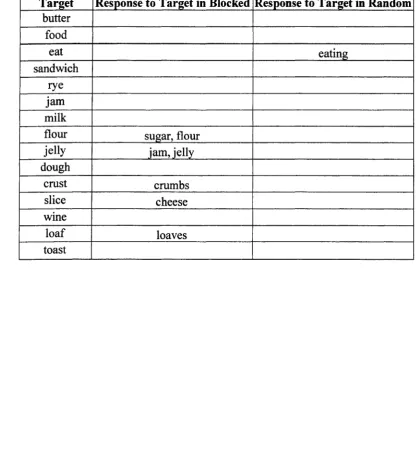
As first responses, JO made 47 semantic errors to targets in the blocked condition.
In contrast, she produced only 7 semantic errors in response to the same words presented
in random order (refer to Table 1 for examples). These results provide quantitative
evidence that supports failed inhibition as the mechanism for impaired explicit access.
However, FIT predicts that impaired selective and inhibitory processes will also impact
the overall pattern of errors. Specifically, given failed inhibition, the number of
candidates available for selection continues to increase with each semantically related
presentation. As such, errors should accrue as a function of position within semantic
categories. Consistent with this prediction, Colangelo et al. (2004) found a significant
semantic interference effect when responses to words in the first half were compared with
responses to words in the second half of the lists (e.g., butter, food, eat, sandwich, rye,
jam , and milk were in the first half of the category, whereas jelly, dough, crust, slice,
wine, loaf, and toast were in the second half of the category): JO produced more errors in
the second half o f each list compared with the first half. In fact, the proportion of overall
errors increased from 47% (66/140) of responses to the first half of words across lists to
59% (83/140) of responses for the second half of the words. In contrast, there was no
difference in number of errors in the first half and second half of the semantic category
for matched words in the random condition.
Cumulatively, the number and pattern o f errors in the blocked relative to random
aloud reading conditions not only suggests a role for spread o f activation in mediating the
the mechanism for impaired explicit access. That impaired explicit access departs from
the facilitation in naming performance seen in the normal population for semantic context
provides additional support for the FIT as an explanation for deep dyslexia (see Damian
et al., 2001 for naming in intact participants).
TABLE 1. Reading Responses to Words in Blocked and Random Conditions
Target Response to Target in Blocked Response to Target in Random butter
food
eat eating
sandwich rye jam milk
flour sugar, flour
jelly jam, jelly
dough
crust crumbs
slice cheese
wine
loaf loaves
A SYSTEMATIC TEST OF THE FAILURE OF INHIBITION THEORY
As stated previously, the semantic blocking studies reviewed above were
completed with JO, a deep dyslexic patient first identified in 1999. Since that time, she
has participated extensively in investigations conducted in our laboratory and is the focus
of the current research program. The studies presented in this dissertation were conducted
serially over the past two years, each several months apart. At present, JO is 53-years old.
She has 14 years of formal education, two of which were at the postsecondary level. She
was first tested 20 years after the removal of a tumour in the left temporal-parietal region,
which the treatment of and later complications left JO with right side paralysis and
profound language disturbances. Unfortunately, neuroimaging results are currently not
available for review.
During the screening phase, JO demonstrated non-fluent aphasia characterized
by very slow, halting speech production. Her utterances were of significantly reduced
length and agrammatic in nature (i.e., typically comprised of single word responses).
Given the extent of her production language difficulties, which included very slow
reading rate (i.e., reading o f single word responses at a rate of approximately 16 targets
per hour), and in respect of her time, comprehensive standardized neuropsychological
testing was not completed. Although not formally tested, she demonstrated good auditory
comprehension for conversational speech and she was able to understand complex task
instructions without difficulty. During repetition o f 300 single and multi-syllabic words,
she made 33 errors, none o f which were semantic responses. With respect to naming, she
produced 134 errors to 242 stimuli pictures, with 73 of her responses being semantic
syllable words and 108 nonwords. O f the 300 common English words, JO correctly read
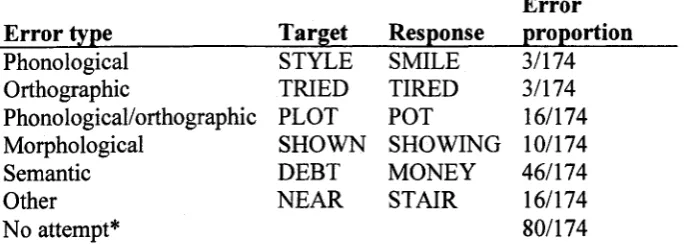
only 126 words and made 46 frank semantic errors (see Table 2 for summary of error type
reported in Buchanan et al., 2003). Regarding the 108 nonwords, she was initially unable
to read aloud a single letter string. As such, her pattern of errors on these tasks is
consistent with the profile of deep dyslexia. The following series of experiments
constitute a systematic examination o f issues raised in previous work and attempt to
refine the description of deep dyslexia.
Table 2. Example of Errors JO Made During Screening
Error Error type_____________ Target Response proportion
Phonological STYLE SMILE 3/174
Orthographic TRIED TIRED 3/174
Phonological/orthographic PLOT POT 16/174
Morphological SHOWN SHOWING 10/174
Semantic DEBT MONEY 46/174
Other NEAR STAIR 16/174
No attempt* 80/174
Note. "*No attempt" responses are items that JO indicated she could not read either by saying "no" or "I don’t know."
Distinction between Explicit and Implicit Access at the Level of the Representation
By manipulating semantic context, the blocking paradigm provided clear support
for the distinction between implicit and explicit access at the task level. However, in order
to demonstrate that this distinction also exists at the level of the representation,
performance must be shown to dissociate based on explicit and implicit task demands for
word level semantic variables (e.g., number o f semantic neighbourhoods). Important to
associated with MONEY and RIVER meanings). Given multiple representations in the
semantic system, these words are linked to several distinct semantic neighbourhoods. In
contrast, unambiguous words (e.g., FOOD) correspond with only one concept and
therefore are consistently associated with one semantic neighbourhood. Based on the
assumption that ambiguous and unambiguous words are associated with a different
number of semantic neighbourhoods, the FIT predicts that these words should differ with
respect to explicit lexical access. Specifically, deep dyslexics are expected to produce
more semantic errors to ambiguous relative to unambiguous words during aloud reading
because these items are associated with several distinct semantic neighbourhoods and a
correspondingly large number of activated candidates competing for selection in the
context of failure of inhibition.
In contrast, given that the effects of failed inhibition are only expected in
conditions that require explicit selection, performance on tasks that require implicit
processing should parallel that observed in the normal population (e.g., lexical decision).
Given the normal advantage for ambiguous relative to unambiguous words based on
implicit task demands (e.g., Borowsky & Masson, 1996), the FIT predicts that deep
dyslexics show facilitation for ambiguous compared with unambiguous words in lexical
decision. Evidence for dissociation in performance based on explicit and implicit task
demands at the word level would strongly support the distinction between explicit and
implicit access. Moreover, this finding would indicate failure of inhibition as the
METHODS
Experiment la and lb: Distinction between Explicit and Implicit Access at the Word
Level
Experiment la: Semantic Ambiguity Reading
The stimuli administered to JO were identical to the stimulus set originally used
by Borowsky and Masson (1996). This stimulus set consisted of 64 matched pairs of
ambiguous and unambiguous words that were controlled for initial phoneme, word
frequency, and word length. The words were also similar with respect to spelling-to-
sound regularity, orthographic familiarity, and number of higher frequency neighbours.
Each word was individually printed in 16-point font on 3X5 index cards. Ambiguous and
unambiguous words were presented in random order. JO was asked to read each word
aloud. The task was participant paced and no time limits were imposed.
Experiment la: Results and Discussion
According to the FIT, ambiguous words should result in more semantic errors
than unambiguous words. The current investigation revealed support for this prediction
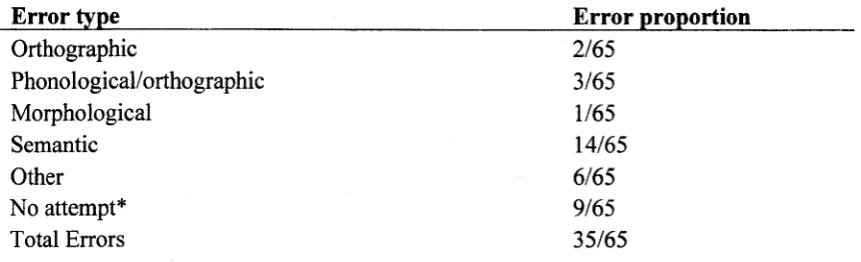
(See Table 3 for error proportions): As first responses, JO produced equivalent number of
total errors in ambiguous (39 errors) and unambiguous (43 errors) conditions, (1, N =
128) = 0.54, p = 0.46. In contrast, the proportion of semantic compared with total errors
was greater for ambiguous (56.4% of total errors) relative to unambiguous (32.6% of total
errors) w o r d s, (1, N = 82) = 4 .7 2 , p = 0.03. The increase in semantic errors for
ambiguous compared with unambiguous words implies intact ability to activate
semantically related candidates and suggests sensitivity to subtle semantic distinctions at
access entries in the semantic system. Instead, increased number of semantic errors in
response to ambiguous relative to unambiguous words indicates a deficit in the ability to
address semantically related entries: Given that ambiguous words are associated with
multiple representations in the semantic system, more semantic neighbourhoods are
activated and a correspondingly large number of candidates are available for potential
selection in the context o f failed inhibition relative to unambiguous words.
Analysis of the pattern of responses in ambiguous compared with unambiguous
conditions provides additional support for the FIT: JO made 14 semantic errors as first
responses to unambiguous words (21.9% of total responses), which is entirely consistent
with her semantic error rate on earlier screening tasks. In addition to semantically related
responses, JO produced phonological, morphological, and orthographical errors, as well
as short circumlocutions and no responses. O f note, the number of nonsemantic errors in
response to unambiguous words (45.3% of total responses) was directly proportional to
the number of nonsemantic errors produced in most reading tasks we have conducted
with her (approximately 46.3% o f total responses). Thus, the pattern o f errors in the
unambiguous condition is consistent with her typical performance and with the classic
deep dyslexia profile. In contrast, the pattern of errors for ambiguous words was
numerically and qualitatively identical to predictions based on the FIT: JO produced 22
semantic errors (34.4% o f total responses) in response to ambiguous words,
proportionately greater semantic errors than that observed for the unambiguous condition
(34.4% versus 21.9%, Fisher's test p = 0.08). Importantly, this result occurred in the
context of fewer nonsemantic errors for ambiguous (26.6% of total responses) compared
which suggests a shift in the distribution of error type from nonsemantic to semantic
responses and indicates deviation from her typical performance profile.
Table 3. Proportion of Errors for Ambiguous and Unambiguous Words
Error type_______________________ Ambiguous Error Unambiguous Error
Orthographic 2/64 2/64
Phonological/orthographic 4/64 5/64
Morphological 2/64 3/64
Semantic 22/64 14/64
Other 2/64 6/64
No attempt* 7/64 13/64
Total Errors 39/64 43/64
Note. "*No attempt" responses are items that JO indicated she could not read either by saying "no" or "I don’t know."
The increase in semantic errors for ambiguous relative to unambiguous words
during aloud reading is consistent with failure of inhibition as an explanation for reading
errors in deep dyslexia. However, the effects of failed inhibition are only expected in
conditions with an explicit selection requirement. In contrast, implicit processing is
assumed to be intact in deep dyslexia. Support for intact implicit processing requires that
deep dyslexic performance parallel normal performance on tests o f implicit access.
Evidence for an ambiguity advantage in lexical decision in the context o f increased
semantic errors for these same words during reading would support the distinction
between explicit and implicit processing in deep dyslexia at the word level.
Exneriment lb: Semantic Ambiguity Lexical Decision
The stimulus set for lexical decision consisted of the same stimuli presented