
ABSTRACT
YESSAYAN, RAFFI ALEXANDER. Improvements to the THOR Neutral Particle Transport Code on High-Performance Computing Systems via Acceleration, Parallelization, and
Performance Analysis. (Under the direction of Dr. Yousry Y. Azmy).
As the availability and capability of high-performance computing (HPC) resources has
grown, so has the demand for high-fidelity simulations. Unfortunately, for methods like the
three-dimensional discrete ordinates approximation to the neutron transport equation, the cost
of high-fidelity simulations climbs rapidly because of the high dimensionality of the phase
space. Simulations can reach into the billions of degrees of freedom and require weeks to run
on unaccelerated, serial implementations of the method. For many applications, this run time
is intractable. To address this, modern codes must implement more advanced algorithms, such
as iterative acceleration and parallelism to reduce run times and better capitalize on computing
resources. When implemented efficiently and given sufficient resources, these methods can
reduce a two-week simulation to hours or minutes. However, these advanced methods may
also introduce complications. Depending on the implemented iterative method, acceleration
techniques, such as diffusion synthetic acceleration, can be resource heavy, while others, such
as Chebychev acceleration, can be unstable for certain problems. Parallelism introduces the
requirement for inter-process communication and, for certain methods, asynchronicity.
Modifications and analysis have been performed on the THOR neutral particle
transport code to implement the above improvements. THOR is intended to enable simulation
of complex geometries in a variety of scenarios, ranging from reactor simulation to
non-proliferation and, as such, must provide capabilities for a variety of applications. This work
describes four major efforts to improve THOR’s capabilities and bring it closer to production
level. First is the implementation of Chebychev power iteration acceleration, a low resource
cost method that reduces iteration count ~2x versus the existing fission source extrapolation and roughly comparable to some implementations of the high-memory usage JFNK solver.
This implementation also includes control logic designed to improve the stability of the method
for challenging problems. Second is the implementation of angular domain decomposition
mid-of ~10x to ~100x depending on available resources and problem parameters. The third item,
in pursuit of optimizing parallel performance, is the development of a modular parallel
performance model. This model captures the run time of THOR’s mono-energetic, zeroth
spatial order, unaccelerated inner/outer iteration solver to within ~5% for reasonably large
problems. The model is designed such that future modifications to the THOR code or to the
parameters of interest (e.g. adding group or spatial order dependence), can be easily added.
This makes the performance model a powerful tool not just for evaluating the efficiency of
existing code, but also for performing comparative studies and localizing inefficiencies in later
additions to THOR. A long-term goal of the THOR project is to enable massively parallel
spatial domain parallelism on 105+ processors. The implementation of the spatial domain
decomposition (SDD) algorithms on unstructured meshes is a massive undertaking beyond the
scope of this work. However, Task four lays the groundwork for this capability by analyzing
the communication inefficiencies present in PIDOTS, a three-dimensional Cartesian mesh
code which implements a parallel Gauss-Seidel SDD algorithm. This analysis demonstrates
that the high count, small-message communication paradigm used by PIDOTS leads to
communication slowdowns on the order of 10x for 105 processors and identifies steps that can
© Copyright 2018 Raffi Alexander Yessayan
Improvements to the THOR Neutral Particle Transport Code on High-Performance Computing Systems via Acceleration, Parallelization, and
Performance Analysis
by
Raffi Alexander Yessayan
A thesis submitted to the Graduate Faculty of North Carolina State University
in partial fulfillment of the requirements for the degree of
Master of Science
Nuclear Engineering
Raleigh, North Carolina
2018
APPROVED BY:
_______________________________ _______________________________
DEDICATION
To my Mom and Dad, Lynn and Arthur Yessayan, for a lifetime of unconditional love,
BIOGRAPHY
Raffi Alexander Yessayan was born in Charlotte, North Carolina on July 21st, 1993 to
Lynn and Arthur Yessayan. He lived in Charlotte until being accepted at North Carolina State
University in Raleigh, North Carolina. During his undergraduate career, he pursued significant
coursework in both nuclear engineering and computer science. Additionally, for two years, he
worked as a teaching assistant in both introductory computing and Fortran programming
courses. In 2015, he graduated Summa Cum Laude with a Bachelor of Science in nuclear
engineering, minors from both the French and Computer Science departments, and having
completed the University Honors Program.
For his graduate coursework, he remained in North Carolina State University’s
Department of Nuclear Engineering and began studying optimization and parallelization
techniques for unstructured mesh neutron transport codes under the direction of Dr. Yousry Y.
Azmy. He is a recipient of the Consortium for Nonproliferation Enabling Capabilities Graduate
ACKNOWLEDGMENTS
I would like to thank my advisor, Dr. Yousry Y. Azmy, for his support and guidance
throughout my graduate career. I would also like to thank Dr. Sebastian Schunert for
contributing his insight and experience to my project, especially with regards to the inner
workings of THOR. Finally, I would like to thank my parents for always providing support
and encouragement throughout my academic career.
The work of the author is based upon work supported by the Department of Energy
National Nuclear Security Administration under Award Number(s) DE-NA0002576.
This report was prepared as an account of work sponsored by an agency of the United
States Government. Neither the United States Government nor any agency thereof, nor any of
their employees, makes any warranty, express or implied, or assumes any legal liability or
responsibility for the accuracy, completeness, or usefulness of any information, apparatus,
product, or process disclosed, or represents that its use would not infringe privately owned
rights. Reference herein to any specific commercial product, process, or service by trade name,
trademark, manufacturer, or otherwise does not necessarily constitute or imply its
endorsement, recommendation, or favoring by the United States Government or any agency
thereof. The views and opinions of authors expressed herein do not necessarily state or reflect
TABLE OF CONTENTS
LIST OF TABLES ... viii
LIST OF FIGURES ... ix
1 Introduction ... 1
1.1 The Neutron Transport Equation... 1
1.2 Iterative Neutron Transport Solvers ... 4
1.3 The THOR Neutral Particle Transport Code ... 6
1.4 Desired Improvements ... 7
1.5 Selected Improvements ... 8
1.6 Thesis Outline ... 9
2 Iterative Acceleration Methods ... 10
2.1 Introduction ... 10
2.2 Literature Review ... 10
2.2.1 Fission Source Extrapolation ... 10
2.2.2 Coarse Mesh Rebalance ... 11
2.2.3 Diffusion Synthetic Acceleration ... 14
2.2.4 Chebychev Acceleration ... 15
2.3 Implementation... 16
2.4 Results ... 18
2.5 Future Work ... 22
3 Parallel Domain Decomposition ... 23
3.1 Introduction ... 23
3.2 Literature Review ... 23
3.2.1 Energy Domain Decomposition ... 23
3.2.2 Spatial Domain Decomposition ... 24
3.2.3 Angular Domain Decomposition ... 26
3.3 Implementation... 27
3.3.1 Work Splitting Routine ... 28
3.3.2 Parallel Execution ... 29
3.3.3 Communication ... 30
3.4.1 Scaling Studies ... 32
3.4.2 Synthetic Communication Modeling ... 36
3.5 Future Work ... 38
4 Parallel Performance Modeling ... 39
4.1 Introduction ... 39
4.2 Literature Review ... 39
4.2.1 Amdahl’s Law ... 39
4.2.2 PPMs for Transport Codes ... 41
4.3 An Overview of the Falcon HPC System... 42
4.3.1 Physical Layout of Falcon ... 43
4.3.2 Network Topology of Falcon ... 44
4.3.3 Other Falcon Notes ... 44
4.4 Complications Stemming from the THOR Cell Solver ... 45
4.5 Methodology ... 46
4.6 Results and Model Validation ... 50
4.6.1 Evaluating the Influence of Canonical Tetrahedron Subdivision ... 50
4.6.2 The Communication Model ... 53
4.6.3 The Parallel Sweep Model ... 56
4.6.4 Evaluating the Model ... 58
4.6.5 The Unified THOR Parallel Performance Model ... 62
4.6.6 Future Work ... 63
5 Parallel Communication Effects ... 65
5.1 Introduction ... 65
5.2 Literature Review ... 65
5.2.1 The PIDOTS Code ... 65
5.2.2 HPC Topology & Communication ... 67
5.3 Results ... 69
5.3.1 Recreating the PIDOTS Scaling Problem ... 69
5.3.2 Justification of Crossover in the Weak Scaling Trends ... 74
5.3.3 Exploring Communication Cost Growth on Falcon ... 75
5.3.4 Modeling the Impact of the Latency Distribution... 78
6 Software Management Improvements ... 84
6.1 Version Control ... 84
6.2 Modular Code Restructuring ... 85
6.3 Formal Testing ... 86
6.4 Documentation and Testing Coverage Metrics ... 87
6.5 Automated Build System ... 87
6.6 Summary ... 88
7 Conclusions ... 89
7.1 Summary ... 89
7.2 Final Comments ... 90
REFERENCES ... 91
APPENDICES ... 95
APPENDIX A – FALCON TOPOLOGY ... 96
LIST OF TABLES
Table 1: Comparison of THOR solver methods [4] ... 20
Table 2: Summary of Falcon Hardware Layout ... 43
Table 3: Simple Cube Test - Canonical Tet Variation [33] ... 51
Table 4: Godiva - Canonical Tet Variation [33] ... 52
Table 5: C5G7 - Canonical Tet Variation [33] ... 52
Table 6: Percent Error for Interpolation Cases, from [33] ... 58
Table 7: Actual vs. Model Results for Takeda-IV & Godiva Cases ... 61
LIST OF FIGURES
Figure 1: Flow diagram of iterative transport solution ... 5
Figure 2: Example of level-of-detail based structured/unstructured mesh, from [16] ... 13
Figure 3: Behavior of Chebychev Acceleration Factors ... 21
Figure 4: Example PGS-SDD Domain ... 25
Figure 5: ADD Parallel Inner Iteration Scheme ... 30
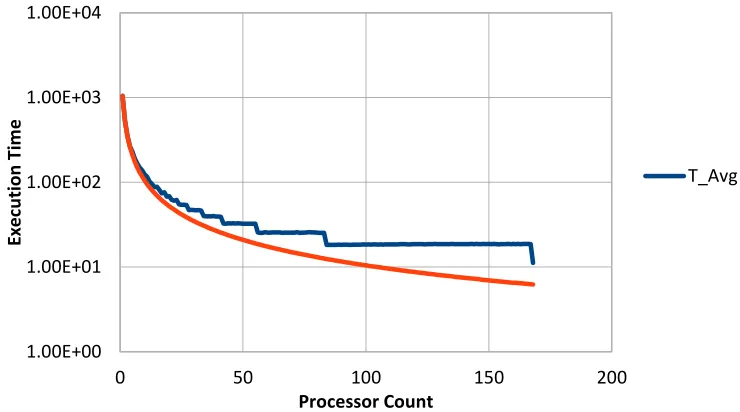
Figure 6: Comparison of Measured and Optimal Times for THOR ADD – Strong Scaling... 33
Figure 7: Strong Scaling for Angular Decomposition Problem plotting efficiency (%) versus the number of CPUs for S12 level-symmetric quadrature. [4] ... 34
Figure 8: Weak Scaling Results for 10k Tet Mesh with THOR ADD ... 35
Figure 9: Measured communication time for minimally loaded nodes performing AllReduce on Falcon. Data sets are labeled as [# of active processors per node] x [# of Nodes], from [4] ... 37
Figure 10: Measured communication time for partially loaded nodes performing AllReduce on Falcon. Data sets are labeled as [# of active processors per node] x [# of Nodes], from [4] ... 37
Figure 11: Possible Configurations for Canonical Tet Decomposition, from [32] ... 46
Figure 12: Hierarchical Timing Model Design, adapted from [33] ... 48
Figure 13: Updated representation of AllReduce Behavior on Falcon, adapted from [33] ... 50
Figure 14: Differing communication trends for p=288 and p=n(n+2) for S8, adapted from [33] ... 54
Figure 15: Differing communication trends for p=288 and p=n(n+2) for S12, adapted from [33] ... 55
Figure 16: THOR/HPC communication time fit, adapted from [33] ... 56
Figure 18: Linear relation between time and number of angles for a fixed value of p,
adapted from [33] ... 57
Figure 19: 400k tetrahedrons mesh model predictions vs measured, adapted from [33] ... 59
Figure 20: Evaluation of processor count dependence in grind time, adapted from [33] ... 60
Figure 21: Amended Model Cases, adapted from [33] ... 60
Figure 22: Final Model Predictions for Simple Cube, adapted from [33]... 63
Figure 23: Original PIDOTS Iteration Count as a Function of Processor Count; adapted from [22] ... 70
Figure 24: Original PIDOTS Weak Scaling Results adapted from [22] ... 71
Figure 25: PIDOTS Iteration Trends from FALCON ... 72
Figure 26: PIDOTS / Falcon Weak Scaling ... 72
Figure 27: Falcon PIDOTS Time Per Iteration ... 73
Figure 28: Histogram of 2-Hop Latency ... 77
Figure 29: Histogram of 3-Hop Latency ... 78
Figure 30: Sketch of Approximate PDF overlaid on Measured 2-Hop Data ... 79
Figure 31: Comparing Latency Models for p=64 ... 81
Figure 32: Comparing Latency Models for p=32,768 ... 81
Figure 33: Falcon IRU Structure and 1D Topology ... 96
Figure 34: Falcon 3D Topology ... 97
Figure 35: Falcon 4D Topology ... 97
Figure 36: Falcon 5D Topology ... 98
Figure 37: Falcon 6D Topology ... 98
Figure 38: Falcon Partial 7D Topology ... 99
Figure 39: PIDOTS / Fission Iteration Behavior ... 100
Figure 40: PIDOTS / Fission Total Execution Time ... 101
1
Introduction
1.1 The Neutron Transport Equation
The neutron transport equation describes the evolution of the neutron distribution over
a six-dimensional phase space formed by position, direction of motion, and energy. This
distribution is referred to as angular flux and, in this thesis, will be denoted as 𝜓(𝑟⃗, Ω̂, 𝐸, 𝑡),
where 𝑟⃗ is the position of the particle in cartesian (x,y,z) space within a volume 𝑑𝑟⃗, Ω̂ is the angular description of the particle’s direction of travel within a cone 𝑑Ω̂, E is the particle’s
energy within a band 𝑑𝐸, and t is the time of evaluation. A standard representation of this equation is given below [1]:
1 𝑣 𝜕 𝜕𝑡𝜓(𝑟⃗, Ω̂, 𝐸, 𝑡) + Ω̂ ∙ ∇⃗⃗⃗ 𝜓(𝑟⃗, Ω̂, 𝐸, 𝑡) + 𝜎𝑡(𝑟⃗, 𝐸)𝜓(𝑟⃗, Ω̂, 𝐸, 𝑡) = ∫ 𝑑𝐸′ ∞ 0 ∫ 𝑑Ω̂′ 4𝜋 𝜎𝑠(𝑟⃗, Ω̂′→ Ω̂, 𝐸′→ 𝐸)𝜓(𝑟⃗, Ω̂, 𝐸, 𝑡) +𝜒(𝐸)
4𝜋𝑘 ∫ 𝑑𝐸
′ ∞ 0 ∫ 𝑑Ω̂′ 4𝜋 𝜈𝜎𝑓(𝑟⃗, 𝐸)𝜓(𝑟⃗, Ω̂, 𝐸, 𝑡) +𝑞𝑒𝑥𝑡𝑒𝑟𝑛𝑎𝑙(𝑟⃗, Ω̂, 𝐸, 𝑡) (1)
In Eq. (1), 𝑣 represents the neutron speed, while 𝜎𝑡, 𝜎𝑠, 𝑎𝑛𝑑 𝜎𝑓represent, respectively,
the neutron cross sections for total interaction, scattering, and fission. The average number of
neutrons per fission event is given by 𝜈 and the resulting fission spectrum is given by 𝜒.
In this form, the first line of the equation represents the neutron sinks, in order: the
change in population with time, the out-streaming of particles, and interaction of particles. The
second line represents the scattering source, or the influx of particles into a volume of phase
space resulting from scattering interactions in other regions (𝑟⃗′, Ω̂, 𝐸′, 𝑡)′ that deposit a particle
into (𝑟⃗, Ω̂, 𝐸, 𝑡). The third line represents the contributions of fission events that result in a
of the original energy, 𝐸′ and that fission is assumed to be isotropic, i.e., it emits particles
evenly amongst the 4𝜋 directions of the unit sphere. The fourth line provides an arbitrary
external source of neutrons. The form given in (1) represents a combination of the two forms
represented in the THOR transport code, k-eigenvalue and fixed source. In THOR, for the former, k is part of the solution and can be any positive real value, while 𝑞𝑒𝑥𝑡𝑒𝑟𝑛𝑎𝑙 is taken to
be zero. For the latter, k must be less than 1 for a solution to exist and 𝑞𝑒𝑥𝑡𝑒𝑟𝑛𝑎𝑙 is a problem parameter.
While (1) provides a clean expression for the neutron transport equation, it is several
steps removed from a form convenient to implement into a numerical code. First, for the
purposes of this work, all problems will be taken to be steady state. As such, the time derivative
of the flux is zero and the corresponding term can be removed. Second, the continuous
variables in space, angle, and energy must be discretized, along with the integrals in angle and
energy. Multiple methods exist by which to perform this discretization. One method, which is
implemented by THOR, is the method of Discrete Ordinates [1], or the 𝑆𝑛 method, which
divides the spatial volume into elements, the angles into a set of discrete ordinates, 𝑛 ∈ 1. . 𝑁,
and the energy range into a set of energy groups, 𝑔 ∈ 1. . 𝐺. The name 𝑆𝑛 stems from the
subscript 𝑛 denoting the level of the angular quadrature used to approximate the angular
integrals.
Rewriting Eq. (1) in this form will require several stages. First, is the treatment of the
angular variable, Ω, via the method of Discrete Ordinates. In this method, the continuous
variable Ω is replaced with the finite set of directions, Ω𝑛, where 𝑛 = 1. . 𝑁. Via numerical
quadrature, this set of angles, paired with appropriate weights (𝑤𝑛), can be used to replace
integrals over Ω with sums over 𝑤𝑛Ω𝑛. Finally, the scattering cross section, 𝜎𝑠, which is a
function of both the incoming and outgoing angle, must be represented using an expansion in
spherical harmonics. Eq. (2) shows the Discrete Ordinates form of the transport equation with
Ω̂∇ψn(𝑟⃗, 𝐸) + 𝜎𝑡ψn(𝑟⃗, 𝐸) = ∑ ∑ Υ𝑙,𝑚(Ω̂𝑛) ∫ 𝜎𝑠(𝑟⃗, 𝐸′→ 𝐸)𝜙 𝑙𝑚(𝑟⃗, 𝐸)𝑑𝐸 ∞ 0 𝑙 𝑚=−𝑙 𝐿 𝑙=0 +𝜒(𝐸)
4𝜋𝑘 ∫ 𝜈𝜎𝑓𝜙(𝑟⃗, 𝐸)
∞
0
𝑑𝐸 +𝑆𝑛(𝑟⃗, 𝐸)
4𝜋
(2)
Here, 𝜓𝑛is the angular flux of the specific angle Ω𝑛 and Υ𝑙,𝑚 is the spherical harmonic
of degree 𝑙 and order 𝑚. All other variables subscripted with n are the same quantities as before, except now they only represent the component along direction n.
Next is the discretization of the energy domain. This will be done via the multigroup
method, which subdivides the energy range into a finite number of groups, G, and defines a set of G transport equations. This replaces integrals over energy with sums over each group. For quantities which are energy dependent, such as cross sections, the group average value is
defined as the flux weighted average over the energy range of the group. An example of the
multigroup discrete ordinates equations for continuous space is shown below [2].
Ω̂∇ψn,g(𝑟⃗) + 𝜎𝑡,𝑔ψn,g(𝑟⃗) = ∑ ∑ ∑ Υ𝑙,𝑚(Ω̂𝑛)𝜎𝑠𝑔′→𝑔(𝑟⃗)𝜙𝑙,𝑔′𝑚 (𝑟⃗) 𝐺 𝑔′=1 𝑙 𝑚=−𝑙 𝐿 𝑙=0 + 𝜒𝑔
4𝜋𝑘 ∑ 𝜈𝜎𝑓,𝑔′𝜙𝑔′(𝑟⃗)
𝐺
𝑔′=1
+𝑆𝑛,𝑔(𝑟⃗) 4𝜋
(3)
Here, 𝜓𝑔,𝑛is the angular flux of the specific group-angle combination. In this form, the
solution is only obtained along one ordinate, Ω̂𝑛, and one group, 𝑔, at a time.
The final phase dimension to discretize is space. There a variety of methods by which
to do this. However, in general, this step is performed by dividing the spatial domain into a set
of mesh cells. Each cell in the mesh has constant material properties and, as a result, constant
cross section. Next, a set of relations are defined to relate the cell center and outbound fluxes
As a result of this discretization, for a given angle, the flux in a cell is only dependent
on values local to that cell, sources and cross sections, and the flux incident on the cell from
its upstream neighbors. This allows for the use of a mesh sweep to evaluate the flux in all cells,
given a starting boundary with a known incident flux.
The known boundary, combined with the cell material information, can be used to solve
for the flux along a given ordinate in the cell and then propagate a cell-edge flux to the
downstream mesh neighbor. When this process is repeated across the entire mesh, it is referred
to as a sweep. After every angle has been swept, a new iterate of the flux profile in the domain
can be generated. As the next section will describe, this iteration process continues until a
sufficiently converged value of the flux solution is produced.
1.2 Iterative Neutron Transport Solvers
Moving from the mathematical expression of the numerical neutron transport equation
to a workable algorithm is relatively straightforward. Solution of the transport equation
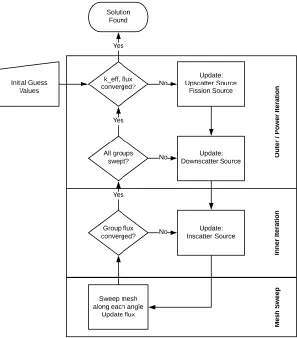
typically uses a set of two nested iterations: outer and inner. A flow diagram of these processes
is given in Figure 1. As it shows, the inner iteration is used to converge the in-scatter source,
while the outer iteration is used to converge the up-scatter source. By sweeping energy groups
Figure 1: Flow diagram of iterative transport solution.
Also of note is the lowest level of the iteration hierarchy, the mesh sweep. In this
operation, the current source and flux values are used to calculate a new flux iterate by moving
along each cell of the mesh, starting from a boundary with known in-flux. In this way, each
cell is solved using the known solution from its upstream neighbor. This sweep is performed
along the entire mesh for each discrete ordinate in the angular approximation. However,
individual sweeps are independent of one another until they are all completed. Once all sweeps
1.3 The THOR Neutral Particle Transport Code
The THOR neutral particle transport code is maintained at NCSU in collaboration with
Idaho National Laboratory (INL). It is a Fortran 95 application designed to solve the
three-dimensional discrete ordinates approximation discretized by unstructured tetrahedral meshes.
As a spatial approximation, it implements the arbitrarily high order transport method of the
characteristic type (AHOTC). The specifics of this implementation are beyond the scope of
this work and are detailed in [3].
To the best of author’s knowledge, THOR is unique in its implementation of this
arbitrarily high-order method on unstructured, tetrahedral meshes. As such, it provides a useful
testbed for the implementation and evaluation of modifications to the AHOTC method in
unstructured geometries. At the beginning of the author’s graduate program, THOR maintained
the following features:
• Serial solvers for both k-eigenvalue and external source problems using a traditional outer/inner iteration scheme
• Support for arbitrary energy groups, angular quadrature refinements, and spatial expansion order
• A Jacobian-Free Newton-Krylov Solver for k-eigenvalue problems
• Fission source extrapolation for acceleration of the outer iteration
Using these features, the THOR code could be used to evaluate a variety of scenarios
relevant to the modern nuclear engineering field. These include reactor core modeling [4],
source localization, and the evaluation of sub-critical weapons-grade material. However, the
neutron transport equation can be an extremely expensive problem to solve since it is
discretized in 6 variables – 3 directional, 2 angular, and 1 energy. Refinements to a given
problem can lead to massively increased computational costs. For small problems, this scaling
can yield several thousand degrees of freedom (DOF) and solving times on the order of
seconds. Even for many iterations of parameter studies, these costs are quite minor. However,
for larger problems, these costs can rapidly become intractable. For the largest problem run in
Lab (INL) [5], this scaling yielded approximately four billion DOF. This problem had a
solution time of ~2 weeks and was simply too time-intensive to run repeatedly. Unfortunately,
as evaluating a high-resolution reactor model, such as the ATR problem, forms a cornerstone
of the verification and validation plan for the THOR code, this posed an obvious challenge.
Based on the need to repeatedly and rapidly run problems on scales up to that of the ATR case,
it was determined that several modifications would need to be made to THOR.
1.4 Desired Improvements
As the ATR problem had demonstrated, the then-current implementation of THOR was
insufficient to tackle the massive problem sizes resulting from the desire for high-fidelity
results. Fortunately, there were a variety of possible modifications that could be made to THOR
to significantly speed up the solver.
However, there were also several limiting factors that restricted this field of choices.
Most important was the fact that previously completed work from another researcher had
verified the existing code via the method of manufactured solutions [6]. This meant that it was
desirable to introduce changes that encapsulated, rather than modified, existing pieces of code.
Maintaining this separation of functionality would allow for improvements to be made to the
code’s speed without risk of impacting verified code. The second constraint was related to the
future plans for THOR. Since many planned projects related to the capabilities of the
non-JFNK solvers, it would be ideal if the power iteration solver saw the greatest benefit from the
implemented changes.
From these needs and constraints, a goal could be developed – reduce the runtime of
the outer/inner iterative solvers as much as possible without significantly modifying existing
1.5 Selected Improvements
Based on the goal defined in section 1.4, there were two obvious paths for improving
the performance of THOR. First, implementation of a new acceleration scheme better than
fission source extrapolation and, second, the parallelization of one of the phase space
dimensions of the neutron transport equation.
For the first, a new acceleration method, there were again two options. In an outer/inner
solver schema, acceleration schemes can be applied to either (or both) the outer or inner
iterations. Several powerful inner iteration schemes exist which sharply decrease the required
number of inner iterations. Unfortunately, these are also typically more resource intensive,
requiring much more memory, and would require implementing significant modifications to
already-verified code. Additionally, k-eigenvalue problems in THOR are dominated by outer iterations. Some outer accelerations, such as the already implemented Fission Source
Extrapolation, are comparatively cheap and require only a short calculation at the end of an
outer iteration cycle. This small implementation and runtime overhead is balanced out by the
comparatively small acceleration they produce.
In the end, since eigenvalue problems are common for THOR, the lightweight,
non-intrusive nature of outer acceleration was found to be a better fit for the current needs. But,
given the expected performance of outer accelerations, it was also decided that simply
implementing a new outer acceleration would not provide a sufficient increase in performance.
To complement the outer acceleration some aspect of the code would also need to be
parallelized. From the variables involved in the transport equation, this left three options,
parallelism in space, angle, or energy.
Parallelism in energy is not ideal as the resulting algorithm is asynchronous due to
energy group coupling and, since the number of groups is typically small, limited in scalability.
While also asynchronous, spatial parallelism is a tempting option. The sheer number of
mesh cells in most problems allows for massive parallelization. Unfortunately, implementing
this parallel structure on unstructured meshes is a major undertaking and well beyond the scope
Finally, there is angular parallelism. Like spatial decomposition, the angular domain
grows in cost at an above-linear rate. However, unlike in the other options, angular
decomposition is synchronous. Angles are evaluated independently for most of the inner
iteration process. During the sweep, each angle is evaluated separately; and, at the end,
aggregate measures are generated form the completed result vector. Because of this, it would
be a relatively non-invasive task to implement an angular decomposition into a functioning
transport solver.
Based on this brief sampling of the available options for acceleration and
parallelization, an outer acceleration paired with angular parallelization best suits the needs of
the THOR project. The implementation and evaluation of the former will be detailed in Chapter
2, while the latter will be described in Chapter 3. Additionally, further evidence from literature
will be provided to justify each choice.
1.6 Thesis Outline
Each of the following chapters in this thesis will present work from single thrust area
of the THOR improvement project. For each thrust area, an overview of the existing literature
will be provided, followed by a discussion of the methodology, results, and conclusions related
to the work
Chapter 2 will discuss the development of the outer acceleration scheme decided on in
the previous sections. Chapter 3 will address the implementation of angular parallelization.
Next, Chapter 4 will present a compartmentalized method for parallel performance evaluation
of the THOR code. Chapter 5 will present an analysis of the performance of parallel codes on
a high-contention HPC system. Chapter 6 will highlight a variety of software management
improvements to the THOR project and explain their importance in the role of a
production-level neutronics code. Finally, Chapter 7 will provide conclusions and an overview of the net
2
Iterative Acceleration Methods
2.1 Introduction
As determined in sections 1.4 and 1.5, the optimal acceleration technique for this
project was not the one which demonstrated the largest increase in computational speed, but
rather the one which provided a reasonable amount of speedup for a relatively low cost in
implementation complexity and invasiveness. This section will review several common inner
and outer acceleration schemes. However, eigenvalue calculations are dominated by outer
iterations and several light-weight outer acceleration algorithms are readily available. In the
end, inner accelerations were deemed sub-optimal for our needs and work shifted focus to outer
acceleration methods. From this pool, Chebychev acceleration was selected. While there was
literature, [7], and anecdotal experience, [8], indicating that Chebychev was not an optimal
method, it was clearly documented in [9] and similar in implementation to the fission source
extrapolation already implemented in THOR. These benefits were deemed sufficient to
outweigh the negatives. In the end, with some modification to the standard algorithm,
Chebychev acceleration proved surprisingly effective and yielded speedups significantly better
than fission source extrapolation and roughly equal to some versions of the THOR JFNK
solver.
2.2 Literature Review
2.2.1 Fission Source Extrapolation
As described in [10], error-mode based fission source extrapolation (FSE) is one of the
most simplistic outer iteration acceleration schemes. However, this does not prevent it from
providing a useful degree of speedup in most problems. FSE is based on the fact that, as an
unaccelerated problem converges, the relative change in the fission density of the problem
be generated. Mathematically, this is achieved through the following steps. First, define the
iteration 𝑞 fission density error as the sum over all spatial cells:
𝑒𝑞 = ∑ |𝐷𝑞− 𝐷𝑞−1| (4)
where Dq is the fission density in iteration q. The fission density is calculated simply as the sum of all fissions in all groups.Next, this error term is used to evaluate an estimate of the eigenvalue and of the acceleration term as:
𝜆𝑞 = 𝑒
𝑞
𝑒𝑞−1 (5)
Θ𝑞 = 𝜆
𝑞
1 − 𝜆𝑞 (6)
This extrapolation term is then applied to both the scalar flux and the fission density:
𝐷𝑞′ = 𝐷𝑞+ Θ𝑞(𝐷𝑞− 𝐷𝑞−1) (7)
𝜙𝑞′ = 𝜙𝑞+ Θ𝑞(𝜙𝑞− 𝜙𝑞−1) (8)
The authors of [10] mention that this approach is highly effective in converging k -eigenvalue problems and problems with significant up-scatter. However, under some cases, a
stable value of Θ will not be found and the acceleration scheme will not prove effective.
2.2.2 Coarse Mesh Rebalance
Coarse Mesh Rebalance (CMR), discussed in [11, 12, 13], is an inner acceleration
scheme that can be applied to the neutron transport equation. As the name implies, the method
involves superimposing a coarse mesh atop the existing fine mesh used by the transport solver.
The current cell-average flux iterate is then accelerated by generating a multiplicative term
Overall the methodology is rather simple. As described by [13] for the slab geometry
case, a set of balances are generated such that the flux in the coarse mesh satisfies:
𝜓
𝑛,𝑗+12
𝑙 =
{ 𝜓
𝑛,𝑗+12
𝑙−12
∗ 𝐹𝑗𝑙, 𝜇𝑛 > 0
𝜓
𝑛,𝑗+12
𝑙−12
∗ 𝐹𝑗+1𝑙 ; 𝜇𝑛 < 0
(9)
where the values for flux at the cell edges, 𝜓
𝑛,𝑗±12
∗ ,
are calculated using the balance relationship
implemented in the given code and the values of 𝐹𝑗𝑙 are the acceleration coefficients. When
applied to all cells in the fine slab mesh, this forms a tridiagonal matrix which can be solved
to yield the 𝐹𝑗𝑙 terms. Having determined a value for the acceleration term in each cell, an
accelerated iterate of the cell-center flux can be generated as:
𝜓𝑛,𝑗𝑙 = 𝜓𝑛,𝑗𝑙− 1
2∗ 𝐹
𝑗𝑙 (10)
As the condition of two edges per cell in 1D yields a tri-diagonal matrix, it can be
inferred that higher dimensional problems will yield an increasingly wide block-diagonal
structure representing the edge coupling between cells.
While the CMR method has been a mainstay of simple, effective acceleration methods,
it presents several problems that make it unfit for our objectives described previously.
First, the presence of the matrix-solve means that CMR will have a significantly higher
per-iteration cost than non-matrix methods, both in memory and time utilization. While this is
not problematic for small problems, it will become a critical concern for extremely large
problems, which are both time and memory limited.
Further complicating the use of CMR concerns its application to unstructured meshes.
In the simple example described above, a fine slab mesh was coarsened into a less fine slab
mapping of the flux variables at cell edges. Applying this same routine to THOR would prove
challenging since an arbitrary group of tetrahedrons cannot be coarsened into another
tetrahedron. This difficulty could be avoided by using the same mesh for both the fine and
coarse meshes. Unfortunately, this approach makes the method inflexible as it would only
allow for that single configuration.
Several sources detail the process of overcoming the difficulties of unstructured-mesh
CMR [14, 15]. However, in both, the solution was to implement a degree of regularity to the
mesh. In doing so, the mesh was unstructured below some level of detail and structured above.
An example of this is provided from openMOC, [15], in Figure 2. Note that the implemented
acceleration is coarse-mesh finite difference, not CMR. Regardless, the system for handling
unstructured meshes is the same.
Figure 2: Example of level-of-detail based structured/unstructured mesh, from [16].
As can be seen on the left of Figure 2, even though the mesh is unstructured, it does
possess a degree of regularity stemming from the repetitive nature of the unit cell lattice. This
regularity is capitalized on to provide matching boundaries for CMR. Similarly, in [14], the
Unfortunately, due to the desired arbitrary-geometry nature of THOR, it would be
impossible to guarantee mesh repetitions of this sort in every problem without artificially
inserting them. As such, CMR is not a viable method for this application given its current
needs.
2.2.3 Diffusion Synthetic Acceleration
Alcouffe [7], describes a trio of Diffusion Synthetic Acceleration (DSA) methods for
use in multi-group, discrete-ordinates problems. The three treatments are designed to provide
a stable, highly-effective acceleration method. These stability improvements make DSA more
efficient than unaccelerated transport iterations under essentially all conditions except extreme
cases, such as unbounded heterogeneity [13]. This degree of improvement would provide a
massive boon to THOR.
DSA is characterized by the utilization of a neutron diffusion operator to accelerate the
inner iterations of the neutron transport solution. From a high-level viewpoint, the results of
an inner transport solve are used as the inputs to a diffusion-like solve. The diffusion solve
provides a greatly increased rate of convergence of the flux iterates. A significant benefit of
this method is that it is effective under most conditions, including those where true diffusion
would not be [7].
However, like CMR, the solution of DSA acceleration requires the creation of an
additional matrix system of equations in the iterative correction terms, consuming both
additional memory and execution time per iteration. However, given the results demonstrated
in [7], this increase in per-iteration cost would be easily outweighed by gains in iteration count
reduction. The comparison in [7] shows DSA consuming anywhere from ~3 to ~10 times fewer
iterations than unaccelerated transport. Additionally, the method proves similarly effective
when compared to Chebychev and CMR.
These substantial speedups, coupled with the evidence of guaranteed convergence
provided by [7]would seem to indicate that DSA is the optimal acceleration to implement into
multi-dimensional problems as material heterogeneity becomes unbounded.Furthermore, as [7] and
[18] discuss, DSA is most easily applied to fixed source problems. Applying it to general
eigenvalue problems can prove challenging. Since THOR primarily evaluates eigenvalue
problems, this weakness, coupled with the desire to modify verified code structures as little as
possible, rendered DSA suboptimal to implement for this project. There is still a significant
desire to implement it in the future as project needs and constraints evolve. But, for now, it is
not the optimal choice.
2.2.4 Chebychev Acceleration
From a review of the literature, Chebychev acceleration seems to be often used, but
rarely described. It is mentioned as an option or used for efficiency comparisons by [7], [9],
and [11], but the implementation is only fully described in Hébert’s work, [9]. Like fission
source acceleration, Chebychev acceleration does not require a matrix evaluation [11]. Instead,
it uses an estimate of the dominance ratio to modify the next flux iterate using a superposition
of old iterates. This makes it extremely cheap to implement in terms of run time costs since it
only involves a set of uncoupled expressions.
In the method described in [9], Chebychev acceleration is implemented as a cyclical
process. First, a series of unaccelerated iterations are used to loosely converge the dominance
ratio. Then, some fixed number of accelerated iterations are performed, with each one using
the dominance ratio estimate as an acceleration parameter. After the fixed number of
accelerations is complete, relations based on the Chebyshev polynomials are used to extract
the equivalent un-accelerated dominance ratio. This new dominance ratio is used to drive a
new cycle of accelerated iterations. At each step in the process, the Chebychev relationships
are used to generate two terms, 𝛼 and 𝛽, which are combined with the old iterative flux
estimates to provide an improved new flux estimate.
In the same publication, Hébert compares the Chebychev method to a proposed
than Chebychev acceleration to implement but yields only marginally better results in terms of
iteration count.
Similarly, in [7], Chebychev is used as one of a variety of acceleration methods for
benchmarking. Of note from these other methods are the unaccelerated, Coarse Mesh
Rebalance, and Diffusion Synthetic Acceleration results. As would be expected from the
earlier discussion, the DSA inner acceleration scheme requires far fewer iterations and is more
stable than any other method. However, it has the most complicated implementation and
highest per-iteration computational cost. Of the remaining methods, Chebychev is generally
able to converge faster than both CMR and unaccelerated inner iterations. However, there is
one case each [7] where Chebychev fails to outperform the other methods. These failures are
attributed to insufficient convergence in the initial guess value for the dominance ratio. Both
[11] and [9] emphasize that the method may become unstable if the initial dominance ratio
guess is poor.
2.3 Implementation
The Chebychev acceleration method implemented in THOR follows closely the form
developed in [9]. A summary of this method, along with the modifications made to it in our
implementation is presented here.
First, a set of unaccelerated iterations is performed while estimating the dominance
ratio as the 2-norm of the flux difference in iteration 𝑘 and 𝑘 − 1:
𝜎𝑘+1= |𝜙𝑘− 𝜙𝑘−1|2 (11)
When the dominance ratio estimate k+1 exceeds 0.5, a Chebychev acceleration cycle is triggered and the current iteration, 𝑘, is designated 𝑛∗. In this cycle, m Chebychev
acceleration steps are executed. During each of these steps denoted with an iterative index p, a
𝜙𝑛∗+𝑝+1 = 𝜙𝑛∗+𝑝+ 𝛼(𝜙𝑛∗+𝑝− 𝜙𝑛∗+𝑝−1) + 𝛽 ∗ (𝜙𝑛∗+𝑝−1− 𝜙𝑛∗+𝑝−2)
𝑝 = 1, . . , 𝑚
(12)
𝛼 =
{
2
2 − 𝜎𝑛∗+1 𝑝 = 1
4 𝜎𝑛∗+1∗ (
cosh[(𝑝 − 1)]
cosh(𝑝𝛾) ) 𝑝 > 1
(13)
𝛽 = {
0 𝑝 = 1
(1 −𝜎
𝑛∗+1
2 ) −
1
𝛼(𝑝) 𝑝 > 1
(14)
𝛾 = cosh−1( 2
𝜎𝑛∗+1− 1) (15)
The acceleration defined above can be applied for m iterations. After this, the acceleration cycle ends and an update to the dominance ratio must be performed to allow for
the re-initiation of the Chebychev scheme. The process of reconstructing the unaccelerated
dominance ratio at the conclusion of a Chebychev cycle is as follows:
𝐸 =||(𝜙
𝑛∗+𝑚− 𝜙𝑛∗+𝑚−1)|
2|
|(𝜙𝑛∗+1
− 𝜙𝑛∗
)|2
(16)
𝐸∗ = [𝐶
𝑚−1∙
(2 − 𝜎𝑛∗+1)
𝜎𝑛∗+1 ]
−1
(17)
𝐶𝑚−1(𝑥) = cosh [(𝑚 − 1) ∗ cosh−1(𝑥)]
The two factors, 𝐸 and 𝐸∗, represent the achieved and theoretical error reduction for a
Chebychev cycle of m steps. Next, they are combined to provide an estimate of the unaccelerated dominance ratio via:
𝜎𝑛∗+𝑚+1= 𝜎
𝑛∗+1
2 ∙ [cosh (
𝑐𝑜𝑠ℎ−1(𝐸𝐸∗)
Assuming the accelerated iteration has remained stable, the new dominance ratio can
be used immediately as the 𝜎𝑛∗+1 value of a new Chebychev cycle of length m.
Unfortunately, this method was found to be frequently unstable for a variety of test
cases. As a result, several modifications were made to the algorithm proposed by [9] outlined
above and the modified version was implemented in THOR.
The most significant of these modifications was to recalculate the theoretical error
reduction, 𝐸∗, during every iteration, replacing the value of m with the current value of p. Using
this continuous update of the 𝐸∗,(𝑝−1), the effectiveness of the Chebychev cycle can be
determined.
If, after a user-determined number of cycles, the achieved error reduction is less than
the 𝑝 − 1 theoretical error reduction, the cycle is deemed ineffective and aborted. From
evaluation of the code performance, ineffective cycles seemed to occur when initial dominance
ratio estimate was poorly converged. As such, when a cycle is aborted a configurable number
of power iterations are queued up prior to the start of the next Chebychev cycle. By doing this,
the acceleration benefits of Chebychev can be maintained while at the same time actively
monitoring for poor convergence.
In addition to this algorithmic change, general stability was improved by tightening the
criteria under which Chebychev iterations start. This was accomplished by requiring a small
number of power iterations to be performed after the initial 𝜎 > 0.5 condition is reached. This
delays the onset of the Chebychev system, but also tends to decrease the number of aborted
cycles.
2.4 Results
The original results from the implementation of this acceleration scheme were
presented in [4]. For that evaluation, the performance of the newly implemented Chebychev
method was compared to the existing unaccelerated, fission-source accelerated, and JFNK
solvers. To evaluate the effectiveness of the methods, a high-dominance ratio benchmark
homogenous cube with a side-length of 200cm and material properties: 𝜎𝑡 = 1, 𝜎𝑠 =
0.7, 𝜈𝜎𝑓 = 0.39 𝑐𝑚−1. A one-dimensional version on this configuration is described in [19].
On this test domain, a monoenergetic flux was converged to 10−7 in scalar flux and 10−8 in
eigenvalue.
For comparison purposes, the default implementations of the THOR unaccelerated and
fission source accelerated solvers, see [6], were used. These simply implement the
methodologies described previously with no special modifications.
Additionally, 3 varieties of the THOR JFNK solver routine were exercised. These three
methods were JFNK-1 (2), JFNK-1 (4), and JFNK-2. The first two evaluate the nonlinear
function using a single outer and either 2 or 4 inner iterations. These limitations on the number
of iterations are designed to minimize the memory footprint of JFNK so that it can be applied
to larger problems without becoming memory constrained.
JFNK-2 abandons this memory constraint and allows for the construction of up to a
30-dimension Krylov subspace. Unfortunately, this method is extremely memory intensive, with
each dimension of the subspace requiring an additional copy of the angular flux moments for
the entire domain to be stored. This is obviously an intractable method for large problems, but
it can be used to provide significant speedup on otherwise challenging problems with small
domains.
As shown in Table 1, the implemented Chebychev acceleration performed quite well
compared to the non-JFNK transport solvers and performed reasonably well when compared
to the JFNK solvers with limited memory footprints. Note that, as is typical for THOR, two
inner iterations were performed per outer iteration for each of the three power iteration based
Table 1: Comparison of THOR solver methods [4].
Method Power/Newton Iteration count (Krylov It. Count)
Transport Sweep
Count Speedup
Power Iteration 2714 5428 1
Fission source
extrapolation 1109 2218 2.5
Chebychev
acceleration 667 1334 4.1
JFNK-1 (2) 8 (679) 1376 3.9
JFNK-1 (4) 7 (522) 2120 2.6
JFNK-2 7 (649) 657 8.3
From these promising speedup results, Chebychev acceleration fulfills the objectives
set forth for acceleration of THOR’s outer iterations. It provides a significant speedup in
general problems and does not incur significant calculation or storage overhead. The method
provides significant improvement over fission source extrapolation while maintaining a
comparable per-iteration computational cost and only requires the storage of an additional
scalar flux vector (as well as assorted scalars). Additionally, the method provides a roughly
equivalent speedup, lower-memory alternative to the JFNK-1 (2/4) methods. This serves a dual
benefit. First, it allows for larger problems to be solved, and second, it allows for transport
iterations to be observed directly by developers for debugging. By its nature, the JFNK solver
is comparatively minimalist in terms of in-process output compared to the more fully-featured
iterative solver output.
Unfortunately, Chebychev acceleration does not provide a perfect approach. As has
been noted several times in this chapter, the method is more prone to instability than the
unaccelerated and fission source solvers.
This instability stems from the inability of the Chebychev relations to provide
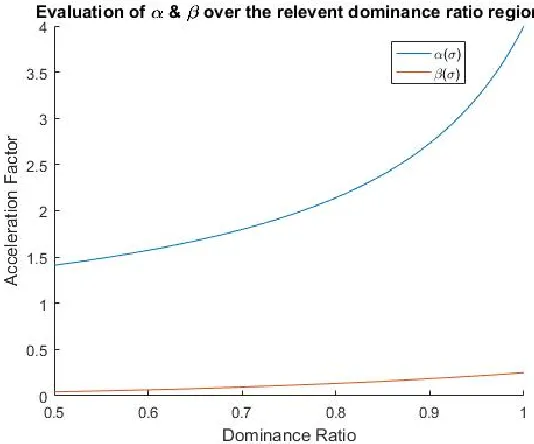
diminishing flux iterates. This is shown in the plot of 𝛼 and 𝛽 as a function of dominance ratio
in Figure 3. Since there is no point in the region where Chebychev acceleration is allowed that
provides negative acceleration factors, the method will always increase the flux. This will
eventually lead to instability in the solution if a value higher than that in the limit solution is
Figure 3: Behavior of Chebychev Acceleration Factors.
This acceleration behavior was the motivating factor behind the addition of the logic to
detect “ineffective” cycles. When the system begins to overshoot, the error climbs rapidly. As
such, when an increase in error is detected, the code stops the Chebychev iterations and uses
power iterations in an attempt to correct the divergence. While not completely effective, this
modification allowed the Chebychev routine to remain stable in several test cases where the
original algorithm [9] otherwise failed. The tradeoff in iteration count is unfortunate, but
worthwhile to increase the odds of convergence.
This instability precludes Chebychev acceleration from being used as a general
first-choice algorithm. However, it does allow it to be used to accelerate problems with known
solutions for scenarios such as benchmarks or to perform parameter studies on a problem for
which it is determined to be stable. This ability to rapidly re-run test cases is critical to
maintaining the ability to implement and debug new THOR features related to the evaluation
2.5 Future Work
It is likely that the Chebychev routines will remain unchanged for the near-term. The
currently implemented version fulfills the needs of ongoing research and performs sufficiently
well. But, as time allows, or as needs change, there are several improvements that could be
made to the algorithm. From discussions with [8], it appears that the stability and performance
of the Chebychev acceleration method can be dramatically improved through the addition of
further pre- and in-acceleration metrics. These metrics can be used to evaluate the readiness of
the problem for (further) acceleration and drive modified unaccelerated iterations to better
prepare the problem for Chebychev acceleration cycles.
Additionally, based on the discussion presented in the literature review, it would be a
significant improvement to THOR’s performance if DSA were implemented. This is a desired
3
Parallel Domain Decomposition
3.1 Introduction
At the beginning of this project, THOR was a serial code. Given the availability of
computing systems from moderate (10s to 100s of processors) to massive (105+ processors) in
the contemporary scientific computing environment, it seemed obvious that THOR could
benefit greatly from at least some degree of parallelism. As discussed in Chapter 1, the desired
features of the acceleration precluded energy and spatial domain decomposition. As such,
Angular Domain Decomposition (ADD) was pursued. Given that THOR’s typical problems
utilize angular quadratures of order S2 through S16, ADD is useful on the medium granularity parallel scale. This is ideal for its current stage of development as it keeps the code flexible
enough to run on personal workstations as well as on mid-scale HPC systems.
3.2 Literature Review
3.2.1 Energy Domain Decomposition
As described by [20], energy domain decomposition (EDD) faces two distinct
problems. The first is one of scaling and the second one of synchronicity.
Firstly, of the three parallelizable variables in a neutron transport problem, the number
of energy groups tends to be one of, if not the, smallest. This severely limits the degree of
parallelism that can be achieved. For a typical THOR problem, EDD would be limited to ~10
processors or, in the extreme case a few tens of groups. This lack of distributable work means
that the maximum speed-up from the method is inherently limited simply due to the low
number of processors which could be used.
While the first issue could be overcome if a given problem demanded many energy
groups, the issue of asynchronicity is more difficult to overlook. As discussed by [20] and
involved in the operation, the more iterations that are needed. This creates a situation in which
the per-iteration gains are penalized by losses in total iteration count.
EDD works by decomposing the loop over all energy groups, i.e., assigning each group
to different processors, just above the inner iteration level in Figure 1. This allows the
calculation for each energy group to proceed in parallel with each processor calculating an
in-scatter source and performing a one-group, all-angles sweep. Unfortunately, as the in-in-scatter
source is typically composed of both up-scatter and down-scatter components, this means that
no energy group will be operating with fully updated scattering source values. Thus, further
iterations will need to be performed to converge the in-scatter sources between the various
groups.
While this method would be possible to implement into THOR within the constraints
laid out in Chapter 1, EDD was deemed sub-optimal for implementation. Given the desire to
preserve the existing solver characteristics, a synchronous method is preferred. Additionally,
while EDD could offer a moderate speedup, concerns were raised about the limited scalability
of the method since THOR is typically used on few-group problems.
3.2.2 Spatial Domain Decomposition
Moving to the other end of the spectrum in scalability is spatial domain decomposition
(SDD). In this decomposition, the spatial mesh is decomposed and spread between several
processors. Now, rather than being responsible for a portion of the transport iteration, each
processor is responsible for an entire transport sweep/solve on a reduced domain. The solutions
from the partial domains are communicated and iterated over to produce a converged solution
for the entire domain.
A variety of SDD methods exist. However, since this topic will be revisited in Chapter
5, focus will be given to the parallel Gauss-Seidel method in [22]. In this method, the problem
domain is subdivided into a set of processor domains, where each processor domain contains
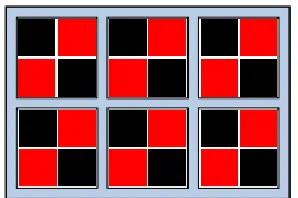
some number of red-black striped sub regions. An example of this is shown in Figure 4.
are converged by repeatedly sweeping over the red sub-domains, updating the boundary fluxes,
sweeping over the black cells, updating the boundary fluxes, and then performing a global
domain convergence check using the most current values for all cells.
Figure 4: Example PGS-SDD Domain.
Unfortunately, due to the need to propagate data between subdomains, this method is
also asynchronous. However, as the size of the spatial mesh is typically very large, thousands
to millions of cells, this decomposition provides significant opportunity for parallelization. The
results shown in [22] indicate scaling well into the tens of thousands of processors.
As mentioned, alternatives to the above PGS method exist. One class of these focuses
on parallelizing the sweep operation by identifying data dependencies between cells and then
parallelizing operations over cells with no unresolved dependencies. One of the earliest
examples of this is the Koch-Baker Alcouffe (KBA) algorithm, which identifies a number of
parallel task pipelines for a sweep and then assigns a processor to one of each of the resulting
sets of mesh cells [23]. Significant work has been conducted to further improve this style of
spatial parallelism, with research focusing on identifying optimal scheduling algorithms [24],
[25], [26]. These algorithms attempt to identify the most parallel configuration of mesh-angle
pair sweeping orders. By allowing multiple starting points and mesh-angle pairs
simultaneously, efficiency far greater than that of KBA can be achieved. Unfortunately, much
of this work is developed for Cartesian meshes, which have inherently known and
far more complicated and even include cycles. This makes the development of an optimal
scheduler for unstructured meshes a daunting task.
Much like DSA was suited for acceleration, SDD seems ideal for parallelization.
Unfortunately, there are several drawbacks that rendered it unsuitable for our purposes.
Foremost amongst these is the sheer man-hour cost of implementation. SDD has been
repeatedly demonstrated for structured meshes. However, it remains a relatively novel
approach on fully unstructured meshes. Implementation of SDD in THOR would form the
basis of a major project, likely larger in scope than the one detailed in this thesis.
3.2.3 Angular Domain Decomposition
Having eliminated EDD and SDD, the remaining variable-domain to decompose is
angle. In angular domain decomposition (ADD), the mesh sweep is decomposed such that N
mesh sweeps occur simultaneously, where N is the number of discrete ordinates in the quadrature set that correspond to explicit boundary conditions.
As [20]discusses, ADD provides a medium level of granularity. It is neither as coarse
as EDD nor as fine as SDD, but instead provides for several 10s to 100s of discrete workflows.
As shown from results in the GONT code,even an optimally implemented version of ADD is
capped at providing significant speedup in the range of 100s of processors [20]. Beyond this
point, the serial costs of the iteration begin to dominate and significantly decreasing speedups
are observed. Based on this fact, it is not reasonable to expect any implementation of ADD to
demonstrate the same scalability as SDD. However, since it is synchronous and more scalable
than EDD, it should generally perform better than that method.
ADD’s synchronicity stems from the fact that, during the sweep process, each angle of
the angular flux matrix is independent from all others. This is true only in Cartesian geometry
(no redistribution term) and when at least one boundary condition per dimension is explicit. It
is not until the generation of the spatial distribution of the angular moments of the flux that
Once all angular sweeps have been completed, the ADD algorithm can use an all-reduce operation to combine and redistribute the partial results from each ordinate [20]. This
provides a much simpler, and typically maximally compact, method for distributing the data.
Compared to SDD, where a processor only needs data from its adjacent neighbors, the
communication structure required by ADD is direct and typically requires no further logic than
that present in standard communication libraries.
Methods do exist to further optimize the communication behavior of the ADD method
[27]; however, as that work showed, the cost of communication typically is low enough that
effort is better spent improving non-communication performance. Additionally, given the
variety of HPC architectures and network interconnects that exist, it is unlikely that any
specific modification will provide a general improvement on all systems.
Regardless of these concerns, ADD provides a perfect match to the needs outlined in
Chapter 1. It provides a minimally invasive method for significant speedup on the scale of the
HPC computer available to the author. Furthermore, since the decomposition is synchronous,
it can be considered independently of the existing, verified, code. If the serial and parallel
versions return the same result, then the code is unaffected.
3.3 Implementation
Implementation of angular domain decomposition into THOR was a relatively
straightforward process, requiring none of the special handling that was seen with Chebychev
acceleration. The implementation consists of three parts: the work splitting routine, the parallel
section, and the communication phase.
Since the intended system for testing THOR is the Falcon HPC at INL, it was important
that the ADD algorithm be designed for message passing systems, not shared memory
architectures. Based on this need, the most straightforward path towards implementation was
to utilize the Open MPI [28], library. In doing so, each execution of the program now allows
components of the code. However, when a parallel section is reached, the work is divided
amongst processors as described in the next section.
3.3.1 Work Splitting Routine
In THOR, due to its use of the level-symmetric quadrature set, the number of angles in
a problem is given by
𝑁 = 𝑛(𝑛 + 2) (19)
Where the 𝑛 is the same quadrature order as given by the 𝑆𝑛 in the definition of the discrete
ordinates method. This means that in an order-𝑛 problem, there are 𝑁 parallel tasks. Again,
this is only true for 3D problems with explicit boundary conditions. To enable fair division of
this workload, the optimal number of tasks per processor is calculated at startup based on the
number of provided processors via:
𝑁𝑂𝑝𝑡𝑖𝑚𝑎𝑙 = ⌈𝑁
𝑝⌉ (20)
For executions where the number of processors, 𝑝, is a factor of the number of angles,
it is a straightforward matter to assign 𝑁𝑂𝑝𝑡𝑖𝑚𝑎𝑙 tasks to each processor. This provides an even
distribution of work and leads to the minimum amount of wasted CPU time during the parallel
portion. However, when the number of angles is not an integer multiple of the number of
processors, work must be assigned such that there is only a one task difference between the
most loaded and least loaded processor.
These needs are met by explicitly mapping a set of 𝑁𝑂𝑝𝑡𝑖𝑚𝑎𝑙 angles to each processor.
A more flexible approach to this mapping would be to simply allow each processor to pull an
ordinate from a queue as it completed its previous one. However, it was judged that this method
burdensome additional control logic. Because of this explicit mapping, a consistently slow
processor will continue to negatively impact the solve speed throughout the entire sweep rather
than allowing other processors to pick up its slack. However, since the expected use of this
capability is the 𝑁 = 𝑝 scenario, this effect is negligible.
3.3.2 Parallel Execution
The implementation of a parallel code on a message-passing architecture can be
considered as a set of 𝑝 independent programs that only interact via communication. As such,
technically, all aspects of the THOR code now exist in parallel. This means that for each of the
𝑝 instances, a full copy of all program data is available in local memory. However, the 𝑝
independent programs may have different values for their variables.
Using the index assigned to each processor and the work splitting routine defined
previously, the ADD implementation of THOR can algorithmically select the set of angles to
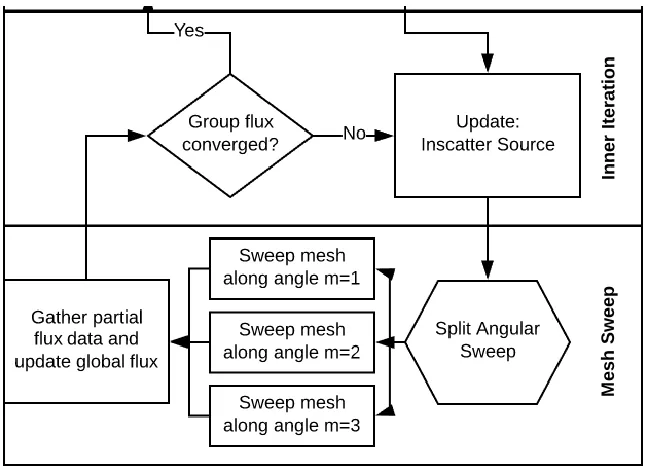
be swept by a given processor. Returning to the flow diagram given in Figure 1, the modified
ADD flow diagram is shown in Figure 5. For compactness, the outer iteration portion has been
omitted as it remains unchanged.
Given the use of a message-passing paradigm, there exist 𝑝 processes executing at all
stages of the routine, including the serial portions. However, except for the three-way split
after the “Split Angular Sweep” stage, all 𝑝 processors are performing identical calculations.
Once the code reaches the split, the work is divided amongst the available processors (a
3-processor solve is shown in Figure 5). Based on this explanation, the work in the serial section
is performed 𝑝 times, but by 𝑝 processors. This means that execution time of the serial portion
remains invariant to changes in 𝑝. Contrasting this is the parallel section, where a total of 𝑁
tasks are split amongst 𝑝 actors. This means that the expected execution time of the parallel
section should decrease as 1
𝑝. The control flow also reflects the fact that this method is
synchronous. From the point where work is assigned, to the point where flux is accumulated,
Figure 5: ADD Parallel Inner Iteration Scheme.
3.3.3 Communication
The remaining aspect of the parallel scheme is the recombination of the partial-sum of
the angular fluxes. For the discrete ordinates method implemented in THOR, only the flux
angular moments need to be retained between iterations. This allows for significant memory
savings and provides a unique benefit during ADD communication. During the angular
sweeps, rather than maintaining a large vector of angular fluxes, the data can be compacted
into the typically much smaller number of angular moments necessary to compute the
scattering source in the inner iterations. This is done on the fly by accumulating contributions
from each computed angular flux in each cell as it is calculated into the angular moments for
that cell. As such the accumulated flux angular moments for group 𝑔 in cell 𝑖 can be given as
𝜙𝑔,𝑖𝑙𝑚 =1
8∑ 𝑤𝑛𝑌𝑙𝑚
𝑒 (Ω̂
𝑛) ∗ 𝜓𝑔,𝑖(Ω̂𝑛) 𝑁
𝑛=1
![Figure 2: Example of level-of-detail based structured/unstructured mesh, from [16].](https://thumb-us.123doks.com/thumbv2/123dok_us/1505827.1184376/26.612.108.529.324.538/figure-example-level-based-structured-unstructured-mesh.webp)
![Figure 7: Strong Scaling for Angular Decomposition Problem plotting efficiency (%) versus the number of CPUs for S12 level-symmetric quadrature [4]](https://thumb-us.123doks.com/thumbv2/123dok_us/1505827.1184376/47.612.124.514.68.286/scaling-angular-decomposition-problem-plotting-efficiency-symmetric-quadrature.webp)

![Figure 20: Evaluation of processor count dependence in grind time, adapted from [33]](https://thumb-us.123doks.com/thumbv2/123dok_us/1505827.1184376/73.612.179.437.433.644/figure-evaluation-processor-count-dependence-grind-time-adapted.webp)

