University of Windsor University of Windsor
Scholarship at UWindsor
Scholarship at UWindsor
Electronic Theses and Dissertations Theses, Dissertations, and Major Papers
1-1-2006
Efficient test sequence generation for Web applications with
Efficient test sequence generation for Web applications with
frames.
frames.
Xiao Wang
University of Windsor
Follow this and additional works at: https://scholar.uwindsor.ca/etd
Recommended Citation Recommended Citation
Wang, Xiao, "Efficient test sequence generation for Web applications with frames." (2006). Electronic Theses and Dissertations. 7145.
https://scholar.uwindsor.ca/etd/7145
NOTE TO USERS
This reproduction is the best copy available.
®
E fficien t test seq u en ce g en eration fo r w eb a p p lication s
w ith fram es
by
Xiao Wang
A Thesis
Submitted to the Faculty o f Graduate Studies and Research through the School o f Computer Science
in Partial Fulfillment o f the Requirements for the Degree o f Master o f at the
University o f Windsor
Windsor, Ontario, Canada
2006
1 * 1
Archives Canada
Library and
Published Heritage
Branch
39 5 Wellington S tre e t O tta w a ON K 1 A 0 N 4 C a n a d a
Bibliotheque et
Archives Canada
Direction du
Patrimoine de I'edition
395, ru e Wellington O tta w a ON K 1 A 0 N 4 C a n a d a
Your file Votre reference ISBN: 978-0-494-42336-3 Our file Notre reference ISBN: 978-0-494-42336-3
NOTICE:
The author has granted a non
exclusive license allowing Library
and Archives Canada to reproduce,
publish, archive, preserve, conserve,
communicate to the public by
telecommunication or on the Internet,
loan, distribute and sell theses
worldwide, for commercial or non
commercial purposes, in microform,
paper, electronic and/or any other
formats.
AVIS:
L'auteur a accorde une licence non exclusive
permettant a la Bibliotheque et Archives
Canada de reproduire, publier, archiver,
sauvegarder, conserver, transmettre au public
par telecommunication ou par Nntemet, preter,
distribuer et vendre des theses partout dans
le monde, a des fins commerciales ou autres,
sur support microforme, papier, electronique
et/ou autres formats.
The author retains copyright
ownership and moral rights in
this thesis. Neither the thesis
nor substantial extracts from it
may be printed or otherwise
reproduced without the author's
permission.
L'auteur conserve la propriete du droit d'auteur
et des droits moraux qui protege cette these.
Ni la these ni des extraits substantiels de
celle-ci ne doivent etre imprimes ou autrement
reproduits sans son autorisation.
In compliance with the Canadian
Privacy Act some supporting
forms may have been removed
from this thesis.
While these forms may be included
in the document page count,
their removal does not represent
any loss of content from the
thesis.
Conformement a la loi canadienne
sur la protection de la vie privee,
quelques formulaires secondaires
ont ete enleves de cette these.
ABSTRACT
Finite state machine based conformance testing techniques have been widely used in
various hardware and software systems. Such techniques can be applied to web
applications to check if the implementation demonstrates the desired navigational
behavior. We explain here how to specify the desired navigational behavior o f a web
application in terms o f extended finite state machine, and under which situations can such
a specification be directly given as a finite state machine. Our emphasis is on the
specification o f web frames which allows the web browser to display more than one
frame pages o f the same application at the same time. Based on this formalization, we
present a solution to generate test sequences from a given finite state machine using the
well-known transition coverage criterion, taking into account the reduction o f testing
equivalent transitions, i.e. transitions describing the navigations triggered by the same
input event from the same frame page. Empirical study has been conducted to
demonstrate the efficiency o f the proposed method in terms o f the lengths o f the
generated test sequences compared to the one without considering the reduction on
testing equivalent transitions.
Keyword: Hyperlink, Web Navigation, Web Frame, Conformance Testing,
ACKNOWLEDGEMENTS
First o f all, I would like to thank my supervisor, Dr. Jessica Chen, for her invaluable
guidance and advices, for her enthusiastic encouragement and her great patience to me.
Without her help, the work presented here would not have been possible.
Next, I would like to thank my committee members, Dr Hu, Dr. Ezeife, and Dr. Lu, for
spending their precious time to read this thesis and putting on their comments,
suggestions on the thesis work.
My special thanks go to Miss. Lihua Duan for their ardent help.
Finally, I would like to give many thanks to family, my wife Guan Jing, my mother
Guangqi Liu, my father Yongju Wang, my younger brother Yan Wang and younger sister
TABLE OF CONTENTS
ABSTRACT...iii
ACKNOWLEDGEMENTS...iv
TABLE OF CONTENTS... v
LIST OF TABLES...vii
LIST OF FIGURES...viii
I. INTRODUCTION AND PROBLEM DESCRIPTION...1
II. BACKGROUND... 12
2.1 WEB APPLICATIONS... 12
2.1.1 U RL... 12
2.1.2 SERVER PAGE, STATIC PAGE AND CLIENT PA G E ...13
2.1.3 SESSION AND COOKIE...14
2.1.4 HYPERLINK AND DYNAMIC HYPERLIN...14
2.1.5 WEB FRA M E...15
2.1.6 THE PROPERTIES OF A CLIENT PAGE... 16
2.1.7 ARCHITECUTRE OF WEB APPLICATIONS...17
2.2 MODELING FORM ALISM S...18
2.2.1 FINITE STATE MACHINE (FSM )... 18
2.2.2 EXTENDED FINITE STATE MACHINE (EFSM )... 19
2.3 CONFORMANCE TESTIN G ... 21
III. RELATED W O R K S... 23
IV. MODELING WEB APPLICATIONS WITH EFSM ... 28
4.2 ADDING FRA M ES... 36
V. OUR TESTING M ETH O D ...41
VI. IMPLEMENTATION... 42
6.1 THE IMPLEMENTION OF THE CPP ALGORITHM ... 42
6.2 IMPLEMENTATION OF THE ALGORTHM OF R P P ...45
6.2.1 HEURISTIC ALGORITHM FOR R P P ... 46
6.2.2 A H O ’S ALGORITHM FOR R PP ... 49
6. 3 THE IMPLEMENTATION OF A GPP A LG O RITH M ... 51
VII. EXPERIMENTS AND EVALUATION...53
7.1 LENGTH OF TEST SEQUENCE...53
7.1.1 NUMBER OF V ER TICES... 54
7.1.2 NUMBER OF E D G E S ... 55
7.1.3 NUMBER OF SU BSETS... 57
7.2 TIME TO GENERATE TEST SEQUENCE...58
VIII. CONCUSION AND FUTURE W O R K ...59
8.1 CONCLUSION... 59
8.2 FUTURE W ORK ...59
REFERENCE...61
APPENDIX A ...64
LIST OF TABLES
TA BLE4.1.1 THE DETAILED INFORMATION OF T ... 3 2
Ta b l e7 . 1 ...5 5
Ta b l e7 . 2 ...5 6
LIST OF FIGURES
Fi g u r e 1.1 s o m e w e b p a g e s o ft h e w e b s i t e 1 ... 8
Fi g u r e1.2 p a r t o ft h e c o r r e s p o n d i n gF S M ...9
F i g u r e 2 . 1 S a m p l e c o d e f o r w e b f r a m e ...1 6
F i g u r e 2 . 2 a n e x a m p l e o f a c l i e n t p a g e ... 1 7
F i g u r e 2 . 3 t h e s t r u c t u r e o f w e a p p l i c a t i o n ... 18
FIGURE2. 4 A SAMPLE OF FSM ... 19
FIGURE4.1 AN EXAMPLE OF E F S M OF THE WEB APPLICATION...3 1
F i g u r e 4 . 2 a n e x a m p l e o f t i m e t a b l e s e a r c h ... 3 5
Figure4.3 t h e EFSM o f t h e w e b a p p l i c a t i o n ...35
F i g u r e 4 . 4 a n e x a m p l e o f m o d e l i n g t h e w e b s i t e o f c o u r s e 2 8 0 ... 3 9
FIGURE6.1 AN EXAMPLE OF THE C PP...45
F i g u r e 6 . 2 a h e u r i s t i c a l g o r i t h m t o s o l v e t h e RPP...4 9
Fi g u r e6 .3 Ex a m p l e o f Ah o’sa l g o r i t h m... 5 1
CHAPTER I
INTRODUCTION AND PROBLEM DESCRIPTION
In recent years, information on the Internet has grown extraordinarily fast around the
world. Web systems have become the primary device for information sharing and
retrieval. Web technologies have been applied to all major areas. The contents o f web
applications is increasing rapidly, which means there are much more pages and
hyperlinks in a web application than before. The quality and reliability o f the web
applications become more and more important. It is necessary to find a suitable way to
check the correctness o f web applications.
A web system can be as simple as a web site that consists o f a set o f static pages like a
personal homepage. It can also be a complicated commercial web application like an
online-store system that can handle various kinds o f transaction requests from different
clients (computers) everywhere in the world. In such a web application, web pages must
be generated dynamically. The diversity and the intensive use o f the web systems are
supported by the advance o f the emerging technologies, such as cookies/sessions,
dynamic web pages, and web frames.
A cookie is a piece o f small text that record identification and some related information
o f a certain client and is stored in the web browser. Once the cookie is created on the
client’s side, for every further request made by the same user, the cookie will be sent
along with the request message until its expiration. Based on cookie technique, a web
application can overcome the shortcoming o f HTTP protocol to recognize a certain client
by establishing a session between the web browser and the web server and thus make the
2
Dynamic web pages are generated dynamically by web servers based on the requested
messages. A dynamic web page is the combination o f a predefined page template and
dynamic contents that are obtained after a web server receives a specific web page
request. The server customizes the page content based on the client attributes and thus
dynamic web pages facilitate users to interact with web servers. A web page can be
generated from two different kinds o f template pages: static page and server page, both
located in the web server. A server page can produce a dynamic web page while static
web page cannot because both its template and its contents are predefined. I f a hyperlink
could be dynamically displayed on the web pages generated by the same server page, we
call such a hyperlink dynamic hyperlink. Here we are only interested in the texts and
hyperlinks o f the client pages. For a client page p generated by a static or server page, we
use O(p) to denote that the observable characteristics in p that we are interested in.
O(p) is represented as a pair < T , H > o f a set T o f text symbols and a set H o f
hyperlink symbols in p .
Web frame is the technology that divides a web page into two or more different frames. A
web frame is a rectangular area in a static HTML page where navigation can take place
independently. Moreover, the different web frames into which a page is decomposed can
interact with each other, in the sense that a hyperlink in a page loaded into a frame can
force the loading o f another page into a different frame. Web frame subdivision can be
recursive. Each web frame has a default page. We call a page that contains web frames a
fram e page. A frame page is a list o f static or server pages and its characteristic is based
on all pages. For example, a client page p o f a frame page is a list o f pairs <Ti,H i >
where i e [1, A] and k is the number o f pages in the frame page.
We can model the specification a web application in terms o f Extend Finite State
3
is a six-tuple: EFSM = (S , s 0, I , O , T , V ) , where s0 is the initial state and S , I , O, V
and T are finite set o f states, input symbols, output symbols, (state) variables, transitions
respectively. Each transition t in the set T is a six-tuple: t = (st, et, it, ot, Pt , A t)
where st, et, i, and ot are the start (current) state, end (next) state, input symbols, and
—^
output symbols, respectively. Pt (v) is a predicate on the current variable values and
At(v) gives an action on variable values. When there is no state variable in the EFSM
and no transition o f the EFSM includes a predicate or post action, the EFSM is simplified
as a Finite State Machine (FSM) [8].
Now, we show how to model web applications in EFSM. We assume that the
forward/backward buttons o f the browsers are disabled and the user cannot type in a URL
in the address bar o f the browsers but can reset to homepage from any page using the
“home” button o f the browsers. When a web application under test (WAUT) has web
frames, we can use a state, transition, input symbol, output symbol and state variables to
represent a list o f server or static pages, a page navigation from one page to another page,
the user’s action on clicking the hyperlink symbol with some inputs that satisfy certain
conditions, a list o f pairs <Tj, H j > where i e [1,&] and k is the number o f the pages in
the page list o f the corresponding state, and variables in a web application respectively.
Note that a state may represent either a frame page, where its list o f pages contains all
pages that are loaded into it, or a static or server page where its list o f pages only contains
this page itself. If there is no cookie/session in the WAUT, we can reduce the EFSM
model to an FSM model.
The EFSM model o f WAUT can be used for conformance testing with certain test
purposes. Conformance testing is to check if a given implementation that can be viewed
4
check i f all navigations conform to the specification o f WAUT. Here we only discuss the
testing about the web application without cookies/sessions that can be modeled as an
FSM. For convenience, we call WAUT as implementation FSM and the FSM derived
from the specification o f WAUT as specification FSM.
A test sequence is generated from the specification FSM. In general, we apply test
sequence that satisfies a certain test criterion to the implementation to check its
correctness by comparing the actual output sequence with the expected one. Based on the
test purpose, a test criterion can be used to generate a test sequence to check for examples,
the correctness o f the output, the start or the end states o f each transition o f the
implementation FSM triggered by a specific input. In the following, we adopt the well-
known transition coverage criterion, i.e., to test each transition at least once. Very often,
we apply results in graph theory to the specification FSM to generate a test sequence
because an FSM can be viewed as a directed graph G = (V,E) where V is a finite set o f
vertices and E is a finite set o f edges. Each vertex stands for a state o f the FSM and an
edge represents a transition. Given a directed graph representing a specification FSM, we
can use an algorithm to resolve the Chinese Postman Problem (CPP) [7] to generate a test
sequence. The CPP is to find a least-cost walk to travel all edges in a directed graph.
Although a test sequence generated by the CPP satisfying the transition coverage
criterion can accomplish our test purpose, such a test sequence could cause
redundant-testing phenomenon when WAUT has web frame pages. A static or server page may be
contained in two or more web frame pages and represented by different states. Thus,
navigation from this page may be represented by two or more different transitions in the
corresponding FSM. For such transitions representing a same navigation, we assume that
5
sequence based on the CPP requires that we check all o f such transitions and therefore
introduces redundancy into the constructed test sequence.
Here we use the website o f Albany public library as an example to show redundancy-
testing phenomenon. This website is used to provide some on-line library services. In the
website, each frame page contains two frames: the right frame and the left one. Figure 1.1
shows some frame pages o f this web site and Figure 1.2 gives an FSM for it. Figure 1.1(a)
is the home page o f the website and we call it Frame page 1. The left frame o f Frame
page 1 shows a static page Px that provides some hyperlinks o f main functions. Its right
frame shows a static page P2 which gives a simple introduction about the website. Z, and
L2 in Frame page 1 are the hyperlinks to the frame pages for basic services and young
people respectively. Figure 1.1(b) is Frame page 2 for basic services. The left frame o f
Frame page 2 shows a static page P3 that provides some hyperlinks to frame pages for
related functions where Z3 in particular is the hyperlink to load static page P7 for
catalogue searching in the right frame. The right frame o f Frame page 2 shows a static
page P4 which gives an introduction together with some hyperlinks about basic services.
Figure 1.1(c) is Frame page 3 that also has two frames. The right one displays the static
page P5 that shows some hyperlinks to frame pages for related functions and Z4 is the
hyperlink to load the web page P7 for catalogue searching in the right. The left frame o f
Frame page 3 shows a static page P6 that gives some interesting contents and hyperlinks
for young people. After clicking the hyperlink Z3, Frame page 4 is shown in Figure 1.1
(d). The left frame o f Frame page 4 shows static page P3 and the right frame o f Frame
page 4 displays static page P7 which provides some different ways to make catalogue
searching by author’s name and the name o f the article, etc. Frame page 5 is generated as
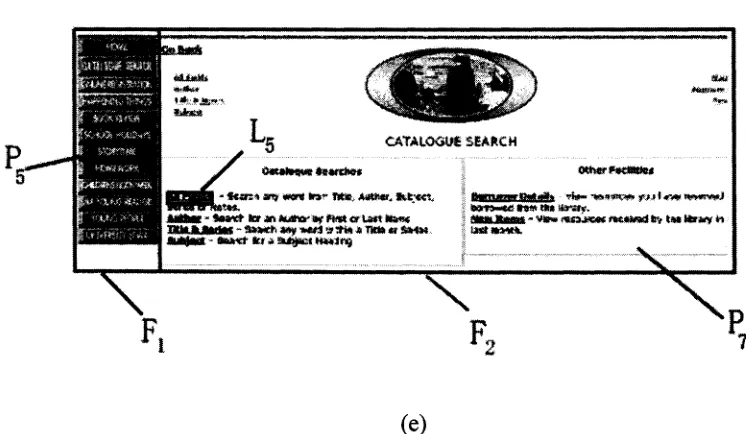
shown in Figure 1.1(e) after clicking the hyperlink o f Z4. The right frame shows the
6
Frame page 4 and 5 is to load a server page in the right frame to provide searching
function by typing key words and turns Frame page 4, 5 into Frame page 6 and 7
respectively.
A
*
O M i t * s»a»eh #u> cvmrm bun'wu* kuttwm&U bOGtii.
ALBANY P U N I C U B ftA R Y A N D W l'O ftM A T T O tl S K W I C8
*Oyr lit* jry h a fr-vndy, pfegce. prtsvlrinq m utlabk ae^es-s to » wmattii o f infl'rWio* oral
*h>eh tnrienM t t » I i m s f p n p t* m ear eotmmty,"
P
(a)
7
rovm m>? if
<♦«*»« fm C$&dm»
CATMPm^ $$mcH
PSTTSSSTI- «m^bH <r<* «r»g few- “4 m, A«fca% W 1 b q ; .
iftrtfrlW f*«**rl» %■* «r*A<lfr»**^r<n*» rlw*
!B&LJUk&Js* - iwsr* in* TTaiii Ti ll m . tfc. fc I t f i m * mr>, — «. * Ts* «r a*«*
&*>«*«? ttetaft - vis** *c* tr** f,
fe»*c*«a ftai ini
aaaoJMMK *««» tm*v*4 »/ tlmt
fc*» 'mkt*.
8
CATALOGUE SEARCH
(e)
Figure 1.1 some web pages o f the website 1
Frame page 1, 2, 3, 4, 5, 6 and 7 are represented by states 50, s3, s2, s3, 54, s 5, and s6
respectively. The transitions tx, t2, t3, r4, t5, and t6 represent six different navigations
in the web site triggered by clicking on hyperlinks Z ,, L2, L3, L4, L5 and Z5 in states so,
9
Figure 1.2 part o f the corresponding FSM
With the corresponding FSM, if we use the algorithm o f CPP to generate a test sequence
to test each transition at least once, transitions t5 and t6 should both be tested. But
actually it is sufficient to test only one o f them because they represent the navigations
caused by the same hyperlink in the same client page.
The above example is illustrative. There may exist many server pages or static pages in
many different frame pages and a test sequence based on the algorithm o f CPP may cause
serious redundancy in testing.
Note that the redundant-testing phenomenon is caused by web frames. From the
viewpoint o f specification-based testing, we need to obtain a “good” model that can
represent the characteristic o f web frames effectively. Second, we need a “good” testing
10
There are two main steps in our work. The first step is to model a web application in
terms o f FSM; The second step is to generate a test sequence with reduced length based
on the FSM model.
In the first step, under certain assumptions, we give general discussions on the EFSM
formalization o f generic web applications with most o f the characteristics such as sever
or static pages, hyperlinks, cookies/sessions, client pages etc. Then we focus on modeling
web applications with web frames that has no cookie/session and dynamic hyperlinks in
terms o f FSM.
In the second step, we show how to search for optimal solution to generate an efficient
test sequence from a given FSM, avoiding the redundant-testing. We show how to use
GPP [4] solution to reach this. The GPP is to find a closed walk in a directed graph G
with minimum weight which traverses at least one edge o f each subset o f the edges from
a given set o f subsets o f edges. We put all transitions in the specification FSM that
represent a same navigation in the web application into a same subset o f transitions and
then make use o f the algorithm o f GPP to generate an efficient test sequence that can
avoid the redundant-testing phenomenon.
To evaluate the proposed method, we compare our testing method with the one based on
the algorithm o f CPP. To carry out this comparison, a java program has been developed to
11
The rest o f this thesis is organized as follows: Section 2 gives a brief introduction to web
applications including web servers, dynamic hyperlinks. Section 3 introduces some
related works on modeling web applications and testing methods. Section 4 presents our
EFSM and FSM models for web applications. Section 5 presents our test method. Section
6 introduces main algorithms for CPP, RPP and GPP. Section 7 analyzes and evaluates
the result o f experiments based on two test methods. Section 8 gives the conclusion and
CHAPTER II
BACKGROUND
In this section, we introduce some related concepts on web applications, such as the
architecture o f web applications, URLs, web frames, web servers and dynamic hyperlinks.
This is followed by a brief introduction to EFSM and conformance testing.
2.1 WEB APPLICATIONS
2.1.1 URL
URL stands for Universal Resource Locator. It is used to locate any resources in the
Internet. URL typically consists o f a URL scheme, an authority, and a path. An URL
scheme indicates a category o f resources, such as http, https, and ftp. The authority
typically consists o f the name or IP address o f a server and the port number. A path is to
show the relative path o f the resource inside the host server in the Internet. The format of
an HTTP URL is often parameterized as: http://<host>: <port>/<path>? <request
parameters>. Here “http://” indicates the resource type is http, and the communication
protocol used to send this request is HTTP. <host> is the web server’s IP address. It
identifies a unique web server in the Internet address. <port> is the port number that the
web server uses for HTTP communication. <path> specifies the relative storage position
o f the request resource. <request parameters> consists o f request parameters a client
passes to the web server. They may come from the input o f the client and/or the
cookies/sessions. These parameters could be used to compute and generate a client page.
For example,
http://www.baidu.com/search?ie=gb2312
shows the basic elements o f a URL. “http://” indicates the resource type is HTTP.
“www.baidu.com” is the domain name and its corresponding IP address can be resolved
13
80 by default, “search” is a relative directory and “ie=gb2312” is the assignment o f a
request parameter.
2.1.2 SERVER PAGE, STATIC PAGE AND CLIENT PAGE
When a web server receives a request message that contains a URL and cookie
information(if provided) from a browser, which can be triggered by clicking on a
hyperlink or typing a URL in the address bar o f browser, it sends back a corresponding
HTML web page according to the request. We call such corresponding HTML web page
a client page. A client page is an HTML document with embedded scripts and is rendered
by the web browser on the client side. A client page can be generated from two different
template pages: static page and server page. Static pages are predefined page templates
that are stored in a local directory o f the web server. The web server can access these
static pages with their file name and file path. For a static page request, the web server
reads that HTML file, packs the file into the response message and sends the message
back to the requested web browser as a client page. A server page can be a Common
Gateway Interface (CGI) script, an Active Server Page (ASP), a Java Server Page (JSP),
or a servlet. If a server page is requested, the web server dynamically creates a client page
according to the information o f the request message. After a client page has been
generated, it is packed in a response message like a client page in the form o f a static
page and sent back to the requesting web browser.
Here we use the term “page” to stand for both o f static and server page. Each web page
has a page ID, to be uniquely identified in the web application. In practice, a web page is
identified by its URL including web server address, and relative directory. For simplicity,
14
2.1.3 SESSION AND COOKIE
Since HTTP is a stateless protocol, an HTTP server cannot recognize two different
requests from the same client. After a response has been sent to a requested browser that
issued the request, the connection is closed. The web server does not keep any
information about the client. There are many cases that some sort o f relationship is
required between two requests made by the same client. In order to resolve the problem,
the concepts o f session and cookie are introduced into web technology.
A session is the time duration used to uninterruptedly browse client pages spent by a
certain user at a web site (application) from starting to browse the first client page to
closing the web browser. In some web applications, a session is setup after the login o f a
client and closed when the client logouts. The concept o f session puts a strong emphasis
on tracking the user’s history.
A cookie is a piece o f small text that record identification and some related information
o f a certain client and is stored in the web browser. Once a cookie is created on the
client’s side, for every further request made by the same user, it is sent along with the
request message until the expiration o f the cookie. Based on cookie technique, a web
application can overcome the shortcoming o f HTTP protocol by recognizing a certain
client and establishing the session between a web browser and a web server.
2.1.4 HYPERLINK AND DYNAMIC HYPERLINK
All pages o f a web application are interconnected by hyperlinks. These hyper- links form
the navigation o f behavior o f the web application. A hyperlink identifies a unique page
15
address, relative directory that stores the page, and the file name. Here we give each
hyperlink in a certain static or server page a unique linkID which is used to identify the
link within the same page.
According to the different information o f cookies/sessions, database or request
parameters, a hyperlink could be dynamically shown on a client page which is generated
from the same server page. Such a hyperlink is called a dynamic hyperlink. For example,
in the online student information system o f University o f Windsor (SIS), after a current
student logged into the SIS, the student can see a hyperlink to view his/her transcript but
it is impossible for a prospective student to see such a hyperlink after login.
2.1.5 WEB FRAME
A web frame (simply called frame below) is a rectangular area in a static HTML page
where navigation can take place independently. Moreover, the different frames a page is
decomposed into can interact with each other, since a link in a page loaded into a frame
can force the loading o f another page into a different frame. Frame subdivision can be
recursive. Each frame has a default page within the page that contains this frame initially
loaded by the user.
<t i t le>horaepage</li t le>
Cframeset cols=50%, 50%>
<frame src = "A. html* NAME^HD
<frame src = "B. html NAME="HELLO")
< /fraieset>
16
<title>A</title>
<a h r e f ^ C . html*' target= "H E L L O "> L inkl< /a>
(b)
Figure2.1 Sample code for web frame
The two pieces o f code above show an example o f a web frame. The code in (a)
illustrates that a page entitled “homepage” has two frames. One is “Hi”; the other is
“HELLO”. A frameset is defined in a page with the frame tag “frameset” and “/frameset”.
When the homepage is initially loaded by the browser, two pages in A.html and B.html
are individually loaded into frames Hi and HELLO, respectively. The code in (b)
illustrates that when A.html is loaded into the frame o f the homepage, the user’s click on
the hyperlink named Linkl can force the frame HELLO to load C.html. This activity will
not change the URL o f the page.
2.1.6 THE PROPERTIES OF A CLIENT PAGE
On abstract level, a client page can be viewed as a list o f pairs < Tt, H t > and i e [1, k] o f a
set Tt o f text symbols and a set H t o f hyperlink symbols where k is the number o f the
server or static pages that generate the client page. If the client page is generated by a
single server or a static page, k = 1; otherwise, the client page is generated by a frame
page and k > 1. A text symbol represents the information o f some text. A hyperlink
symbol represents the existence o f a hyperlink: it means the user’s clicking on the
hyperlink symbol on a client page can trigger a request message to the server
Note that although the formats o f a hyperlink symbol and o f a hyperlink are the same, a
hyperlink symbol is however different from a hyperlink used to retrieve a client page. A
17
come from cookie or input variables. A hyperlink symbol is a hypertext displayed in a
web page. It does not contain the input from the client to this page. It may contain
however cookie information on this page.
Figure 2.2 shows an example o f a client page that is generated by a single server page. It
is the homepage o f the student web mail system o f University o f Windsor. In this client
page, the black lines point out all the text and hyperlink symbols: the pair < T , H > . The
hyperlink symbol “Sign in” cannot contain any input o f the clients because the input o f
current page has not yet been given.
FAQ
n*m*m
F»«g*r Yew P m w in l ?
CfciWH Year P;mw««d HWteAeceaM
U to « )r
Untftawf lirtiH iM iiifcjia
Hyperlink syb#ol
Figure2.2 an example o f a client page
2.1.7 ARCHITECTURE OF WEB APPLICATIONS
Figure 2.3 illustrates a generic architecture o f web applications. A web application is an
18
database. It is a typical 3-tier model. While realizing more complicated functions, the
modem web applications have expanded from a 3-tier model to an N-tier one.
Web
Browser
HTTP R equest.
►
<
---HTTP Request
Server
HTTP
database
Figure2.3 the structure o f we application
A web browser is a standard window application and the users use it to visit the web
application by clicking hyperlinks or typing in URLs. After sending out a request
message for a client page, the browsers will receive a response message from the web
application server, the message contains the requested client page.
2.2 MODELING FORMALISMS
2.2.1 FINITE STATE MACHINE (FSM)
A finite state machine [8] can be represented as a 5-tuple M = (I , 0 , S , 8 , k) , where I , O
and S are finite and nonempty sets o f input symbols, output symbols and states
respectively.
8 : S x I -> S is the state transition function and
19
When the machine is in current state s and receives an input a from I , it moves into the
next state specified b yS(s, a) and produces an output given by X(s, a).
Figure 2.4 shows an example o f an FSM where I = {a,b}, O - {0,1}, S = {s0,s x,s2} ,
S (s0,a) = sl ,S ( s l ,b) = s 2, X(s0,a) = l and X(st, b) = 0 . The initial state o f the FSM is s0 .
b/0
a /1
Figure2.4 a sample o f FSM
2.2.2 EXTENDED FINITE STATE MACHINE (EFSM)
Finite state machines are widely used as modeling formalism for many applications such
as sequential circuits and control portions o f communication protocols. However, in
practice the systems which we are interested in usually include variables and operations
based on variable values; ordinary finite state machines are not powerful enough to
model them in a succinct way. Extended finite state machines, which are finite state
machines extended with variables, have emerged from the design and analysis o f this
kind o f systems.
In the following we denote a finite set o f variables by a vector: v = ( v , , ..., v t ). A
—► —¥
20
valid if P ( v ) = True. An action is an assignment: v := A ( v ) where A is a function o f
-> V .
An extended finite state machine (EFSM) is a six-tuple:
EF SM = (S, s0,1 ,0 , T, V)
where s0 is the initial state and S , I , O , V and T are finite sets o f states, input
symbols, output symbols, variables, and transitions respectively. Each transition t in the
set T is a six-tuple
t = {s„ e„ it , ot , Pt , A,)
where st, et , it and ot are the start (current) state, end (next) state, input, and output,
—¥ *4
respectively. Pt (v) is a predicate on the current variable value and At (v) gives an action
on variable values.
Initially, the machine is in its initial state s0 s S with initial variable values: v .
—>
Suppose that the current state is s and the current variable values are v . Upon input / , the
machine follows a transition t = (s, e, i, o, P , A,) if v is valid for P : P ( v ) = True.
In this case, the machine outputs o , changes the current variable values by
action v := A ( v ) , and moves to state e.
For each state s e S , let all the transitions with start state 5 and input j e l be:
21
machine (EFSM), the sets o f valid variable values o f these r predicates are mutually
disjoint, i.e., VPt n Vp = 0 , 1 < k , , j < r , k ± j . Otherwise, the machine is
nondeterministic. In a deterministic EFSM there is at most one possible transition to
follow from a given state with given input. In the present work, we consider only
deterministic EFSM.
2.3 CONFORMANCE TESTING
Given a specification and an implementation which can be regarded as a “black box”, we
need to check if the implementation conforms to the specification. This is called the
conformance testing. The specification o f a web application can be modeled as an FSM.
To conduct a conformance testing, a test sequence can be generated based on the FSM.
The test sequence can be applied on the web application to check whether the output is
consistent with the specification o f the web application.
In an FSM, two states s t and Sj are equivalent if and only if for any input sequence the
finite state machine will produce the same output sequence. For two states in different
machines with the same input and output sets, equivalence is defined similarly. Two
machines M and M ' are equivalent if and only if for every state in M there is a
corresponding equivalent state in M ' and vice versa. Given an FSM, there may exist two
or more states equivalent. A machine is minimal if and only if no two states are
equivalent. All FSMs we refer to here are minimal. During the procedure o f test, the
WAUT itself can be considered as an FSM. Our conformance testing is to check whether
the two FSMs (the specification and implementation FSMs) are equivalent.
Generally speaking, each FSM can be considered as a directed graph. A state in FSM can
22
graph has a path from each node to every other node, it is strongly connected. We say an .
FSM is strongly connected if its corresponding directed graph is strongly connected. For
conformance testing, we assume that a) the specification FSM A is strongly connected
and minimal; b) the implementation FSM B has the same input and output alphabets as
A . If machine A is not strongly connected, there may exist some states that cannot be
reached during the test, thus we will not be able to tell with certainty if machine B is
correct.
Given a specification FSM, an essential task to conduct conformance testing is to
generate an effective test from this FSM. The effectiveness o f a test sequence is judged
by the criterion used to generate the test sequence. Here we adopt the well-used transition
coverage criterion which requires that the test sequence o f the FSM covers each transition
at least once. According to the literature [1], the problem o f constructing a minimal-
length test sequence satisfying this criterion is resolved by solving CPP in the underlying
CHAPTER III
RELATED WORKS
Our work is divided into three steps. The first step is to model the specification o f a
WAUT in terms o f EFSM; The second step is to generate a test sequence with reduced
length based on the given model; The third step is to provide empirical study to evaluate
the performance o f our testing method. There are several approaches to modeling the
specifications o f web applications for the purpose o f testing providing the corresponding
testing methods. We show the related modeling work and their corresponding testing
methods and present their key ideas here.
In [17], it has been presented a testing method and testing tools based on the analysis o f
the structure o f a web application. In the first part, the authors consider that the central
entity in a web application is the web page. Based on this concept, they defined most o f
the related properties and associations o f the entities by UML, and an UML-based model
is built which can be exploited for analysis and testing. Two tools, Re Web and Retest,
have been developed to support the analysis and testing o f the web applications. Re Web
downloads and analyzes the pages o f a web application with the purpose o f building a
UML model o f it. TestWeb generates and executes a set o f test cases for a web
application whose model was computed by Re Web. A test case generation engine inside
TestWeb is used to generate test cases, and the generation is based on a reduced graph by
removing static web pages without forms in a navigation paths.
In [11], the authors presented a methodology to support web application testing based on
the Web Test Model, called WTM, which can capture both structural and behavioral test
objects o f the web applications created by forward and reverse engineering tools. The
testing work is divided into three parts according to: object perspective, behavior
perspective, entities o f a web application are described using ORD (Object Relation
Diagram) in terms o f objects and dependent relationships. From the behavior perspective,
the authors used PND (page navigation diagram) to depict the navigation behavior o f a
web application and PND can be derived from ORD. At the same time, a set o f OSDs
(Object State Diagram) is used to represent the state-dependent behavior o f interacting
objects. From the structure perspective, the authors use the BBD (Block Branch Diagram)
and FCD (Function Cluster Diagram) to capture the control and data flow information o f
the scripts and functions in a web application. In the behavior testing, a navigation tree
from the home page is constructed to generate test cases.
In [15], the authors proposed an approach to integrating existing testing techniques with a
state-based testing which is to discover inconsistencies introduced by interactions with
web browser buttons. The authors call the approach as base-line testing strategy. The
authors considered the influence o f the web browser on the navigations among web pages.
A user can force the browser to display and reload the previously visited page or refresh
the current web page by clicking on the related buttons, such as back, forward and fresh
buttons. In order to test a web application with the browsers, a state chart o f back and
forward and refresh buttons is constructed with four states, BDFD(Back Disable,
Forward Disable), BEFD(Back Enable, Forward Disable), BEFE(Back Enable, Forward
Enable), BDFE(Back Disable, Forward Enable). After flattening each baseline test case
w ith the state chart, the testing model is generated as a transition tree. The root o f the tree
is the home page o f the web application, and each path o f the tree is tested separately.
In [14], the authors exploited an object-oriented test model o f a web application in terms
o f UML class diagrams. The test model includes each component o f the web application
relevant for testing purposes together with the relationship among them. The paper
proposed a definition o f the unit level for testing web applications. Based the model, the
authors separately discussed both unit level testing and integration testing. For unit
Test case is selected in order to assure that the decision table variants are assumed both
true or false. For integration testing, test case can be derived by use case diagram. For
each use case o f a web application, web pages collaborating to its implementation are
taken into account and functional test cases are generated and executed for each o f them.
In [13], the authors extended the data flow testing techniques to web applications and
used web application test model (WATM) to capture the test object o f web applications.
The key o f this paper is to test the dataflow o f HTML and XML document in web
applications so that the elements o f an HTML or XML document are considered as
structured variables within an object o f WATM. In the WATM, test cases o f the data flow
are derived from three different perspectives: intra-object, inter-object and inter-client.
From the intra-object perspective, test paths are selected for the variables that have def
use chains within an object. A test case can be obtained from the dataflow graph o f
related functions in an object. From the inter-object perspective, test path should traverse
across objects. It means that a test case can be derived from the data interactions across
objects in WATM. From the inter-client perspective, an object often contains variables
that are shared by multiple clients so that test cases should be derived from the data graph
which depicts the data interactions among the clients.
In [1], the authors describe a technique for generating an optimal (minimal in time) test
sequence for an implementation o f a protocol. A protocol can be specified as a
deterministic finite state machine, where the state o f the protocol is defined as a stable
condition in which the protocol rests until an input is applied and to undergo a transition
from the current state to a new state, where it stays until the next input. The purpose o f
this paper is to present a method to test whether there is a discrepancy between the
specification and implementation o f an FSM. In this paper, the technique is based on an
optimization technique that has been developed to solve a class o f problem, such as the
CPP (Chinese Postman Problem) on directed graphs. The algorithm described in this
FSM. Furthermore, a concept called a Unique Input/Output Sequence is used in place o f
an more cumbersome distinguishing sequence, so that both the controllability and
observability problems o f the protocol testing problem are resolved simultaneously.
In [3] and [19], although the authors don’t mention modeling work for web applications,
they offer algorithms that are accessible to implement and produce reduced testing
sequences based on most o f models. Especially in [3], although many pseudo-code
descriptions o f the CPP exist, no executable algorithm for it is available. The aim o f this
paper is to motivate and exhibit a clear working algorithm rather than efficient algorithm
and the author make use o f negative canceling algorithm replacing matching algorithm to
improve the feasibility o f the CPP algorithm significantly. The RPP (Rural Postman
Problem) is NP-complete problem and the author [3] presents a branch and bound
algorithm (an heuristic algorithm) for the exact solution o f the RPP based on bounds
computed from Lagrangean Relaxation and on the fathoming o f some o f the nodes by the
solution o f minimal cost problem.
We do our work following previous pattern: modeling web applications first and then
producing test sequences based on test methods. In most o f previous papers
[17][11][15][14], the authors consider web pages and components as central entities and
then define the relationship between them in models, here we follow this idea, but the
authors don’t use an formal method to model web applications, on the contrary, we use
FSM as [1], even EFSM, to model web applications in our work. Most o f testing methods
in previous work are simple to exhaust all possible paths in models but don’t mention that
web frame can cause redundant-testing phenomenon. For example, in [11], the authors
presented a method to transform the behavior model from PND to FSM with a
corresponding testing method that generates test case based on the derived navigation test
tree, but they did not discuss that web frames may introduce the redundant-testing
phenomenon. In [17], web frame is discussed but such discussion only aims at analyzing
property in web frames. In our work, we put an emphasis on solving this problem by
CHAPTER VI
MODELING WEB APPLICATIONS WITH EFSM
We assume that the forward/backward buttons o f the browsers are disabled and the user
cannot type in a URL in the address bar o f the browsers but can reset to homepage from
any page using the “home” button o f the browsers.
For a web application without web frame, a state represents a server page or a static page.
In practice, the homepage o f the web application is represented as an initial state. An
input symbol represents the user’s action on clicking the hyperlink symbol with some
inputs that satisfy certain condition. When there is no input, we simply use the hyperlink
symbol as input. An output symbol is a pair < T , H > o f a set T o f text symbols and a set
H o f hyperlink symbols. Let O be a mapping from the set o f client pages to the set o f
< T , H > pairs.
The variables in an EFSM o f a web application are put into three different categories:
cookie variable, database variable and hyperlink variable. A variable used to record login
status o f a user in a certain session is a cookie variable.
—^
A transition < s x, s 2 ,h, < T ,H > , P(v), A > represents a page navigation from the page
represented by s, to the page represented by s 2 , trigged by the user’s action on
hyperlink h . The observation o f this navigation is the texts i n T and hyperlinks in H
appeared in the page represented b y s 2. This navigation is enabled when P (v ) returns
true with the values o f v in s ,. A is the post action on the variables v . For example, we
use a Boolean cookie variable x to represent the login state o f a user in a certain session.
I f x is true, it means that the user has logged in. Otherwise, the user has not. When a user
clicks the hyperlink symbol “lo go ff’ on a client page, a transition can be triggered. The
input o f this transition is the hyperlink symbol “logoff’. The predicate o f the transition is
A dynamic hyperlink is a hyperlink whose presence in a page depends on the history o f
reaching the page. A transition for clicking on a dynamic hyperlink symbol is not always
enabled. Here we use a Boolean hyperlink variable v to record such status o f a transition
and we add v = true to the predicate o f the transition. Thus, if a hyperlink variable is true,
the corresponding transition can be triggered.
Recall that we have both hyperlink and hyperlink symbols in a web application, and that
a hyperlink symbol may contain cookie information. In our setting, i) a hyperlink symbol
is only used for checking the output o f a transition, i.e., the existence o f a hypertext in the
pair o f the properties o f the target page o f the transition, ii) Cookies are represented
separately as state variables and thus to check the correctness o f a cookie in the target
page o f a navigation, we need to check the value o f the corresponding cookie variable.
We use an example o f a part o f SIS to explain how to model a web application with
EFSM. Figure 4.1(a) is a client page generated by the login page (static page). Each user
uses this client page to input her/his ID and password to login the system. After login, the
web application records some relative identity and navigation information and goes to a
client page generated by the function panel page (a server page). Figure 4.1(b) illustrates
the client page o f the function panel page. Figure 4.1(c) illustrates the function o f viewing
transcript where various students can view the transcript information.
\
m T Y O F
D S O R |
Please enter your Student Number mid Access Code
Student Number p — —--j Personal Access Code j j
I E nter |
Enter GUEST If you dont have a student Id. No password required
(a) Login page o f SIS
•
What's New
• View Student Evaluation of Teaching (SET) Results
Personal Information
• Change vour Access Coda
Registration Information
• Check vour registration time • Register / Add or Drop Courses • Search for a course to take • Show details about a course • View vour transcript • Application to Graduate • CourseiExam Timetables
• Update vour address
• View vour Schedule & Grades • View vour exam details
• Check progress towards vour degree • Exam Numbers d m orM
• Request printed transcript.
• Other Post Secondary School Transcripts • Request an Enrollment Certificate for this term
(b) Function panel page o f SIS
Courea Dslails
Your schedule and Grades
Your transcript
D ecree Audit
Your Account
Main SISweb menu
End S ession
V iew Transcript
2 0 0 5 W ia c e r— - - —
H3C- C o m p u te r S c i e n c e
COHPSCI SiO L i t e r a t u r e R ev iew e n d S u r v e y I P t 3 .0 0 )
COHPSCI 52 0 P r e s e n t a t i o n s e n d T o o l s I P { 3 .0 0 )
COHPSCI 5 3 9 D & erg in g N o n - t r a d i t i o n a l D a t a b a s e s y s te m S 3 . 0 0
COHPSCI 5 69 S e m a n tic Web X- 3 . 0 0
S o; i»gin page ( s t a t i c page)
S (: f u n c t i o n p a n e l page(set-v< » page)
S 2 : tra n scrip t page (server page)
S 3 ‘- lo g o ff p a g e is e rv e r page)
(d) The corresponding EFSM o f SIS
Figure4 1 an example o f EFSM o f the web application
First o f all, note that the hyperlink to the transcript page is a dynamic hyperlink. To
model this part o f the SIS, we need three Boolean variables. The first one is a cookie
variable Session to record user’s login status; the second one is a hyperlink variable
T transcript to represent the availability o f the transition corresponding to the
hyperlink to the transcript page; the third one is a cookie variable status to record the
user’s status: current or prospective student. I f the variable status and T_transcript are
true, it means the user’s login is successful and the transition to the transcript page can be
enabled. If variable status is false, it means that the use o f the transition to the transcript
page is not available.
The corresponding EFSM o f the SIS is machine M (Figure4.1). SM = {s0, s2, s3} ,
s0 is initial state, I = {a, b, c, d ) , O = {o,, o2, o3} , T = {/,, t2, t3 t4, t5} ,
V = {Session, T_transcript, status} and the initial value o f Session, T_transcript and
function panel page (a server page), s2 is the transcript page (a server page) and s 3 is the
logoff page (server page), a is clicking on the hyperlink o f ‘view transcript’, b is
clicking on the hyperlink o f ‘Main SISweb menu’, c is clicking on the hyperlink o f
‘lo g o ff, d is clicking on the hyperlink o f ‘Enter’ with the input o f user’s ID, password
satisfying the condition such that the user is a current student. o1 is the pair o f a set o f the
hyperlink symbols in the client transcript page and the related transcript content (text
symbol). o2 is the pair o f a set o f the hyperlink symbols in the client function page and
some text symbols. o3 is the pair o f a set o f the hyperlink symbols in the client logoff
page (here the set is empty) and the related text content symbols o f logoff. Table4.1.1
shows the detailed information o f T .
Name Sstate Estate Input Output Predicate Action
h s2 a Session= true
Status = current
T_transcript=true
*2 s2 Sl b °2 Session = true
h s2 S3 c 03 Session = true Session = false
U Si S3 c <>3 Session = true Session = false
^5 S0 Si d 02 Session = true;
Status = current;
T tran sc rip t = true.
4.1 A SPECIAL CASE
When a web application server does not have sessions/cookies, web frames or databases
that are used to record the history o f the path, nor dynamic hyperlinks, we can test each
server page or static page separately by providing a set o f URLs with parameters as input.
Instead o f writing a specific test driver, we can browse all server pages to find all those
containing a hyperlink to this server page under test, type in those hyperlinks and get to
the server page under test by providing all typical request parameters. As we do not
assume the availability o f the navigation diagram, we need to analyze the typical request
parameters in order to gain confidence in all possible behavior o f this server page under
test.
Alternatively, we can assume that the abstract behavior o f the web application is
described as an EFSM. We also assume that hyperlinks are predefined and these
hyperlinks cannot be generated dynamically. According to this assumption, all hyperlinks
contained in static or server pages are defined at the design stage o f a web application.
We use a simple timetable search example to illustrate a web application that meets the
above conditions. Figure 4.2(a) is a homepage o f an airline company. In this homepage, a
user can fill in the form to look up the related timetable. The information o f departure city,
arrival city and departure date should be given by the user in the form. After clicking
‘submit’ hyperlink, a result is shown in another client page o f the result page. There are
two kinds o f results, one contains the related timetable and the back hyperlink as shown
in the client page (Figure 4.2(b)); the other contains sorry information and the back
hyperlink in the client page because no timetable satisfies the user’s requirement (Figure
4.2(c)). Figure 4.3 shows the corresponding EFSM M o f the web application. In the
EFSM, SM = {s05 , s0 is the initial state, I M ={a, b, c} , 0 M = {ox, o2, o3} and
T = {tv t2, t3}. Input a is clicking on the hyperlink o f ‘submit’ with the input variables
existence o f the timetable true, b is clicking on the hyperlink o f ‘submit’ such that that
input request results in no information found, c is clicking on the hyperlink o f ‘back’. ox
is the pair o f the form o f the related timetable (text symbols) and the hyperlink symbol o f
‘submit’, o2 is the pair o f the sorry information and the hyperlink symbol o f ‘back’, o3 is
the pair o f the user form and the hyperlink symbol o f ‘submit’. V = </> and no predicate
and post action exists in any transition o f the EFSM. If no predication, post action or state
variable exists in an EFSM, such EFSM is in fact an FSM. Figure 4.3 shows the
corresponding FSM o f the web application.
% Online tim etab le
U P * . - ,f l b
k ikrrWftf Obt .d
■
UtMMOjUU_. __ \
1
Tdeparture date * * * city 0 Printable tim etab le S llb e it'
(a)
Timetables
Flight: M N nyC aentyW J'ttB fe (tato; MoMsy Mtreh 2S, 2007
IK *
____
Text Content
Back hyperlink
mmmmggmmmmm
Timetables
FB9I*: Abbo»t1ftrd^C)-VXXlc 811^9 W - P E K
IM&& Suflflty 300(5
W * ca n t provld* a tjm tu b le fo rth * n f M M d r*ui*.Pl«a*«tty a 4ffiM M t(*M .
Figure4.2 an example o f timetable search
a : submit hyperlink w ith input S.T. tim eta b le does not e x is ts fc o n d it io n )
tim eta b le e x is ts (c o n d it io n )
C : back h y p e rlin k
O p the r e la te d tim eta b le and back hyperlink
O^: the sorry inform ation and back h yperlink
O^: the u ser form and the h yperlink o f submit
Figure4.3 the EFSM o f the web application
back hyperlink sorry information
(c)
S o : homepage ( s t a t i c page)
S j : re s u ltp a g e (se r v e r page)
4.2 ADDING FRAMES
Here a web application we refer to stands for a web application without cookies/sessions,
dynamic hyperlinks or databases. If a page contains a frameset, actually the page consists
o f two or more static or server pages. Each frame o f the frameset displays the client pages
in a certain area o f the page containing the frameset. We call a page that contains
frameset as initial fram e page which corresponds to a URL. As we explained before, each
frame o f an initial frame page can load any page by hyperlink. After loading another page
into any frame by hyperlink, an initial frame page turns into a derived frame page. An
initial frame page is from a static or server page but a derived frame page does not really
exist on server side. Here we use the term “frame page” to stand for both o f initial and
derived frame page.
For FSM derived from a web application with frame, we consider each state representing
a list o f pages. If a server or static page does not have a frameset, a state represents the
server or static page and its list o f pages only contain this page itself. If a page has a
frameset, it should be a frame page and a state representing it has a list o f pages contains
all pages that are loaded into the frame page.
We use the website o f University o f Windsor course 60-280 as an example to explain how
to model a web application with frame into an FSM. Figure 4.4(a) shows the initial frame
pagel and its URL is http://cs.uw indsor.ca/~xichen/60280. Pagel has two frames: index,
info window. Each frame contains one page. Index and info window frames contain the
pages ‘framel.htmT and ‘home.html’ respectively. Figure 4.4(b) shows a derived frame
page2 and still has the same frames as pagel. Index and info window frames contain the
pages ‘frameLhtmP and ‘lab.html’ respectively. Figure 4.4(c) shows another derived
frame page3 with the same frames. Index and info window frames contain pages
‘fram el.htm l’ and ‘assignmenthtmT. The hyperlink ‘laboratory’ is one o f the hyperlinks
simplicity, we call ‘fram el.htm l’, ’home.html’, ‘lab.html’, ‘assignment.html’, frame
index, frame info window, hyperlink ‘laboratory’ as P I, P2, P3, P4, F I, F2, L I
respectively. We use P1:P2, P1:P3, and P1:P4 to represent Frame p ag el, Frame page2
and Frame page3. Figure 4.4(d) shows the abstract structure o f the part o f the web site.
■r iiw. !irf- -X? ■zwa-'U'A.-HWl
?***«. »'>*.■■■ij «■*
t *?.«*/ ij;
P2
W
g H L .
\
V
FI
F 2(a) Frame pagel
<v>»i
■J *u h
I L aboratory fo r 60-280 W tatfr 2 0 «
|u> i t ft 5 safari Mb #9
Mb #11 ft.5m*rlu
ilabfttfflSmnfcri Mb#12ft.5awk*
F2
FI
# As»lor»tn*n<s
m w m . P4
migpans&M
asagaaeai#?
5-*Md jwar w ugttetxt a» m xlm aa feefats «r <m <&e 4a» » SQ280@*»*KtoM'.t» owtt If yea fans# laara shso ea* 8* 8sr sn a s a g r s n e it. y«« efeotf4«S<o **ad * nadtaie.BS i pr»*uoi.
F2
(c) Frame page3
"t
P. Pi
17
p,
p3
17
Fs